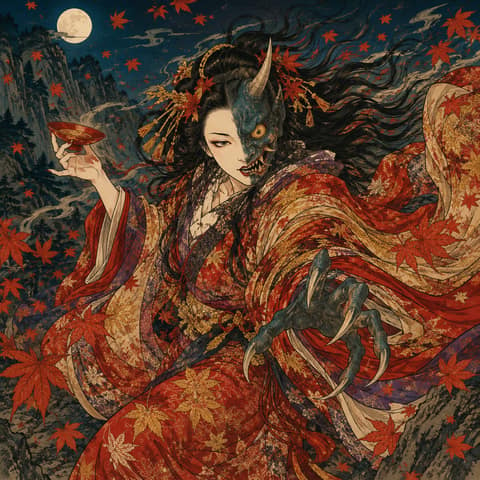
Taira no Koremochi is a historical warlord of the Kanmu Taira clan from the mid-Heian period, remembered in legend as the demon-slaying hero who vanquished the demoness Momiji of Togakushi in Shinano. Known by the alias 'Yogo no Shogun' (General of the Fifteenth) because he adopted the fifteenth son of his uncle, he forms a typical archetype of the warrior who subjugates demons with the divine protection of buddhas and deities, alongside figures like Sakanoue no Tamuramaro and Minamoto no Yorimitsu.
The core of the Momiji legend centers on the plot where Koremochi, ordered by the Imperial Court to subjugate the demoness Momiji nesting in Mt. Togakushi, struggles against her dark magic. Driven into a corner, Koremochi confined himself to Kitamuki Kannon in Bessho Onsen[1] to pray for the dispersal of the demonic thief, and received a demon-conquering short sword from an old monk (or old man) who appeared in a divine dream. In the rematch, Momiji's illusions were rendered ineffective, and it is said that Koremochi struck down the demoness on Mt. Arakura[1] with this divinely bestowed sword. He well embodies the standard pattern of a demon-slaying hero tale: subduing an enemy beyond human intellect not only through martial valor but through prayers to the divine.
Folklore & Legends
The story of Koremochi and Momiji has spread widely through Noh, Kabuki, and *jitsuroku-mono* (popular accounts based on historical facts). In the late Muromachi-period Noh play *Momijigari*, Koremochi is intoxicated and put to sleep by a beautiful woman on Mt. Togakushi, and the deity Hachiman appears at his bedside in a dream to tell him her true identity is a demon and bestows a divine sword—here, the protector is Hachiman. In contrast, in the *jitsuroku-mono* published in Meiji 19 (1886) titled *Kitamukisan Reigenki: Togakushiyama Kijo Momiji Taiji no Den*[2], the role of protector is taken by Kitamuki Kannon of Bessho Onsen. This is believed to be because the compilers were locals of the Bessho area and intended to glorify Bessho as a Kannon pilgrimage site to attract visitors. It perfectly illustrates how the same hero tale swaps its protecting deity to suit the convenience of the local land.
Historic sites associated with Koremochi are scattered throughout Shinano. It is said that Koremochi prayed at and later renovated Kitamuki Kannon[1] in Bessho Onsen, and a Shogun's Mound enshrining him remains in Bessho, Ueda City. On the other hand, the site of the decisive subjugation battle is considered to be Mt. Arakura around Togakushi, while in Kinasa (present-day Nagano City), traditions still coexist that revere the slain Momiji as a noblewoman excelling in medicine, handicrafts, and literature. Koremochi stands in the position of a subjugator carrying out the center's orders to quell demons, which contrasts with the sympathy the local area pours onto Momiji. The relationship between the subjugating warrior, the slain demoness, and the protecting deity shares the exact same structure as the tales of Sakanoue no Tamuramaro defeating Suzuka Gozen and Otakemaru. As a demon-slaying hero rooted in Shinano, Koremochi plays an indispensable role in the Momiji legend.
Yokai Cards1
Taira no Koremochi across multiple art-style decks
Taira no Koremochi is an entity of the 'demon-slaying hero' archetype who stands not on the side of *yokai*, but on the side that strikes them down. Just as Sakanoue no Tamuramaro subdued Suzuka Gozen and Otakemaru, and Minamoto no Yorimitsu subdued Shuten-doji, Koremochi carved his name in lore as the one who vanquished the demoness Momiji of Togakushi. What makes him a hero is not pure military force, but the fact that the story weaves in 'the limits of human power'—he is initially defeated by Momiji's dark arts and can only conquer the demon after praying to buddhas and deities.
The fascination of Koremochi's figure lies in the flexibility with which his protector swaps depending on the medium of the legend. In Noh it is Hachiman, in Bessho-lineage accounts it is Kitamuki Kannon—the same warlord is protected by different divinities depending on local faith and theatrical convenience. This implies that Koremochi is not an entity rigidly tied to a specific god, but rather a vessel carrying the archetype itself of 'the warrior who slays demons with divine protection'. While Kinasa reveres Momiji as a noblewoman, Koremochi is strictly a subjugator executing the orders of the center, and only by combining both does the dual nature of good and evil in the Momiji legend emerge. In this encyclopedia where *yokai* are the main characters, Koremochi is a rare subjugator included as a 'counterpart existence that makes the demon possible'.
Character Profile
This section is our own creative profile for storytelling. It is not historical fact or scholarship.
While excelling in martial valor, he possesses the piety to pray deeply to divine powers against opponents he cannot match on his own. He has a strong sense of responsibility to complete the subjugation he was ordered to undertake, and a tenacity that refuses to retreat even in hard-fought battles.
Vanquishing the demoness with a divinely bestowed demon-conquering short swordBreaking dark magic through confinement and prayer at Kitamuki KannonLeadership as a warlord fulfilling the Imperial Court's mandate
Weaknesses
Initially utterly powerless against Momiji's illusions and dark arts, unable to subdue the demoness with his own strength alone. He carries the human limitation of only being able to grasp victory after receiving divine protection.
Habitat
Centered around the subjugation tales in Mt. Arakura, Togakushi, Shinano Province, historic sites remain at the place of prayer, Kitamuki Kannon in Bessho Onsen (present-day Ueda City, Nagano Prefecture).
The diagram below is a diagnostic evaluation chart for The Yogo General Who Vanquished the Demoness Momiji. The higher the value of each item, the stronger that characteristic is expressed.