Yokai Encyclopedia

Encyclopedia of Japanese Yokai

121 Yokai|14 Category|Page 3 of 6
Localization in Progress - More content available in Japanese version
View Japanese
Sort by: NameAscending
Epic
  • Ittan-Momen

    Ittan-Momen

    Epic

    ee-tahn moh-men

    The Strangling Cloth of Satsuma's Night Sky: Ittan-Momen (Folklore Version)

    Household SpiritsKagoshima

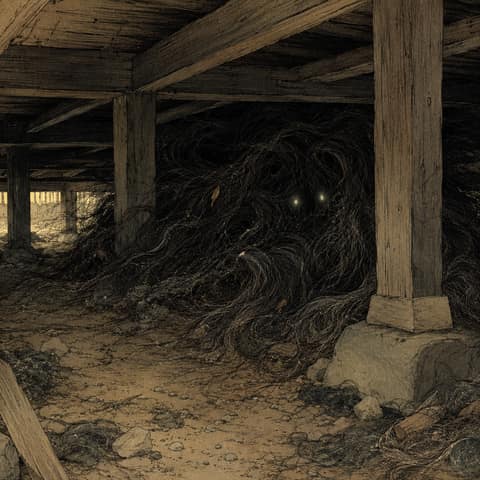
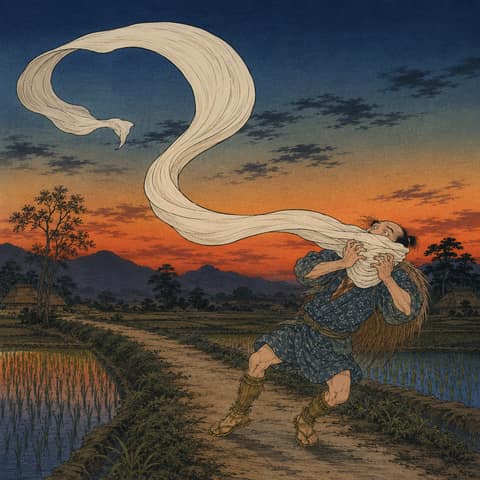
    Completely stripped of the pop-culture motif of a "friendly yokai with eyes and a mouth that speaks a local dialect" depicted in later anime and manga, this interpretation faithfully reproduces the "fundamentalist terror" of the oldest folktales passed down in the Osumi Peninsula of Kagoshima Prefecture. This version of the Ittan-Momen is depicted as an entirely "Faceless, silent assassin" completely incapable of communicating with humans. The core of its terror lies in its overwhelming "silence" and "otherness." On dimly lit paths between rice paddies at dusk, or at the edge of deserted woods at night, it glides down from the sky just like an ordinary piece of white cloth, making no sound of flapping wings or footsteps. Then, it silently descends from above the target's head, completely covering the human's entire face with the sensation of cold, damp cloth, and rapidly suffocates them by wrapping tightly around their neck multiple times. Since it is merely a long piece of cloth with no eyes, nose, or mouth, the victim can neither read its emotions nor beg for their life; they are simply robbed of their sight and breath in the darkness, experiencing the ultimate "claustrophobic terror." Furthermore, it is accompanied by a highly gruesome episode showing that it is not merely a "moving piece of cloth (a tool spirit)." A man who was attacked by this apparition on a dark road and was about to die of suffocation unsheathed the wakizashi (short sword) at his waist and frantically slashed at the cloth wrapped around his face. At that moment, the cloth instantly vanished into the darkness, but the blade of the sword left in the man's hands was thickly smeared with warm "fresh blood." This vivid, physical tale of confrontation—where "slashing it causes it to bleed"—strongly suggests that the Ittan-Momen is not merely a trick of the wind or a cloth monster, but an unidentified "fleshy, grotesque predator," brilliantly embodying the primal fear lurking in the rural darkness.

  • Kasha (Corpse-Dragging Fiend)

    Kasha (Corpse-Dragging Fiend)

    Epic

    KAH-shah

    Cat-Type Kasha (Early Modern Tale Variant)

    Ghosts & SpiritsIwateGunma

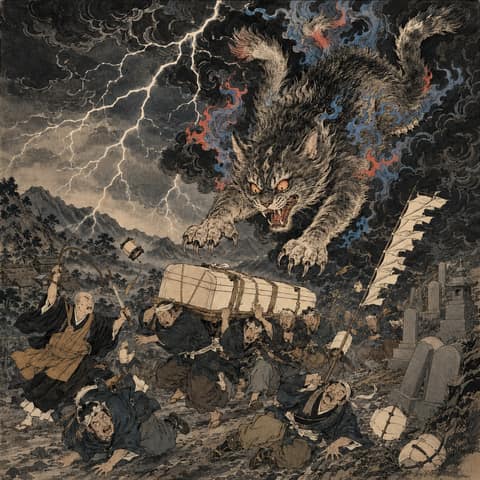
    A composite form of the bakeneko that solidified in the late 17th century. An aged cat arrives with thunderstorm or dark clouds, seizing the corpse from a coffin by exploiting lapses during funeral processions or wakes. After Toriyama Sekien’s illustrations, the feline form became standard. Regional lore varies: forked tails, attendant will-o’-wisps, or concealment within black clouds. Its targets are not limited to evildoers. Folk countermeasures include night-long vigil at the wake, placing knives or razors atop the coffin, using prayer beads and sutra recitation, and disruptive funeral tactics.

  • Kashima Reiko

    Kashima Reiko

    Epic

    Kashima Reiko

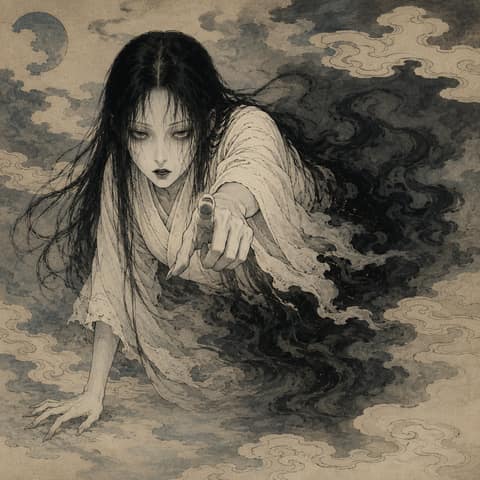
    The Woman Who Asks from the Other End of the Phone: Kashima Reiko

    Spirit / ghostUrban legend that emerged in the 1970s, often told around Kakogawa and Takasago in Hyōgo Prefecture

    The telephone as postwar infrastructure and kaidan device. The basic entry covers the contagious structure of Kashima Reiko's curse; this fuller explanation looks more closely at the medium that carries it: the telephone. In Japan, the spread of black rotary phones into ordinary households rose sharply in the postwar decades, from about 8 percent in 1965 to about 80 percent in 1975. It is unlikely to be a coincidence that a legend emerging in the 1970s chose the device of "a question coming by telephone." The anxiety of a new infrastructure entering the home became part of the legend's core machinery. Where prewar Aka Manto belongs to alleys and night roads, and Hanako-san of the 1980s belongs to the school toilet, Kashima Reiko is distinctive because she violates the postwar private space of the household telephone. From the 1990s onward, the setting expanded into text media such as email and LINE, keeping pace with the evolution of postwar communication infrastructure. The structure of the "Where are your legs?" question. At the center of the Kashima Reiko legend is a question: "Does Kashima-san have legs?" "Where are her legs?" and similar variants. A wrong answer is fatal, but correct replies such as "Kamashi," "Kashima Reiko," "above the waist," or "from above the waist downward" are said to save the listener. Like Aka Manto's "red paper or blue paper" and Kokkuri-san's yes-or-no exchanges, this is a no-win question structure common in children's oral ghost stories. At the same time, it offers an escape route: correct knowledge can save you. Folklorist Noboru Miyata, in Yōkai no minzokugaku (Iwanami Shoten, 1985), argued that question-based children's kaidan satisfy a childhood desire for intellectual advantage, the feeling that those who know the answer survive. The transformation of postwar social memory into ghost story. The theory that Kashima Reiko began with the "1948 Kakogawa American-soldier incident" has not been historically confirmed. Even so, it preserves in ghost-story form a social memory of sexual violence suffered by Japanese women under the U.S. occupation. Postwar U.S.-Japan relations, defeat, occupation, and the security order, left many experiences insufficiently spoken in official discourse. Such unspoken harm can settle into the underground layer of urban legend and surface in the 1970s as a supernatural presence. Folklorist Norio Murakami has discussed this mechanism of social memory turning into kaii, noting that experiences excluded from public memory can remain in the form of ghost stories and spirit possession. Kashima Reiko is a representative example. Contagious curses in the internet age. Kashima Reiko's structure, in which hearing the story makes one part of the curse, became a foundation for the chain-mail culture, internet curses, and creepypasta of the 2000s and beyond. "Forward this email to X people or you will be cursed," "anyone who sees this URL will be cursed": these online curse formulas have their prototype in Kashima Reiko's instantly contagious oral kaidan. Internet-era kaidan such as Kunekune (2003) and Hasshaku-sama (2008) inherit the same device, turning the reader into a participant in the curse. Kashima Reiko therefore played an important mediating role between 1970s oral kaidan and 2000s internet horror. The ecology of Teketeke and Kuchisake-onna. Postwar Japanese children's oral kaidan do not exist as isolated beings. They form an ecology of mutual reference, merger, and branching. Kuchisake-onna (1978), Kashima Reiko (late 1970s), and Teketeke (1980s) follow one another chronologically and share motifs: a damaged female body, a question structure, and a curse aimed at children. In Tōru Tsunemitsu's Gakkō no kaidan (Kodansha KK Bunko, 1990), these stories were gathered under the category of "school kaidan," helping establish them as a single folkloric genre worthy of study. Dandadan and modern transmission. In Yukinobu Tatsu's Dandadan, serialized in Shueisha's Shonen Jump+ from 2021 and adapted for television anime in 2024, Kashima Reiko was reshaped as a major supernatural figure and became familiar again to Generation Z. The adaptation keeps the key elements of the source tradition, the missing lower body, the telephone, and the contagion of the curse, while recasting them in the character language of contemporary shonen manga. From children's oral legend in the postwar 1970s to manga and anime of the 2020s, Kashima Reiko has become a rare urban kaidan transmitted across nearly half a century.
  • Kasho Tengu

    Kasho Tengu

    Epic

    Kasho-tengu

    Venerable Chuhoson, the Great Tengu of Mount Kasho

    Apparition of the Mountains and FieldsGunma

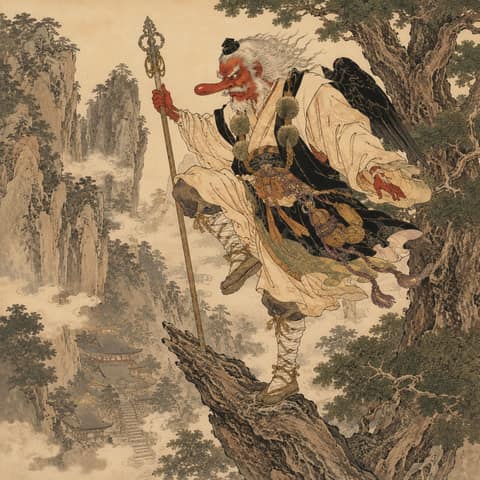
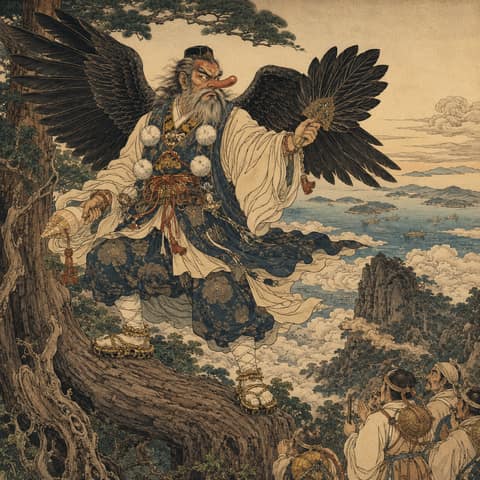
    The Kasho Tengu distinctively stands apart from the common noun "tengu"; it is an entity unique to Kashozan Miroku-ji. At its core lies an actual historical high monk, the Venerable Chūhōson. This reflects a "monk-deification type" of tengu faith, wherein a holy man with superhuman ascetic powers settled into the mountain as a tengu (an incarnation of Kasho Buddha) after his death. Its ranking as one of the Three Great Tengu of Japan (alongside those of Mount Takao and Kurama), the boastfully largest Great Tengu mask in the country, and the unique votive custom of borrowing a mask and returning two the following year distinguish this tengu from other mountain tengu. Combined with its historical prestige as a prayer site for the Tokugawa family, the Kasho Tengu is deeply rooted in the Numata region as a tengu of worldly benefits, governing victory in battle, traffic safety, and the fulfillment of all wishes.

  • Kawauso (Otter Yokai)

    Kawauso (Otter Yokai)

    Epic

    kah-wah-OO-soh

    Tradition-Based Transforming Otter

    Animal ShapeshiftersKochiTokushima

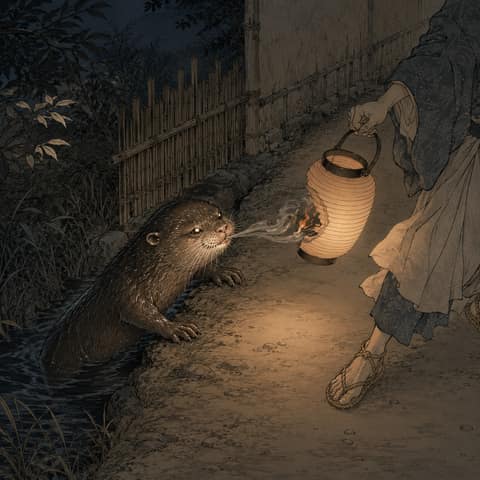
    A rendition based on records and oral tales of the shape-shifting otter. It mimics human speech, but its intonation and sentence endings sound off, and when pressed with questions it gives nonsensical replies. Its guises range from a beautiful woman to a child or a monk, distracting passersby and misleading them with tricks such as snuffing lanterns, inviting people to wrestle, or making stones and tree roots appear human. In some regions it overlaps with kappa lore, possessing great strength in water and luring victims to look upward to gain advantage. In the context of spirit possession, it is feared for sapping a person’s vitality and inducing lethargy. While violent episodes are recorded, most encounters amount to threats or pranks.

  • Kejōrō (Hair Courtesan)

    Kejōrō (Hair Courtesan)

    Epic

    keh-JOH-roh

    Printed Edition – Sekien School Variant

    Household SpiritsEdo period

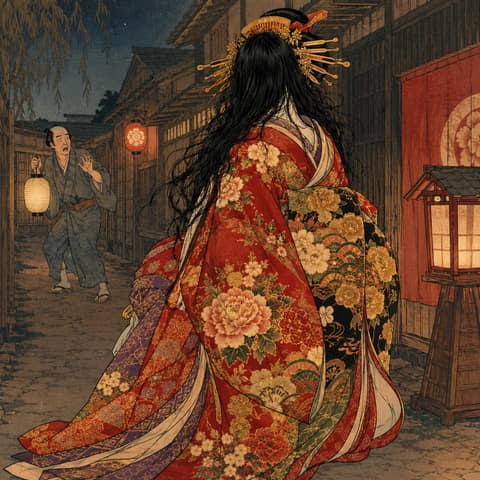
    A canonical image based on Toriyama Sekien’s illustrations and Edo kibyoshi. Dressed like a courtesan of the pleasure quarters, its hair grows unnaturally long to shroud the body so the face cannot be discerned. Born from urban satire centered on Yoshiwara and a pun linking courtesans with shapeshifters, it appears as a literary construct with no proper name or origin tale. Sometimes read as a faceless yōkai, it serves as a symbol that reverses the viewer’s desires and assumptions. Sources are primarily printed editions, with scant oral tradition.

  • Keukegen

    Keukegen

    Epic

    KAY-oo-kay-gen

    Kehakigen (Traditional Version)

    General ClassificationsJapanese folklore

    A hair-covered apparition of uncertain origin first depicted in Sekien’s illustrated compendium. Its name implies “seldom seen,” and this rarity is considered its defining trait. Later links to dampness or illness are editorial interpretations without firm oral tradition. Adhering to the original source, only its appearance and rarity are treated as certain.

  • Kidōmaru (Demon Prodigy)

    Kidōmaru (Demon Prodigy)

    Epic

    kee-DOH-mah-roo

    Classical Lore Version

    Demons & GiantsKyoto

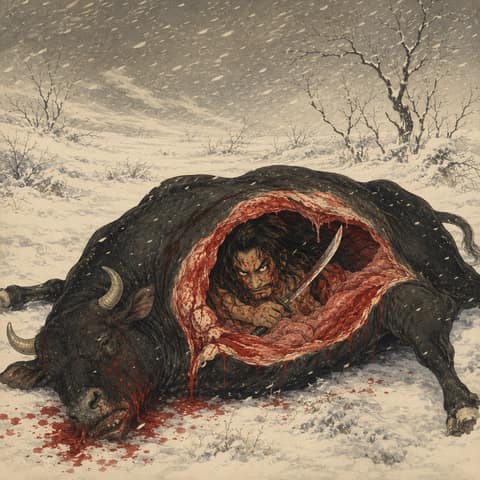
    Centered on Kokon Chomonjū, this version frames Kidōmaru as an oni confronting Minamoto no Yorimitsu (Raikō) and Watanabe no Tsuna. After escaping capture, he shadows his targets and, anticipating them on the road to Kurama, lies in wait at Ichiharano by hiding inside the body of a cow—an audacious ruse seen through by Raikō’s caution. When Tsuna’s arrow breaks the concealment, Kidōmaru reveals his oni form and charges, only to be felled by a single stroke from Raikō. Iconography was fixed by Toriyama Sekien as a figure draped in cowhide in the snow, and early modern warrior prints often depict him as a rival in contests of sorcery. His lineage is unsettled: in the Unbara tradition he is the child of Shuten Dōji, while in war tales he is a novice from Mount Hiei. In all strands he is understood as a being who hides in wilds, watching for opportunity through brute strength, transformation, and stealth. Avoiding later embellishments, this reconstruction centers on his core behaviors of concealment, transformation, and ambush.

  • Kihachi

    Kihachi

    Epic

    Kihachi

    Kihachi, the Savage God of Aso's Frost

    Oni / GiantKumamoto

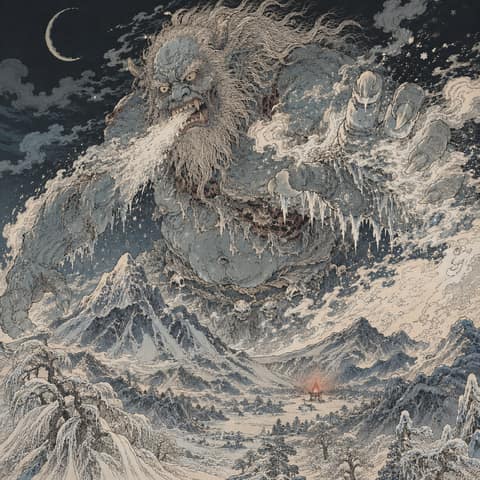
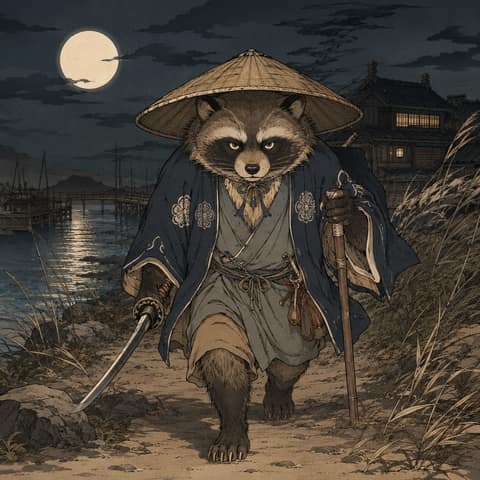
    Kihachi was a savage deity who served as an arrow retriever for Takeiwatatsu-no-Mikoto, the pioneer god of Aso. Exhausted from his duties, he kicked an arrow back with his foot, enraging the god, who chased him to Takachiho and struck him down. Yet his severed body attempted to knit itself back together to revive, and even when buried in three separate pieces, he laid a curse, swearing to "make frost fall upon the Aso Valley." Left with no choice, Takeiwatatsu-no-Mikoto enshrined Kihachi as a deity at Shimo Shrine, where every year for fifty-nine days, a young maiden keeps a sacred fire burning day and night to warm his cold, severed body—a ritual that continues to this very day. A demon that brings the chill of frost to Aso, the Mountain of Fire. Slain only to become a god, he is the embodiment of the deep, complex layers of mythology woven into this land.

  • Killing Stone

    Killing Stone

    Epic

    Sesshōseki

    The Killing Stone of Nasu, the Poison-Breathing Stone

    Dwellings and ObjectsTochigi

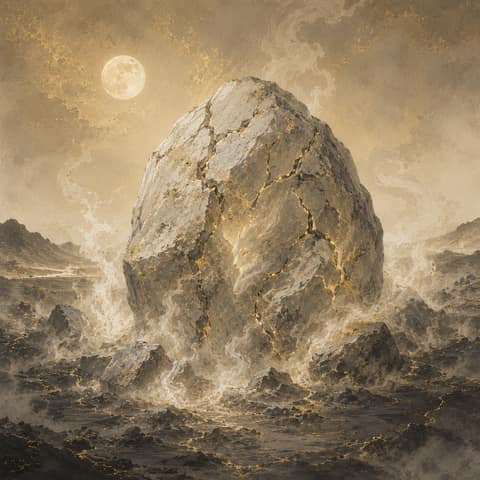
    This version looks at how the Sesshōseki, as a poison stone, has been told of on the noh stage and at sites of worship. In the noh play Sesshōseki, when the traveling priest Gennō approaches the stone on the Nasu Plain, a village woman appears and tells the stone’s origin; in time the stone splits open and the spirit of the fox emerges from within. The spirit repents of the evil deeds of its life, vows to attain buddhahood, saved by the priest’s ritual power, and vanishes. Here the Killing Stone is not merely a stone that kills, but something in which a lost soul dwells, to be quieted through memorial rites. Around the Killing Stone lies a desolate land where no plant grows and sulfurous smoke hangs in the air, called from of old the Sai-no-Kawara, lined with countless Jizō statues that mourn the dead. The Nasu Onsen Shrine stands close by, and at its Goshinka (Sacred Fire) Festival each May, a rite is said to be held in which the shrine’s fire is carried before the stone to quiet the mountain’s fire and the stone’s numinous power. Seen this way, the dread of the Killing Stone is rooted less in a stone that moves of its own will than in the sense of a boundary: “step past here and you lose your life.” The very zone filled with poison fumes was feared as a threshold between the world of the living and the world beyond, and it was believed that calamity reached only those who trespassed that boundary.

  • Kincho

    Kincho

    Epic

    Kincho

    Kincho, Hero of the Awa Tanuki War

    ShapeshifterTokushima

    This is Kincho, the guardian deity of Yamatoya and the tanuki commander of Hikaino. Originally a highly loyal tanuki saved by Moemon, he strove to bring prosperity to the dye shop in return for his life. He later went to train under Rokuemon, the supreme commander of Shikoku's tanuki, but despite his extraordinary talents being recognized, he incurred Rokuemon's wrath by refusing a marriage proposal. After his friend was murdered, Kincho led the Hikaino tanuki army in the epic three-day "Awa Tanuki War" against Rokuemon. Though he ultimately vanquished his arch-nemesis in a one-on-one duel, he too succumbed to his wounds. Revered in death as Kincho Myojin, his name lives on today as a god of business prosperity and victory.

  • King of the Waterfall Spirit

    King of the Waterfall Spirit

    Epic

    tah-kee RAY-oh

    Sekien Iconographic Interpretation

    Deities & Divine SpiritsShiga

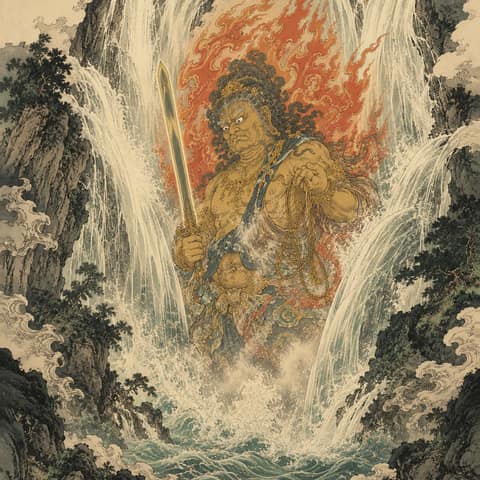
    An interpretive line anchored in Toriyama Sekien’s iconography, organizing the notion of Fudō Myōō’s epiphany at waterfalls as a yokai-encyclopedia entry. The title “Takiryōō” is treated as a pictorial theme, while the entity itself is viewed as a manifestation of Myōō devotion. It appears at waterfall basins across the provinces, subduing demons and malign influences, and is cited in miracle tales told by ascetics and pilgrims. Its virtue and demon-subduing nature take precedence over yokai-style terror, placing it closer to a divine spirit among strange phenomena. Concrete site names and dated incidents are scarce, with accounts drawn mainly from iconographic materials and temple origin narratives.

  • Kinrei (and Kintama)

    Kinrei (and Kintama)

    Epic

    kee-NREH

    Kinrei • Kintama, Curated Tradition Edition

    Ghosts & SpiritsAcross Japan (noted in Edo, the Kanto region, and Suruga)

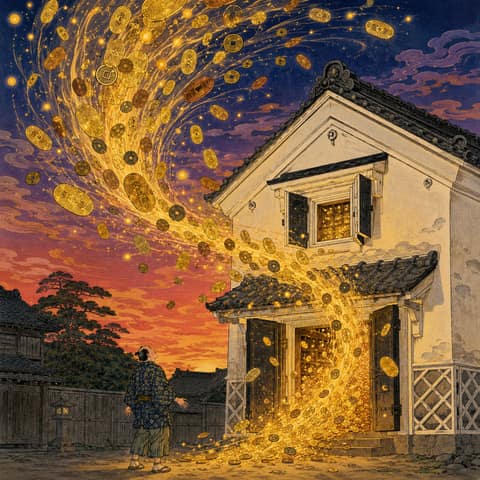
    Kinrei appears in Edo-period art and commentary as a spiritual notion symbolizing the reward for moral practice, with household prosperity explained as part of a heaven-given order. Rather than a visitor like a tangible kami, it is understood as the auspicious aura born of selflessness and good deeds. Kintama, by contrast, is told across regions as a strange fire or orb-like visitant that brings luck to a home when respectfully enshrined, yet turns ominous if scraped or damaged, a taboo tied to its form. Early chapbooks and ghost collections depict swarms of coin-spirits drifting in the evening sky, or a roaring sphere flying in to enter the honest. Postwar retellings often link it to the rise and fall of household fortunes, but older records stress symbolic meaning and will-o’-wisp tales. Because names and traits overlap among regional traditions, sources differ in how they use “Kinrei” and “Kintama.”

  • Kodama (Japanese Tree Spirit)

    Kodama (Japanese Tree Spirit)

    Epic

    kodama

    Kodama (Ancient Tree and Echo Spirit)

    Mountain and Forest SpiritsTokyoOkinawa

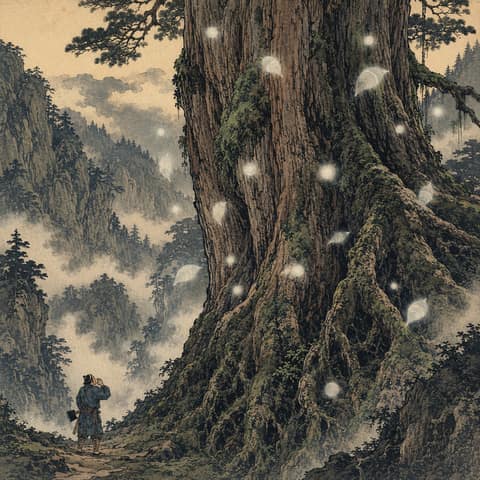
    This is the classical kodama: not a mascot-like creature, but the unseen presence of an old tree and the voice that seems to answer from the mountain. It draws on older ideas of tree divinity, on the belief that ancient trunks hold spiritual force, and on the folk reading of yamabiko, the returning mountain echo. The kodama may remain invisible, showing itself only through sound, silence, unease, or the taboo surrounding a tree that should not be cut without ceremony. This version emphasizes the traditional boundary: kodama can be described as a tree spirit, a forest yokai, or a lingering kami-like presence, but its power lies precisely in not fitting only one category.

  • Kodama (Japanese Tree Spirit)

    Kodama (Japanese Tree Spirit)

    Epic

    kodama

    Kidama-sama of Aogashima

    Mountain and Forest SpiritsTokyoOkinawa

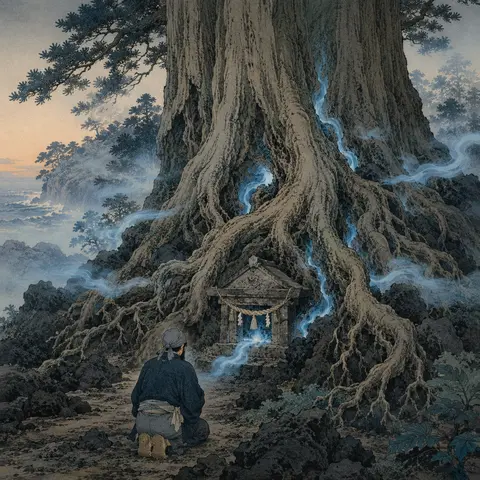
    A wood spirit from Aogashima in the Izu Islands, long honored by islanders as “Kidama-sama” or “Kodama-sama,” enshrined at small altars set at the roots of great cedars. The island forest drinks sea wind and volcanic breath, driving deep roots through shallow soil. The spirit dwelling there is not a mere echo, but an ancient memory woven from the age of the tree itself. At dawn mist, if you call its name before the shrine, the reply comes only once, a slightly damp sound, taken as a sign of assent. If it returns twice or thrice, uneven and jarring, it warns that the season is wrong—do not cut. Before felling wood, locals offer a handful of rice, sea salt, and a cup of shochu, tap the trunk three times, and state the reason and the count. Kidama-sama honors this rule: when respect is paid, it sets the wind fair, keeps blades from dulling, and prevents workers from losing their way. If slighted, the mountain’s sounds grow muddy, blades kick against knots, and toil is shadowed by illness. Its form is uncertain, yet elders speak of a “shadow of rings”: when the bark reddens in the evening glow, a single pale eye like a water mirror appears deep in the grain and melts away. Before great winds or earth-rumblings, pebbles at the shrine rearrange themselves, a sign of the forest’s breath in disorder; those who heed it halt farm and boat work and lessen harm. It is not closed to outsiders: give your name, bring salt as a gift, keep your voice low before the shrine, and the returning echo softens and the mountain path confuses less. Laughing and shouting bring a delayed, high, splintered reply that lingers in the ear and upsets your sense of direction. When a tree’s life nears its end, Kidama-sama may appear in dreams to say, “Now I change worlds.” Villagers take this as a good omen, planting three saplings after a fall and moving the shrine to the new root to carry the breath onward. Thus the island forest renews by generations, and the spirit moves without fading, a vivid afterimage of the old tree gods living strong on a sea-bound isle, quietly listening as a mediator between mountain rites and ocean sustenance.

  • Kodama (Japanese Tree Spirit)

    Kodama (Japanese Tree Spirit)

    Epic

    kodama

    Southern Island Kinushi-Haunted Kodama

    Mountain and Forest SpiritsTokyoOkinawa

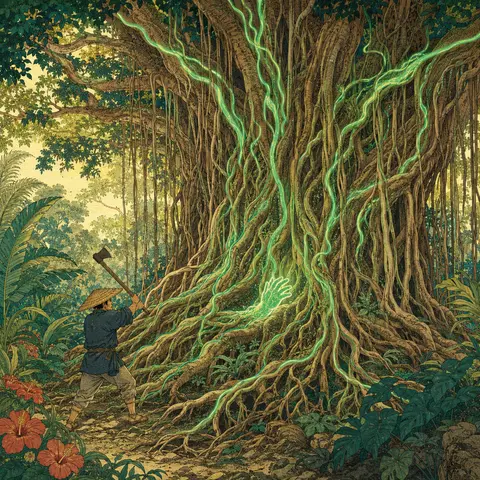
    Among the kodama whose echoes are heard across Japan, a southern island variant dwelling especially in Okinawa’s Yanbaru and sacred utaki groves is known as the Kinushi-Haunted Kodama. As its name implies, it settles like a lord within each individual tree, living in sync with the tree’s breath, the flow of sap, and the spread of its roots. Old lore says that if a woodcutter lightly taps the trunk before the first axe bite and offers a name and prayer, the kodama will tune the sound within the wood, align the wind with the intended fall, and guide the work safely. Strike in silence, however, and the tree will creak and cry, hollow tones will stutter across the mountains, and within days the surrounding leaves will lose color as if scorched. On uneasy nights, a heavy thud may carry through the mountain village though no tree has fallen; this is said to be the cry of a Kinushi-Kodama in unbearable pain. The tree where that sound is heard will soon shed dieback from its crown, white mycelium will gather at the roots, and its life will end. Witnessing this, elders understood that sound is the true form of the kodama, and passed down taboos: do not raise your voice at the forest’s threshold, and when calling a tree by name, pause to await its answer. Though it has no body, at dusk the air around the roots will sometimes shimmer like water and a childlike laugh may echo twice or thrice; islanders take this as a good omen and offer salt and black sugar to that tree. If a small child naps in its shade, mosquitoes and midges keep away and the sea breeze softens. Elders say that when winds from beyond the sea make their rounds among the mountain gods, the kodama resonates with the wind and guards the village bounds. Often confused with mountain echoes, the Kinushi-Haunted Kodama differs in that it does more than repeat a voice: by the timing and tone of its reply it foretells fortune. A clear prompt note means a good day for work, a heavy delayed reply is a sign to rest, and a muffled response from within the trunk portends sickly leaves. The islands also keep rites for transplanting trees. On the eve of root-pruning, stroke the trunk three times and name the soil of the new site; the kodama will fold the root tips and slim itself so it will not thirst during the journey. Neglect this and hollow knocks will sound nightly at the new place and the household may fall to fever. In coastal banyans dwell playful spirits known as Kijimunā. In older thought, Kijimunā are those Kinushi-Kodama that took on a more human-like notion of form: the kodama is the voice of the roots, the Kijimunā the laughter of the branches. Both are tree divinities at heart, guiding the respectful and chastening the careless with sound. Thus in the southern island forests, sound is law, and people and trees have long lived by each other’s breath.

  • Kokkuri-san

    Kokkuri-san

    Epic

    こっくりさん

    Composite Deity of Fox, Dog, Raccoon Dog: Kokkuri-san

    Spirits / GhostsDerived from Western table-turning; became popular starting from Shimoda, Izu in 1884.

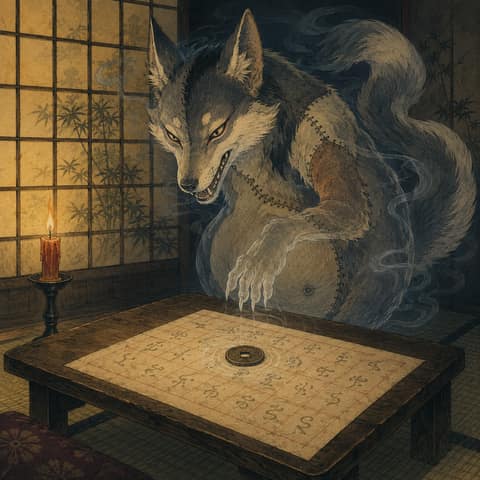
    The Ideomotor Effect and the Significance of 'False Wonder'. While the basic explanation touched upon Enryo Inoue's classification, the detailed explanation delves deeper into the significance of its scientific demystification. The ideomotor effect is a phenomenon named by British physiologist William Carpenter in 1852, referring to involuntary micro-movements of muscles without human awareness. Table-turning, dowsing, Ouija boards, and Kokkuri-san—these all share the exact same principle for moving a coin or pointer. Inoue independently verified this latest Western theory in Meiji-era Japan, demonstrating that 'yokai can be explained by science,' making it a representative case of pre-war Japanese enlightening rationalism. Kokkuri-san's mystery shifted from a 'physical mystery' to a 'psychological mystery triggered by the unconscious.' Selection of the Three Beasts 'Kokkuri'. Choosing which kanji to assign to the sound 'kokkuri' was arbitrary, but the selection of 'fox, dog, raccoon dog' (狐·狗·狸) had roots in the lineage of Japanese animal spirit beliefs. Foxes represent the ability to bewitch humans, as seen in Inari worship and Tamamo-no-Mae; raccoon dogs are equally famous shape-shifters known for belly-drumming (haratsuzumi) and Bunbuku Chagama; dogs are known as mediums for spirit possession in local beliefs like inugami (dog gods). Combining the three beasts was an intellectual invention that summoned the three major representatives of Edo-period animal shape-shifter tales at once, wrapping the alien nature of the 1884 Shimoda origin (Western table-turning) in traditional Japanese spiritual concepts. Inheritance of Summoning Rituals in School Spaces. Since the 1970s boom, Kokkuri-san has become a significant game played during recesses and after school in elementary and junior high schools. Folklorist Noboru Miyata pointed out in *The Folklore of Yokai* (Iwanami Shoten, 1985) that post-war Japanese schools became new 'sites for summoning rituals.' Kokkuri-san (1970s-) → Hanako-san (1980s-) → Hasshaku-sama (2008-). All these share the common structure of 'summoning/sealing spirits in school spaces,' reading as modernized, secularized, and gamified versions of magical rituals from the Heian period (such as Ushi-no-koku Mairi and chanting the Sonsho Dharani). Bans and the Tradition of the 'Correct Ending'. From the late 1970s to the 80s, many schools issued bans on Kokkuri-san. This responded to the frequent occurrence of abnormal behavior among children (mass hysteria, hyperventilation, trance states), demonstrating the effect when the ideomotor effect combines with group psychology. Concurrently, the tradition of the 'correct ending method' became refined among children—chanting 'thank you' together, returning the coin to the torii, tearing up and throwing away or burning the paper, etc. These ritualistic steps are structurally similar to medieval curse-breaking practices (henbai, scattering rice, scattering salt), drawing folkloric attention as a case where modern children unwittingly reenact classical magical rituals. Re-creation in Manga and Anime. Following Jiro Tsunoda's *Ushiro no Hyakutaro* (1973-1980), Kokkuri-san became a staple motif appearing repeatedly in manga and anime. It was a key element in the 1995 Toho film *School Ghost Stories 2* (directed by Hideyuki Hirayama), and in the 2012 TV anime *Inu x Boku SS*, Kokkuri-san was incorporated into the protagonist's bloodline. Recently, comedy manga personifying Kokkuri-san, like *Gugure! Kokkuri-san* (by Midori Endo, serialized in Square Enix's *Monthly G Fantasy* 2011-2016, animated in 2014), have also become massive hits. It is a rare case where Meiji scientific demystification and modern subculture reception intersect through the same apparition. 2010s Modern Kokkuri-san. Around 2015, a modern version of Kokkuri-san resurged among junior high and high school students. This involved displaying the syllabary on a smartphone app, with friends placing multiple fingers on the screen to move it. Some schools again reported students yelling and making strange noises, prompting faculty intervention. A table-turning trick shown by shipwrecked sailors in Izu Shimoda 140 years ago has continuously changed form while being passed down through modern Japanese youth culture—this is Kokkuri-san's most peculiar trait.

  • Konoha Tengu

    Konoha Tengu

    Epic

    KOH-noh-hah TEN-goo

    Konoha Tengu (Classical Depiction)

    Mountain & Wilderness SpiritsShizuoka

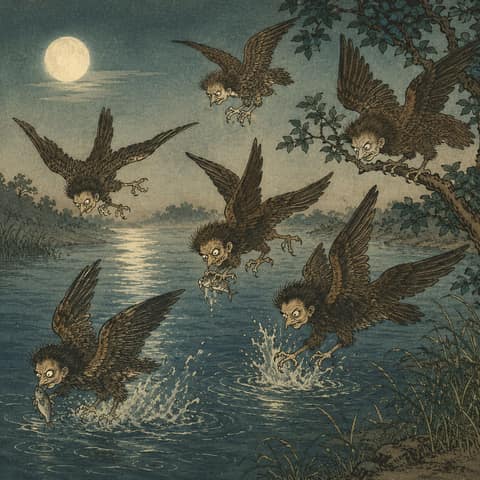
    A figure based on Edo-period essays and ghost tales. Ranked below the long-nosed yamabushi-style tengu, it performs menial tasks and is described as birdlike or as a human-faced bird. Accounts vary by region and source: flocks seen at night catching fish on the Ōi River in Suruga, references to them as white wolves within the tengu realm and as elder wolves elevated in rank, and tales of trickery such as a hunter in Iwakuni being toyed with by a tengu disguised as a boy. Overall, rather than causing great harm to people or livestock, they tend to interact through shapeshifting and bewilderment. Ukiyo-e sometimes shows them resting in trees, suggesting they are not invariably violent. Their nature is tied to the mountain borderlands, quick to sense human intrusion and retreat.

  • Konpira-bo

    Konpira-bo

    Epic

    konpira-bo

    The Forty-Eight Tengu Guarding Mount Zozu, Konpira-bo

    TenguKagawa

    Konpira-bo is a yokai that embodies the history of Kotohira-gu (Matsuo-dera Konpira Daigongen) as a sacred mountain of Shugendo during the era of Shinto-Buddhist syncretism. Listed as one of the "Forty-Eight Tengu," he is revered as the great tengu commanding Mount Zozu in Sanuki. His true form is either a yamabushi who accumulated harsh austerities and transformed into a tengu, or a familiar (guardian deity) of Konpira Daigongen. This duality represents a typical structure of tengu legends in mountain beliefs across Japan. Particularly within the Konpira faith, which holds aspects of a maritime guardian and water deity, he assumes the role of warding off evil and dispensing divine punishment while enshrined in the deep mountains behind the shrine. Although Kotohira-gu is a Shinto shrine today, ascending the stone steps to the inner shrine and walking along the approach lined with ancient trees still profoundly conveys the majesty of the forest once believed to be the domain of Konpira-bo, imbued with the atmosphere of Shugendo.

  • Kudan (Prophetic Human-Cow Yokai)

    Kudan (Prophetic Human-Cow Yokai)

    Epic

    koo-DAHN

    Late Edo Kawaraban Woodblock Version of the Kudan

    Half-Human BeingsKyotoHiroshima

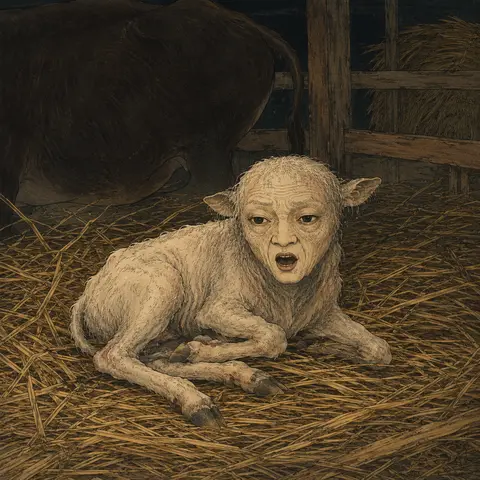
    A Kudan image that spread in the late Edo period through kawaraban broadsides and printed books. Depicted as a human-faced cow, it appears, utters a prophecy, and soon dies. A Tenpō-era broadside recounts an appearance in Tango, stressing powers over harvest fortunes and averting misfortune, with cases recommending the display of its image. Meanwhile, the Kutabe of Etchū’s Mt. Tateyama appears in records from the 1820s onward, showing diverse traits such as a woman’s or elder’s face, sharp claws, and eyes drawn on the torso. Both share a reputation for prophecy and warding off epidemics, and their circulation increases during crises. The folk etymology linking the formulaic phrase “kudan no gotoshi” at the end of documents to the monster Kudan is viewed skeptically based on earlier linguistic usage. In folklore, the core pattern is appearance, proclamation, short life, and the image used as an amulet, while place names, dates, and specific efficacies vary widely by source.

  • Kudan (Prophetic Human-Cow Yokai)

    Kudan (Prophetic Human-Cow Yokai)

    Epic

    koo-DAHN

    Kurahashiyama Notice of Protective Talismans (Kudan Variant)

    Half-Human BeingsKyotoHiroshima

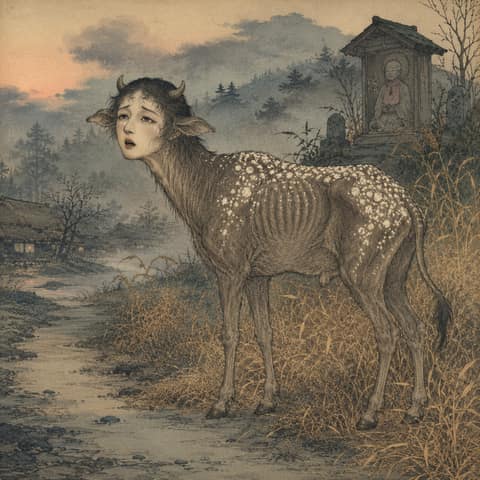
    Known as the Kurahashiyama Notice of Protective Talismans, this variant is said to have appeared from the mountain valleys of Yosa District after the Tenpō Famine. Though half-ox and half-human, its face looks somewhat young, with a broad brow, moist eyes, and a faintly upturned mouth. The ox body is gaunt with ribs showing, yet white flecks like morning dew scatter across its back, taken as signs that mark the year’s omens. It appears mostly between midnight and dawn, at paddy ridges along the mountain foot or before boundary shrines, witnessed typically by those on night rounds or out to relieve themselves. The kudan speaks no more than three times. First, it declares the Path of Pestilence, fixing from which direction the sickness will come and in which month it will intensify. Second, it details the Method of the Posted Image: draw its likeness on a half-sheet, paste it facing north on the inner lintel of the doorway or atop the rice bales, use fresh soot for ink and half-size paper offered at the previous autumn festival, and allow only one sheet per household. Third, it states the Year’s Aspect, leaving brief lines on bounty or scarcity and on protections within the home. When it finishes, it chews the paddy grass, bows its head, its breath thins, and it expires before sunrise. The village carries its body to the mountain’s base, covers it shallowly with earth, and sets a sprig of bamboo above. After seven days, when unearthed, the bones are soft and only the hooves remain hard; fitting a hoof to a brush shaft and tracing the edge of the charm was said to let misfortune flow out of the house. The image has fixed conventions: a single vertical crease at the center of the human brow, three white dots on the ox shoulder, and a bifurcated tail flowing to the left. Errors weaken its efficacy, and if the tail is drawn to the right, the disease’s direction reverses and brings calamity. The kudan also teaches that replacement of the posted image is limited to twice a year, at barley harvest and on the first day of the Frost Month. The artist must purify the hands with salt, keep the lamp dim at night, speak no words while drawing, and at the end write small, This extends not only to this house but to the neighboring hamlet. Homes that keep these rules know fewer domestic quarrels and lighter crop damage. The Kurahashiyama kudan closely matches the archetype of a prophetic beast in that it announces both good omens and protections from pestilence, yet it never speaks of profit in trade or victories in war, confining its words to home and field. A Kurahashiyama broadsheet states that posting its image in a storehouse or earthen-floor entry will drive out damp from the granary and keep illness from the threshold, and when sending copies to distant villages, they must circulate within three nights. Delay was thought to wither the effect, prompting village youths to run them by night. Later tales try to link a formulaic closing phrase of legal documents to the kudan, but this version forbids it, warning that using that phrase in a talisman blunts its power. Those who see it suffer a brief fever, which lightens after seven days, and they avoid serious illness for three years. Its short life is a vow not to linger in the world, and the more it returns to the earth, the deeper its words take root.

  • Kudan (Prophetic Human-Cow Yokai)

    Kudan (Prophetic Human-Cow Yokai)

    Epic

    koo-DAHN

    Ushi-no-Ko, Entrusted Oracle Variant

    Half-Human BeingsKyotoHiroshima

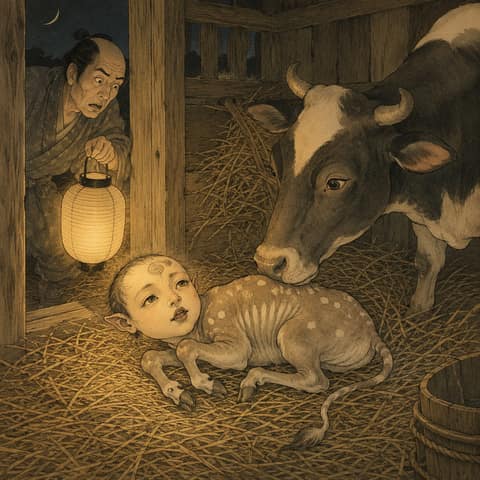
    This Entrusted Oracle variant of the Ushi-no-Ko is born with mingled human and bovine features and speaks human language the moment it emerges from its cow mother, asking to be called a kudan. It appears only in byres attached to human homes or in pens on mountain pastures, distinct from types that manifest in the open wilds. Its face ranges from a young woman’s to a gaunt elder’s, yet the eyes are always moist and fixed, piercing the listener without widening. Instead of a cry it sighs briefly, first urging that the mother cow not be slaughtered. It then foretells roughly seven years of abundance, household prosperity, or the dispersal of epidemics, and declares that in the eighth year war or calamity will cast a shadow. It ends by stating its own short life, saying it will die within three days. If the body is buried shallowly it averts misfortune, but display as a spectacle draws gloom upon the house. Even so, antiquarians have preserved it as taxidermy or portraits, and capturing its image in broadsheets or records is accepted as apotropaic. Its oracles address only large-scale matters such as harvests, plagues, drought, and war, and it remains silent on personal fortunes. This preserves the weight of its words and tests the listener’s judgment, keeping it apart from trivial divination. The truer the prophecy, the healthier the mother cow remains thereafter, and the household’s cattle and horses are said to avoid disaster. If its birth is treated as a joke and made a commotion, it bites its tongue to blood and falls silent. When drawn, give it short horns, a thick neck, and the rounded body of a calf. It has four legs, a tail thin and long like straw rope, and small hooves. A single swirl of hair sits on its brow; stamping that spot with ink and hanging the image at home was believed to ward off fire and theft for seven years. During the three days after birth it wishes to look outside once late at night. If the back door is cracked open at moonrise and it is faced northeast, its words will carry clear, according to oral lore. It does not call itself a god, only one who knows the world’s turn ahead of time. Offerings should be simple, a pinch of salt and a bowl of pure water. After death it is wrapped in a straw mat and buried in a byre’s corner or on a raised ridge of a field; setting a hat upside down to keep off rain is said to keep grain luck in the family line. It appears most in checkpoint towns by the sea and along mountain herb-gatherers’ roads, especially in border villages where travelers mingle, places thought to gather the world’s signs for it to read.

  • Kumitezuri

    Kumitezuri

    Epic

    KOO-mee-teh-ZOO-ree

    Historico-Philological Edition

    Deities & Divine SpiritsOkinawa

    Named in the Chūzan Seikan and centered on the sacred Kuntama image that links royal authority with rites, this critical edition presents both the goddess interpretation and the reading of ritual names. It concerns prayers for maritime safety, abundance, and dynastic peace. Rather than fixing a concrete personal deity, it understands the being as manifesting through ritual practice such as possession, oracular revelation, and the prayers and gestures of noro priestesses. Aware of regional variations and early modern conflations with Kinmamon, it prioritizes the symbols of the sea, the sun, and the far-off Nirai Kanai, situating the figure within the Ryukyuan ritual system.

  • Kunekune

    Kunekune

    Epic

    くねくね

    The White Silhouette Standing in the Rural Distance: Kunekune

    Spirit / GhostModern internet ghost story originating around 2000

    The epistemological horror of "looking itself is a curse". The basic description touched upon the narrative structure and visual elements, but this thorough breakdown dives into Kunekune's greatest uniqueness—the punishment for cognition itself. Many traditional Japanese ghost stories inflict harm through physical contact (having legs cut off, being decapitated, being severed at the waist) or by approaching a specific location (abandoned houses, mountain passes, tunnels). Kunekune is different. Standing in the distance, it causes no harm, but the moment an observer uses binoculars or strains their eyes to "see its true identity"—attempting to complete their cognition—they go insane. This structure, which punishes the observer's subjectivity (understanding, interpretation, verbalization) itself, is unique for bringing a philosophical dimension to the ghost story. Undercurrents with Lovecraftian cosmic horror. In the 1920s and 30s, H.P. Lovecraft (1890-1937) established the concept of cosmic horror: "attempting to understand an existence beyond human cognitive abilities results in the loss of sanity." Representative works include "The Call of Cthulhu" (1928) and "At the Mountains of Madness" (1936). Kunekune can be read as an entity that reconstructs this structure within the Japanese rural landscape. While it is unclear if the Japanese internet writers directly referenced Lovecraft, the idea of a "punishment for cognition" parallels the central theme of American weird fiction, demonstrating the intellectual depth of post-war Japanese horror culture. The significance of selecting "rural landscapes" as the space. Kunekune always appears in open rural spaces such as "rice paddies, riverbanks, and beaches." In contrast to many urban legends set in "enclosed spaces" (abandoned houses, schools, bathrooms, train stations), Kunekune appears in the distant, unobstructed view. This is not unrelated to the increase in urban-born populations during the post-war rapid economic growth period, where urban youths' opportunities to experience "rural life" were limited to vacations, returning to hometowns, or summer camps. For an urban youth visiting their grandparents during summer vacation, the distant view of a rice paddy is the epitome of "non-ordinary scenery" disconnected from daily life. Placing Kunekune there gives form to the "vague anxiety towards the countryside" felt by urban residents. The cultural background of the 2003 2channel Occult board. The 2ch Occult board in 2003 supported the golden age of internet forum-posted ghost stories, alongside Hachishakusama in 2008 and Kisaragi Station in 2004. 2ch's anonymity, the blurred boundary between fiction and reality, and its copy-paste virality served as the incubator for ghost stories like Kunekune, where "fiction disclaimers are dropped, making them real." Folklorist Ryuhei Hirota (ASIOS) terms this "internet folklore," categorizing it as a new ghost story generation mechanism distinct from the oral tradition of urban legends. The difficulty of visual adaptation. The 2010 film adaptation "Kunekune" (directed by Hisataka Yoshikawa) highlighted the difficulty of visually reproducing the original's "looking itself is a curse" structure. Because film is a visual medium, depicting something that "should not be looked at" creates a self-contradiction. The same issue applies to SCP Foundation entities that "punish visual contact," which are similarly difficult to adapt for the screen. Kunekune is rather a rare ghost story that maintains its vitality in "media that leave room for imagination," such as text, illustrations, and dramatic readings. As one of the "Three Major 2ch Forum Ghost Stories". Kunekune (2000/2003), Kisaragi Station (2004), and Hachishakusama (2008) are representative forum-posted ghost stories born on the 2ch Occult board between the early and late 2000s, often grouped together in later years as the "Three Major Forum Ghost Stories." Kunekune presents epistemological horror, Kisaragi Station the eeriness of traveling to the otherworld, and Hachishakusama the structuralization of folkloric wards—each offering unique narrative mechanisms. Repeatedly reproduced on TikTok and YouTube horror channels in the 2020s, they have become a pathway for Gen Z to rediscover "2000s Japanese internet ghost stories."

Showing 49 - 72 of 121 yokai