Yokai Encyclopedia

Encyclopedia of Japanese Yokai

121 Yokai|14 Category|Page 5 of 6
Localization in Progress - More content available in Japanese version
View Japanese
Sort by: NameAscending
Epic
  • Reverse Pillar

    Reverse Pillar

    Epic

    sah-kah-BAH-shee-rah

    Traditional Kaidan Edition Gyakubashira (Inverted Pillar)

    Household SpiritsVarious regions of Japan

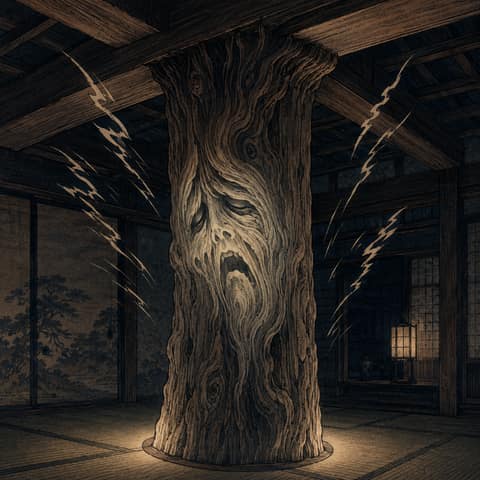
    A post–early modern belief that a pillar installed upside down, defying carpenters’ respect for a tree’s natural root spread, brings mishaps to a house. Persistent midnight house-settling, creaking beams, and uncanny whispers were read as the “curse of the inverted pillar,” prompting reinstallation or prayer. Shigeru Mizuki notes leaves birthing a spirit from the reversed wood, or the pillar itself transforming, yet older records more often treat it as signs of noise, misfortune, and ill omen. Deliberate inverted motifs used as apotropaic design (e.g., Yomeimon) belong to the ritual idea of intentional imperfection and are distinct from this yokai. As a taboo rooted in building folklore, it appears in regional carpenters’ lore, temple and shrine records, and essays.

  • Sanki Daigongen

    Sanki Daigongen

    Epic

    sanki-daigongen

    Japan's Only Demon God Guarding Mount Misen, Sanki Daigongen

    Oni/Giant MonsterHiroshima

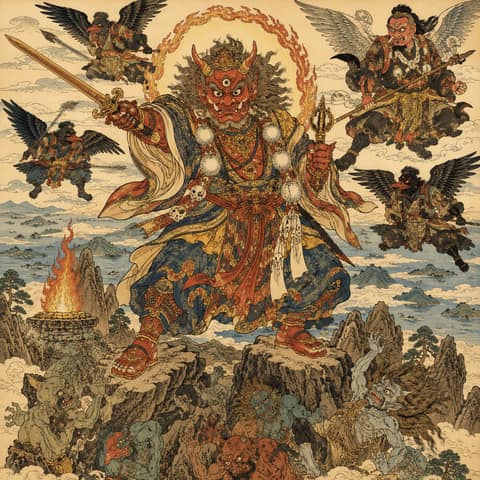
    The core of Sanki Daigongen lies in its reversed divine nature, transforming the originally feared oni into a "guardian deity that wards off evil." The three demon gods—Tsuicho, Jibi, and Mara—each govern fortune, wisdom, and subjugation, with Dainichi Nyorai, Kokuzo Bosatsu, and Fudo Myoo as their original Buddhist forms. This trinity structure demonstrates the fusion of the Honji Suijaku (original reality and manifested traces) thought of Shingon esoteric Buddhism with mountain asceticism and tengu worship. The fact that it commands large and small tengu as familiars is directly connected to folk tales of Mount Misen being a spiritual mountain of tengu (like the tale of Masanori Fukushima's tengu extermination). It embodies the sacredness of Mount Misen itself, characterized by Kukai's founding, the unextinguishable spiritual fire, and the strange rock formations likened to Mount Sumeru. The Itsukushima Shrine (Ichikishima-hime and Benzaiten) on the sea and Sanki Daigongen on the mountain form a pair as the guardian deities of the two poles of Miyajima—the sea and the mountain.

  • Sarugami (Monkey Deity)

    Sarugami (Monkey Deity)

    Epic

    sah-roo-GAH-mee

    Simian Deity in Medieval Tales

    Deities & Divine SpiritsShigaOkayama

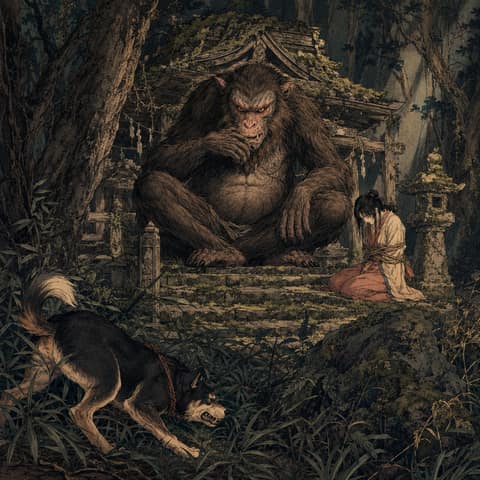
    In medieval Japan, the monkey deity was told as a fusion of mountain divinity and simian monster. It ruled mountain domains and demanded offerings like a calendar ritual, seen as a relic of ancient sacred marriage rites, yet storytelling emphasized its brutality as a yokai. In slaying tales, a passing hunter or a monk with sacred power stands in as a substitute, and a trained dog plays the decisive role. The defeated deity sometimes possesses a shrine official to beg forgiveness, hinting at lingering sanctity. In some regions it was known as a possessing spirit, with sudden rages blamed on its curse. Early modern ghost stories pair man‑eating ferocity with comic butt‑fondling, portraying the ambivalent scorn and fear directed at monkeys.

  • Satori

    Satori

    Epic

    sah-TOH-ree

    Traditional Version: Kakku of Hida and Mino

    Mountain & Wilderness SpiritsGifu

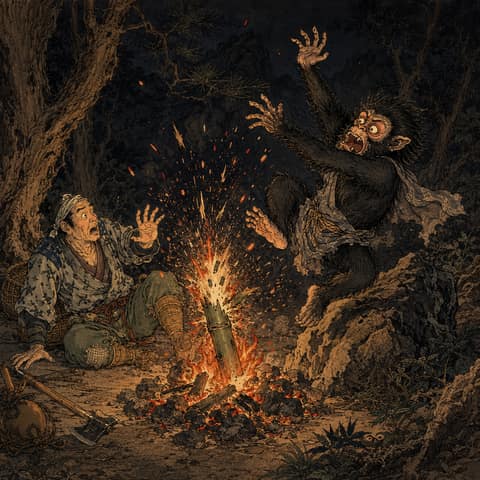
    A simian-form apparition modeled on Sekien Toriyama’s Konjaku Gazu Zoku Hyakki entry and natural-historical notes in Sino-Japanese texts. It appears on remote mountain paths, instantly voices the thoughts of woodcutters and travelers, and gauges their behavior. Disinclined to harm humans, it withdraws swiftly when sensing danger, in line with Sekien’s text. In folktales its figure varies by region—monkey, mountain man, tengu, or tanuki—but its core is “mind reading” and retreating at sudden noises. Its mind reading mirrors the other’s thoughts and repeats them, closer to a warning than provocation. It reads presences in mountain stillness yet proves vulnerable to the unexpected—sparks from a campfire or a flying splinter. The name Kakku is linked to the character 玃 through phonetic conflation, from which an independent yokai image emerged. Traditions span Chubu to Kanto, Tohoku, Chugoku, and Kyushu, telling of a being that measures the boundary between people and the otherworld in the mountains.

  • Sazae-oni (Turban Shell Ogre)

    Sazae-oni (Turban Shell Ogre)

    Epic

    sah-ZAH-eh OH-nee

    Pictorial and Allegorical Representation (Sekien Edition)

    Animal ShapeshiftersJapanese folklore

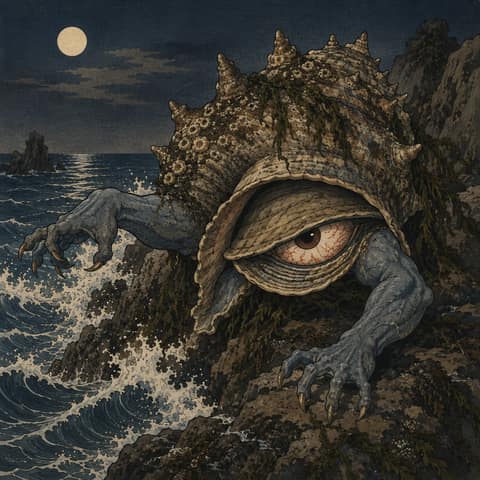
    A work by Toriyama Sekien that riffs on a transformation tale in the Book of Rites, caricaturing the principle by which a sea shell assumes a demonic aspect. Depicted as a turban shell with a human arm and an eye on its lid, it serves less as a harmful monster than as a visualization of ideas about metamorphosis and things-turned-spirits. It aligns with shell personifications in early modern Hyakki Yagyo paintings, conveying a sensibility that sees numinous presence in coastal nature. Later erotic ghost anecdotes are largely inventions and should be understood apart from this prototype.

  • Shirōneri

    Shirōneri

    Epic

    shee-ROH-neh-ree

    Based on Sekien’s Illustrations

    Animated Objects & UndeadJapanese folklore

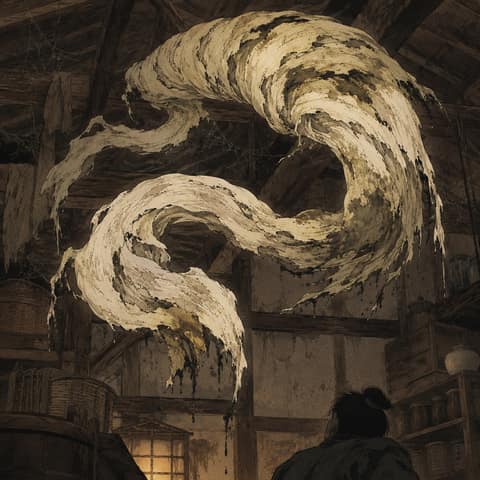
    Anchored in Toriyama Sekien’s imagery, this version sees an aged dishcloth trailing long and fluttering in the wind, reimagined as a yokai. The original illustration offers little about harming humans, so it is understood as a symbol of attachment to old objects and the impermanence of things. Aggressive traits found in later ghost tales should be kept separate; here the focus is the eerie nature of a “moving old cloth” and the visual impression of it gliding between walls under a night lamp.

  • Shokuin (Zhu Yin)

    Shokuin (Zhu Yin)

    Epic

    SHOH-koo-een

    Book-Borne, Picture Scroll Edition

    Deities & Divine SpiritsUncertain; derived from the Classic of Mountains and Seas (Shan Hai Jing), transmitted to Japan through texts

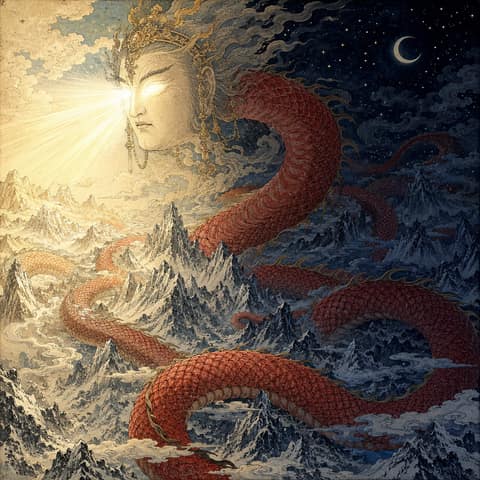
    In Japan it is understood as a foreign divinity-spiritoriginating in the Classic of Mountains and Seas and related encyclopedic interests. Imagery follows the key points of a human face upon an immense red serpent body, whose opening and closing eyes divide day from night and whose breathing brings seasonal winds and heat or cold. Confusion with the Torch Dragon appears in early modern commentaries, yet most introductions cautiously note textual loci and descriptive differences, and signs of domestic worship are scarce. Consequently, local rites, taboos, and oral lore are meager, with reception centered on reading, sketching, and use as an art motif. It is often cited as an example of incorporating a foreign divinity into yokai catalogues and is positioned as a personification of time and the seasons.

  • Shōkera

    Shōkera

    Epic

    SHOH-keh-rah

    Traditional Iconography Interpretation

    霊・亡霊Japanese folklore

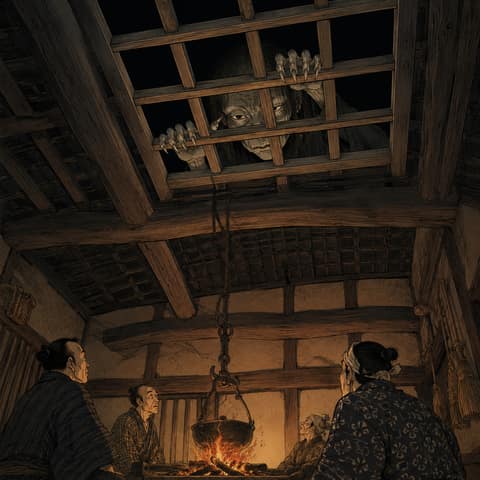
    Based on Toriyama Sekien’s depiction, this interpretation frames the yokai as a watchful presence peering through a skylight during Kōshin night. It is identified with the Sanshi or treated as a spiritual agent acting on their behalf, examining human sloth and broken vows and, upon transgression, bringing misfortune with sharp claws. The name also appears in historical kana as “Shaukerá” or “Seukerá,” and its concrete form varies by region and source, yet it is positioned as a yokai that visualizes the normative ethos of Kōshin belief. Early modern sources offer little explanatory text, with later folkloric readings filling the gaps.

  • Snake-Bone Hag

    Snake-Bone Hag

    Epic

    jah-KOHTS-bah-bah

    Sekien Iconography Standard

    General ClassificationsJapanese folklore

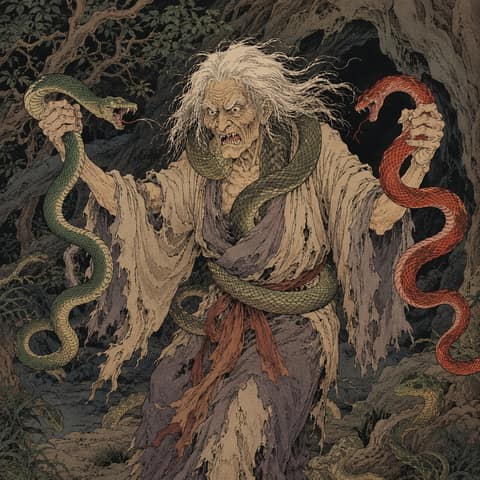
    Jakotsubā is a name based on the image and brief note in Toriyama Sekien’s Konjaku Hyakki Shūi (late 18th century), without any specific oral tradition attached. The picture shows an old woman wreathed in snakes. The note mentions the Shanhai Jing’s account of the Wuxian people in the Overseas West Classic, citing those who hold a blue snake in the right hand and a red snake in the left, yet it stops short of directly identifying this old woman. The term itself appears in early modern chapbooks and theater as a derogatory label for an old woman, which Sekien likely molded into a yokai. Later encyclopedias claim she is the wife of “Snake Goemon,” that the blue snake freezes and the red snake burns, but these are embellishments inspired by Sekien’s wording, not grounded in cited tradition. Folklorically it visually aligns with the lineages of “oni-baba” and “snake bride,” but because no rites, taboos, or place-names unique to Jakotsubā are identified, academic treatments handle it as source-undetermined.

  • Sokushinbutsu

    Sokushinbutsu

    Epic

    Sokushinbutsu

    Sokushinbutsu, the Living Buddha Enshrined in the Earth

    Humans-Turned-Yokai / DemigodsYamagata

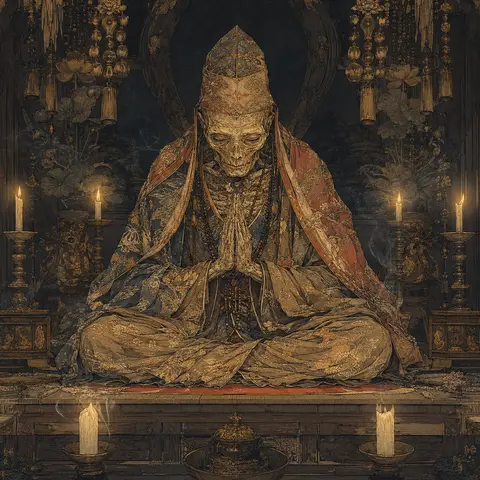
    Unlike other yokai that are purely imaginary aberrations, the *sokushinbutsu* is a rare existence—a real, historical ascetic who ascended halfway to godhood through absolute faith. The inner sanctuary of Mount Yudono has no shrine building; instead, a giant, brownish-red sacred rock gushing hot water serves as the object of worship itself, and pilgrims must walk the approach barefoot. In this sacred area that preserves the archetype of nature worship, ascetics aimed for *sokushin-jōbutsu*—becoming a Buddha in this very life. The "tree-eating asceticism" was a preparation for self-mummification: first giving up grains, and eventually restricting salt and water to the absolute limit to wither the body. In the final stage, they confined themselves in an underground stone chamber connected to the outside world only by a bamboo tube with a bell. The moment the sound of the bell ceased, the ascetic was considered to have successfully entered eternal meditation. Exhumed without having decayed, their bodies became Buddhas, enshrined beside the main temple deities to continuously shoulder the suffering of the masses. They are not objects of terror, but the physical incarnations of a will to save humanity that transcended death itself, most vividly demonstrating the Dewa Sanzan region's views on death and the concept of the mountains as the otherworld.

  • Suiko (Water Tiger)

    Suiko (Water Tiger)

    Epic

    sui-ko

    The Scaled Suiko, Child-Sized

    Water SpiritsHubei, China (introduced to Japan through Edo-period texts)

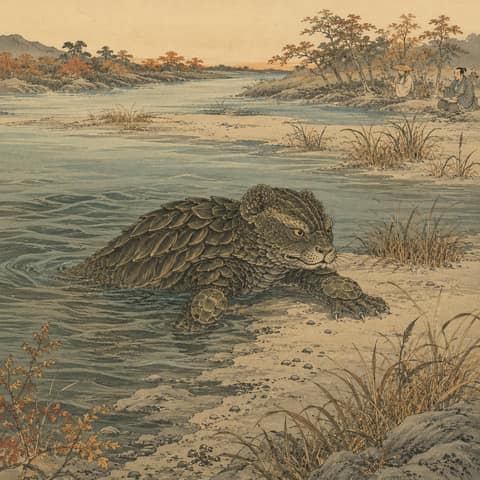
    This version digs into what sets the suiko apart: it is not a creature of oral legend but one shaped within the pages of books. Where the kappa was born from the fears of riverside life and took on countless forms and names from region to region, the image of the suiko travelled almost entirely through citations in Chinese materia medica and gazetteers. That is why its defining features stay remarkably consistent — a body the size of a small child, hard scales, the habit of baring its carapace on the autumn sand, and the trick of showing only its knees above the water. Japanese scholars cited these Chinese accounts while puzzling over how to square them with the kappa right in front of them. The *Wakan Sansai Zue* placed the two side by side and cautiously judged them "alike yet not the same," while the *Suiko Kōryaku* tried to file reports of water creatures from across the land under the heading "suiko." Toriyama Sekien's illustration in the *Gazu Hyakki Yagyō* is likewise a picture drawn from this continental learning. There are articles touting ways to capture it or its medicinal uses, but interpretations differ from book to book, and the truth remains unclear. The suiko, in the end, is a second face of the water spirit — the trace left by an early-modern attempt to reinterpret the familiar kappa through the lens of Chinese scholarship.

  • Suiko-sama (Water Tiger Deity)

    Suiko-sama (Water Tiger Deity)

    Epic

    sui-ko-sa-ma

    Suiko Daimyōjin of Tsugaru

    Deities & Divine SpiritsAomori

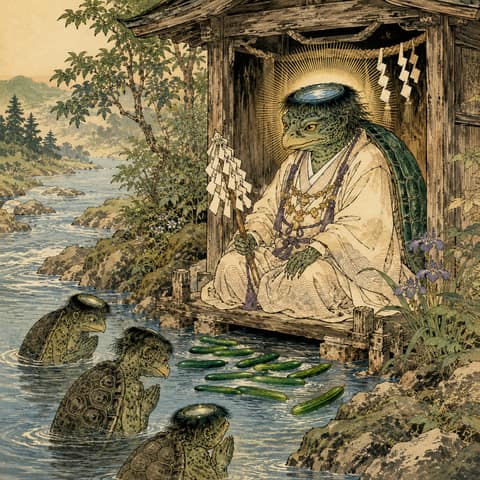
    This version digs into Suiko-sama as a faith that "raised a yokai all the way to a god." The kappa is by nature a fearsome creature that drags people into the water. The wisdom of the Tsugaru Suiko-sama cult lies in this: rather than slaying the kappa, it made the creature into a god who commands forty-eight of them as their head, entrusting it with the order of the waterside. The faith was bound tightly to the lives of children. The custom of offering cucumbers and floating them downstream in the river-playing season was at once a prayer to the deity and a way of impressing on children the everyday warning, "never let your guard down at the water." Benzaiten's form is borrowed for the sacred image because two water deities naturally merged into one. It shares only its kanji name with the ferocious "suiko" of the Chinese books; in substance the two are nothing alike. Suiko-sama is a water god in the manner of the snow country — one in which people reshaped the local dread of the kappa into an object of prayer. The specific rites and incantations vary greatly from district to district, and many have not survived to the present.

  • Tall Woman

    Tall Woman

    Epic

    tah-kah-OHN-nah

    Iconography-True (Sekien-Based)

    Household SpiritsJapanese folklore

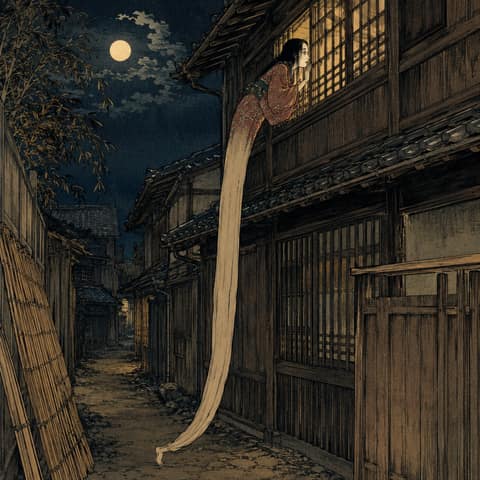
    Reconstructed strictly from Sekien’s original image while preserving the absence of contemporaneous commentary. The figure is a gaunt woman whose body from the feet to the hips stretches like a serpent, extending from an alley up to the second-floor lattice of a townhouse to peer inside. Her actions are chiefly to startle, with no fixed malice. Regional proper names are uncertain, and later popular tales (brothels, satire, etc.) are treated as accretions. She is understood as a symbolic apparition that exploits nighttime quiet and architectural features, instilling unease in residents through her gaze.

  • Teke Teke

    Teke Teke

    Epic

    てけてけ

    Teke Teke, the Crawling Half-Woman

    Spirit / GhostModern urban legend of the 1990s-2000s, based on train accident motifs

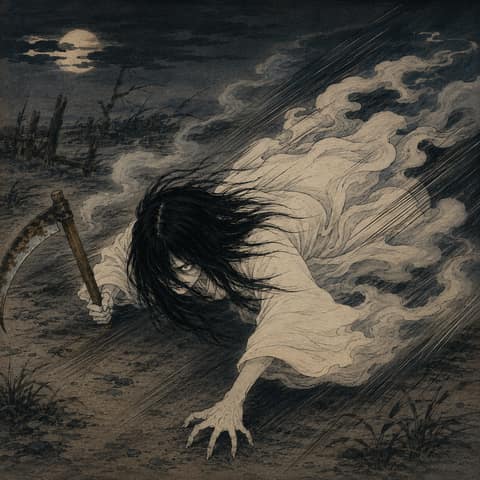
    The "Woman Missing Her Lower Half" as a Post-War Japanese Horror Motif. While the basic description traces her origins and spread, a deeper analysis repositions Teke Teke within a broader cultural sphere: the motif of the "physically mutilated female ghost" in post-war Japan. The "female ghost lacking a complete body" is a recurring archetype in Japanese horror. From Oiwa (facial disfigurement, Nanboku Tsuruya's "Tokaido Yotsuya Kaidan," 1825) and Kasane (facial and bodily disfigurement, Encho Sanyutei's "Shinkei Kasanegafuchi"), to post-war entities like the Slit-Mouthed Woman (mouth disfigurement, first appeared in Gifu in 1979), Teke Teke (missing lower half), Kashima-san (missing lower half), and Hachishakusama (abnormal height), there is a common thread of "the loss of female physical integrity." Within this lineage, Teke Teke is unique for her connection to the "railway," a piece of post-war Japanese infrastructure. The Linguistic Choice of the Onomatopoeia "Teke Teke". The name "Teke Teke" mimics the sound of crawling on both arms, and this specific onomatopoeia is the result of several linguistic choices. First, the combination of the plosives 't' and 'k' suggests the hard, striking sound against a wooden floor or concrete. Second, the repetition (teke-teke) creates an eerie sense of a "slow, continuous pursuit." Third, it rolls easily off the tongue, making it easy for children to reenact. Derivative names like "Patapata," "Kotokoto," and "Katakata" have all undergone similar phonological selections, demonstrating a folk-acoustic pattern of "expressing the sound of movement with a two-syllable onomatopoeia." The Genealogy of Railway Accident Urban Legends. Japan's railways during the post-war period of rapid economic growth were the site of numerous fatal accidents, becoming a hotbed for ghost stories. Alongside Teke Teke, various railway and crossing-related legends have been recorded nationwide since the 1970s, such as "a woman standing behind you when you look back at a crossing," "a figure missing its lower half at the edge of a platform," or "being spoken to by a woman waiting for a train along the tracks." In "The Folklore of Yokai" (Iwanami Shoten, 1985), folklorist Noboru Miyata argued that post-war urban infrastructures (railways, tunnels, housing complexes) function as new spaces for generating ghost stories, replacing traditional locations like bodies of water, crossroads, and mountain passes. Teke Teke is perhaps the most successful entity born of these "infrastructure ghost stories." Cross-referencing with Kashima-san and the Structure of the "Answer". The method to survive Teke Teke—"answering 'Kashima-san'"—spread widely as a derivative rule. This follows the same pattern as answering "pomade" or "bekko ame" (tortoiseshell candy) to the Slit-Mouthed Woman, actively engaging children's imaginations by embedding a "correct answer" within the story. The countermeasures for Kashima-san herself are diverse, such as "answering 'Kamashi'" or "chanting the full name 'Reiko Kashima'," turning the countermeasures themselves into a trend among children. This can be read as a secularized form of the spells and mantra beliefs that have existed since the Heian period, now taking place within the school environment. Interpretation of the 2009 Film Adaptation. Director Koji Shiraishi's film "Teke Teke" (2009) adopted the Kakogawa, Hyogo origin theory, depicting the monster as a woman (real name "Reiko Kashima" = Kashima Reiko) whose lower body was severed in a post-war railway suicide. The film reconstructed the oral cross-referencing between Teke Teke and Kashima-san as "two sides of the same person." Bolstered by its connection to the idol culture of the time—starring AKB48's Yuko Oshima—Teke Teke served as a prime example of how post-war children's oral ghost stories were mediated into mainstream Heisei-era cinematic horror. Reproduction in the Internet Age. Since the 2010s, Teke Teke has been repeatedly reproduced through ghost story reading channels on YouTube, paranormal content on Niconico, and horror shorts on TikTok. In the 2020s, she has been embraced anew by Generation Z as a "scary story told at school during childhood," making her a rare case of an 80s-90s children's oral tradition successfully passing down through generations. Teke Teke is perhaps the clearest example of how the lifeline of a ghost story can endure while adapting its medium from "oral tradition → children's magazines → movies → the internet."
  • Thousand-Wolf Pack

    Thousand-Wolf Pack

    Epic

    SEHN-bee-kee OH-oh-kah-mee

    Senbiki-Ōkami

    Animal ShapeshiftersAcross Japan (Shikoku, Izumo, Echigo, etc.)

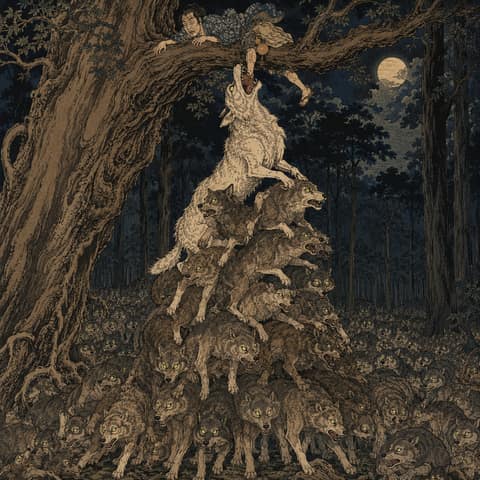
    The traditional image of the Senbiki-Ōkami portrays not a lone wolf but the terror of a pack moving under command. Tales begin on a nighttime pass where a survivor escapes up a tree. The pack gains height through leaps and coordinated boosts, and when they cannot reach, they summon a chieftain or outside entities such as an old cat, an ogress, or the Blacksmith’s Wife. Those summoned are linked to in-home impostors disguised as family, and by morning the world bears traces—bloodstains, missing household vessels, wounds, or memorial steles—that anchor the tale in reality. Though the wolves’ behavior is exaggerated, older interpretations align it with knowledge of nocturnal habits and pack movement, and prayers, edged tools, and daybreak commonly mark the turning point. Depending on region, the chieftain appears as a white-maned great wolf, an old cat, or an ogress, with names like the Blacksmith’s Wife, Koike Hag, or Yasaburō Hag, yet the core pattern of tree-bound escape and summoning remains. Folklorically, the story links calamity lurking at borders—mountain passes, the hour before dawn—to shapeshifters within the home, often accompanied by memorial towers and place-name lore.

  • Ubagabi (Old Woman’s Fire)

    Ubagabi (Old Woman’s Fire)

    Epic

    OO-bah-gah-bee

    Ubagabi (Traditional Accounts Version)

    Natural Phenomena SpiritsOsakaKyoto

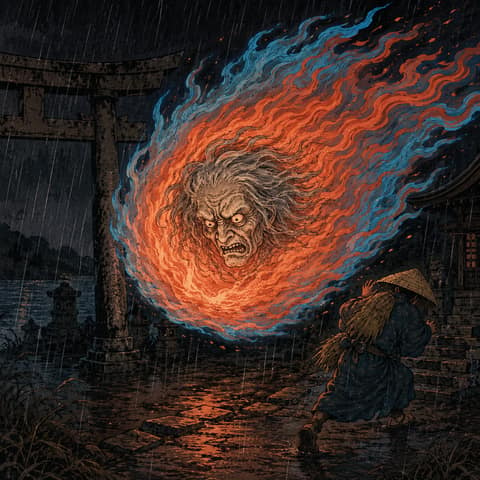
    A reference version based on images of Ubagabi that appear frequently in Edo-period essays and ghost tales. In Kawachi, an old woman who stole oil from a shrine was said to become a ghostly fire after death, drifting around shrine approaches and village paths on rainy nights. In Tanba, it was tied to water calamities on the Hozu River, feared as lights that swarm over the water. It appears as an orange fireball about one shaku in size, at times bearing the face of an old woman or the shadow of a bird. Contact is an omen of misfortune, though accounts note it can be driven off by calling out or by taboo words. With moral contexts of stolen shrine oil, child abandonment tales, and water disasters behind it, the Ubagabi endured as a ghost-fire embodying regional taboos and faith.

  • Ubume (Ghost of a Dead Mother)

    Ubume (Ghost of a Dead Mother)

    Epic

    OO-boo-meh

    Ubume (Traditional Form)

    Ghosts & SpiritsVarious regions of Japan (especially Tōhoku, Kantō, and Kyūshū)

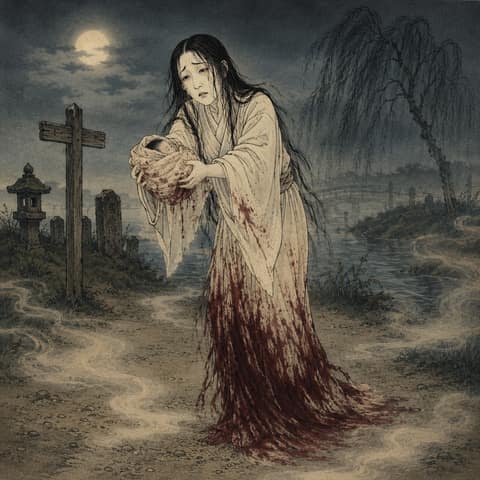
    A spirit formed from the regrets of a woman who died in childbirth, said to appear along night roads, crossroads, and riverbanks. Early modern tales and illustrated books depict her with blood soaking her lower body, cradling a baby and asking passersby to mind the child. Outcomes vary: the helper discovers they held a stone or Jizo statue, receives great strength or wealth as recompense, or suffers misfortune such as being bitten by the infant. Regional variants include Fukushima’s “Obo,” where distracting her with a strip of cloth is advised, and Kyushu’s “Ugume,” whose true nature is revealed at dawn. Edo scholars compared her with nocturnal bird-like portents in Chinese records and reasoned that the qi of those who die in childbirth becomes a yokai. Temple and shrine legends tell of salvation through nembutsu or daimoku, linking her to prayers for childrearing and safe delivery. Ubume is both feared and revered, a spiritual figure embodying a mother’s enduring love.

  • Ushi-no-koku Mairi (Cursing Rite at the Hour of the Ox)

    Ushi-no-koku Mairi (Cursing Rite at the Hour of the Ox)

    Epic

    OO-shee-noh-KOH-koo MY-ree

    Ritual Icon of the Cursing Hour

    Ghosts & SpiritsKyoto

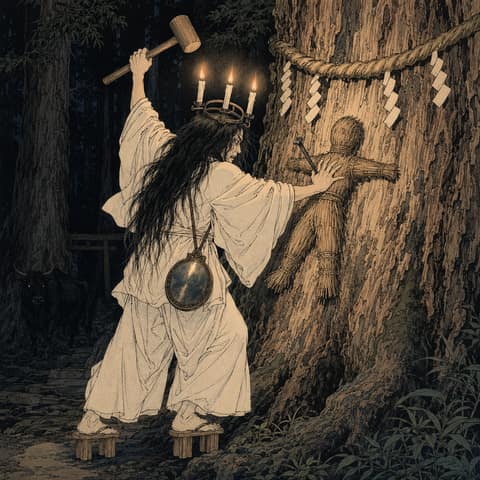
    A codified image of the classic Ushi-no-koku mairi centered on Edo-period etiquette. Clad in white burial garb with disheveled long hair, the practitioner inverts an iron trivet as a crown with three candles lit, hangs a mirror on the chest, and moves toward the shrine on single-toothed geta to muffle steps. At the sacred tree, a doll bearing the target’s name is pinned and a five-inch nail is hammered in each night. The witching hour is strictly the third quarter of the Ox Hour, with fulfillment said to come on the seventh night. If witnessed, the rite loses its power, so silence and care to leave no tracks are prescribed. In art, a black ox sometimes accompanies the figure; lore holds that straddling it on the final night brings success, while shrinking back means failure. Straw-doll usage became common in the early modern era, with roots in ancient scapegoat effigy piercings and Onmyodo katashiro rites. Folklore often stops short of asserting curses as real, instead telling that breaking taboos or exposure nullifies the act.

  • Uwan

    Uwan

    Epic

    OO-wahn

    Emaki Manifestation Type (Mansion Apparition)

    Household SpiritsJapanese folklore

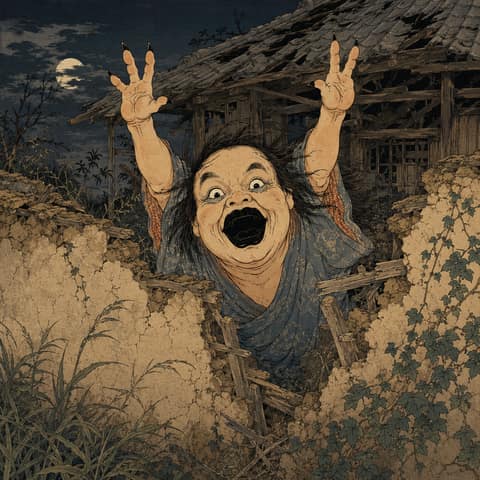
    A reconstruction based on Edo-period yokai picture scrolls. Depicted with a humanlike face marked by iron-blackened teeth, raising a three-fingered hand, appearing from behind fences or in ruined houses and shouting “uwan.” No early sources clearly state direct harm to people; its main behavior is appearing and intimidating. Because of similar regional names and frequent mansion backdrops, it is sometimes taken as a house-dwelling entity, but this is unproven and the portrayals are spare. Later creative tales—such as being driven off by a retort or killing victims—should be treated separately from the core record.

  • Wanyūdō

    Wanyūdō

    Epic

    wah-nyoo-DOH

    Traditional Iconography, Sekien School

    Household SpiritsKyoto

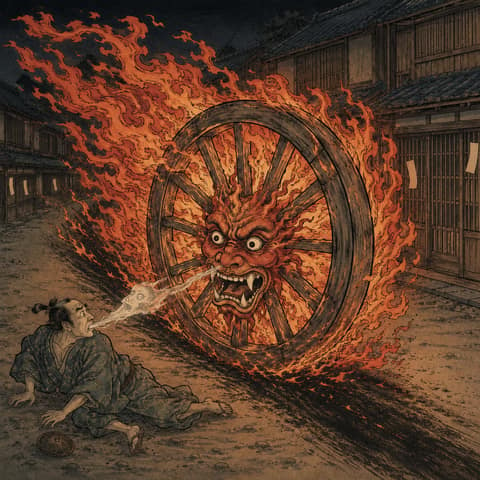
    An interpretation grounded in Toriyama Sekien’s depiction. On night roads and at crossroads, a blazing wheel cruises low to the ground, its axle set with a monk-demon mask that fixes passersby with an unblinking stare. Meeting its gaze or succumbing to fear is said to drain one’s vital spirit, leaving the victim stupefied. Its origins trace to Kyoto wheel-ghost tales and likely overlap with the katagiriguruma motif, yet Sekien adopted a nyūdō mask and fixed it as a male figure. The source is uncertain, defying a firm label as vengeful spirit, tsukumogami, or will-o’-the-wisp. Countermeasures include posting a paper charm reading “This is the village of Katsumo” at the doorway, or avoiding eye contact and hiding. Few variants name specific places or people; the core image remains a plain yokai preserved in classical records.

  • Warei

    Warei

    Epic

    warei

    The Goryo of Uwajima: Yamaga Seibee Kinyori

    Spirit / GhostEhime

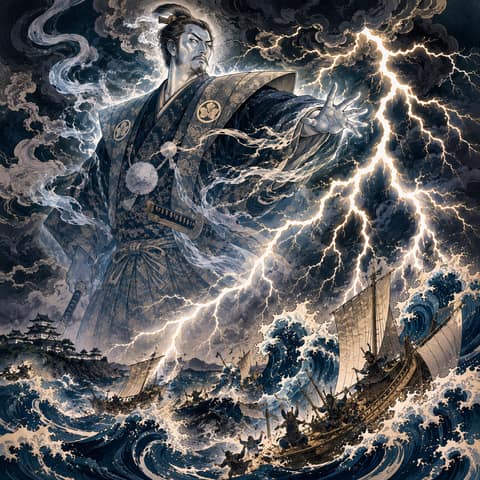
    The *Warei* is an entity that embodies the dynamics of *goryo* belief—where a vengeful spirit transforms into an honorable spirit (*goryo*) and then into a guardian deity—within the early modern history of Uwajima. In life, Yamaga Seibee was a retainer who devoted himself to the reform of domain administration. His unnatural death (the Warei Disturbance) and the subsequent chain of lightning strikes and shipwrecks that struck the participants gave people a tangible sense of a curse. The spirit, initially enshrined out of awe and fear, reversed its nature when his innocence was publicly recognized, acquiring the divinity of 'Warei-sama' protecting fishing and industry. The herd of *Ushi-oni* that parades in the Warei Festival at Warei Shrine is a ritual device to comfort and pacify this *goryo*, showing how monsters (*ushi-oni*) and spirits (*warei*) are inextricably linked in Uwajima's festivals.

  • Yamabiko

    Yamabiko

    Epic

    yah-mah-BEE-koh

    Traditional Figure (Kodama and Mountain-Deity Retainer Interpretation)

    自然現象・自然霊Nagano

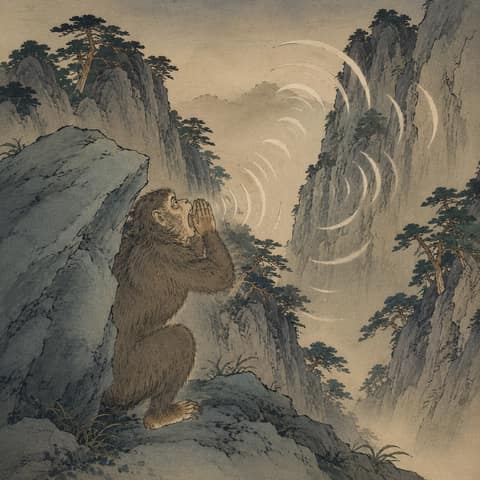
    Yamabiko is the personification of echoes in the mountains, interpreted as a kodama or a retainer of the mountain deity. Its habit of repeating words back is seen as a boundary-marking reply within the mountain domain, warning against reckless shouting that disrupts the mountain’s vital energy. Early modern images depict it as a small beast akin to a dog or monkey; figures in Hyakkai Zukan and Gazu Hyakki Yagyō have been linked to the yama-ko in Wakan Sansai Zue and to Penghou, said to dwell within trees. Depending on region, intermediaries vary—bird calls like the yobukodori or resonant rocks such as “Yamabiko Rock.” Phenomenon, spirit, and monster imagery overlap in layered tradition.

  • Yamanoke

    Yamanoke

    Epic

    Yamanoke

    The Headless One-Legged Entity Possessing Women

    山野の怪2007年2ちゃんねる発祥の創作怪談

    The Literary Prowess of the "ShareKowa" Golden Age. As mentioned in the base description, Yamanoke is a masterpiece from the golden age of 2channel's occult board. In this deep dive, we will explore the specific literary mechanisms that make this story so effective. The 'ShareKowa' (Scary Stories You Can't Laugh At) thread produced numerous internet legends, but Yamano Keita's Yamanoke stands out for its exceptional narrative pacing. The story transitions seamlessly from a mundane, slightly mischievous act by a father (driving down an unpaved mountain road to scare his daughter) into a sudden encounter with the incomprehensible. The pacing of the escape, the creeping realization of the daughter's abnormal behavior, and the dramatic diagnosis by a temple priest are woven together with the precision of a professional horror short story, elevating it far beyond a simple forum post. The Psychological Horror of Possession. Unlike monsters that simply attack or kill, Yamanoke's terror lies in "possession." When the daughter is afflicted, she loses her sanity and begins mimicking the monster's eerie "Ten-sou-metsu" chant. The horror is twofold: the physical danger of the encounter, and the psychological devastation of watching a loved one's mind be erased and replaced by something alien. The ticking clock element introduced by the priest—"if not exorcised within 49 days, she will never recover"—adds a desperate, suspenseful tension to the narrative that mirrors classical demonic possession tropes while rooting them firmly in Japanese folk Buddhism. The Resonance with Classical Mythology: Xing Tian. The morphological similarity between Yamanoke and the Chinese mythological figure Xing Tian (from the *Classic of Mountains and Seas*) is a subject of endless fascination among folklore enthusiasts. Xing Tian, the headless giant who fought the Yellow Emperor using his chest as a face, represents relentless, unyielding willpower in Chinese mythology. Whether Yamano Keita intentionally borrowed this imagery or arrived at it independently, transplanting this bizarre, ancient anatomy onto a modern Japanese mountain spirit creates a visual that is both absurd and deeply unsettling. The juxtaposition of a mythological warrior's body with the behavior of a grinning, muttering stalker is a masterclass in character design. The Linguistic Genius of "Ten-sou-metsu". The phrase "Ten-sou-metsu" is a brilliant piece of horror writing. In Japanese, the syllables "ten," "sou," and "metsu" evoke kanji related to heaven (天), sending/transferring (送), and destruction/annihilation (滅). It sounds like a fragmented Buddhist incantation or a curse. Because the author never provided a canonical kanji spelling or translation, readers are forced to imagine what this entity is trying to convey. Is it a threat? A countdown? A prayer? This linguistic ambiguity forces the reader's imagination to do the heavy lifting, ensuring the monster remains truly incomprehensible and, therefore, terrifying. The 2025 Resurgence and Sequel. The landscape of internet horror was shaken in late 2024 when Yamano Keita, the original author, re-emerged on social media after nearly two decades. The release of the sequel, *Zange* (Confession), in March 2025 proved that the author's ability to craft atmospheric dread remained entirely intact. The fact that an internet legend born in 2007 could receive a direct, canonical continuation 18 years later—and that the internet community reacted with such fervor—demonstrates that entities like Yamanoke are not just disposable forum posts, but enduring pieces of modern digital folklore that command genuine cultural legacy.

  • Yamawaro (Mountain Child)

    Yamawaro (Mountain Child)

    Epic

    ya-ma-wa-ro

    The Mountain Boy of Western Japan, the Yamawaro

    Mountain & Wilderness SpiritsKyushu (yamawaro; mountains of western Japan)

    This version looks at the yamawaro — the kappa's "other half" — from the side of life in the mountains. If the kappa is the being that menaces people at the water's edge, the yamawaro is the one that appears at the worksites of mountain labor. It helps woodcutters and charcoal burners haul their timber, taking sake or rice balls in return. Yet the exchange follows a strict code: hand over the promised goods first and it runs off without working, and break a promise and it flies into a furious rage and brings down misfortune. To those who worked the mountains, the yamawaro was at once a dependable partner and a neighbor not to be trusted, one that bared its fangs at any lapse of courtesy. The tales of the yamawaro are packed tight with the eeriness of the mountains: the "tengu-fell," the sound of a great tree crashing down when no one is there; a voice that mimics human songs and the strokes of an axe to the life; and the strange weakness of disliking the line of a carpenter's ink pot. These are the very dread felt by those who venture deep into the hills. And the legend of the "crossing of the kappa" — entering the mountains at the autumn equinox and returning to the rivers at the spring equinox — ties the yamawaro and the kappa together with a single thread. A single water god that passes between mountain and river — its mountain face is the yamawaro.

Showing 97 - 120 of 121 yokai