Beside a Light That Will Not Quite Go Out
Ao-andon’s eeriness does not lie in something suddenly attacking from complete darkness. What Toriyama Sekien’s note captures is the instant when an oil flame seems about to die, then brightens again, changing the position and density of every shadow. A face, the ribs of a lantern, paper, and the objects on the floor remain visible, yet none keeps quite the same form. Something called Ao-andon is said to appear at times amid that shifting light and dark[2].
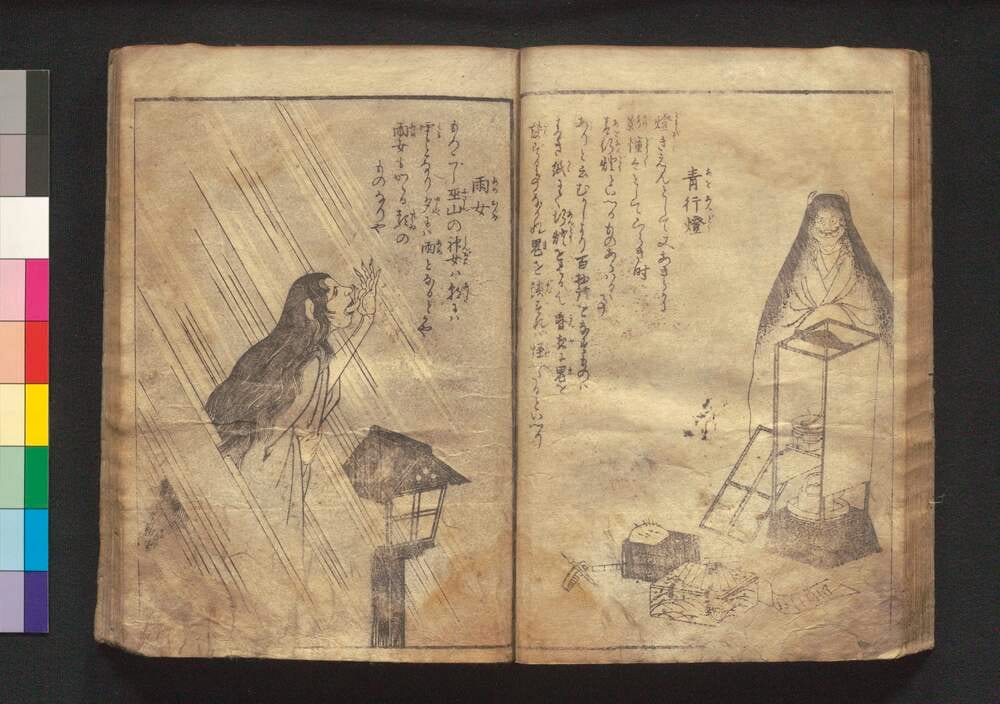
In the line of first-edition copies prefaced in 1781, the right-hand page of the spread is "Ao-andon" and the left-hand page is "Ameonna." Though the two entries occupy the same image, each has its own title and explanatory note; they are not consecutive scenes from a single event.
One Blue-Paper Lantern and One Hundred Wicks
Asai Ryōi’s Otogibōko is essential for understanding the older apparatus of Hyakumonogatari. Here a single lantern is covered in blue paper and holds one hundred wicks. One wick is removed after each tale, so the gathering gradually grows darker. It is neither one hundred lanterns nor one hundred candles. The light thinning through blue paper is itself the device that makes the number of tales told perceptible.
Modern Hyakumonogatari events may arrange candles, but that staging is not the single practice that reproduces every early modern record. The accounts describe several methods: removing wicks, extinguishing flames, placing a mirror, or using oil in a large dish. [5]
Hyakumonogatari Has No Single Ending
The claim that participants must always stop at ninety-nine tales does not fit the varied endings of early works. Some tell of a huge hand appearing around the ninety-ninth story, while another turns to laughter when a loud disturbance proves to be a human leg. There are even accounts of a woman’s head appearing after a hundred tales, of high winds or tremors following their completion, and of treasure received from a ghost. [7][8][5]
Hyakumonogatari was more than a terrifying taboo. It could be a contest of courage, an occasion for the company’s wit, a comic tale, a structure for ghost-story collections, and a game in which tellers and listeners shared tension. To make samurai tests of courage—or magical ritual alone—its sole origin is to miss that breadth.
A Page Named by Sekien
Otogibōko has a lantern covered in blue paper, but no named figure of Ao-andon. The earliest documented named image is Sekien’s illustration of 1781. [1] It remains difficult, however, to survey every earlier printed book, essay, and lexical source, so whether Sekien coined the name outright is still unsettled.
The name "Ao-andon" turns a description of a blue-paper lighting device into the heading for the strange figure that appears beside it. Nothing says that an old lantern transformed after a hundred years, and there is no origin tale of a tsukumogami. It is a printed invention that layers an object, a ghost-story practice, and the feeling of a dark room into a single name and image.
Ao-andon on the Right,
Ameonna on the Left
Sekien’s book is read from right to left. The right-hand page, bearing Ao-andon’s title and explanatory note, shows a square lantern with its front frame removed and a figure standing behind it. The left-hand page is "Ameonna," with a waterside apparition and a different note. [2] Their placement on the same spread is not evidence that they are sisters, companions, co-appearances, or beings with the same powers.
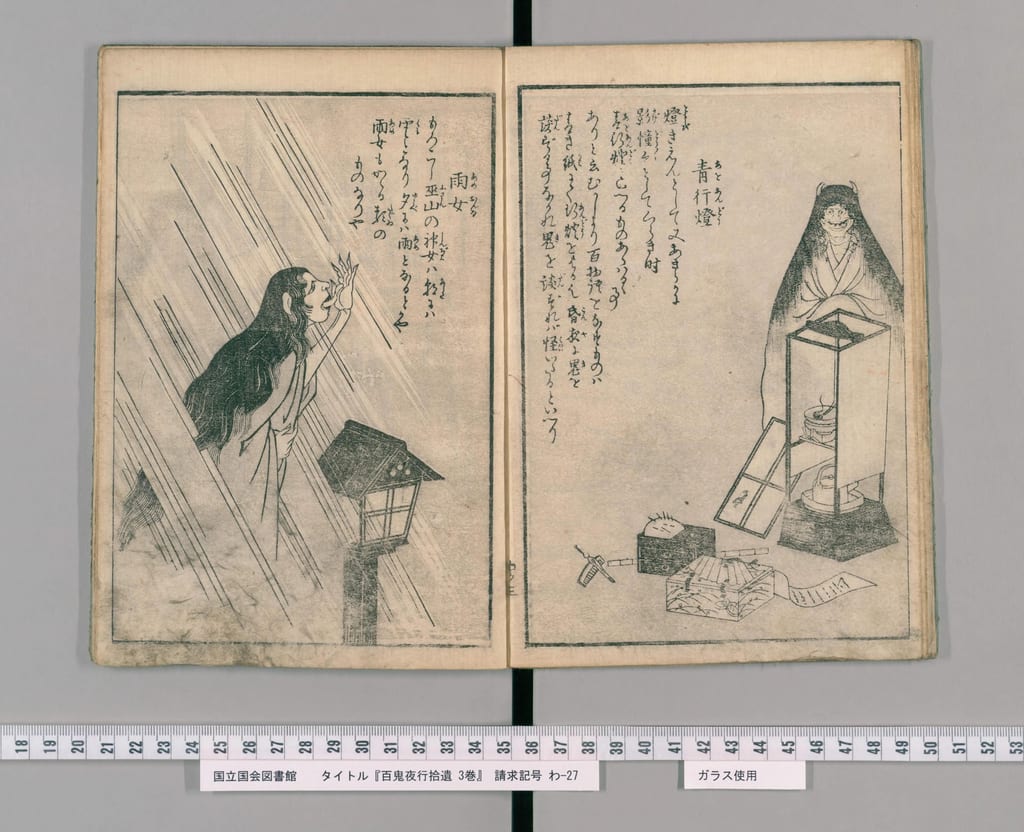
This is the edition published by Nagano’ya Kankichi in 1805. It makes the composition especially clear, but it is not the first edition of 1781 itself[12]. Separating the work’s year of first publication from the edition underlying a digital image avoids presenting the old illustration as an "original from 1781."
Long Hair,
Horns,
and Dark Teeth
The figure wears its hair long, has two hornlike projections on its head, and shows darkly rendered teeth. It is often called a demon woman because its outline suggests women’s clothing, but the note gives no gender, age, or social standing. Nor can the uncolored areas of a monochrome print be determined to be white clothing. The dark teeth may possibly be read as ohaguro, but it is better not to establish a cosmetic practice from the image alone.
The early modern print does not show blue skin, an enormous muscular body, or long claws that tear people apart. Blue first describes the paper covering the lantern; it does not specify the figure’s skin color.
The Space Left by the Objects at Its Feet
The lantern’s front frame has been removed, revealing an oil dish and wicks inside. A box, papers, slender rodlike objects, and items resembling combs or hairpins are scattered on the floor. They invite thoughts of letters, sewing, and grooming, but the note names neither the individual objects nor their owner.
Later interpretations read the sewing tools, combs, and love letters as the jealousy of a wife who suspects her husband of infidelity. This is a compelling hypothesis for thinking about the image, but one cannot assert a plot of husband, wife, love letters, and grudge as Ao-andon’s early tradition. The unexplained everyday objects leave room for a different story to arise for every viewer.
The "Judge of the Hundredth Tale" Is a Later Image
Modern creative works can compellingly present Ao-andon as the ruler of ghost stories who must appear at the hundredth tale, an embodiment of the participants’ accumulated fear or malice, or a demon woman who summons one hundred supernatural beings. Yet Sekien records no personality, role, purpose, attacks, mental influence, harm, or speech. The spider’s hand, woman’s head, high wind, and tremors that appear in Hyakumonogatari more broadly cannot be reassigned as powers of Ao-andon itself.
Because the short early modern note leaves so much unsaid, later dictionaries, manga, novels, and games gave new personalities to the empty spaces. This is an important later layer of Ao-andon’s reception, distinct from abilities attested in the original text[6].
Its Weaknesses and Exorcism Are Unknown
Since the hundredth tale is not an appearance condition, no weakness can be inferred from stopping at ninety-nine. Sekien’s page does not present brightening the light, removing the blue paper, extinguishing the lantern, or waiting for dawn as ways to defeat it. Nor can one construct an inverse rule from the note’s statement that it may appear when a fading flame brightens again, as though increasing the light would make it disappear.
The absence of a specific tale of harm does not mean that Ao-andon is harmless. Where early records are silent, the most accurate course is to call its capacity either to harm or to protect unknown.
A Yokai Without a Particular Place
Shimogyō in Otogibōko, Umayabashi in the "Hyakumonogatari of Umayabashi," and the Inaba Hyakumonogatari record are settings for Hyakumonogatari literature or regions where accounts were collected. They do not mean that a yokai called Ao-andon appeared, was worshipped, or originated there. Nor does the fact that Sekien worked in Edo and that his book belongs to Edo publishing culture establish Tokyo as a place where Ao-andon appears.
If Ao-andon has one location, it is not a mountain or town on a map but an imagined room where light filtered through blue paper meets the voices of ghost stories. Its specific place of origin, sightings, shrine, and rites are unknown.
A Blue Name That Reached the Present
In 2023, a newly discovered bluish-purple bioluminescent polychaete was named Polycirrus aoandon. [13] It is an instance in which Ao-andon’s name and its image of blue light have travelled beyond yokai culture. The modern explanation accompanying the scientific name and what Sekien wrote in 1781 belong to different historical layers.
The Eeriness of What Remains Unknown
Ao-andon has no detailed birth story, battle tale, or set speech. What remains is a blue-paper lantern, an oil flame that dims and returns, trembling shadows, long hair and horns behind the lantern, everyday objects on the floor, and a brief warning against telling of the strange in the night.
When its identity is not filled in with a single answer, Sekien’s device becomes clearer: an ordinary room slowly begins to look strange. Ao-andon’s fascination lies less in a prescribed action at the hundredth tale than in the fact that, even when we see it standing nearby, we still do not know why it is there.
Character Profile
This section is our own creative profile for storytelling. It is not historical fact or scholarship.
Yokai Type - Traditional Yokai
Category - Household Spirits
Rarity - Uncommon
Personality - Unknown. The image shows a figure with long hair and hornlike projections, gazing forward from behind a lantern.
Compatibility - Unknown. Early sources do not say that it approaches people moved by resentment, jealousy, or fear.
Abilities - It is said to appear at times amid trembling shadows when a fading light brightens again
Weaknesses - Its means of defeat, sealing, or avoidance are unknown. No early source confirms stopping at ninety-nine tales or brightening the light as a weakness.
Habitat - Depicted in connection with the indoor setting of Hyakumonogatari, where a lantern covered in blue paper is used. Its specific place of origin and appearances are unknown.