Yokai Encyclopedia
Encyclopedia of Japanese Yokai
一般 
Manhole-Backed Cat-Boar
EE-boo-tah SEH-oh-ee neh-koh-jee-shee
Midnight Patrol Variant
Household Spirits Sewer networks of coastal cities After one in the morning, tiny hoofbeats dot the asphalt as a soft clatter of manhole lids joins in. They travel in lines of two to five, with the lead sniffing the wind to read the flow of damp air. The second tilts the lid on its back, flashing back the streetlight as a signal. On rainy nights after the storm, they rake fallen leaves into the gutters with noses and forepaws like closing staff at a shop. One courier said that just before a tunnel, when his bike light suddenly died, two large eyes aligned ahead and cast a faint glow only at his feet. The eyes look like crystal, but they seem to gather the city’s reflections and dim automatically when the light turns red. As dawn begins, the herd returns behind park fountains or to the corners of underground garages, props their back lids against the wall, and grooms. Parents teach their young to fold a receipt corner into a neat triangle, giving a gentle bonk if they fumble. Sometimes their playfulness goes too far and they spin a lid so much that neighborhood cats end up dizzy. They rarely harm people and instead help the city breathe by straightening misaligned covers and clearing clogged drains. Photos often fail as the lid’s reflection throws off focus, though a clear shot is said to be possible if you stand a can of coffee on the gutter’s edge.
名妖 
Mujina
MOO-jee-nah
Traditional Tale Compliant – Trickster Mujina
General Classifications Across Japan (many tales in the eastern provinces) A trickster figure based on mujina tales from across Japan. It appears as a beast about the size of a dog with slightly short forelegs; elders are said to show a cross-shaped patch of fur on the back. Skilled at disrupting attention and sense of direction, it makes travelers mistake fields for rivers, ridges for water surfaces, and straw stacks for human figures on night roads. Malicious ones disguise food and latrines as other things, causing shame or misfortune. When taking human form it favors inconspicuous looks such as a boy, a traveler, or a village woman, and may lure with voice alone. In many regions its lore blends with tanuki and fox tales, with the name “mujina” used regardless, but it broadly belongs to the class of beasts that bewitch. Rather than being repelled by martial arts or spells, most stories end with it vanishing once its true nature is seen through, after which it avoids the area. The proverb “mujina of the same hole” means birds of a feather, combining the observation that they share burrows with associations from trickster tales. Traditions are rich in eastern Japan, and Edo-period paintings depict it under the title “Mami” or “Badger.”
珍しい 
Medochi
me-do-chi
The Kappa Lurking in Tsugaru’s Waters — Medochi
Water Spirits Tsugaru region, Aomori Prefecture (a dialect name for the kappa, Iwaki River basin) This version looks closely at how the medochi, though merely “a dialect name for the kappa,” carries a face all its own, belonging to the land of Tsugaru. Begin with the name. Medochi derives from mizuchi (蛟), which once meant a water-serpent deity. How it came to be the name of the kappa traces a larger current in waterside belief — a water-god declining over the ages, descending step by step from a revered deity into a dreaded yokai. The name medochi carries that memory of decline down to the present day. In its image, too, the Tsugaru medochi stands apart. Where the Edo artists drew the kappa with a beak and a shell, the people of Tsugaru told of a monkey face and a black body. Around Towada they say the medotsu has a red face; color and form waver from place to place. All that holds constant is the stature of a child, and that eerie pull toward the water. What must not be overlooked in matters of belief is its two-sidedness with Suiko-sama. In Tsugaru, the medochi that drags people under (the demon) and the Suiko-sama that quells it (the water-god) are often spoken of as two faces of one same being. In 1934 Orikuchi Shinobu saw with his own eyes the Suiko image at Nagata, had a copy made of it, and held a river festival at Kokugakuin. The figure of “one Suiko-sama for forty-eight” has no scholarly grounding, yet the sense of rank — the medochi governed by a “chief” — is truly rooted in the water-god belief of Tsugaru. Its weaknesses, and the means of quelling it, all come back to its bond with the river. It dissolves at the touch of a hemp stalk; offer the first cucumber of the season and it takes no one; enshrine Suiko-sama and the deep pool grows calm. The people of Tsugaru lived by the water and feared it too — and the medochi, this kappa, is something like the knot they tied of those days in their hearts.
名妖 
One-Eyed Boy Monk
hee-TOH-tsu-meh koh-ZOH
Traditional Aspect (Hitotsume-bō)
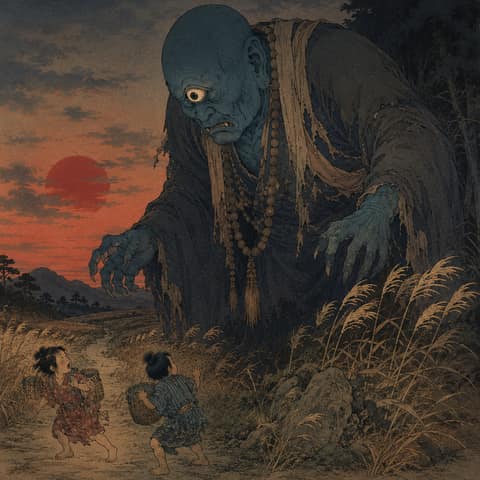
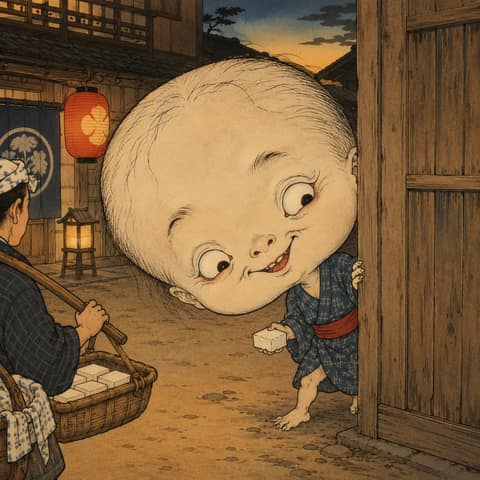
山野の怪 Across Japan (Edo, Aizu, Tanba, Bizen, etc.) A整理 based on Edo-period picture scrolls such as Hyakkai Zukan and Bakemono-zukushi depicting the figure known as Hitotsume-bō. It takes the form of a shaven-headed child monk, appearing suddenly in parlors, on bridges, slopes, and crossroads, then vanishing once satisfied with the onlooker’s reaction. Though often associated by inference with the one-eyed, one-legged monk of Mount Hiei, direct identification is avoided. Folklore links it to food by claiming it dislikes beans, and later images show it carrying tofu, yet it rarely intends harm to people or livestock. Its appearances vary by season and weather; in some regions, its single eye is said to glow dimly on rainy nights in late autumn. Names vary by locale, including “Hitotsu-managu” in Ōshū and the widespread “Hitotsume-kozō” and “Hitotsume-bō.”
名妖 
Ittan-Momen
ee-tahn moh-men
Ittan-Momen
Household Spirits Satsuma and Ōsumi Provinces (present-day Kagoshima Prefecture, Japan) Grounded in historical accounts, this version emphasizes its low flight from dusk into night and its tendency to wrap around people. It shows little animal intent, instead seeming to attack when borne by wind and terrain. It favors unseen field ridges and forest edges, moving during dim hours. Its cloth-like lightness and suppleness define its behavior—swift on strong winds, sluggish when the air is still.
伝説 
Issun-bōshi (One-Inch Boy)
EE-soon BOH-shee
Otogizoshi Version Issun-boshi
Half-Human Beings Settsu Province, Naniwa Bay (trad.) A figure based on Muromachi late-period Otogizoshi editions: born from the prayers of a childless elderly couple, he faces exclusion due to his tiny body and sets out on a determined journey. In the capital he serves a noble house and meets a princess. Even when swallowed by an oni, he exploits his size to outmaneuver it, then gains transformation of body and status through the Magic Mallet. Its core arc has four movements—passage from waterside to capital, negotiation with the otherworld (oni), acquisition of a treasure, marriage and advancement—and is often linked to the water-born appearance of the deity Sukunabikona. It also functions as a catchall for regional “little child” tales (Mamesuke, Gobutaro), and in Edo-period fiction and kyoka it appears as a yokai-like motif. While modern popular versions soften ethics into simple moralism, the prototype is a story of wit, border-crossing, and rites of passage.
名妖 
Ippon-Datara
EE-pohn dah-TAH-rah
Kii–Kumano Tradition Variant
Mountain & Wilderness Spirits Kii Province (Kumano) and surrounding mountain regions A portrayal of the Ippon-datara based on records from Kii and Kumano through Nara. It is said to be one-eyed and one-legged, but firsthand sightings are rare; in many regions a single large track left after snowfall is taken as proof of its presence. Its most notable trait is appearing on December 20, the “Hate-no-Hatsuka,” a day overlapping taboos of mountain deities and roads, effectively discouraging entry into the mountains. In its link to smithing, folklore explains the one-leg one-eye form as derived from the tatara blower treading the bellows with one foot and watching the furnace with one eye. In the Obagatōge lineage it is equated with the oni-god Inosasao, once a terror of the peak but sealed by a monk and released only once a year. In Kumano and Itsukushima it is said “only footprints appear, not the body,” feared yet seldom directly harmful. While stories of one-legged snow spirits (such as Yuki-nyūdō and Yukibō) have blended with it, this entry centers on the Kumano–Nara stream, emphasizing three points: the taboo day, the single track, and the blacksmith-origin theory.
名妖 
Hitome-ryō
HEE-toh-meh RYOH
Hitome-no-Ren of Tado (Tradition-Based)
Deities & Divine Spirits Ise Province (modern Tado, Kuwana City, Mie Prefecture) A wind divinity anchored to Mount Tado, once feared as a one-eyed dragon god. Ideas of “divine wind” recorded in Edo-period sources intersected with local weather watching, leading sailors on the Ise Bay route and coastal villages to revere it deeply. Later it blended in folk belief with the smithing deity Ame-no-Mahitotsu-no-Kami, and shrines preserved doorless architecture so the god’s passage would not be hindered. It governs storms and rain, is invoked for bringing and stopping rain and for protection from maritime disasters, yet tales also stress its aramitama, a wild and fearsome aspect. Iconography varies: sometimes a dragon body, sometimes a one-eyed deity, but details remain uncertain.
珍しい 
The Seven Companions
shee-chee-neen DOH-gyoh
Collected Tradition Edition (Shikoku Type)
Ghosts & Spirits Sanuki Province (Kagawa Prefecture) An amalgam of seven-in-a-row ghost tales found across Shikoku. Its core traits are threefold: seven figures advance in single file without a word, they appear at crossroads, on night roads, or at rainy dusk, and an encounter portends misfortune. Names, time of appearance, and garb vary by locale. In Sanuki they look human but are usually invisible, perceptible only through a ritual vantage—peering from beneath a cow’s hindquarters. A subtype limited to crossroads at the dead of night is called Shichi-nin Dōji, and certain once-busy junctions are remembered for their passage. The Shichi-nin Dōshi, who appear in rain wearing straw raincoats and hats, are linked to executed souls; a folk remedy to dispel the gloom after meeting them is to fan oneself with a winnowing basket. In Tokushima, seven child spirits accompanying the Headless Horse are said to have faded after Jizō statues were erected for their repose, reflecting a regional belief that memorial rites quell calamity. Though sometimes conflated with Shichi-nin Misaki, local names and functions differ; Shichi-nin Dōkō are identified by the outward feature of seven spirits marching in a line.
珍しい 
Seven-Fathom Wife
NAH-nah-hee-roh NYOH-boh
Composite Folklore Edition
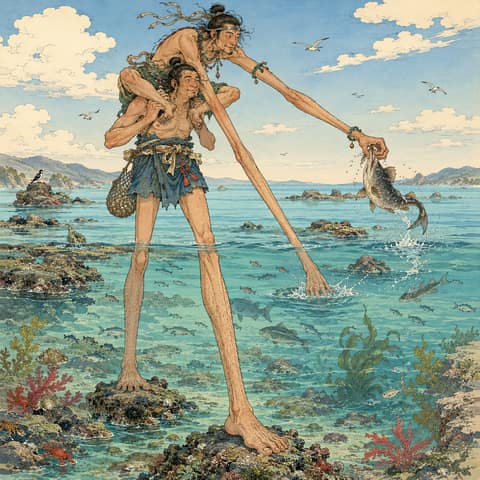
Half-Human Beings Izumo region, Oki Islands, and Hōki region (western Japan) Shichihiro Nyōbō is a giant-woman tale widely told in Izumo, Oki, and Hōki, appearing at boundary places such as mountain paths, riverbanks, and shores. Her form shifts by locale: in Ama on Oki she is a wild-haired mocker who hurls stones, along the Shimane coast a sea-wind woman flashing blackened teeth, in Yasugi a beggar beauty trailing a long robe, and in Hōki a pallid grinder-woman who sharpens while singing grain songs. Common threads are excessive length of body or neck and the way laughter, gestures, or song serve as lures. In banishment tales, sword wounds link to petrification, with odd stones, mounds, or ancient trees named as origins, and some lineages claim heirloom swords or tack from these encounters. The cycle is not pure horror; beauty, begging for alms, and the humble fear tied to the sound of grinding grain mingle together, encoding folk lessons about handling boundary anxieties: do not meet the gaze, do not answer voices, avoid night roads. It is comparable to early modern long-faced demon-maidens, yet Shichihiro Nyōbō is marked by ties to local sacred landscapes of mountains and coasts.
珍しい 
Seven-Step Viper
SHEE-chee-hoh-jah
Tradition-Faithful Seven-Step Viper
Animal Shapeshifters Yamashiro Province – Higashiyama, Kyoto Based on the account in Kabhiko, it is framed as a small dragon-serpent linked to a manor in Kyoto’s Higashiyama. It resembles a dragon yet is not deified, lurking beneath the soil and under stones, and manifests alongside ominous signs such as withering garden trees and cracked garden stones. Its defining trait is an extreme toxicity said to kill within moments of a bite, echoing ancient lore and fear of deadly vipers. Sightings are rare, with tales in which swarms of strange snakes appear first, and at the end the Seven-Step Viper reveals itself as the true body. It bears four legs, upright ears, and red scales edged in gold—colors read as both auspicious and baleful—and is often taken as a sign of a household’s decline or a disturbance in the land. In folk practice it is tied to neglected stones on mountain skirts and old gardens, and locals would pray before moving stones to avert calamity.
稀少 
Elder Shamisen
SHAH-mee-CHOH-loh
Sekien Zue Version
Animated Objects & Undead Edo period An interpretation grounded in the pictorial tradition of Toriyama Sekien’s Hyakki Tsurezure-bukuro. A shamisen that has gained a soul through long use is depicted like an aged monk, with robe-like garb and staff-like fittings. It plays on the proverb “a novice cannot leap straight to elder,” reinforcing the lesson that one must advance step by step in the arts, and it also cautions against mistreating tools. Similar images appear in Tsukioka Yoshitoshi’s prints, and later yokai encyclopedias introduce it as a representative tsukumogami. Lacking many named folktales, it spread chiefly through paintings and printed books.
珍しい 
Sanmai Tarō
SAHN-mai tah-ROH
Zammai Taro (Folkloric Type)
Ghosts & Spirits Toyama Prefecture; Ishikawa Prefecture A figure based on local lore in which death-spirits amassed at a burial ground (zammai) congeal and manifest as a single monster. In Toyama it appears as a humanlike specter that performs ominous signs, while in Ishikawa it is feared as a giant priest-like ogre. It is bound to human life, death, and the order of funerary practice, often marked by nighttime sounds and prescribed etiquette. Widely said to be unable to cross running water, a belief linked to folk practices of digging trenches around the zammai. Its form and stature are not fixed and vary with the density of gathered spirits. Folklore records note collections from the early Showa era, with regional spellings such as “Zammai” and “Zanmai.”
珍しい 
Three-Eyed, Eight-Faced
SAHN-meh YAH-zoo-rah
Tradition-Concordant Version: The Tosa Saramiyama Tale
Half-Human Beings Tosa Province (Tosayama Village, Takagawa and Saruyama; present-day Kochi) This version organizes the Saramiyama monster tale preserved around Takagawa in Tosayama Village, Tosa Province. Aside from the aberrant traits of three eyes and eight faces, its appearance is left undescribed, with only the enormity of its remains emphasized. Cast as a mountain demon that attacks passersby, the tale centers on pacifying the mountain and slaying it with fire under the leadership of a local notable. A ritual wand (gohei) is said to have endured amid the blaze, leaving traces in toponyms and legendary sites known as the Pacifying Stone and Pacifying Place. While linked by association to regional stories of multi-headed serpents, it is not directly identified with them, and the true nature of the three-eyed, eight-faced being remains unknown. The story conveys taboos against crossing mountain boundaries and the folk theme of calming with fire and purification, though details such as dates, identities, and specific rites are unclear in tradition.
珍しい 
Shiranui (Mysterious Sea Fires)
shee-rah-NOO-ee
Parent Fire Guide of Hassaku
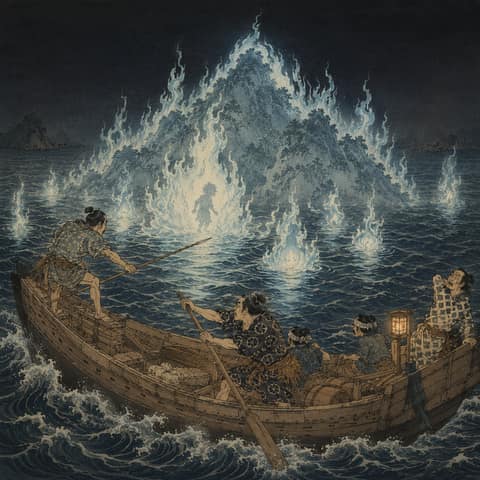
Aquatic Spirits Coasts of Yatsushiro Sea and Ariake Sea, Higo Province (Kyushu) Among the shiranui, the Parent Fire Guide of Hassaku is a high-ranking variant that appears before dawn on the first day of the eighth lunar month. A single reddish light, sometimes two, first kindles several kilometers offshore, called the parent fire by villagers. It then splits to either side birthing child lights, until hundreds and thousands form a single horizontal line. People say the line may stretch four to eight ri, invisible from the surf but clearly seen from headlands or heights a few ken above the tide wind. When the ebb runs deepest, about the hour around midnight, the flames breathe in unison, and distant watchers see a shimmer like dragon scales flickering beneath the waves. If chased the lights retreat, if neared they draw away. Launch a boat to seize them and they slip aside with the shadow of the current, allowing no approach while indicating only the heading home. Old records tell that when Emperor Keikō’s boat was wrapped in darkness, this parent fire rose far ahead and turned his prow toward shore. For this reason villagers revered the nameless fire, ceasing their nets and resting their oars at midnight on Hassaku, waiting for the line to unspool. The Parent Fire Guide is linked to the presence of a stormy dragon god, yet it shuns harming people and instead warns against arrogance and haste. Boats that grasp for quick profit wander bewildered along the line and must furl their sails, while those who heed the tide climb a shore pine to read the fire’s breathing and slip out quietly with the break in the lights. Offshore shoals then prove gentler than expected, and on the return the embers sway by the coastal shadow to welcome the boat. So pure is the parent fire that villagers murmur Thousand Lanterns or Dragon Lantern and press their hands in prayer, but if people call it coarsely and jeer, the line breaks at once and scatters into beach fog. Wind does not fan it larger, it waxes and wanes only by the pulse of the tide. Thus from capes and mounds it appears a tidy band, while from the wave edge it cannot be seen. They say the Parent Fire Guide can even shift the angle of shrine shimenawa by the sea and the hue of lighthouse flames, and when the sacred rope bows slightly seaward at night, it is a sign that far offshore the lights are being born. Elders who know this tell young crews, Today the tide falls and the fire will rise, refrain from sailing. Unlike man-made flames it leaves no ash or smoke. Only at one hour after dawn do shells on the flats shine pale rose, and dew on reed tips holds the fire’s afterglow. On such mornings villagers cast salt upon the beach and give thanks for the lives guided by the fire. The Parent Fire Guide opens the way to those who know awe and courtesy, withdraws from the overproud, and quietly redraws the boundary between sea and humankind.
稀少 
Furaku-Furaku (The Dangling Lantern Spirit)
boo-RAH-boo-RAH
Sekien Plate Standard
Animated Objects & Undead Japanese folklore An arrangement of Furafurabu based on the depiction in Toriyama Sekien’s Hyakki Tsurezure Bukuro. The lantern is tied to bamboo, its torn paper resembling a mouth, tilting as it looms over the road. The scene evokes rice field ridges and scarecrows, and while the caption mentions “the lantern fire of Yamada,” it also muses that it might be foxfire. This yields competing readings—either a fox in disguise or a transformed implement—but since the volume files it among tool-spirits, understanding it as a tsukumogami is appropriate. The name varies between “Fufuraku” on the image and “Furakaku” in the catalog, though “Furafurabu” is generally accepted. No fixed local legends or concrete curse tales survive; it is received as a subtype of the generic lantern yōkai, a visual fright that startles travelers at night.
名妖 
Ushi-no-koku Mairi (Cursing Rite at the Hour of the Ox)
OO-shee-noh-KOH-koo MY-ree
Ritual Icon of the Cursing Hour
Ghosts & Spirits Kyoto Prefecture (Kifune shrine cult), and areas around shrines across Japan A codified image of the classic Ushi-no-koku mairi centered on Edo-period etiquette. Clad in white burial garb with disheveled long hair, the practitioner inverts an iron trivet as a crown with three candles lit, hangs a mirror on the chest, and moves toward the shrine on single-toothed geta to muffle steps. At the sacred tree, a doll bearing the target’s name is pinned and a five-inch nail is hammered in each night. The witching hour is strictly the third quarter of the Ox Hour, with fulfillment said to come on the seventh night. If witnessed, the rite loses its power, so silence and care to leave no tracks are prescribed. In art, a black ox sometimes accompanies the figure; lore holds that straddling it on the final night brings success, while shrinking back means failure. Straw-doll usage became common in the early modern era, with roots in ancient scapegoat effigy piercings and Onmyodo katashiro rites. Folklore often stops short of asserting curses as real, instead telling that breaking taboos or exposure nullifies the act.
伝説 
Ryōmen Sukuna
RYOH-men SKOO-nah
Hida's Two-Faced Sukuna: Chronicle and Local Tradition
Demons & Giants Hida Province (northern Gifu Prefecture) The original text of the Nihon Shoki etches Sukuna's body in remarkable concreteness: "one body with two faces, each turned away from the other; their crowns joined so that there is no nape; limbs on either side; knees, yet no hollows behind them and no heels." One torso, two faces set back to front, no nape where the heads meet, and limbs on each side—read plainly, four hands and four feet alike, an eight-limbed marvel. Yet most of the images that survive locally are carved as "two faces, four arms"—two faces, four arms, two legs. That the Shinsen Mino-shi records the founder of Nichiryūbu-ji as a "two-faced, four-armed stranger" belongs to the same strain, and the discrepancy between the textual description (eight limbs) and the iconographic tradition (four arms, two legs) is not to be overlooked in reading the Sukuna image. It was Enkū who raised that iconography into art. The seated Ryōmen Sukuna at Senkō-ji sets its two faces side by side rather than front and back, one wearing wrath, the other compassion. This form, salvation glimmering within fury, resonates with the belief that Sukuna was an incarnation of Guze or Senju Kannon. His historical reality demands caution. Naniwa no Neko Takefurukuma, named as his vanquisher, properly belongs to the section on Empress Jingū, so his placement in the Nintoku chronicle is itself anachronistic. That a Kannon-incarnation tale should attach to Nintoku's reign—supposedly before Buddhism's arrival—is likewise a later construction, and the view that the whole account is a fabrication of the editorial stage carries weight (Nagafuji Yasushi). Nagafuji reads Sukuna as the original deity of Mt. Kurai, a hero hidden away by the central histories, while Hōga Toshio traces him genealogically to the ancestor of the Hida no Miyatsuko. As for the monstrous body, Haga Susumu reads it as the misperceived and exaggerated gear—shin guards and the like—of Hida's mountain folk. The name, too, invites many theories. From the sound "Sukuna," some traditions argue a tie to Sukunabikona, and Ōbayashi Taryō offered a comparative-mythology framework treating Sukunabikona as Ōkuninushi's "second self." The motif of a god who appears in pairs chimes with the two-faced form of Sukuna. Some also overlay the image of the uncanny Sukuna onto the fact that ancient Hida was a singular "land of craft" that sent its artisans (Hida no Takumi) to the center, though there is no direct documentary link between the two. What is certain is that a single name has been handed down in opposite directions by center and province, and that this very split is what gives the being called Ryōmen Sukuna its shape.
稀少 
Kyūsenbō
kyū-sen-bō
The Grand Chief Who Commands the Kappa of Kyushu — Kyūsenbō
Water Spirits Kuma River, Yatsushiro, Kumamoto → Chikugo River, Kurume, Fukuoka (the chief of the kappa) This version looks closely at Kyūsenbō’s singular standing — less a single yokai than the chief of the whole kappa kind. The kappa is by nature a yokai that changes its name from place to place, told of scattered across the rivers of each region. Among them, Kyūsenbō is drawn as the “head” who governs nine thousand kappa across Kyushu with a single hand. This is unlike the fox’s tenko — a vertical ladder up which a single fox climbs through cultivation. The seat Kyūsenbō holds is a horizontal command over many kappa: in plain terms, the authority of a general over an army. That authority is tested in the contest with Katō Kiyomasa. The single battle handed down by the Honchō Zokugenshi reflects at once the kappa’s strength and its weakness. With nine thousand familiars in hand, he is yet helplessly defeated the moment he faces the monkey the kappa has dreaded since of old. The outcome is settled not by force of arms but by the logic of the natural enemy — and in this the kappa’s true nature is laid plainly bare. What comes after defeat is his turn toward the water-god. The Kyūsenbō who moved to the Chikugo River changed from a man-attacking demon into a guardian against flood. His bond of serving Suitengū at Kurume shows the kappa to be a being that bears both meanings at once — the peril of water and the bounty of water. The monument at the Place of the Kappa’s Arrival in Yatsushiro, the kappa masks of Suitengū, and the kappa clan Hino Ashihei founded in the Shōwa era — the tale of Kyūsenbō lives on still, from an Edo miscellany to the town-building of today, as a thread of memory the people of Kyushu have spun together with the river.
伝説 
Nine-Tailed Fox
Kyūbi no Kitsune
White-Faced, Golden-Furred Nine-Tailed Fox
Animal Shapeshifters Throughout Japan (a collective name for Inari foxes and bewitching foxes) The name “white-faced, golden-furred nine-tailed fox” means a fox with a white face, golden fur, and nine tails. It traces back to a Chinese tradition that identified Daji—the consort who beguiled King Zhou of the Shang—as a white-faced, golden-furred nine-tailed fox; in Japan this image became fixed as the form revealed by Tamamo-no-Mae, the spirit-fox who menaced the Heian court, when her true nature came to light. Edo-period popular fiction such as the Ehon Sangoku Yōfuden (Illustrated Tale of the Bewitching Woman of Three Kingdoms) portrays this fox as a great spirit-fox that piled up evil deeds across the three lands of India, China, and Japan. The tale of Tamamo-no-Mae is said to have taken shape by the Muromachi period, surviving in the otogizōshi Tamamo no Sōshi and the noh play Sesshōseki. The plot runs thus. At the side of the retired Emperor Toba was a woman named Tamamo-no-Mae, of rare beauty and deep learning, who drew all his affection to herself. When the emperor fell ill from an unknown cause, the onmyōji Abe no Yasunari (modeled on the historical Abe no Yasuchika) divined the matter and saw that the source of the illness was Tamamo-no-Mae. Her true nature exposed, she changed into the white-faced, golden-furred nine-tailed fox and fled to the Nasu Plain in Shimotsuke Province, but she was pursued and struck down by the forces of Kazusa-no-suke and Miura-no-suke. The ending in which the slain fox turns directly into the poison-spewing “killing stone” (Sesshōseki) is in fact absent from the older forms of the story; it is said to have been added for the first time in the noh play Sesshōseki. The Sesshōseki of Nasu was long feared as a poison stone that killed people and beasts who drew near, until in 1385 the priest Gennō shattered it with his ritual power, the broken pieces scattering far and wide. In March 2022, the Nasu killing stone was actually found to have split in two, drawing fresh attention alongside the legend. Tamamo-no-Mae was depicted again and again in painting as well. In 1833 Utagawa Kuniyoshi portrayed her facing an onmyōji, leaving a composition in which the nine-tailed fox’s true form is reflected in the mirror the man holds. Showing the true nature mirrored in a glass or on water was a device that let a single picture hold both faces at once—the peerless beauty and the dreadful spirit-fox. Even among nine-tailed foxes, and in stark contrast to the helpful face of Inari’s white fox, this white-faced, golden-furred nine-tailed fox has been handed down as the most uncanny and fearsome form, one that threatens royal authority itself. While natural-history works such as the Wakan Sansai Zue (Illustrated Sino-Japanese Encyclopedia) recorded the habits and spiritual power of the fox, the tale of Tamamo-no-Mae—through noh, popular fiction, and ukiyo-e—engraved deep into popular memory the image of a spirit-fox that joins intelligence and beauty with the perilous power to lead people astray.
神格 
Kuzuryū (Nine-Headed Dragon)
koo-zoo-RYOO
Togakushi Kuzuryu Ōgami (Great Nine-Headed Dragon of Togakushi)
Deities & Divine Spirits Togakushi in Shinano Province; Kuzuryū River basin in Echizen Province The Kuzuryu Ōgami of Mount Togakushi is venerated as a water deity pacified through subjugation and transformed into a benevolent god. Medieval accounts center on a tale of pacification and sanctification by a figure known as Gakumon, after which the deity became revered as Kuzuryu Gongen, a principal icon for rainmaking, integrated into the rites of shrine attendants and Shugendō practitioners. It is said to favor pears as offerings, and from the early modern period was believed to cure toothache and bless marriages. Its representations vary by era—divine statue, serpent form, or dragon form—and it is linked to rock grottoes, springs, and ravines. As a guardian of local water sources and a symbol of agricultural stability, its tempestuous aspects are understood to be soothed through requiem rites and festivals. Even without mixing with Echizen traditions of the Black and White Dragons, it shares the essential functions of a water god, governing rain, river levels, and community livelihood.
稀少 
Nyūbachibō
nyoo-bah-chee-BOH
Emaki Seigan Iconography Version
Household Spirits Japanese folklore Taking as precedent the disc-like apparition found in Muromachi-period Night Parade of One Hundred Demons scrolls, the Edo artist Toriyama Sekien shaped it in Hyakki Tsurezure Bukuro as a human figure bearing a bronze plate. Sekien frequently depicted utensils turned yokai, and Nyūchibō is one of these, yet the textual notes are brief and its conduct remains undefined. Amid overlapping names and forms—nao-bachi, dōbachi, and surigane used in temple rites and theater orchestration—later commentators supplied the trait of startling people by sounding. No specific regional lore is attached; it is recognized iconographically within the broader class of utensil-spirits. Its qualities today largely reflect fragments of folk materials and modern reinterpretations in yokai handbooks.
名妖 
Futakuchi-onna (Two-Mouthed Woman)
foo-tah-KOO-chee OHN-nah
Futakuchi-onna
Half-Human Beings Edo period Aligned with Edo-period strange tales, this type’s true hunger is amplified by a mouth on the back of the head. The front mouth feigns daintiness, while the rear mouth manipulates the hair to pull dishes close. It secretly devours nearby food, sowing domestic discord and appearing in stories about household budgets and shame. In art, a fanged mouth peeks from between coiffed hair. Said to be keen to sounds and smells, it hides its nature deftly in public.
稀少 
Five-Limbed Face
goh-tai-MEN
Iconographic Tradition Version
Mountain & Wilderness Spirits Japanese folklore A version based on the recurring grotesque motif in Edo-period yokai picture scrolls: a head with limbs attached directly to it. Many sources lack captions, and names vary, such as “Gotaimen” and “People of the Lower Country.” The figure often stands bowlegged and sidesteps, heightening visual dissonance and comic effect. Folklorists debate whether such visual oddities caricature social decorum and misalignment, yet no direct oral tradition is recorded. This version prioritizes the repetition of the image and the spread of names, avoids attaching behavior or powers, and limits the setting to generic outdoor scenes. Later studies and commentaries are consulted, but attributes beyond primary sources are not added.
Showing 21 - 40 of 404 yokai