YOKAI.JP

Yokai Encyclopedia

Encyclopedia of Japanese Yokai

592 Yokai|14 Category|Page 25 of 25
Localization in Progress - More content available in Japanese version
View Japanese
Sort by: NameAscending
  • 天穂日命

    天穂日命

    Divine

    あめのほひのみこと

    出雲へ傾いた天つ穂霊・天穂日命

    神霊・神格Shimane

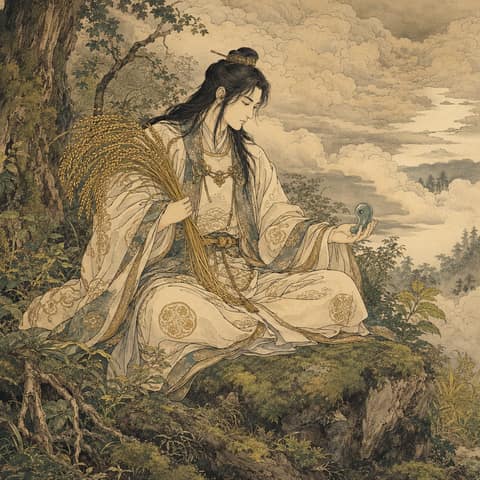
    Ame-no-hohi carries an ambiguity of belonging from the very moment he was born through the 'ukehi' pledge. Ameno-hohi-no-Mikoto emerged from the breath of Susanoo-no-Mikoto, but because the source material was Amaterasu Omikami's jewel, he is considered a child of Amaterasu. This structure anticipates his entire life. The one who sets him in motion and the one to whom he belongs are different. The place where he receives his orders and the place his heart leans toward are different. Ame-no-hohi, despite being born into the lineage of heavenly deities, is a deity who deeply embeds himself into the earthly Izumo. The character of the "rice ear spirit" residing in his divine name is also crucial. Kokugakuin University annotations interpret 'Ho' as rice ear and 'Hi' as spirit, explaining Ame-no-hohi as the heavenly spirit of rice ears. Rice ears are not completed solely in heaven. They must descend to the paddy fields, endure the seasons, and ripen through the moisture of the land and human hands. It is no mere coincidence that Ame-no-hohi is dispatched to Ashihara-no-Nakatsukuni. He is the rice ear meant to transfer the heavenly order to the earth, while simultaneously being a spirit that cannot function unless it touches the earthly soil. During the pacification of Ashihara-no-Nakatsukuni, this character manifests dangerously. The myriad deities and Omoikane nominate Ame-no-hohi as the messenger to pacify the unruly earthly deities. However, he curries favor with Okuninushi and does not report back for three years. Reading this alone, Ame-no-hohi appears to be a deity who abandoned his mission. Yet, in the deeper layers of the myth, the very fact that he was absorbed by the earth is significant. When heaven's command reaches the earth, it does not achieve fruition exactly as commanded; it is transformed by the local deities, human rituals, and the memories of Izumo. Ame-no-hohi embodies this transformation physically. This single point of "not reporting back" elevates Ame-no-hohi from a mere agricultural deity to a pivotal juncture in the story. Reporting back (fukuso) is the words that return what was seen on earth to Takamagahara, closing the loop of command. Because he does not do this, heaven's command is suspended in midair, necessitating a new messenger. Silence is not a void; it is a rift created between heaven and earth. The deities of Izumo enter this rift, eventually opening the stage for the massive negotiation known as Kuni-yuzuri (the transfer of the land). The tradition of the "Izumo-no-Kuni-no-Miyatsuko-no-Kamuyogoto" illuminates this deity in a different light. According to Kokugakuin University annotations, the Kamuyogoto narrates that Ame-no-hohi went to observe the state of the earthly realm, and his son Ame-no-hinadori, along with Futsunushi, pacified the unruly deities. Here, silence is not disloyalty; it is the process of measuring the earth as the ancestral deity of the Izumo governors and establishing ritual legitimacy. Ame-no-hohi's "flattery" is read as political deviation in central mythology, but as an approach to pacify deities in Izumo's rituals. The same act transforms into either betrayal or mediation depending on the observer's position. This deity's power is not the power to submit opponents with a sword. He enters the opponent's side, delays his return, and postpones his words of report. In modern terms, Ame-no-hohi is a deity of the middle ground. From the perspective of those issuing commands, he is difficult to handle; from the perspective of the land, he is easy to accept. That is precisely why stronger messengers and war gods must appear after him. Ame-no-hohi's failure pushes the Kuni-yuzuri myth to its next stage. The sensation of praying to him is closer to re-establishing relationships than seeking victory or punishment. Leaning toward Izumo was a betrayal of orders, but simultaneously the result of listening too closely to earthly voices. Ame-no-hohi stands on the boundary between understanding the opponent and losing his original mission. Therefore, his protection is precarious. He softens people, but also makes them easily swayed. When dealing with the ties of family, community, or organizations, this deity does not say, "Return and report immediately." He prompts one to first enter the land, know the opponent's deities, and then question what words should be returned. For those who pray, Ame-no-hohi is not a deity who grants quick success. Rather, between conflicting worlds, he is a deity who asks how far one should empathize with the other and from where one should return to their original mission. Amidst negotiations and the complex ties of lineage, community, and organization, when simple righteousness alone cannot move things forward, the story of Ame-no-hohi offers profound assistance. Just as rice ears only ripen once they take root in the soil, the protection of this deity also begins with the resolve to set foot on the opponent's land.

  • 尻目

    尻目

    Rare

    しりめ

    夜道で光る尻の一眼・尻目

    人妖・半人半妖Kyoto

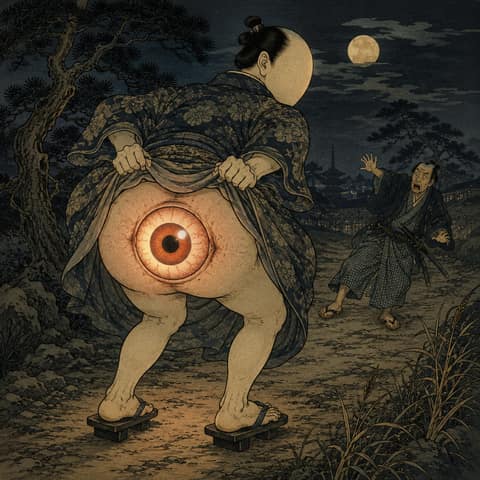
    Read as a glowing single eye on a buttock on a night road, the Shirime touches upon the core of yokai expression despite being an extremely short tale. Appearance, disrobing, exposure, luminescence, and flight. If one extracts only the plot, it ends in a few lines. Yet within those few lines, the fundamental human recognitions of looking at another person, looking at a face, and looking at eyes are sequentially betrayed. The scene where a samurai is hailed on a night road to Kyoto and shown a strong light from a single eye on a buttock is not a tale of combat, but a ghost story that uses the gaze itself as a weapon. The first trick is the lack of a face. Yokai of the Noppera-bo lineage erase the face, the center of humanity. Without a face, one cannot read the other's emotions, the intent behind their words, or the presence of hostility. The Shirime builds upon this unease of facelessness and shifts the eye to yet another location. This is why it is explained as a variant of the Noppera-bo: the eyes that should be on the face are lost and placed on the buttocks, the most defenseless and laughter-inducing part of the body. Here, terror and comedy become inseparable. The second trick is the destruction of etiquette. Being called out to by a stranger on a dark road is unsettling enough, but when the other party suddenly strips off their kimono, the scene drops from the tension of the warrior class to an obscene farce. However, in the very next instant, that farce reverses into the bizarre through the glowing eye. The Shirime is not interesting because it is vulgar. It is terrifying because it transforms a vulgar gesture into an "eye" that stares back at the human. Not only are you shown something you shouldn't see, but you are stared back at from that very spot. This reversal constitutes the Shirime's decisive strike. The third trick is its brevity. The Shirime has almost no birth tales, no extermination tales, and no long curses. It is not weak because of this; rather, it is perfectly suited for a single illustration. Small yokai preserved in picture scroll materials are remembered not for the depth of their narrative, but for their visual iconography, where meaning arises the moment they are seen. The Shirime is typical of this; before hearing an explanation, the mere composition of an eye on a buttock captures the reader. This yokai clearly demonstrates that yokai iconography sometimes travels faster than the narrative. The setting of the night road heading to Kyoto also supports the Shirime's function. The entrances and crossroads of a city are boundaries where the known and the unknown, the order of day and the anxiety of night switch places. When called out to there, a person first searches for the other's face. The very act of searching for the face becomes the Shirime's trap. The moment one understands that there is no face and no gaze, the eye returns from an entirely different place. Therefore, while being a yokai of Kyoto, the Shirime is remembered not for the historical pedigree of famous places, but as a sudden ambush in the middle of the road. The reason the Shirime became well-known again in yokai introductions after Mizuki Shigeru is also because the speed of its imagery aligns well with modern media. Yokai encyclopedias like Mizuki Shigeru's "Illustrated Encyclopedia of Japanese Yokai" transposed fragments of regional folklore and classical picture scrolls into a format where modern readers can search, compare, and remember them as pictures. The Shirime carries no moral lesson, speaks no ethics, and survives solely through a single bizarre bodily arrangement. Precisely because of this, it is easily transplanted into overseas yokai introductions and gaming reception. Fearing the Shirime does not mean fearing that something will attack. It means fearing that the arrangement of the world will instantly become wrong. A face has no face, a buttock has an eye, and that eye glows. The samurai flees not because he is a coward, but because the opponent he should cut down with his sword is not there. The Shirime appears not as an enemy, but as an accident of perception. In the darkness of the night road, the order of the body is turned inside out. Just through that comical and cruel instant, the Shirime is sufficiently a yokai. In that sense, the Shirime does not end as a vulgar whimsical fantasy. It is a yokai that bends human confidence in seeing the world correctly at the shortest possible distance. The speed of that distortion is precisely the power of this small yokai.

  • 山地乳

    山地乳

    Uncommon

    やまちち

    奥州山中に寝息を吸う獣・山地乳

    動物変化奥州 (現·東北地方、具体地未詳)

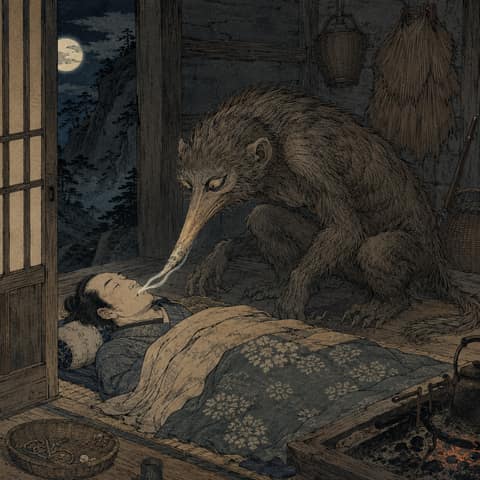
    When reading the Yamachichi, the most important thing is not to overinflate this yokai as a "well-known local legend." The core material is the "Ehon Hyaku Monogatari", which tells of its transformation from an old bat to a Nobusuma and then to a Yamachichi, alongside the strange effect of sucking sleeping breath. Precisely because it is a yokai with scarce materials, accurately placing its appearance, actions, and conditions makes its outline clearer. The appearance of the Yamachichi is a mountain beast resembling a monkey with a pointed snout. It does not shapeshift into a human like a fox or a tanuki, nor does it lure people with human speech like a Yama-uba. It remains a beast, drawing near to the breathing of a sleeping human. Breathing is the entering and exiting of life, and sleeping breath is the sound of defenseless life. Because the Yamachichi sucks that sound, its terror lies not in claws or fangs, but in the sensation of life being drained in the vulnerable gap of sleep. However, the tale of the Yamachichi is not a simple blood or spirit-sucking story. If someone is watching, the person whose breath is sucked gains a long life. If no one watches, they die the next day. This condition is mysterious; the eyes of a third party determine whether the anomaly harms or saves the human. The structure where the monster's power is reversed by being seen is also the charm of Hyaku Monogatari (Hundred Tales) style storytelling. The triangular relationship of the person in the bedroom, the sleeper, and the watcher establishes the small narrative of the Yamachichi. Its location is said to be Oshu, but Oshu here is a broad regional name and should not be shrunk down to a single modern point. Using Mutsu Province as a receptacle for the ancient place name is to indicate the scope of Oshu found in literature, not to assert it as solely a yokai of Fukushima Prefecture. Rather than a precise point on a map, the Yamachichi is a yokai spoken of within the sense of distance of "the mountains of Tohoku." If connections are to be drawn, it is closest to the Nobusuma and the Satori. The Nobusuma appears in the text as the preceding stage of the Yamachichi, supporting the Yamachichi's position as an aged form. The Satori shares an interpretive intersection, as the text states, "Deep in the mountains, this is called satori-kai," but the mind-reading Satori and the breath-sucking Yamachichi are not identical. By lining them up while maintaining this difference, we can see the subtle divergence concerning breathing, thinking, and sleeping among the beast yokai of the mountains and fields.

  • 布刀玉命

    布刀玉命

    Divine

    ふとだまのみこと

    岩戸に御幣を取り持つ祭具神・布刀玉命

    神霊・神格ChibaTokushima

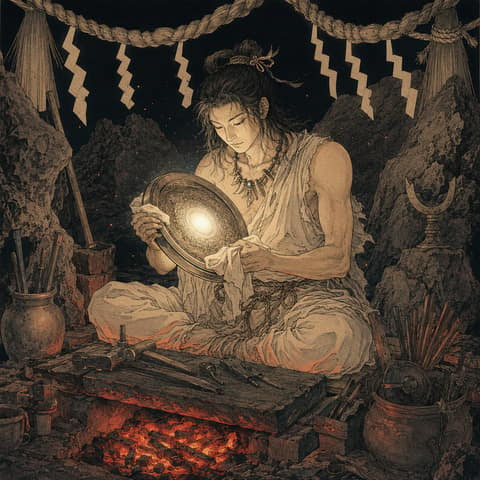
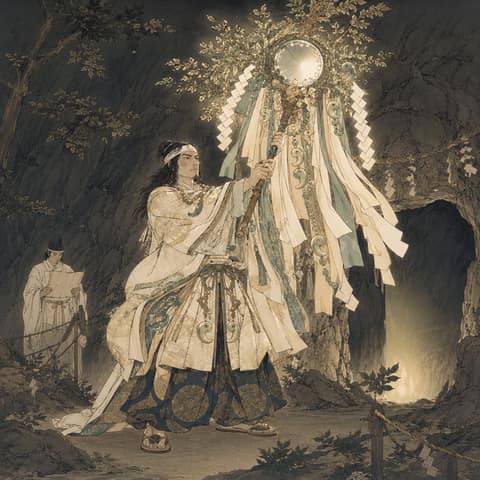
    Futodama, holding the *gohei* (ritual wand) before the Heavenly Rock Cave, is the deity in myth who transforms the objects prepared by the gods into the active power of ritual. When Amaterasu-Omikami hides within the cave, the world sinks into darkness. Following Omoikane's plan, the gods make the long-singing birds cry out, gather hard iron, forge a mirror, craft curved jewels, perform divination with deer bone and *hahaka* wood, and hang jewels, a mirror, and cloth upon a *Sasaki* tree. At the conclusion of these preparations, the *Kojiki* (Ama-no-Iwato II) records: Futodama, holding the grand *gohei*. In this moment, Futodama transitions the completed ritual tools into active divine service. The power of this deity lies in the very act of "holding." The *gohei* is not merely paper or cloth; it is a marker directed toward the divine, a pathway for prayer, and a medium to purify the space. When Futodama takes it in his hands, the jewels, mirror, cloth, and divination are no longer disparate materials, but a singular, unified ritual offered to Amaterasu. If Ame-no-Koyane's prayers form the center of voice, Futodama's *gohei* is the center of physical matter. Voice alone lacks form, and objects alone remain silent. Only when both are present is a space established before the cave to welcome the deity. Kokugakuin University's commentary highlights how the myth is densely layered with elements of ancient ritual. The mirror reflects Amaterasu, the jewels bear sacred adornment and spiritual power, the cloth is an offering, and the oracle bones seek divine will. Within this material worship, Futodama stands at the juncture where ordinary objects are transformed into "sacred offerings." Therefore, viewing him merely as a keeper of props is entirely insufficient. Futodama is the deity who presides over the exact moment when objects enter the sacred order. During the Descent of the Heavenly Grandson, this role is brought down to earth. In the *Kojiki* (Tenson Korin II), Futodama descends as one of the Five Attendant Deities and is named the ancestor of the Inbe clan. The Five Attendant Deities each carry functions such as ritual, dance, mirror-making, and jewel-crafting, demonstrating that the heavenly grandson's rule over the earth relies on more than just military might or lineage. It requires the techniques of worship, creation, and offering. Futodama is the deity who connects heavenly ritual tools to earthly vocations. The official deity description of Awa Shrine makes this connection remarkably concrete. The Upper Shrine's main deity, Ame-no-Futodama, served closely by Amaterasu and is revered as the ancestral god of the Inbe clan. The shrine further explains that because he led the Inbe deities in overseeing the creation of mirrors, jewels, textiles, weapons, and shrine construction, he is worshipped as the founding deity of all industries in Japan. Here, the hands that held the *gohei* before the cave have expanded to encompass crafts, architecture, textiles, and weaponry. The history of Oasahiko Shrine in Awa paints him as the "ancestral god who founds industry" in that region. During Emperor Jimmu's reign, his grandson Ame-no-Tomino-Mikoto is said to have arrived in Awa Province to sow hemp and paper mulberry seeds, producing cloth to establish the region's industry, while enshrining Futodama as a guardian deity. Materials like hemp, paper mulberry, and cloth resonate deeply with Futodama's nature as a deity of ritual implements. The cloth draped before the gods is the same cloth that pioneers new lands and builds industries. Here, we witness an ancient mindset where ritual and production were inseparable. Awa Shrine's traditions continue this narrative, stating that Ame-no-Tomino-Mikoto later led a branch of the Inbe clan from Awa across the sea to the Boso Peninsula, planting hemp and grain, and enshrining Futodama and his consort at Mera Beach. This migration story connects Futodama's divinity to tales of movement and pioneering. The deity who holds ritual tools appears not only before the gods but also at the sites where land is cleared, crops are planted, and shrines are built. Treating physical objects with sacred respect was, in itself, the act of laying the foundation for human life. Read in a modern context, Futodama may be a "behind-the-scenes" deity, but he is by no means a minor one. The preparation of ceremonies, the setting of stages, the management of sacred tools, architecture, paper-making, textiles, metalwork, crafting tools, and the passing down of family trades—to support the voices and dances on stage, one needs the technical skill to gather materials, arrange procedures, and maintain the integrity of the space. Futodama grants divine grace to these very skills. When praying, creating, or inheriting, one must never treat the materials at hand with disrespect. This quiet, steadfast ethic is the true power of Futodama.

  • 湍津姫神

    湍津姫神

    Divine

    たぎつひめのかみ

    大島に鎮まる海中道の女神・湍津姫神

    神霊・神格Fukuoka

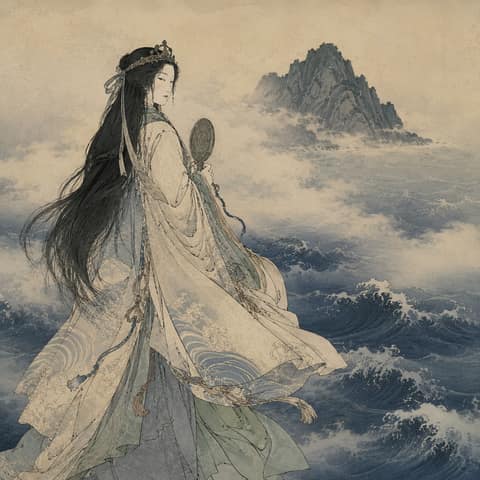
    To understand Tagitsuhime, who resides on Oshima, one must first look at Nakatsu-miya not merely as the "middle of the three shrines," but as a sanctuary situated mid-voyage on the sea. Munakata Taisha links Okitsu-miya on Okinoshima, Nakatsu-miya on Oshima, and Hetsu-miya in Tajima as three shrines, collectively calling them Munakata Taisha. Its official history designates the three goddesses as the daughters of Amaterasu Omikami, layering the memories of state rituals and foreign exchange over the national treasures excavated from Okinoshima. Tagitsuhime of Nakatsu-miya stands at the center of this immense religious sphere, receiving and passing along both the awe of the open ocean and the prayers of the mainland. Today's Nakatsu-miya is treated as Munakata Taisha Nakatsu-miya even in official World Heritage documents. It is situated at 1811 Oshima, Munakata City, Fukuoka Prefecture, and the official Munakata Taisha webpage lists its enshrined deity as Tagitsuhime-no-Kami. Here, Tagitsuhime is not an abstract water deity, but a goddess with a tangible island, shrine buildings, approach paths, and festivals. Oshima is an inhabited island reached by ferry from the mainland, unlike Okinoshima, which generally refuses human entry. Yet simultaneously, Oshima is an island that looks out toward Okinoshima, houses the Okitsu-miya Yohaisho (worship hall for praying from afar), and transmits the taboos of the sea to human settlements. Tagitsuhime's "middle" exists between an accessible sacred site and an inaccessible one. Tracing the pronunciation of her divine name sharpens the contours of this goddess even further. "Tagitsu" encompasses the state of water rushing violently and boiling up. Rather than a deity of a calm lake surface, Tagitsuhime is a deity of places where tides shift, currents change, and a ship's judgment is tested. Guarding a voyage does not simply mean calming the waves. Sometimes it means allowing progress, sometimes ordering a wait, and sometimes forcing a turn back. Tagitsuhime's protection works not as a power to make the sea obey humans, but as a power to return humans to the sea's rhythm. Mount Mitake, behind Nakatsu-miya, is indispensable for considering Tagitsuhime's Aramitama (rough spirit). The official Munakata Taisha webpage notes that Mitake Shrine is located at the highest point on Oshima, enshrining Amaterasu Omikami and the Aramitama of Tagitsuhime, while noting that according to Japanese mythology, it is said to be the site of Tagitsuhime's descent. If Nakatsu-miya at the foot is the shrine that greets worshippers, Mitake at the summit is where the island itself received the deity. The shadow of the mountain visible from the sea, and the sea route viewed from the mountain—these intersecting gazes forge Tagitsuhime's divinity. The history of rituals shown in official World Heritage documents corroborates this duality. It is noted that by the late seventh century, open-air rituals sharing commonalities with Okinoshima rituals were conducted at the Mitakesan ritual site on Oshima and the Shimotakamiya ritual site on the mainland. Furthermore, the *Kojiki* and *Nihon Shoki* from the early eighth century record that the Munakata clan worshipped the three Munakata goddesses across the three shrines. Here, the structure of the three shrines connected by the sea was established. Tagitsuhime bears the intermediate memory within this, linking the ancient rituals of Okinoshima to the shrine-based rituals on the mainland. Discrepancies with classical texts are, in fact, an entryway to reading Tagitsuhime more richly. In the oath-taking section of the *Kojiki*, the name Takitsuhime-no-Mikoto appears, and she is recorded as being worshipped as one of the three Munakata goddesses. On the other hand, in the present Munakata Taisha, Tagitsuhime is the deity of Nakatsu-miya. Reducing this difference to "which is correct" loses the depth of the Munakata faith. The divine names in the classics, the three-shrine rituals preserved by priestly families, and the archaeological landscapes organized as a World Heritage site represent different historical layers. Tagitsuhime is also a deity who traverses these layers. Placing the maritime rituals overseen by the Munakata clan in the background, Tagitsuhime ceases to be merely the "second of the three goddesses." Official World Heritage documents state that the ancient rituals on Okinoshima were carried out by people of the Munakata region who possessed advanced navigational skills and engaged in foreign exchange. The sea was a trade route, a danger zone, a path for diplomacy, and a place to pray to the gods. Nakatsu-miya on Oshima is where all of these are concentrated into a single point. Here, travelers simultaneously feel the awe of heading out to the open sea and the relief of returning to the mainland. If reading this figure in an encyclopedia, Tagitsuhime is the "guardian deity of the flow." Flow is not just water currents. From myth to ritual, from Okinoshima to Oshima, from taboo to worship, from the prayers of the ancient state to modern traffic safety, the faith has flowed down to the present, changing its form. Tagitsuhime reconnects the things that threaten to sever along the way. Calming her Aramitama on the mountain peak, looking up to her Nigimitama (gentle spirit) at Nakatsu-miya, and gazing toward Okinoshima beyond the remote worship hall. Her divine authority manifests itself more as the shifting tides signaling the time to cross, rather than through flashy miracles.

  • 瀬織津姫

    瀬織津姫

    Divine

    せおりつひめ

    速川の瀬に立つ祓戸の水神・瀬織津姫

    神霊・神格Shiga

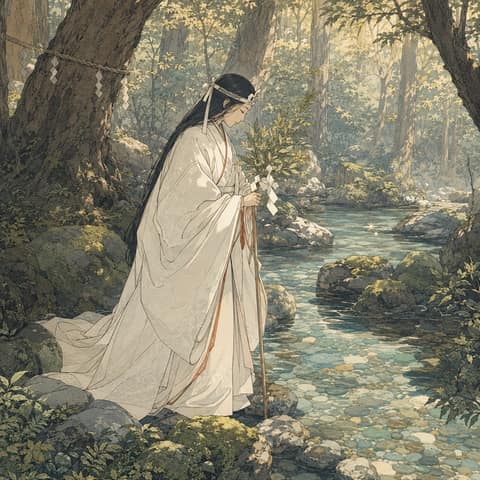
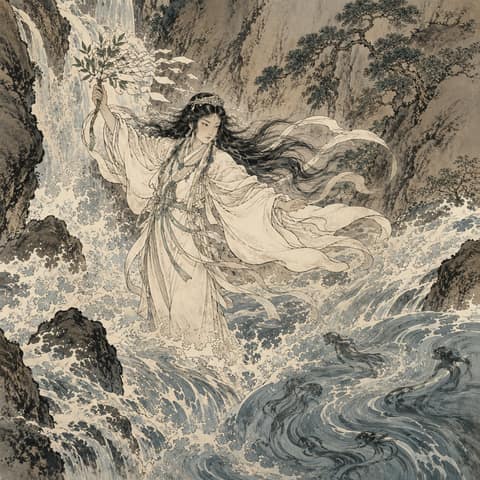
    The key to reading Seoritsuhime lies in placing purification not on "making white" but on "making move." The sins and impurities in the Oharai-no-Kotoba are not things merely to be reflected upon in the mind. They are transferred onto purification objects, named by the incantation, and handed over to the water falling from the mountains. Seoritsuhime is their first carrier. The place she resides is not a calm lake surface, but the rapids of a swift river. In places where water hurries, where currents swirl, where footing becomes unstable, sins are separated from the human domain. The work of this deity differs from gentle comforting. Seoritsuhime does not envelop and preserve impurities. She receives what has been purified and carries it straight out to the great ocean. There is an ancient wisdom here that, rather than continually analyzing sin, one should change its location at a certain point. A human community would break if it only accumulated sins and impurities internally. Thus, purification reveals sins through words, places them on objects, and returns them to the natural cycle. Seoritsuhime is the deity of that switch, the power itself that returns stagnant things to the flow. Observing the chain of the four Haraedo deities makes Seoritsuhime's role even clearer. When she carries them from river to sea, Hayaakitsuhime swallows them in the tide's whirlpool, Ibukidonushi blows them away with his breath to the Root Country and Bottom Country, and Hayasasurahime finally causes them to be lost. In other words, Seoritsuhime is not the completion of eradication, but the initiation of the transfer toward eradication. The deity who handles the first step is often the closest to humans. In the moment a person lets go of a sin or impurity, it has not yet disappeared. However, it is no longer in the owner's hands. Seoritsuhime stands in that suspended time. Seoritsuhime's charm as a water goddess is also born from this. Water is precious not because it is pure, but because it purifies by flowing. It does not reject turbidity; it carries it. It is natural that faiths drawn to waterfalls and rapids turn toward Seoritsuhime. Falling water continuously crosses boundaries: from top to bottom, from mountain to river, from river to sea. The goddess standing there is not the guardian of a fixed sanctuary, but a deity who facilitates passage across boundaries. Her purity is not a halted innocence, but an order maintained by flow. On the other hand, one should keep a distance from the temptation to speak of Seoritsuhime as the "hidden true body" of Amaterasu Omikami. In the official explanation of Ise Jingu, Aramatsuri-no-Miya is the first auxiliary shrine of the Naiku, enshrining the Aramitama of Amaterasu Omikami, and the Aramitama is explained as a particularly conspicuous manifestation of divine power. Seoritsuhime's name is not placed there. Therefore, narratives connecting the two are safely treated as later annotations, folk beliefs, and modern reception. There is no need to deny such layers, but mixing them with the deity's character in the original texts ironically causes Seoritsuhime's own contours to be lost. Seoritsuhime's uniqueness lies not as a shadow name for the sun, but in the procedure of water. If Amaterasu Omikami is the deity who illuminates and orders the world, Seoritsuhime is the deity who hands over the sins and impurities inevitably generated within that order to the water for circulation. A bright order requires a system to process shadows. The place where Seoritsuhime works in the Oharai-no-Kotoba is exactly that location. To maintain a world ruled by light, water must carry the dirt away. She is not an opponent of light, but the waterway ensuring the world of light does not break. Praying to this deity does not mean pretending the dark things inside oneself never existed. Rather, it is about giving them a name, giving them a form, and handing them over to where they should flow. Seoritsuhime does not condemn those holding sins, but she refuses to let them hold onto them forever. Sadness, regret, anger, the turbidity of old relationships. She carries such things to the water's edge and creates a moment to let go. Her purification is not forgetting but transferring, not forgiveness but a flow path. Therefore, before Seoritsuhime is a pure goddess, she is a goddess of movement. In this sense, Seoritsuhime's divine authority is easily reinterpreted into modern emotional organization, but she should not be confined to simplistic psychology. The purification of the Oharai-no-Kotoba was a public word meant to rebuild a grand order encompassing not just the individual's inner self, but the community, officials, and the nation. Seoritsuhime connects that word to the water. She is a deity who hands over what cannot be resolved by the heart alone to space, current, and time.

  • 玉祖命

    玉祖命

    Divine

    たまのおやのみこと

    岩戸に御珠を連ねる玉作神・玉祖命

    神霊・神格Wakayama

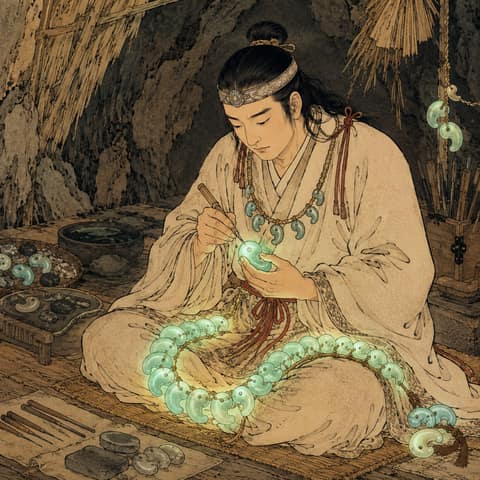
    Tamanooya, who strung the sacred beads at the rock cave, is the deity in the Ama-no-Iwato myth who gathers light into particles and brings them to order. When Amaterasu-Omikami hides in the cave, the gods follow Omoikane's plan: they make a mirror, craft jewels, hang cloth, and perform divination. The *Kojiki* (Ama-no-Iwato II) records that they had Tamanooya make the Yasakani no Magatama and the five hundred stringed Yasumaru beads. What Tamanooya creates here is not a single gem, but a spiritual rosary of many beads strung together to hang before the altar. The jewels stand in pair with the mirror at the Ama-no-Iwato scene. The mirror reflects Amaterasu's figure on one surface, while the jewels fill the sacred space with many particles. If the mirror is an implement for "seeing," the jewels are implements for "tying." By boring holes, threading strings, and aligning the particles without disorder, scattered small lights become a single ritual implement. Tamanooya's work is not merely to make the material beautiful, but to align individual brilliance into an order directed toward the divine. When Kokugakuin University's commentary reads the Ama-no-Iwato myth as an origin tale of ancient rituals, jewels—along with mirrors, cloth, ironware, and oracle bones—are major items that make the ritual possible. Jewels are implements close to the body; they decorate, protect, and indicate the status or spiritual power of the wearer. When hung on the true sakaki tree before the cave, a personal adornment transforms into a sacred symbol. Tamanooya is the deity who makes this transformation possible. In the Descent of the Heavenly Grandson, Tamanooya's vocation is connected to the history of human clans. The *Kojiki* (Tenson Korin II) counts Tamanooya among the Five Attendant Deities and designates him as the ancestor of the Tamanooya clan. This indicates that jewel-making descended to earth not just as manual labor, but as a vocation rooted in heavenly rituals. The techniques of polishing, piercing, and stringing jewels became part of the ritual technology supporting the heavenly grandson's world. In the official overview of Hinokuma and Kunikakasu Shrines, Tamanooya is enshrined in the auxiliary shrine of Kunikakasu Shrine. Kunikakasu Shrine enshrines the Hibokokagami (Sun Spear Mirror) as its sacred body, and the same page transmits the history of two sacred mirrors being cast during Amaterasu's seclusion in the cave. The enshrinement of Tamanooya in a shrine centered on mirror myths clearly shows that the ritual implements of the rock cave myth are not complete with mirrors alone. The jewels string light around the mirror. Tamanooya's power lies in not neglecting the details. Jewel-making requires selecting materials, polishing, boring holes, stringing, and arranging. If any one step is disrupted, the rosary will not take a form fitting for the gods. Rather than creating a massive light all at once, this deity refines small lights one by one, connects them, and makes them into a meaningful sequence. Tamanooya is the deity who teaches the weight of the finest manual labor within a grand ritual that changes the world. Seen in a modern light, Tamanooya resonates well with the senses of jewelry, accessories, rosaries, beads, souvenirs, design, lineage, and matchmaking. The work of polishing, selecting, and connecting small things is inconspicuous but supports people's memories and prayers. Tamanooya, who strung the sacred beads before the rock cave, is a deity who does not waste a single particle of light. He beautifully ties scattered things together and prepares the space to welcome the lost light. Those quiet, steady hands are the very essence of Tamanooya's divinity. Furthermore, Tamanooya is often paired with Ishikoridome. If Ishikoridome gathers light onto a single mirror surface, Tamanooya divides light into many particles and then creates a single chain from them. Concentration and connection, reflection and decoration, a single surface and many particles. Through these two crafts, the Ama-no-Iwato ritual simultaneously possessed light for seeing and light for tying. Tamanooya's jewels were not only beautiful but were implements that turned the gods' collaboration into a visible form. The gods' operation was not a single heroic act, but a collective ritual where wisdom, dance, prayers, cloth, mirrors, and jewels supported each other. Tamanooya is also the deity who symbolizes that collectivity as a chain of particles. The power to tie small things together deeply supports grand divine rituals.

  • 田心姫神

    田心姫神

    Divine

    たごりひめのかみ

    沖ノ島に鎮まる海北道中の女神・田心姫神

    神霊・神格Fukuoka

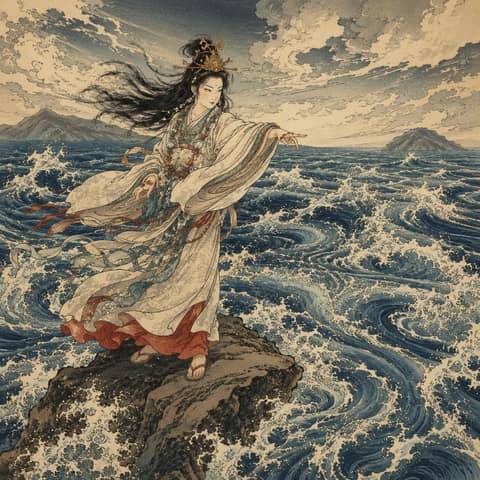
    The key to understanding Tagorihime lies in the fact that Okinoshima is a "distant island." The three shrines of Munakata Taisha are arranged such that one ventures deeper into the sacred realm the further one crosses the sea: Hetsumiya on the Kyushu mainland, Nakatsumiya on Oshima, and Okitsumiya on Okinoshima in the Genkai Sea. The fact that the deity of Okitsumiya, placed furthest offshore, is Tagorihime clearly illustrates her character. She is not a guardian nestling close to human settlements, but a divine presence that arises when navigators spot the island's silhouette, read the tides, and stand in awe of unseen dangers. In the classic texts, she is born from a sword. The ukehi (oath) section of the Kojiki records that Amaterasu Omikami took Susanoo-no-Mikoto's ten-span sword, rinsed it in the Ame-no-Manai well, chewed it to pieces, and from the narrow mist of her breath blown away, Takiribime-no-Mikoto was formed. The sword is an object of military might and oaths, the well water is a medium of purification, and breath and mist are boundaries without form. Because Tagorihime is born at the intersection of these three, she can be understood not merely as a sea deity, but as the goddess of the very moment when martial force is transformed into prayer. The variations in her divine name indicate that she is a deity who cannot be confined to a single reading. Called Takiribime-no-Mikoto or Okitsushima-hime-no-Mikoto in the Kojiki, she is spoken of as Tagorihime or Tagirihime in the Nihon Shoki lineage. Depending on whether "Takiri" is read as the "surging (tagiru)" of the tides or "Tagiri" as the mist upon the sea, the expression she shows changes slightly. In either case, however, at her core lies the power to alter visibility right in the middle of the water's surface. To navigators, fog was both a danger and a sign signaling the realm of the gods. In the Munakata faith, this mythology is tied to actual sea routes. Okinoshima is a maritime transport hub connecting the Japanese archipelago and the Korean Peninsula, and official World Heritage documents explain that rituals praying for navigational safety and successful exchange were held from the late 4th century to the late 9th century. The evolution of offerings shows a transition of ritual sites from atop giant boulders, to rock shelters, half-rock-shelter half-open-air, and finally open-air locations, narrating how the ancient rituals of Okinoshima are essential in considering the formation of indigenous Japanese faith moving from nature worship to shrine rituals. The taboos surrounding the island reinforce Tagorihime's "invisibility." Official World Heritage documents convey customs such as not speaking of what one sees or hears on Okinoshima, not taking a single tree, blade of grass, or stone, and requiring even Shinto priests to undergo purification in the sea before entering. These are not so much a matter of secrecy as they are a decorum meant to prevent the consumption of the sacred realm. Tagorihime is not a deity who discloses everything within statues or narratives. Through what is not spoken, what is not taken away, and what is left behind on the island, she exists all the more profoundly. On the other hand, she is not confined solely to Okinoshima. The history of Munakata Taisha regards the three goddesses as the three daughters of Amaterasu Omikami, telling how the land of Munakata, which fulfilled the functions of overseas diplomacy, trade, and national defense, became deeply tied to state rituals. The description of "state rituals" seen in the history of Munakata Taisha prevents Tagorihime from remaining merely a deity of maritime safety. In the ancient state, crossing the sea meant trade, diplomacy, warfare, and prayer. Precisely because of this complexity, her stillness resonates not as weakness, but as the posture that both the state and humanity ought to uphold when facing the ocean. Furthermore, in the genealogy of the Kojiki, Takiribime-no-Mikoto bears Ajisukitakahikone-no-Kami and Takahime-no-Mikoto with Okuninushi-no-Kami. This means that the maritime goddess of Munakata also holds a place within the Izumo lineage. Situated in the genealogy of Okuninushi-no-Kami, Tagorihime is a guardian of the northern sea routes, while simultaneously a mother goddess expanding the bloodline of Izumo mythology. The goddess retreating far offshore paradoxically links the myths of the land. This duality is the quiet strength of Tagorihime. The deeper she withdraws into the island, the more she expands as the knot binding the entire mythology together.

  • 白蔵主

    白蔵主

    Epic

    はくぞうす

    僧に化けて狐釣りを止める白狐・白蔵主

    動物変化Yamanashi

    Hakuzosu, disguised as a monk, is a particularly theatrical yokai even among tales of fox transformation. Foxes often transform into beautiful women, travelers, or close family members, but Hakuzosu chooses the form of a monk. That choice holds the power not only to reassure the other person but to move them with words. The old fox in Tsurigitsune disguises himself as the hunter's uncle and preaches on the sin of fox trapping. The persuasion succeeds to the point of making him throw away his traps, but the bait on the way home destroys that victory. Hakuzosu does not lose because he deceived a human. Because the fox, who spoke using human ethics, is ultimately pulled back into the fox's own hunger, he is comical, pitiful, and terrifying. This form does not render the yokai called a fox a simple villain. Hakuzosu is on the side whose clan was killed; he is an avenger, and a preacher. His words contain a protest against killing, while simultaneously containing deception through transformation. If Kuzunoha of Shinoda Forest is remembered as a fox mother unable to sever ties with humans, Hakuzosu is an old fox breaking down between human law and a fox's body. Both are stories of foxes entering human society, but while Kuzunoha is a story of love and parting, Hakuzosu is a story of eloquence, traps, desire, and exposure. The Hakuzosu of Tsurigitsune undergoes a double transformation on stage. The first transformation is within the story, where the fox transforms into the monk named Hakuzosu. The second transformation is in the actor's body, where the kyogen master adopts the fox's posture and movement, yet hides it beneath the behavior of a human monk. The struggle between intellect and instinct, pointed out as a key element of appreciation, appears not only in lines but in the way of walking, the way of looking back, and the spacing as he is drawn to the bait. Therefore, Hakuzosu is a yokai that is read as well as a yokai that is performed. The true identity of the fox is not exposed at the end; it becomes visible as the body gradually returns to a fox. On the other hand, the Hakuzosu of the Ehon Hyaku Monogatari lineage makes the monk-shaped fox look even darker as a ghost story accompanied by the place name of Kai Province. As seen in the National Diet Library bibliography, the book is a ghost story art collection written by Momosanji and illustrated by Takehara Shunsen, and late-Edo readers received this fox through a combination of pictures and captions. While the stage Hakuzosu returns to a fox through a momentary failure, the picture book Hakuzosu lurks long within human settlements. What becomes problematic here is not only how skillfully the fox transforms. It is how much people believe in the institutions of monk's robes, temples, and sermons. Hakuzosu exploits that form of trust. The white fur of the fox and the human status overlap in Hakuzosu's name and notation. The variant spellings Hakuzosu (白蔵主, 伯蔵主, 白蔵司, 伯蔵司) gently oscillate readings between the fox's white hair, a monk's name, and a fox disguised as a human. While the names of transforming foxes often remain attached to lands or people's names, in Hakuzosu's case, the very act of "the fox borrowing a name" becomes the core of the apparition. To give one's name is to acquire a role in society. By taking a monk's name, Hakuzosu enters the inside of the temple, enters the inside of the hunter's house, and finally returns to a fox in front of the audience. Placing Hakuzosu within the genealogy of foxes, he is not a great demon fox like the Nine-Tailed Fox or Tamamo-no-Mae that shakes royal authority. Nor is he a fox woman who leaves behind a child like Kuzunoha. Hakuzosu concentrates the point of contact between fox and human into "persuasion" and "traps." Humans catch foxes with traps, and foxes catch humans with words. Both are techniques reading the opponent's weakness, and those techniques succeed for just an instant. However, when the smell of bait, the desire for prey, and the logic of revenge overlap, the fox approaches his own trap. The reason the story of Hakuzosu has survived so long is that it depicts not a fox's cunning, but a weakness that is harder to escape the wiser one is. Hakuzosu on an encyclopedia acts as a keystone expanding fox-type yokai horizontally. If the Nine-Tailed Fox bears the nation and calamity, Kuzunoha parent and child and parting, and the wild fox possession and marginality, Hakuzosu connects performing arts and narrative, monk's form and fox's body. The fox is not a single mold; it can be a divine messenger, a mother, a calamity, or an actor. By placing Hakuzosu, an axis of "the performed fox" is established within the vast yokai group called foxes.

  • 舌長姥

    舌長姥

    Uncommon

    したながうば

    荒野の破屋に舌を伸ばす姥・舌長姥

    人妖・半人半妖NiigataTokyo

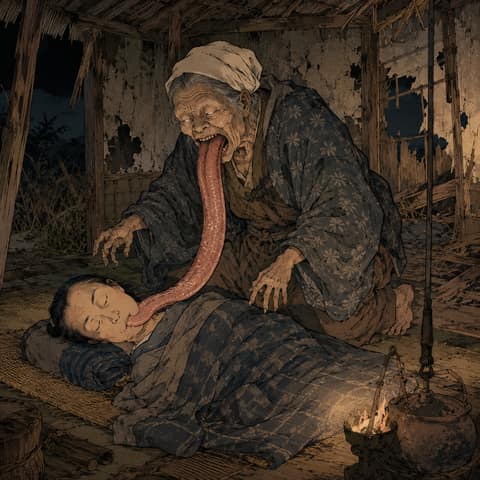
    When viewed as a hag extending her tongue in a ruined shack in the wilderness, the terror of the Shitanaga-uba lies less in the monster's appearance itself and more in the moment hospitality flips into predation. The travelers, conditioned by nightfall, getting lost, and fatigue, search for a house and believe they are saved by the old woman's invitation. However, the night's lodging is not a safe zone of the human community, but a trap waiting in a closed room for them to fall asleep. In the scene where the tongue extends to the sleeper, the everyday and soft action of "licking"—rather than the use of blades or claws—transforms into the violence of obliterating the flesh, producing a tactile terror much closer than the red face of Shu-no-banbo. This hag monster's outline becomes clearest when working as a pair with Shu-no-banbo. In the setting of the journey from Echigo to Edo, the Shitanaga-uba is placed inside the house, while Shu-no-banbo acts as a voice from the outside. It is the Shitanaga-uba whose name is called first, and Shu-no-banbo appears saying, "Shall I help?" In other words, the Shitanaga-uba is not a mere servant, but one of the principal culprits moving in front of the prey. If Shu-no-banbo is a yokai of sight, the Shitanaga-uba is a yokai of touch, and the two terrors mesh seamlessly within the same night. While the story connects Echigo Province and Edo on the map, pinning the Shitanaga-uba down solely as a "yokai of Niigata Prefecture" misses the core of the tale. What is important is that an unnamed wasteland opens its jaws halfway between a known land and a known city. The ending, where the house vanishes, suggests the possibility that the anomaly's dwelling was not permanently there, but rose up for just one night to absorb the travelers. Thus, on this page, Echigo Province is listed as the story's starting point, Edo as the destination, and "Unknown" side-by-side as the limit of her origin. In later yokai culture, while Shu-no-banbo stands out by gaining the iconography of a red face and large mouth, the Shitanaga-uba is easily compressed into the short name "the old woman with the long tongue." Yet, that very compression is the strength of this yokai. The moment you hear her name, you know her shape, and the moment you know her shape, you know what she will do. She is not a flashy protagonist, but an anomaly that lingers in the reader's bodily senses through the minimal elements of an inn, sleep, and a tongue.

  • 芝右衛門狸

    芝右衛門狸

    Epic

    しばえもんだぬき

    芝居を愛した淡路の名狸・芝右衛門狸

    動物変化HyogoOsaka

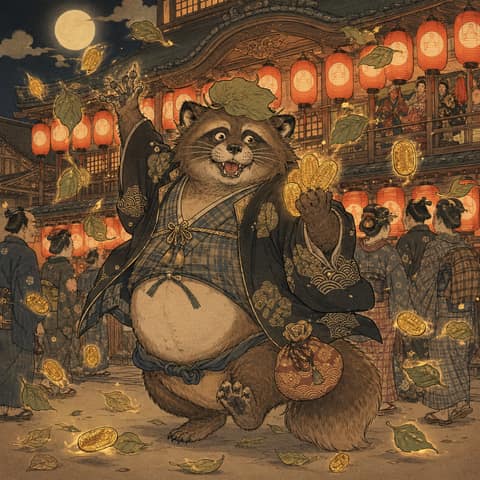
    When reading about the Shibaemon-tanuki, the first thing to note is that his "love for theater" is not a mere decoration. Many bake-danuki deceive people, use leaves that look like coins, and distort human senses on mountain roads or street corners. Shibaemon has this power too, but his destination is neither a treasure house nor a mansion; it is the theaters of Dotonbori. In other words, this tanuki shape-shifts not to steal, but to watch. He is drawn to human performing arts, attempting to slip into the audience. The softness and danger of Shibaemon's story lie in this depiction of an outsider drawn to human culture. The magic of turning leaves into money is the most well-known economic illusion in tanuki folklore. The moment mountain leaves become town currency, the contract between nature and human society is swapped. However, in the theater, suspicion arises when leaves are found mixed into the admission fees. Shibaemon's magic can entertain people temporarily, but it breaks down at the point of accounting. When a guard dog is placed there, the illusion is forced back into a physical problem. The tragedy of being barked at, chased, and reverting to the form of a tanuki shows that his magic could not completely slip through the gates of society. In the legends where he is accompanied by his wife, Omasu, the tragedy deepens. Omasu loses her life by confusing the illusion of a feudal lord's procession with reality, and Shibaemon heads to the theater carrying that loss. Here, watching the play is both an act of entertainment and an act of fulfilling a promise to the dead. Therefore, Shibaemon's end is not just a comical tale of failure. Laughter and tears, the lightness of disguise and the weight of mourning overlap in one plot, drawing the tanuki's story closer to the story of the performing arts itself. The plot seen in the "Ehon Hyakumonogatari" and the local Shibaemon faith in Sumoto do not share the exact same context. In the former, the old tanuki appears as a non-human intellectual telling ancient tales to the human Shibaemon; in the latter, he rises as a famous tanuki commuting from the mountains of Awaji to the theater districts of Osaka. What connects them, however, is the tanuki's deep involvement with the "storytelling" and "spectacle" of human society. A tanuki who imparts knowledge, a tanuki who watches plays, a tanuki revered by actors after death. Through this continuity, Shibaemon, despite being a monster of the wild, is pulled strongly toward the side of words and the stage. The development of his enshrinement at Nakaza and Sumoto Hachiman Shrine after death changes Shibaemon from a "slain monster" to a "re-welcomed guardian." For the theater, he was an outsider who wanted to enter the audience, a patron who might have been killed by mistake, and eventually a god who protects the stage. The shrine returning to Sumoto acts as a device reconnecting this story to its homeland. The round trip of a Mikuma mountain tanuki traveling to an Osaka theater and finally returning to Awaji connects Awaji's local folklore to the memories of urban performing arts. If Danzaburo-danuki of Sado is spoken of as a great boss of wealth and illusion, and Kinchō of Awa as a famous tanuki of honor and battle, then Shibaemon stands out as the "audience tanuki." He does not merely threaten humans from the outside; he desires to see the stages humans create. Because that desire was shattered by a dog and then saved by faith, the Shibaemon-tanuki feels remarkably human even among bake-danuki. More than his power to shape-shift, it is his desire to see, hear, and enjoy that shines through as the defining trait of this famous tanuki.

  • 葛の葉

    葛の葉

    Legendary

    くずのは

    信太森に帰る狐母・葛の葉

    動物変化Osaka

    Kuzunoha of Shinoda Forest is an entity that transforms a fox's shapeshifting tale into a mother's story. Stories of foxes transforming into human women exist everywhere, but in Kuzunoha's case, seduction or mischief is not placed at the center. The rescued fox becomes a human wife as a repayment of kindness, gives birth to a child, and eventually returns to the forest upon having her identity discovered. While maintaining the ancient mold of an inter-species marriage, this plot connects the spiritual power of a fox and a human lineage into a single tragic family history by connecting it to the birth tale of the famous onmyoji, Abe no Seimei. The stage of the story is the Shinoda Forest. The white fox saved by Yasuna takes the form of Kuzunoha, they become husband and wife, and raise Dojimaru. However, a fox that has entered the human world cannot live in that form forever. When her true identity is exposed, Kuzunoha cannot continue to hold her child as a mother, nor can she discard her return to the forest as a fox; she cannot abandon either. In that torn moment, she leaves a farewell poem written on a sliding door (shoji). While indicating her whereabouts, the poem simultaneously implies that even if he goes there, a complete reunion will not be fulfilled. The forest of Shinoda is a place of homecoming, but at the same time, it becomes a place to pursue the mother lost from the human home. Ashiya Doman Ouchi Kagami turned this tale of a fox mother into a strong memory of the stage. The National Theatre performance script found in the NDL Search indicates that the "Kuzunoha scene" has been treated as subject matter for Kabuki appreciation classes even in modern times. The subtitle "Shinoda-zuma Urami Kuzunoha" in the Meiji-era publication pushes the sorrow of Shinoda's wife to the forefront right from the title stage. While Kuzunoha is often explained as "Seimei's mother," on stage she should rather be seen as a woman who leaves her name and departs, a fox whose true identity is known, an otherworldly being who cannot sever the fact that she is a mother. In iconography, Kuzunoha is remembered by the scene of parting with her child. Ashiya Doman Ouchi Kagami: Abe Yasuna, Kuzunoha, and Yokanpei by Toyohara Kunichika in the Izumi City Digital Archive is registered as an actor print depicting the performance at the Ichimura-za in 1865, conveying that Kuzunoha was firmly established in the visual culture of the stage. What is important here is the tension of the "fox mother in human form" played by the actor, rather than the figure of the fox itself. The audience views the parting as the sorrow of a human mother and child, even while knowing she is a fox. It is the moment when a yokai stands at the center of a human drama, and Kuzunoha's charm lies in this duality. The fox's power acts as inheritance rather than attack in Kuzunoha. The child she bears, Dojimaru, is later spoken of as Abe no Seimei. The explanation that Seimei possesses supernatural talent because he carries the blood of a fox is the logic of legend, not history. However, this logic functions to reconnect the onmyoji's spiritual authority back to the natural and otherworldly realms. Seimei's extraordinary abilities are supported not only by courtly knowledge but also by the power of his mother from the forest. There, Kuzunoha becomes a mediator passing the fox's demonic power to human society. Simultaneously, Kuzunoha restrains the dangerous allure often found in fox legends. While Tamamo-no-Mae and the Nine-Tailed Fox are spoken of as entities that disrupt the court, Kuzunoha does not destroy the home; she departs after establishing it. That is why it is sad. When her true identity is revealed, the story does not proceed in the direction of "exterminating the monster." She is depicted not as an enemy to be vanquished, but as a mother who must return. This distinction makes Kuzunoha uniquely special within the genealogy of fox yokai. The significance of reading Kuzunoha in an encyclopedia is to confirm that yokai are not made solely of terror. She is a fox, a wife, a mother, a famous scene on stage, and a geographic memory in Izumi. The figure returning to the Shinoda Forest is the moment the life that briefly opened between yokai and human closes. What remains there is not the eeriness of a supernatural entity whose true form was exposed, but the very process by which affection crossing boundaries is carved long into the land and performing arts. This figure can be read especially as the "mother who leaves her name" among tales of fox wives. Kuzunoha does not merely depart; she points the way to Shinoda Forest through her poem, carving her origins into her child's memory. In the sense that the mother's disappearance directly becomes the beginning of the Seimei legend, she is never a supporting character in the story, but the very entrance bringing spiritual authority from the Otherworld.

  • 野寺坊

    野寺坊

    Uncommon

    のでらぼう

    荒寺の鐘守・野寺坊

    人妖・半人半妖Tokyo

    When viewed as the bell-keeper of a ruined temple, the Nodera-bo is a yokai that dwells in a "place where sound should not ring." The temple bell was a voice that carved out the time of the community and announced Buddhist services and mourning. However, in Sekien's illustration, the bell tower is covered in grass and ivy, and the temple has slipped from human hands. The monk-like figure standing there is neither striking the bell nor chanting sutras. He simply exists beside the bell. In a place that has lost its function, it looks as if only the duty remains. This stillness is the terror of the Nodera-bo. The "Nodera-bo" in the "Yō" section of the first volume of "Gazu Hyakki Yagyo" does not close its meaning with an explanatory text. Sekien combined the thin monk shape, torn robes, the bell tower, ivy, and wild grass, leaving just enough clues for the reader to intuit, "This is something that appears in a ruined temple." As a yokai illustration, it boasts an extremely strong composition, with most of the frame approaching negative space. Rather than the true identity of the anomaly, the wind blowing at the temple's edge, the untended woodwork, and the time of the plants entwining the bell linger in the eye. The Nodera-bo preserves the sensation of having "seen something" before the yokai is explained away in words. It is easy to conclude that this yokai is the ghost of a monk, but such a reading is too narrow. The Nodera-bo does not possess a clear name from its lifetime like the vengeful monk spirits Tesso or Raigo. Nor does it have an origin story of destroying Buddhist law like the Teratsutsuki. While possessing the eeriness of a monk-like form akin to the Aobozo or Nurobotoke, the Nodera-bo leans even closer to its location. In other words, the subject of the anomaly is not just the "monk" but also the "wild temple." A temple without people still requires the shadow of a monk. Read in this way, the Nodera-bo approaches the personification of the ruined temple itself. As Kenji Murakami's "Yokai Jiten" indicates, the Nodera-bo is not a dense folk tale told in a specific region, but a yokai whose later explanations were constructed from Sekien's imagery. With this type of yokai, it is necessary not to hide the scarcity of source material as a weakness, but to look at what that scarcity birthed. Because there is only a name and a picture, the reader imagines the sound of the bell. Why is the monk there? For whom is he guarding the bell? Why did the temple fall into ruin? The lack of answers overlaps with the negative space of the ruined temple. Yokai encyclopedias post-Shigeru Mizuki bridged this negative space to modern readers. By entering the Mizuki-lineage yokai directories, the Nodera-bo became a name known not only to those who read Sekien, but to readers flipping through yokai encyclopedias. However, even with modern characterization, the core of the Nodera-bo is not flashy abilities. The ruined temple, the bell, the black robes, the grass, the silence. When these five are present, the yokai rises up even without a story. The Nodera-bo is a yokai for reading the unseen presence left in a space of faith abandoned by people. When a temple is alive, the bell makes a sound. When a temple falls into ruin, the bell falls silent. Yet, if a thin monk were standing beside the silent bell, that place would no longer be a complete ruin. Someone is still keeping watch. Or perhaps, only the thing keeping watch remains. The Nodera-bo is a yokai that locked that sense of unease into a single illustration.

  • 野衾

    野衾

    Uncommon

    のぶすま

    顔を覆う山野の飛膜獣・野衾

    動物変化Tokyo

    In this form, the Nobusuma should be read as a small beast that flutters down from the treetops to press a cloth-like gliding membrane against a traveler's face. The core of its terror lies not in fangs or claws, but in instantly snatching away the ability to "see and breathe." On a mountain path, something drops from above, a damp membrane sticks to the face, the eyes and nose are sealed, and all sense of direction is lost. This sequence of physical sensations elevates the Nobusuma from a mere flying squirrel to a yokai. Sekien's illustration does not make the Nobusuma overly gigantic. In fact, it is terrifying precisely because it is small, agile, and has an indistinct outline in the dark. It does not attack head-on like a giant snake or an oni, but drops from the shadow of branches, roofs, or cliffs at an angle the traveler does not anticipate. Its form with spread membranes looks like cloth, yet it is not cloth. Therein lies the decisive difference from the pre-existing Fusuma. While the white-cloth Fusuma is an ownerless cloth turned spectral, the Nobusuma is a yokai of misrecognition born the instant an animal's body is mistaken for cloth. If we consider the Nobusuma's ability as "covering the face," its closeness to the Nodepo becomes clear. The Nodepo is said to spit something bat-like from its mouth to cover a person's face and block their eyes. The Nobusuma is described either as being akin to that spat-out object or as the transformation of an old bat. Either way, the function of the attack is the same: first, steal the vision; next, disrupt the breathing; finally, suck the blood or life force. This sequence can be read as a reconstruction of the terror of suddenly losing one's bearings on a mountain road into the behavioral pattern of a yokai. Furthermore, the Nobusuma cannot be simply rationalized away by saying, "If you know the real animal, you won't be scared." Flying squirrels do exist, but it is not guaranteed that someone seeing a shadow gliding overhead at night can correctly identify it. In the mountains, the distinction between bird or beast, cloth or shadow, a branch moved by the wind or a living creature blurs in an instant. The Nobusuma inhabits that time of unidentifiability. The progression where old natural history books record the animal's name, Sekien translates it into a yokai illustration, and bizarre tales add the traits of blood-sucking and face-covering perfectly demonstrates that knowledge does not erase superstition—knowledge itself becomes the raw material for anomalies. What this version emphasizes is the liminality of the Nobusuma, ending up neither simply as a "small mountain animal" nor a "cloth tsukumogami." Its body is a beast, its appearance is cloth, and its behavior is a yokai. From the traveler's perspective, there is almost no time to judge what it is. The instant the face is covered, terror arrives before the name. Therefore, it is best read not as a protagonist yokai with a grand narrative even in encyclopedias, but as an anomaly condensed into a single moment on a night road. The more it maintains its small size, the more the unsettling closeness of the attack stands out. The crucial element is that distance—feeling as if you could brush it away with a hand, yet you cannot—more than any massive monster. Geographically, the Nobusuma is difficult to pin down to a single prefecture. While the cloth-type Fusuma can be established as local folklore in Sado or Tosa, the Nobusuma strongly retains the character of Edo's commercial publishing having reassembled a nocturnal mountain beast into a yokai. Therefore, this version takes Edo publishing culture as its starting point, while treating its habitat as mountain forests, ravines, and forest edges near human settlements. What lurks there is not a grand yokai showing its full form, but a tiny darkness already plastered to your face the moment you think you saw it. In YOKAI.JP, positioning this Nobusuma as a "Gliding Beast of the Wild" is the most natural fit.

  • 針女

    針女

    Rare

    はりおなご

    宇和島夜道の鉤髪女・針女

    人妖・半人半妖Ehime

    When viewing the Hari-onna as the "hook-haired woman of the Uwajima night roads," the fear of this yokai is not just that "her hair becomes a weapon." What appears first is the form of a beautiful woman; she does not threaten her victim from afar, but builds a connection by offering a smile. When smiled at by a stranger on a dark road, a person might smile back as a greeting. The Hari-onna takes that small response as a signal to undo her hair and expose the hooks. The anomaly only begins to move after waiting for the victim's reaction. The design of having fishhook-like barbs at the ends of her hair is so clear that it practically explains the name Hari-onna (Needle Woman). Needles are for piercing, but here they function at the tips of her hair to snag. They are not blades for cutting, but hooks for entangling those who flee. Disheveled hair is a sign of disorder and terror, and at the same time, it is the reversal of a beautiful woman's hair instantly changing into a capturing tool. Even though her hair was seen as part of her face and adornment, the moment she draws near, it becomes external hands that seize the victim's body. Treating the location in detail, the Hari-onna can be read as a yokai of the night roads in the Uwajima region, southern Ehime Prefecture. The official explanation on Mizuki Shigeru Road lists the location as the Uwajima region, Ehime Prefecture, and general summaries also append the name of Sakuraoka in the former Johen Town. However, the Hari-onna is not a yokai fixed to a specific shrine or ancient battlefield. Her location is the living sphere of the "Uwajima region," and her scene is the night road. Therefore, it is best to place the Uwajima region as the main axis on the map, and explain the details in the text. Rather than forcing a pin into an unverified point, positioning her as a mystery encountered on the roads of Nanyo fits this yokai better. When speaking of the Hari-onna, one cannot avoid the overlap with the Nure-onago. The Nure-onago is also known as a female yokai who smiles at people and stalks those who respond. Kenji Murakami states that because the traits of the Hari-onna are common with the Nure-onago of the Uwajima region, it is possible that Shigeru Mizuki emphasized the traits of the Nure-onago to create the "Hari-onna." This observation does not diminish the value of the Hari-onna. Rather, it is a prime example showing how a yokai is renamed and visually sharpened within an illustrated encyclopedia. If the Nure-onago is a yokai of smiles and obsession, the Hari-onna is a yokai given a memorable form in a single stroke with her "hooked hair." Comparing her to similar yokai makes the Hari-onna's position easy to see. The Iso-onna is spoken of as a female yokai who attacks people with her hair on the beach, and the Nure-onna is tied to the waterside and the grotesque form of a snake's body. The Kuchisake-onna creates modern urban horror through a question and facial reversal. The Ohaguro-bettari reveals a faceless visage with blackened teeth from beneath beautiful attire. The Hari-onna sits somewhere in between; she does not tear her face itself, but transforms her hair. She does not carry the strong presence of the sea like waterside female monsters, nor is she as modern as urban legends. She is a yokai who stands on the night roads of Nanyo with nothing but a smile and her hair. For this reason, keeping her description free from excessive added abilities makes it stronger. Explanations of her sucking massive amounts of blood, devouring souls, or flying around cities might be possible as later creative works, but they are not the core directly supported by the materials. Her solid outline consists of a woman's appearance, a smile, hooked hair, snagging and dragging men away, and the location of the Uwajima region. With smaller yokai, keeping this outline intact retains their scariness. The Hari-onna is a brief, sharp female yokai who makes victims realize—in the instant they return a friendly expression on a night road—that their expression was the very signal for her to capture them.

  • 高御産巣日神

    高御産巣日神

    Divine

    たかみむすびのかみ

    高木神として命を下す造化神・高御産巣日神

    神霊・神格Tokyo

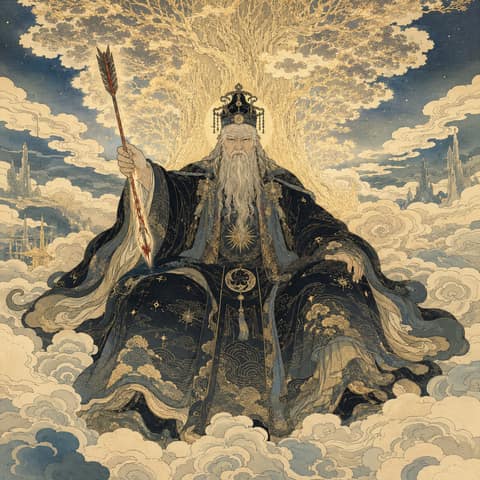
    Takamimusubi, who issues commands as Takagi-no-Kami, has his core in the transformation of an unseen creator god into a political decision-maker. At the beginning of the *Kojiki*, Takamimusubi appears as the second deity to come into being in Takamagahara when heaven and earth began, but immediately hides his form as a solitary deity. Here, the name is placed but the form is not depicted. The power supporting the beginning of the world is shown not as personal martial prowess or emotion, but as the root action that generates existence. However, entering the pacification of Ashihara-no-Nakatsukuni, this hidden deity emerges from silence. When Ame-no-Oshihomimi returns after seeing earthly turmoil, by the command of Takamimusubi and Amaterasu-Omikami, the myriad gods are gathered at Ame-no-Yasukawa. What is important here is that the command is issued not by Amaterasu alone, but jointly with Takamimusubi. If the sun goddess is the visible center, Takamimusubi is the unseen gravity that operates that center as a system. The name Takagi-no-Kami is another entry point for understanding this deity. The *Kojiki* (Ashihara-no-Nakatsukuni Pacification III) explains that Takagi-no-Kami is another name for Takamimusubi in the scene where the returned arrow reaches Amaterasu and Takagi-no-Kami. The official explanation of the enshrined deity at Takagi Shrine also lists the names Takamimusubi (Kojiki), Takamimusubi-no-Mikoto (Nihon Shoki), and Takagi-no-Kami, introducing the understanding that he is the deification of a tall tree. A tall tree stretches vertically from earth to heaven. As an impression of the name, Takagi-no-Kami can be read as an axis passing heavenly commands to the earth. In the story of the returning arrow, Takagi-no-Kami's judgment appears sharply. The arrow Ame-no-Wakahiko used to kill Nakime ascends back to heaven, reaching Takagi-no-Kami's hands stained with blood. Seeing it, Takagi-no-Kami declares that if Ame-no-Wakahiko has no evil heart, it shall not strike him, but if he does, it shall strike him, returning the arrow to earth. The arrow pierces Ame-no-Wakahiko. The fearsomeness of this scene lies in the fact that the deity does not punish out of anger, but reads the evidence, declares conditions, and reverses Ame-no-Wakahiko's own action into a judgment. In the scene of the Kuni-yuzuri, Takagi-no-Kami acts like a signature on a command. When Takemikazuchi descends to Izumo and thrusts the question upon Okuninushi, that authority is expressed as the command of Amaterasu-Omikami and Takagi-no-Kami. This shows that the transfer of rule over Ashihara-no-Nakatsukuni is told not as mere armed force or negotiation, but as a legitimate heavenly decision. Takagi-no-Kami is not a sword-wielding deity, but stands behind the sword-bearing envoy, turning the question into a "mandate of heaven." In the Tenson Korin, Takamimusubi's generative power also enters the lineage. Amaterasu and Takagi-no-Kami try to send Ame-no-Oshihomimi down to the pacified Ashihara-no-Nakatsukuni, but he suggests sending his newborn child, Ninigi-no-Mikoto. The text places Ninigi as the child born from Takagi-no-Kami's daughter, Yorozuhata-Toyoakitsushi-Hime. Takagi-no-Kami not only issues commands but is also involved in the maternal lineage of the heavenly grandson. Here, "generation" and "rule" are not separate. Being born itself creates the legitimacy to descend to earth. The divinity of Takamimusubi resonates well with Omoikane. In the pacification of Ashihara-no-Nakatsukuni, Omoikane confers with the gods and undertakes the judgment of selecting envoys. Takamimusubi calls upon that thinking and stands on the side of convening the heavenly council. The god of wisdom devises the strategy, and the god of creation establishes the space for council and command. Reading this relationship, the politics of Takamagahara appears not as the single shout of a hero god, but as a system where generation, light, wisdom, force, and negotiation overlap and operate. It is natural as a reading of the myth that Takagi-no-Kami is connected to the divine virtues of "creation of all things" and "successful consultations" in modern faith. The official divine virtues of Takagi Shrine list creation of all things, fulfillment of wishes, negotiations, and successful consultations for Takamimusubi. Looking at the generation at the beginning of heaven and earth, the council at Ame-no-Yasukawa, the dispatch of envoys, the Kuni-yuzuri, and the Tenson Korin as a single flow, this deity is not only a god who "births something" but a god who "places what is born into order." Takamimusubi is the generation before light, the consensus behind commands, and the deity who reties the story descending to earth from heaven.

Showing 577 - 592 of 592 yokai