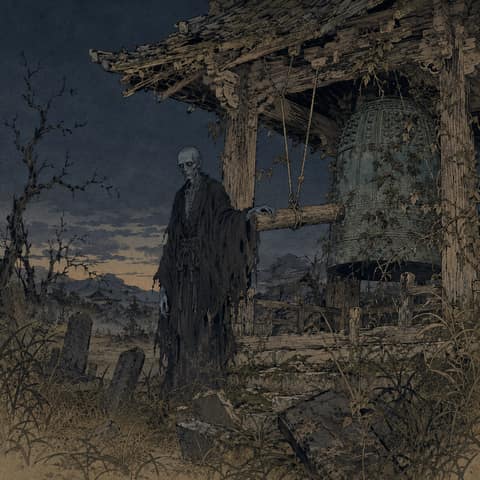
A black, monk-shaped apparition from Edo-period yokai picture scrolls, shown with protruding eyes drooping downward. Examples appear in Sawaki Suushi’s Hyakkai Zukan and Toriyama Sekien’s Gazu Hyakki Yagyo. These sources provide no captions, so its origins and traits are unknown. In Sekien’s version it emerges from a household Buddhist altar (butsudan), leading later writers to interpret it as a spirit of altars or ritual implements, though historical proof is lacking.
Folklore & Legends
The name and image appear in picture scrolls and board games, with little accompanying narrative. Sekien depicts it coming out of a butsudan, and later explanations claim it leaps from altars to frighten people. In the Bakemono-zukushi Emaki, a similar image is retitled “Umi-bōzu,” with a caption about attacks at Shido Bay in Sanuki; however, this does not clearly belong to Nuribotoke’s original tradition.
Based on Edo-period yokai picture scrolls: a monk-like figure lacquer-black in color with protruding drooping eyes, accompanied behind by hairlike or fishtail-like elements. Most sources lack commentary, leaving its nature and origins unclear. In Sekien’s depiction it emerges from within a household Buddhist altar, which later encouraged reinterpretations as a possessed object or tool-spirit, though the original intent is uncertain. Accordingly, it is treated as an image embodying anxieties and awe surrounding domestic ritual spaces, with abilities limited to what the images suggest.
Character Profile
This section is our own creative profile for storytelling. It is not historical fact or scholarship.
The diagram below is a diagnostic evaluation chart for Canonical Traditional Iconography. The higher the value of each item, the stronger that characteristic is expressed.