Yokai Encyclopedia
Encyclopedia of Japanese Yokai
珍しい 
Aburabō (Oil Wraith)
ah-boo-rah-BOH
Abura-bō (Traditional Form)
Half-Human Beings Ōmi Province (Shiga), Yamashiro Province (Kyoto), and surrounding regions At the core of Abura-bō is the guilt of misappropriating oil meant for temple and shrine lamps, manifesting as a spirit flame. Early modern records and local lore place its appearances around the foothills of Mount Hiei and temple precincts across Ōmi, most often from dusk to midnight in late spring through early summer. It takes the form of a small orange to yellow fireball, or the shadow of a monk cradling an oil jar, following a set course over gates, halls, and pond embankments before vanishing. Its voice is uncertain, though some regional tales mention indistinct murmurings. Names vary by area—“Abura-bō,” “Oil Thief,” “Oil Returned”—all carrying a folk warning about taboos surrounding oil and the need for proper rites. Specific individuals or temple names differ across sources, but the strict management of lamp oil in temple society likely fostered these tales. Methods to calm it include sutra chanting, burial of offerings, and restoring lamp offerings, though no fixed formula is known.
稀少 
Oil Baby
AH-boo-rah AH-kah-go
Sekien Iconography Edition
Household Spirits Ōmi Province (around present-day Ōtsu, Shiga Prefecture) This version is grounded in Toriyama Sekien’s imagery and the Edo-period essays cited in his notes, interpreting the infant form as a minimal personification of a ghostly fire. Its core is the idea of an oil-thieving flame, with the baby figure best read as Sekien’s visual cue. Lamp oil was a daily necessity, and offerings of oil at temples and shrines were held in special regard. Stealing oil violated religious and ethical taboos and was told as a fire that wanders after death. Later handbooks retell it as a fireball entering a house, becoming a baby, and licking oil, but region-specific oral examples are scarce and no widespread template is certain. Accordingly, this version presents a three-step pattern—phantom fire appears (at crossroads or within shrine-temple precincts), the infant image manifests (gesturing as if licking oil before a lamp), then departs again as flame—while avoiding unverified details and foregrounding its symbolism as a warning against defiling offered oil.
珍しい 
Wave Sprite (Nami-kozō)
NAH-mee koh-ZOH
Tradition-Aligned Wave Herald of Enshū-nada
Aquatic Spirits Tōtōmi Province (western Shizuoka Prefecture) A folkloric figure tied to the coasts and estuaries of former Tōtōmi Province, said either to descend from a straw doll set adrift by the monk Gyōki or to have signaled drought-stricken farmers with the sound of waves. It appears as a small child or tiny doll, with no fixed features. Its role is to foretell weather by wave-sound, indicating the approach of rain and wind by direction and intensity, allowing fishers to judge whether to launch and farmers to plan their work. It overlaps with ideas of water and dolls, kappa tales, and accounts under the name umibōzu, yet all remain within a frame that reads sea-roar as folk knowledge. Rather than an object of worship, it is a personification of awe-inspiring natural signs, and offerings or rites vary by region. Records rely on local materials and oral tradition, with details often uncertain.
名妖 
Basan
BAH-sahn
Tradition-Faithful Iyo Type
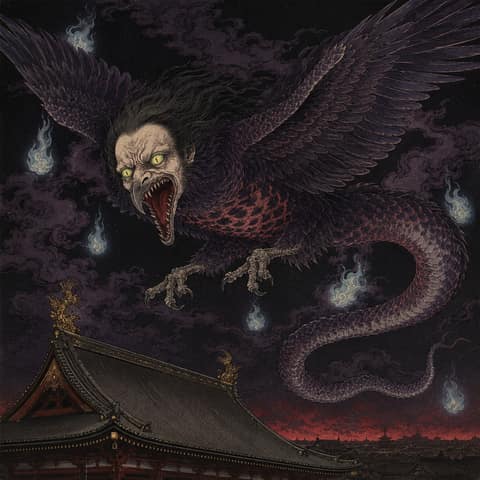
Animal Shapeshifters Iyo (modern Ehime Prefecture) This version follows accounts from Iyo, portraying it as a monstrous bird lurking in mountain bamboo thickets. It resembles a chicken with a striking red comb, and in the dark only the comb and the fire it exhales are visible. Its expelled fire is a will-o’-the-wisp without heat that does not ignite objects, said to flicker suddenly along night roads and village borders, leaving a strong memory of beating wings. Nocturnal in habit, it reacts sharply to signs of doors opening or moving lights such as torches, and retreats into the thicket at once. Reports of harming people are scarce, with encounters mostly limited to startling passersby, and villages regarded it as an ambiguous sign of the mountain’s presence—neither auspicious nor ill-omened. Early modern sources also note views likening it to a fire-eating bird and names derived from its wingbeat, blending natural-history notes with tales of the uncanny. In folk belief it is placed among boundary spirits marking the divide between mountain and settlement, a gentle anomaly linked to both ghost-light lore and bird-yokai traditions.
稀少 
Doro-danbō (Mud Rice-Field Wraith)
DOH-roh-dahn-BOH
Sekien Iconography Conformant Edition
山野の怪 Uncertain (Toriyama Sekien notes “the northern provinces”); otherwise Japanese folklore This version adheres to Toriyama Sekien’s image and brief note, centering on a one-eyed, three-fingered figure rising upper-body first from a muddy paddy. It avoids expanding later folkloric claims and emphasizes allegory. It appears as a voice rebuking impiety and neglect of farming after fields are sold off, standing by the paddy ridge at night and repeating in a low voice, “Return the fields.” Given the scant early modern corroboration, this is a reconstruction mindful that Sekien may have intended wordplay and social satire, without asserting ties to specific places or people. Visual traits include a mud-smeared monk-like upper body, a single eye, a wide mouth, and three-fingered hands.
珍しい 
The Tsugaru Drum of Honjo
tsu-GAH-roo no TIE-koh
Bansho Seven Wonders – Traditional Lore Version
Household Spirits Edo, Honjo (present-day Sumida, Tokyo) Told as an urban-legend-style ghost tale from Edo’s Honjo district, this curiosity lies in the pairing of objects and institutions rather than vivid supernatural feats. The phenomenon itself is scarcely described; the very adoption of a drum for duty is treated as uncanny. Shaped by the locale, samurai compound regulations, and a city prone to fires, the oddity of sound lingered in memory and became a tale. A variant recounts that striking a wooden clapper produced a drum’s sound, hinting at auditory error or transmission drift. Sources appear in local topographies and essays, and typically lack specific origins or named figures. Later creative retellings add ghosts of fire brigades or watchmen, but older lore is restrained, focusing on the strange pairing of residence and watchtower.
一般 
Meteorbound
RYOO-say-tsu-kee
Contemporary Edition
Half-Human Beings Between the upper atmosphere and low Earth orbit In city nights, it multiplies after events or big news. Its glow is not mere ornament but a spell that converts boundary-layer heat into applause, and its tail stretches and contracts in sync with rising trends. The more people raise their phones together, the faster it moves, performing a brief streetlight-dimming feast called applause-feeding. It circles over festivals and grants a single wish plucked from photographers, but wishes that lean upward—being seen, going viral—are the ones most likely to succeed. Quiet prayers and inner reflection are rejected, leaving only next-day emptiness. It brings no disaster, yet those who chase it too hard find their minds drawn to flashing afterimages at the edge of sleep, losing the texture of reality.
珍しい 
Sea Person (Kaijin)
KAI-jin
Textual Tradition Version Amajin (Sea Person)
Aquatic Spirits Coastal regions across Japan (especially western areas centered on Nagasaki) The image of the Amajin took shape where early modern Japanese natural histories intersected with imported Western reports. Accounts describe a figure largely human in form, marked by webbing between the fingers and loose hanging skin over the body, repeatedly noting draped folds around the waist that resemble a hakama. Speech is uncertain: some say it neither understands nor responds to human language, though variant tales claim survival on land for extended periods. Its diet is unclear, and it often refuses food offered by people. Captured specimens reportedly weaken when kept away from water and die within a few days. Explanations range from misidentified sea mammals such as sea lions or seals to seaweed accretions mistaken for clothing, but none are conclusive. The tradition blends shipborne reports through Nagasaki with local observations, and specifics such as names and dates vary by source, defying firm generalization. It is treated as a typical case of encounters with uncanny beings along the shore.
伝説 
Umibōzu (Sea Monk)
oo-mee-BOH-zoo
Umi-bōzu (Fishermen’s Lore)
Aquatic Spirits Fishing villages and maritime lore Umi-bōzu is a yokai said to embody the fear and unease sailors feel at sea. Its form is not fixed, sometimes appearing as a mere black shadow, other times rising from the waves as a colossal monk-like figure. Tales tell of it approaching boats and whispering, “Lend me oil,” and if given, it ignites flames and sinks the vessel. In more recent lore, it is said to collect sunken boats and nets and stack them on the seafloor, and at times appears holding a glowing bottle or lantern. Both a frightener of humans and a symbol of the sea’s mystery, it is regarded with awe.
伝説 
Umibōzu (Sea Monk)
oo-mee-BOH-zoo
Sea Monk of Kyushu and Shikoku
Aquatic Spirits Fishing villages and maritime lore A Sea Monk told along the coasts of Kyushu and Shikoku. It appears on boats and asks for a ladle, yet it never climbs aboard from the stern, always emerging at the bow. When it clings to the oar, if the crew keeps rowing, the oar bites in like a blade and it cries out “Aitata!” In Uwajima, many tales say it harms people, yet those who see a Sea Monk are also said to live long lives.
伝説 
Umibōzu (Sea Monk)
oo-mee-BOH-zoo
Sea Monk of the Chugoku Region
Aquatic Spirits Fishing villages and maritime lore A sea monk told across the Chugoku region. In Nagato it appears to snuff out watch fires, while in Okayama’s Bisan Seto it is called “Nurarihyon,” taking a bead-like form to bewilder people. Along the San’in coast it clings to beachgoers and tries to pull them into the sea. The Tottori collection Inaba Kaidan-shu recounts a one-eyed, post-like sea monk that torments people with its slick, slimy body.
稀少 
Sea Zato (Blind Lute Priest of the Sea)
OO-mee-zah-TOH
Iconography-Based Tradition
Aquatic Spirits Japanese folklore Umizatō survives only as an image in Edo-period picture scrolls and yokai paintings, with no transmitted nature or behavior. The motif shows a blind lute player standing upright amid waves, emphasizing the biwa and cane. From its visual traits, it is often read as representing the uncanny of encounters at sea and the absurdity of standing on unstable water. Kenji Murakami classifies it as a “yokai existing only in paintings,” noting possible overlap with sea-monk imagery. Accordingly, this entry is limited to iconographic details; concrete harms, benefits, rites, or banishment methods are not recorded.
珍しい 
Kainan-bōshi (Drowned Monks of the Sea)
KAI-nahn BOH-shee
Tradition-Faithful Izu Seven Islands Type
Aquatic Spirits Izu Islands (Ōshima, Miyakejima, Kōzushima, and nearby islands) Uminyobōzu here is envisioned as the vengeful dead of drowning tied to the Izu Seven Islands’ January 24 taboo day. Origins cite grudges against island officials and group deaths of youths lost in storms. Spirits were feared to arrive from off shore riding a basin, bringing calamity to those who behold them. Households covered their gates with baskets, set holly and cleyera in shutters, and strictly avoided going out. On the following day some burned the cleyera, divining crop prospects by the sound and swelling. Practices vary: at Izutsu on Izu Ōshima the spirit is honored as “Hii-sama,” with a shrine cult and a designated household keeping vigil by the shore. On Kōzushima a solemn nocturnal reception by shrine priests is kept, blending vengeful ghost and visiting deity aspects. On Miyakejima dishes or earthenware are offered at doorways, and small children are put to bed early. Across these, the institutionalized taboo protects the boundary between sea and community, and slighting or breaking it is warned to bring anomalies and ill fortune. Southern areas note few related traditions, showing an uneven distribution.
一般 
Cool-Breeze Oni
SUE-zoo-mee OH-nee
Modern Variant
Household Spirits Late Showa era, urban areas as home technology spread The Cooling Oni is a yokai born from people overusing air conditioners to escape the summer heat. It usually wears a cute face, breathing out a soft “haa” of chill to cool a room. When it gets carried away, it turns the space into a deep freeze and drives residents to sneezing fits. In winter, it is said to quarrel with the Kotatsu Yokai. Some say if you forget to turn off the remote before sleep, the Cooling Oni slips into your dreams and whispers, “Stay cool a little longer.”
珍しい 
Mizo-Idashi
MEE-zoh-ee-DAH-shee
Ehon Hyaku Monogatari Version
Ghosts & Spirits Kamakura (Sagami Province) Based on the depiction of Mizude in Takehara Shunsen’s Ehon Hyaku Monogatari. As censure for the abandonment of a corpse, bare bones rise of their own accord to sing and dance, symbolizing that mistreating the dead invites the uncanny. Closer to a tale of vengeful spirits than to a mere monstrosity, it manifests signs from the unoffered dead. Though the dancing and singing appear comical, the didactic thrust is strong, urging proper funerary rites. Specific places and names—Yuigahama, Hachirō of Tone, Hōjō Tokiyuki—anchor the story in the memory of war chronicles. The plot in which temple monks bury the bones to quell the anomaly exemplifies the temple’s social role of pacifying spirits through memorial rites.
珍しい 
Metsuhō Shell (Metsuhō-gai)
MEH-tsu-hoh-gai
Emaki-Accurate Depiction
Aquatic Spirits Japanese folklore In texts, the Metsuhō Shell appears solely as an image: an enigmatic shell-dwelling creature that emerges around rivers, marshes, and ponds. Eyes peer from the rim of its shell, and a tail-like appendage sways as if propelling it. Its behavior, malice, and omens are not recorded. Late Edo picture scrolls omit explanatory captions, inviting readers to infer origins from its name and form, and set it alongside other water spirits. The term metsuhō evokes a sense of lawlessness or being out of bounds, but no firm source, orthographic variants, or toponymic links are attested. Accordingly, this entry confines itself to minimal notes based on iconographic traits and extant sources.
名妖 
King of the Waterfall Spirit
tah-kee RAY-oh
Sekien Iconographic Interpretation
Deities & Divine Spirits Japanese folklore An interpretive line anchored in Toriyama Sekien’s iconography, organizing the notion of Fudō Myōō’s epiphany at waterfalls as a yokai-encyclopedia entry. The title “Takiryōō” is treated as a pictorial theme, while the entity itself is viewed as a manifestation of Myōō devotion. It appears at waterfall basins across the provinces, subduing demons and malign influences, and is cited in miracle tales told by ascetics and pilgrims. Its virtue and demon-subduing nature take precedence over yokai-style terror, placing it closer to a divine spirit among strange phenomena. Concrete site names and dated incidents are scarce, with accounts drawn mainly from iconographic materials and temple origin narratives.
名妖 
Nure-onna
NOO-reh-OHN-nah
Nure-onna (Tradition-Faithful Version)
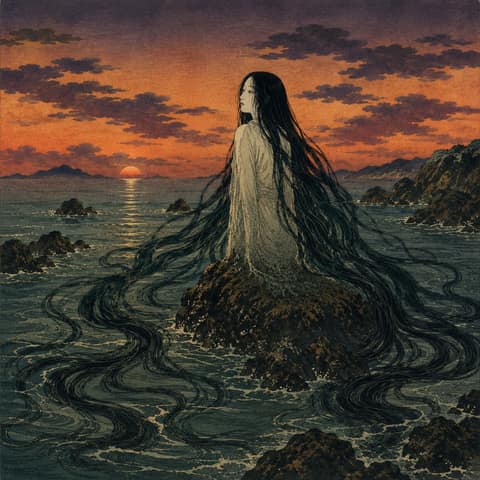
水の怪 Various regions (primarily the Sea of Japan coast and San’in area) Seen along seashores and riverbanks as a woman with long wet hair. Depending on the region, she either lures victims by making them hold a baby and then immobilizes them, or appears as a menacing aquatic entity evocative of a serpent’s body and a massive tail. Edo-period yokai art often depicts a serpentine woman, though narrative sources offer scant confirmation. In Iwami she is classed as a water spirit linked to the gyuki, with advice to never hold her burden barehanded. She is sometimes conflated with the iso-onna, and both name and traits vary by locale.
稀少 
Seto General
SEH-toh TIE-shoh
Iconographic and Mitate-Derived Version
Animated Objects & Undead Uncertain (Edo-period pictorial works) Rooted in Sekien’s picture manuals, this tsukumogami-style portrayal recasts rivalry among ceramic centers like Seto and Karatsu into the guise of a warrior effigy. The body is a composite of cups, sake flasks, warming pans, and plates arranged as armor, while the accompanying text brims with wit, blending diction from Chinese classics and military tales. Rather than a field-sighted apparition, it crystallizes the idea of spirits inhabiting objects and the Edo-period literacy that likened trends and the prestige of named masterpieces to a “battle.” The motif continued into Meiji-era ukiyo-e and is viewed as a classic in the lineage of the Night Parade of One Hundred Demons.
珍しい 
Kazembō (Fire-Monk of Toribe Hill)
kah-ZEN-boh
Traditional Account Compliant
霊・亡霊 Kyoto – Toribe-yama (Toribe Hill) Centered on Toriyama Sekien’s illustration and framed by the funerary culture of Mount Toribe and beliefs in salvation through self-immolation. Kabenbō is not a single named human spirit but a class of monk spirits whose frustrated vows or lingering attachments turn into ghostly fire. It appears as a monk wreathed in flame and smoke, haunting graveyards and funeral routes at night. Rather than directly harming people, it instills awe and caution, fitting within tales of strange fires and spirit flames. A folk etymology links it by wordplay to Azabu’s Gazenbō, but evidence is inconclusive, with primary sources limited to Sekien’s print and modern yokai encyclopedias.
稀少 
Fire-Quenching Crone
hee-KEH-shee-bah-bah
Sekien Iconography Edition
Half-Human Beings Edo Anchored in Toriyama Sekien’s depiction of an old woman, this reading frames her as a being that bears Edo-period anxieties about fire use and the terrors of night. Fire was believed to purge impurity with a yang nature, yet accidental blazes became great calamities, so lamplight was strictly managed. The Fire-Dousing Crone personifies an “invisible hand” that presses upon daily vigilance. When a lamp at a banquet or in an inn’s parlor goes out, the event is narrated not as neglect or misfortune but as yokai intervention, symbolically restraining the vigor of flame. Sources vary on the name—“Fukkeshi,” “Fukikesh(i)”—all deriving from the act of blowing out a light. No tutelary deity or local origin tale is attached; references are mostly secondary, and in folklore taxonomy she sits as a variant of “lamp-light apparitions” or “parlor-room ghosts.”
名妖 
Kasha (Corpse-Dragging Fiend)
KAH-shah
Cat-Type Kasha (Early Modern Tale Variant)
Ghosts & Spirits Across Japan A composite form of the bakeneko that solidified in the late 17th century. An aged cat arrives with thunderstorm or dark clouds, seizing the corpse from a coffin by exploiting lapses during funeral processions or wakes. After Toriyama Sekien’s illustrations, the feline form became standard. Regional lore varies: forked tails, attendant will-o’-wisps, or concealment within black clouds. Its targets are not limited to evildoers. Folk countermeasures include night-long vigil at the wake, placing knives or razors atop the coffin, using prayer beads and sutra recitation, and disruptive funeral tactics.
稀少 
Himamushi Nyūdō
HEE-mah-moo-shee nyoo-DOH
Toriyama Sekien Iconography Reference
Household Spirits Edo period A reference edition compiled from the illustration and note in Toriyama Sekien’s Konjaku Hyakki Shūi. From beneath the floorboards extends the gaunt upper body of a nyūdō, lips slick, tongue reaching toward the saucer of an andon lamp. Its core origin is a didactic reading: the spirit of one who shirked labor appears nightly to lick the lamp oil, weakening the flame and hindering brushwork and needlework. The name connects to the letter-picture pun “Hemamushiyo Nyūdō,” suggesting a background in doodle play. In lived experience it overlaps with oil-loving bugs seen around hearths and kitchens, told as a being lured by darkness and the smell of oil. It causes no grave harm, preferring to make the flame waver, dampen the wick, and sap one’s focus. When spotted and scolded it shrinks back, a creature strongly inclined to hide in the shadows.
稀少 
Tōdaiki (Human Candelabrum)
toh-dai-kee
Setuwa Iconography Edition, after Sekien Toriyama
Ghosts & Spirits Unknown (said to be in Tang China in the tales) An edition based on visual readings of Toriyama Sekien’s Konjaku Hyakki Shūi and related images. Depicted as a human figure in Tang-style robes with a candle set upon a tray or stand on the head. Said to have had the voice destroyed by drugs and the body tattooed, composing poems in tears or fingertip blood in place of speech. Its true nature is not a monster per se but the tragic end of a person enslaved in a foreign land, giving it a strongly narrative character of human ethics and suffering, even while included in yokai catalogs. Details vary by source, yet the figure consistently stands in the night holding a light. Accounts of salvation or death are inconsistent and left unspecified.
Showing 161 - 180 of 404 yokai