Yokai Encyclopedia
Encyclopedia of Japanese Yokai
神格 
Suzaku (Vermilion Bird)
Suzaku
Suzaku, the Vermilion Bird, Guardian of the South
Animal Transformations China (guardian of the south among the Four Symbols; its name survives in Heian-kyō's Suzaku Avenue and Suzaku Gate) The key to reading Suzaku lies in its directional symbolism as "the fire bird of the south" and in its subtle distinction from the phoenix. Its origin is in the stars of heaven. Chinese astronomy likened the chain of the seven southern mansions (Well, Ghost, Willow, Star, Extended Net, Wings, Chariot) to a bird form, and made this the Vermilion Bird. The Huainanzi's "Treatise on the Patterns of Heaven" makes the emperor of the south the Flame Emperor and its beast the Vermilion Bird, assigning it to Fire, summer, and the color vermilion. The "Vermilion Bird in front, Black Tortoise behind" of the Book of Rites' "Qu Li" and the southern-palace Vermilion Bird of the Records of the Grand Historian' "Treatise on the Celestial Offices" stand in the same system. The vermilion of Suzaku is the color of the Fire phase, figuring the blazing southern sky of summer. The relationship between Suzaku and the phoenix requires care. Because their images and auspicious connotations closely resemble each other the two tend to be identified, but Suzaku belongs to the Four Symbols (of astronomical, directional origin) and the phoenix to the Four Auspicious Beasts (the numinous beasts alongside the qilin, the numinous tortoise, and the responding dragon)—they are numinous birds of originally different categories. Rather than declaring "Suzaku = phoenix," it is more accurate to grasp that they have been spoken of as overlapping because of their close resemblance. In Japan, the notion of south = Suzaku was carved into the capital. The Suzaku Avenue and Suzaku Gate of Heian-kyō are its traces. As for surviving iconography, there were the Four Symbols murals of the Takamatsuzuka Tomb, but the Suzaku of the southern wall was lost to grave-robbing, and four-direction completeness is limited to the Kitora Tomb. The fire bird of the south, so easily lost, still spreads its wings in the stone chamber of Asuka.
稀少 
Taimatsumaru
tie-MAHT-soo-mah-roo
Sekien Iconography Edition
Mountain & Wilderness Spirits Japanese folklore An interpretive version based on Toriyama Sekien’s Hyakki Tsurezurebukuro image and notes. It bears a raptor’s body wreathed in ghostly flame, tongues of fire trailing from beak and talons. Its glow is not a guiding light but a will-o’-the-wisp that scrambles sight and sense of direction. Sekien links it to the glow of “tengu pebbles,” weaving puzzling mountain lights into tengu lore. Said to break the chanting and meditation of yamabushi and devotees, it was feared less for wounds than for unsettling the mind and leading feet astray. Though local oral traditions are scarce, it is understood in line with common notions of phantom fires and tengu fire.
珍しい 
Ita-oni (Board Demon)
EE-tah-oh-nee
Canon-Concordant (Based on Tradition)
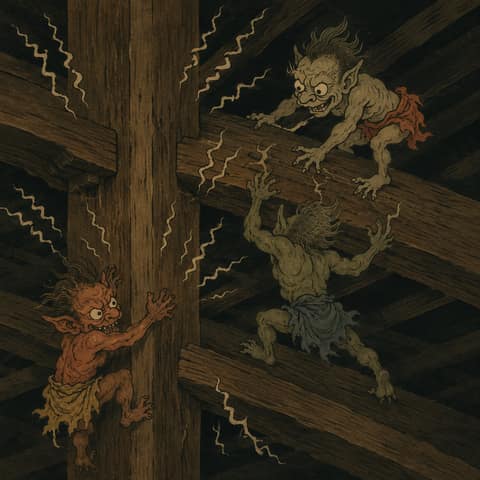
Household Spirits Courtly and aristocratic residences around Heian-kyō (Kyoto), Japan Drawing on the Konjaku Monogatari-shū, later scholarship calls it “Ita-oni” (Board Ogre). The entity is either a board itself or a phenomenon dwelling in a board, taking a plank-like form that juts from roof beams or lattices. Its motive and will are unstated, but its core act is crushing sleepers to death. In Heian court and aristocratic residences, night watch and gate duty were crucial, and tales of the uncanny often served to reinforce discipline. Here too, it bypasses two armed men and strikes a defenseless sleeping place, embodying the ethic that negligence invites death. While it aligns with the idea of spirits inhabiting objects, it lacks tales of aging into autonomy or growth, and is told as a transient manifestation of a specific board appearing to suit the scene. There are no records of pursuit or capture, and it appears and vanishes swiftly without leaving traces.
珍しい 
Pillow-Flipper
mah-koo-rah-GAH-eh-shee
Traditional Type – Temple and Shrine Anomaly Affiliation
Household Spirits Across Japan A pillow-flipping subtype rooted in old beliefs that pillows are linked to the movement of the soul and to boundaries. It manifests at thresholds between sacred and secular spaces such as certain parlors, pillars, or Buddhist rooms, turning sleepers’ heads toward a Buddha or principal icon, or simply inverting the pillow to signal a reversal of order. Noted in essays and picture scrolls from the Edo period onward, it often ties into temple Seven Wonders and scroll-haunt tales. In some regions it is read as the play of a zashiki-warashi, the sign of a spirit of someone who died in the house, or a guise of a shapeshifting animal. The fear it inspires has shifted over time: once viewed as a portent of deadly curse, in modern times it tends to be treated as a lighter bedroom haunting and prank.
一般 
Branching Fox
eh-dah-BOON-kee-gee-tsoo-neh
Modern Variant
Animal Shapeshifters the deep layers of a virtual repository It slips into quiet development environments like a shadow, sprouting branches with the same name to cloud human judgment. By slipping past reviews, or reverting only configuration files to an older form, it mass-produces bugs that refuse to reproduce. Its origins lie in the superstition of shadow-doubling and the fatigue of collaboration. One name yet two minds, it feeds on human hesitations and grows stronger.
名妖 
Sazae-oni (Turban Shell Ogre)
sah-ZAH-eh OH-nee
Pictorial and Allegorical Representation (Sekien Edition)
Animal Shapeshifters Japanese folklore A work by Toriyama Sekien that riffs on a transformation tale in the Book of Rites, caricaturing the principle by which a sea shell assumes a demonic aspect. Depicted as a turban shell with a human arm and an eye on its lid, it serves less as a harmful monster than as a visualization of ideas about metamorphosis and things-turned-spirits. It aligns with shell personifications in early modern Hyakki Yagyo paintings, conveying a sensibility that sees numinous presence in coastal nature. Later erotic ghost anecdotes are largely inventions and should be understood apart from this prototype.
珍しい 
Kiri Ichibē
KEE-ree EE-chee-bay
Traditional Lore Version
Ghosts & Spirits Niigata Prefecture (Minamiuonuma District; Minamikambara District) A multiplying apparition said to appear at night on mountain passes and bypaths in Niigata. It takes the form of a small child to lower one’s guard, then hounds its target into striking; each cut doubles its number, forcing flight. Its true nature is unstated—seen as a vengeful spirit or a mountain entity—but folklore stresses that its power fails at dawn or at the cock’s crow. The name “Ichibai” points to its doubling trait, and tales note chicken motifs on sword fittings acting as talismans. Its exact origin is unknown; encounter stories warn against night travel on mountain roads.
稀少 
Yarikechō (Spear Tuft Spirit)
yah-ree-keh-CHOH
Yarigechō (Iconographic Tradition)
Animated Objects & Undead Edo period, Japan A type of tsukumogami typical of early modern yokai art. The hair-spear used both as a practical weapon and as a symbol in processions was thought to accrue spiritual potency through associations with masters and tales of valor. In Hyakki Tsurezure Bukuro, Sekien depicted it wielding a wooden mallet, assigning it a specific object-name while drawing on older iconographic bones. The name Yarigechō likely arose where Night Parade motifs from the Muromachi era, Edo antiquarian taste, and the culture of famed implements converged. Modern print editions and nishiki-e varied the image, sometimes stressing the spear’s decorative plumes, yet it lacks distinctive oral lore and is known mainly through pictures and bibliographic notes.
名妖 
Hashihime (Bridge Princess)
HAH-shee-HEE-meh
Hashihime of Uji (Traditional Form)
Half-Human Beings Yamashiro Province (Uji River, Uji Bridge) An integrated portrayal of Hashihime as a local divinity of Uji Bridge on the Uji River and as the jealous demon-woman of medieval war tales and Noh. As a local deity she was venerated at the bridgehead as a water and land guardian, protecting crossings and safe passage. Traditions forbid praising other regions or singing lines that stir jealousy upon the bridge, reflecting the belief that local gods dislike talk that exalts elsewhere. In the later tale, a woman visits Kifune, undergoes purificatory austerities in the Uji River, becomes a demon, and encounters a warrior at Ichijō Modori-bashi. Toriyama Sekien noted the shrine at Uji Bridge, and the Noh play Kanawa fixed the image of a demon-woman crowned with an iron trivet. Folklorically, bridges are liminal spaces, linked to water deities, female divinities, and warnings against jealousy, so ritual and storytelling long coexisted. While invented details vary by source, devotion to Uji Bridge, the Modori-bashi encounter, and the dual nature of taboo and protection form the core.
稀少 
Hatahiro
HAH-tah-HEE-roh
Emaki Source – Sekien Edition
付喪神・骸怪 Japanese folklore A version based on the conceptual monster Toriyama Sekien presented through painting and notes. Resentment dwelling in a cloth takes serpentine form and wanders in search of its master, merging the symbolism of tool-spirits and snakes. As folklore data, independent oral accounts are scarce, so it remains a pictorial taxonomy that links tsukumogami tales with legends of loom sounds heard near water. Etymological notes mention associations with the performance term “nijūhiro” and wordplay, but firm sources are limited. Visually, a long bolt of cloth writhes into a snake shape, its tip commonly rendered like a tongue or a slit.
珍しい 
Shidai-daka (Ever-Rising Tall One)
SHEE-dye-DAH-kah
Canonical Folkloric Type
Mountain & Wilderness Spirits Chūgoku region (Shimane, Yamaguchi, Hiroshima, Okayama) A baseline profile of Shidaidaka as a roadside, look-up-type apparition recorded across the Chugoku region. It resembles a human silhouette with head and shoulders dissolving into darkness, and its height stretches or shrinks in response to one’s gaze. Harmfulness varies by tale, but fear intensifies through the act of looking up. Countermeasures include keeping your gaze lowered, watching the ground, or peering between your legs, which causes the figure to diminish and dissipate. It is linked to the Mikoshi-nyudo, and tales of the similarly named “Shidai-zaka” are viewed as slope or mountain-path variants. Hunter stories connect it with the nekomata, and identifications differ by locale. Creative embellishments are common, but the core taboo warns that one’s gaze amplifies the phenomenon.
珍しい 
Shōkichi Kappa
shō-kichi kappa
Shōkichi Kappa, the Sumo-Loving Kappa of Bungo
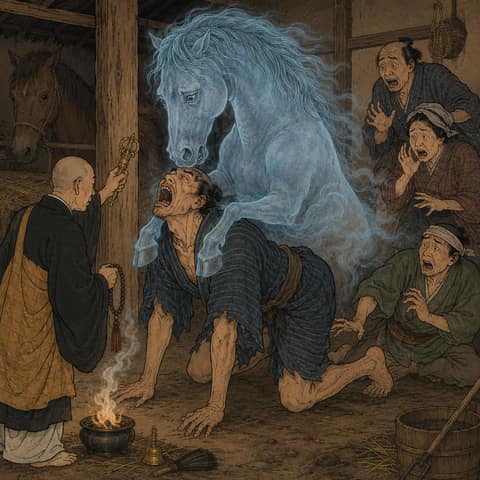
Water spirit Hita, Ōita Prefecture (old Bungo Province; Shōkichi and the kappa tale) This version turns to the phenomenon of "kappa possession" that the Shōkichi tale conveys. Most kappa stories play out at the water’s edge, but here the river sumo is carried right into the home. Brought back by his family, Shōkichi went on raging as if locked in a grapple with an unseen opponent—exactly the work, people said, of a kappa that had possessed a human being. A water-spirit climbing onto dry land by borrowing a human body: there lies the spine-chilling fascination of this tale. The means of quelling it, too, reflects the faith of the land. What first took effect was the power of Gō Yoshihiro’s signed blade. The belief that the kappa dreads a keen edge is found in many regions, and the detail that it raged again once the sword was removed shows that power plainly. What finally settled the disturbance was the prayer of a shugenja, an ascetic who trains secluded in the mountains. Quelling kappa possession with these two—the power of the blade and the ascetic’s spiritual force—is a hallmark of Kyushu kappa tales. Hita has gathered many kappa stories, the Hita Gunshi foremost among them, and together with the "Bungo Kawatarō" of the same Bungo, they attest to the depth of this region’s kappa beliefs.
名妖 
Killing Stone
Sesshōseki
The Killing Stone of Nasu, the Poison-Breathing Stone
Dwellings and Objects Nasu, Nasu District, Tochigi Prefecture (the Sesshōseki of old Shimotsuke Province) This version looks at how the Sesshōseki, as a poison stone, has been told of on the noh stage and at sites of worship. In the noh play Sesshōseki, when the traveling priest Gennō approaches the stone on the Nasu Plain, a village woman appears and tells the stone’s origin; in time the stone splits open and the spirit of the fox emerges from within. The spirit repents of the evil deeds of its life, vows to attain buddhahood, saved by the priest’s ritual power, and vanishes. Here the Killing Stone is not merely a stone that kills, but something in which a lost soul dwells, to be quieted through memorial rites. Around the Killing Stone lies a desolate land where no plant grows and sulfurous smoke hangs in the air, called from of old the Sai-no-Kawara, lined with countless Jizō statues that mourn the dead. The Nasu Onsen Shrine stands close by, and at its Goshinka (Sacred Fire) Festival each May, a rite is said to be held in which the shrine’s fire is carried before the stone to quiet the mountain’s fire and the stone’s numinous power. Seen this way, the dread of the Killing Stone is rooted less in a stone that moves of its own will than in the sense of a boundary: “step past here and you lose your life.” The very zone filled with poison fumes was feared as a threshold between the world of the living and the world beyond, and it was believed that calamity reached only those who trespassed that boundary.
伝説 
Hira-san Jirōbō
Hira-san Jirōbō
The Second-Seat Great Tengu — Hira-san Jirōbō
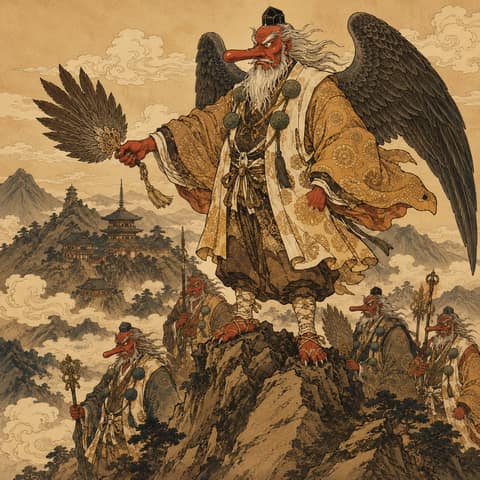
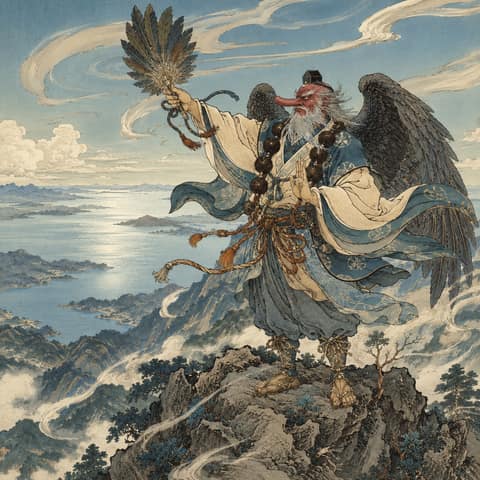
Mountain & Wilderness Spirits Mt. Hira, Ōmi Province (Shiga; western shore of Lake Biwa) The key to reading Hira-san Jirōbō lies in the meaning of the rank "second seat, next after Tarōbō," and in the medieval sources particular to Mt. Hira. In the tengu hierarchy, Jirōbō is held to be the second after Atago-san Tarōbō. This ordering appears almost in common both in the forty-eight tengu of the Tengu-kyō and in the Eight Great Tengu framework, and the very names Tarōbō and Jirōbō derive from the ordinals "one" and "two." Rather than being told of alone, Jirōbō appears more often paired with Tarōbō as the twin pillars of the tengu world. The firm ancient layer of Hira's tengu lies in the Hirasan Kojin Reitaku (by Keisei, 1239). This dialogue, in which the aged tengu of Mt. Hira answers Keisei's questions and speaks of the tengu world and the afterlife, is a primary source particular to Mt. Hira, showing that Hira held a firm place as a tengu sacred mountain in the medieval age. Here one common confusion should be set right. Jirōbō is often bound to the tale of the Chinese tengu Chira Eiju (= Zegaibō), but the original story in the Konjaku Monogatarishū, Book 20 runs on the plot of a tengu of Shintan defeated by a monk of Mt. Hiei, and does not name Mt. Hira as the seat of the Japanese tengu. Making Chira Eiju the tengu of Hira is a later arrangement; the tradition proper to Mt. Hira itself should rather be sought in the aforementioned Kojin Reitaku. The tale of relocation from Mt. Hiei is likewise understood not as historical fact but as a later narrative telling the changeover of a sacred mountain's leadership. Based at Mt. Hira, the sacred peak of Ōmi, fearing Buddhist law while testing human conceit—this coexistence of modesty and fortitude is the image of Jirōbō. Chigiri Kōsai of tengu scholarship, too, set Jirōbō in the place next after Tarōbō.
名妖 
Kejōrō (Hair Courtesan)
keh-JOH-roh
Printed Edition – Sekien School Variant
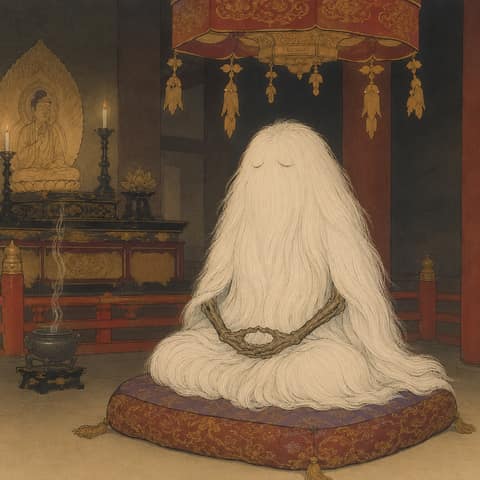
Household Spirits Edo period A canonical image based on Toriyama Sekien’s illustrations and Edo kibyoshi. Dressed like a courtesan of the pleasure quarters, its hair grows unnaturally long to shroud the body so the face cannot be discerned. Born from urban satire centered on Yoshiwara and a pun linking courtesans with shapeshifters, it appears as a literary construct with no proper name or origin tale. Sometimes read as a faceless yōkai, it serves as a symbol that reverses the viewer’s desires and assumptions. Sources are primarily printed editions, with scant oral tradition.
名妖 
Keukegen
KAY-oo-kay-gen
Kehakigen (Traditional Version)
General Classifications Japanese folklore A hair-covered apparition of uncertain origin first depicted in Sekien’s illustrated compendium. Its name implies “seldom seen,” and this rarity is considered its defining trait. Later links to dampness or illness are editorial interpretations without firm oral tradition. Adhering to the original source, only its appearance and rarity are treated as certain.
珍しい 
Kiko (Air Fox)
ki-ko
The Kiko — Mid-Ranking Fox Become a Breath of “Ki”
Animal Shapeshifters Throughout Japan (third rank in the fox hierarchy) This version digs into the role the Kiko plays among the four fox ranks: that of a boundary. The fox hierarchy is not merely an order of strength but a single ladder by which the beast draws step by step closer to spirit and to god. The rung on which the Kiko stands is the very seam dividing “the flesh-bodied Yako” from “the form-shedding Kūko and Tenko”. Where the Yako is known for visible mischief — leading travelers astray, taking on a guise to fool them — the Kiko, having already slipped free of its shell, turns its workings further inward: possessing a person, troubling the heart. The view that the fox in tales of possession is no ordinary Yako but a Kiko of deeper attainment is rooted right here. There is one more thing visible in the Kiko: incompleteness. Where the Kūko holds twice its power and goes on to become the Tenko and depart the human world, the Kiko cannot yet cut its ties to people. Swaying between the instinct of the beast and the detachment of a god, deceiving and possessing by turns, it is in a sense a fox still only halfway through its training. If the higher foxes are beings that watch quietly over the world, the Kiko is the one that, nearest of all to humankind, still struggles on.
珍しい 
Water-Begging Ghost
MEE-zoo-koi YOO-ray
Testament Ghost and Water-Begging Ghost (Traditional)
Ghosts & Spirits Across Japan (tales circulated mainly in Edo) A traditional reading grounded in the side-by-side entries of the Testament Ghost and the Water-Begging Ghost in Ehon Hyaku Monogatari. The spirits of those who died with last words unspoken or burdened by thirst appear at night to plead for water. Individual names and deeds are seldom told; instead they serve as moral parables urging memorial offerings. When monks chant sutras, perform memorial services, feed hungry ghosts, or make alms to the dead, their thirst is said to be soothed with the symbolic “sweet dew” described in scripture. Told in both towns and villages, they appear where people and water meet—by wells, bridges, graves, and roadsides. They stir pity more than terror, and tales warn that rough treatment brings a curse, while respectful rites lay them to rest.
名妖 
Suiko (Water Tiger)
sui-ko
The Scaled Suiko, Child-Sized
Water Spirits Hubei, China (introduced to Japan through Edo-period texts) This version digs into what sets the suiko apart: it is not a creature of oral legend but one shaped within the pages of books. Where the kappa was born from the fears of riverside life and took on countless forms and names from region to region, the image of the suiko travelled almost entirely through citations in Chinese materia medica and gazetteers. That is why its defining features stay remarkably consistent — a body the size of a small child, hard scales, the habit of baring its carapace on the autumn sand, and the trick of showing only its knees above the water. Japanese scholars cited these Chinese accounts while puzzling over how to square them with the kappa right in front of them. The *Wakan Sansai Zue* placed the two side by side and cautiously judged them "alike yet not the same," while the *Suiko Kōryaku* tried to file reports of water creatures from across the land under the heading "suiko." Toriyama Sekien's illustration in the *Gazu Hyakki Yagyō* is likewise a picture drawn from this continental learning. There are articles touting ways to capture it or its medicinal uses, but interpretations differ from book to book, and the truth remains unclear. The suiko, in the end, is a second face of the water spirit — the trace left by an early-modern attempt to reinterpret the familiar kappa through the lens of Chinese scholarship.
名妖 
Suiko-sama (Water Tiger Deity)
sui-ko-sa-ma
Suiko Daimyōjin of Tsugaru
Deities & Divine Spirits Tsugaru region, Aomori Prefecture (around Mt. Iwaki; Suiko Daimyōjin) This version digs into Suiko-sama as a faith that "raised a yokai all the way to a god." The kappa is by nature a fearsome creature that drags people into the water. The wisdom of the Tsugaru Suiko-sama cult lies in this: rather than slaying the kappa, it made the creature into a god who commands forty-eight of them as their head, entrusting it with the order of the waterside. The faith was bound tightly to the lives of children. The custom of offering cucumbers and floating them downstream in the river-playing season was at once a prayer to the deity and a way of impressing on children the everyday warning, "never let your guard down at the water." Benzaiten's form is borrowed for the sacred image because two water deities naturally merged into one. It shares only its kanji name with the ferocious "suiko" of the Chinese books; in substance the two are nothing alike. Suiko-sama is a water god in the manner of the snow country — one in which people reshaped the local dread of the kappa into an object of prayer. The specific rites and incantations vary greatly from district to district, and many have not survived to the present.
珍しい 
Kenmun
KEN-moon
Spirit of the Amami Banyan – Kenmun
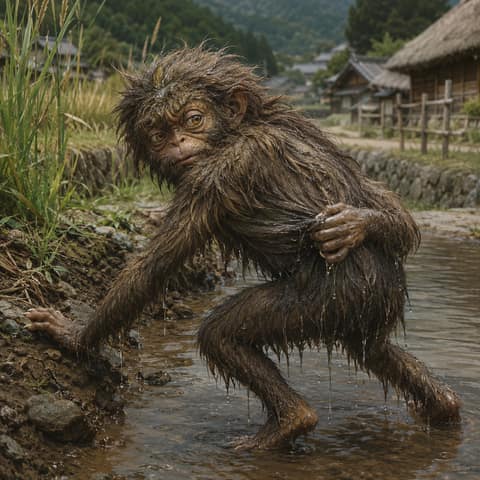
Water Spirits Amami Islands, Kagoshima (banyan-tree spirit, the Kenmun) This version looks closely at the form and nature of the kenmun—kin to the kappa, yet bearing colors all its own from Amami. It stands about as tall as a child, its skin tinged with red, its body covered in ape-like hair, with hair that is black or red. In the dish on its head it holds the water that is its source of strength, and its fingertips, its drool, and the dish itself are said to glow faintly. Where the mainland kappa is bound to rivers and pools, the kenmun makes its home in old banyan (gajumaru) trees and moves between sea and mountains with the seasons—a distinctive character rooted in the nature of the southern isles. Its range, too, spreads from island to island, with its own tellings handed down on Amami Ōshima, Kakeroma, Tokunoshima, Okinoerabu, and elsewhere. In the tales of older generations it was most often a harmless spirit that helped people, but as the ages passed its mischievous, menacing side came to the fore. As the island life lived alongside the forest fades, the kenmun’s own place, too, is slowly drawing away.
珍しい 
The Woman of Ikebukuro
ee-keh-BOO-kroh no OHN-nah
Edo Folk Belief: The Woman from Ikebukuro
General Classifications Ikebukuro, Toshima District, Musashi Province (modern Toshima, Tokyo) A late Edo period folk belief recounts that households employing a woman from Ikebukuro would suffer a barrage of noisy disturbances: sounds of thrown stones, damaged shutters, flying utensils and lanterns, and small fires flitting into the tatami room. Many versions begin with an affair between the master and a maid, and the phenomena cease once the maid is dismissed. Explanations vary, including obligations to the local tutelary deity, links to Osaki-possession tales from the Chichibu area, or simple human contrivance such as hoaxes and harassment. Rather than a single yokai individual, the term serves as a catch-all for disturbances tied to hiring women from certain locales, with parallel cases recorded for places like Ikejiri, Numabukuro, and Meguro.
稀少 
Kutsutsura
koo-TSOO-TSOO-rah
Iconographic Critical Edition
Animated Objects & Undead Japanese folklore A version organized from Toriyama Sekien’s anecdotes and imagery, presenting a beast-man figure bearing a symbolic clog (kutsu) to signify an animated implement. In Hyakki Tsurezure Bukuro, paired with the opposing page’s Long Crown, it allegorizes the proverb “Do not put on shoes in a melon patch, nor adjust your crown beneath a plum tree,” depicting caution against suspicion through a yokai image. No concrete sightings or harms are recorded; it is loosely linked to tales of creatures that eat melons in fields, and banishment is mentioned only via talismanic precedents. No firm association with specific Japanese locales is attested, and its design likely references Muromachi-period yokai scrolls featuring beast forms bearing shallow clogs.
伝説 
Kappa
KAH-pah
The Dish-Headed River Spirit – Kappa
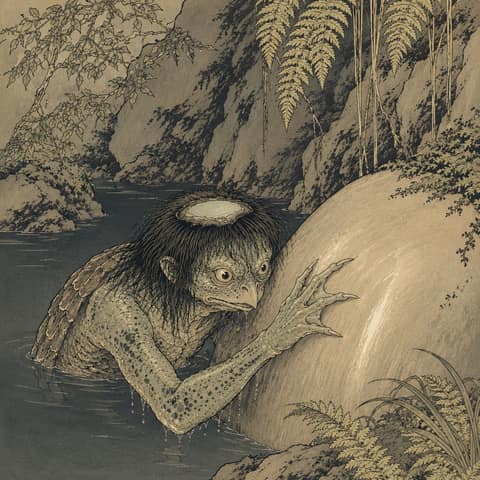
Water Spirits Rivers, ponds, and marshes throughout Japan "Kappa" is not, in truth, the name of any single creature. It is a collective term—the word by which the whole of Japan, each region in its own dialect, has called the water spirits that dwell in rivers and ponds. In southern Kyushu it is the Garappa; in Tōhoku, the Medochi; in Shikoku, the Enko; in Chūbu, the Kawaranbe; in Kinki, the Gataro; in Kyushu again, the Hyosube. From place to place the name and the form shift a little, and the total is said to exceed eighty. Some are close to monkeys, some shaggy with fur, some moving in troops. Yet all share a common core: they live by the water, hold water in the dish on their heads, and drag away people and horses. The kappa, in other words, is the shared name of a vast clan into which all the water spirits of the land have gathered. It is the reading of folklore studies that binds these many variants into one. Yanagita Kunio and Orikuchi Shinobu held that the kappa was originally a god who governed water—a water deity—who declined into a yokai as belief in it faded. The fact that in the komahiki legends the kappa always tries to pull a horse or ox into the water may itself be a memory of festivals in which horses and oxen were offered to a water deity in prayer for a good harvest. In Kappa Komahiki Kō (1948), Ishida Eiichirō compared this bond between horse and water deity with myths from across Eurasia. Precisely because it is a god of water, the kappa draws water to the fields, grants fish, and even hands down bone-setting remedies—while also drowning people and pulling out their shirikodama. Its twin aspects, blessing and curse, are the two sides of a fallen water deity. Traces of the water deity show even in the turning of the seasons. Across western Japan it is widely told that at the autumn equinox the kappa goes up into the mountains to become a yamawaro, and at the spring equinox comes down again to the river to return to being a kappa. The field god who descends from the mountains to the villages in spring, the mountain god who returns to the peaks in autumn—that idea of coming and going maps exactly onto the exchange between kappa and yamawaro. In this way the clan’s variants, too, are bound to one another as a single continuous terrain. The clan even has its legend of a chieftain. On the Kuma River in Kyushu the tale survives of Kusenbō, a kappa general who crossed over from the continent at the head of nine thousand kindred. Having drawn the wrath of Katō Kiyomasa, he was driven from the region, moved to the Chikugo River, and became one of the retainers of the Suitengū shrine in Kurume. That a kappa was imagined not as a lone monster but as a clan linked from river to river is plainly expressed in this tale of a boss. Places tied to the kappa are found all over the country. At Tōno in Iwate there is a "Kappa Pool" (Kappa-buchi) where kappa are said to appear, and at Jōken-ji temple, in honor of a kappa that put out a fire with the water from its head-dish, stand "kappa guardian lions" whose heads are shaped like a dish. At Lake Ushiku in Ibaraki the painter Ogawa Usen, who depicted kappa all his life, was called "Usen of the Kappa," and Tanushimaru in Fukuoka styles itself "the birthplace of the kappa clan." In the Kappabashi district of Tokyo a legend tells of Sumida River kappa who came each night to help a merchant pressing ahead with flood-control works. To this day kappa festivals are held in many places, and the kappa lends its name to sake brands and town mascots alike—remaining the most beloved of all Japan’s water yokai.
Showing 141 - 160 of 404 yokai