Yokai Encyclopedia
Encyclopedia of Japanese Yokai
珍しい 
Fire of the Akuro-gami
AH-koo-roh-gah-mee no HEE
Canonical Folklore Version
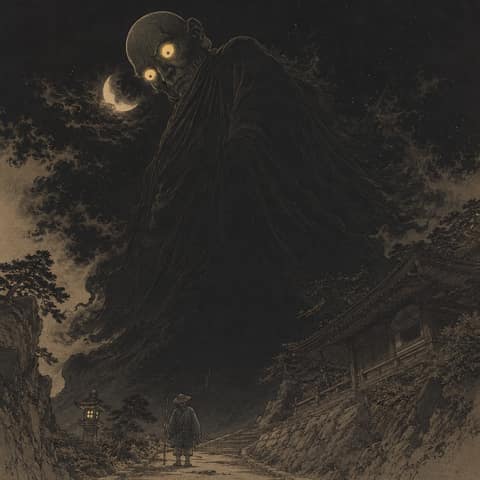
Natural Phenomena Spirits Ise Province (modern Mie Prefecture) A figure based on Edo-period records. On rainy nights it drifts low, coming and going like a procession of lantern lights. Rather than misleading travelers, it was dreaded for bringing illness to anyone who drew near, and the only recourse was to lie flat on the ground until it passed. Local names vary, and it is classed as one type of strange fire from Ise Province. Its substance is unknown, it makes little sound, and reports note few sensory details such as heat or odor even at close range.
珍しい 
Akki (Malevolent Oni)
AHK-kee
Akki (Traditional Image)
General Classifications Across Japan The traditional image of the akki is a collective notion of “oni” that personify external calamities such as epidemics and natural disasters, spoken of not as individuals but as targets to be subdued. After Buddhism took root, they were systematized as beings set against benevolent deities, often depicted as groveling demon figures trampled by the Four Heavenly Kings or Wisdom Kings to display divine might. Among commoners, practices like Setsubun bean-throwing and displaying foul-smelling or thorny materials expressed a shared intent to guard boundaries and repel misfortune at the threshold of the home. In texts they overlap with terms like akuma and jaki, and over time could also signify inner demons of desire and agitation, yet in daily practice they were treated chiefly as personifications of external threats.
伝説 
Atago-san Tarōbō
Atago-san Tarōbō
Supreme Commander of the Tengu — Atago-san Tarōbō
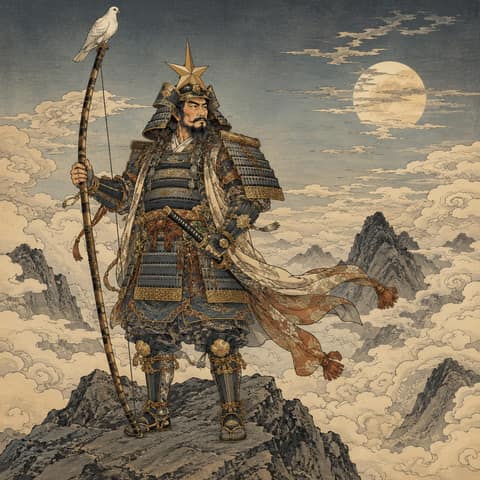
Mountain & Wilderness Spirits Mt. Atago, Yamashiro Province (Ukyō-ku, Kyoto) What made Atago-san Tarōbō "the supreme commander of the tengu"? The question lies in the overlap between the history of the Atago cult and the figure of this single tengu. As a sacred mountain of fire-warding, Mt. Atago was the center of the Atago Gongen cult, syncretized with its original Buddhist form, Shōgun Jizō. The Hakuun-ji engi, which transmits its founding, tells of the ascent of En no Ozunu and Taichō, the shrine on Asahi Peak, and the syncretism with Shōgun Jizō. Shōgun Jizō is an armored Jizō mounted on horseback, joining victory in war with protection from fire. Bearing the numinous power of this Atago Gongen, Tarōbō took on the character of a thaumaturge and guardian deity surpassing any mere mountain apparition. The star-anise flower against fire, the talismans above each hearth, the Atago confraternities (kō) across the land—this density of folk practice was the foundation that raised Tarōbō to the summit of the tengu of every province. The oldest-class textual witness to his proper name is found in the Engyō-bon Tale of the Heike (transcribed 1309–10), where he appears as "the foremost great tengu of Japan" and "Tarōbō of Mt. Atago." As to his identity, the theory in the Genpei Jōsuiki of the fallen Shinzei (Kakimoto no Ki Sōjō) is renowned; but Shinzei was a man of the early Heian period, and since the dates do not match the era the Jōsuiki sets, this is an undeterminable "tradition." It should be read as a tale that lays over Tarōbō the Buddhist notion that arrogance casts a high monk down into a tengu, and his origin cannot be fixed to a single source. His standing as supreme commander is attested by both the performing arts and the scriptures. The Noh play Kurama Tengu of the Muromachi period chants the great tengu of the provinces in geographical order, and the early-modern Tengu-kyō arrays the forty-eight tengu and places Tarōbō at their head. The image of him leading a retinue of crow-tengu and commanding the lords from Hira-san Jirōbō downward rests upon this accumulation of medieval tengu tales. An iconography of him armed and astride a boar is also transmitted, yet his essence lies in being a Gongen-like presence enthroned on the peak, guarding the sacred precincts across Yamashiro. Chigiri Kōsai of tengu scholarship likewise set Tarōbō at the apex of the great tengu of all the mountains.
珍しい 
Hand-Eyes
TEH-no-meh
Traditional Picture-Scroll Reference Edition
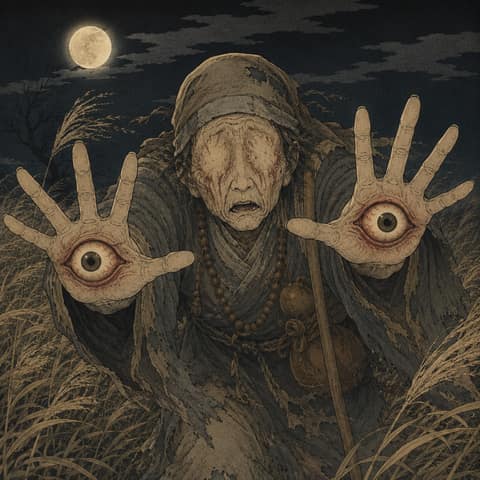
Mountain & Wilderness Spirits Japanese folklore An interpretation grounded in the imagery found in Sekien’s Gazu Hyakki Yagyō and night-parade picture scrolls from the Tenpō era onward. It is depicted as a shaven-headed figure like a blind monk, with large eyeballs set in both palms, standing in a moonlit wasteland. Narrative explanations are sparse, but linked to the illustration and tale in Shokoku Hyaku Monogatari, it is assumed to locate targets in darkness with the eyes in its hands and to sniff out those who have fled and hidden. In collected folklore it sometimes connects to vengeful spirits of the blind, and is often read as a symbol of exchanged sight and touch, witnessing and exposure. Etymological wordplay has been suggested (raising a hand-eye, bald monk), but none is definitive.
稀少 
Hossumori, the Fly-Whisk Guardian
HOSS-soo-MOH-ree
Sekien Iconography Standard
Animated Objects & Undead Edo period; derived from picture scrolls Based on the tsukumogami of the fly-whisk as depicted in Toriyama Sekien’s Hyakki Tsurezure Bukuro. Seated cross-legged beneath a canopy, it embodies the purity of a ritual implement and the quietude of a spirit matured through long use. Strong Zen symbolism underlies it, with an allusion to “the Buddha-nature of the dog,” implying that Buddha-nature manifests beyond sentient and insentient distinctions. In China the fly-whisk was said to dispel demonic hindrances, leading to the idea of a tool-spirit that allows nothing to obstruct enlightenment. Though a tool-yokai, it is not told to cause disturbances like other Hyakki creatures; instead it sits in composure, contemplating its own nature. Its image is chiefly tied to places where ritual implements gather within temples—main halls, monks’ quarters, and storerooms—rather than to specific local legends.
珍しい 
Chōchin-bi (Lantern Fire)
CHOH-cheen-bee
Chochin-bi (Lantern-Flame, regional will-o’-the-wisp type)
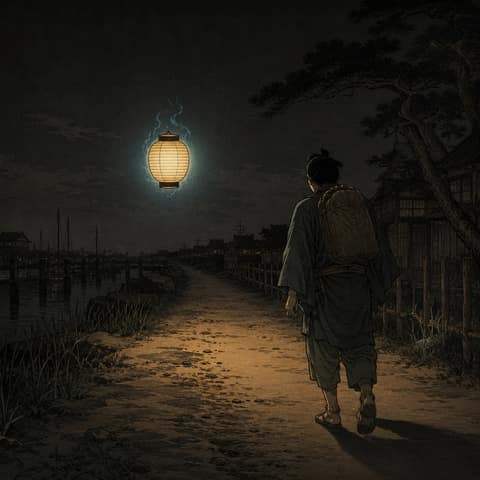
Natural Phenomena Spirits Across Japan (notably Shikoku, Yamato, and Ōmi traditions) A regional catch-all name for ghostly lights about the size of a paper lantern. In some areas it is conflated with kitsune-bi and tanuki-bi, its name stemming from the idea of monsters lighting lanterns. It appears on rainy nights along riverbanks, dikes, and graveyards, drifting at a fixed height. Accounts vary by era and locale: vanishing when approached, splitting when struck, or marching in clusters. In folklore it portends untimely death or a curse and marks taboos along the roadside, anchoring tales that warn against pursuit or striking it. It appears in early modern essays and kaidan, sometimes gaining proper names (such as Koemon-bi) and lodging in local memory. Natural ignition and animal-origin theories coexist, and its true nature remains unsettled.
稀少 
Nadezatō (the “Smoothing” Blind Monk)
NAH-deh-zah-TOH
Iconography-Based Version
General Classifications Yatsushiro, Kumamoto Prefecture (Matsui Collection) This version relies solely on images from picture scrolls with minimal notes. Nade-zato has a transmitted name and appearance, but the textual account is missing, so its nature and conduct cannot be fixed. The iconography shows a shaven-headed, blind masseur-like figure with eyes left undrawn; some depictions emphasize long fingers or claw-like hands. Related imagery includes an identical type titled “Mugan” (No-Eyes) in Edo-period Hyakki-zu, suggesting variant naming. Tada Katsumi notes that nade may connect to nademono, which transfers defilement by touch, and to an old byname for “cat,” hinting at a being that feigns meekness to hide its true nature; however, this is scholarly interpretation, not a firm local tradition. Accordingly, abilities, weaknesses, and habits are scarcely recorded and should be treated as unknown.
一般 
Kazutsumi Dōji (Number Block)
kah-zoo-TSOO-mee DOH-jee
Modern Edition
Half-Human Beings Urban preschools; beneath living room floors The more learning tilts toward tablets, the more often it appears, turning problems into tangible forms to restore a sense of touch. It subtly shifts difficulty to let safe failures stack up. When the block tower holds steady at the peak, understanding sets in, and if it falls, it offers a new angle. For parents and teachers, it rings like a wind chime to cue the right rhythm of guidance.
稀少 
Fuguruma Yōhi (Letter-Carriage Enchantress)
FOO-goo-ROO-mah YOH-hee
Iconographic Edition, Sekien Toriyama Source
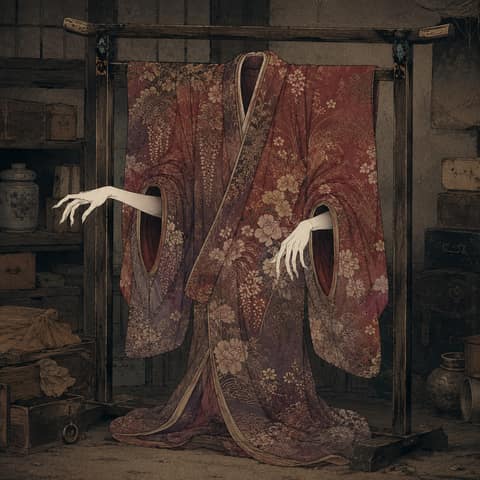
Animated Objects & Undead Edo period An interpretation grounded in the imagery and captions of Toriyama Sekien’s Hyakki Tsurezure Bukuro. The document cart was a conveyance for papers in the imperial court, temples, and aristocratic residences, kept ready for emergencies. The accumulated sentiments within long-kept love letters are thought to congeal and manifest as a lady-in-waiting–like apparition. With little basis in oral tradition, this is a conceptual yokai born of early modern literature and painting, more often told as a presence that displays and summons remorse than as one causing concrete harm. The customary name is Fumikuruma Yohi, though later sources sometimes confuse it with Fumikuruma Yoki.
名妖 
Hōsōshi (Exorcist of the Great Exorcism)
HOH-soh-shee
Hōsōshi of the Courtly Tsuina Rite
神霊・神格 Imperial court (continental ritual imported to Japan) In the imperial court’s Great Tsuina exorcism, this figure confronts and drives out pestilential oni. Wearing a four-eyed square mask, bear hide, and armed with a halberd and great shield, he leads pages and tsuina attendants to circuit the four directions of the palace. The rite follows set forms—onmyoji invocations, drum cues, and expulsion beyond the gates—and later influenced demon-chasing observances at temples and shrines. By the late Heian period, shifts in the term tsuina saw him at times enact a visible “oni role.” Though attire, implements, and routes changed with ceremonial norms, the core purpose remained the banishment of epidemics and ill fortune.
稀少 
Hiyori-bō (Fair-Weather Monk)
hee-YOH-ree-boh
Sekien’s Illustrated Edition: Hiyori-bō
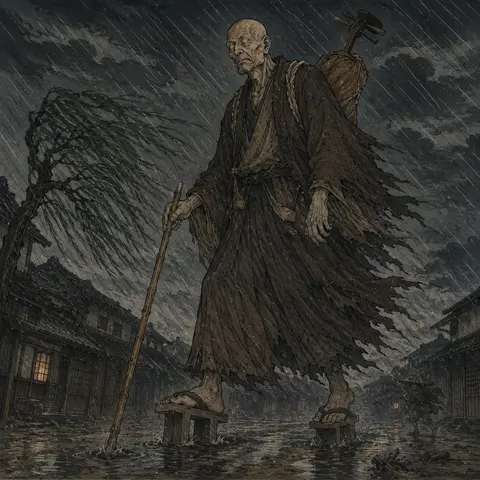
Weather & Calamity Spirits The mountains around Hitachi Province (modern Ibaraki Prefecture), Japan An interpretation based on Toriyama Sekien’s image in Konjaku Gazu Zoku Hyakki of a yokai that governs fair weather. Said to be sighted in the mountains during sunny days and absent when it rains. Historical field lore is scant; the figure seems to layer folk weather prayers (teru-teru-bōzu, hiyori-bōzu) and the image of weather-working ascetics or monks onto a yokai form. Identification with Chinese drought deities is a modern scholarly view without direct evidence. Thus its form is told as a simple monk-like silhouette, a symbolic bearer of prayer for clear skies and the act of watching for good weather.
名妖 
Prince Sawara
SAH-wah-rah shin-NOH
Emperor Sudō as Vengeful Spirit – Traditional Goryō Version
Ghosts & Spirits Yamato Province An image grounded in local and court memories that Prince Sawara’s resentment manifested as a goryō. Amid suspicion over his alleged crimes he died by fasting, and later plagues, famine, and illnesses afflicting the imperial line were seen as his curse. The court sought reconciliation through land donations, sutra recitations and esoteric rites, reburial, and posthumous honorific titles, carefully enshrining him as a goryō. Revered as a power that judges right and wrong, he received offerings at shrines and temples, seasonal services, and apologies at his mausoleum. In later years, rites centered on the Sudō Tennō Shrine took form, spreading protective faith between the capital and Yamato. His grudge was understood not as private spite but as a warning against political disorder and calumny, prompting rulers to vow purity and justice with sacrifices, written oaths, and sutra offerings. The spirit bears a wild aspect, yet when appeased turns to guardianship.
珍しい 
Akashi-sama
ah-KAH-shee-sah-mah
Standard Folkloric Account
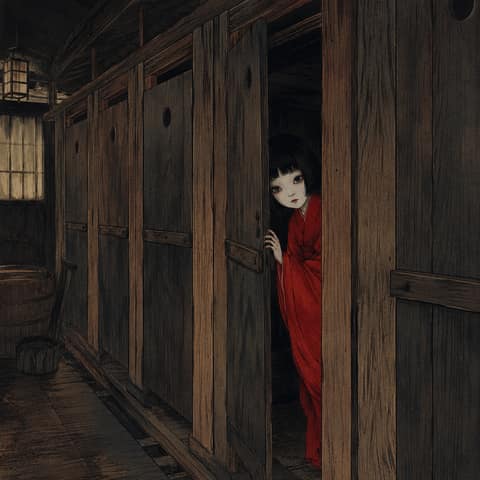
Ghosts & Spirits Hodogaya Ward, Yokohama, Kanagawa Prefecture A compiled standard telling of Akashi-sama from Hodogaya Ward. Its core traces to the late Edo period: a deranged lord craved bloodshed, cut down a hunter’s daughter, and was slain by the hunter. Thereafter the name was feared and spread as an oral warning against going out at night. Details like appearance, clothing, and the hour of manifestation are inconsistent; storytellers stress effects such as “it appears” or “it takes you away.” This is a scare-tale type of uncanny being tied to local norms, functioning practically in household discipline and communal safety. Identifying real persons or places requires caution; it is sometimes paired with the proper name “Akashi Gozen,” but lineage remains unclear.
稀少 
Boroboroton
boh-roh-boh-roh-TOHN
Sekien Zufu Edition
Animated Objects & Undead Edo period, Japan An image based on Toriyama Sekien’s Hyakki Tsurezure-bukuro. A futon long used and then cast aside rises at night, bounding about the room to startle its former owner. Its malice is mild, acting mainly as a chastening presence that creates a commotion to spur repentance. The name is often read as a play on the tattered fabric’s “boro-boro” and the term for Fuke Zen monks, intertwining beliefs about spirits inhabiting tools with literary wit. Though local folk attestations are scarce, iconographically it is treated as a link in the lineage of tsukumogami tales.
名妖 
Moon Rabbit
TSOO-kee-noh oo-SAH-ghee
Moon Rabbit Pounding Mochi
Animal Shapeshifters Across Japan (widespread after the arrival of Buddhism) An image of the Moon Rabbit grounded in Japanese iconography. From Asuka-period examples onward, the rabbit within the lunar disk was paired with the solar crow in medieval Buddhist painting and received as a bearer of celestial phenomena. In early modern times, depictions of a rabbit using a Chinese-style mortar and pestle spread through books and prints, and by the eighteenth century the mortar shifted into a characteristically Japanese hourglass shape. The rabbit came to be understood not as compounding an elixir of immortality but as pounding mochi, linking it through wordplay to moon viewing and full-moon festivals. In lore, a self‑sacrificing rabbit ascends to the moon by Indra’s grace, with the lunar shadows and smoke-like markings read as its traces. In folk practice, people gazed at the moon seeking the rabbit’s silhouette, and the theme persisted in moon‑vigil gatherings and storytelling, overlapping with other celestial yokai and lunar deities.
一般 
Moon-Eater Veil
TSOO-kee-goo-ee GAH-koo-shee
Contemporary Edition
Half-Human Beings Urban high-rises and suburban overlooks in Japan Drawn by the city’s flicker and the simultaneous cheers of social media, it appears when everyone chases the same moment in the same frame, stretching its shadow long. It pinches the boundary of waxing and waning like a thin bookmark and rounds only the moon seen through lenses. In dreams it seeps dusk through gaps in blackout curtains, planting a déjà vu of conference rooms and classrooms suddenly sinking into twilight. Those caught by it feel anxious that they “didn’t capture it” even after witnessing celestial events, and on full-moon nights they search for missing crescents. Rarely, for those who observe carefully and honor record and experience separately, it returns the image with a slight rim of shadow left.
稀少 
Uyauyashi
oo-yah-oo-YAH-shee
Iconographic Tradition Edition
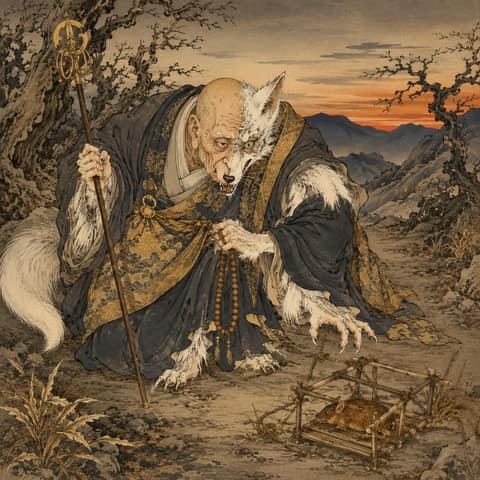
Mountain & Wilderness Spirits Japanese folklore A reconstruction based on imagery from picture scrolls. It kneels low to the ground, the body slack, skin ashen-brown mottled with pale spots. The face is indistinct, the line between mouth and nose blurred, with a damp sheen. In keeping with rare records that preserve little more than its name, no guiding motive is assigned. Said to be seen as a crouching lump by mountain paths or along thickets, it inspires awe and a sense of distance. If approached, it withdraws before its form can be fixed, making pursuit difficult. No confirmed harm is attributed to it, and encounter tales remain general.
稀少 
Oboroguruma (The Hazy Carriage)
oh-BOH-roh-goo-ROO-mah
Oboroguruma (after Sekien’s Iconography)
Household Spirits Kyoto A depiction of the Oboroguruma based on Toriyama Sekien’s image and Edo-period readings: a half-transparent ox-drawn carriage appears on a hazy night, its blinds blocked by an enormous face. It is said to echo rancor from Heian-era carriage quarrels, yet avoids naming individuals or tying to single incidents, instead embodying social tensions from festivals and spectacles that possess objects. It is also understood as part of the Night Parade of One Hundred Demons, startling people through a double sign of sound (creaking wheels) and form (an ox cart with a face). Direct harm is not always told; it manifests as a token of dread and ill omen, prompting witnesses to recoil. As an object-yokai, old carts and festival gear set the stage, and disputes over space or viewing cause the tale to arise. Excess specifics are avoided, with the hazy night and cart sounds serving as its marks of appearance.
名妖 
Konoha Tengu
KOH-noh-hah TEN-goo
Konoha Tengu (Classical Depiction)
Mountain & Wilderness Spirits Across Japan (mountains and fields of Suruga, Tōtōmi, Suō, etc.) A figure based on Edo-period essays and ghost tales. Ranked below the long-nosed yamabushi-style tengu, it performs menial tasks and is described as birdlike or as a human-faced bird. Accounts vary by region and source: flocks seen at night catching fish on the Ōi River in Suruga, references to them as white wolves within the tengu realm and as elder wolves elevated in rank, and tales of trickery such as a hunter in Iwakuni being toyed with by a tengu disguised as a boy. Overall, rather than causing great harm to people or livestock, they tend to interact through shapeshifting and bewilderment. Ukiyo-e sometimes shows them resting in trees, suggesting they are not invariably violent. Their nature is tied to the mountain borderlands, quick to sense human intrusion and retreat.
名妖 
Kodama (Tree Echo Spirit)
koh-DAH-mah
Kodama (Ancient Tree Aspect)
Mountain & Wilderness Spirits Mountain forests across Japan An image of the kodama rooted in ancient beliefs about tree deities. It dwells in old trees and is understood as a presence that answers through sound and subtle signs. Its form is unfixed, keeping itself unseen while warning people not to break the laws of the mountain. Drawing on folk readings of the echo phenomenon, it highlights ties to the manners of woodcutters and pilgrims. Following tradition, it avoids excessive personification and invented anecdotes.
名妖 
Kodama (Tree Echo Spirit)
koh-DAH-mah
Kidama-sama of Aogashima
Mountain & Wilderness Spirits Mountain forests across Japan A wood spirit from Aogashima in the Izu Islands, long honored by islanders as “Kidama-sama” or “Kodama-sama,” enshrined at small altars set at the roots of great cedars. The island forest drinks sea wind and volcanic breath, driving deep roots through shallow soil. The spirit dwelling there is not a mere echo, but an ancient memory woven from the age of the tree itself. At dawn mist, if you call its name before the shrine, the reply comes only once, a slightly damp sound, taken as a sign of assent. If it returns twice or thrice, uneven and jarring, it warns that the season is wrong—do not cut. Before felling wood, locals offer a handful of rice, sea salt, and a cup of shochu, tap the trunk three times, and state the reason and the count. Kidama-sama honors this rule: when respect is paid, it sets the wind fair, keeps blades from dulling, and prevents workers from losing their way. If slighted, the mountain’s sounds grow muddy, blades kick against knots, and toil is shadowed by illness. Its form is uncertain, yet elders speak of a “shadow of rings”: when the bark reddens in the evening glow, a single pale eye like a water mirror appears deep in the grain and melts away. Before great winds or earth-rumblings, pebbles at the shrine rearrange themselves, a sign of the forest’s breath in disorder; those who heed it halt farm and boat work and lessen harm. It is not closed to outsiders: give your name, bring salt as a gift, keep your voice low before the shrine, and the returning echo softens and the mountain path confuses less. Laughing and shouting bring a delayed, high, splintered reply that lingers in the ear and upsets your sense of direction. When a tree’s life nears its end, Kidama-sama may appear in dreams to say, “Now I change worlds.” Villagers take this as a good omen, planting three saplings after a fall and moving the shrine to the new root to carry the breath onward. Thus the island forest renews by generations, and the spirit moves without fading, a vivid afterimage of the old tree gods living strong on a sea-bound isle, quietly listening as a mediator between mountain rites and ocean sustenance.
名妖 
Kodama (Tree Echo Spirit)
koh-DAH-mah
Southern Island Kinushi-Haunted Kodama
Mountain & Wilderness Spirits Mountain forests across Japan Among the kodama whose echoes are heard across Japan, a southern island variant dwelling especially in Okinawa’s Yanbaru and sacred utaki groves is known as the Kinushi-Haunted Kodama. As its name implies, it settles like a lord within each individual tree, living in sync with the tree’s breath, the flow of sap, and the spread of its roots. Old lore says that if a woodcutter lightly taps the trunk before the first axe bite and offers a name and prayer, the kodama will tune the sound within the wood, align the wind with the intended fall, and guide the work safely. Strike in silence, however, and the tree will creak and cry, hollow tones will stutter across the mountains, and within days the surrounding leaves will lose color as if scorched. On uneasy nights, a heavy thud may carry through the mountain village though no tree has fallen; this is said to be the cry of a Kinushi-Kodama in unbearable pain. The tree where that sound is heard will soon shed dieback from its crown, white mycelium will gather at the roots, and its life will end. Witnessing this, elders understood that sound is the true form of the kodama, and passed down taboos: do not raise your voice at the forest’s threshold, and when calling a tree by name, pause to await its answer. Though it has no body, at dusk the air around the roots will sometimes shimmer like water and a childlike laugh may echo twice or thrice; islanders take this as a good omen and offer salt and black sugar to that tree. If a small child naps in its shade, mosquitoes and midges keep away and the sea breeze softens. Elders say that when winds from beyond the sea make their rounds among the mountain gods, the kodama resonates with the wind and guards the village bounds. Often confused with mountain echoes, the Kinushi-Haunted Kodama differs in that it does more than repeat a voice: by the timing and tone of its reply it foretells fortune. A clear prompt note means a good day for work, a heavy delayed reply is a sign to rest, and a muffled response from within the trunk portends sickly leaves. The islands also keep rites for transplanting trees. On the eve of root-pruning, stroke the trunk three times and name the soil of the new site; the kodama will fold the root tips and slim itself so it will not thirst during the journey. Neglect this and hollow knocks will sound nightly at the new place and the household may fall to fever. In coastal banyans dwell playful spirits known as Kijimunā. In older thought, Kijimunā are those Kinushi-Kodama that took on a more human-like notion of form: the kodama is the voice of the roots, the Kijimunā the laughter of the branches. Both are tree divinities at heart, guiding the respectful and chastening the careless with sound. Thus in the southern island forests, sound is law, and people and trees have long lived by each other’s breath.
稀少 
Mokugyo Daruma
MOH-koo-gyoh dah-ROO-mah
Iconographic Tradition, Sekien Lineage
Animated Objects & Undead Japanese folklore An interpretation of a tsukumogami rooted in Toriyama Sekien’s imagery, layering the sleepless symbolism of the wooden mokugyo with Daruma’s rigor of training. More often understood as a moral metaphor within temple culture than as a tale told to frighten. Some regions claim a mokugyo sounds on its own in the hall at night, but systematic oral tradition is scarce. Later artists such as Yoshitoshi followed the design, fixing the visage of a face upon a mokugyo seated on a round mat. It is positioned less as a source of terror than as a presence that sharpens the tension of practice.
珍しい 
Shu no Ban
SHOO noh BAHN
Classical Sources Version: Vermilion Tray (Watcher of Necks)
Ghosts & Spirits Echigo and Aizu, various provinces (Japan) In early modern tales, the Vermilion Tray is depicted as a red-faced monk-like figure, appearing as an accomplice of the Long-Tongued Crone or showing its visage alone, reappearing to unnerve and harm people. The name varies between “Watcher of Necks” and “Vermilion Tray,” commonly read as Shunoban. Classic illustrations and yokai prints note a red face, horns, a split mouth, and a fiery aura, though details differ by source. Encounters occur mainly at night at shrine gates, in wastelands, and in tumbledown shacks, and the harm is told as loss of spirit leading to fainting, lingering illness, or death. Reports span regions such as Aizu and Echigo, not as a fixed local deity but as a circulating tale-type of the uncanny.
Showing 121 - 140 of 404 yokai