Yokai Encyclopedia
Encyclopedia of Japanese Yokai
稀少 
Kosame-bō (Little Rain Monk)
koh-sah-meh-BOH
Sekiens Iconography Edition
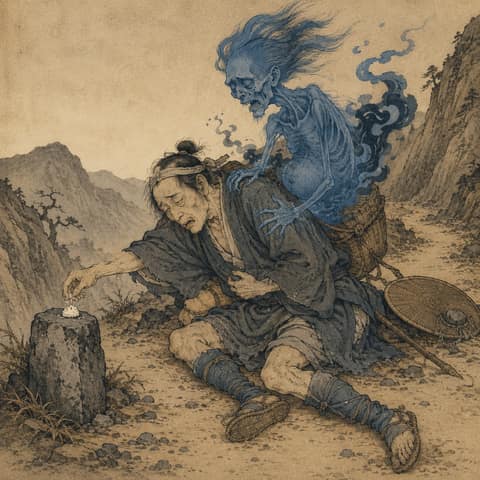
Mountain & Wilderness Spirits Around Mount Ōmine and Mount Katsuragi (tradition) A reconstruction based on Toriyama Sekien’s image and brief note. It appears as a small monk drenched by rain, emerging on rainy nights in the mountains. It softly asks passersby for offerings due to a monk, but refusal does not necessarily bring harm. Its place is tied to the sacred Shugendō ranges of Ōmine and Katsuragi, yet no verified lore links it to specific temples or persons. Later sources that say it begs for food or small coins likely simplify Sekien’s term “sairyō” (offerings), with little direct oral backing. Its wandering is said to occur only on fine-threaded rainy nights, and reports from clear nights or downpours are uncertain. Methods to banish or summon it are unknown, and meetings on mountain paths are told merely as fleeting oddities.
稀少 
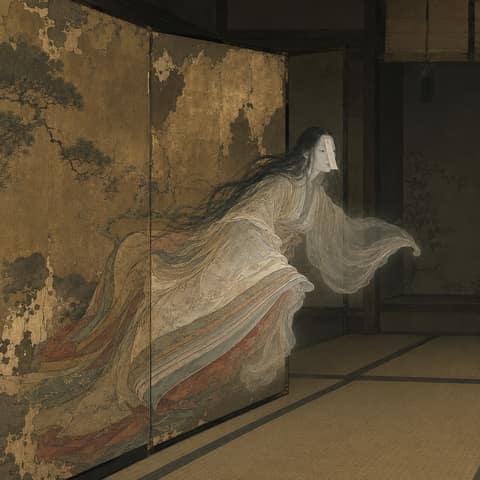
Byōbu-Nozoki (Screen-Peeker)
BYOH-boo no-ZOH-kee
Iconographic Tradition–Conforming Version
Animated Objects & Undead Japanese folklore Centered on the commentary in Toriyama Sekien’s Konjaku Hyakki Shūi, this reading emphasizes the habit of peering in from beyond the folding screen. Rather than causing harm directly, it primarily spies on hidden affairs. Some note that the image of lofty screens in Chinese classics shaped its formation, while in Japan it became linked to the belief that bedroom furnishings can accrue spirit, with a folding screen that has long reflected human lives aging into a yokai. It is not a fixed local deity but is understood as a type of haunted implement tale (tsukumogami).
伝説 
Yamauba
yah-mah-OO-bah
Yamanba (Traditional Folkloric Form)
Mountain & Wilderness Spirits mountain regions An elderly woman with white hair and a body hardened by life in the mountains, she is famed as the nurturing figure who raised Kintaro. Her deeply lined face reflects priceless life experience, and she offers precise guidance to the lost. Though she may appear strict, a profound love resides beneath the stern exterior.
伝説 
Yamauba
yah-mah-OO-bah
Mother of Kintaro
Mountain & Wilderness Spirits mountain regions Deep in the Ashigara Mountains, in a secluded hollow along bamboo ridgelines untrodden by humans, dwells a lineage of yama-uba known as the Yae-giri Mother Form. Bathed at birth in dew gathered on layered paulownia leaves and nourished by the breath of the mountains, this line is said to conceive children through union in dreams with an akairyū—an “red dragon” that appears on nights when crimson vapors gather. They rarely mingle with the human world, opening paths for those who keep the mountain’s order and baring fangs at those who trample its law. The Ashigara Yae-giri Mother Form takes as her charge the raising of children, favoring those with especially strong vital spirit. With few words she teaches how to split firewood, read the presence of beasts, ford streams, follow the courses of stars, and use the virtues of roots, leaves, and bark. When a child stumbles on a stone she watches and smiles, and when blood is drawn she silently applies moss juice. It is not pampering but passing on the mountain’s severity as it is. The crimson vapor seen in the Konjaku Monogatari is her warding veil, a barrier that blinds the eyes of outside gods. When Yorimitsu ascended from Kazusa, he recognized that vapor and sent Watanabe no Tsuna, an act born of the ancients’ intuition about this Mother Form’s power. In a thatched hut lived an old woman and a youth not yet twenty. The old woman called herself a demon-woman and felt no shame for her bond with the dream-red dragon, saying only that the child was born according to the mountain’s law. The boy she raised was later named Sakata Kintoki and became famed, yet once a child enters the world the Yae-giri Mother Form releases attachment and fades like mountain mist, caring nothing for wealth or honor, wishing only that the mountain’s balance remain unbroken. In Edo times, when the Kimpira jōruri was popular, she was portrayed as an ogress, but in old tales of Ashigara, oni signifies awe-inspiring power and is not confined to evil. Stories of bearing a thunder child and of a red dragon entrusting a child to the paulownia atop Mount Kintoki show this lineage’s dual nature of receiving from heaven and nurturing on earth. When sharing the mountain’s bounty she wears the face of an old mother, against ravagers she takes the aspect of a peak-dwelling oni. At midnight, when crimson vapor drapes the ridge, she consults the stars over a child’s fate and, if needed, commands beasts and trees to open the way. She leaves no treasure, only marks carved in wood grain and the remembered weight of a hand-axe in a child’s palm. Even now, on mist-laden mornings deep beyond the Ashigara Pass, she is said to listen for the breath of those who are meant to be raised, hidden within the rustle of bamboo wrens.
名妖 
Yamabiko
yah-mah-BEE-koh
Traditional Figure (Kodama and Mountain-Deity Retainer Interpretation)
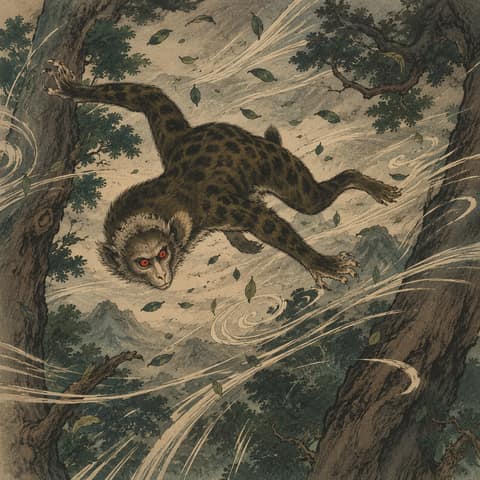
自然現象・自然霊 Across Japan (mountains and gorges) Yamabiko is the personification of echoes in the mountains, interpreted as a kodama or a retainer of the mountain deity. Its habit of repeating words back is seen as a boundary-marking reply within the mountain domain, warning against reckless shouting that disrupts the mountain’s vital energy. Early modern images depict it as a small beast akin to a dog or monkey; figures in Hyakkai Zukan and Gazu Hyakki Yagyō have been linked to the yama-ko in Wakan Sansai Zue and to Penghou, said to dwell within trees. Depending on region, intermediaries vary—bird calls like the yobukodori or resonant rocks such as “Yamabiko Rock.” Phenomenon, spirit, and monster imagery overlap in layered tradition.
珍しい 
Yamamoto Gorōzaemon
yah-mah-MOH-toh goh-ROH-zah-eh-mon
Inō Mononoke-roku: Variorum Tradition
Mountain & Wilderness Spirits Miyoshi, Bingo Province (modern Miyoshi City, Hiroshima Prefecture) This version builds on a record narrative centering on the Miyoshi anomalies of Kan’en 2. The chieftain declares himself in samurai guise at the close of the thirty days of hauntings, mentioning a wager with Kamino Akugorō. He states he is neither tengu nor fox spirit, yet some paintings depict him as a three-eyed crow-tengu, revealing a gap between text and image. Across manuscripts his name varies—Yamamoto Gorōzaemon, Yaman-moto Gorōzaemon, Yamamoto Tarōzaemon—and in alternate strands he bestows different gifts, such as a mallet or a scroll of rites. Around Miyoshi, multiple “trial of the brave” tales persist, sharing a sequence of fixed-term hauntings, the master of the house remaining unshaken, the leader’s appearance and words of praise, and a token left upon departure. His concrete nature and origin remain unsettled, while his role as a demon-king-like commander is emphasized. Given differences among early modern essays and picture scrolls, proper names and details should be treated as variant by text.
名妖 
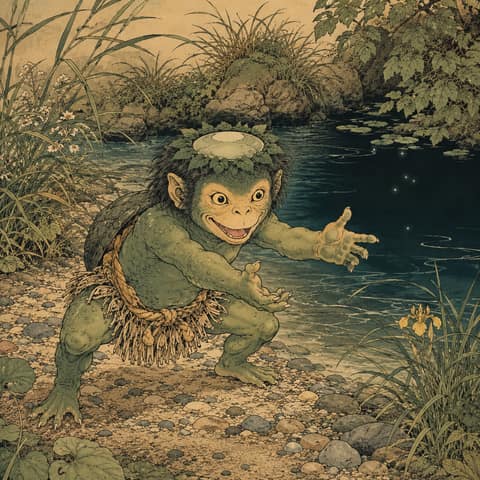
Yamawaro (Mountain Child)
ya-ma-wa-ro
The Mountain Boy of Western Japan, the Yamawaro
Mountain & Wilderness Spirits Kyushu (yamawaro; mountains of western Japan) This version looks at the yamawaro — the kappa's "other half" — from the side of life in the mountains. If the kappa is the being that menaces people at the water's edge, the yamawaro is the one that appears at the worksites of mountain labor. It helps woodcutters and charcoal burners haul their timber, taking sake or rice balls in return. Yet the exchange follows a strict code: hand over the promised goods first and it runs off without working, and break a promise and it flies into a furious rage and brings down misfortune. To those who worked the mountains, the yamawaro was at once a dependable partner and a neighbor not to be trusted, one that bared its fangs at any lapse of courtesy. The tales of the yamawaro are packed tight with the eeriness of the mountains: the "tengu-fell," the sound of a great tree crashing down when no one is there; a voice that mimics human songs and the strokes of an axe to the life; and the strange weakness of disliking the line of a carpenter's ink pot. These are the very dread felt by those who venture deep into the hills. And the legend of the "crossing of the kappa" — entering the mountains at the autumn equinox and returning to the rivers at the spring equinox — ties the yamawaro and the kappa together with a single thread. A single water god that passes between mountain and river — its mountain face is the yamawaro.
稀少 
Mountain Sprite (Sansei)
SAHN-say
Traditional Account (Wakan Sansai Zue and Sekien Lineage)
Mountain & Wilderness Spirits China – around Anguo County, Hebei Province This version draws on Chinese materials cited in the Edo-period encyclopedic Wakan Sansai Zue and on Toriyama Sekien’s pictorial interpretation. The mountain spirit lurks in the hills, watching mountain huts where salt is set out for cooking or work and edging closer to them. Sources differ on size, some saying about one shaku while others claim three to four shaku. Its hallmark is a single leg with a heel set backward, making its tracks hard to read. It favors small wetland creatures like crabs and frogs and appears along stream gullies. It is said to bring lustful harm at night, but will retreat if the drought deity’s name “Batsu” (Hatsu/Boatsu, the Chinese demoness Ba) is spoken, a type of name-utterance apotropaic. Those who harm or consort with it suffer illness or fires, functioning as a cautionary taboo against contact. In Japan, Sekien labeled it “Yamaki” (mountain demon) and depicted it peering into a hut with a crab in hand, providing visual cues; local oral lore is scant, and treatment remains largely bibliographic. Modern reinterpretation is restrained, keeping to the contours of old records.
稀少 
Yamaoroshi
yah-mah-oh-ROH-shee
Based on Sekien Toriyama’s Iconography
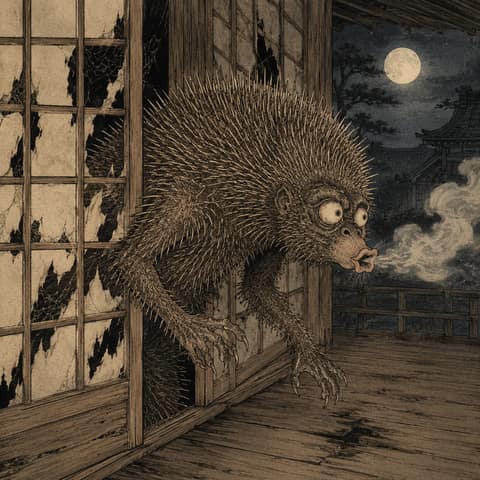
Animated Objects & Undead Japanese folklore A reconstruction guided by Sekien Toriyama’s image and notes. The head resembles a grater, its surface studs likened to porcupine quills. Though written as “Yamaoroshi,” its nature is not a mountain wind itself but an abstract monster born from combining a utensil (grater) with a bestial image. Daikon radishes and mortars placed nearby signal a tsukumogami-style scene, with no specific harm or blessing described. Rooted in Edo-period paintings, it lacks regional oral lore or cult, and later handbooks often present it as an example of utensil transformation and wordplay.
珍しい 
Iwanabōzu (Monk Trout)
ee-wah-nah-BOH-zoo
Iwaname Monk (Tradition-Faithful)
Animal Shapeshifters Mino Province (Ena District) and various regions of Japan Based on Edo-period records and regional folktales. An aged char trout appears in the guise of a Buddhist monk and speaks to anglers. It often urges moderation, citing the temple’s domain or the pool’s lord, and departs quietly if given alms. Later it may be caught as a great char, where rice or rice cakes given as alms are found in its belly, revealing its identity. The motif reflects reverence for river and pool guardians and ideas akin to eel and other water deities. Depending on region, it appears as a harmless, didactic type, a warning type bearing deadly poison, or a salvific type that sacrifices itself to stop a levee breach, yet all embody folk norms that safeguard the boundary between waters and livelihoods.
珍しい 
Gangi Kozō
GAHN-ghee koh-ZOH
Archaic Illustration-Concordant Form
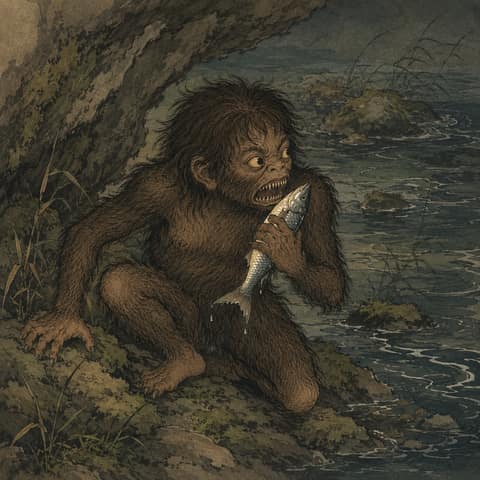
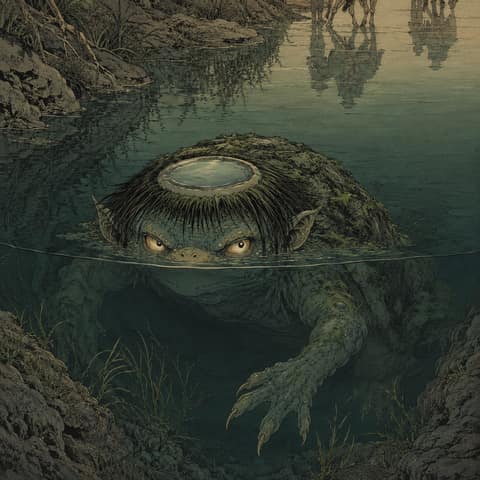
Aquatic Spirits Uncertain (appears in Edo-period picture books) A reconstruction based on Toriyama Sekien’s image and its brief note. It lurks along riverbanks and in shallow pools beneath cliffs, seizing fish when the moment is right. Its body is close to a small boy’s in build but covered in coarse hair, and its teeth are file-like, said to rasp flesh from its catch. While traits recalling the kappa (such as webbing and a waterside life) come to mind, definitive attributes like a carapace or head-dish are not attested and are therefore omitted. The “bank” and “cliff” elements in the name are read as descriptive of its haunt, not a regional or clan identifier. Modern commentary notes a cautious link to beings bearing “cliff” in mountain-怪 lexicon (e.g., Takiwaro), but stops short of identification. Extant primary sources are Sekien’s picture and text; no behavior, curse, or offering rites are transmitted. Here it is treated as a small waterside uncanny, silently stalking fish.
名妖 
Emperor Sutoku
Emperor Sutoku
Emperor Sutoku, the Vengeful Spirit Exiled to Sanuki
Spirits & Ghosts Sakaide (Kagawa Prefecture) and Kyoto (place of exile and death; shrines of pacification) This edition follows in close detail—discerning the boundary between history and the legend that runs from the Hōgen Monogatari onward—how a single deposed emperor turned into the Great Tengu and Great Demon-Bond called the greatest in Japanese history. First, the history must be grasped. Sutoku's misfortune lay in the political exclusion of being shunned by the cloistered emperor Toba as an "uncle-child" and being made to abdicate without ever holding the power of cloistered rule. After the early death of Emperor Konoe, that his younger brother Go-Shirakawa, rather than his own son Prince Shigehito, was set up became the trigger for the Hōgen Rebellion (1156). On the defeated Sutoku's side, Minamoto no Tameyoshi and Taira no Tadamasa were put to public execution for the first time in roughly four hundred years, and Sutoku himself was exiled to Sanuki. Up to here it is history grounded in records. The uncanny is born beyond that, in the stratum of legend. Both the curse said to have been written in blood—"I shall become the Great Demon-Bond"—after biting off his tongue, and the figure of him turning into a tengu with nails and hair grown long, are stories transmitted not by contemporary records but by the Kamakura-period Hōgen Monogatari. Yet this legend spread with great persuasive force, and the great fires, forceful appeals, and upheavals that struck the capital from the Angen years onward—indeed, the Jishō-Juei War leading to the fall of the Taira—came to be read as Sutoku's curse. The events themselves are history; the interpretation that ascribes them to Sutoku's rancor is goryō belief—the two must be seen as sharply distinct. What fixed Sutoku's tengu image was literature. "Unkei Miraiki," book twenty-seven of the Taiheiki, depicts Sutoku as a demon-king ruling the throngs of tengu and demon-bonds, and in the early-modern era "Shiramine" in Ueda Akinari's Ugetsu Monogatari gave vivid form to Sutoku's vengeful spirit confronting Saigyō—not as a long-nosed tengu but as a golden kite. The image of Sutoku told of as "the foremost Great Tengu of Japan" and "the greatest vengeful spirit in Japanese history" stands upon this accumulation of literature. What deserves attention is that his pacification reached even into the modern era. In the first year of Meiji (1868), the Meiji government welcomed Sutoku's divine spirit, resting in Sanuki, to the capital and enshrined it at Shiramine Jingū. That at the outset of a new reign they still feared the curse of a deposed emperor seven hundred years past tells how deep-rooted the dread of Sutoku's vengeful spirit was. A poet who left a famous verse in the Hyakunin Isshu, and a great demon-king who curses the throne—this very gulf is what pushed Retired Emperor Sutoku to the apex of goryō belief.
稀少 
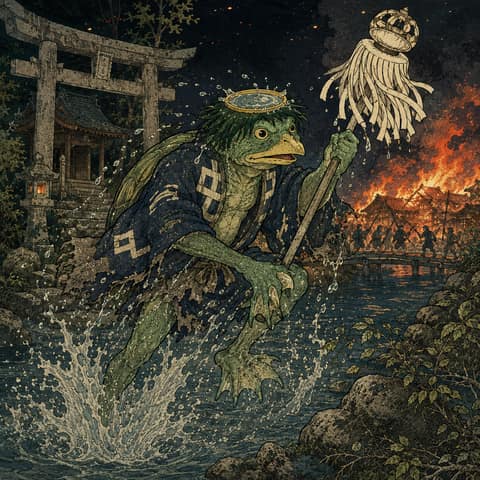
Heiroku
HAY-roh-koo
Iconography-Concordant Version
Animated Objects & Undead Japanese folklore An interpretation grounded in Toriyama Sekien’s examples and Muromachi picture scrolls, taking the aberrant figure bearing a gohei as its standard. The paper-streamer wand signals ritual purity, yet Henroku brandishes it as an emblem of turmoil. It is not tied to any specific land or person, and is understood as an allegorical presence that appears where festivals or shrine order falter. Later traditions sometimes read it as a tsukumogami inhabiting the gohei, but firsthand accounts are scarce, and it is discussed chiefly within the lineage of visual iconography.
神格 
Taira no Masakado
Taira no Masakado
Masakado, Goryō God of the Kantō
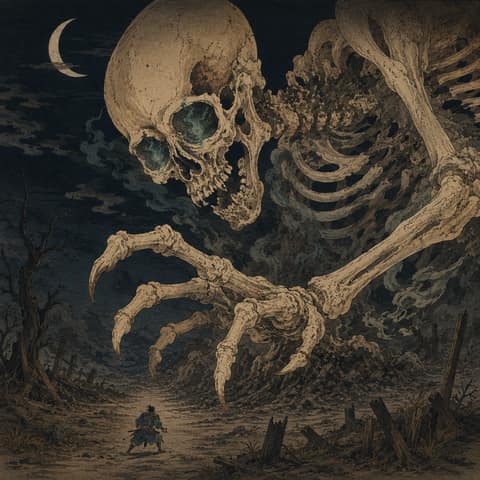
Divine Spirits & Deities The Kantō region (the Masakado Grave-Mound at Chiyoda, Kanda Myōjin, and the old Bandō homelands) This edition follows in close detail—while fixing the boundary between history and legend—how a single Bandō warrior became the uncanny "flying head" and then turned into a god who guards Edo. First, history and the uncanny must be separated. The revolt itself is conveyed by the near-contemporary Shōmonki, which records in classical Chinese the private feud beginning in 935, the subjugation of the Kantō provincial seats, the proclamation as New Emperor, and the death in battle in 940. But here there is no marvel of a flying head. The supernatural story of a head that would not rot, cried out, and flew appears only centuries later, in the Nanboku-chō-period Taiheiki, with anecdotal relays such as the Konjaku Monogatari-shū in between. It is in this later stratum of legend that Masakado is told as a "yokai." The story of the curse around his head mound is newer still. The dread transmitted at the Masakado Grave-Mound at Ōtemachi—"move it and it curses"—is a modern urban legend, layered onto events that occurred in the heart of the city in the Taishō and Shōwa eras: the deaths of those involved in building the Ministry of Finance's temporary office after the Great Kantō Earthquake, and the bulldozer accident during the Occupation. The factual events and the interpretation that attributes them to Masakado's curse must be carefully separated. The path of deification, on the other hand, reaches back into the medieval age. In the second year of Enkyō (1309), the Ji-sect holy man Shinkyō Shōnin, who attributed a plague to Masakado's curse, pacified the spirit and added it to the enshrined deities of Kanda Myōjin. This, like Michizane, is the textbook goryō belief of enshrining a raging vengeful spirit and turning it into a protecting god. The ups and downs—drawing the reverence of the people as the great tutelary of Edo, being removed from the enshrined deities as a traitor in the Meiji era, and being restored at the end of Shōwa—also reflect well the duality of the image of Masakado as a hero who rebelled against the throne. In later ages, the story of his daughter Princess Takiyasha commanding a giant skeleton won popularity in kabuki and popular fiction and was depicted in Utagawa Kuniyoshi's "The Old Palace at Sōma"; it should be noted that this is a derivative starring the daughter, not Masakado himself.
伝説 
Yūrei (Ghost)
YOO-ray
Toriyama Sekien “Yūrei” (An’ei era)
霊・亡霊 Across Japan An image based on the “Yūrei” in Toriyama Sekien’s Gazu Hyakki Yagyō, published around 1776 (An’ei 5). In a nighttime graveyard a woman’s ghost appears between drooping willows, wearing a white burial robe and a forehead cap, raising her arms as if to halt a passerby. It is a transitional depiction from before footless forms and the triangular headcloth became fixed conventions, emphasizing the lifelike force of the arms and the willow and gravestones as symbols of place. Sekien’s plates organized contemporary strange tales, Buddhist views, and funeral customs, profoundly shaping the visual codification of yūrei. While indicating gender and costume, the image leaves the source of attachment unspecified, inviting the viewer to imagine the relationship.
伝説 
Zashiki-warashi
za-shi-ki-wa-ra-shi
The Zashiki-warashi — Child Who Guards the House in Iwate
Human-Spirits / Half-Human Iwate and Aomori Prefectures (guardian child of Tōhoku farmhouses) This version turns to another aspect of the zashiki-warashi, the one behind its bright face as a god of good fortune. It has long been said that the zashiki-warashi has differences of rank according to where it dwells. The high-ranking ones—fair-skinned and beautiful, appearing in the inner parlor—are called choppirako and welcomed with joy, while the low-ranking ones that crawl about the earthen floor or beneath the rice mortar are called notabariko or usutsukiko and held to be somehow eerie beings. The zashiki-warashi straddles both the pure high seat within the house and the darkness close to the earth. This place beneath the earthen floor and the mortar is deeply tied to the dark theory of the zashiki-warashi’s origins. In the poor villages of a famine-stricken Tōhoku, it is said, infants who could not be raised were put to death under the names mabiki ("thinning out") or kogaeshi ("returning the child"), and were buried not in graveyards but on the earthen floor of the house or beside the hearth. Might the zashiki-warashi be the spirit of a child buried in this way within the house? Sasaki Kizen is recorded as having stated that the zashiki-warashi was the spirit of a child smothered and buried inside the home. The endearing figure of a god of fortune was also a thin skin covering the most painful part of village life. Even so, people did not hate these children but enshrined them as gods who guard the house. Yanagita Kunio saw the zashiki-warashi as a gohō-dōji, a divine child who protects the Buddha, transformed into a guardian of the home, while Orikuchi Shinobu placed it in the lineage of the marebito—visiting deities who come from outside to bring blessings to a house—and of ancestral spirits. It is where remorse for a dead child and longing for the prosperity of the house melt into one that this strange being, the zashiki-warashi, stands.
伝説 
Hiko-san Buzenbō
Hiko-san Buzenbō
Chief of the Tengu of Kyūshū — Hiko-san Buzenbō
Mountain & Wilderness Spirits Mt. Hiko (Hikosan), Buzen Province (Soeda, Tagawa District, Fukuoka) The key to reading Hiko-san Buzenbō lies in Hikosan—the vast sacred site that is one of the three great centers of Shugendō in Japan—and in the tengu's character of two faces, reward and punishment. The history of Hikosan Shugendō issues from the Nara-period monk Hōren. Taking as founder this monk, whom the Shoku Nihongi records as having been granted forty chō of field in Buzen Province in the third year of Taihō (703), Hikosan grew into a great center of Shugendō ranking with the Dewa Sanzan and Ōmine. The name of Buzenbō appears with certainty in the Kamakura-period engi the Hikosan Ruki (1213). This work likens the forty-nine grottoes bored into the peaks of Hikosan to Miroku's Tosotsu Heaven and made the eighteenth the "Buzen-kutsu," the seat of Buzenbō. This very system of grottoes is the matrix of the faith in Buzenbō as chief of the tengu of Kyūshū. The Edo-period scale of the "Three Thousand Eight Hundred Bō of Hikosan" tells of this sacred site's prosperity. What characterizes the tengu Buzenbō is the sternness of his reward and punishment. As the history of Takasumi Shrine transmits, upon those of greedy and evil heart he carries off children and sets fire to houses in chastisement. Conversely, the wishes of the upright and deeply devout he hears and grants, and them he guards. These two faces of reward and punishment symbolize, as a tengu's judgment, the strict precepts that a Shugendō mountain imposes and the grace shown to those who keep them. The dread of a child-snatching tengu and the faith of parents praying for their children's safety were the front and back of one and the same Buzenbō. The separation of Shintō and Buddhism in the first year of Meiji and the prohibition of Shugendō in Meiji 5 (1872) scattered the yamabushi of Hikosan and dismantled the world of the three thousand eight hundred bō. The institution of Shugendō was lost, but the tengu faith of Buzenbō lives on at Takasumi Shrine; chanted in the Muromachi Noh play Kurama Tengu and standing among the forty-eight tengu of the Tengu-kyō as the great tengu of Kyūshū, he is still feared as one who sits upon the peak of Hikosan. Chigiri Kōsai of tengu scholarship, too, placed him within the system of the great tengu of the many mountains.
珍しい 
Penghou
POONG-hoh
Edo-Period Scholarly Edition (Bibliographic and Picture Scroll Tradition)
Natural Phenomena Spirits Introduced from China (appearing in Japanese bibliographies and picture scrolls as a foreign yokai) An Edo-period rendering of Penghou, organized within the Japanese concept of kodama after scholars and painters absorbed Chinese narratives. It is depicted as a dog with a human face, tied to venerable camphors and other old trees. Echoes in the mountains were taken as the work of tree spirits, and notes on Penghou informed dog-shaped variants within yamabiko imagery. Early modern natural histories cite Chinese texts explicitly, layering foreign entries atop local lore rather than reporting concrete regional怪談, so place-specific tales are scarce. Japanese accounts treat it as a “tree spirit,” equating kimoki with kodama, linking it to taboos on felling and the cult of ancient trees. Details vary across sources, but two elements persist: it appears bleeding from an old tree, and it bears a human-faced canine form. This version eschews embellished fiction to show how Chinese originals were received in Japanese encyclopedias.
珍しい 
Shadow Woman
KAH-geh-OHN-nah
Kage-onna (Traditional Depiction)
Half-Human Beings Uncertain (pictorial sources point to Edo–Kyoto area) The image of the Kage-onna traces back to Sekien’s prints and has been understood as a “woman of shadow alone,” appearing where houses meet moon-cast light. In early modern homes, shoji and wooden doors let light pass, creating a boundary between outside brightness and interior dimness where a woman’s outline emerges. Lore says her visit is fleeting, more a portent of household unrest than a threat. Whether she is the shadow of the living or a trace of the dead is uncertain, and she is sometimes linked to family misfortune or the mood of the local deity. Proper conduct is to refrain from pursuit, lower the fire, close the doors, and speak no words. The next day, households often cleanse the well, garden trees, and crawlspace, seeking rites to calm the omen. The shadow makes no footsteps and shifts its shape in the wind. Dogs and cats are said to react keenly, yet harm is rarely told, and she seldom lingers.
稀少 
Ushirogami (The Back-Hair Spirit)
oo-SHEE-roh-gah-mee
Iconographic and Literary Tradition Type
Ghosts & Spirits Across Japan (primarily Edo-period and Tsuyama traditions) A type shaped by Edo-period print culture, centered on Sekien’s imagery and the psychologized readings in kyoka verse. Rather than a concrete monster, it personifies the feeling of being held back by a tug at one’s trailing hair, dulling decisions through interference from behind. Mizuki Shigeru cites tales from the Tsuyama area that give it a corporeal aspect—ruffling a woman’s hair, breathing hot air—but in all cases it touches from behind and stirs hesitation. It is often grouped with hesitation-inducing yokai such as Okubyogami, Sodehiki-kozō, and Furifuri. Though there are notes of it being enshrined in Ise, specific rites are unknown, and it appears mainly in moral and didactic contexts. Stories survive in both urban and local settings, yet no clear lineage of deity name or object is shown, with wordplay and the concretization of psychology driving its transmission.
珍しい 
Trailing Boy
AH-toh-oh-ee koh-ZOHH
Trailing Boy Monk (Tradition-Faithful)
Mountain & Wilderness Spirits Kanagawa Prefecture (eastern Tanzawa) A version organized from folklore materials of a child-shaped mountain spirit seen in the eastern Tanzawa mountains. Generally harmless, it simply follows quietly behind travelers, yet at times steps ahead at forks to guide them onto the right path. It wears rough straw matting or homespun, sometimes pelts, blending into the forest’s shadow and vanishing when one turns back. It is said to appear most often in the afternoon, and at night to carry a small light like a lantern. Those who meet it repeatedly often think of lost children and leave rice balls, yams, sweets, or dried persimmons on rocks or stumps as offerings. Some accounts say it fades away as one nears the villages, others that it withdraws when called to at night, and none describe it as vengeful. Rooted in overlapping ideas of mountains and the dead, it stands as a symbol of the boundary nature of the mountain realm.
一般 
Lost-Item Kozō
wah-soo-reh-MOH-noh koh-ZOH
The Lost-and-Found Imp (Modern Version)
Half-Human Beings Schoolhouses and everyday life The Lost-and-Found Imp hoards pencils, erasers, and other small items that slip from backpacks and pockets, claiming them as its treasures. It giggles when people scramble in confusion searching for their things, then vanishes, satisfied. Not purely mean-spirited, it will quietly return an item to a desk when the owner is truly distressed and close to tears. Said to exist since the terakoya school era, children have long warned, “If you forget your things, the little imp will take them.”
珍しい 
Echo-Worm
OHH-seh-ee-choo (ohh-OH-seh-ee-choo)
Edo Essays and Anecdotes Edition
Half-Human Beings Introduced from China; recorded across Japan A portrait of the Echo-Answering Worm from Edo-period essays and tales. Marked by high fever and a sore like a mouth on the abdomen, its voice echoes the host’s words and at times spews curses. It craves food and drink, and refusal is said to raise the fever. Cures attempted include prayers and decoctions, especially a method of selecting and combining drugs it dislikes, then administering them so the creature weakens and later exits the body. Some accounts describe a lizard-like form with horns, though appearances vary widely. Chinese lore of the echoing parasite merged with Japan’s notion of the human-faced sore, emphasizing a mouth opening in the belly. Attempts to exhibit the illness for profit were recorded, though families often refused for shame. Its origins span materia medica and storytelling, long understood as a disorder set at the boundary of medicine and the uncanny.
伝説 
Onryō (Vengeful Spirit)
ohn-RYOH
Goryo Cult
Ghosts & Spirits Across Japan A framework that enshrines vengeful spirits as goryo to pacify their curses and turn them into sources of blessing. Epidemics and natural disasters were seen as manifestations of resentment, and reconciliation was sought through founding shrines, conferring divinity, and institutionalizing festivals. Curse deities bear a dual aspect of fear and veneration, and their wild power was believed to transform into communal guardianship through proper requiem rites. Practices ranged from state rituals to village memorials, including era name changes, imperial envoys, Goryo-e, and Hojō-e. For individuals, memorial offerings, sutra copying, nenbutsu, and esoteric prayers were performed, while restoring honor and granting divine ranks were means to ease a spirit’s grievances. Narratives and origin legends explained why resentment arose, giving social memory to causes such as false accusation, untimely death, and broken lineages. A vengeful spirit’s power was not indiscriminate but signaled its intent according to causes, believed to speak through dreams, oracles, thunder and fire, and plague. Pacification was not a one-time act but continued through annual festivals and shrine upkeep, with warnings that neglect would invite resurgence.
Showing 101 - 120 of 404 yokai