Yokai Encyclopedia
Encyclopedia of Japanese Yokai
名妖 
Ceiling Licker
TEN-joh-NAH-meh
Traditional Interpretation (after Sekien Toriyama)
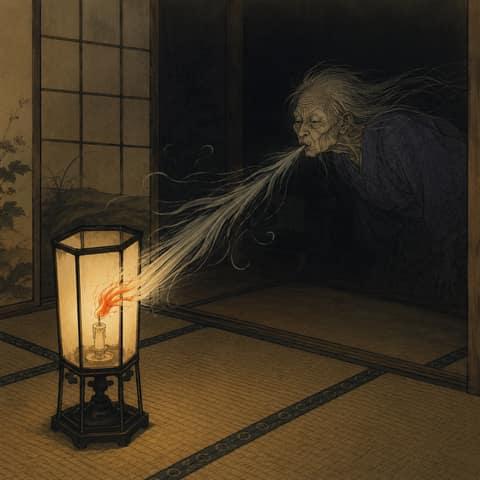
Household Spirits Edo period An interpretation based on Toriyama Sekien’s picture book: a being that lets a long tongue hang down and roams old houses licking the ceiling. Rather than harming people directly, it is portrayed as bringing chill, gloom, and dampness into rooms. Its iconography is traced to a Muromachi-period Night Parade of One Hundred Demons scroll showing a creature extending its tongue upward, and later Edo-to-modern compendia ascribed to it the habit of licking away stains, soot, and cobwebs from ceilings. No proper name, lineage, or origin myth survives; it is taken as a symbol of household hauntings in general. Tradition places it in sparsely occupied buildings such as old temples and mansions, with wet streaks and speckles appearing on boards at night cited as its traces, though a firm regional folklore core is hard to confirm.
名妖 
Amenosagume
ah-meh-noh-sah-GOO-meh
Amanosagume
Half-Human Beings Unclear; linked to Takamagahara and Naniwa (Takatsu) in the chronicles Amanosagume is a priestess-like goddess named in the Kojiki and Nihon Shoki whose pronouncements of fortune and ill omen can overturn situations. Said to have accompanied Ame-no-Wakahiko, she once declared a singing woman’s voice inauspicious, reflecting an older stratum where divine intent and spoken proclamation tied closely to political ritual. The Kojiki writes her as Amasagume, while the Nihon Shoki uses Amanosagume. Fragments of the Settsu Fudoki and Man’yō poetry tell that she moored in Takatsu aboard the Heavenly Rock Boat, linking her to the toponym lore of Naniwa. Whether she is counted among heavenly or earthly deities varies by source, and honorifics applied to her are inconsistent. Folklore studies sometimes view her as a prototype of the contrary amanojaku, though others stop short of a direct syncretism. Few rites to her survive today: at Hirama Shrine in Wakayama she is revered as Amasagume-no-Mikoto, and at Shoten Shrine in Sagami she is remembered as a goddess who seeks bonds. Avoiding creative additions, her character within the sources can be summarized as a goddess who moves events through divination and declarative speech.
伝説 
Tenko
Tenko
Tenko, the Celestial Fox in Communion with Heaven
Animal transformation (dōbutsu henge) China and Japan (the highest rank of fox spirits) This version explores why the Tenko is spoken of as “a yōkai yet near to a god,” and where it truly stands. Of the four grades of fox, only the lowest — the Yako — appears before people in a body of flesh to bewitch them. The higher its rank, the more a fox becomes a formless, spiritual presence, and at the summit, the Tenko, it is described less by any shape than by its very workings: seeing for a thousand leagues, communing with the will of heaven. As Yanagita Kunio and Nakamura Teiri have laid out, the Tenko is the utmost extreme of the senko, the spirit fox that has lived a thousand years and accumulated virtue. In neither deceiving people nor leading them astray, but watching over them from above, the Tenko stands at the opposite pole from the Yako. It was this transcendence that drew the Tenko up into religious faith. Just as Dakiniten is attended by a white fox and Izuna Gongen rides one in the guise of a karasu-tengu, the highest fox is enshrined as a familiar of the gods and buddhas, or as a deity in its own right. The power to which warlords prayed for victory, and to which villagers pressed their palms in hope of fire prevention and good fortune, was in the end the power of this fox in communion with heaven. One thing to be wary of is confusing Tenko with tengu. Because an old usage read “shooting star” as amatsu-kitsune, the two have long been mistaken for one another , yet the Tenko is, properly, a fox that has raised its spiritual rank to the utmost limit — a being of a wholly different lineage from the mountain-ascetic tengu.
伝説 
Tengu
Tengu
What Is a Tengu? An Overview of Types and Iconography
Mountain & Wilderness Spirits Kyoto, Shiga, and Wakayama Prefectures (the seats of the great tengu on the various sacred mountains) This edition is not about a single seat on a particular sacred mountain, but a general treatise that thoroughly unravels "what a tengu is" from the history of its iconography and types. The individual traditions of each seat are left to the page of each great tengu. The form of the tengu is not uniform. The first type is the long-nosed tengu—ruddy face and high nose, clad in the ascetic's headcloth (tokin) and the suzukake robe, a feather fan in hand and one-toothed high clogs on the feet. The second is the crow tengu, with a crow's beak and wings, grasping a sword or a vajra staff. The third are the lesser tengu called leaf tengu and wood-chip tengu, held to be weak and numerous kin. Rather than a fixed classification, these reflect the breadth of the tengu image across eras and regions. The iconography shifted over time. The Heian-period tengu was first conceived as a bird like a black kite, and the image of the crow tengu retains that vestige. The long nose grows prominent only from the late Kamakura period; the Zegaibō Emaki depicts a scene in which a tengu that had disguised itself as a human has its nose lengthen as it returns to bird form. As for the origin of the long nose, there are theories that derive it from the high-nosed Jidō mask of gigaku and link the crow tengu to the Karura (Garuda) mask, and a view that sees the long nose as an iconographic vestige of a bird's beak—but none can be called settled doctrine. It was overlaid with the god Sarutahiko, described in the Nihon Shoki as having a nose seven hand-spans long, and the custom arose of using a tengu mask for the role of Sarutahiko in festivals. The tengu's dual nature is rooted in the Buddhist notion of the way of the tengu. Because it studies the Buddhist path it does not fall into hell, and because it handles heterodox arts it cannot reach paradise either—an intermediate state, and the one who falls there was held to be the arrogant monk. The Tengu Zōshi depicts this notion as satire of the monks of the seven great temples, yet Chigiri Kōsai too warns that the simplification "only arrogant monks become tengu" goes too far. Demon though it is, once subdued it turns to guardianship, and it was held that if a Shugendō practitioner recites the Tengu Sutra he may summon the tengu of the various provinces to grant his wishes—this amplitude between guardian and demon is the very core of the tengu. The certain medieval source for the grouping called the "Eight Great Tengu" lies in the libretto of the Muromachi-period Noh play Kurama Tengu. The passage in which the great tengu calls up the tengu of the provinces he commands in geographical order—"In Tsukushi, Buzenbō of Hiko-san; in the four provinces of Shikoku, Sagamibō of Shiramine; Hōkibō of Ōyama; Saburō of Iizuna… the host of Zenki of Ōmine, Takama of Katsuragi"—shows that the Eight Great Tengu were rooted in medieval belief and performing arts, not an Edo invention. Still, the composition wavers by source, with a variant that adds Hōkibō of Ishizuchi-san; it is no fixed roster.
伝説 
Tengu
Tengu
Hieizan Hōshōbō, Great Tengu of Mount Hiei
Mountain & Wilderness Spirits Kyoto, Shiga, and Wakayama Prefectures (the seats of the great tengu on the various sacred mountains) Hōshōbō of Mount Hiei is a great tengu who ranges the peaks of Hiei, where the capital meets the lake, dwelling between cedar and cypress crowns and the sea of clouds. Cloaked in the ridge winds of the Sannō shrines, he bears crow’s wings and a feather fan like a yamabushi’s ritual tool, said to appear at midnight with the lingering echo of a conch. His face is severe, ruddy with a high nose, eyes keen as if seeing through the ages. Yet his bearing recalls a monk, and the folds of his robes carry the scent of sutras. Named among the forty‑eight tengu of the Tengu Sutra since olden times, he guards Enryakuji’s teachings and the mountain’s vital currents, and in the era of the monastery’s ascendancy was said to guide and correct the conduct of its students both openly and unseen. Hōshōbō is not merely masterful in martial arts but cuts through the frayed edges of words to reveal a thing’s true nature. When a seeker loses their way, he thickens the mist and erases the markers, or lures an unsettled heart into the shadows of halls and pagodas—not to mislead, but to teach that wavering within is what leads one astray. When that is realized, the fog clears at once and Hiei’s ridgeline turns blade‑bright. Conversely, those who climb seeking fame and profit or who slight the Sannō deities are driven off by winds that make leaves into blades, never again permitted a frivolous ascent. Elders of Hiei whisper that Hōshōbō entrusts the essence of Lotus and Esoteric teachings to the wind, marshals flocks of birds to the cadence of chanting, and governs prayers for rain and for clearing skies. If Enryakuji’s bell tolls strangely, it is a sign of his feather fan stirring on the heights, and there were nights when sutra characters trembled across the lake’s ripples. At times he appears at a young ascetic’s bedside, delivering a single thunderous admonition that severs the root of delusion, leaving at dawn a single drop of white dew—medicine when diligence holds, poison when sloth prevails. He most abhors when urban rumors and power struggles spill onto the mountain, and bears an art that stills the blades of speech. When people wound each other with slander, a downslope wind rattles the town eaves and falsehoods collapse under their own weight; thus those who guard their tongues gain his protection. Yet he shows no mercy to those who hide pride behind practice: he lightens their footsteps until they lose the ground and wander forbidden paths of empty theory, and only when they admit their fault do their feet return to earth. On nights when the bush warbler in Hiei’s forest falls suddenly silent and distant thunder rings pure, Hōshōbō is near. If pilgrims bare their heads and pay full respect before the Sannō, the ridge wind softens and a single shaft of light breaks the clouds. This is called the Return of Hōshō—a sign that prayers in the mountain have been rightly answered. Hōshōbō is both guardian of the mountain and tester of the teaching; fear becomes reverence, and reverence opens the way. Only those who grasp this find his wings a sheltering shade for the road.
伝説 
Tengu
Tengu
Kakukai-bō of Yokogawa
Mountain & Wilderness Spirits Kyoto, Shiga, and Wakayama Prefectures (the seats of the great tengu on the various sacred mountains) Kakukai-bō of Yokogawa is said to be a tengu variant who turned from human monk to winged guardian of the Dharma from the late Heian into the early Kamakura era. Once a virtuous priest of deep Shingon lineage, he ran himself ragged settling mountain disputes until he grasped a boundary no worldly rule could protect, becoming a winged keeper of sacred law. In Kōya’s inner precincts, they tell how one night a gale whirled through a hall and the middle gate shuddered, then its doors shed their hinges, unfurled as twin feathers, and split the black clouds to fly off. Those doors became Kakukai-bō’s wings. Ever since, he appears with the comings and goings at temple gates, raising a fierce wind before those who disturb the rule and presenting a single line of precept. He resembles a karasu-tengu, yet his face keeps the gaunt trace of an old monk and his long nose curves like a mountain ridge. His feathered robe echoes priestly vestments, layered in cinnabar and ink, its cuffs frayed like the edges of ancient sutras. He carries a feather fan akin to a monk’s staff, and when he sweeps it, seed-syllables rise like chaff off paper, racing along the ground as ropes of warding. He speaks sparingly, but his words hang like a bell’s aftertone, stopping the feet of those who have strayed. He guards the mountain’s thresholds—the shrine and temple gates, the bends of approach paths, the joins of ridge and valley—where human law brushes mountain law, serving as their mediator. When a practitioner keeps purity, he lets fall a single white feather from the cloudbreak as a sign of safe passage. But if pride sprouts, the vigil lamp flickers once and a cold wind runs down the back. Feeling this thrice, one must follow his guidance to descend the mountain or doff one’s robe and return to first intent. He also teaches the ‘Doctrine of Drying’: to clear the heart, remove needless damp—a metaphor tied on the mountain to drying beans for stores and keeping offerings pure. Though unproven, it stands as a sign of turning the mountain’s rigor into daily sustenance. Late at night when mist pools in the valleys, he patrols with a train of crows. They are his eyes and ears, giving short signals to those swayed by rumor. Read rightly, the signs lead one off the wandering path, read wrongly, one circles the same ground three times. This is called Kakukai’s Rounds, and on the third turn, if one straightens the crook in the heart, the eastern ridge pales and the path opens naturally to the main gate.
伝説 👹Tengu
Tengu
The Forty-Eight Tengu – The Great Tengu of the Provinces in the Tengu Sutra
Mountain & Wilderness Spirits Kyoto, Shiga, and Wakayama Prefectures (the seats of the great tengu on the various sacred mountains) The tengu do not stop at the Eight Great Tengu. Each of the sacred mountains of the provinces was believed to have its own great tengu, and the early-modern esoteric prayer-scripture the Tengu Sutra lists their representatives as forty-eight seats—the "Forty-Eight Tengu." This edition is an overview that surveys the full roster and the provenance of the scripture itself. The Tengu Sutra is an esoteric, Shugendō-lineage prayer text said to have been compiled in the Edo period. It is not an orthodox sutra of the Buddhist canon, but belongs to the lineage of incantation-scriptures that a yamabushi recites in his devotions to summon (invoke the descent of) the tengu of the sacred mountains of the provinces, borrowing their numinous power to pray for the dispelling of demons, the subjugation of enemies, and the fulfillment of all wishes. The text begins with the chant "Homage to the great tengu and the small tengu," lists the names of the various tengu, then gives the total of the tengu as "one hundred twenty-five thousand five hundred in all," and closes with the mantra "On aromaya tengusumanki sowaka." This "one hundred twenty-five thousand five hundred" is not a real count but a symbolic number representing innumerable tengu, and the forty-eight seats named by their proper names are positioned as the representatives among them. As for the transmission of the manuscripts and printed editions of the Tengu Sutra, there are philological studies such as Takahashi Sei's "The Tengu Sutra: Its Present State and Whereabouts" (2016), and it is difficult to fix the date of compilation strictly to a single point. The roster of the Forty-Eight Tengu runs in the form of "bō" titles (sacred-mountain name + the name of the bō). The opening begins with the great tengu of the Kinai—Atago-san Tarōbō, Hira-san Jirōbō, Kurama-san Sōjōbō—and is followed by the tengu of the Shugendō sacred mountains across the land such as Fuji, Nikkō, Haguro, Akiba, Hikosan, and Ishizuchi. Below are listed all forty-eight seats, collated against two confirmable lines of sources, together with the bō title, sacred mountain, and province (present-day prefecture). ★ marks the Eight Great Tengu that have their own pages in this encyclopedia. 1. ★Atago-san Tarōbō (Mt. Atago, Yamashiro / Kyoto) 2. ★Hira-san Jirōbō (Mt. Hira, Ōmi / Shiga) 3. ★Kurama-san Sōjōbō (Mt. Kurama, Yamashiro / Kyoto) 4. Hiei-zan Hosshōbō (Mt. Hiei, Yamashiro / Kyoto) 5. Yokawa Kakkaibō (Yokawa, Mt. Hiei, Yamashiro / Kyoto) 6. Fuji-san Daranibō (Mt. Fuji, Suruga / Shizuoka) 7. Nikkō-san Tōkōbō (Mt. Nikkō, Shimotsuke / Tochigi) 8. Haguro-san Konkōbō (Mt. Haguro, Dewa / Yamagata) 9. Myōgi-san Nikkōbō (Mt. Myōgi, Kōzuke / Gunma) 10. Tsukuba-san Hōinbō (Mt. Tsukuba, Hitachi / Ibaraki) 11. ★Hiko-san Buzenbō (Mt. Hiko (Hikosan), Buzen / Fukuoka) 12. Ōhara Sumiyoshi Kenbō (Kengamine, Mt. Daisen (disputed), Hōki / Tottori (tentatively identified)) 13. Etchū Tateyama Nawadarebō (Mt. Tate, Etchū / Toyama) 14. Amanoiwafune Dantokubō (Amanoiwafune, location unknown) 15. Nara Ōku Sugisakabō (unknown, location unknown) 16. Kumano Ōmine Kikujōbō (Kiku-no-iwaya, Mt. Ōmine, Yamato / Nara) 17. Yoshino Minasugi Kozakurabō (Mt. Yoshino, Yamato / Nara) 18. ★Nachi Takimoto Zenkibō (Nachi Takimoto, Kii / Wakayama) 19. Kōya-san Kōrinbō (Mt. Kōya, Kii / Wakayama) 20. Niitayama Satokubō (Mt. Niita (disputed), Kōzuke / Gunma (tentatively identified)) 21. Kikaigashima Garanbō (Kikaigashima, Satsuma / Kagoshima (tentatively identified)) 22. Itatōyama Tondonbō (Mt. Itatō, location unknown) 23. Saifu Takagaki Kōrinbō (Mt. Kamado (Mt. Hōman), Chikuzen / Fukuoka (tentatively identified)) 24. Nagato Fumyō Kishukubō (unknown, Nagato / Yamaguchi (tentatively identified)) 25. Tsudoki Oki Fugenbō (Oki Island (disputed), Oki / Shimane (tentatively identified)) 26. Kurokenzoku Konpirabō (Mt. Zōzu, Sanuki / Kagawa) 27. Hyūga Obata Shinzōbō (unknown, Hyūga / Miyazaki (tentatively identified)) 28. Iōjima Kōtokubō (Iōjima, Satsuma / Kagoshima (tentatively identified)) 29. Shiōzan Rikyūbō (Mt. Shibi, Satsuma / Kagoshima (tentatively identified)) 30. ★Hōki Daisen Seikōbō (Mt. Daisen, Hōki / Tottori) 31. Ishizuchi-san Hōkibō (Mt. Ishizuchi, Iyo / Ehime) 32. Nyoigatake Yakushibō (Nyoigatake, Yamashiro / Kyoto) 33. Tenmanzan Sanmanbō (Mt. Tenman (disputed), Mino / Gifu (tentatively identified)) 34. Itsukushima Sankibō (Mt. Misen (Itsukushima), Aki / Hiroshima) 35. Shiragayama Kōshakubō (Mt. Shiraga, Tosa / Kōchi (tentatively identified)) 36. Akiba-san Sanshakubō (Mt. Akiba, Tōtōmi / Shizuoka) 37. Takao Naigubu (Mt. Takao, Yamashiro / Kyoto) 38. ★Iizuna Saburō (Mt. Iizuna, Shinano / Nagano) 39. Ueno Myōgibō (Mt. Myōgi, Kōzuke / Gunma) 40. Higo Ajari (Mt. Kinpō (disputed), Higo / Kumamoto (tentatively identified)) 41. Katsuragi Takamabō (Mt. Kongō (Katsuragi), Yamato / Nara) 42. ★Shiramine Sagamibō (Shiramine, Sanuki / Kagawa) 43. Kōra-san Chikugobō (Mt. Kōra, Chikugo / Fukuoka) 44. Zōzu-san Kongōbō (Mt. Zōzu, Sanuki / Kagawa) 45. Kasagi-san Daisōjō (Mt. Kasagi, Yamashiro / Kyoto) 46. Myōkō-san Adachibō (Mt. Myōkō, Echigo / Niigata) 47. Ontake-san Rokkokubō (Mt. Ontake, Shinano / Nagano) 48. Asamagatake Kinpeibō (Mt. Asama, Kōzuke / Gunma (tentatively identified)) Three cautions are needed in reading this roster. First, the bō titles (the names of each seat) agree across multiple sources and are reliable, but errors mixed into secondary web information mar the identification of the province and prefecture. For instance, Mt. Shibi is in Kagoshima Prefecture (Satsuma), and "Hyūga" is the old province name of Miyazaki Prefecture—misattributions confusing these with places in the Kantō or Tōhoku are in circulation. In this roster, "tentatively identified" is appended to seats whose identification has latitude, and "location unknown" to seats whose whereabouts cannot be confirmed among the sources. Second, there are seats such as Amanoiwafune Dantokubō, Nara Ōku Sugisakabō, and Itatōyama Tondonbō whose location multiple sources hold to be "unknown," and no place name has been forced upon these. Third, there is variation between the bō titles of the Eight Great Tengu and the wording of the Tengu Sutra text. For example, the Ōyama Hōkibō of the Eight Great Tengu appears in the text as "Hōki Daisen Seikōbō," and Ōmine Zenkibō appears in the "Nachi Takimoto Zenkibō" / "Kumano Ōmine Kikujōbō" line of wording. The Eight Great Tengu are commonly explained as eight representative seats drawn from among these forty-eight, but the bō titles do not agree word for word. The framework of the Forty-Eight Tengu shows most plainly that the tengu was not a solitary yokai but a deity of mountain worship seated throughout the sacred mountains of the whole country. Chigiri Kōsai, who compiled the study of tengu, likewise organized these mountain tengu into a single system. Each seat of the Eight Great Tengu (★) is treated in detail on its own page, but they too are simply the especially high peaks within this sea of one hundred twenty-five thousand five hundred tengu.
珍しい 
Tengu Pebble Shower
TEN-goo TSU-boo-teh
Tradition-Faithful Edition
自然現象・自然霊 Various regions of Japan (noted in Kaga and Edo records) Tengu-tsubute is told as a formless anomaly whose cause has been variously ascribed to tengu, foxes, or divine intent. Stones fly from all directions though no thrower is seen, impacts and sounds are real yet no stones are found, no marks remain, and the events repeat at set hours. Cases are recorded widely from Kaga, Kanazawa, and Edo in urban quarters to shrine precincts, and some reports note that crowds of onlookers or official patrols led to its quieting. Morally it serves as a warning against misconduct and as an omen of crop failure or illness, and older records link it with thunder as stones cast by Tenjin. Folklore studies connect it conceptually to stone-throwing rites, mass petitions, and indochi stone fights, understanding it as an expression of a supernatural will.
名妖 
Amano-zako (Heaven-Contrary Deity)
ah-mah-noh-ZAH-koh
Zukai-Conformant Demon-Deity Form
Deities & Divine Spirits Uncertain (descriptions chiefly in Edo-period encyclopedias) This version follows the core account in Wakan Sansai Zue, depicting Amanozako as a ferocious demon-deity born from turbulent qi. Her appearance blends human and beast, with a high nose, long ears, and powerful fangs. Her temper is ever contrary, shunning proper procedure and delighting in reversals. She is said to wield overwhelming spiritual force, boasting the strength and presence to hurl even mighty gods afar. While conceptually akin to the Amanojaku, her lineage is unsettled, and claims that she is progenitor of the Tengu are limited. The note that she is mother of Tenma-no-O is confined to the Zue citation, with little broad support in oral tradition. Here the focus remains on her classical traits as a demon-deity—contrary speech, contrary action, and ferocious might—kept within the bounds of early-modern images and texts.
名妖 
Amanojaku
ah-mah-noh-JAH-koo
Traditional Iconography and Folktale
Demons & Giants Various regions of Japan (ancient strands linked to Yamato and Izumo mythic cycles) Amanojaku is understood as a fusion of the trampled demon in Buddhist iconography and the folk image of a small imp fond of mimicry and speaking in reversals. Many temple and shrine statues of the Four Heavenly Kings or Shukongōshin place a small demon underfoot, signifying the subjugation of worldly desires and wicked intent. In stories, Amanojaku habitually reads people’s hidden thoughts, balks at requests, and does the opposite of commands to sow confusion. In mountain lore it is told as a being of tremendous strength, with unfinished stone piles, bridge piers, and toppled boulders on peaks attributed to its failed feats. Interpreting echoes as the voice of Amanojaku is a personification of natural phenomena, overlapping regionally with names like kodama and yamabiko. In fairy tales such as Uriko-hime, it serves as a touchstone-like adversary that preys on carelessness or greed, carrying a moral lesson. Overall, Amanojaku lives across iconography, folktales, and dialect traditions as a mirror of human contrariness and the gaps in the heart.
珍しい 
Heaven-Descending Maiden
AH-moh-roh-nah-goo
Lore-Faithful Version
Ghosts & Spirits Amami Ōshima, Kagoshima Prefecture Amakudari-Onna is recorded in Amami Ōshima as a variant of celestial maiden tales, emphasizing the visiting woman who steals human souls. She may appear even under clear skies with a light drizzle, marked by unusual attire carrying a white furoshiki. Her targets are mainly young men; she approaches with smiles and sensual allure, and if they comply, she takes their life or soul. A ladle of water serves as the medium, with taboos warning that drinking it lets her carry victims to the heavens. Folk defenses include staring her down and observing proper drinking etiquette, tying the tale not only to the uncanny but also to admonitions against nighttime wandering, illicit affairs, and improper hosting. Names vary—Amagari-onna, Amore-onna, Hagoromo beauty—reflecting regional shifts, yet the core remains consistent: a woman descending from heaven, fine rain, seduction, soul theft. Though mingled with later hagoromo legends, it strongly retains the imprint of Amami’s visiting-deity beliefs.
珍しい 
Female Tengu
OHN-nah TEN-goo
Annotated Tradition Edition: Female Tengu
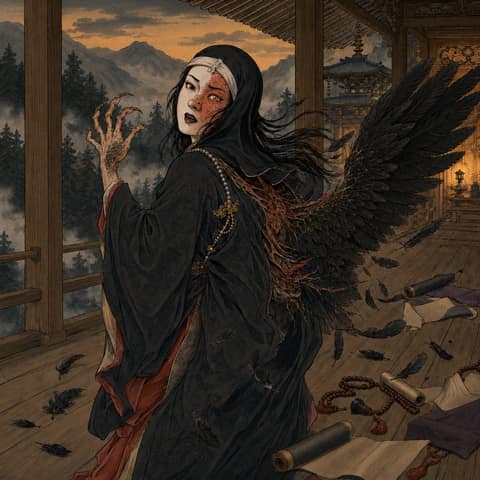
Mountain & Wilderness Spirits Sacred mountains and river valleys across Japan The Female Tengu is a strand within the broader image of tengu sporadically referenced in texts and oral lore. She is depicted in women’s attire such as kosode, light robes, or scarlet hakama, yet her back-borne wings and supernatural power mark her as a tengu. In The Tale of the Heike and its offshoots, the nun-tengu appears as a metamorphosis born from religious decline, providing a female counterpart to the monk-tengu. Edo-period mountain-encounter tales often stress prohibitions against women, noting the absence of female tengu, while river-tengu lore sporadically mentions married pairs or feminine features. Claims tracing their lineage to the goddess Amanozakoyahime appear in early modern natural-history writings but remain interpretive rather than doctrinal. Regional variation is great and no single image dominates, yet they share the general tengu attributes of might, illusion, and flight. Stripped of creative exaggeration, the Female Tengu is best seen as a projection of womanhood within the tengu world, with specific names and genealogies largely unknown.
珍しい 
Nyoi Jizai (Will-at-Will Scepter Spirit)
NYOH-ee jee-ZAI
Emaki Edition
Animated Objects & Undead Japanese folklore A consolidation based on the nyoi monster depicted in Muromachi-period Night Parade of One Hundred Demons scrolls and on Toriyama Sekien’s Hyakki Tsurezure Bukuro images and captions. Following the tsukumogami belief that tools gain spirit with age, the nyoi’s original function of “reaching at will” is exaggerated as occult power. Two iconographic lines exist: one shows a humanoid with a tea-brown body and long claws that scratch a person’s back with extended arms, the other shows the nyoi itself sprouting wings and drifting in midair. Both appear late at night in bedrooms or Buddhist rooms, said to seek out itchy spots and places the hand cannot reach. Some readings hold that the morally wanting are left with claw marks, yet region-specific oral lore is scant, and the figure relies mainly on pictorial sources and later yokai commentaries.
名妖 
Myōtaraten
myoh-tah-rah-ten
Myōtaraten, Local Guardian Deity
Deities & Divine Spirits Echigo Province (Niigata), Dewa Province (Yamagata) A compiled version of the Myōtaraten images rooted in local faiths of Echigo Yahiko and Okitama in Dewa. Their origin tales involve transformations of an old woman, an ogre, or a shapeshifting cat, whose ferocity is quelled when enshrined, after which they call rain and protect children and the virtuous as village guardian deities. Though bearing a Buddhist-style celestial name, the being is essentially a deified female presence embodying the numinous power of mountains and borders, centered on faith around Mount Yahiko and the Ichihon-yanagi wayside shrine. One tradition says thunder roars once a year when she returns to Sado, aligning agrarian views that link thunderstorms with harvests. Names and forms vary—old crone, celestial maiden, demoness—but the core is a turn toward benevolent protection.
名妖 
Ubagabi (Old Woman’s Fire)
OO-bah-gah-bee
Ubagabi (Traditional Accounts Version)
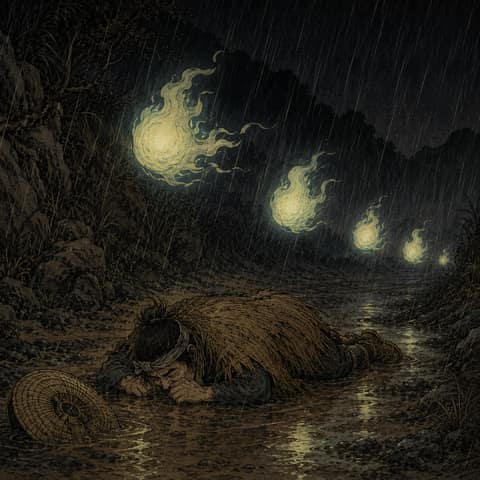
Natural Phenomena Spirits Kawachi Province; Tanba Province (Japan) A reference version based on images of Ubagabi that appear frequently in Edo-period essays and ghost tales. In Kawachi, an old woman who stole oil from a shrine was said to become a ghostly fire after death, drifting around shrine approaches and village paths on rainy nights. In Tanba, it was tied to water calamities on the Hozu River, feared as lights that swarm over the water. It appears as an orange fireball about one shaku in size, at times bearing the face of an old woman or the shadow of a bird. Contact is an omen of misfortune, though accounts note it can be driven off by calling out or by taboo words. With moral contexts of stolen shrine oil, child abandonment tales, and water disasters behind it, the Ubagabi endured as a ghost-fire embodying regional taboos and faith.
伝説 
Abe no Seimei
AH-beh noh SAY-may
Onmyoji Seimei
Ghosts & Spirits Said to be from Yamashiro Province (Kyoto) A portrait of Abe no Seimei shaped around the historical court onmyoji, later embellished by folklore. He is chiefly depicted as a practitioner of astronomy, calendrics, divination, and purification, presiding over rites such as ritual stamping, ablution, and directional avoidance. Shikigami were originally discussed as doctrinal techniques of Onmyodo or auxiliary spirits, symbolized as secret transmissions within the family line. Prayers for rain and healing from epidemics functioned to stabilize society through knowledge of seasons, stars, and directions combined with public ritual. From early modern times onward, Seimei was elevated as the progenitor of the Tsuchimikado house, and miracle tales multiplied in temple-shrine origin stories and storytelling. Records of a real government official merged with the image of a thaumaturge in yokai tales, fixing his name as representative of Onmyodo.
珍しい 
Atakemaru
ah-TAH-keh-mah-roo
Atakemaru (Possessed Vessel Tale)
Household Spirits Said to originate from Izu Province (Itō) A folkloric image of Atakemaru, the famed shogun’s flagship, remembered as a presence imbued with lingering spiritual power after dismantling and reuse. The ship’s splendor and public reverence fused with the belief that soul can dwell in objects, becoming a warning that rough treatment of its timbers invites strange happenings. Its manifestations are indirect—unsettling noises, revelatory dreams, possession of household members—with details varying by place and storyteller. Because historical service records blend with oral tradition, the tale functions as a symbolic, cautionary yokai story.
神格 
Treasure Ship
TAH-kah-rah-boo-neh
Traditional Version (Treasure Ship Print)
Deities & Divine Spirits Across Japan The Treasure Ship print traces back to boat images used to cast off bad dreams, circulated through urban and temple–shrine annual events. By the early modern period, designs commonly featured the Seven Lucky Gods and heaps of treasures, with auspicious characters on the sail to amplify good omens. Appending a palindrome verse tied it closely to first-dream traditions, preserving the logic of keeping a good dream and consigning a bad one to the river. While designs vary by region and publisher, the print uniquely combines two layers of meaning: inviting fortune and transferring or dispelling impurity. Folklorically, it links to New Year’s purification from year’s end through the first week, backed by its spread as an urban print commodity, ties to temple and shrine origin tales, and the vogue for Seven Lucky Gods as playful stand-ins.
名妖 
House Groans (Yanari)
yah-NAH-ree
Ienari (Traditional Depiction)
Household Spirits Various regions of Japan In picture scrolls it appears as little goblins shaking beams and pillars, a visual rendering of the intangible phenomenon of creaks and tremors within a house. In actual lore it is often told as the house itself rumbling without a fixed cause, though in some regions it is tied to animal curses, the misdeeds of residents, or signs of spirits lingering on the estate. It is said to occur late at night, especially around the Dead of Night, and noises arising at vital spots such as the hearth, storehouse, or armory were feared as ominous. Quiet sitting or sutra chanting, checking and offering for the crawlspace, and purifying beams and pillars are said to calm it, but if it persists, moving house is sometimes recommended. Traditional advice warns against hasty causal claims, urging first a review of the property’s lineage and proper rites to ancestral and household deities.
稀少 
Temple Woodpecker
TEHM-puhl WUUD-peh-ker (teh-rah-TSOO-tsoo-kee)
Temple Woodpecker (Sekien Zufu depiction)
Animal Shapeshifters Yamato and Settsu regions (around present-day Nara and Osaka) A form based on Toriyama Sekien’s illustration and accounts in war chronicles. It bears the will to hinder the Buddhist Law, pecking at temple timbers late at night as an omen of ill fortune. Tradition ties its origin to the vengeful spirit of Mononobe no Moriya, though its shape follows that of a woodpecker. In strange tales the sound comes first, a shadow is seen, and its true body is rarely caught. Folklorically it fuses bird-borne calamity lore with etiologies for temple damage.
珍しい 
Fūki (Sealed Boar)
FOO-kee
Fūki (Excerpted in Natural History Digests)
Animal Shapeshifters Unknown In compilations of foreign marvels, this variant appears as an excerpt that records only the name from the source and a note on its habitat. In Japan there are no sighting reports or oral traditions, and iconography never settled, so descriptions refrain from asserting its nature or powers. What remains are the spelling Fūki and its residence in the mulberry groves, with citations of sources and notes of foreign origin customarily added to avoid confusion with other monsters.
珍しい 
Kodama Mouse
koh-DAH-mah NEH-zoo-mee
Kodamanezumi (Canonical Folkloric Version)
Animal Shapeshifters Kitaakita District, Akita Prefecture A curated version of a mountain anomaly told among matagi hunters in northern Akita, framed within hunting rites and taboos. It looks like a dormouse or tiny field mouse, round, small, and quick. When it faces a person, it suddenly swells and unleashes a single blast like a gunshot. In many accounts it bursts apart, scattering flesh and viscera, while other tellings say it only bounces about and booms without exploding. Either way, an encounter is a dire sign of the mountain god’s anger or warning, and hunts were to be halted after a sighting. To continue was feared to bring empty bags, bad weather, or avalanches. To avert the curse one should descend the mountain and purify oneself at home by chanting “Namu Aburaunken Sowaka.” As for origins, one tale says seven matagi of the Kodama school were punished and became Kodamanezumi, while another reads the legend as a taboo memory arising from digging up hibernating dormice. Dates and sources are uncertain, with most accounts preserved orally.
稀少 
Hand from a Kosode Sleeve
koh-SOH-deh no TEH
Iconographic Tradition, Based on Sekien Toriyama
住居・器物 Edo period An interpretation aligned with Toriyama Sekien’s imagery and accompanying text. Only a white feminine hand emerges from the sleeve opening, while the absent owner is signified by the garment itself as the main subject. The kosode was a fine everyday robe of the time; whether it became a keepsake, was dedicated to a temple, or sold marks the branching fate, with spiritual disturbance manifesting as attachment residing in the clothing. It layers commentary on courtesans’ circumstances and the irony of buyout money with an aesthetic for dress and a sense of impermanence, functioning less as a concrete monster than as a “visible metaphor.” In folktales, illness after acquiring secondhand clothes and nightly apparitions of a white hand often cease once the robe is offered to a temple and sutras are chanted. Situated at the crossroads of possessed objects and ghost lore, it can be read as tsukumogami, yet its focus remains the emotions of the garment’s former owner.
名妖 
Azuki-arai (Bean Washer)
ah-ZOO-kee ah-RAH-ee
Azukiarai of the Mountain Stream
Ghosts & Spirits Various regions—especially mountain valleys in Kanto, Chubu, and Kinki Rooted in the classic image of the Azukiarai, it blends with the sounds of ravines and flumes, washing red beans through the midnight hours. It lures with sound and tests the curious who peer in. Drawing on early modern notes that it excels at counting and judges vessel measure and bean quantity at a glance, it is not wantonly harmful, but serves as a keeper of taboos along the water’s edge.
Showing 81 - 100 of 404 yokai