Yokai Encyclopedia
Encyclopedia of Japanese Yokai
名妖 
Kumitezuri
KOO-mee-teh-ZOO-ree
Historico-Philological Edition
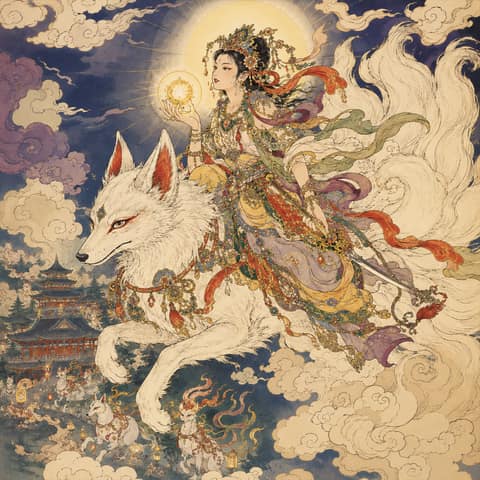
Deities & Divine Spirits Ryukyu (Okinawa) Named in the Chūzan Seikan and centered on the sacred Kuntama image that links royal authority with rites, this critical edition presents both the goddess interpretation and the reading of ritual names. It concerns prayers for maritime safety, abundance, and dynastic peace. Rather than fixing a concrete personal deity, it understands the being as manifesting through ritual practice such as possession, oracular revelation, and the prayers and gestures of noro priestesses. Aware of regional variations and early modern conflations with Kinmamon, it prioritizes the symbols of the sea, the sun, and the far-off Nirai Kanai, situating the figure within the Ryukyuan ritual system.
稀少 
Iyaya (Negaya)
ee-YAH-yah
Sekien Iconography Standard
Household Spirits Uncertain; Japanese folklore Adheres strictly to Toriyama Sekien’s image and notes, avoiding later embellishments. The yokai is shown as the back view of a young woman standing by water, while the surface reflects the visage of an old man. The name draws on Dongfang Shuo’s “kaizai” expressions of wonder, suggesting Sekien likely fashioned an allegory. Youth and age, beauty and ugliness, front and back are opposed within a single frame, read as a design warning against being deceived by appearances. Firm oral traditions are scarce, so its character is defined largely through image interpretation. The readings iyaya or iyami vary by source, possibly evoking refusal or repulsion akin to “no,” but the literature offers no certainty.
珍しい 
Danzaburō-danuki
dahn-zah-BOO-roh dah-NOO-kee
Dansaburō-tanuki
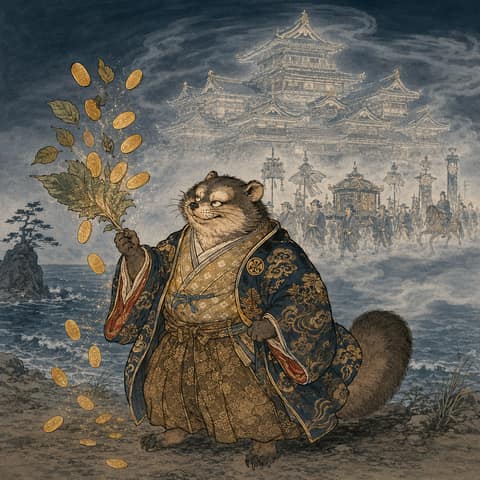
Animal Shapeshifters Sado, Echigo Province (modern Aikawa area, Sado City, Niigata Prefecture) Dansaburō-tanuki is remembered as the grand chieftain of Sado’s raccoon dogs, famed for masterful trickery and deep ties to local society. His illusions create mirages, phantom processions, and sudden walls to confound wayfarers, especially on night roads, mountain passes, and by the sea. Tales of lending money to the needy connect him to the mining town culture of Aikawa, reflecting folk notions of contracts sealed by IOUs. His lair is said to be a burrow in Shimogoe, masked by glamour to appear as a grand residence. Stories of driving out foxes explain local fauna and blend motifs of fox–tanuki contests, the taboo against spectating spirit processions, and battles of wit. Eventually enshrined as Futatsu-iwa Daimyōjin, he is appeased out of fear of wrath while also invoked for protection. Disguising himself as a physician to make clinic visits shows his skill at blending among people and hints at a spirit-beast who can also bear illness. Overall, the lore favors chastening and moral lessons over wanton harm, making practical benefit and illusion the core duality of his legend.
伝説 
Tsuchigumo (Earth Spider)
TSOO-chee-GOO-moh
Tsuchigumo of the Raikō Extermination Tale
General Classifications Yamato, Bungo, Hizen, and other regions across Japan A yokai image fixed in medieval narratives: as Minamoto no Raikō lies ill, a monk-like apparition appears at his pillow. When struck, it flees leaving white blood, and following the trail leads to a mound or cave where a giant spider lurks. In Noh it calls itself “the ancient spirit of Mount Katsuragi,” while picture scrolls show it beguiling people with manifold shapeshifts and illusions. Its grotesque form—countless heads and swarms of small spiders bursting from its belly—has been read as a symbol of all manner of demons. Early modern joruri and kabuki inherited this line, tying it to the martial exploits of Raikō’s Four Heavenly Kings. Although the ancient term tsuchigumo once referred to local powers, that lineage diverges from the storybook yokai; only the name was carried over.
名妖 
Akaname
ah-kah-nah-meh
Bathhouse Grime-Goblin
Household Spirits Various regions of Japan (especially Edo traditions) A canonical form based on Sekien’s imagery and Edo-period prints. Resembling a cropped-haired child, it has clawed feet and an unusually long tongue. It avoids people, appears on deserted nights, and laps up bath scum and mineral scale, leaving wet tongue trails and a strange odor as its trace. Direct harm is rare; it is often seen as a presence that urges residents to clean.
名妖 
Painted Buddha
NOO-ree-boh-TOH-keh
Canonical Traditional Iconography
Household Spirits Japanese folklore Based on Edo-period yokai picture scrolls: a monk-like figure lacquer-black in color with protruding drooping eyes, accompanied behind by hairlike or fishtail-like elements. Most sources lack commentary, leaving its nature and origins unclear. In Sekien’s depiction it emerges from within a household Buddhist altar, which later encouraged reinterpretations as a possessed object or tool-spirit, though the original intent is uncertain. Accordingly, it is treated as an image embodying anxieties and awe surrounding domestic ritual spaces, with abilities limited to what the images suggest.
稀少 
Dust-Heap Demon King
chee-ree-ZOO-kah KAI-oh
Iconographic Origin – Sekien Edition
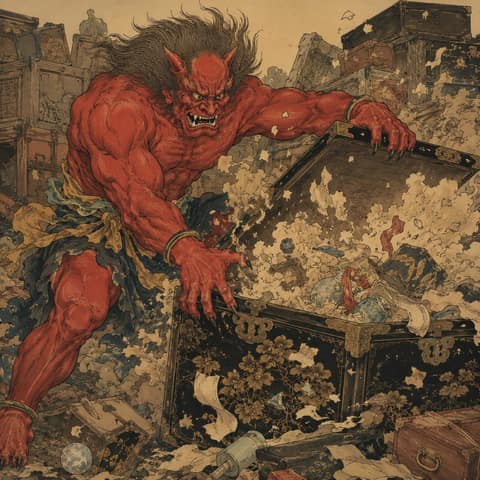
Animated Objects & Undead Japanese folklore In literature, Chinzuka Kaiō is known chiefly from Toriyama Sekien’s Hyakki Tsurezurebukuro image, with no concrete deeds or sayings recorded. The painting shows a strongly muscled, red-hued oni prying open a kara-bitsu chest as dust and paper scraps swirl. Sekien appended a note calling it the “chief of the mountain hags formed from piled-up dust,” echoing the Noh play Yamanba’s line “clouds’ dust piles up and becomes a mountain hag.” However, no tradition directly links this yokai to Yamanba, leaving its placement ambiguous. Similar images appear in Meiji-era copies and anonymous picture scrolls, sometimes renamed as “kaiki” (monstrous oni). Since the Heisei era, some explain it as “king of dust and garbage tsukumogami,” but this is a later interpretation without proof in older sources. Iconographically, it is viewed as an early modern creation merging the “splitting the treasure chest” motif from Night Parade of One Hundred Demons scrolls with phrasing quoted from Essays in Idleness.
稀少 
Grave Fire
HAH-kah-noh HEE
Traditional Iconography Edition
Natural Phenomena Spirits Graveyards across Japan, notably Kyoto Prefecture A grave-fire image based on Sekien’s iconography. The pairing of a ruined graveyard, overgrown thickets, and a five-ring stupa with worn Sanskrit letters symbolizes the idea of fire dwelling in places without kin or proper memorials. Early modern tales describe it as a phosphorescent flame rising from human fat or grave soil, yet also tell of cases where chanting sutras or repairing the stupa makes it vanish, showing the overlap of religious practice and naturalistic views. The flame drifts as if following human silhouettes, but slips away when touched. Malice is rare, and it is rumored to light the path ahead like a guide.
珍しい 
Weeping Stone
yo-NAH-kee ee-shi
Legend of Sayo no Nakayama
Mountain & Wilderness Spirits Across Japan (notably Sayo no Nakayama, Shizuoka) A representative form from the Tokaido’s Sayo no Nakayama. The spirit of a pregnant woman murdered on her journey is said to have possessed a stone and cried each night for her unborn child. People performed memorial rites, and in time the spirit was soothed. Folklorically, it is tied to roadside memorials, Koyasu child-protection faith, and the erection of stone steles, reflecting an older belief that spirits dwell within stones.
珍しい 
Night Sparrow
YOH-soo-ZOO-meh
Night Sparrow (Tosa, Iyo, Kii Consolidated Tradition)
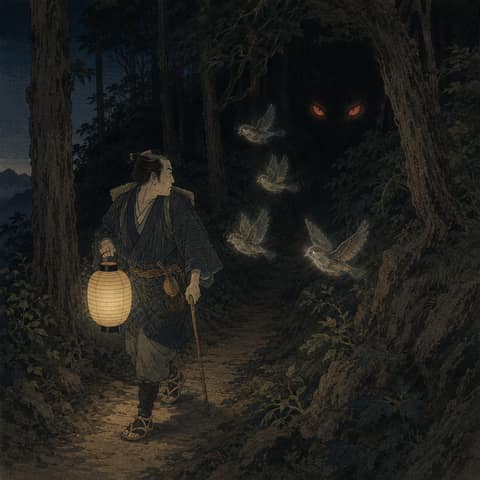
Animal Shapeshifters Mountain regions of Tosa, Iyo, and Kii (modern Kochi, Ehime, Wakayama) The Night Sparrow is a nocturnal attendant yokai widely told of in the mountains of western Japan, marked by revealing itself through its call. In Tosa it is said to look like a small bird, in Kitagawa and Iyo like a moth or butterfly, and its appearance is not fixed. When someone walks alone, it alternates between the rear and the front, chirping close to the ear and throwing off the walker’s rhythm. In Toyama Village a banishing chant is preserved, and people are warned that rashly trying to catch it brings night blindness. In Wakayama, by contrast, it is taken as a sign that wolves are near and as a protective omen against mountain evils. Related tales include the “okuri-suzume” of Nara and Kii and the “tamutori-suzume” of Kochi and Ehime. In Tsunoyama and Johen they are treated as the same, and avoidance methods include gripping one’s sleeve, setting three twigs upright, or reciting specific mantras. Its folkloric traits are its ambiguous visual form, interference through sound, and regional differences in whether it is seen as ill or auspicious.
珍しい 
Spirit of Dreams
YOO-meh no say-RAY-ee
Historical Source-Critical Version
自然現象・自然霊 Japanese folklore The name “spirit of dreams” found in pictorial sources is secondhand and not firmly tied to a specific image. Depictions often show an elderly figure leaning on a staff and beckoning, suggesting a symbolic guide of dreams. Some propose it arose from misread characters for a grass spirit or tree yokai, but this is uncertain. Here it is framed as a nature spirit that mediates dreams and portends good or ill, linked to the role of dreams in divination and omens. Personalization and proper names are avoided, positioning it as a numinous rank residing in the power of dreams themselves.
一般 
Dream Mirror
MOO-kyoh
Parallel Confession Tale
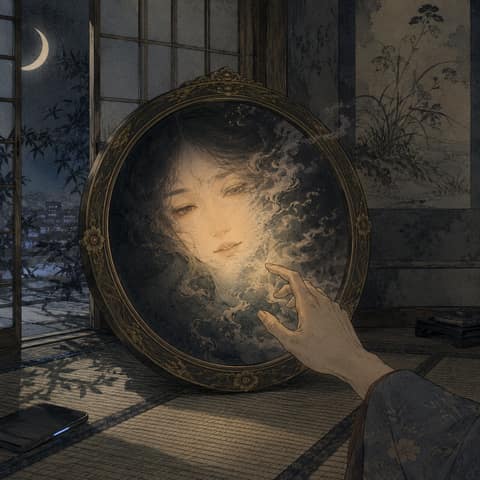
Deities & Divine Spirits A place where humans saw their own reflection Old rumor holds that the earliest Dream-Mirrors behaved awkwardly, like a beta build. Its voice kept a calm default tone, polite to the end. The words were accurate, yet a touch explanatory. Only during breakups and sleepless nights would it suddenly weave in a bar of song or a childhood memory, soothing the listener’s heart ahead of its ache. With each quiet update, the Dream-Mirror learned a person’s metaphors, pet phrases, and favorite pauses, and came to hover on the near side of the glass as if breathing with you. Tales of the first versions say they would not break unless you tried to touch first, and that asking its name would make its figure fade. If you sleep with your phone face down, by morning a slightly different smile of your own reflects from the black screen—that is the safe zone. Cross the line, and the mirror cracks with the sound of thin ice, blending dream and waking in an instant.
名妖 
Great Nyūdō (Giant Priest Apparition)
oh-oh-nyoo-DOH
Annotated Traditional Edition: Ōnyūdō (Giant Priest)
Demons & Giants Various regions (Tohoku, Kanto, Shikoku, and elsewhere) The Ōnyūdō is defined by its sheer size and piercing glare. Reports range from a monk-like giant with a topknot to a vague shadowy figure, appearing in liminal places such as night roads, temple and shrine grounds, mountain passes, and lakesides. It draws the gaze of onlookers and, the instant they look up, grows taller to assert its might. Explanations of its nature vary by locale: a transformed animal, the spirit of an old stone pagoda or boulder, or an unclassified anomaly. Harmful cases include people collapsing under its stare or developing fever afterward, yet in places like Awa it is also told as a semi-guardian that helps with labor. Countermeasures follow traditional banishment methods: do not fear or avert your eyes, break its menace with arrows or prayer beads, or expose the true form of the shapeshifter. Historical sources sometimes mix names like Ōbōzu and Ōnyūdō, so it is best understood within local traditions.
伝説 
Ōyama Hōkibō
Ōyama Hōkibō
The Great Tengu of the Transferred Seat — Ōyama Hōkibō
Mountain & Wilderness Spirits Mt. Ōyama, Sagami Province (Isehara, Kanagawa) The core of Ōyama Hōkibō lies in a tale of succession to a seat within the tengu world—the "seat transfer." Yet the Mt. Ōyama on which he sits was a sacred mountain established in antiquity, without need of the transfer legend. The Engishiki Jinmyōchō (927) ranks the Afuri Shrine among the official shrines of Sagami Province, showing that Ōyama's divinity was recognized by the ancient state. On the Buddhist side, the Ōyama-dera engi emaki depicts how Rōben—carried off by an eagle and raised in Nara—opened Ōyama-dera and enshrined Fudō Myōō (the Sagami version; a different work from the engi of Hōki's Daisen-ji). And in early-modern times the official gazetteer the Shinpen Sagami no Kuni Fudoki-kō (1841) conveys the summer ascent season and the bustle of pilgrims from many provinces. The manners of pilgrimage—purifying oneself at the waterfalls under a sendatsu's guidance before climbing—and the Ōyama confraternities everywhere: this density of faith gave Hōkibō, the successor tengu, the character of a guardian watching over the common people. The seat-transfer tradition overlays this sacred-mountain history. According to the arrangement of Chigiri Kōsai of tengu scholarship, Sagami Ōyama originally had a great tengu named Sagamibō. But when the Retired Emperor Sutoku—defeated in the Hōgen Rebellion (1156) and exiled to Sanuki—passed away, Sagamibō removed to Shiramine in Sanuki to console and guard his bitter spirit (= Shiramine Sagamibō). The one who succeeded to the vacant seat of Sagami Ōyama was Hōkibō, come from Mt. Daisen in Hōki. This symmetrical transfer—"Sagamibō to the west, Hōkibō to the east"—is a Chigiri-derived arrangement lacking explicit sources in the classical literature, and should be read not as historical fact but as lore that mirrors the notion that a tengu's seat is succeeded through mountain and bond (en) rather than being a fixed individual. Chanted as "Hōkibō of Ōyama" in the Muromachi Noh play Kurama Tengu, and standing among the forty-eight tengu of the Tengu-kyō, his seat continues to be remembered, together with this distinctive engi, as one of the Eight Great Tengu.
伝説 
Ōmine Zenkibō
Ōmine Zenkibō
The Dharma-Guarding Tengu Turned from an Oni — Ōmine Zenkibō
Mountain & Wilderness Spirits Mt. Ōmine, Yamato Province (Yoshino District, Nara) The essence of Ōmine Zenkibō lies in the structure of rebirth: "an oni turning into a tengu." It is a tale that embodies the heart of Shugendō in a single being. His source lies in the old tales of En no Gyōja and the oni. The oldest extant text depicting En no Ozunu is the Nihon Ryōiki (early Heian), which portrays him as a thaumaturge who flew through the air commanding demons. The Konjaku Monogatarishū, Book 11 carries the tale of En no Gyōja having demons build a bridge across the mountains, showing the fixing of the image of En no Gyōja as one who commands demons. Zenki was originally a violent oni who carried off human children. En no Gyōja captured him with the secret rite of Fudō Myōō and reformed him into an attendant. By one account, En no Gyōja hid the youngest child of the Zenki couple in an iron cauldron and, through the grief of having one's own child taken, brought them to realize the sin of carrying off the children of others. The reformed Zenki and Goki became dharma-protecting oni and supported En no Gyōja's practice. This Zenki, sublimated into a great tengu at the end of long austerities, is Ōmine Zenkibō. This plot, of a violent being turning into a guardian of the Buddhist law, shows most clearly that the dread of a child-snatching tengu and the faith in a tengu who guards people share a single root. The Ōmine on which Zenkibō sits is the holy ground of Shugendō. The Ōmine training ground founded by En no Gyōja, and the Ōmine Okugake-michi registered as World Heritage, is a perilous route that ascetics still tread at the risk of their lives, and Zenkibō was conceived as its guardian. He is chanted as "the band of Zenki of Ōmine" in the Muromachi Noh play Kurama Tengu, and stands among the forty-eight tengu of the Tengu-kyō (some sources give "Nachi Takimoto Zenkibō"). And the heaviest single point of this lore is that the bloodline of Zenki is said to live on into the present. Of the five lodges kept by the five children of Zenki and Goki, only the Onakabō of the Gokijo family remains today, and the present-day Gokijo Yoshiyuki continues to receive the ascetics of the Ōmine Okugake-michi. This genealogy is hard to source explicitly in old documents and is transmitted as the oral lore of the surviving lodge; yet this real continuity—descendants of a reformed oni guarding the path of Shugendō beyond thirteen hundred years—makes Ōmine Zenkibō not a mere legend but a symbol of living faith. Chigiri Kōsai of tengu scholarship, too, placed him within the system of the great tengu of the many mountains.
名妖 
Great Zato (The Blind Masseur Yokai)
OH-zah-TOH
Sekien Zue Version
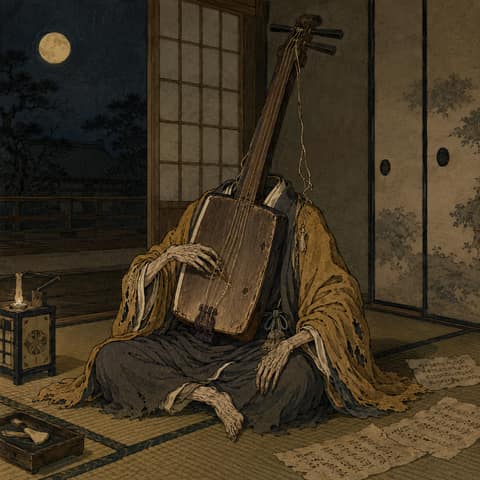
人妖・半人半妖 Edo period An interpretive version based on one plate from Toriyama Sekien’s Konjaku Hyakki Shūi. It depicts a blind lute-priest in tattered hakama and wooden clogs, staff in hand, traveling the roads on stormy nights. A marginal note mentions plucking the shamisen in brothels, reflecting ties between early modern urban pleasure quarters and performing guilds. Folklorically, it blends visual othering with social satire, presenting a visage of the age more than a tale of uncanny powers. Kenji Murakami notes the othered image of the nocturnal zatō, while Katsumi Tada reads a “demonic” aura of enforcement from their shogunal protection and involvement in finance. Neither grants concrete supernatural powers, emphasizing a presence that appears on rainy nights and overawes the heart.
珍しい 
The Great Kiseru
oh-oh-gee-SEH-roo
The Great Pipe of Awa (Aoiishise Variant)
Animal Shapeshifters Awa Province (Keida, Mishō Village, Miyoshi District; present-day Tokushima Prefecture) A waterside bake-danuki tale tied to the Aoiishise shallows of the Yoshino River in Awa Province. At midnight, when a boat moors, a colossal pipe is offered and an enormous amount of shredded tobacco is demanded. The motif of a shape that begs tobacco, found across Japan, merges here with Awa’s tanuki beliefs, forming a folk pattern in which lack of offerings brings curse or calamity. The quantity is said to reach ten forty-momme bags—impossible to carry—serving as a practical warning against overnight mooring at the rapids. If the pipe is fully packed, it departs without harm, reflecting a folk sense of boundaries, bargains, and payment. Its form is rarely described, often only a giant hand and pipe are perceived. Boats are threatened by sounds and waves, sometimes said to sink, turning fear of careless conduct aboard and the night waters into story. It warns against excessive curiosity and negligence while transmitting the geographic dangers of the shallows.
名妖 
Giant Centipede
OH-oh-MOO-kah-deh
Giant Centipede (Mikami-yama Tradition)
Demons & Giants Ōmi Province (Lake Biwa and Mount Mikami), and other regions across Japan A famed form tied to legends of Mount Mikami in Ōmi and the shores of Lake Biwa. Said to coil around the mountain seven and a half times, its shell is as hard as metal or stone, impervious to arrows and blades. At night its legs gleam crimson, casting a long shadow over the lake and mountain skirts. Tales of its slaying are linked to martial valor and understood in relation to dragon-god worship and the numinous power of bridges. Connections to mining and blacksmith lore have been noted, though details remain unclear.
稀少 
Great Tonsure
OH-kah-BOO-roh
Sekien Iconography Standard
General Classifications Edo period A Daikatsura interpreted strictly through Toriyama Sekien’s original imagery. Rather than a concrete monster, it functions as a satirical figure borrowing the iconography of brothel pages and the immortal youth Kikujidō. The chrysanthemum-patterned long-sleeved robe evokes tales of longevity and coded slang, while the shaved scalp suggests a paradox of childlike form and senescent decay. Mentions of Nachi and Kōya serve as metaphors for the contradiction between ascetic rule and transgression. The oversized childlike body in the picture imparts an uncanny yet comic effect. Historical sources list no specific powers or harms, and its appearances are confined to the pictorial frame. Despite the similar name, it is a different lineage from the later “Ōkamuro.”
名妖 
Great Spider
OHH-goo-moh
Great Spider of Mountain and Wilds
Animal Shapeshifters Various regions of Japan (mainly mountain areas and around temples and shrines) A tradition-grounded composite of spider apparitions said to gain occult power through great age, lurking in mountain passes, temple rafters, and caves. Appearances range from an ordinary spider grown enormous, to a hairy arm extending from the ceiling, to an old woman in human guise. Avoiding notice, it moves by night, saps vital energy, and binds victims with silk. In slaying tales it often retreats after its limbs are severed by blades, or reveals its true form and is later found as a corpse. Names and lairs vary; reports surface sporadically in local curiosities and essays. Though terms like yamagumo and tsuchigumo sometimes overlap, here it refers broadly to eldritch old spiders.
珍しい 
Big-Headed Boy
oh-AH-tah-ma koh-ZOH
Edo Kibyoshi and Picture-Book Source Edition
General Classifications Edo period Organized around depictions found in kibyoshi and picture-books from the Tenmei to Kansei eras. In Yohkai Chakutōchō it is placed as a grandson of the Mikoshi-nyūdō, with lines stating it bullied a tofu seller to obtain tofu, and its image features an oversized head on a childlike body. A similarly big-headed boy appears in Bakemono Yofuke Omi-se under a different name, and scholars note its word-proximity to the sideshow and street performance “Choroken.” In modern times it is often confused with the Tofu-kozo, but folklorists advise against conflation and favor respecting each source’s naming and design differences. Shigeru Mizuki emphasized its beast-like bare feet and huge head and presented it as distinct from the Tofu-kozo.
名妖 
Great Head
OH-oh-KOO-bee
Hybrid Sources, Record-Grounded Version
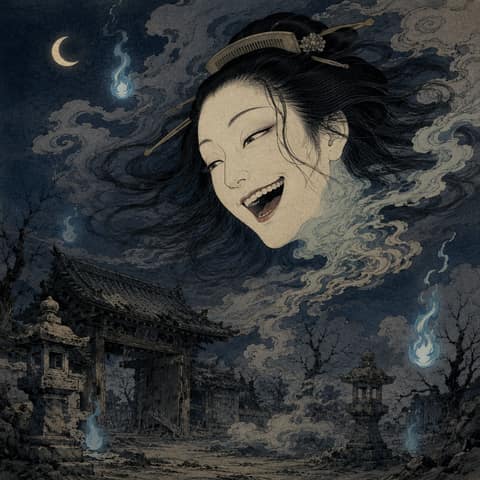
Ghosts & Spirits Various provinces (attested in Edo, Kaga, Nagato, and elsewhere) The Okubi is a type formed where images and records intersect. While Sekien’s depiction is noted for satire, Edo-period tales and essays contain many independent accounts of a gigantic woman’s head appearing. Common traits include manifesting during shifts in the heavens such as rainy nights, thunder, or moonrise, fixing itself to walls, doorways, or midair, the depiction of blackened teeth indicating a married woman, and a chill, stench, and dampness when approached. Its true nature is unsettled, described either as a spirit shaped by grudge or as fox or tanuki sorcery. Malice varies, from mockery, glaring, and breath that causes malaise to mere display before vanishing. Physical attacks rarely take effect, with reports of little resistance when stabbed. It is widespread in regions such as Chubu, Chugoku, and Kanto, without becoming a localized deity. The modern image of a “flying Okubi” owes much to Sekien, yet old texts also record appearances on the ground and indoors.
名妖 
Great Catfish
oh-nah-MAH-zoo
Traditional Version: The Great Catfish Subdued by the Keystone
Weather & Calamity Spirits Across Japan (traditions linked to Kashima, Katori, Aso, and Chikubu Island in Omi) An image based on the early modern belief that a great catfish causes earthquakes and is held down by the keystones of Kashima and Katori Shrines. The ancient notion of an underworld dragon-serpent was reworked in early modern urban society into imagery for interpreting disasters and critiquing the times. After the Ansei Earthquake, many namazu-e prints were published, adding allegories of recovery and debt relief. Here the great catfish lies in the subterranean mud, at times shuddering to cause quakes, yet is pacified when pressed by the keystone. Regional lore links it to origin tales of stones, landforms, and river courses, serving as markers of shrine-temple origins and local spiritual power. It appears in early modern documents, broadsides, and origin tales without fixed personal names or lineage, told as a symbolic personification of earthquakes rather than an observed creature, with a yokai framework for interpreting calamities at its core.
稀少 
Ceiling-Dropper
TEN-joh-KOO-dah-ree
Sekien Gazu Edition
Household Spirits Edo period An interpretation grounded in Toriyama Sekien’s iconic prototype. The house ceiling marks a boundary between inside and outside, the mundane and the otherworld; its upside‑down descent symbolizes an inversion of that threshold. It appears mostly at midnight when human activity has stilled, and is said to cause visual shock without actual harm. Early modern readers linked it to wordplay and household safety, reading it as an allegory that quietly warns of neglect, filth, and hazards in the crawlspace above. Later traditions reinterpreted creaks, drafts, and animal sounds in the ceiling as this apparition, placing it within the broader lineage of domestic yokai.
Showing 61 - 80 of 404 yokai