Yokai Encyclopedia

Encyclopedia of Japanese Yokai

91 Yokai|14 Category|Page 2 of 4
Localization in Progress - More content available in Japanese version
View Japanese
Sort by: NameAscending
Legendary
  • Inugami

    Inugami

    Legendary

    EE-noo-GAH-mee

    Inugami (Traditional Form)

    Animal ShapeshiftersTokushimaKochi

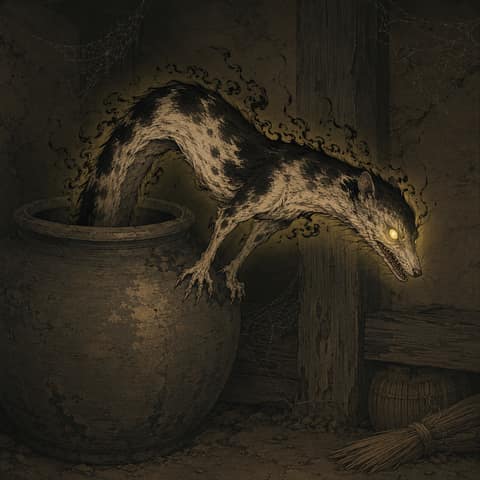
    Inugami are feared as hereditary possessing spirits tied to certain lineages, bringing wealth and prosperity yet shunned as curse gods. Rites and keeping methods vary by region, with offerings made in storerooms, under floorboards, or at water jars. Their form is not fixed: accounts describe a mottled mouse-like creature, a black-and-white weasel-like shape, a long-mouthed rat, or something bat-like. Houses said to keep inugami were believed to have as many spirits as family members, and the spirits were rumored to run to other homes to obtain desired goods. The possessed might bark, tremble in the shoulders, or gorge themselves, and even cattle, horses, and tools were said to be possessed. Exorcism was performed through prayers and esoteric rites, with shrines in Tokushima particularly noted. Origins are variously traced to sorcery, legal taboos, and rites that turn a dog’s head into a fetish, differing by locale.

  • Issun-boshi

    Issun-boshi

    Legendary

    EE-soon BOH-shee

    Issun-boshi of the Needle-Sword and Schemes

    Human-Yokai / Half-Human Half-YokaiOsakaKyoto

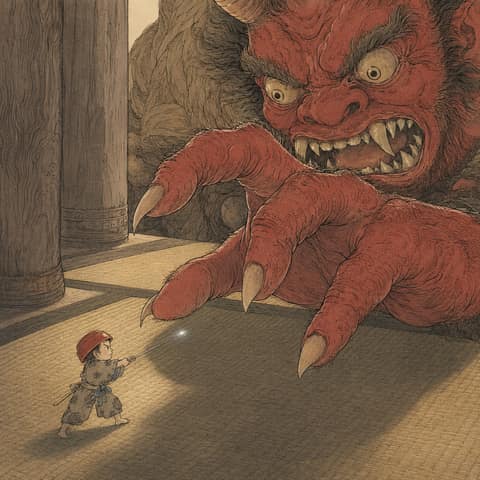
    This interpretation shatters the illusion of the "innocent and brave little person" sanitized by later children's literature, restoring his true nature as the "extremely ambitious and cunning trickster" depicted in the original Muromachi *Otogizoushi*. This version of Issun-boshi carves out his destiny not through martial force, but through advanced psychological manipulation (off-board tactics) and amoral scheming. His greatest defining trait is his abnormal "upward mobility." Burdened with the supreme handicap in human society—a height of merely one sun (about 3 cm)—he never abandons his ambition to take a powerful man's daughter as his wife and achieve worldly success. His method of framing the princess using the "rice grain scheme," having her disowned by her father to socially isolate her, and creating a state of complete dependence on him, displays a cold-blooded Machiavellianism that puts modern psychopaths and con artists to shame. Even in his battle with the oni, he does not fight fair and square. He turns the desperate situation of being swallowed whole to his advantage, executing a gruesome internal destruction (assassination technique) by continuously stabbing the oni's internal organs from the safety of its body (stomach and eyeballs) with his needle-sword. Finally, he robs the oni of its treasure, the "Miracle Mallet," using it to rapidly grow his body and ultimately obtain the ultimate social status of a "perfect human man." He represents the darkest and most realistic rags-to-riches hero in Japanese literary history, overturning his inherent, irrational handicaps entirely through intellect, lies, and the plunder of otherworldly power (the oni's treasure).

  • Izanagi

    Izanagi

    Legendary

    Izanagi

    Izanagi no Mikoto, ancestral god of creation, land-birth, and purification

    Deity / divine spiritHyogo

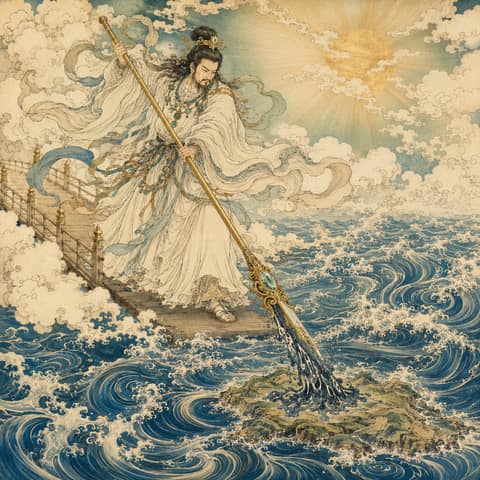
    The Seven Generations of the Gods and the cosmology of creation. The basic account covers land-birth and god-birth. Looking more closely, the Seven Generations of the Gods form a creation sequence in their own right. The Kojiki says that after heaven and earth open, the three creator deities and the Separate Heavenly Deities appear, followed by the divine generations beginning with Kuni-no-tokotachi. The line moves from solitary, abstract deities toward paired gods, then finally reaches Izanagi and Izanami as husband and wife. Myth moves from abstraction into relation, sex, marriage, and birth. Their marriage and the birth of the land are the decisive passage from divine potential into a concrete world. The Floating Bridge, the jeweled spear, and Onogoro Island. The scene in which the two gods stand on the Floating Bridge of Heaven and stir the sea with Ame-no-nuboko is one of the most important images in ancient Japanese cosmology. The bridge joins heaven and earth as a vertical world axis. The spear is an instrument of creation. Brine hardening into an island marks the passage from liquid to solid, from formlessness to form. Onogoro Island means something close to an island that congealed by itself, suggesting that creation is not only divine command but also natural self-formation. The scene can be read beside Pangu's separation of heaven and earth, the Indian cosmic egg, and Eurasian myths of stirring primordial waters. The descent to Yomi, an early East Asian Orpheus myth. Izanagi's descent to Yomi, his broken taboo, and his flight from the dead belong to the mythic type in which someone enters the underworld to recover a lost wife and fails after violating a prohibition. The Greek story of Orpheus and Eurydice is the most famous example, while Izanagi's version, written in the Kojiki in 712, is one of East Asia's earliest textual witnesses to the type. The stolen glimpse, the broken command, the pursuing dead, and the protective peaches all echo underworld narratives from India, China, and Europe, suggesting deep affinities across ancient Eurasian religious imagination. Misogi, the origin myth of Shinto purification. After escaping Yomi, Izanagi washes away its pollution at Awagihara. This is the origin myth of misogi and harae. Gods are born as he removes garments and objects from his body; sea deities are born as he washes in the stream; finally, the highest deities emerge from his eyes and nose. The structure binds body, impurity, purity, and divine birth together. The hand-washing before shrine worship, the Nagoshi no Oharae summer purification, and ritual ablutions before major ceremonies all find a mythic source here. Eda Shrine and Izanagi Jingu honor him as the ancestral deity of purification, showing how an ancient myth continues inside living Shinto practice. The Three Precious Children and ancient Japan's cosmic order. Izanagi divides the sky, night, and sea among the Three Precious Children. Amaterasu Omikami receives Takamagahara, the realm of heaven, daylight, and light. Tsukuyomi no Mikoto receives the realm of night, quiet, and calendrical rhythm. Susanoo no Mikoto receives the sea plain, the ocean and its violent force. This threefold division is not only a mythic plot point. It later supports the legitimacy of the imperial line and Ise Shinto. Medieval, early modern, and modern political thought in Japan repeatedly return to this narrative. It is a central line running through Japanese ideas of state, religion, and cosmic order. Taga Taisha, Izanagi Jingu, and Eda Shrine. The three major sacred places of Izanagi correspond to different moments in the myth. Izanagi Jingu in Awaji marks the beginning of land-birth, the marriage of the two gods, and Izanagi's hidden palace. Eda Shrine in Miyazaki marks Awagihara, purification, and the birth of the Three Precious Children. Taga Taisha in Shiga became a popular early modern shrine of long life and vitality. Together these sites turn the sequence of creation, purification, and longevity into geography and pilgrimage, sustaining Izanagi worship across Japan. Motoori Norinaga's Kojiki-den and the formation of kokugaku. Motoori Norinaga, the Edo-period kokugaku scholar, completed the forty-four-volume Kojiki-den in 1798, using rigorous philology and historical linguistics to interpret the Kojiki, including the myths of Izanagi. Debate continues over whether such myths should be read as history, symbolic narrative, or cultural memory, but Norinaga's method laid an important foundation for modern Japanese humanities. Izanagi therefore extends beyond myth alone. He belongs to the intellectual history of kokugaku, Shinto, modern national thought, and postwar folklore studies, and remains a symbolic figure in Japanese religion, scholarship, politics, and culture.

  • Izanami

    Izanami

    Legendary

    Izanami

    Izanami no Mikoto, Ancient Mother Goddess of Birth and Death

    Deity / divine spiritMie

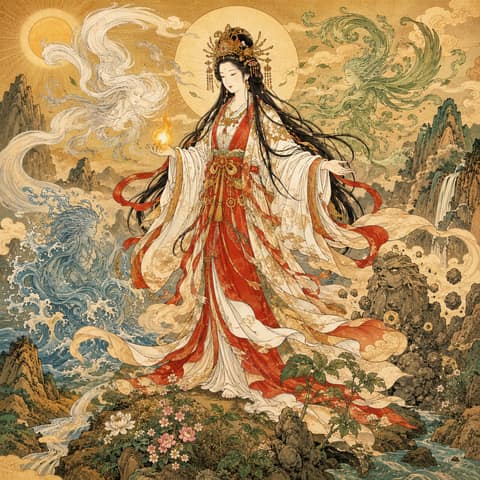
    The cycle of birth and death: the nature of an ancient mother goddess. The basic profile described Izanami's mythic role; the deeper issue is that she embodies birth and death in a single archaic mother figure. Izanami gives birth to the Oyashima islands and thirty-five nature deities, and even on her deathbed continues to produce gods of mines, earth, and grain from her vomit, urine, and excrement. This resembles the ambivalence of mother goddesses across the ancient world, such as Gaia in Greece, Inanna in Sumer, or Kali in India: the one who gives life also contains death. Izanami is more than a creator deity. She joins birth and death, the living world and the underworld, purity and pollution into one Japanese variation of the archaic mother goddess. Kagutsuchi's birth and the symbolism of fire. Izanami dies because she gives birth to the fire god Kagutsuchi, an event of major symbolic force in ancient Japanese cosmology. Fire begins civilization: forging, pottery, cooking. Yet fire also brings destruction and death. In ancient societies, childbirth itself could threaten a woman's life, and the myth binds those dangers together. Kagutsuchi is born, Izanami dies, and from her dead or dying body arise deities of mines, earth, and grain. This chain makes the material foundations of civilization, metallurgy, agriculture, land-making, emerge from the sacrifice of the mother goddess. The myth gives a stark expression to an ancient worldview: civilization stands on the body of the mother. Yomi no Kuni and the queen of the dead. After burial, Izanami reigns as queen of Yomi no Kuni. This is an unusual structure in ancient myth. Chinese underworlds are often ruled by male figures such as Fengdu or the Lord of Mount Tai; India has Yama, and Greece has Hades. In Japanese myth, however, the realm of the dead is ruled by the former creation goddess. Izanami's rule over Yomi shows the close ancient Japanese linkage of woman, death, and underworld. Later images of Enma, Jizo, and the Sanzu River grow in soil prepared by this imagination of the dead. The idea of death as a feminine principle is one of the most striking points for comparative religion. The burial debate: Izumo and Kumano. The Kojiki names Mount Hiba, on the Izumo-Hoki border, as Izanami's burial place, while a variant in the Nihon Shoki names Kumano in Kii. The two traditions map onto two religious geographies. The Izumo line, Shobara in Hiroshima, Yasugi in Shimane, and Higashi-Izumo in Matsue, connects with Izumo ritual lineages and faith in Ne no Katasukuni. The Kumano line, Hana no Iwaya in Mie and Kumano Hayatama Taisha in Wakayama, connects with Kumano Sanzan worship, Fudaraku sea-crossing beliefs, and Pure Land imagination. Izumo lies to the north, facing the Sea of Japan; Kumano lies to the south, facing the Pacific. Together the two burial traditions form a core problem in the religious geography of ancient Japan. Hana no Iwaya Shrine and ancient iwakura worship. Hana no Iwaya Shrine in Kumano, Mie, is named in the Nihon Shoki as Izanami's burial place and is one of Japan's oldest shrines; it has no shrine hall and worships a forty-five-meter sacred rock as its divine body. Iwakura worship is an old Japanese mode of nature veneration in which trees, boulders, waterfalls, and mountain peaks are treated as places where divine spirits dwell. Later shrine architecture grew out of such natural sacred places, and Hana no Iwaya preserves an especially ancient layer by having no main building. The Otsunakage rite, held on February 2 and October 2, hangs a rope about 170 meters long from the sacred rock to the precincts; it is a rare living folk practice that carries ancient rock worship into the present. "One thousand a day, fifteen hundred a day": the cosmology of life and death. The exchange at Yomotsu Hirasaka is the moment when Japanese myth fixes the order of life and death. Izanami says she will kill one thousand people a day; Izanagi answers that he will cause fifteen hundred to be born. The scene is grief after marital separation, but also a cosmic declaration that death and life, underworld and this world, feminine and masculine principles will stand in permanent tension. Death counts one thousand; birth counts fifteen hundred. Life exceeds death. That inequality becomes a religious expression of life's continuation. Japanese myth does not remain a simple tragedy; it turns the dialectic of life and death into cosmology. Izanami reevaluated in the twenty-first century. Postwar feminist myth studies and cultural criticism have moved beyond reading Izanami only as a victim of patriarchal myth. They also understand her as an embodiment of the ancient mother goddess who unites birth, death, and the underworld. Motoori Norinaga's Kojiki-den, completed in 1798, laid the philological foundation; later comparative mythologists such as Orikuchi Shinobu, Obayashi Taryo, and Yoshida Atsuhiko added new interpretive layers. In the twenty-first century, Izanami is no longer merely a mythic character. She has become an image of the feminine root of Japanese myth and of cosmic order as mother, continuing to shape religion, scholarship, and cultural imagination.

  • Jorōgumo (Enchanting Spider)

    Jorōgumo (Enchanting Spider)

    Legendary

    jo-ROH-goo-moh

    Tradition-Faithful Jorōgumo Archetype

    Animal ShapeshiftersShizuokaNagano

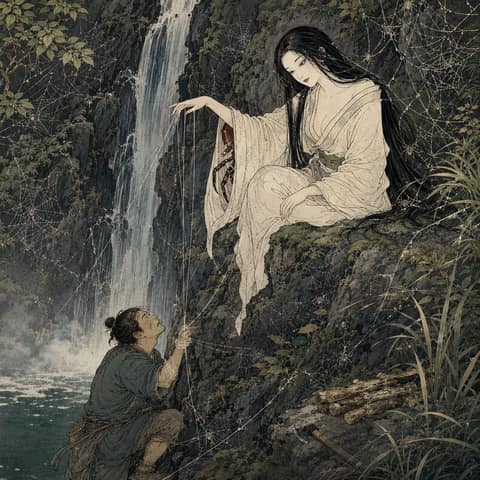
    A Jorōgumo based on the canonical image found in Edo-period sources. A great spider, having aged into a yokai, assumes the form of a young woman or a mother and child to exploit lapses in human judgment. She appears at liminal places such as waterfalls, deep pools, verandas at the edges of mountain villages, and abandoned houses, casting many layers of silk to bind victims and dull their judgment through sleep or enchantment. Toriyama Sekien depicted her commanding fire-breathing spiderlings, helping fix motifs of acting in groups and fleeing into the upper parts of houses such as the attic. In some regions she is deified as a protector against drowning, with stones or small shrines raised in her honor. Many tales end with her being thwarted by human wit—cutting her threads and tying them to a stump, or seeing through her disguise—while others warn of taboos where breaking a vow of secrecy brings death, or of fatal infatuations that drain one’s life. This profile avoids modern embellishment and stays within the breadth of existing tradition.

  • Juroujin

    Juroujin

    Legendary

    じゅろうじん

    Juroujin, the Pure Sage of Longevity Accompanied by a Black Stag

    Divine Spirit / DeityChina (Daoist avatar of the South Pole Old Man Star) / Introduced during the Muromachi period / Pilgrimage sites of the Seven Lucky Gods in Kanto and Kinki (Zen, Obaku, and Tendai sect temples)

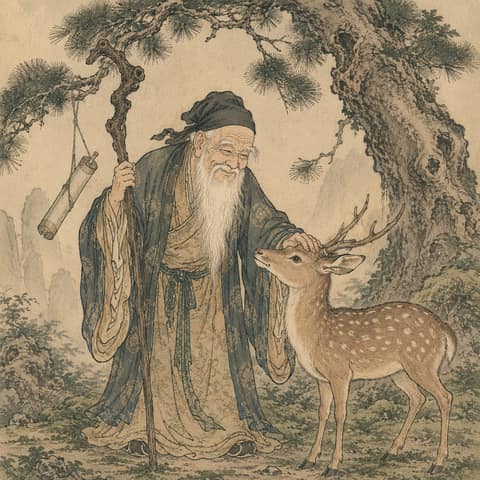
    Juroujin's true form is the South Pole Old Man Star (Canopus). This is the alpha star of the constellation Carina—the second brightest star in the entire night sky after Sirius. Because it only appears low in the southern sky of the Northern Hemisphere, ancient Chinese lore passed down the saying, "The year it can be seen is a year of universal peace; the land where it can be seen is a land of longevity." Already registered as an astronomical deity in the 'Treatise on Astrology' of the *Records of the Grand Historian* and the 'Treatise on Astronomy' of the *Book of Jin*, it forms the core of Longevity Star worship in Chinese folk belief. Daoism personified this star as the Longevity Star or Longevity Sage, arranging auspicious items alongside him: a black stag said to live 1,500 years, the Peaches of Immortality of the Queen Mother of the West (which extend life by a thousand years with a single bite), and a gourd containing the elixir of immortality. Iconographically, he is depicted as a short old man with a long head and a long beard, tying a sutra scroll to the head of his staff. A "short body and long head" is a physical omen of longevity in Chinese physiognomy, a formative principle entirely identical to that of his counterpart, Fukurokuju. This is the reason the two have long been considered the same deity under different names. His arrival in Japan occurred in the late Muromachi period (15th century), routed through monks traveling to Song and Ming China and the importation of Daoist and Buddhist paintings by Zen monasteries. The prototype of the current Seven Lucky Gods was formed during the Higashiyama culture period when Zen monks and painters (such as Noami, Soami, and Sesshu) bundled the localized Ebisu, Daikokuten, Bishamonten, and Benzaiten with the imported deities Hotei, Fukurokuju, and Juroujin into the "Seven Gods of Fortune and Virtue." The overlap with Fukurokuju had been an old issue since before the Song dynasty. In Japan, this was resolved by dividing their roles: "Fukurokuju = a secular deity synthesizing happiness, wealth, and longevity," and "Juroujin = an ascetic longevity deity purified to the single virtue of longevity." During the Edo period, a significant number of variant Seven Lucky Gods groupings circulated that removed Juroujin to avoid duplication, replacing him with the sake-loving beast Shojo, Kisshoten, or Fukusuke. Juroujin was loved by the common people for his appearance as an unpretentious, sake-loving sage, appearing frequently in the treasure ship pictures of Kyoden Santo (*Kottoshu*, 1813), Hokusai Katsushika, Kuniyoshi Utagawa, and Yoshitoshi Tsukioka. In the Seven Lucky Gods pilgrimages across Edo and Tokyo, his sites were often small halls belonging to Zen, Obaku, and Tendai sects, gathering prayers for longevity and health, especially from the elderly and the sick. In folk tradition, he also holds an important position as a main constituent deity of the "First Dream Treasure Ship" (established in the mid-Edo period), where placing a treasure ship picture containing Juroujin under one's pillow early on New Year's Day is said to grant an auspicious dream.

  • Kama-itachi

    Kama-itachi

    Legendary

    kah-mah-ee-TAH-chee

    Kama-itachi

    Animal ShapeshiftersNiigataNagano

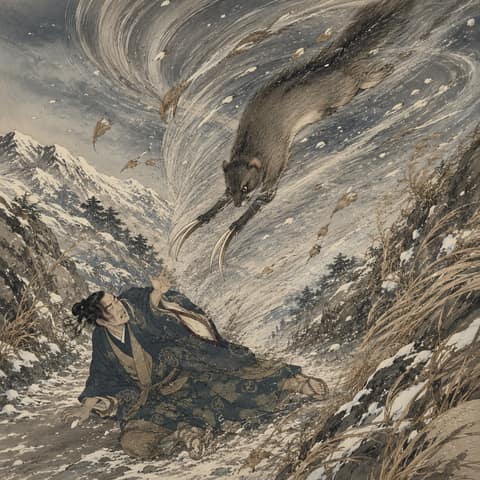
    Kama-itachi is a name for a wind-borne anomaly found in Edo-period art, essays, and oral lore, referring both to the phenomenon and its alleged agent. It is tied to whirlwinds and chill gusts in northern and mountainous regions, noted for razor-like lacerations when one stumbles on the road, delayed pain or bleeding, and frequent injuries to the legs. Its true nature varies across sources: invisible minor spirits, beasts riding the wind, or acts of deities coexist as explanations. In Shin’etsu it is said to strike those who break calendrical taboos, and in Hida a three-stage action is told. In parts of Chubu and Kinki, the whirlwind itself is called kama-itachi, while Edo essays report beast tracks left after a dust devil. Under regional aliases like Tosa’s “Field Sickle,” funerary tools turned uncanny are blamed for similar wounds. In haiku it settled as a winter season word and a sign of wind-borne calamity. This version limits itself to attested sources, avoids overlinking to specific places or persons, and presents regional types side by side.

  • Kappa

    Kappa

    Legendary

    KAH-pah

    The Dish-Headed River Spirit – Kappa

    Water SpiritsKumamotoFukuoka

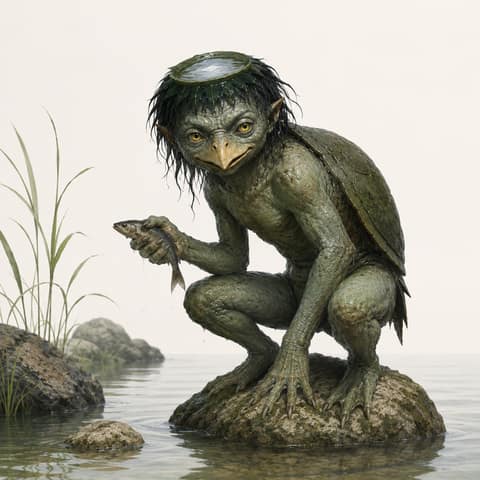
    "Kappa" is not, in truth, the name of any single creature. It is a collective term—the word by which the whole of Japan, each region in its own dialect, has called the water spirits that dwell in rivers and ponds. In southern Kyushu it is the Garappa; in Tōhoku, the Medochi; in Shikoku, the Enko; in Chūbu, the Kawaranbe; in Kinki, the Gataro; in Kyushu again, the Hyosube. From place to place the name and the form shift a little, and the total is said to exceed eighty. Some are close to monkeys, some shaggy with fur, some moving in troops. Yet all share a common core: they live by the water, hold water in the dish on their heads, and drag away people and horses. The kappa, in other words, is the shared name of a vast clan into which all the water spirits of the land have gathered. It is the reading of folklore studies that binds these many variants into one. Yanagita Kunio and Orikuchi Shinobu held that the kappa was originally a god who governed water—a water deity—who declined into a yokai as belief in it faded. The fact that in the komahiki legends the kappa always tries to pull a horse or ox into the water may itself be a memory of festivals in which horses and oxen were offered to a water deity in prayer for a good harvest. In Kappa Komahiki Kō (1948), Ishida Eiichirō compared this bond between horse and water deity with myths from across Eurasia. Precisely because it is a god of water, the kappa draws water to the fields, grants fish, and even hands down bone-setting remedies—while also drowning people and pulling out their shirikodama. Its twin aspects, blessing and curse, are the two sides of a fallen water deity. Traces of the water deity show even in the turning of the seasons. Across western Japan it is widely told that at the autumn equinox the kappa goes up into the mountains to become a yamawaro, and at the spring equinox comes down again to the river to return to being a kappa. The field god who descends from the mountains to the villages in spring, the mountain god who returns to the peaks in autumn—that idea of coming and going maps exactly onto the exchange between kappa and yamawaro. In this way the clan’s variants, too, are bound to one another as a single continuous terrain. The clan even has its legend of a chieftain. On the Kuma River in Kyushu the tale survives of Kusenbō, a kappa general who crossed over from the continent at the head of nine thousand kindred. Having drawn the wrath of Katō Kiyomasa, he was driven from the region, moved to the Chikugo River, and became one of the retainers of the Suitengū shrine in Kurume. That a kappa was imagined not as a lone monster but as a clan linked from river to river is plainly expressed in this tale of a boss. Places tied to the kappa are found all over the country. At Tōno in Iwate there is a "Kappa Pool" (Kappa-buchi) where kappa are said to appear, and at Jōken-ji temple, in honor of a kappa that put out a fire with the water from its head-dish, stand "kappa guardian lions" whose heads are shaped like a dish. At Lake Ushiku in Ibaraki the painter Ogawa Usen, who depicted kappa all his life, was called "Usen of the Kappa," and Tanushimaru in Fukuoka styles itself "the birthplace of the kappa clan." In the Kappabashi district of Tokyo a legend tells of Sumida River kappa who came each night to help a merchant pressing ahead with flood-control works. To this day kappa festivals are held in many places, and the kappa lends its name to sake brands and town mascots alike—remaining the most beloved of all Japan’s water yokai.

  • Kijimuna

    Kijimuna

    Legendary

    kijimuna

    The Banyan Spirit: Kijimuna

    自然現象・自然霊Okinawa

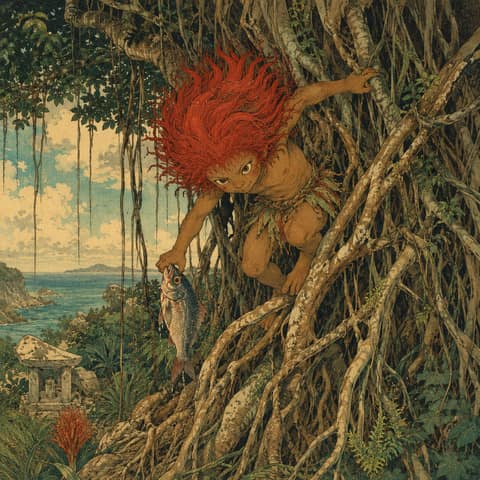
    The Nansei Islands Tree Spirit Lineage and "Banyan Culture". While the basic overview discusses regional name variations and dietary habits, this deep dive explores the profound roots of the "Banyan Culture in the Nansei Islands" upon which the Kijimuna stands. The banyan tree (*Ficus microcarpa*) is an evergreen of the mulberry family native to tropical and subtropical climates, characterized by its imposing form draped in countless aerial roots. Ancient banyans, some over several centuries old, are revered as sacred trees where deities reside and have been fiercely protected as objects of worship in the *Utaki* (sacred groves) across Okinawa. The Kijimuna is inextricably tied to these ancient banyans; their existence is merged with the local religious belief that cutting down an *Utaki* tree will rain catastrophe upon the entire village. Comparative Folklore with the Amami "Kenmun". The Kijimuna is frequently compared by folklorists to the "Kenmun" of Amami Oshima—a yokai that shares traits like a red body, dwelling in trees, and a love for fishing and sumo wrestling. The academic distinctions are as follows: - The Kenmun is often categorized alongside the Kappa as more of a "water anomaly," whereas the Kijimuna leans heavily toward being a "nature spirit" of the trees. - The Kenmun prefers sumo wrestling, while the Kijimuna's core folklore revolves around cooperating in fishing. - The Kenmun features many tales regarding male/female pairs and married couples, whereas the Kijimuna is fundamentally treated as an individual entity. By grouping both under the broader umbrella of "Tree Spirits of the Nansei Islands," the island folklore of Okinawa and Amami emerges as a unified cultural sphere. This distribution correlates significantly with the history of human migration and linguistics (the Ryukyuan languages and Amami dialects) in the region. "Fish Eyes" and the Okinawan Concept of the Soul. The Kijimuna's peculiar habit of eating only the left eye of a fish (or both eyes, in some telling) is not mere grotesque eccentricity. In ancient Japanese and Ryukyuan animism, the "eye" was considered one of the primary vessels where the soul resided. Eating an animal's eyes was interpreted as the act of consuming its spirit. Thus, the Kijimuna is not eating the physical flesh of the fish, but draining its soul. This gave rise to regional customs where the leftover, eyeless fish was prized as a "body emptied of its soul." This represents a distinct Ryukyuan variation of the pan-Japanese "Eye = Soul" ideology dating back to the Jomon period. The "Befriend, then Rupture" Narrative Structure. Tales of relations between humans and Kijimuna strictly follow a set pattern: "Massive bounties via fishing cooperation → A minor human blunder (breaking a promise, damaging a banyan, farting) → A total rupture → A lifelong curse." This is not a simple morality tale of good versus evil. It functions to transmit the ethics of living in moderation with nature through the allegory of a "transactional relationship" with a tree spirit. Societal rules—such as "do not cut the banyan," "do not monopolize the fish," and "show respect to entities of the otherworld"—are encoded into a narrative structure designed to be passed down to the next generation. Okinawan Yokai Studies from Kunio Yanagita and Fuyu Iha. Genshichi Shimabukuro's 1929 *Yanbaru no Dozoku* systematically recorded the oral traditions of the Yanbaru region and stands as a pivotal document in the lineage of Okinawan folklore studies pioneered by Kunio Yanagita and Fuyu Iha. Pre-war Okinawan folklore heavily attracted the attention of mainland Japanese academia. As a "unique spirit non-existent on the Japanese mainland," the Kijimuna occupies a critical position in comparative Japanese yokai research. Post-war, local researchers like Tsuneo Sakihara carried the torch, ensuring the spirit's inclusion as a standalone entry in major modern encyclopedias like Kenji Murakami's 2005 *Nihon Yokai Daijiten* (Comprehensive Dictionary of Japanese Yokai). Resurgence in Modern Tourism and Pop Culture. During the community revitalization movements in post-war Okinawa (1970s–90s), the Kijimuna (and Bunagaya) was reconstructed as a powerful symbol of regional identity. Examples include the "Village of the Bunagaya" in Kijoka, the Okinawa Television mascot "Yu-tan," its appearance in Tsuyoshi Takamine's 1989 film *Untamagiru*, and the annual "Kijimuna Festa." Its robust survival in both tourism and modern media is highly exceptional, especially considering how many mainland yokai exist today solely within the pages of old books. As a spirit embodying Okinawa's perspective on nature, sacred trees, and the ethics of coexistence, the Kijimuna remains a living entity in the 21st century.

  • Kiyohime

    Kiyohime

    Legendary

    きよひめ

    Kiyohime, the Serpent Woman Who Burned Dojoji

    Human-Yokai / Half-Human Half-YokaiWakayama

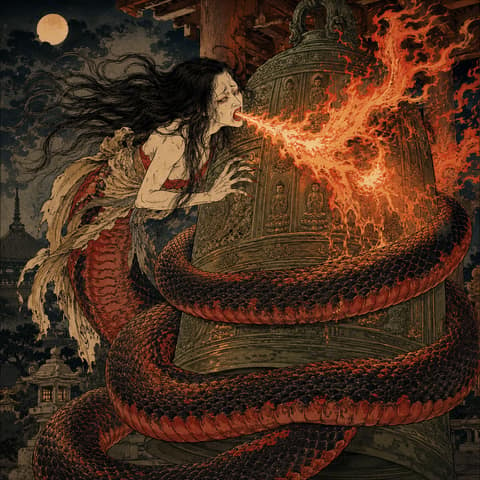
    This version places Kiyohime's personal nature at the forefront of the Dojoji legend. She is not merely a serpentine monster. Four layers overlap within her: the woman who confessed her love, the woman who was fled from, the woman who crossed the river, and the serpent woman who burned the bell. Dojoji Temple conveys the story through picture scroll storytelling (etoki), and in the Noh play *Dojoji*, the shirabyoshi dancer from the sequel tale disappears under the bell, only to reappear as a serpentine demoness . In other words, the terror of Kiyohime lies in the fact that the incident of the past is never truly over, being continually actualized on the stage of performing arts. In terms of yokai classification, Kiyohime is simultaneously a "serpent woman" and a "woman turning into a Hannya." She gathers within a single human body the anger and sorrow carved into the Hannya mask, the jealousy Hashihime left at the bridge and river, and the serpentine calamity mythologically displayed by Yamata no Orochi. The temple bell should have been a safe hiding place, but upon touching Kiyohime's obsession, it becomes a furnace instead of a refuge. This is where the symbolic nature of the Dojoji legend lies. The Buddhist temple, the Kumano pilgrimage route, the water of the Hidaka River, the metallic sound of the bell, and the fire of a woman collide at a single point, changing a romance tale into a yokai tale.

  • Koga Saburo

    Koga Saburo

    Legendary

    Koga Saburo

    Koga Saburo, the Serpent Deity of the Underworld

    Half-Human / Half-YokaiNaganoShiga

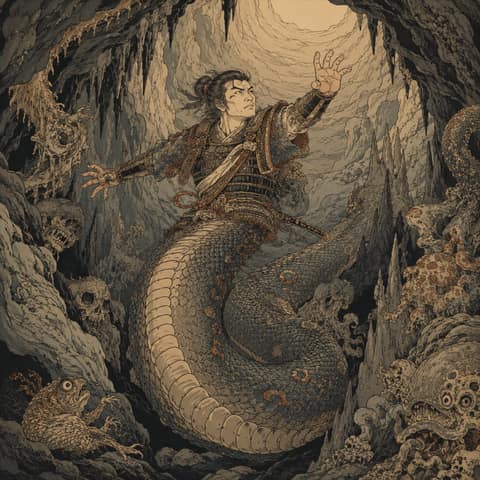
    The fascination of the Koga Saburo legend lies not merely in its heroic epic, but in how it explains the origins of Suwa Myojin as "the return of a mortal who fell underground." Unlike Takeminakata-no-Kami from the Kojiki, who retreats to Suwa as the defeated figure in the myth of the transfer of the land, Koga Saburo travels from Omi to Shinano, falls into the underworld through a cave on Mount Tateshina, and returns as a serpent. The deity of Suwa does not simply descend from the heavens, nor does it merely arrive from central mythology; it manifests by passing through mountain caves, subterranean kingdoms, and the body of a snake. This narrative beautifully weaves together the elements of Suwa worship—water, mountains, dragons, serpents, hunting, and the syncretism of Shinto and Buddhism—into a single tale. This is precisely why it is meaningful to establish Koga Saburo as a distinct figure alongside the official enshrined deity Takeminakata.

  • Kojin

    Kojin

    Legendary

    こうじん

    The Raging Fire and Boundary Deity, Kojin

    Divine Spirits / DeitiesSeikojin Kiyoshikojin Seicho-ji Temple (Takarazuka, Hyogo Prefecture; head temple of the Sanbo Kojin faith) / Seto Inland Sea cultural sphere of the Chugoku and Shikoku regions (Okayama, Hiroshima, Yamaguchi, Ehime, etc.)

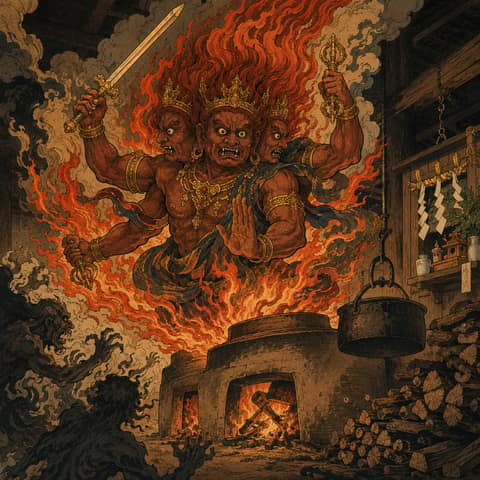
    Aramitama Ideology and the Duality of Japanese Religion. While the basic description touches upon Kojin's two main systems, this thorough explanation delves deeper into the "Aramitama" (rough spirit) concept and the dualistic structure of Japanese religion. Ancient Shinto understands deities on an axis of "Nigimitama" and "Aramitama," recognizing that a single deity possesses both an aspect of a gentle savior and that of a raging curse-bringer. The Nigimitama gently protects people, while the Aramitama brings curses and disasters; ritually balancing the two is viewed as the religious goal of purification. The Kojin faith represents the extreme realization of this option to "worship the Aramitama independently." It holds a paradoxical structure: by fearing and worshipping a terrifying deity, its violent power is transformed into a protective force for the community. This is a variation of a universal structure in East Asian religious culture, comparable to the City God (Cheng Huang) in China, local deities in Korea, and spirit worship in Southeast Asia. Yaksha Origins and Esoteric Syncretism. Sanbo Kojin is a composite deity that incorporated the form of ancient Indian Yaksha spirits, blending elements of Buddhism, Shinto, mountain asceticism, Esoteric Buddhism, and Onmyodo. In ancient Indian mythology, Yakshas were semi-divine, semi-demonic beings guarding forests, mountains, and treasures; upon entering Buddhism, they were recontextualized as protectors of the Dharma (such as the retinues of Vaisravana). The process by which this merged with Japanese hearth and fire worship to become Sanbo Kojin is a prime example of the dynamism of Buddhism's reception in ancient Japan. The three-faced, six-armed wrathful statue, adorned with flaming hair, fangs, and carrying a bow and arrow, is the result of the fusion between its Yaksha roots and ancient Japanese demon-god imagery. The Religious Economy of Ascetics, Onmyoji, and Monks. The nationwide spread of the Sanbo Kojin faith during the Edo period was driven by the active proselytization of religious groups like Shugendo ascetics, Onmyoji, and lower-ranking monks. Operating outside the institutional structures of major temples and shrines, they made their living by offering prayers, fortune-telling, distributing talismans, and presiding over festivals for local communities. By preaching devotion to Sanbo Kojin, issuing talismans, and organizing rituals, a social system was built that supported the economic foundation of these wandering ascetics. The religious history of medieval and early modern Japan must be understood not just as a history of changing doctrines, but as concrete social history encompassing religious economy, the hierarchy of practitioners, and negotiations with local communities—with the spread of Sanbo Kojin serving as a typical case. The Seto Inland Sea Cultural Sphere and Kagura Theater. Bitchu Kagura in Okayama Prefecture originated as a ritual to "invite Kojin and dance before him," earning the alternative name "Kojin Kagura," and was designated a National Important Intangible Folk Cultural Property on February 24, 1979. In the late Edo period, the scholar Nishibayashi Kokukyo composed mythological plays (Shin-no) such as "The Transfer of the Land by Okuninushi," based on the Nihon Shoki and Kojiki, incorporating them into the rituals and thereby establishing the modern form of Bitchu Kagura. This is a symbolic example of how classical mythology and local Kojin faith heavily intertwine in the Seto Inland Sea cultural sphere. It preserves a unique theatrical culture where national deities (Susanoo, Okuninushi), Kojin, and local gods appear together as an integrated pantheon on the Kagura stage. Since ancient times, the Seto Inland Sea has been a maritime trade route with the continent and the Korean Peninsula, a center of Shingon Esoteric Buddhism, and a vast cultural region where local Shinto traditions—such as those of Izumo, Kibi, and Sanuki—have densely intersected. Ji-Kojin and Village Communities. The outdoor Ji-Kojin possesses a different origin story than the indoor Sanbo Kojin. Worshipped by individual households, kin groups, or small settlements—often using the estate's demon gate, village borders, or mounds beneath large trees as vessels—Ji-Kojin acts as a guardian of community boundaries, land, and ancestors. The dense concentration of Ji-Kojin worship in the mountain villages of the Chugoku region and the islands of the Seto Inland Sea has functioned as a mechanism to religiously reaffirm the hierarchical order of families, small settlements, and villages. The festival dates of the 28th of every month, January, May, and September hold social significance beyond simple religious rituals, acting as social time to confirm the solidarity of community members. Gyuba Kojin: The Industrial Aspect. A third system of Kojin that has garnered folkloric attention is Gyuba Kojin (the Kojin protecting cattle and horses). Tied to the history of using cattle and horses as primary sources of power for farming and transport in the mountain villages of Chugoku and Shikoku, the custom of affixing Kojin talismans in stables and praying for the animals' health during spring and autumn festivals was widespread. This reflects the religious life of pre-modern farming villages, where livestock were not mere economic assets but were religiously positioned as members of the family and community. With the advance of mechanization and modern power sources, Gyuba Kojin worship rapidly declined, but numerous ritual artifacts remain preserved in museums and local history centers across Chugoku and Shikoku. Re-evaluation in the 21st Century. In post-war Japan, folklorists such as Kenichi Tanigawa, Noboru Miyata, and Kazuhiko Komatsu advanced academic re-evaluation of Kojin worship, repositioning it as "the representative of Japan's indigenous local deities." In literature, Miyuki Miyabe's novel *Kojin* (Asahi Shimbun Publications, 2014) explored the deity, becoming a widely read narrative that cross-pollinated Edo-period local Kojin faith with modern societal anxieties. Today, in the 21st century, Kojin festivals and Kagura are inherited as intangible folk cultural properties throughout the Seto Inland Sea, Chugoku, and Shikoku regions. It remains one of the few "active" folk deities living on across academia, literature, and regional folklore. Homes enshrining Sanbo Kojin are still numerous, serving as precious embodiments of folkloric continuity.
  • Konaki-jiji

    Konaki-jiji

    Legendary

    konaki-jiji

    The Crying Old Man of Tokushima: Konaki-jiji

    山野の怪Tokushima

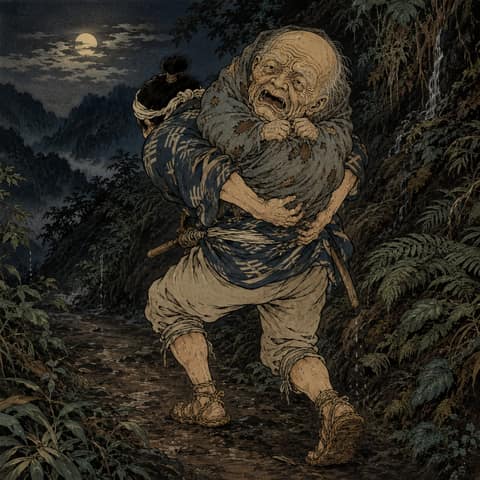
    The Folkloric Cliché of the "Crying Baby on a Mountain Path". While the basic overview outlines the structure of the Konaki-jiji legend, this deep dive probes the dark undercurrents of the "crying baby on a mountain path" cliché. Historically, in Japan's rugged mountainous regions, practices like infanticide (mabiki), child abandonment, and high infant mortality rates cast a long, daily shadow over village life. Experiencing auditory hallucinations of a baby crying on a lonely mountain road was a universally shared psychological trauma among these communities. This is exactly why legends of the *Ubume* (the ghost of a woman who died in childbirth) are distributed so widely across the country. Hearing an infant's cry at liminal spaces—mountain passes, riverbanks, or forest paths—serves as the foundational, deep-rooted material for ghost stories across Japan. The Konaki-jiji is Shikoku's unique, composite yokai, created by welding this primal auditory fear to the "form of an old man" and the "crushing weight" motif. Kunio Yanagita's Structural Methodology. The methodological genius of Kunio Yanagita's *Yokai Dangi* (1956) lies not in treating a yokai in isolation, but in reading it structurally alongside its relatives. By aligning the Konaki-jiji's "getting heavier" mechanic with the *Obariyon* and the *Ubume*, Yanagita illuminated a developmental history: the fusion of the primal "crying baby" archetype with the later addition of the "crushing weight" narrative. This comparative approach became the gold standard for post-war folkloristics, heavily influencing later yokai scholars like Kazuhiko Komatsu and Noboru Miyata. The Gogya-naki and the Shikoku Folklore Sphere. The fact that "Gogya-naki"—a cousin of the Konaki-jiji—is distributed entirely across Shikoku highlights the uniqueness of the island's folkloric sphere. In Mima District, Tokushima, records detail a Gogya-naki that hops through the mountains on one leg, its cries powerful enough to trigger earthquakes; Yanagita rightly identified this as identical to the Konaki-jiji. Shikoku's mountain folklore possesses traits distinct from Honshu (the central highlands) and Kyushu (sacred mountain cults). It forms a highly complex religious ecosystem where Shugendo (mountain asceticism), the 88-Temple Pilgrimage, and indigenous Shinto are stacked in multiple layers. The Konaki-jiji is a direct product of this intense Shikoku mountain folklore. The "Real-Life Old Man" Theory and the Mechanics of Monsterification. The local account recorded by historian Masahiro Takita—suggesting that a real, eccentric old man used to mimic baby cries—is highly suggestive when analyzing how yokai are born. The phenomenon where a marginalized villager with abnormal behavior (due to mental illness, isolation, or dementia) is sublimated into a yokai legend over several generations is seen throughout Japan. "Yokai" often function as social devices used to process and mythologize a community's memory of its peripheral members (the elderly, beggars, foreigners, or the disabled). The local Konaki-jiji lore is a rare case that brings this folkloric mechanism to the surface, offering prime material for reading yokai studies through the lens of social history. Shigeru Mizuki's Post-War Yokai Revival Movement. Shigeru Mizuki (1922-2015) was the driving force behind the revival of yokai culture in post-war Japan. Through *GeGeGe no Kitaro* (serialized prominently in Weekly Shonen Magazine from 1968), he elevated half-forgotten, hyper-local folklore into household names across the nation. Within the Kitaro family, the Konaki-jiji was reconstructed as a "good-natured yokai from Tokushima," gaining massive popularity as a bearded, staff-wielding elder in a monk's robe. The transformation of the Konaki-jiji from a malicious, crushing murderer in local folklore to an agent of justice in modern pop culture is a subject of intense academic debate, serving as a prime example of how an author's intervention can fundamentally alter the DNA of a traditional legend. Regional Revitalization and Applied Yokai Studies. In 2001, Yamashiro Town in Tokushima (the legend's birthplace) erected a stone statue of the Konaki-jiji, kickstarting its regional branding as a "Yokai Village." Through initiatives like yokai haunted houses, mascots, and stamp rallies, post-war folkloristics successfully transitioned from an academic discipline into an engine for regional economic growth and tourism. This represents a classic structural model: local yokai (like Ittan-momen in Kagoshima, Sunakake-baba in Nara, and Nurikabe) gain national fame via *Kitaro*, only to be re-imported back to their hometowns as cultural capital for regional revitalization. The Modern History: From Local Lore → Kitaro Fame → Regional Tourism. The modern history of the Konaki-jiji perfectly maps the typical trajectory of Japanese yokai culture. It traces a three-stage cultural metamorphosis: an entity that was merely oral folklore in one specific region before the war, achieves national celebrity through Mizuki's manga in the post-war era, and finally flows back into its birthplace to be monetized as a tourism asset. This exact path is shared by several core members of the Kitaro family. It proves that the Konaki-jiji is not merely a "fairy tale from the past," but a yokai that actively embodies the ongoing, modern processes of cultural production and regional identity building.

  • Koropokkuru

    Koropokkuru

    Legendary

    koropokkuru

    Little People Under the Leaves: Koropokkuru

    自然現象・自然霊Hokkaido

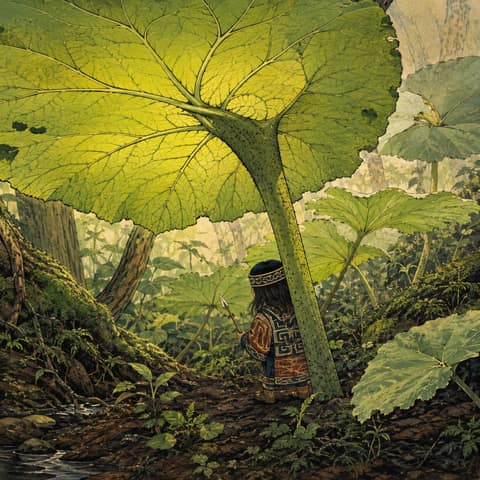
    The Ecological Perspective: "People Under the Butterbur Leaves". While the basic overview touched upon the Ainu etymology, this deep dive explores how the Koropokkuru legend is fundamentally tied to the ecology of Hokkaido and Sakhalin. The giant butterbur (*Petasites japonicus var. giganteus*) native to Hokkaido possesses stalks taller than a human adult, with leaves exceeding 1.5 meters in diameter. The custom of repurposing these massive leaves as umbrellas or roofing is common among northern hunter-gatherers, and the Ainu themselves used them daily for shelter from the rain, drying racks, and containers. The image of "little people living under the butterbur" is a direct symbolic manifestation birthed from the sheer proximity and utility of this giant plant in their daily lives. Silent Trade as a Universal Ritual. The core of the Koropokkuru legend—"leaving goods in the dead of night and departing without ever showing their faces" (silent trade)—is not unique to the Ainu. Herodotus recorded silent trade between the Carthaginians and Libyans in his *Histories*, and identical customs have been confirmed among indigenous groups in Africa, Southeast Asia, and the Arctic. In cultural anthropology, this is defined as a "ritualized distancing to exchange goods across linguistic barriers or hostile relations." The Koropokkuru legend can be read as the narrative mythologization of this universal practice, suggesting it reflects a concrete history of trade rather than a mere fantasy of "imaginary little people." Tsuboi and Watase's Indigenous Theory and Its Refutation. During the 1890s, Shozaburo Watase's 1886 "Pit Dwelling = Koropokkuru Theory" and Shogoro Tsuboi's subsequent anthropological hypotheses ignited a massive academic debate that engulfed the entirety of Ainu studies. The academic world was split between the mainstream camp (descending from Siebold) asserting that "Stone Age Japanese were the ancestors of the Ainu," and Tsuboi's camp arguing that "the Koropokkuru were indigenous, and the Ainu were invaders." Tsuboi's popular serialization of his theories in 1895–1896 leaked the academic debate to the general public, mass-producing the "image of the Koropokkuru" in textbooks, novels, and paintings. While post-war archaeology confirmed the "Jomon to Ainu" lineage and entirely debunked Tsuboi's theory, the debate remains a rare historical instance where an academic dispute successfully molded the national imagination. Takuro Segawa's Paradigm Shift: "The Foreign Ainu". The innovation in Takuro Segawa's 2008 book *Who Were the Koropokkuru?* lies in rejecting the binary "indigenous or not" debate and connecting the legend to the concrete history of the Northern Kuril Ainu in the Middle Ages. He highlights the following points: - Silent trade was actually practiced by the Northern Kuril Ainu. - The Northern Kuril Ainu practically utilized pit dwellings into the Middle Ages. - The use of pottery and long-distance travel to gather clay are archaeological facts of the Northern Kuril Ainu. - The Koropokkuru legend exists everywhere *except* the Northern Kurils (as people do not mythologize themselves into "little people"). By rereading the legend not as "imagination" but as a "concrete memory of a different Ainu group," this perspective illuminates the regional differences and historical diversity *within* the Ainu, serving as an ethnographic achievement that deconstructs the monolithic image of the Ainu people. The Departure Tale and the "Ugly Visage" Motif. The story where a curious Ainu youth grabs a Koropokkuru woman's hand, causing the tribe to flee north in shame, belongs to a universal folklore archetype: "contact with another tribe → erroneous intervention → loss of the relationship." Structurally, it is deeply related to the Greek myth of Echo, the Japanese folktale of the Crane's Return of a Favor, and the taboo of Toyotama-hime in the *Kojiki* (where looking upon the true form brings disaster). The separation caused by "seeing what must not be seen" is the mythologization of the folk ethics governing the maintenance of boundaries and respect for distance between different tribes. Modern Children's Literature and the Ethics of Ainu Representation. Satoru Sato's post-war *Korobokkuru Tales* series (1959–) reconstructed the Koropokkuru as a unique, original fantasy world detached from Ainu folklore, becoming a multi-generational classic of Japanese children's literature. Conversely, in the 21st century, there is a growing movement demanding that mainstream works borrowing Ainu culture respect the voices and agency of the Ainu people themselves. The history of the Koropokkuru image is multi-layered, spanning academic controversies, literary creation, commercial branding (e.g., Jaga Pokkuru), and the ethics of cultural representation. Moving forward, it is necessary to move beyond consuming them merely as "cute little mascots" and to acknowledge the profound indigenous history and academic legacy that stands behind them.

  • Kuchisake-onna

    Kuchisake-onna

    Legendary

    くちさけおんな

    Woman in the Red Mask / The 1979 Kuchisake-onna

    Human Yokai / Half-Human Half-YokaiModern urban legend originating in Gifu in 1978, no specific sacred site

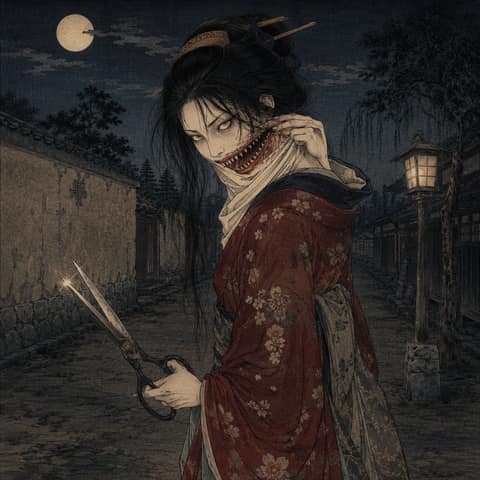
    Reconstructing the 1979 phenomenon's outbreak timeline. The general overview of this entry outlined the 7-month progression, but here we delve into a finer timeline. Early December 1978: A farmer's elderly woman's toilet sighting in Shinsei-cho, Motosu-gun, Gifu Prefecture -> January 26, 1979: Gifu Nichinichi Shimbun "Editor's Notes" (written by editorial writer Mutsumi Murase) notes "According to rumors among Gifu children, a beautiful woman resembling an actress," forming the oldest layer as a local paper before national papers -> March 23 issue: Shukan Asahi's "The Tokaido Trek of the Kuchisake-onna Legend" by Teruo Kanauchi et al. marks the first national magazine appearance -> April-May: Nationwide strengthening of school commute patrols -> June 29 issue: Shukan Asahi's large feature by Etsuro Hiraizumi peaks the event -> June 21: A 25-year-old woman in Himeji City, Hyogo Prefecture, arrested for violating the Swords and Firearms Control Law while wandering around carrying a kitchen knife dressed as Kuchisake-onna (first copycat) -> July: Shukan Josei and Josei Jishin follow up -> August: Rapid subsidence with the start of summer vacation. This 7-month progression can be accurately tracked through newspapers, weekly magazines, and police records. Concurrently, police cars were dispatched in Koriyama City, Fukushima Prefecture and Hiratsuka City, Kanagawa Prefecture, group dismissals were implemented in Kushiro City, Hokkaido and Niiza City, Saitama Prefecture, and hostesses in Ginza started services asking customers "Am I pretty?", showing ripples into the adult world. These precise timeline trackings are theoretically impossible for Edo-period oral yokai, demonstrating a unique case of the undulation structure where a yokai of the post-war mass media age "conquers the country in a short period and disappears in a short period". The dual mechanism of cram schools and national magazines: Yoshiyuki Iikura's point. Yoshiyuki Iikura of Kokugakuin University (oral literature, modern folklore) points out that post-war cram schools served as the medium for the spread of Kuchisake-onna. Pre-war children's rumors were basically confined within school districts, but post-war cram schools created places where children gathered across school districts, acting as a catalyst for cross-district word-of-mouth diffusion before mass media. This, combined with national magazine features from March 1979 onwards, established a diffusion mechanism where word-of-mouth and print mutually amplified each other. Edo-period yokai basically spread through oral media alone (although ukiyo-e and picture books intervened, the mutual amplification of children's daily word-of-mouth and print did not occur), and modern folklore collections were recorded solely by researchers' investigations. In contrast, Kuchisake-onna covered the country in half a year through a three-layer structure of cram school word-of-mouth + national magazine print + television wide shows. This is a form of yokai generation born from the urban space of 1970s Japan, unique to the post-war mass media age. The condensation of modern social symbols: "Mask + Plastic Surgery + City". The standardization of Kuchisake-onna's image as a "beautiful woman covering her lower face with a mask" is highly valuable for sociological decoding. The 1970s Japanese cosmetic surgery boom—a social background where cosmetic surgery clinics rapidly increased in Tokyo and Osaka, and double-eyelid surgeries and nose jobs became common—created a complex fear of "beautiful women who had plastic surgery," establishing the association of mouth hidden by mask = plastic surgery scars. One of the origin theories, the "botched plastic surgery theory," retroactively narrativized this association, becoming widespread during the resurgence of Kuchisake-onna in the 1990s. Furthermore, post-war nuclear families + dual-income households + women's social advancement created anxiety in children left alone at home without their mothers, destabilization of "mother" and "female" representations, and wariness of "unknown women encountered on night streets", all of which were projected onto the image of Kuchisake-onna. In other words, Kuchisake-onna is a symbol condensing the "anxieties of 1970s Japan concerning the city, family, and body" into a single yokai figure. This has a yokai function unique to a post-war individualized society, distinct from the Edo-period yokai's role of maintaining the order of the local community (lessons for children, moral warnings). Distance from the Edo-period Kuchisake-onna prehistory: Continuum or independent occurrence? The Edo-period tales of "women with slit mouths" mentioned in the general overview—the umbrella man tale in Okubo Hyakunincho from "Kaidan Oi no Tsue", the Yoshiwara tayu tale in "Ehon Sayo Shigure", the tale of Nakabashi's Takano Shozaemon's wife in "Shin Chomonju", and the Meiji-era real-life example of Otsuya in Shigaraki, Shiga Prefecture—certainly form the archetype of the "woman whose mouth is slit to her ears" motif, but a direct lineage with the 1979 phenomenon has not been academically confirmed. Toru Joko's "School Ghost Stories" and Yoshiyuki Iikura adopt the position of reading the 1979 Kuchisake-onna not as a continuum from the Edo period but as an independently occurred post-war phenomenon, with the Edo-period archetype merely waiting in the ancient layer and not having a direct parental relationship. This is an important distinction in yokai research: emphasizing "continuity" tends to be the inclination of local tourism materials (local histories of Gifu, Izumo, etc.), while emphasizing "independence" is the inclination of folklore and modern sociology. It is academically honest to introduce the Edo-period archetype as an ancient motif while positioning the 1979 incident as an independent phenomenon that re-occurred under post-war specific conditions. Modern reception: Incorporation into yokai dictionaries and cross-East Asian re-creation. The fact that Shigeru Mizuki's "Illustrated Encyclopedia of Japanese Yokai" (1991) included Kuchisake-onna as an item in the yokai dictionary is often pointed out as a symbolic moment when "modern bizarre phenomena were formally incorporated into the framework of yokai." With this, the urban legends originating from post-war mass media were formally incorporated into the "yokai" framework alongside Edo-period tsukumogami and modern folklore collections. Film adaptations are represented by Koji Shiraishi's "Carved: The Slit-Mouthed Woman" (2007), produced as a post-war horror film that tackled the 1979 phenomenon head-on. The Korean version, "Ghost Mask: Scar" (2019, directed by Go Sone), was a Japan-South Korea co-production that combined Korea's plastic surgery culture with Kuchisake-onna, demonstrating the vitality of cross-East Asian modern bizarre phenomena. In manga, Episode 31 of Shou Makura and Takeshi Okano's "Hell Teacher Nube" is a representative sympathetic re-creation, rewriting it as a story where a woman branded a "yokai" has an animal spirit possessing her exorcised by Nube, returning to her beautiful self—a story of recovery rather than exclusion. This indicates that post-war yokai culture embodies modern ethics (individual dignity, representation of minorities) distinct from the Edo period. The very fact that modern yokai born in the 1970s continue to maintain their vitality in yokai culture even in the 2020s, 50 years later, proves the enduring power of post-war mass media-generated yokai.

  • Kurama-yama Sōjōbō

    Kurama-yama Sōjōbō

    Legendary

    Kurama-yama Sōjōbō

    Kurama-yama Sōjōbō, Who Taught the Art of War to Ushiwaka

    Mountain & Wilderness SpiritsKyoto

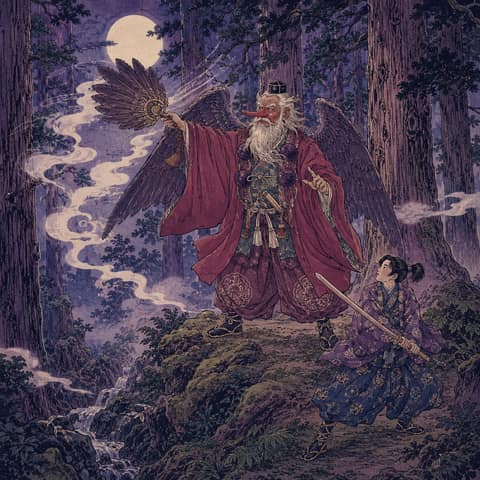
    The legend of Kurama-yama Sōjōbō is a subject to be read with careful separation of historical fact from later accretion. The credibility of its setting rests in the history of Kurama-dera. The Kurama-buki-dera engi relates that Ganchō built a hermitage in the first year of Hōki (770) and that Fujiwara no Iseto raised the temple halls in the fifteenth year of Enryaku (796). This ancient sacred mountain holds the valley of Sōjō-ga-tani where Sōjōbō dwells, and was held to be the place of descent of Gohō Maō-son. The firm dramatization of the tale of martial transmission to Ushiwakamaru begins with the Muromachi-period Noh play Kurama Tengu. In its plot the great tengu of Kurama teaches the art of war to Ushiwaka, who, pursued by the Heike, had taken refuge at Kurama-dera; performed as a fifth-category Noh, it unfolded widely into later kabuki and ukiyo-e. Yet this transmission tale does not exist in the older Gikeiki. What the Gikeiki transmits is the tale of Ushiwaka's acquiring the books of strategy (the Rikutō and Sanryaku) treasured by the onmyōji Kiichi Hōgen—no tengu appears. The identification that binds the two, "Kurama Tengu = Kiichi Hōgen," arose in early-modern times. Its source is the jōruri Kiichi Hōgen Sanryaku no Maki (1731, premiered at the Takemoto-za), which has a scene calling Kiichi Hōgen "the tengu who long ago taught swordsmanship to Ushiwaka on Mt. Kurama." Here the Gikeiki's Kiichi Hōgen and the Noh's tengu-transmission tradition were fused into one. Thus the story widely known today—that Ushiwaka learned the art of war from the Kurama tengu—is rightly seen not as deriving from the Gikeiki, but as a layered legend that began with the Muromachi Noh and was bound to Kiichi Hōgen in the Edo jōruri. One further point to note is the relation to Gohō Maō-son. The grand present-day doctrine by which Kurama-dera links it to Sōjōbō is a modern teaching arranged only after the temple became independent of the Tendai school and founded Kurama-kōkyō in Shōwa 24 (1949)—a lineage apart from the medieval Sōjōbō tradition. The Sōjōbō of the medieval tradition was, as one of the forty-eight tengu, a master tengu who imparted the martial arts and the way of the mountains.

  • Kurozuka

    Kurozuka

    Legendary

    kurozuka

    The Tragedy of Adachigahara: The Hag of Kurozuka

    鬼・巨怪Fukushima

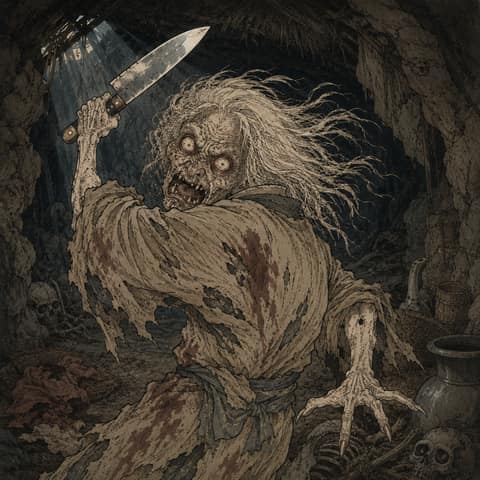
    The Embodiment of the Abyss of "Karma". Kurozuka (Iwate) is not merely a flesh-eating monster lurking in the mountains. Originally a refined wet nurse for Kyoto aristocrats, she resorted to the madness of murder to cure her mistress's illness, only to plunge into utter insanity and devolve into a demon after unwittingly killing her own daughter. This sequence of events is Japanese literature and theater's most harrowing depiction of "maternal devotion gone rogue," "blind loyalty," and the "inescapable retribution of karma." Her image, brandishing a butcher knife, radiates not just monstrous terror, but the bottomless sorrow and despair of a human toyed with by the cruelty of fate. The "Taboo of Looking" and the Boundary to the Otherworld. In the Kurozuka legend, the taboo of "do not look into the inner room" plays a pivotal role. The front room of the hut represents the "mundane human space," while the inner room is the "otherworld of death and demons" filled with white bones. The moment the traveling monk breaks the taboo, everyday reality collapses, exposing the "monstrous abnormality" hidden within the old woman. This is a perfect medieval adaptation of the ancient Japanese mythic motif of "forbidden viewing" (like Izanagi looking at Izanami in the underworld), symbolizing how terrifyingly fragile the boundary between human and demon, life and death, truly is. Immortal Rebirth Through Art and Tourism. Continuously reinterpreted across Noh, Joruri, Kabuki, and Ukiyo-e (such as Yoshitoshi's bloody prints), Kurozuka established itself as a core repertoire of Japanese theater history. In the modern era, it remains vividly alive as an "active folklore" through works like Baku Yumemakura's *Onmyoji*, Osamu Tezuka's manga, and the tourism efforts in Nihonmatsu City, Fukushima (Adachigahara Furusato Village, Kurozuka Historical Site). Kurozuka has transcended a simple ghost story, elevating into an eternal symbol exploring the philosophical question of the "demonic nature lurking within the human heart."

  • Majimun

    Majimun

    Legendary

    majimun

    The Collective Ryukyuan Demon: Majimun

    霊・亡霊沖縄·奄美の魔物の総称、特定地点なし(沖縄圏汎存在)

    "Mamono" vs. "Majimun": Similar Words, Different Worlds. While the basic overview touched upon the shared etymology with the ancient word "Majimono," this deep dive explores how "Majimun," despite sounding akin to the mainland Japanese "Mamono," operates within an entirely different conceptual framework. The mainland "Mamono" is an abstract concept that absorbed the Buddhist and Onmyōdō notion of "Mara" (demons/impediments to enlightenment). In stark contrast, the Ryukyuan Majimun is rooted in the indigenous, pre-Buddhist animism of the southern islands, holistically encompassing nature spirits, ghosts of the dead, localized spirits, and haunted objects. This reflects the historical trajectory of the Ryukyu Kingdom, which received relatively little influence from the centralized Buddhist cultural sphere, thereby preserving its unique religious ecosystem. The Logic of Genesis: "The Generation of Demonic Force". While the mainland Japanese *Tsukumogami* relies on the generative logic that "a tool left for 100 years will have a soul dwell within it," the Ryukyuan object Majimun operates on a more abstract dynamic theory: "demonic force is generated from old objects." This aligns perfectly with the Ryukyuan religious concept of *Seji* (spiritual power), grounded in a worldview where invisible forces inherent in all things manifest under certain conditions. Following Chōei Kinjō's classification, Majimun can be understood as the "photographic negative of Seji"—spiritual power turned malignant. A Structural Analysis of "Crotch-Crawling". The universal Ryukyuan taboo that "you will die if an animal Majimun crawls between your legs" is structurally fascinating. In the schema of the human body, the crotch is a privileged liminal space acting as a "bottom-to-top passageway." For an otherworldly entity to pass through this space signifies an invasion and a violent forced extraction of the soul. While this parallels mainland Japan's spiritual anxieties regarding boundaries like "bridges, crossroads, and borders," Ryukyu is unique in its emphasis on the boundaries of the physical body. In Ryukyuan belief, the *Mabui* (soul) is not fixed to a specific spot but flows in and out; "crotch-crawling" is positioned as a violent connection that forces this extraction. The Epistemological Trait: "Majimun Have No Fixed Form". Surveying the cases in the *Yokai Database*, the greatest characteristic of the Majimun is its "lack of inherent visual form." It is only named by appending "Majimun" to whatever it has possessed or transformed into (a pig, a rice scoop, an infant). There exists no iconographic representation of "Majimun itself." This stands in sharp contrast to mainland Japanese yokai, which, since Sekien Toriyama's *Gazu Hyakki Yagyo* (The Illustrated Night Parade of a Hundred Demons), moved toward solidifying "visual identity as individual characters." Ryukyu retained the Majimun as an abstract concept of "invisible demonic force" until the very end, making it a uniquely challenging subject in comparative yokai studies. Kinjō, Iha, and Orikuchi: The Lineage of Pre-war Okinawan Studies. In the pre-war era, Majimun research blossomed within the broader context of Okinawan Studies. Sparked by Fuyū Iha's *Ko Ryukyu* (Ancient Ryukyu) in 1911, prominent mainland scholars like Shinobu Orikuchi and Kunio Yanagita frequently visited Okinawa, positioning the southern islands' folklore as a vital comparative mirror to the mainland. Chōei Kinjō's yokai treatises were written amid this academic tide, providing a perspective that read the Majimun not merely as a "bizarre Okinawan oddity," but as a "systematic expression of the Ryukyuan concept of the soul." Post-war scholars like Ken'ichi Tanigawa and Kenji Murakami inherited this mantle, shaping the modern discipline of Ryukyuan yokai studies. Systemic Integration with Shisa and Utaki Faith. The Majimun concept does not operate in isolation; it forms a cohesive system with the entirety of Ryukyuan religious culture. Majimun shoulder the "demonic power," while the *Shisa* (guardian lion statues), *Utaki* (sacred groves), *Yuta* (shamans), and *Nuru* (priestesses) shoulder the "sacred power." The symmetry and mutual necessity of these two sides construct the Ryukyuan cosmic order of the sacred and the profane, the pure and the impure, and this world and the next. To study Majimun is directly tied to studying the entire worldview of Okinawan folklore, possessing a cultural anthropological scope far beyond a single monster encyclopedia entry. Modern Legacy: Folkloric Tourism and Entertainment. In post-war Okinawa (and especially after the reversion to Japan), Majimun legends have been adapted into tourism resources, children's books, and manga. They appear in children's literature like *Okinawa no Majimun-zu!* (Border Ink), in exhibits at the Ocean Expo Park's "Native Okinawan Village," and even in mainland exhibitions like the Hyogo Prefectural Museum of History's 2017 showcase on Ryukyuan Yokai. However, because Majimun are inextricably linked to Okinawan living ethics, boundary consciousness, and views on life and death, their consumption in the context of tourism and entertainment demands a respectful attitude toward their profound cultural depths.

  • Mary-san's Phone Call

    Mary-san's Phone Call

    Legendary

    めりーさんのでんわ

    Call from a Discarded Doll / The Girl Spirit Behind You

    Dwellings & ObjectsLate 1990s modern urban legend, phone-based ghost story

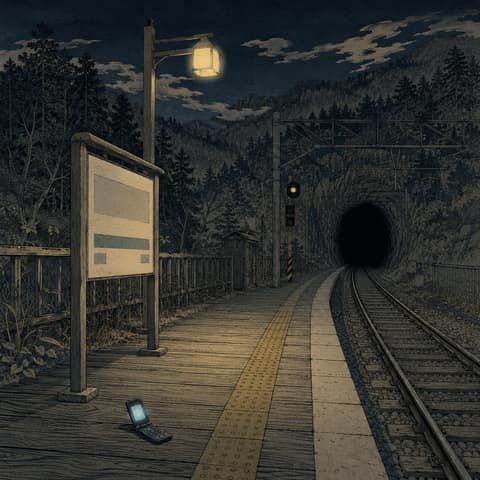
    The Representative Phone-Medium Urban Legend. Mary-san's Phone Call is regarded as the ultimate realization of post-war Japanese urban legends, perfectly embodying the three characteristics of "object possession," "phone medium," and "distance compression." Alongside Hanako-san of the Toilet (debuted 1948, fixed-location type) and Hachishaku-sama (Eight-Feet Tall) (originated online 2008, humanoid pursuit type), it stands as one of the three major pillars of post-war urban folklore. Notably, by using the telephone—the newest communication medium of its time—as the conduit for the supernatural, it marks a stark departure from pre-war oral traditions or shrine-based ghost stories, instead presupposing a modern industrial society and mass-produced toy culture. The Foreign Doll as a Cultural "Other". The specific designation of the Mary doll as "foreign-made" is a crucial folkloric detail. During Japan's post-war period of rapid economic growth, mass-produced foreign dolls (like Barbie and Blythe, the precursors to Licca-chan) entered Japanese households via the occupying forces, acquiring a dual nature of aspiration and eeriness in girls' culture. The narrative structure of "a discarded foreign doll seeking revenge" in Mary-san's Phone Call aligns seamlessly with Hiroshi Matsuyama's interpretation that the legend crystallizes post-war Japan's complex emotional distance and tension toward foreign toys and the artifacts of victorious nations. The cultural friction is also evident in how the Licca-chan doll was marketed by heavily emphasizing its "Japanese-ness." The Historicity of the "Telephone" Medium. The late 1970s marked an era when landline telephone penetration in regular households reached 90%, making it commonplace for children to answer the phone at home. Concurrently, services like the Licca-chan Phone (1968-) and various telephone services (time, weather, fortunes) fostered children's imagination that a distinct personality might exist on the other end of the line. The core eeriness of Mary-san's Phone Call—the sensation that "someone is peeking into my house from the other end of the phone"—is inherently tied to the landline culture of that era. In the age of mobile phones and smartphones, where the connection between a phone number and a physical location is diluted, similar ghost stories have evolved into mobile ringtone or voicemail variants like *One Missed Call*. The Vocal Training Function of Repetitive Phrasing. Mary-san's Phone Call also serves as a classic example of an oral ghost story memorized and passed down by children. The repetitive phrase "I am Mary-san, I am currently at [Location]" is easy to memorize and possesses an open-ended structure where the story works simply by swapping out the location. In storytelling settings like school lunch breaks, field trips, sleepovers, and tests of courage, narrators infinitely spawn local variations by inserting their own neighborhood or specific landmarks. This is a prime example of the "recursive oral generation" structure of urban legends pointed out in *Toshi no Ana*. Re-systematization in the 1990s "School Ghost Stories" Boom. During the 1990s, amidst the "School Ghost Stories" boom sparked by Toru Tsunemitsu's *Gakkou no Kaidan* (1990) and fueled by children's books and TV shows, Mary-san's Phone Call became a standard repertoire piece. It frequently appeared in Toho's 1995 *School Ghost Stories* film series and various ghost story variety shows. Through this process, what was originally an oral tradition originating in the Kanto region was consolidated into a nationwide urban legend. Alongside contemporaries like "Kashima Reiko," "Teketeke," and "Aka Manto" (Red Cape), it forms a core component of post-war school ghost stories. The Dramatic Structure of "Right Behind You". The story's final phrase, "I am Mary-san, I am right behind you," serves as a classic example of dramatic reversal (peripeteia) in urban legends and has been the subject of both literary criticism and folklore studies. Because the physical act of holding a phone receiver to one's ear implies that "the field of vision is diverted from behind," the moment the voice on the phone finishes speaking, the physical action of turning around is inherently delayed. Incorporating this physical time lag into the horror structure is the unique genius of Mary-san's Phone Call. The 2011 film adaptation similarly anchors its narrative around this climactic final line.

  • Namahage

    Namahage

    Legendary

    Namahage

    Namahage, the Visiting Deity of the New Year

    Divine Spirits / DeitiesAkita

    The true essence of the Namahage lies in "blessings through awe." The act of clashing knives and storming into a house with loud voices is meant to engrave a powerful admonition upon children and the lazy; the violence itself is not the goal. Through a dialogue with the head of the household, the Namahage extracts a promise of diligence for the coming year, exorcises misfortune, and departs. This series of rituals has functioned as a mechanism to spiritually brace the entire village at the turning of the year. The design and color of the masks, the movements, and the spoken lines differ from village to village. Some areas receive visits in pairs, while others have strict rules for the visiting order and the etiquette of the dialogue. The straw that falls from their kede garments is picked up as a lucky charm for good health, demonstrating how the folk tradition links the deity's visit to practical, worldly benefits in various locales. The core of the Namahage event is not merely fearing them as demons, but treating them as "guest deities" (marōdogami) complete with rituals of welcome and farewell.

  • Nekomata

    Nekomata

    Legendary

    neh-koh-MAH-tah

    Split-Tailed Old Cat Nekomata

    Animal TransformationTochigi

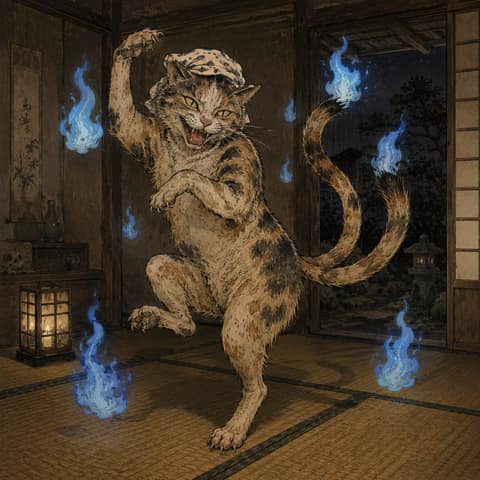
    The form of a cat kept in a human home for many years, aging until its tail splits into two, thereby "ascending" to acquire the power to speak and manipulate ghostly flames. Discarding the "mountain beast" aspect spoken of for the species as a whole, this is an interpreted version that maximizes its nature as a "house yokai" (kayou) sharing living space with humans. In this version, the Nekomata is said to stand on its hind legs late at night, place a towel on its head, and dance wildly in the shadows of the hearth. This bizarre dance, originating from the depiction in Toriyama Sekien's "Gazu Hyakki Yagyo", added a somewhat comical and human-like charm to what was originally a terrifying monster cat legend. Furthermore, this Nekomata skillfully mimics the faces and voices of people to deceive family members. It often takes the form of an old woman, which is sometimes interpreted as a projection of the power and underlying intimidation of the matriarch who managed the household for years, superimposed onto the image of an old cat. The folklore presents a clear duality: if the homeowner treats the cat roughly or kills it unreasonably, it becomes a vindictive curse deity, setting ghostly fires (Nekomata fire) in the house and ruining the family lineage. On the other hand, a carefully cherished Nekomata uses its demonic powers to "protect the house." As depicted in works like Sawaki Suushi's "Hyakkai Zukan", there are benevolent tales of them shapeshifting into a shamisen-playing geisha to save a benefactor in a crisis, or using their demonic fire to intimidate and burn away other evil spirits or diseases (impurity) attempting to enter the home. To them, the split tail is not merely a sign of monstrosity; one tail serves as an antenna symbolizing "gratitude (or resentment) toward humans," and the other symbolizes "the demonic nature of a beast."

  • Nekomata

    Nekomata

    Legendary

    neh-koh-MAH-tah

    Hearth-Guarding Old Nekomata

    Animal TransformationTochigi

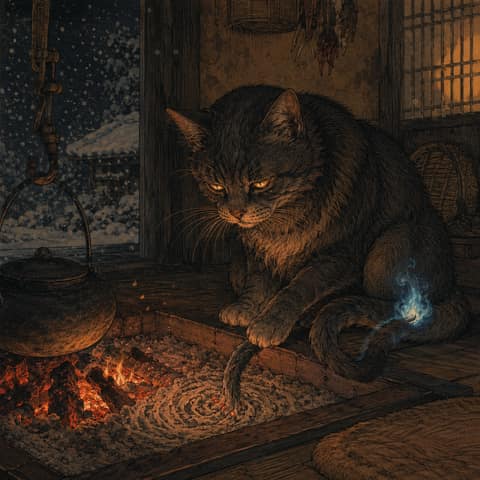
    The Hearth-Guarding Old Nekomata is a version of a cat that has been kept in one place for many years, growing old by the hearth stained with soot and ash, until one night it suddenly manifests with a tail split in two. Positioned at the opposite extreme from the violent Nekomata that attacks humans in the mountains (as noted in texts like "Meigetsuki"), this being inhales the breath of the house and its generations of life, absorbing the spirit of fire and cooking smoke, and thus behaves much like a household deity (or Zashiki-warashi). While it is an extension of the folk belief that "a pet cat transforms" cited in "Tsurezuregusa", it carries a much more protective nature. Even without using human words, it signals by clinking the pot lid or drawing patterns in the ash. The pale ghostly fire (Nekomata fire) that darts in the corner of the parlor late at night is not a curse fire to be feared as in "Yamato Kaiiki", but is rather considered a purifying mark where this old Nekomata preemptively licks away the house's fire hazards and burns off evil energies. In some villages, it is believed that one tail connects "the lineage of the family" and the other "the divine spirit of fire," making the split not a mere deformity but a sacred sign holding dual duties. The Old Nekomata always draws near when the family gathers around a corpse. There is a common fear that cats resurrect the dead, often causing confusion with the Kasha (the monster cat depicted snatching corpses in works like "Gazu Hyakki Yagyo"). However, this version never causes a disturbance; it merely sniffs the ragged breath with its nose and lights a small spark to dispel lingering earthly attachments. Therefore, the proper etiquette is for the family not to brandish blades before the Nekomata, but instead to burn a single stick of incense as a "farewell fire." If a long-kept cat is treated roughly, the stove will burn empty in the dead of night, and overlapping wet footprints will appear on the walls. Conversely, in homes that mourn respectfully, folklore akin to the "urban legends" pointed out by Kunio Yanagita survives: on a snowy morning, only the space under the shoji is warm, and the shadows of mice vanish entirely from the rice bin. This version is sometimes spoken of as an old cat that once disappeared into the mountains returning out of longing for the house, or as an old indoor cat whose tail split naturally over time. The custom of cutting tails to prevent transformation (the origin of the bent-tail cat) also exists, but in areas protected by the hearth-guard, this is taboo, with strict warnings that "injuring the tail will also split the family's fortunes." In appearance, its back skin droops to look like a cloak, casting a shadow-like figure in dimly lit rooms. This is why it is mistakenly thought to shapeshift into the dead, but the Old Nekomata dislikes unnecessary transformation. When it occasionally borrows the appearance of a grandmother, it is only to lull a child to sleep, making no sound and leaving behind only the scent of soot and ash. Though it does not show itself to travelers, during milestones of the house—such as taking in a groom or the first night in a newly built home—it taps its claws lightly under the floorboards to foretell fortunes. Three taps mean good luck; two mean beware of fire. If the lamp wick is damp, it smoothes it with its tongue; if the stove fire is too strong, it fans it weaker with its tail. In exchange for taking on these small daily troubles, a custom remains for the family to share the "edges of the meal" with it. Three grains of rice, a pinch of salt, and a little steam. As long as these are observed, the Nekomata will not bewilder humans, and the strange noises at night will be dismissed as mere "house creaks."

  • Nine-Tailed Fox

    Nine-Tailed Fox

    Legendary

    Kyubi no Kitsune

    White-Faced, Golden-Furred Nine-Tailed Fox

    Animal shapeshifterKyotoTochigi

    The "white-faced, golden-furred nine-tailed fox" is exactly what the name says: a fox-spirit with a white face, golden hair, and nine tails. Today it is almost automatically understood as Tamamo-no-Mae's true form, but that image did not appear fully formed. It grew from several lines that merged over time: the nine-tailed fox of Chinese classics, the tale of Daji becoming a nine-tailed fox, the Japanese Tamamo-no-Mae legend, and the Sesshoseki tradition of Nasu. The older nine-tailed fox was not necessarily evil. The Shan Hai Jing makes the Qingqiu fox a man-eating beast, yet the nine-tailed fox was also treated in ancient China as an auspicious creature, and Japan received the idea that the nine-tailed fox could be a sacred beast. Nine tails, in other words, did not originally mark simple wickedness. They marked the extremity of otherworldly power. That power might bless kingship or destroy it; the uneasiness lies in that doubleness. Nor was Tamamo-no-Mae always the white-faced, golden-furred nine-tailed fox. Shinmei-kyo records her name, and Tamamo no Soshi gives the story of a beauty serving Retired Emperor Toba who is exposed as a fox. But in the older form the fox has two tails. Terashima Shuichi's account stresses that almost four centuries of rewriting stand between that tale and the tight identification of Tamamo with the Nine-Tailed Fox. Without that gap, the history of the legend's remaking disappears. The decisive change was the joining of Daji's fox to Tamamo. The story that Daji, beloved of King Zhou of the Shang, became a nine-tailed fox was amplified through Chinese commentaries and fiction and reached Japan early. In the late Edo period, Japanese yomihon connected Daji, the Indian Kayo-fujin, and Tamamo-no-Mae as previous bodies and incarnations of one fox. Ehon Sangoku Yofuden was especially important: it made a single fox-spirit bewitch rulers in India, China, and Japan, and fixed Tamamo-no-Mae as the Japanese manifestation of the white-faced, golden-furred nine-tailed fox. The Sesshoseki gave the fox a story after death. In the noh play Sesshoseki, the stone is not merely poisonous rock but the dwelling place of a fox-spirit still bound by obsession. A monk breaks and pacifies the stone through ritual power, changing fox-slaying into an act of salvation. Nasu Town's official tradition likewise says that the stone is the transformed fox that flew from India and China, joining the legend to the sulfurous landscape Basho described in Oku no Hosomichi. Tamamo-no-Mae does not end when she is exposed at court. She remains in Nasu as stone. Painting and performance made this doubleness visible. After the 1751 puppet play Tamamo-no-Mae Asahi no Tamoto, Tamamo appeared repeatedly in joruri and kabuki as a role that was both peerless beauty and fox-spirit. In Utagawa Kuniyoshi's Abe Yasuchika Praying over Tamamo-no-Mae, nine beams of light open behind the beauty, placing courtly grace and vulpine truth in the same image. Mirrors, reflected water, halos that become tails: all are devices for showing that Tamamo is a being who can be seen through. The terror of the white-faced, golden-furred fox lies not in teeth or claws, but in the fact that she first appears as beauty and intellect. She knows Buddhist texts, Chinese classics, waka, and court music; she answers questions without hesitation and earns trust and affection. She does not invade from outside. She is invited into the center. For that reason, force alone cannot expose her. Divination, prayer, mirrors, water, and the stories that keep retelling her are what bring the hidden fox into sight. At the same time, she is not an entirely foreign enemy. She arises from the same fox imagination as Inari's white fox, the hierarchies of tenko and kuko, the tenderness of fox-wife stories, and the fear of fox possession. As Tamamo-no-Mae she may tilt royal power; as the Sesshoseki she leaves poison in the land. Yet people pacify her, enshrine her, paint her, perform her, and keep her in memory. The white-faced, golden-furred nine-tailed fox is not evil that has been erased. It is evil that remains speakable after defeat.

  • Ninigi-no-Mikoto

    Ninigi-no-Mikoto

    Legendary

    ににぎのみこと

    Tenson Korin (Heavenly Descent)

    The Structure of the Ancient State Myth: "Tenson Korin". While the basic description touches upon the outline of the Heavenly Descent, this deep dive explores the structure of the "Tenson Korin" as the foundational myth of the ancient Japanese state. The Tenson Korin depicts the divine descent from Takamagahara (the celestial world of purity and order) to Ashihara no Nakatsukuni (the earthly world of chaos and conquest) as the core myth establishing ancient Japan's foundation, ruling authority, and the origins of agricultural civilization. Its intricate structure—involving specific artifacts (the Three Sacred Treasures), attendants (the five pillar gods), commands (the divine decree), and bedding (the Madoko-ofusuma)—forms the fundamental basis for religious ceremonies like the ancient enthronement rituals, the Niiname-no-Matsuri, and the Daijosai. Transcending a simple mythological tale, it is a foundational narrative device that has threaded through Japanese state, religion, politics, and culture from antiquity to the modern era. Comparative Mythology of Descent Myths in World History. In global mythology, the Tenson Korin myth is positioned as a quintessential example of "heavenly descent/divine incarnation" myths. From the Dangun myth of the Korean Peninsula (Hwanung, son of the Lord of Heaven, descending to Mount Taebaek), to the legends of Genghis Khan in Mongolia, the shaman descent tales of northern Tungusic peoples, the descent of Krishna in India, and the Incarnation in Christianity, "divine descent from heaven to earth" myths are widely distributed across the ancient world. The similarities with descent myths in Northeast Asia (like Korea and Mongolia) present a crucial comparative religious question, suggesting that ancient Japanese mythology may have formed within a broader Northeast Asian cultural sphere. Understanding the Tenson Korin not as an isolated Japanese phenomenon but as a Japanese variation of a shared ancient Northeast Asian mythological imagination is a significant achievement of post-war Japanese mythological studies. The Historicity of the Descent Site Controversy. The fact that the alleged location of Ninigi's descent site, "Takachiho Peak in Tsukushi Hyuga," is split between two major traditions—Takachiho Town in Miyazaki Prefecture and the Kirishima mountain range in Kagoshima Prefecture—is the result of the ancient state myth evolving through multiple layers of regional folklore, geographic manifestation, and political competition. The ancient central government (the Yamato Court) did not pinpoint a specific location, adopting the abstract name "Takachiho in Hyuga," allowing independent "our land is the descent site" traditions to develop throughout southern Kyushu across the medieval, early modern, and modern periods. Amid modern tourism branding rivalries, local historical research, and shrine heritage systems, the two major traditions coexist, functioning as unique cultural resources. This is a classic example of how ancient mythology is multi-layeredly integrated into regional culture. Konohanasakuya-hime and the Origin of Lifespan ── The Choice Between Beauty and Eternity. The fact that Ninigi-no-Mikoto's choice of Konohanasakuya-hime (the cherry blossom goddess) and rejection of Iwanaga-hime (the rock-eternal goddess) became the origin myth explaining why his descendants—the Imperial lineage and humanity—lack eternal life illustrates the "fundamental tension between beauty and eternity" in ancient Japan. The contrast between the beautiful but fleeting cherry blossom and the ugly but eternal rock demonstrates the root structure of the ancient Japanese view of life, aesthetics, and impermanence. As a uniquely Japanese concept of impermanence predating the introduction of Buddhism, this idea has been passed down as a foundational philosophy threading through later Japanese culture, including Ukiyo (the floating world), cherry blossom appreciation, Bushido, and the tea ceremony. It serves as crucial material providing the mythological basis for the Japanese aesthetic of "it is beautiful precisely because it fades." From Umisachi-hiko and Yamasachi-hiko to Jimmu's Eastern Expedition. Among the three children of Ninigi-no-Mikoto and Konohanasakuya-hime, Yamasachi-hiko (Hoori-no-Mikoto) visited the Sea God's palace, married Toyotama-hime, and fathered Ugayafukiaezu-no-Mikoto, who in turn had Emperor Jimmu with Tamayori-hime. This four-generation lineage forms the core of ancient Japanese state legitimacy. Jimmu's Eastern Expedition (the myth of Emperor Jimmu migrating east from Hyuga to Yamato to ascend the throne) is the logical conclusion of the Heavenly Descent, mapping the establishment of the ancient Japanese state as a three-stage geographic migration: "Takamagahara → Hyuga → Yamato." As the starting point of ancient state mythology, Ninigi-no-Mikoto is the foundational deity spanning over two millennia of political history, from Jimmu's expedition and successive enthronements to the ancient Ritsuryo system, pre-war State Shinto, the post-war Imperial family, and the modern Emperor system. The Tenson Korin Cultural Sphere of Southern Kyushu. Southern Kyushu (Miyazaki, Kagoshima, and southern Kumamoto Prefectures)—the primary area enshrining Ninigi-no-Mikoto—has developed unique religions, cultures, and folklore as the "Land of the Heavenly Descent" since ancient times. With the Yokagura of Takachiho Town (a Nationally Designated Important Intangible Folk Cultural Property reenacting the opening of the heavenly rock cave), the sacred Kagura dances and festivals of Kirishima Jingu, the pilgrimages to the imperial tomb at Nitta Shrine, and the Jimmu accession festival at Miyazaki Jingu, the region maintains a multi-layered system of religion, performing arts, and festivals that carries ancient mythology into the present. The creation of modern regional brands like "Myths of Hometown Miyazaki" and "Kirishima Tourism" are prime examples of how ancient myths have expanded into modern regional revitalization, tourism industries, and educational materials. This is a rare instance of ancient mythology functioning as a living cultural resource spanning over two thousand years. Ninigi-no-Mikoto in the 21st Century ── Ancient Mythology and Modern Japan. In the 21st century, Ninigi-no-Mikoto and the Tenson Korin myth are preserved as material for ancient historical research, southern Kyushu tourism, Shinto rituals, and pop culture. Moving from political reinforcement under State Shinto before and during the war, to cultural relativization under the post-war separation of religion and state, and finally to multi-layered expansions in 21st-century tourism, subcultures, and education, the ancient myth maintains a strong continuity with modern Japanese spiritual culture. Continuously reimagined in subculture works like the games 'Okami' and 'Megami Tensei,' and the manga 'Demon Slayer,' the ancient Heavenly Descent myth bridges two millennia to continually drive the spiritual culture of 21st-century Japanese people. He is the symbolic deity of Japanese mythology, embodying the continuous thread of cultural inheritance from antiquity to the present.

Showing 25 - 48 of 91 yokai