Yokai Encyclopedia

Encyclopedia of Japanese Yokai

91 Yokai|14 Category|Page 4 of 4
Localization in Progress - More content available in Japanese version
View Japanese
Sort by: NameAscending
Legendary
  • Tengu

    Tengu

    Legendary

    Tengu

    Kakukai-bō of Yokogawa

    Mountain & Wilderness SpiritsKyotoShiga

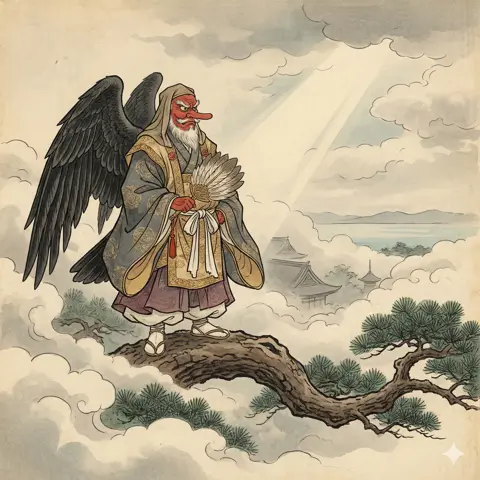
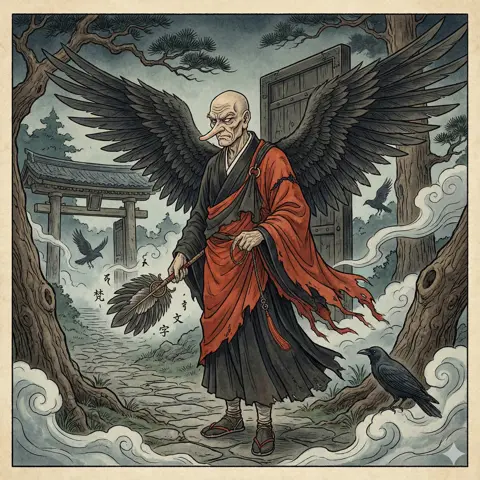
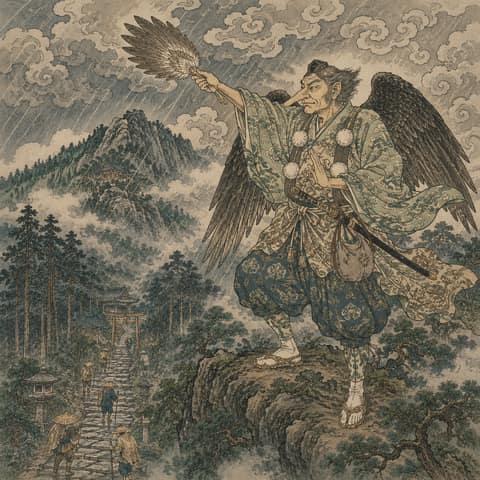
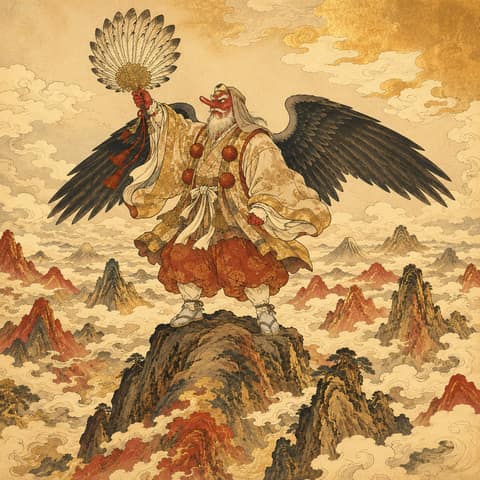
    Kakukai-bō of Yokogawa is said to be a tengu variant who turned from human monk to winged guardian of the Dharma from the late Heian into the early Kamakura era. Once a virtuous priest of deep Shingon lineage, he ran himself ragged settling mountain disputes until he grasped a boundary no worldly rule could protect, becoming a winged keeper of sacred law. In Kōya’s inner precincts, they tell how one night a gale whirled through a hall and the middle gate shuddered, then its doors shed their hinges, unfurled as twin feathers, and split the black clouds to fly off. Those doors became Kakukai-bō’s wings. Ever since, he appears with the comings and goings at temple gates, raising a fierce wind before those who disturb the rule and presenting a single line of precept. He resembles a karasu-tengu, yet his face keeps the gaunt trace of an old monk and his long nose curves like a mountain ridge. His feathered robe echoes priestly vestments, layered in cinnabar and ink, its cuffs frayed like the edges of ancient sutras. He carries a feather fan akin to a monk’s staff, and when he sweeps it, seed-syllables rise like chaff off paper, racing along the ground as ropes of warding. He speaks sparingly, but his words hang like a bell’s aftertone, stopping the feet of those who have strayed. He guards the mountain’s thresholds—the shrine and temple gates, the bends of approach paths, the joins of ridge and valley—where human law brushes mountain law, serving as their mediator. When a practitioner keeps purity, he lets fall a single white feather from the cloudbreak as a sign of safe passage. But if pride sprouts, the vigil lamp flickers once and a cold wind runs down the back. Feeling this thrice, one must follow his guidance to descend the mountain or doff one’s robe and return to first intent. He also teaches the ‘Doctrine of Drying’: to clear the heart, remove needless damp—a metaphor tied on the mountain to drying beans for stores and keeping offerings pure. Though unproven, it stands as a sign of turning the mountain’s rigor into daily sustenance. Late at night when mist pools in the valleys, he patrols with a train of crows. They are his eyes and ears, giving short signals to those swayed by rumor. Read rightly, the signs lead one off the wandering path, read wrongly, one circles the same ground three times. This is called Kakukai’s Rounds, and on the third turn, if one straightens the crook in the heart, the eastern ridge pales and the path opens naturally to the main gate.

  • 👹

    Tengu

    Legendary

    Tengu

    The Forty-Eight Tengu – The Great Tengu of the Provinces in the Tengu Sutra

    Mountain & Wilderness SpiritsKyotoShiga

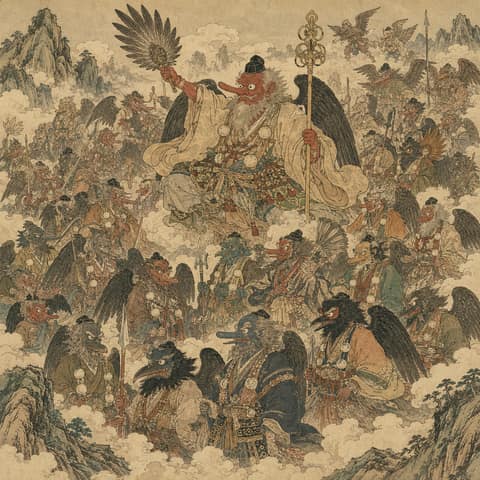
    The tengu do not stop at the Eight Great Tengu. Each of the sacred mountains of the provinces was believed to have its own great tengu, and the early-modern esoteric prayer-scripture the Tengu Sutra lists their representatives as forty-eight seats—the "Forty-Eight Tengu." This edition is an overview that surveys the full roster and the provenance of the scripture itself. The Tengu Sutra is an esoteric, Shugendō-lineage prayer text said to have been compiled in the Edo period. It is not an orthodox sutra of the Buddhist canon, but belongs to the lineage of incantation-scriptures that a yamabushi recites in his devotions to summon (invoke the descent of) the tengu of the sacred mountains of the provinces, borrowing their numinous power to pray for the dispelling of demons, the subjugation of enemies, and the fulfillment of all wishes. The text begins with the chant "Homage to the great tengu and the small tengu," lists the names of the various tengu, then gives the total of the tengu as "one hundred twenty-five thousand five hundred in all," and closes with the mantra "On aromaya tengusumanki sowaka." This "one hundred twenty-five thousand five hundred" is not a real count but a symbolic number representing innumerable tengu, and the forty-eight seats named by their proper names are positioned as the representatives among them. As for the transmission of the manuscripts and printed editions of the Tengu Sutra, there are philological studies such as Takahashi Sei's "The Tengu Sutra: Its Present State and Whereabouts" (2016), and it is difficult to fix the date of compilation strictly to a single point. The roster of the Forty-Eight Tengu runs in the form of "bō" titles (sacred-mountain name + the name of the bō). The opening begins with the great tengu of the Kinai—Atago-san Tarōbō, Hira-san Jirōbō, Kurama-san Sōjōbō—and is followed by the tengu of the Shugendō sacred mountains across the land such as Fuji, Nikkō, Haguro, Akiba, Hikosan, and Ishizuchi. Below are listed all forty-eight seats, collated against two confirmable lines of sources, together with the bō title, sacred mountain, and province (present-day prefecture). ★ marks the Eight Great Tengu that have their own pages in this encyclopedia. 1. ★Atago-san Tarōbō (Mt. Atago, Yamashiro / Kyoto) 2. ★Hira-san Jirōbō (Mt. Hira, Ōmi / Shiga) 3. ★Kurama-san Sōjōbō (Mt. Kurama, Yamashiro / Kyoto) 4. Hiei-zan Hosshōbō (Mt. Hiei, Yamashiro / Kyoto) 5. Yokawa Kakkaibō (Yokawa, Mt. Hiei, Yamashiro / Kyoto) 6. Fuji-san Daranibō (Mt. Fuji, Suruga / Shizuoka) 7. Nikkō-san Tōkōbō (Mt. Nikkō, Shimotsuke / Tochigi) 8. Haguro-san Konkōbō (Mt. Haguro, Dewa / Yamagata) 9. Myōgi-san Nikkōbō (Mt. Myōgi, Kōzuke / Gunma) 10. Tsukuba-san Hōinbō (Mt. Tsukuba, Hitachi / Ibaraki) 11. ★Hiko-san Buzenbō (Mt. Hiko (Hikosan), Buzen / Fukuoka) 12. Ōhara Sumiyoshi Kenbō (Kengamine, Mt. Daisen (disputed), Hōki / Tottori (tentatively identified)) 13. Etchū Tateyama Nawadarebō (Mt. Tate, Etchū / Toyama) 14. Amanoiwafune Dantokubō (Amanoiwafune, location unknown) 15. Nara Ōku Sugisakabō (unknown, location unknown) 16. Kumano Ōmine Kikujōbō (Kiku-no-iwaya, Mt. Ōmine, Yamato / Nara) 17. Yoshino Minasugi Kozakurabō (Mt. Yoshino, Yamato / Nara) 18. ★Nachi Takimoto Zenkibō (Nachi Takimoto, Kii / Wakayama) 19. Kōya-san Kōrinbō (Mt. Kōya, Kii / Wakayama) 20. Niitayama Satokubō (Mt. Niita (disputed), Kōzuke / Gunma (tentatively identified)) 21. Kikaigashima Garanbō (Kikaigashima, Satsuma / Kagoshima (tentatively identified)) 22. Itatōyama Tondonbō (Mt. Itatō, location unknown) 23. Saifu Takagaki Kōrinbō (Mt. Kamado (Mt. Hōman), Chikuzen / Fukuoka (tentatively identified)) 24. Nagato Fumyō Kishukubō (unknown, Nagato / Yamaguchi (tentatively identified)) 25. Tsudoki Oki Fugenbō (Oki Island (disputed), Oki / Shimane (tentatively identified)) 26. Kurokenzoku Konpirabō (Mt. Zōzu, Sanuki / Kagawa) 27. Hyūga Obata Shinzōbō (unknown, Hyūga / Miyazaki (tentatively identified)) 28. Iōjima Kōtokubō (Iōjima, Satsuma / Kagoshima (tentatively identified)) 29. Shiōzan Rikyūbō (Mt. Shibi, Satsuma / Kagoshima (tentatively identified)) 30. ★Hōki Daisen Seikōbō (Mt. Daisen, Hōki / Tottori) 31. Ishizuchi-san Hōkibō (Mt. Ishizuchi, Iyo / Ehime) 32. Nyoigatake Yakushibō (Nyoigatake, Yamashiro / Kyoto) 33. Tenmanzan Sanmanbō (Mt. Tenman (disputed), Mino / Gifu (tentatively identified)) 34. Itsukushima Sankibō (Mt. Misen (Itsukushima), Aki / Hiroshima) 35. Shiragayama Kōshakubō (Mt. Shiraga, Tosa / Kōchi (tentatively identified)) 36. Akiba-san Sanshakubō (Mt. Akiba, Tōtōmi / Shizuoka) 37. Takao Naigubu (Mt. Takao, Yamashiro / Kyoto) 38. ★Iizuna Saburō (Mt. Iizuna, Shinano / Nagano) 39. Ueno Myōgibō (Mt. Myōgi, Kōzuke / Gunma) 40. Higo Ajari (Mt. Kinpō (disputed), Higo / Kumamoto (tentatively identified)) 41. Katsuragi Takamabō (Mt. Kongō (Katsuragi), Yamato / Nara) 42. ★Shiramine Sagamibō (Shiramine, Sanuki / Kagawa) 43. Kōra-san Chikugobō (Mt. Kōra, Chikugo / Fukuoka) 44. Zōzu-san Kongōbō (Mt. Zōzu, Sanuki / Kagawa) 45. Kasagi-san Daisōjō (Mt. Kasagi, Yamashiro / Kyoto) 46. Myōkō-san Adachibō (Mt. Myōkō, Echigo / Niigata) 47. Ontake-san Rokkokubō (Mt. Ontake, Shinano / Nagano) 48. Asamagatake Kinpeibō (Mt. Asama, Kōzuke / Gunma (tentatively identified)) Three cautions are needed in reading this roster. First, the bō titles (the names of each seat) agree across multiple sources and are reliable, but errors mixed into secondary web information mar the identification of the province and prefecture. For instance, Mt. Shibi is in Kagoshima Prefecture (Satsuma), and "Hyūga" is the old province name of Miyazaki Prefecture—misattributions confusing these with places in the Kantō or Tōhoku are in circulation. In this roster, "tentatively identified" is appended to seats whose identification has latitude, and "location unknown" to seats whose whereabouts cannot be confirmed among the sources. Second, there are seats such as Amanoiwafune Dantokubō, Nara Ōku Sugisakabō, and Itatōyama Tondonbō whose location multiple sources hold to be "unknown," and no place name has been forced upon these. Third, there is variation between the bō titles of the Eight Great Tengu and the wording of the Tengu Sutra text. For example, the Ōyama Hōkibō of the Eight Great Tengu appears in the text as "Hōki Daisen Seikōbō," and Ōmine Zenkibō appears in the "Nachi Takimoto Zenkibō" / "Kumano Ōmine Kikujōbō" line of wording. The Eight Great Tengu are commonly explained as eight representative seats drawn from among these forty-eight, but the bō titles do not agree word for word. The framework of the Forty-Eight Tengu shows most plainly that the tengu was not a solitary yokai but a deity of mountain worship seated throughout the sacred mountains of the whole country. Chigiri Kōsai, who compiled the study of tengu, likewise organized these mountain tengu into a single system. Each seat of the Eight Great Tengu (★) is treated in detail on its own page, but they too are simply the especially high peaks within this sea of one hundred twenty-five thousand five hundred tengu.

  • Tenko

    Tenko

    Legendary

    Tenko

    Tenko, the Celestial Fox in Communion with Heaven

    Animal transformation (dōbutsu henge)China and Japan (the highest rank of fox spirits)

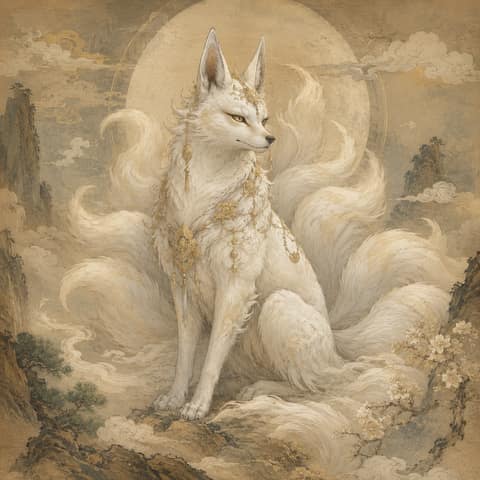
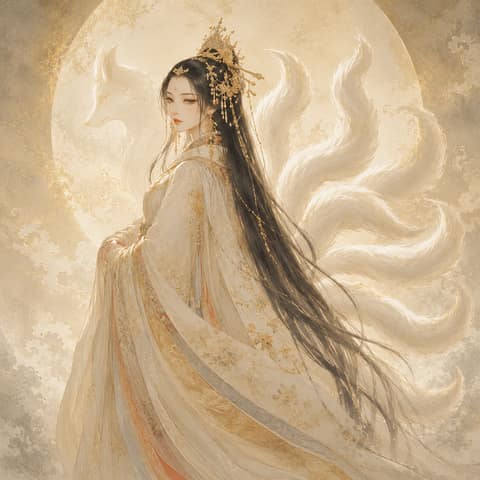
    This version explores why the Tenko is spoken of as “a yōkai yet near to a god,” and where it truly stands. Of the four grades of fox, only the lowest — the Yako — appears before people in a body of flesh to bewitch them. The higher its rank, the more a fox becomes a formless, spiritual presence, and at the summit, the Tenko, it is described less by any shape than by its very workings: seeing for a thousand leagues, communing with the will of heaven. As Yanagita Kunio and Nakamura Teiri have laid out, the Tenko is the utmost extreme of the senko, the spirit fox that has lived a thousand years and accumulated virtue. In neither deceiving people nor leading them astray, but watching over them from above, the Tenko stands at the opposite pole from the Yako. It was this transcendence that drew the Tenko up into religious faith. Just as Dakiniten is attended by a white fox and Izuna Gongen rides one in the guise of a karasu-tengu, the highest fox is enshrined as a familiar of the gods and buddhas, or as a deity in its own right. The power to which warlords prayed for victory, and to which villagers pressed their palms in hope of fire prevention and good fortune, was in the end the power of this fox in communion with heaven. One thing to be wary of is confusing Tenko with tengu. Because an old usage read “shooting star” as amatsu-kitsune, the two have long been mistaken for one another , yet the Tenko is, properly, a fox that has raised its spiritual rank to the utmost limit — a being of a wholly different lineage from the mountain-ascetic tengu.

  • Tsuchigumo (Earth Spider)

    Tsuchigumo (Earth Spider)

    Legendary

    TSOO-chee-GOO-moh

    Tsuchigumo of the Raikō Extermination Tale

    General ClassificationsNaraKyoto

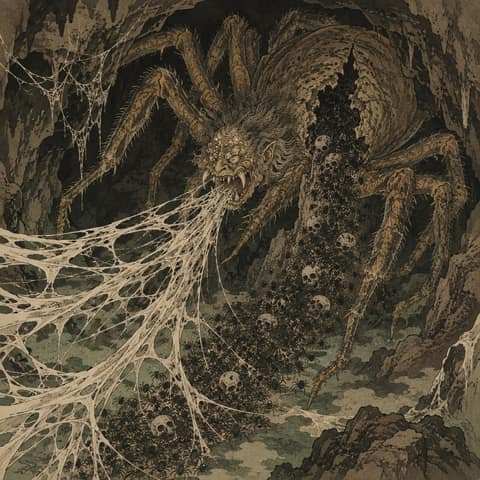
    A yokai image fixed in medieval narratives: as Minamoto no Raikō lies ill, a monk-like apparition appears at his pillow. When struck, it flees leaving white blood, and following the trail leads to a mound or cave where a giant spider lurks. In Noh it calls itself “the ancient spirit of Mount Katsuragi,” while picture scrolls show it beguiling people with manifold shapeshifts and illusions. Its grotesque form—countless heads and swarms of small spiders bursting from its belly—has been read as a symbol of all manner of demons. Early modern joruri and kabuki inherited this line, tying it to the martial exploits of Raikō’s Four Heavenly Kings. Although the ancient term tsuchigumo once referred to local powers, that lineage diverges from the storybook yokai; only the name was carried over.

  • Tsukumogami

    Tsukumogami

    Legendary

    tsoo-KOO-moh-gah-mee

    Tsukumogami (Classical Depiction)

    Household SpiritsMedieval Japan, chiefly the Kinai region

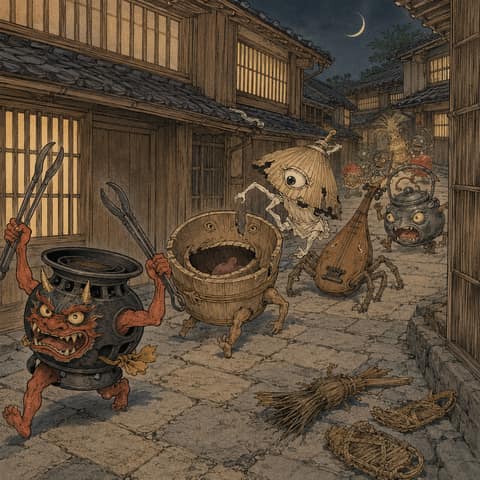
    Rooted in Muromachi-period picture scrolls, this portrayal centers on tools and household objects that gain spirit through long use. When discarded carelessly, they bear resentment and cause disturbances, yet they can be calmed by Buddhist rites, prayers, or renewed respectful use, and may act protectively thereafter. The number of one hundred years is symbolic, expressing the accumulated time that grants spiritual potency. Their forms vary widely—humanoid, demonic, bestial—with everyday implements such as braziers, washbasins, and sake pourers often depicted transforming. Although the name spread less in the early modern era, tool-spirits continued to appear in Night Parade of One Hundred Demons imagery, reflecting attitudes toward tools and impermanence. Local names are not fixed, and sources chiefly trace to the Tsukumogami picture scrolls and old glosses. The tales avoid fanciful additions, serving as moral lessons urging people to cherish and respect their tools.

  • Tsukuyomi-no-Mikoto

    Tsukuyomi-no-Mikoto

    Legendary

    つくよみのみこと

    God of Night, Moon, and Calendar: Tsukuyomi-no-Mikoto

    Divine Spirit / DeityNagasaki

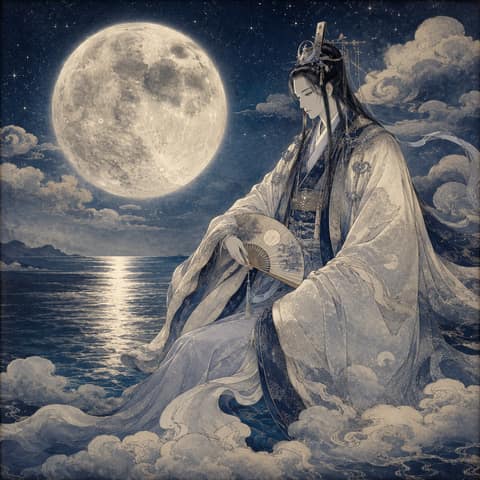
    Tsukuyomi's Position Among the Three Precious Children. While the basic description touches upon Tsukuyomi's primary myth, this detailed explanation delves into the deity's unique structural position within the "Three Precious Children" (Mihashira-no-uzu-no-miko). The tripartite rule by Amaterasu Omikami (Takamagahara, day, light), Tsukuyomi (Yoru-no-Oskuni, night, moon), and Susanoo-no-Mikoto (the sea, untamed force) established the three domains of day, night, and wild power in ancient Japanese cosmology. However, Tsukuyomi alone has almost no detailed mythological narratives throughout the *Kojiki* and *Nihon Shoki*, disappearing from the center of the story immediately after being entrusted with the "Yoru-no-Oskuni." The discrepancy between the high structural position as the middle child and the sparsity of mythological activity is a major point of discussion in the study of ancient Japanese mythology. The Slaying of Ukemochi — A Contrast with the Kojiki. Tsukuyomi's primary mythological tale, the slaying of the food deity Ukemochi, is recorded only in the *Nihon Shoki* and does not appear in the *Kojiki*. In the *Kojiki*, this identical narrative motif is performed by Susanoo-no-Mikoto against Ogetsuhime. This indicates that ancient Japanese mythology possessed a single narrative template for the "origin of grain = five cereals sprouting from a deity's corpse," which was assigned to different deities (Susanoo vs. Tsukuyomi) in the two texts. The difference in this allocation is a vital piece of evidence for examining the compilation process, variant transmissions, and cosmological consistency of ancient Japanese myths. The editorial intent of the *Nihon Shoki* in assigning the Ukemochi murder to Tsukuyomi is interpreted as an effort to emphasize the connection between the moon and the agricultural calendar. Comparative Religion of a "Quiet Deity". Tsukuyomi's "quiet, reclusive" personality is unique even when compared to lunar deities worldwide. From Selene and Artemis in Greece, to Luna in Rome, the Persian moon god Māh, the Chinese lunisolar calendar, and Korean lunar spirits, moon deities across the ancient world are often depicted as highly active and central figures. In contrast, Japan's Tsukuyomi is rare for having few myths and an emphasized serene, introverted, and mediatory nature. Scholars such as Shinobu Orikuchi and Eiichiro Ishida deciphered this characteristic, concluding that "the Japanese moon deity has a 'watchful' nature," and organized the ancient Japanese relationship with the moon not as one of "direct worship" but as a connection of "quiet watchfulness." Moon and Immortality Beliefs — Okinawa and East Asian Comparisons. Nikolai Nevsky, Shinobu Orikuchi, and Eiichiro Ishida positioned Tsukuyomi's primitive attributes within the broader East Asian beliefs linking the "moon and immortality". In Okinawa and the Ryukyu Islands, there is a tradition of "Sudemizu" (water of molting or rejuvenation), a water of immortality bestowed upon humanity from the moon, indicating a symbolic link between the moon's "molting" (the cycle from full moon to new moon) and immortality/rebirth. Similar "moon and immortality" beliefs are distributed across China, Korea, Mongolia, and Southeast Asia, framing the prototype of Tsukuyomi as a Japanese variation of this widespread belief system. The moon's periodicity, its association with feminine tides, the agricultural calendar, and the mystery of its waxing and waning all multi-layered the ancient faith. Gassan Shrine and Shugendo. Gassan Shrine in Yamagata Prefecture, a former Kanpei-taisha (Imperial shrine, 1st rank), served as the core of the Three Mountains of Dewa (Mt. Haguro, Mt. Gassan, Mt. Yudono) and became a center for mountain worship and Shugendo from the Heian period onward. Mt. Gassan is an extinct volcano standing 1,984 meters tall, where Shugendo practitioners envisioned a "Pure Land where Tsukuyomi resides" at the summit, aiming for the rebirth of the soul through rigorous mountain asceticism. Within Shugendo, Tsukuyomi developed uniquely as a deity symbolizing the "moon of death and rebirth," occupying a significant position within the complex evolution of mountain worship, Shugendo, and Pure Land Buddhism during the Heian, medieval, and early modern periods. Even today, the "Gassan-mode" (pilgrimage to Mt. Gassan) is carried on as a symbolic custom of Tohoku folklore and Shugendo. The Geography of Tsukuyomi Shrines. The enshrinement sites of Tsukuyomi are distributed across four main lineages: (1) Gassan Shrine in Yamagata Prefecture (Tohoku mountain worship); (2) Tsukiyomi Shrine in Kyoto (central Shinto under the ancient Ritsuryo system); (3) Tsukiyomi-no-miya and Tsukiyomi-no-miya as auxiliary shrines of the Inner and Outer Shrines at Ise Jingu in Mie Prefecture (State Shinto and the Ise Jingu system); and (4) Tsukiyomi Shrine in Iki City, Nagasaki Prefecture (the oldest Tsukuyomi shrine in Japan, tracing the Korean Peninsula route). The Kyoto shrine is considered to have derived its spirit from the Iki shrine, serving as valuable folkloric-geographical evidence showing the route through which lunar worship originating from the continent and the Korean Peninsula was transmitted to ancient Japan. This demonstrates that Tsukuyomi worship is not an isolated phenomenon unique to Japan but the result of formation within a broad East Asian network of lunar beliefs. Tsukuyomi in the 21st Century. In postwar Japanese subculture works—such as the *Megami Tensei* game series, *Okami*, and the "Moon Breathing" in the manga *Demon Slayer*—Tsukuyomi's attributes of tranquility, mystery, isolation, and dark-night moonlight have a high affinity with modern character design. The symbolic deity of "night, moon, tides, calendar, and immortality" in ancient Japanese cosmology continues to acquire new meanings in the 21st-century era of globalization, space exploration, and social media. Pilgrimages to Mt. Gassan, Ise, and various Tsukiyomi shrines are inherited today, and the serene, mysterious lunar faith has been deeply rooted in the spiritual culture of the Japanese from ancient times to the present. The fact that the deity with the least mythological activity continues to live on in the most serene form within modern Japanese spiritual culture symbolizes the profound wonder of how mythological culture is passed down.

  • Umibōzu (Sea Monk)

    Umibōzu (Sea Monk)

    Legendary

    oo-mee-BOH-zoo

    Umi-bōzu (Fishermen’s Lore)

    Aquatic SpiritsNagasakiEhime

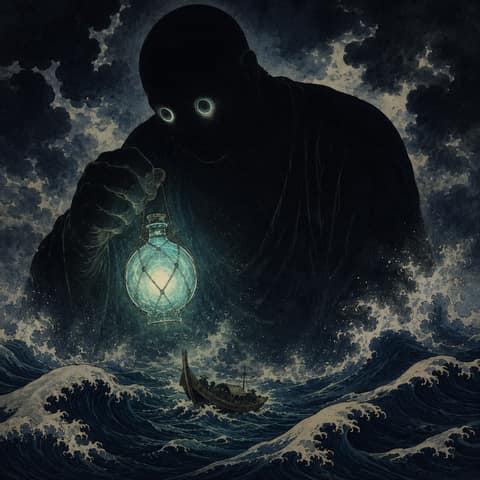
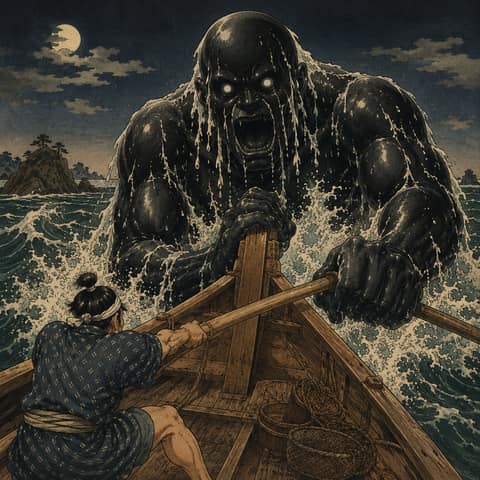
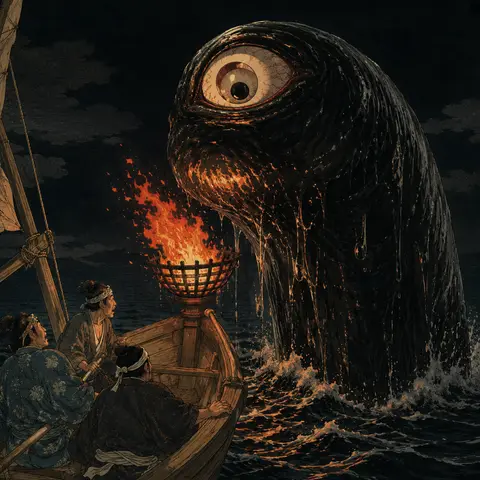
    Umi-bōzu is a yokai said to embody the fear and unease sailors feel at sea. Its form is not fixed, sometimes appearing as a mere black shadow, other times rising from the waves as a colossal monk-like figure. Tales tell of it approaching boats and whispering, “Lend me oil,” and if given, it ignites flames and sinks the vessel. In more recent lore, it is said to collect sunken boats and nets and stack them on the seafloor, and at times appears holding a glowing bottle or lantern. Both a frightener of humans and a symbol of the sea’s mystery, it is regarded with awe.

  • Umibōzu (Sea Monk)

    Umibōzu (Sea Monk)

    Legendary

    oo-mee-BOH-zoo

    Sea Monk of Kyushu and Shikoku

    Aquatic SpiritsNagasakiEhime

    A Sea Monk told along the coasts of Kyushu and Shikoku. It appears on boats and asks for a ladle, yet it never climbs aboard from the stern, always emerging at the bow. When it clings to the oar, if the crew keeps rowing, the oar bites in like a blade and it cries out “Aitata!” In Uwajima, many tales say it harms people, yet those who see a Sea Monk are also said to live long lives.

  • Umibōzu (Sea Monk)

    Umibōzu (Sea Monk)

    Legendary

    oo-mee-BOH-zoo

    Sea Monk of the Chugoku Region

    Aquatic SpiritsNagasakiEhime

    A sea monk told across the Chugoku region. In Nagato it appears to snuff out watch fires, while in Okayama’s Bisan Seto it is called “Nurarihyon,” taking a bead-like form to bewilder people. Along the San’in coast it clings to beachgoers and tries to pull them into the sea. The Tottori collection Inaba Kaidan-shu recounts a one-eyed, post-like sea monk that torments people with its slick, slimy body.

  • Ushioni

    Ushioni

    Legendary

    OO-shee OH-nee

    Cow-Headed, Spider-Bodied Sea Demon: Ushioni

    Animal ShapeshifterEhimeKochi

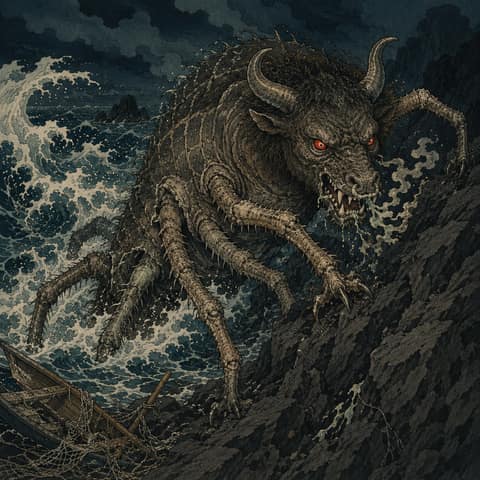
    This is the interpretation of the Ushioni depicted in Edo-period yokai picture scrolls and perhaps the most popular in modern yokai encyclopedias: a "sea demon with a cow's head and a spider's body." In this version, the Ushioni visualizes the primal fear of "dark, deep waters" such as seas and pools, combined with the "relentless obsession" of never letting prey escape, symbolized by a spider's web. From a folkloric perspective, the "cow" has been a sacred animal deeply connected to agriculture and flood control in ancient Japan, worshipped as the messenger of water deities, or as the water deity itself (e.g., Gozu Tenno). A prevalent interpretation is that the Ushioni lurking in the abyss is the fallen form of the "fury of nature (water deity)" that people once worshipped and feared, reduced to a yokai as the original faith lost its substance. Its absolute lethality—cursing someone to death simply by licking their shadow—and its cunning in using a Nure-onna as bait to exploit psychological openings surpass the level of a mere low-intelligence beast, strongly retaining the unreasonable divine wrath from when it was a god. Because of its tremendous vitality, driven by malice enough to keep moving even after its head is cut off, ordinary humans cannot hope to stand against it. To quell this overwhelming violence, one had no choice but to either rely on higher Buddhist powers, such as Senju Kannon (the Thousand-Armed Avalokitesvara), or to respectfully incorporate the Ushioni itself into festivals as a vanguard of the portable shrine (a divine familiar), utilizing its "Aramitama" (rough, violent spirit) as a city defense system.

  • Yamato Takeru

    Yamato Takeru

    Legendary

    Yamato Takeru

    Yamato Takeru, the tragic hero and greatest warrior of ancient Japan

    Divine spirit / deified heroShiga

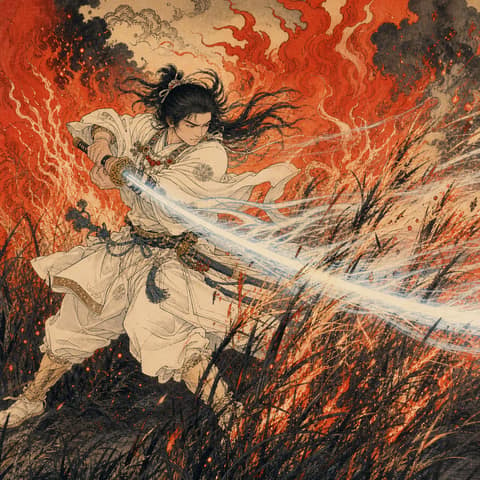
    The ancient mythic type of the tragic hero. The general entry covered Yamato Takeru's myth. Here the focus is the ancient pattern of the tragic hero. Yamato Takeru is a rare heroic deity who unites the tragic hero, short-lived warrior, father-son conflict, sacrificial love, and ascent after death in a single figure. He begins with fratricide, is rejected by his father and sent on campaigns, survives through his wife's sacrifice, and dies from a mountain god's curse. That arc is structurally close to tragic heroes across the ancient world, including Heracles, Sigurd, and Arjuna. It is a Japanese form of a widespread story pattern: the fate, suffering, and heavenly transformation of the hero. Father-son conflict and the myth of heroic exile. Yamato Takeru is estranged from Emperor Keiko and repeatedly ordered to go on distant campaigns. In comparative mythology, this belongs to the broad pattern of a dangerous son being exiled, tested, and made to conquer. Stories in which a father or ruler sends such a figure away are often compared with traditions surrounding David, Sigurd, and Zheng He, and they reflect questions of patriarchy, succession, and kingship. The tale marks the killing of the brother as a failure of human restraint, yet it also shows the father's coldness. That double structure gives the story a tragic intelligence beyond simple good and evil. Disguise as a young woman: strategy turned into myth. In the Kumaso episode, Yamato Takeru disguises himself as a young woman, enters the enemy camp, and kills the chieftain. The scene is a memorable mythic rendering of military strategy, disguise, and surprise attack. Yet the female disguise is more than tactics. In ancient Japanese myth and folklore, reversal, thresholds, and the crossing of gendered boundaries can be sources of ritual power and sacred danger. Yamato Takeru's disguise can therefore be read not simply as deception but as an act that embodies the magical force of inversion. It also stands as a mythic ancestor to later religious and theatrical traditions of cross-gender performance in kagura, noh, and kabuki. The Kusanagi sword and the Three Sacred Treasures. Yamato Takeru receives the Kusanagi sword from Yamato-hime, escapes the Yaizu fire with it, and after his death the sword is enshrined at Atsuta Jingu. Kusanagi is one of the Three Sacred Treasures at the core of ancient Japanese royal legitimacy. Its transmission runs from Susanoo's defeat of Yamata no Orochi, to presentation to Amaterasu, to the heavenly descent of Ninigi, to Yamato-hime, to Yamato Takeru, and finally to Atsuta Jingu. Through that chain, myth, sacred object, and imperial lineage are joined in material and religious form. Yamato Takeru is one of the few figures who actually uses a sacred treasure in battle, making him a symbol of the union of artifact, hero, and state. Ototachibana-hime's sea sacrifice and the origin of Azuma. Ototachibana-hime's self-sacrifice at sea and Yamato Takeru's cry, "Azuma haya," are treated as the mythic origin of Azuma, the eastern lands and eastern Japan. Ancient myth did not only entertain; it gave meaning to names, geography, land, and local custom. Here a woman's sacrifice becomes attached to the name of the entire east. Hashirimizu Shrine in Yokosuka still enshrines Ototachibana-hime, showing that the episode continues not only in texts but also in place names, worship, and local memory. The death poem and ancient Japanese longing for home. The death poem Yamato Takeru sings at Nobono, "Yamato wa kuni no mahoroba," has long been cherished as one of ancient Japan's foundational expressions of homeland, longing, and love of country. Mahoroba means an excellent, beautiful place, and the word condenses an early feeling for the homeland and the land itself. It influenced later waka traditions such as the Man'yoshu, Kokinshu, and Shinkokinshu. The structure is powerful: a hero at the edge of death praises the place he longs to return to. In modern Japan, the poem has continued to appear in education, literature, music, and public speech. The white-bird legend and ancient Japanese ideas of ascent and rebirth. After death, Yamato Takeru becomes a white bird, rises from his tomb, passes through Kotohiki-no-hara in Yamato and Shiki in Kawachi, and flies high into the sky. The legend is a representative example of the ancient Japanese idea that a hero may ascend and be transformed after death. In early Japan, the white bird could be imagined as a bearer of souls or a messenger of the gods. Beliefs in the dead soul becoming a bird and rising to the sky also have affinities with northern Asian, Siberian, and Korean ideas of birds, funerary practice, and the soul. The image later resonated with Pure Land faith, Shinto views of death, warrior ethics, and even the spiritual culture around the kamikaze special attack corps. It is not merely an ending to a hero tale. It is one of the narratives through which ancient Japan thought about death, religion, and beauty. Yamato Takeru in the twenty-first century. Today Yamato Takeru remains a subject of ancient-history research, local tourism, Shinto worship, and popular culture. Visits to Nobono, Kotohiki-no-hara, Atsuta Jingu, Yaizu Shrine, and Hashirimizu Shrine continue. He is repeatedly reshaped in works such as the game Okami, the 1994 film Yamato Takeru, and manga including Demon Slayer. Across more than two millennia of cultural memory, he has remained a symbol of the tragic hero, the short-lived warrior, love and sacrifice, and ascent after death. From political emphasis in prewar State Shinto, through postwar cultural reinterpretation, to plural retellings in the twenty-first century, he is a model case of how an ancient divine figure can keep entering modern culture.
  • Yamauba

    Yamauba

    Legendary

    yah-mah-OO-bah

    Yamanba (Traditional Folkloric Form)

    Mountain & Wilderness SpiritsKanagawa

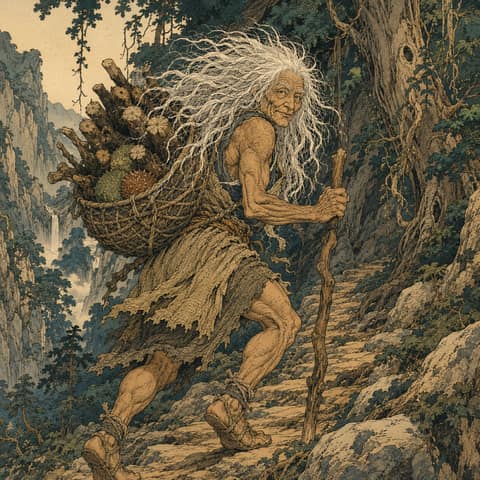
    An elderly woman with white hair and a body hardened by life in the mountains, she is famed as the nurturing figure who raised Kintaro. Her deeply lined face reflects priceless life experience, and she offers precise guidance to the lost. Though she may appear strict, a profound love resides beneath the stern exterior.

  • Yamauba

    Yamauba

    Legendary

    yah-mah-OO-bah

    Mother of Kintaro

    Mountain & Wilderness SpiritsKanagawa

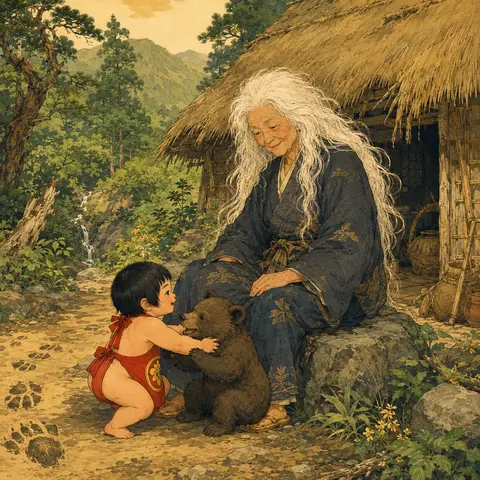
    Deep in the Ashigara Mountains, in a secluded hollow along bamboo ridgelines untrodden by humans, dwells a lineage of yama-uba known as the Yae-giri Mother Form. Bathed at birth in dew gathered on layered paulownia leaves and nourished by the breath of the mountains, this line is said to conceive children through union in dreams with an akairyū—an “red dragon” that appears on nights when crimson vapors gather. They rarely mingle with the human world, opening paths for those who keep the mountain’s order and baring fangs at those who trample its law. The Ashigara Yae-giri Mother Form takes as her charge the raising of children, favoring those with especially strong vital spirit. With few words she teaches how to split firewood, read the presence of beasts, ford streams, follow the courses of stars, and use the virtues of roots, leaves, and bark. When a child stumbles on a stone she watches and smiles, and when blood is drawn she silently applies moss juice. It is not pampering but passing on the mountain’s severity as it is. The crimson vapor seen in the Konjaku Monogatari is her warding veil, a barrier that blinds the eyes of outside gods. When Yorimitsu ascended from Kazusa, he recognized that vapor and sent Watanabe no Tsuna, an act born of the ancients’ intuition about this Mother Form’s power. In a thatched hut lived an old woman and a youth not yet twenty. The old woman called herself a demon-woman and felt no shame for her bond with the dream-red dragon, saying only that the child was born according to the mountain’s law. The boy she raised was later named Sakata Kintoki and became famed, yet once a child enters the world the Yae-giri Mother Form releases attachment and fades like mountain mist, caring nothing for wealth or honor, wishing only that the mountain’s balance remain unbroken. In Edo times, when the Kimpira jōruri was popular, she was portrayed as an ogress, but in old tales of Ashigara, oni signifies awe-inspiring power and is not confined to evil. Stories of bearing a thunder child and of a red dragon entrusting a child to the paulownia atop Mount Kintoki show this lineage’s dual nature of receiving from heaven and nurturing on earth. When sharing the mountain’s bounty she wears the face of an old mother, against ravagers she takes the aspect of a peak-dwelling oni. At midnight, when crimson vapor drapes the ridge, she consults the stars over a child’s fate and, if needed, commands beasts and trees to open the way. She leaves no treasure, only marks carved in wood grain and the remembered weight of a hand-axe in a child’s palm. Even now, on mist-laden mornings deep beyond the Ashigara Pass, she is said to listen for the breath of those who are meant to be raised, hidden within the rustle of bamboo wrens.

  • Yomotsushikome

    Yomotsushikome

    Legendary

    よもつしこめ

    Underworld Pursuer of the Kojiki: Yomotsushikome

    Divine Spirit/DeityYomi (Mythology) / Yomotsu Hirasaka Lore Site (Higashi-Izumo-cho Iya, Matsue City, Shimane Prefecture)

    The Position of Grotesque Deities in Kiki Mythology. While the basic description touches on the accounts in the *Kojiki* and *Nihon Shoki*, the deep dive explores Yomotsushikome's position as a "grotesque deity" within the mythological system. Deities in *Kiki* mythology are broadly classified into three layers: (1) Takamagahara lineage (heavenly/pure deities), (2) Ashihara-no-Nakatsukuni lineage (earthly/indigenous deities), and (3) Yomi lineage (deities of the dead/grotesque deities). Yomotsushikome belongs to the third lineage, forming a cohesive system alongside Izanami (the goddess stationed in Yomi), the Eight Thunder Deities, and the Underworld Army. *Kiki* mythology is not a simple dualism of good and evil; it possesses a three-tiered structure of "life, purity, and light" versus "death, impurity, and darkness," where grotesque deities are positioned as essential entities upholding the order of the underworld. Etymology of "Shiko"—The Semantic Field of Ancient Japanese. Interpreting "shiko" as "ugly" is a reductive interpretation from the Middle Ages onwards. In ancient Japanese, "shiko" was a rich word connoting "strength, hardness, and terror." Cognate words like "shikobuchi" (rocky abyss) and "shikofune" (sturdy boat) express the hardness of coastal rocks. "Shikome" was not merely an "ugly woman" but understood as a "hard, strong, and terrifying female demon-deity." The names of ancient deities tended to be based on "spiritual power and function" rather than "visual features," positioning Yomotsushikome as a "female demon-deity with terrifying power governing death." The fixed image of a "flesh-rotting, fanged hideous hag" in medieval picture storytelling is a later reconstruction distinct from her original mythological figure. East Asian Comparison of Peach Warding Beliefs. The episode of Izanagi using peaches to repel Yomotsushikome serves as a key subject in comparative religion regarding East Asian warding culture. In Chinese Taoism, warding off evil spirits using peach wood swords, peach charms, peach seals, and peach offerings was systematized and widely spread to East Asian regions. The magical power of the peach repeatedly used in Japanese court rituals (Tsuina, Tango no Sekku, Momo no Sekku) was formed through the complex intertwining of the Izanagi myth in the *Kojiki* and Chinese Taoist peach worship. This is a classic example of how ancient Japan constructed its unique system while assimilating the religious cultures of the Chinese mainland and the Korean peninsula. The Pursuit Tale as a Narrative Type. A hero escaping from the land of the dead by throwing magical items that transform to delay pursuers—this is known in world mythology as the "Magic Flight" motif, a widely distributed narrative type. Similar tales exist in the Greek myth of Orpheus and Eurydice, Eastern European folklore of Baba Yaga, and Native American creation myths, demonstrating a universal structure of ancient human concepts of the underworld and escape narratives. The tale of Izanagi and Yomotsushikome holds exceptionally high comparative mythological value as one of the oldest literary records of this global narrative type in East Asia. The Geography of Yomotsu Hirasaka—Relationship with the Izumo Belief Sphere. The modern estimated site of Yomotsu Hirasaka in Higashi-Izumo-cho Iya, Matsue City, Shimane Prefecture, is located in the core region of the ancient Izumo belief sphere, alongside the Izumo Kuni-no-Miyatsuko stronghold, Kumano Taisha, and Kamiarizuki legends. In the *Kojiki* and *Nihon Shoki*, Izumo is depicted as the intersection of the three mythological layers—Takamagahara, Ashihara-no-Nakatsukuni, and Yomi—and placing the "entrance to Yomi" in Izumo was no coincidence. It reflects Izumo's status as the religious center for "death, the otherworld, and Ne-no-Katasukuni" in ancient Japan. Myths involving Okuninushi, Susanoo, Izanagi, and Izanami intersect in this region, serving as the key to deciphering ancient religious geography. Reduction Since the Middle Ages and Modern Renewed Interest. In medieval sermons, picture storytelling, Noh, and Joruri theater, Yomotsushikome was fixed into the image of a "flesh-rotting, fanged hideous hag," losing the original ancient semantic field of a "strong female demon-deity." However, since the 2010s, amidst a renewed interest in Japanese mythology, re-evaluations based on findings in ancient linguistics, mythology, and archaeology are progressing. Modern subcultures such as the *Megami Tensei* game series, *Record of Ragnarok* manga, and *Demon Slayer* anime functionally reconstruct ancient mythological materials, thereby reintroducing the mythological worlds of Yomotsushikome, the Underworld Army, and Yomi to younger generations. This is a symbolic example of cultural historical circulation from ancient to modern times. Positioning as "Japan's Oldest Yokai". Yomotsushikome is a female demon-deity appearing in the *Kojiki* (712 CE), Japan's oldest extant book, giving her a unique status not just as a "post-Heian yokai" but as a "grotesque deity recorded in the original texts of Japanese mythology." Predating the yokai systems involving oni, tengu, and kappa that formed from the Middle Ages onwards—in an era where the boundary between ancient gods (kami) and yokai was still undifferentiated—she is a core subject for tracing the origins of yokai studies. Dismantling the binary opposition of "is it a god or a yokai?", she serves as an excellent starting point for examining the rich, multi-layered nature of ancient Japan's grotesque deities.

  • Yuki-onna

    Yuki-onna

    Legendary

    Yuki-onna (the Snow Woman)

    The White Apparition of the Snow-Country Night

    Natural Phenomena & Nature SpiritsIwate

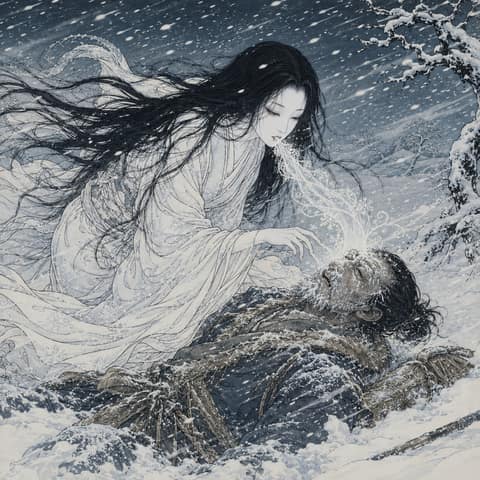
    As a "white apparition," the Yuki-onna is told of as a white figure that suddenly stands in one's path on a blizzard night, leaving no footprints. Before she draws near, the air first turns cold and one's breath freezes white; then, in the glow of the snow, a woman with a long trailing hem floats dimly into view. This sense that "the cold announces her before she comes" is the shared core of encounter-tales across the regions. Her face alone is translucently pale, her eyes glint from within, and she either gives no answer when addressed or asks one's name in a low voice. In many versions the taboo runs thus: answer her question and your life-force is drained; stay silent and you are spared. The tale of Minokichi and O-Yuki that Lafcadio Hearn set down in Kwaidan conveys this white-apparition image most vividly. Having frozen the old woodcutter Mosaku to death in a storm-bound hut, the snow woman leaves the young Minokichi with a single command: tell no one what you have seen tonight. Later Minokichi weds a traveling woman named O-Yuki, fathers children, and lives happily — until one snowy night, watching his wife's pale profile as she sews by lamplight, he sees in her the face of the snow woman of long ago and lets the words slip. O-Yuki reveals herself, declares that she spares him only for the love of their children, and vanishes through the smoke-hole as a white mist. A bond sealed by a single forbidden word comes undone: the sorrow of parting, and the otherworldly woman who longs for a human, crystallize here. In pictorial tradition she is usually painted as a tall woman in white in pale washes, her outline never drawn too firmly, dissolved into a white scarcely distinguishable from the snow. Her feet are blurred into haze and she casts no shadow, lending the air of something not of this world. Less a spirit who sings and dances than a still apparition who stands without sound and vanishes without sound — that is the true nature of the Yuki-onna as a "white apparition."

  • Yūrei (Ghost)

    Yūrei (Ghost)

    Legendary

    YOO-ray

    Toriyama Sekien “Yūrei” (An’ei era)

    霊・亡霊Across Japan

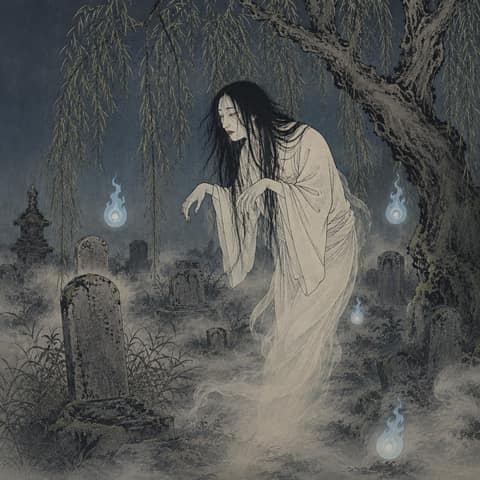
    An image based on the “Yūrei” in Toriyama Sekien’s Gazu Hyakki Yagyō, published around 1776 (An’ei 5). In a nighttime graveyard a woman’s ghost appears between drooping willows, wearing a white burial robe and a forehead cap, raising her arms as if to halt a passerby. It is a transitional depiction from before footless forms and the triangular headcloth became fixed conventions, emphasizing the lifelike force of the arms and the willow and gravestones as symbols of place. Sekien’s plates organized contemporary strange tales, Buddhist views, and funeral customs, profoundly shaping the visual codification of yūrei. While indicating gender and costume, the image leaves the source of attachment unspecified, inviting the viewer to imagine the relationship.

  • Zashiki-warashi

    Zashiki-warashi

    Legendary

    za-shi-ki-wa-ra-shi

    Child Protector of Iwate Homes: Zashiki-warashi

    Half-Human / Half-YokaiIwateAomori

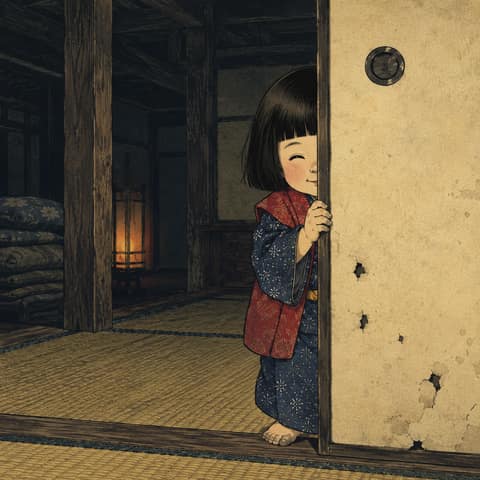
    This version is interpreted as a child deity that resides in old houses in Tohoku and governs the rise and fall of the household. In this iteration, the zashiki-warashi possesses both the innocent, friendly side of a "god of fortune" and the cold side of a "god of fate" that will mercilessly abandon the family to ruin if displeased in the slightest. Its nature varies depending on the space where it appears: the pale, beautiful Chopirako appears in "hare" (sacred/formal) spaces like the inner parlor, while the Notabariko or Usutsukiko appear in "ke" (profane, or spaces closest to death) like the dirt floor or kitchen. A popular theory once claimed in some dictionaries that the description of "Chopirako" was found in the Edo-period essay "Jippoan Yureki Zakki," but this is a clear error caused by confusion with other literature; the first mention of zashiki-warashi hierarchies comes strictly from the Tohoku local studies by Kizen Sasaki and others. It is said that zashiki-warashi are mainly visible to the children of the house or outside guests. Even today, there are places like the inn Ryokufuso in Ninohe City, Iwate Prefecture, where guests from all over the country visit in hopes of meeting a zashiki-warashi (= being granted wealth). If someone tries to harm it, such as by shooting it with a bow, it will disappear; if enshrined warmly, it will enrich the home forever. Its adorable childlike appearance is a thin veil concealing the most painful sacrifices (infanticide) of village life, making it the ultimate "guardian deity of the home" born from regret for dead children and the obsession with family continuity.

  • Ōmine Zenkibō

    Ōmine Zenkibō

    Legendary

    Ōmine Zenkibō

    The Dharma-Guarding Tengu Turned from an Oni — Ōmine Zenkibō

    Mountain & Wilderness SpiritsNara

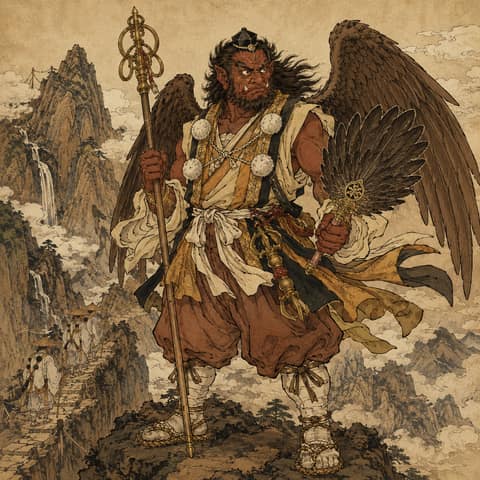
    The essence of Ōmine Zenkibō lies in the structure of rebirth: "an oni turning into a tengu." It is a tale that embodies the heart of Shugendō in a single being. His source lies in the old tales of En no Gyōja and the oni. The oldest extant text depicting En no Ozunu is the Nihon Ryōiki (early Heian), which portrays him as a thaumaturge who flew through the air commanding demons. The Konjaku Monogatarishū, Book 11 carries the tale of En no Gyōja having demons build a bridge across the mountains, showing the fixing of the image of En no Gyōja as one who commands demons. Zenki was originally a violent oni who carried off human children. En no Gyōja captured him with the secret rite of Fudō Myōō and reformed him into an attendant. By one account, En no Gyōja hid the youngest child of the Zenki couple in an iron cauldron and, through the grief of having one's own child taken, brought them to realize the sin of carrying off the children of others. The reformed Zenki and Goki became dharma-protecting oni and supported En no Gyōja's practice. This Zenki, sublimated into a great tengu at the end of long austerities, is Ōmine Zenkibō. This plot, of a violent being turning into a guardian of the Buddhist law, shows most clearly that the dread of a child-snatching tengu and the faith in a tengu who guards people share a single root. The Ōmine on which Zenkibō sits is the holy ground of Shugendō. The Ōmine training ground founded by En no Gyōja, and the Ōmine Okugake-michi registered as World Heritage, is a perilous route that ascetics still tread at the risk of their lives, and Zenkibō was conceived as its guardian. He is chanted as "the band of Zenki of Ōmine" in the Muromachi Noh play Kurama Tengu, and stands among the forty-eight tengu of the Tengu-kyō (some sources give "Nachi Takimoto Zenkibō"). And the heaviest single point of this lore is that the bloodline of Zenki is said to live on into the present. Of the five lodges kept by the five children of Zenki and Goki, only the Onakabō of the Gokijo family remains today, and the present-day Gokijo Yoshiyuki continues to receive the ascetics of the Ōmine Okugake-michi. This genealogy is hard to source explicitly in old documents and is transmitted as the oral lore of the surviving lodge; yet this real continuity—descendants of a reformed oni guarding the path of Shugendō beyond thirteen hundred years—makes Ōmine Zenkibō not a mere legend but a symbol of living faith. Chigiri Kōsai of tengu scholarship, too, placed him within the system of the great tengu of the many mountains.

  • Ōyama Hōkibō

    Ōyama Hōkibō

    Legendary

    Ōyama Hōkibō

    The Great Tengu of the Transferred Seat — Ōyama Hōkibō

    Mountain & Wilderness SpiritsKanagawa

    The core of Ōyama Hōkibō lies in a tale of succession to a seat within the tengu world—the "seat transfer." Yet the Mt. Ōyama on which he sits was a sacred mountain established in antiquity, without need of the transfer legend. The Engishiki Jinmyōchō (927) ranks the Afuri Shrine among the official shrines of Sagami Province, showing that Ōyama's divinity was recognized by the ancient state. On the Buddhist side, the Ōyama-dera engi emaki depicts how Rōben—carried off by an eagle and raised in Nara—opened Ōyama-dera and enshrined Fudō Myōō (the Sagami version; a different work from the engi of Hōki's Daisen-ji). And in early-modern times the official gazetteer the Shinpen Sagami no Kuni Fudoki-kō (1841) conveys the summer ascent season and the bustle of pilgrims from many provinces. The manners of pilgrimage—purifying oneself at the waterfalls under a sendatsu's guidance before climbing—and the Ōyama confraternities everywhere: this density of faith gave Hōkibō, the successor tengu, the character of a guardian watching over the common people. The seat-transfer tradition overlays this sacred-mountain history. According to the arrangement of Chigiri Kōsai of tengu scholarship, Sagami Ōyama originally had a great tengu named Sagamibō. But when the Retired Emperor Sutoku—defeated in the Hōgen Rebellion (1156) and exiled to Sanuki—passed away, Sagamibō removed to Shiramine in Sanuki to console and guard his bitter spirit (= Shiramine Sagamibō). The one who succeeded to the vacant seat of Sagami Ōyama was Hōkibō, come from Mt. Daisen in Hōki. This symmetrical transfer—"Sagamibō to the west, Hōkibō to the east"—is a Chigiri-derived arrangement lacking explicit sources in the classical literature, and should be read not as historical fact but as lore that mirrors the notion that a tengu's seat is succeeded through mountain and bond (en) rather than being a fixed individual. Chanted as "Hōkibō of Ōyama" in the Muromachi Noh play Kurama Tengu, and standing among the forty-eight tengu of the Tengu-kyō, his seat continues to be remembered, together with this distinctive engi, as one of the Eight Great Tengu.

Showing 73 - 91 of 91 yokai