Yokai Encyclopedia

Encyclopedia of Japanese Yokai

47 Yokai|14 Category|Page 2 of 2
Localization in Progress - More content available in Japanese version
View Japanese
Sort by: NameAscending
Divine
  • Moriya-no-kami

    Moriya-no-kami

    Divine

    もりやのかみ

    Moriya-no-kami, the Local Deity of Suwa Who Confronted Takeminakata-no-kami

    Divine SpiritNagano

    The charm of Moriya-no-kami lies in the fact that he is spoken of not as the victor of the central mythology, but as the deity who was there first. Takeminakata-no-kami is the Great God of Suwa standing at the center of the official historical view of Suwa Grand Shrine, but the story of that god entering Suwa requires a god on the receiving end. Moriya-no-kami fulfills that role. He is not a god who fights, loses, and vanishes, but one who, after reconciling, enters into the ritual order as the High Priest. Therein lies a uniquely Suwa-like layering of faith, not merely conquest and replacement. When reading Onbashira, Mishaguji, the Moriya clan, and Suwa Myojin as a single geological stratum, Moriya-no-kami stands precisely at the boundary of those layers.

  • Mugidono Daimyōjin

    Mugidono Daimyōjin

    Divine

    MOO-gee-doh-noh dye-MYOH-jin

    Measles Iconography: Demon-Trampling Aspect

    Deities & Divine SpiritsEdo period

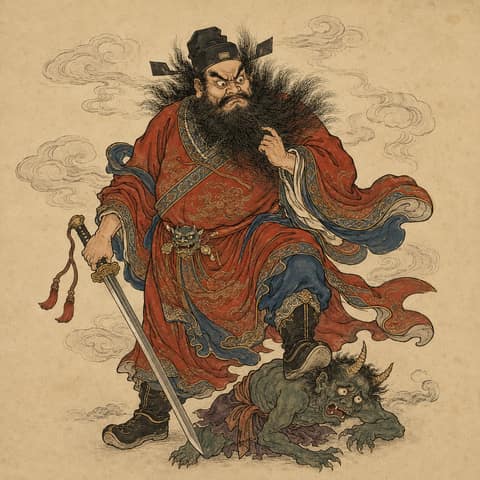
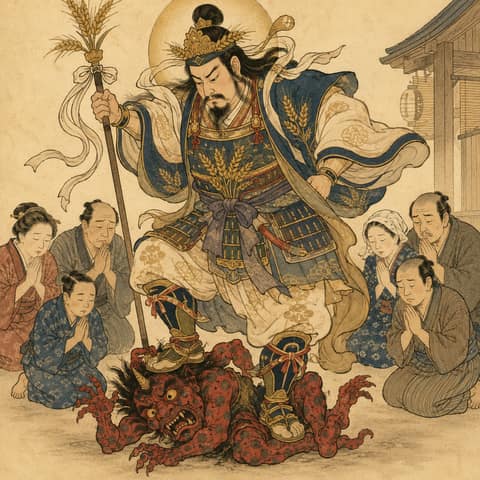
    A canonical image of Muginodo Daimyojin found in measles prints. A formidable deity subdues a red-black oni under both feet while onlookers press their hands in prayer. Though the god’s origins are unclear, the image renders the disease visible and calms anxiety through the act of trampling. The accompanying text lists convalescent care, dietary restrictions, and prayers for recovery, blending devotion with practical guidance. The design reflects the plain sincerity of folk belief.

  • Niutsuhime

    Niutsuhime

    Divine

    niutsuhime

    The Guardian Deity of Mount Koya, Niu Myojin

    Divine Spirit/DeityWakayama

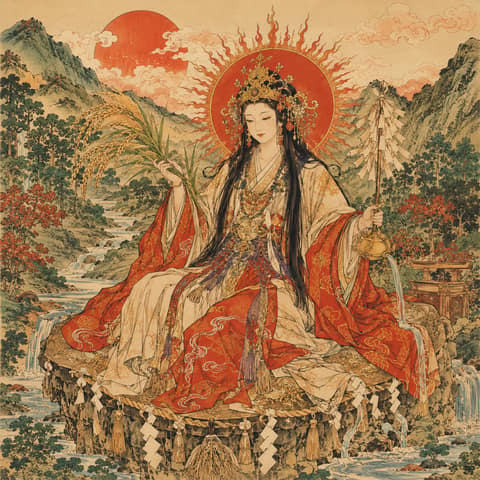
    Niutsuhime is the "god of the land" at the foundation of Mount Koya's religious landscape. Although the sacred site of Shingon esoteric Buddhism is known as the mountain of the Buddha (Dainichi Nyorai), its foundation is a land governed by local deities from before Kukai's arrival. The founding legend establishes the indispensable role of both Niu and Takano Myojin through a narrative of yielding this territory (dedication of divine land). The cinnabar indicated by the name "Niu" has been highly valued since ancient times as a mineral for preservation, warding off evil, and magic. The distribution of mercury veins at the foot of Mount Koya corroborates the existence of the Niu clan mining group and the deity they worshipped. Simultaneously, due to her location controlling the headwaters of the Kinokawa River, she is also revered as a water god, extending her protection to agriculture and irrigation. Under the syncretism of Shinto and Buddhism, she was considered a manifestation (suijaku) of the Womb Realm Dainichi Nyorai, and was enshrined in the Miyashiro and Amano-sha shrines within Mount Koya as the mountain's guardian. The romon gate and main sanctuary of the World Heritage Niutsuhime Shrine continue to convey that this goddess is the starting point of Mount Koya's 1,200 years of faith.

  • Oguchi-no-magami

    Oguchi-no-magami

    Divine

    Oguchi-no-magami

    The Divine Messenger of Chichibu Mitsumine: Oinu-sama

    Divine Spirits / DeitiesSaitamaTokyo

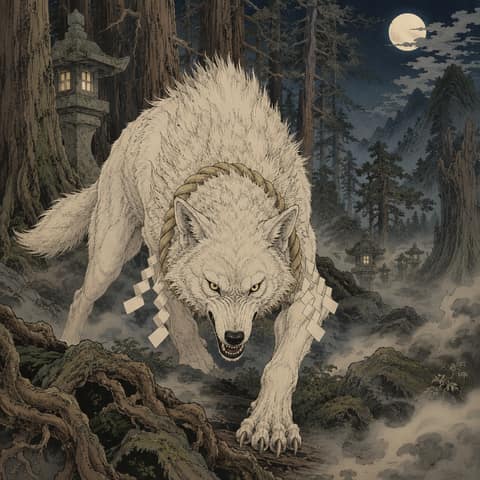
    Oguchi-no-magami is not merely a beastly yokai, but the crystallization of a faith that enshrined the Japanese wolf—a real, apex predator of the mountains—as a "True God." Centered around Mitsumine Shrine in Chichibu, Musashi Province, and extending to sanctuaries like Musashi Mitake Shrine and Hodosan Shrine, it is a guardian deity that permeates the wolf-worshipping sphere of the Kanto region. Its essence lies in "purification and exorcism." The fire that attacks a house, the thief that sneaks in, the evil spirits that possess people—the divine nature of a "watchdog" capable of sniffing out and driving away unseen disasters was strongly sought after by the commoners of the early modern period. The unique practice of *Gokensoku Haishaku* is an intense form of faith where the deity itself is welcomed into the home for a year. Through repeated cycles of returning and renewing the amulet, the bond between the deity and the household is maintained. The fact that an extinct beast is still treated as a god today demonstrates the deep-rooted strength of this faith.

  • Oyamatsumi

    Oyamatsumi

    Divine

    oyamatsumi

    The Supreme Deity of Mountains, Seas, and War

    神霊・神格Ehime

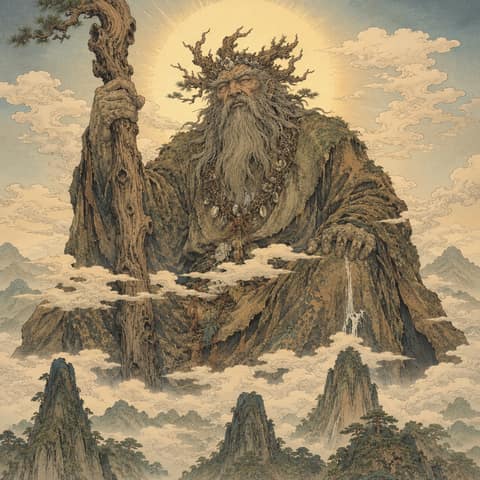
    The Master of Life's Eternity and Finitude. The myth wherein Oyamatsumi offers his daughters Iwanaga-hime (the eternity of rock) and Konohanasakuya-hime (the fleeting beauty of a blossom) to the Heavenly Grandson is not merely a marriage tale, but a philosophical myth determining human lifespan and natural providence. When Ninigi-no-mikoto chose only the beautiful younger sister and sent back the ugly older sister, Oyamatsumi delivered a declaration that was both a curse and a prophecy: "The lifespan of the Heavenly Grandson, which should have been eternal like a rock, will now scatter fleetingly like a blossom." He is depicted as a god with a cold, primordial fatherhood who teaches humanity both the beauty and harshness of nature, and the finitude of life. A Massive Perspective of Nature That Rejects Anthropomorphism. Among Japanese deities, rather than being depicted in a specific anthropomorphic form (such as an old man), Oyamatsumi is strongly perceived as a massive mountain block, a dense forest, or an island serving as a navigational landmark. This grand scale is the very perspective of mother nature, transcending the morals and ethics of human society. Even during the era of Shinto-Buddhist syncretism (Honji Suijaku), rather than being tied to a specific Buddha, he was worshipped as an overwhelming aggregate of natural energy. Guardian of Mines, Blacksmithing, and Brewing. The multifaceted nature of the mountain god expanded further. He was devoutly worshipped as a professional deity by miners who extracted ore from the mountains and by blacksmiths. Furthermore, he possesses the aspect of a god of brewing as "Sakatoke-no-kami." This stems from ancient memories of alcohol being brewed from wild nuts and spring water found in the mountains, and the indispensability of alcohol in rituals before the gods. Oyamatsumi is an all-powerful tutelary deity (Ubusunagami) who manifests on all boundary lines where nature's bounty is transformed into human culture (livelihood).

  • Raijin

    Raijin

    Divine

    らいじん

    Raijin, the Deity Who Strikes Drums to Summon Thunder

    神霊・神格賀茂別雷神社 (上賀茂神社、現·京都府京都市北区) / 北野天満宮 (現·京都府京都市上京区、天神信仰) / 雷電神社 (現·群馬県邑楽郡板倉町)

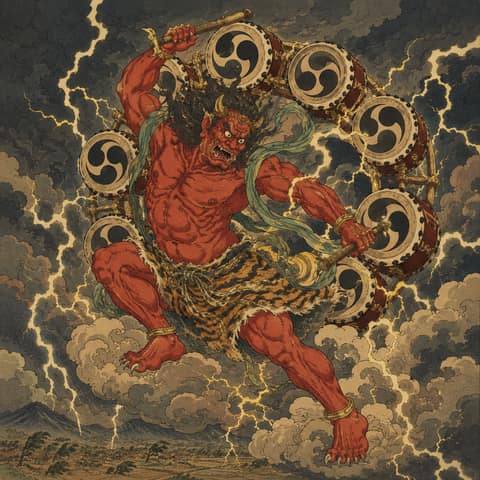
    The definitive image of Raijin was established by Tawaraya Sotatsu's "Wind God and Thunder God Screens", a pair of two-panel folding screens with a gold-leaf background. It pits a white Raijin on the left (carrying a ring of connected drums on his back) against a green Fujin on the right (carrying a wind bag). This composition was faithfully reproduced by subsequent Rimpa school painters like Ogata Korin and Sakai Hoitsu, becoming the standard iconography for Fujin and Raijin today. The drums encircling Raijin's back are said to produce thunderclaps when struck; combined with his ogre-like form, tiger-skin loincloth, and sharp claws, this design visualizes the tempestuous forces of the sky. In the history of faith, Raijin can be broadly classified into three lineages. First is the classical thunder god represented by Kamo-wakeikazuchi-no-Okami (Kamigamo Shrine). Second is the Tenjin lineage, which conflates the vengeful spirit of Sugawara no Michizane with Karai Tenjin (Kitano Tenmangu, founded in 947). Third is Takemikazuchi, who bears "thunder" in his name but is essentially a sword and martial deity, and should not be equated with Raijin. In the Kanto region, Raiden worship spread outward from its headquarters at Raiden Shrine in Itakura, Gunma; it enshrines deities like Karai-no-Okami, Oikazuchi-no-Okami, and Wakeikazuchi-no-Okami as targets for prayers against lightning strikes and for bountiful harvests. In an agrarian society, lightning was seen as a harbinger of fertility—striking rice paddies to make the crops bear fruit as "inazuma" (literally "spouse of the rice"). Thus, Raijin has long been revered as a dual-natured entity: a terrifying deity who delivers heavenly punishment, and a benevolent god who brings the blessings of rain and harvest.

  • Ryūjin

    Ryūjin

    Divine

    Ryūjin (the Dragon God)

    Ryujin, Water-God Who Stills the Storm

    Divine Spirits & DeitiesKanagawaKyoto

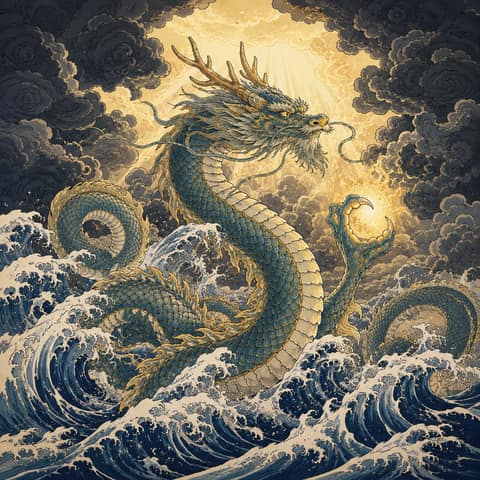
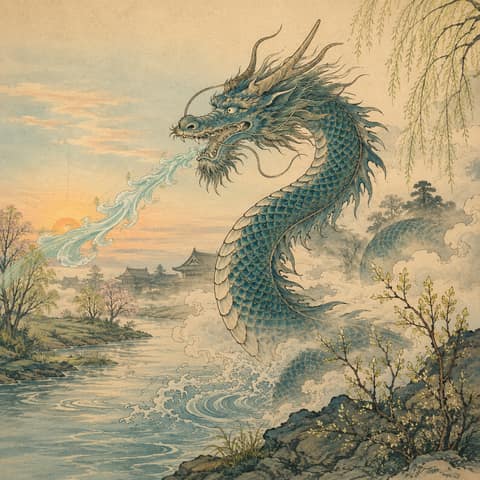
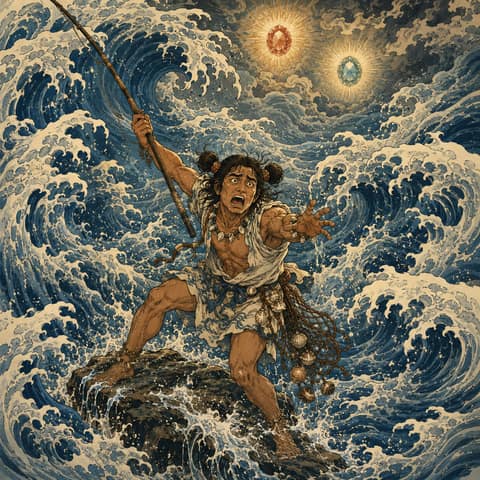
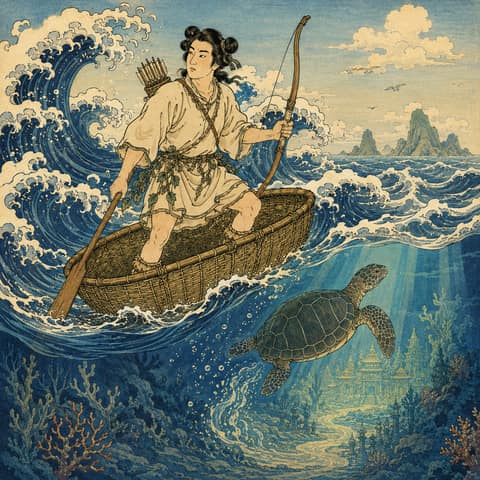
    As the "water-god who stills the storm," Ryujin stands at the border of sea and sky holding the weather in his hands, and it was to him that fishermen, sailors, and the rice-growing folk of the villages prayed most urgently. His power cuts both ways. At times he grants the blessed rain that nourishes the paddies; at times he raises great waves and tempests that shatter ships. For this reason people approached him through many rites, hoping to calm his raging face and draw out his face of blessing. The greatest divine treasures the sea-dragon holds are the tide-flowing and tide-ebbing jewels that command the rise and fall of the tide. Hoori received these two jewels from the sea-god, drowning his elder brother with the flowing jewel and saving him with the ebbing jewel to force his submission. This power to govern the tide at will reveals the very essence of the dragon who rules the sea. At coastal shrines people prayed for storms to subside and for good catches; inland they prayed for rain, offering black horses in drought and sinking offerings into deep pools to court his favor. The legends of human sacrifice handed down at Lake Ashi and at ponds across the land share a single plot — a high priest subdues the raging dragon and turns it into a guardian — telling us that fear and reverence were two sides of one coin. His face as lord of the Dragon Palace is of a piece with this water-divinity. Beyond the sea, on the floor of the waters, the dragon's palace is an otherworld of riches and of time, and one who visits it either gains treasure or, like the one who opened the jeweled box, bears away years that can never be regained. Ryujin is no mere monster but a deity who embodies water itself — the very resource of life and death — and to still the storm was, in the end, to make people keep the fragile covenant drawn between humankind and nature.

  • Sakanoue no Tamuramaro

    Sakanoue no Tamuramaro

    Divine

    さかのうえのたむらまろ

    God of War Pacifying Demons, Tamura Daimyojin

    Divine Spirit / DeityKyotoMie

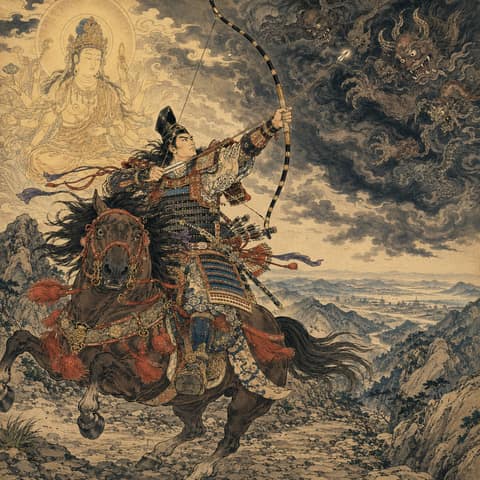
    This version of Sakanoue no Tamuramaro is not treated as the historical military official, but as the deified Tamura Daimyojin of later generations. He is told as a warrior receiving the protection of Kannon at Kiyomizu-dera, a paired husband-and-wife deity with Suzuka Gozen at Suzuka Pass, and as General Tamura subjugating Akuro-o and Otakemaru in Tohoku. A single person's name wandered through the temple origins of Kyoto, the mountain pass faith of Suzuka, and the shrine and temple origins of Tohoku, acquiring different faces in each land. The power of Tamuramaro is not the sword that slashes demons itself. Kiyomizu Kannon, Vaisravana, Suzuka Gozen, the sacred sword, and the gods of the passes support his story, transforming his martial prowess into "protection acknowledged by the gods and buddhas." Therefore, in the Tamura-gatari, rather than the scenes of defeating enemies, what matters more is which gods and buddhas took his side, in what land he was enshrined, and to which mounds or temples the memories were transferred. Sakanoue no Tamuramaro is a hero who defeats yokai, but at the same time, an axis to pass down yokai as stories to later generations.

  • Seiryū (Azure Dragon)

    Seiryū (Azure Dragon)

    Divine

    Seiryū

    Seiryū, the Azure Dragon, Guardian of the East

    Animal TransformationsNara

    Seiryū is not a dragon standing alone, but a numinous beast that takes on meaning only within the directional system of the Four Symbols. This edition traces its astronomical origin and its reception in Japan. The origin lies in the heavens. Chinese astronomy distributed the twenty-eight lunar mansions across the four quarters, seven to each, and likened the chain of stars of the seven eastern mansions (Horn, Neck, Root, Room, Heart, Tail, Winnowing Basket) to a single dragon. This is Seiryū. The Huainanzi's "Treatise on the Patterns of Heaven" makes the emperor of the east Taihao and its beast the Azure Dragon, assigning it to the Wood phase and spring, weaving the five directions, five colors, five seasons, and Five Phases into a single cosmology. The "Treatise on the Celestial Offices" of the Records of the Grand Historian likewise makes the eastern palace of heaven the Azure Dragon, binding constellation to numinous beast. The azure of Seiryū is the color of the Wood phase, figuring the rising life-force of spring in the east. Its deep layer is engraved in relics. The lacquer garment chest from the tomb of Marquis Yi of Zeng (c. 433 BCE), the oldest astronomical relic to bear the names of the twenty-eight mansions, depicts the Azure Dragon and White Tiger as a pair. In the Han period, the patterns of the Four Symbols adorned roof tiles, bronze mirrors, and pictorial stones, becoming emblems that warded off evil and summoned fortune. In Japan, the Four Symbols were received as a theory of astronomy, tomb-building, and capital planning. The Four Symbols' banners of the first year of Taihō (701) in the Shoku Nihongi are the certain literary first appearance, and in iconography the Azure Dragon on the eastern wall of the Kitora Tomb in Asuka survives as one wing of a four-direction-complete mural of the Four Symbols. Thus Seiryū was placed between star and terrain, as the guardian beast that governs the east and brings the spring.

  • Sugawara no Michizane

    Sugawara no Michizane

    Divine

    Sugawara no Michizane

    Tenman Daijizai Tenjin: Michizane

    Divine Spirits & DeitiesKyotoFukuoka

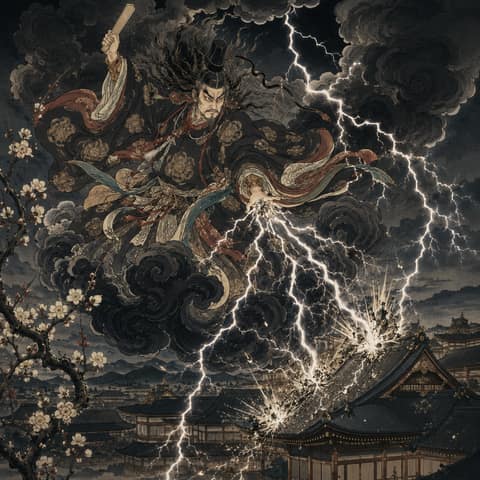
    This edition follows, in close detail and bound to chronology and iconography, how a single man of letters became a thunder god and then turned into the god of learning—those two transformations. Michizane's becoming a vengeful spirit did not begin immediately upon his death. In the eighth year of Engi (908) his former disciple Fujiwara no Sugane died; the next year, the ninth of Engi (909), the very author of his exile, Fujiwara no Tokihira, died at thirty-nine; and in the twenty-third year of Engi (923) the crown prince Yasuakira passed away. That year the court restored Michizane to Minister of the Right and posthumously granted him the junior first rank, absolving him of guilt—yet the calamities did not cease, and in the third year of Enchō (925) even the next crown prince, Yoshiyori-ō, left the world at only five. The process by which this chain of deaths came to be felt by the people of the capital as the curse of the innocent Michizane is the very genesis of goryō belief. Its apex was the lightning strike on the Seiryōden in the eighth year of Enchō (930). The lightning that struck the palace in the midst of a rain-prayer council killed Fujiwara no Kiyotsura, who had watched over Michizane at Dazaifu, instantly, and burned the nobles present one after another. The reading of lightning as Michizane's will became decisive here, and the spirit, surpassing a mere vengeful ghost, was exalted into a dread godhead called Karai-Tenjin, Tenman Daijizai Tenjin, and Nihon Daijō Itoku-ten—a deity who commands the thunder. The Kamakura-period Kitano Tenjin Engi Emaki depicts this scene of becoming a thunder god as the masterpiece of the scroll, and the image of Tenjin driving the thunderclouds cast its shadow even upon the later wind-and-thunder-god paintings of Tawaraya Sōtatsu and others. The iconography of Tenjin has two contrasting lineages. One is the raging Fire-and-Thunder Deity of the engi scrolls, mounted on thunderclouds and hurling lightning. The other is the composed image of a man of letters and official in court robes holding a baton (shaku), accompanied by a plum at his side—and this became the standard image of the god of learning. The "Tang-crossing Tenjin" (Totō Tenjin), clad in Chinese robes, bearing a sack and holding a sprig of plum, is a variant based on a Zen monastic tale that Michizane crossed in a single night to a Song-dynasty Zen master to receive his teaching. The shift of weight from vengeful spirit to god of learning advanced gradually. Already in the mid-Heian period he was praised in ritual prayers as a merciful god presiding over letters and honesty, and in the fourth year of Shōryaku (993) the posthumous senior first rank and the office of Chancellor were conferred, fully restoring his honor. But his popular establishment as the god of academic success came far later, in the Edo period, with the spread of terakoya schools. The image of Michizane the outstanding scholar in life was hung in the places of penmanship, and as the guardian of reading, writing, and learning, Tenjin shed the dread of the thunder god and spread to Tenmangū shrines across the land.

  • Sukunabikona

    Sukunabikona

    Divine

    sukunabikona

    The Tiny God of Wisdom and Nation-Building

    Divine Spirit / DeityShimane

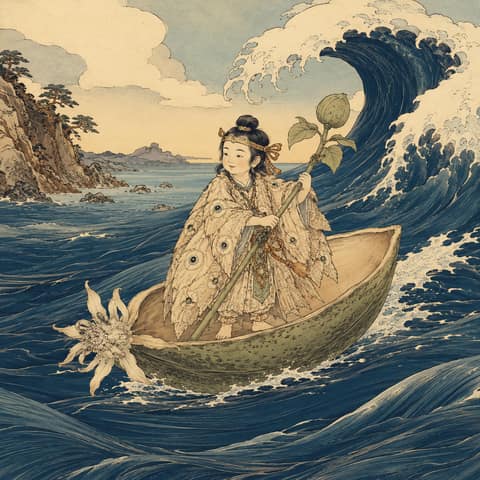
    Sukunabikona is the "paired" deity who supported Okuninushi, the main god of Izumo Taisha, as his sole partner in nation-building. His divinity is fully realized not in isolation, but as one half of a pair with Okuninushi. The contrast between the massive earthly god (Kunitsukami) Okuninushi and his diminutive stature—small enough to ride in a milkweed pod boat—highlights their collaboration. His functions center on practical arts and civilization-building, such as medicine, incantations, agriculture, sake brewing, and hot springs. He left his mark beyond Izumo in the founding legends of hot springs like Dogo and Arima, as well as at Sukunahikona Shrine (the god of medicine in Doshomachi, Osaka), becoming a nationwide figure in medicine and hot spring worship. His departure, bouncing off a millet stalk to the Eternal Land, acts as the hinge connecting the myth to the arrival of Omononushi at Mt. Miwa, embodying the Izumo mythos structure where nation-building is achieved through the successive cooperation of multiple gods. His archetype of a small body with immense power is also the mythological origin of "tiny child" folktales like Issun-boshi.

  • Sumiyoshi Sanjin

    Sumiyoshi Sanjin

    Divine

    すみよしさんじん

    Guardian of the Sea & Waka Kami (Default)

    Divine Spirit / KamiOsaka

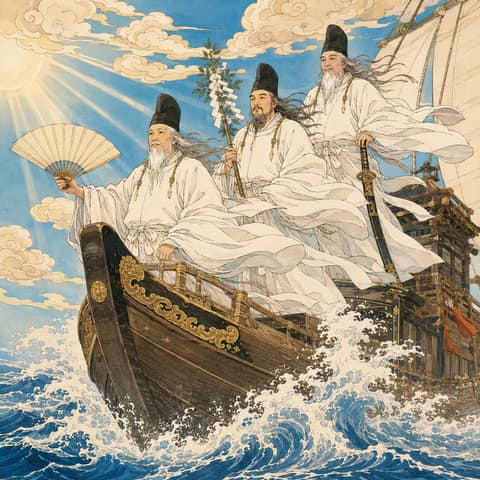
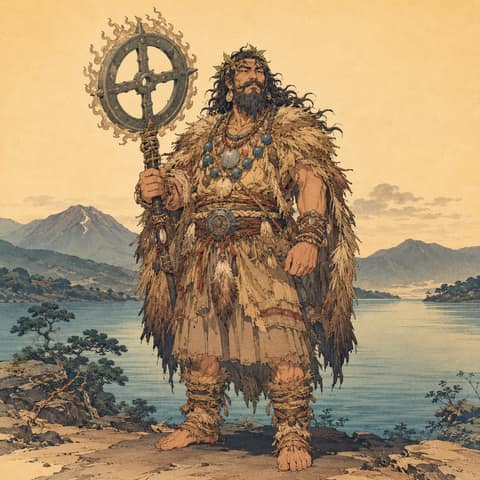
    The true identity of the Sumiyoshi Sanjin is the three kami of purification belonging to Izanagi-no-Mikoto, appearing in the first volume of the Kojiki (Age of the Gods). When Izanagi returned from Yomi (the underworld) and performed misogi (purification) at Ahagihara in Himuka of Tsukushi, he submerged himself in seawater to cleanse his body. From three different depths, three deities were born: recorded as 'Sokotsutsu-no-o-no-kami, Nakatsutsu-no-o-no-kami, Uwatsutsu-no-o-no-kami' in the Kojiki, and as 'Sokotsutsu-no-o-no-Mikoto, Nakatsutsu-no-o-no-Mikoto, Omotetsutsu-no-o-no-Mikoto' in the Nihon Shoki. The orthographic difference between 'Uwa' (upper) in the Kojiki and 'Omote' (surface) in the Shoki is one basis for the later interpretation of 'tsutsu' as layers of water. Simultaneously, the three Watatsumi kami (Sokotsu, Nakatsu, Uwatsu Watatsumi) were born, making Sumiyoshi and Watatsumi a paired dual structure—bottom = Sokotsutsu/Sokotsu Watatsumi; middle = Nakatsutsu/Nakatsu Watatsumi; surface = Uwatsutsu/Uwatsu Watatsumi. This tripartite structure is common to both texts. The etymology of 'Tsutsu' has not been academically resolved. Major theories are listed alongside each other: ① Star theory — 'Tsutsu' is an archaic word for 'star' (hoshi); it deifies the three central stars of Orion (ancient name 'Miboshi') as navigational stars for ancient seafaring clans. However, this is a modern theory advocated by Hoei Nojiri in "Japanese Stars" (1936), and there are no direct supporting primary texts from early folklorists like Orikuchi or Yanagita; treating it as the 'accepted folkloric theory' is academically inaccurate. ② Tsu (port) theory — 'Tsu' is a particle meaning 'of', and the second 'tsu' means 'port/sea route', an interpretation from Orikuchi's lineage; ③ Tsuchi phonetic change theory — 'Tsu' is a particle, and 'chi' is an honorific spirit suffix (akin to Orochi or Nozuchi); ④ Tsutsu-ro theory — 'Tsuchi' equals 'tsuji' meaning sea route; ⑤ Ship spirit theory — ancient ship spirit worship enshrined at the bottom of a boat; ⑥ Tsutsu toponym theory — derived from Tsutsu at the southern tip of Tsushima, the origin of seafaring clans; ⑦ Literal tube theory — using bamboo tubes as a yorishiro (vessel). Listing multiple theories is academically accurate, and it is particularly imprecise to refer solely to the 'star theory' as the accepted view. The Empress Jingu legend is the most important narrative in the history of Sumiyoshi Sanjin worship. According to the Nihon Shoki, when Empress Jingu became possessed after Emperor Chuai's death, the Sumiyoshi kami delivered an oracle: "Conquer Silla, a land filled with gold and silver. If you worship us three deities, Silla and Kumaso will submit." They protected her maritime expedition (subjugating Silla, Baekje, and Goguryeo), and upon her return, a second oracle commanded: "Enshrine our Aramitama (rough spirit) in Yamada village of Anato (Nagato)" — this became the origin of the Shimonoseki Sumiyoshi Shrine. Enshrining the Nigimitama (gentle spirit) in Settsu became the origin of Sumiyoshi Taisha. The structure of jointly enshrining Empress Jingu and Sumiyoshi Sanjin originated here, establishing the unique four-hall structure of Sumiyoshi Taisha. However, the dating of the Empress Jingu chronicles is heavily debated by scholars, and treating the legendary date (211 AD) as historical fact requires extreme caution—archaeologically, it is pointed out as potentially reflecting events from the 4th century onwards. Sumiyoshi Taisha, the head shrine (2-9-89 Sumiyoshi, Sumiyoshi-ku, Osaka), is the Ichinomiya of Settsu Province, one of the Twenty-Two Shrines (Middle Seven Shrines), and a former Kanpei-taisha. Its official history dates its founding to the 11th year of Empress Jingu's regency (211 AD) on the first Day of the Hare in the Month of the Hare — a legendary date without archaeological proof. Its four main halls have a unique layout: the First, Second, and Third Halls line up vertically (facing west, toward the sea), while the Fourth Hall sits south of the Third, forming an L-shape. The First Hall enshrines Sokotsutsu-no-o, the Second Nakatsutsu-no-o, the Third Uwatsutsu-no-o, and the Fourth Empress Jingu. "Sumiyoshi-zukuri" is considered the oldest style in shrine architectural history, characterized by a gabled roof, cypress bark thatch, and red and white walls. The current main halls were built in 1810 and are all designated National Treasures. The steeply arched red Sorihashi (Taiko Bridge) is the iconic visual symbol of the Sumiyoshi faith, frequently appearing in ukiyo-e, paintings, and waka poetry. There are over 2,300 branch shrines nationwide (the official number from Sumiyoshi Taisha, whereas Wikipedia undercounts at ~600). The distribution is concentrated along coastlines, ports, the Seto Inland Sea, Kyushu, and northern Japan, proving it to be the most vital faith for fishermen, shipping merchants, and navy personnel from ancient to modern times. The "Three Great Sumiyoshi" and ancient shrine dispute: ① Sumiyoshi Taisha (Osaka) = Settsu Ichinomiya, Nigimitama, Head Shrine; ② Sumiyoshi Shrine (Shimonoseki, Yamaguchi) = Nagato Ichinomiya, Aramitama, site of Empress Jingu's return oracle; ③ Sumiyoshi Shrine (Hakata, Fukuoka) = Chikuzen Ichinomiya, self-proclaimed "Japan's First Sumiyoshi-gu", oldest theory identified with Ahagihara. Additionally, Hon-Sumiyoshi Shrine in Kobe is based on an influential Edo-period theory by Motoori Norinaga (1764-1798) identifying Settsu's Sumiyoshi village as the ancient "Nanakura's Long Strait". Academically, the "first Sumiyoshi" cannot be determined, with each shrine claiming primacy based on its own legends. In ancient and medieval times, it was customary for Japanese envoys to Sui and Tang China to pray at Sumiyoshi Taisha before departing. The "Tosa Nikki" (Ki no Tsurayuki, 935) also notes prayers for maritime safety to the Sumiyoshi deities. In Heian-period waka by poets like Izumi Shikibu, Ki no Tsurayuki, and Ono no Komachi, Sumiyoshi frequently appears, positioning the kami at the head of the "Three Deities of Waka". In the medieval and early modern periods, the Noh play "Takasago" featured the "Pines of Sumiyoshi and Takasago" as a symbol of marital harmony and longevity, often performed at shrine weddings. The Noh play "Sumiyoshi Mode" is another masterpiece representing this faith. The rice-planting ritual (Otaue Shinji), a National Important Intangible Folk Cultural Property, is Sumiyoshi Taisha's most representative festival, sanctifying the entire rice-farming cycle from planting to harvest. As a samurai faith from the medieval to Edo periods, they garnered reverence from warrior clans like the Minamoto due to Empress Jingu's Sankan Seibatsu legends. During the Muromachi and Sengoku periods, Sumiyoshi Taisha received immense veneration from the shipping industry in the Seto Inland Sea, Settsu, and Izumi, actively participating in both commercial and military affairs as the guardian of maritime traffic in Osaka Bay. Today, visits by the Maritime Self-Defense Force, merchant ships, fishermen, and shipping businesses remain robust. It is one of Osaka's premier spots for New Year's visits, Shichi-Go-San, and shrine weddings. Affectionately called "Sumiyoshi-san" in the Kansai region, the Sumiyoshi Sanjin are a national divine presence offering wide-ranging blessings for maritime protection, safety at sea, poetry, scholarship, marital harmony, safe childbirth, and business prosperity. The 2,300 branch shrines, known as Sumiyoshi Shrine, Sumiyoshi-sha, Sumie Shrine, or Sumiyoshi Jinja, line Japan's coastlines and ports, forming the backbone of an uninterrupted maritime faith from ancient times to the present day.
  • Suzaku (Vermilion Bird)

    Suzaku (Vermilion Bird)

    Divine

    Suzaku

    Suzaku, the Vermilion Bird, Guardian of the South

    Animal TransformationsNaraKyoto

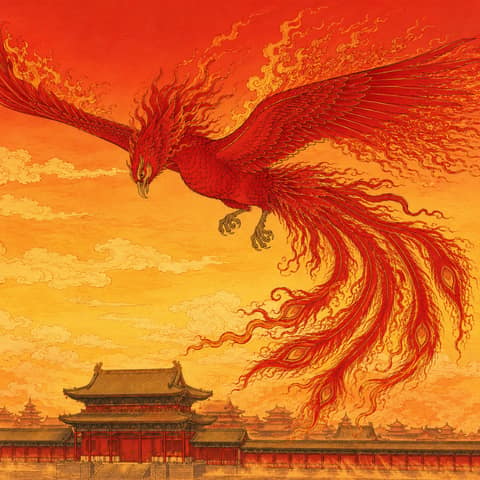
    The key to reading Suzaku lies in its directional symbolism as "the fire bird of the south" and in its subtle distinction from the phoenix. Its origin is in the stars of heaven. Chinese astronomy likened the chain of the seven southern mansions (Well, Ghost, Willow, Star, Extended Net, Wings, Chariot) to a bird form, and made this the Vermilion Bird. The Huainanzi's "Treatise on the Patterns of Heaven" makes the emperor of the south the Flame Emperor and its beast the Vermilion Bird, assigning it to Fire, summer, and the color vermilion. The "Vermilion Bird in front, Black Tortoise behind" of the Book of Rites' "Qu Li" and the southern-palace Vermilion Bird of the Records of the Grand Historian' "Treatise on the Celestial Offices" stand in the same system. The vermilion of Suzaku is the color of the Fire phase, figuring the blazing southern sky of summer. The relationship between Suzaku and the phoenix requires care. Because their images and auspicious connotations closely resemble each other the two tend to be identified, but Suzaku belongs to the Four Symbols (of astronomical, directional origin) and the phoenix to the Four Auspicious Beasts (the numinous beasts alongside the qilin, the numinous tortoise, and the responding dragon)—they are numinous birds of originally different categories. Rather than declaring "Suzaku = phoenix," it is more accurate to grasp that they have been spoken of as overlapping because of their close resemblance. In Japan, the notion of south = Suzaku was carved into the capital. The Suzaku Avenue and Suzaku Gate of Heian-kyō are its traces. As for surviving iconography, there were the Four Symbols murals of the Takamatsuzuka Tomb, but the Suzaku of the southern wall was lost to grave-robbing, and four-direction completeness is limited to the Kitora Tomb. The fire bird of the south, so easily lost, still spreads its wings in the stone chamber of Asuka.

  • Taira no Masakado

    Taira no Masakado

    Divine

    Taira no Masakado

    Masakado, Goryō God of the Kantō

    Divine Spirits & DeitiesTokyoChiba

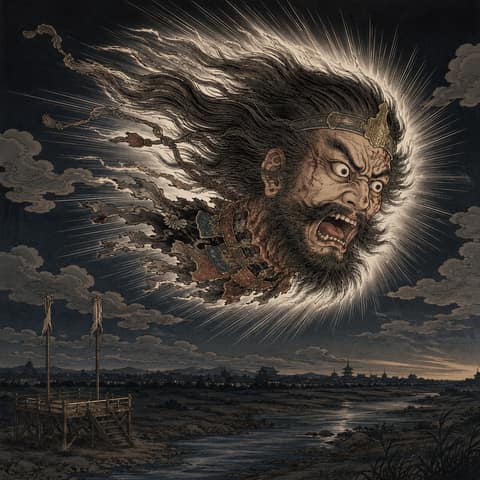
    This edition follows in close detail—while fixing the boundary between history and legend—how a single Bandō warrior became the uncanny "flying head" and then turned into a god who guards Edo. First, history and the uncanny must be separated. The revolt itself is conveyed by the near-contemporary Shōmonki, which records in classical Chinese the private feud beginning in 935, the subjugation of the Kantō provincial seats, the proclamation as New Emperor, and the death in battle in 940. But here there is no marvel of a flying head. The supernatural story of a head that would not rot, cried out, and flew appears only centuries later, in the Nanboku-chō-period Taiheiki, with anecdotal relays such as the Konjaku Monogatari-shū in between. It is in this later stratum of legend that Masakado is told as a "yokai." The story of the curse around his head mound is newer still. The dread transmitted at the Masakado Grave-Mound at Ōtemachi—"move it and it curses"—is a modern urban legend, layered onto events that occurred in the heart of the city in the Taishō and Shōwa eras: the deaths of those involved in building the Ministry of Finance's temporary office after the Great Kantō Earthquake, and the bulldozer accident during the Occupation. The factual events and the interpretation that attributes them to Masakado's curse must be carefully separated. The path of deification, on the other hand, reaches back into the medieval age. In the second year of Enkyō (1309), the Ji-sect holy man Shinkyō Shōnin, who attributed a plague to Masakado's curse, pacified the spirit and added it to the enshrined deities of Kanda Myōjin. This, like Michizane, is the textbook goryō belief of enshrining a raging vengeful spirit and turning it into a protecting god. The ups and downs—drawing the reverence of the people as the great tutelary of Edo, being removed from the enshrined deities as a traitor in the Meiji era, and being restored at the end of Shōwa—also reflect well the duality of the image of Masakado as a hero who rebelled against the throne. In later ages, the story of his daughter Princess Takiyasha commanding a giant skeleton won popularity in kabuki and popular fiction and was depicted in Utagawa Kuniyoshi's "The Old Palace at Sōma"; it should be noted that this is a derivative starring the daughter, not Masakado himself.

  • Takeminakata

    Takeminakata

    Divine

    takeminakata

    Suwa Myojin: The Independent King of Water and War

    神霊・神格Nagano

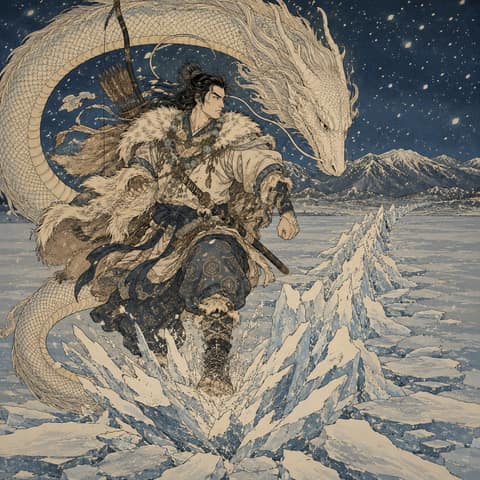
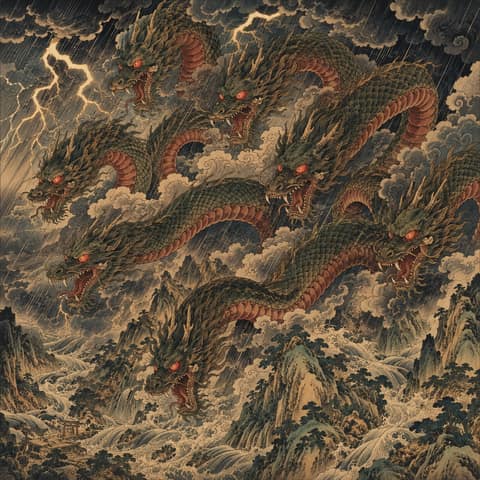
    Identity as the Resisting God. Takeminakata is the only rebellious deity who attempted physical resistance against the order of the heavenly realm (Takamagahara). The essence of "resistance against centralization" and "regional independence (indigeneity)" is deeply etched into his nature. His defeat and confinement in Suwa serve as a metaphor for the Yamato Kingship's pacification of the Japanese archipelago; yet, within the enclosed basin of Suwa, he never withered away. Instead, he cultivated a fierce, indigenous energy (epitomized by the frenzied Onbashira festival) powerful enough to surpass external authority. He possesses a dark hero-like charm—"defeated, yet unyielding"—which is exceptionally rare in Japanese mythology. Manifestation as a Dragon God (Water God). Takeminakata is also frequently spoken of in the form of a massive dragon or snake god dwelling in Lake Suwa. The natural phenomenon known as "Omiwatari," where the lake freezes completely in winter and the ice violently cracks and buckles upward with a roaring sound, is believed to be the trail left by Takeminakata (Kamisha) visiting his consort, Yasakatome-no-kami (Shimosha). For ages, this has been an important ritual for predicting the year's fortunes and agricultural yields. His power as a dragon god who controls wind and rain to bring water was an object of absolute awe and gratitude in agrarian societies. The Onbashira Festival and the Regeneration of Energy. Essential to the discussion of Takeminakata's worship is the "Onbashira Festival," an extraordinary nationwide festival held every seven years. Massive logs are cut from the mountains, ridden down steep slopes at the risk of people's lives (Ki-otoshi), and erected at the four corners of the shrines. This savage festival is the crystallization of indigenous tree worship—such as that of Mishaguji—and the ferocious martial spirit of Takeminakata. By periodically replacing the massive trees that house the divine spirit, the god's energy is regenerated and amplified, imparting vitality to the earth. It powerfully conveys the zenith of animism continuing from ancient times into the present day.
  • Toyotama-hime

    Toyotama-hime

    Divine

    とよたまひめ

    Grandmother of the Imperial Line

    Divine Spirit / Sea DeityNagasaki

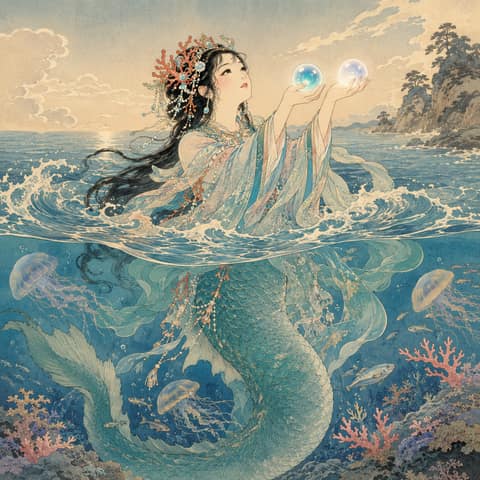
    Taking the form of a giant shark (eight-fathom wani) in the *Kojiki* and a dragon in the *Nihon Shoki*, she is the grandmother of the first emperor and the maternal origin of the seafaring Azumi clan. A sacred deep-sea shrine maiden symbolizing pearls, whose legends live on in Udo Jingu's Breast Rock and Watadzumi Shrine.

  • Treasure Ship

    Treasure Ship

    Divine

    TAH-kah-rah-boo-neh

    Traditional Version (Treasure Ship Print)

    Deities & Divine SpiritsAcross Japan

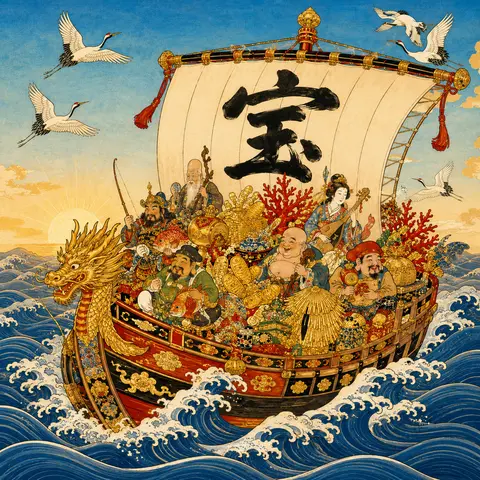
    The Treasure Ship print traces back to boat images used to cast off bad dreams, circulated through urban and temple–shrine annual events. By the early modern period, designs commonly featured the Seven Lucky Gods and heaps of treasures, with auspicious characters on the sail to amplify good omens. Appending a palindrome verse tied it closely to first-dream traditions, preserving the logic of keeping a good dream and consigning a bad one to the river. While designs vary by region and publisher, the print uniquely combines two layers of meaning: inviting fortune and transferring or dispelling impurity. Folklorically, it links to New Year’s purification from year’s end through the first week, backed by its spread as an urban print commodity, ties to temple and shrine origin tales, and the vogue for Seven Lucky Gods as playful stand-ins.

  • Ubagami

    Ubagami

    Divine

    Ubagami

    Ubagami, the Old Goddess Who Saves the Women of Tateyama

    Deity / Divine SpiritToyama

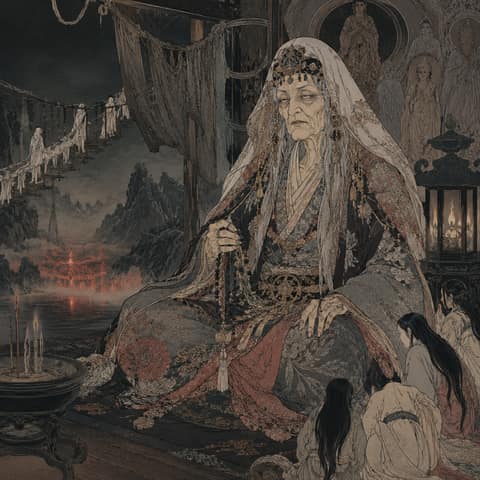
    Ubagami is not a mere yōkai, but a divine entity embodying the very structure of Tateyama—a sacred mountain where Hell and the Pure Land coexist. In the Tateyama Mandala, Ubagami is depicted alongside underworld motifs such as Sai-no-Kawara (Children's Limbo), the Sanzu River, and the Blood Pool Hell. She possesses two faces: that of Datsueba, who judges the dead, and that of a savior who sends women off to the Pure Land. From the Middle Ages onward, the Blood Bowl Sutra (Ketsubonkyō) faith propagated the belief that women were destined to fall into the Blood Pool Hell due to the supposed impurity of childbirth. Amidst this profound terror, Ubagami functioned as the sole savior for female believers. It is said that the sixty-six statues lined up in the Ubadō of Ashikuraji reflect the "Sixty-Six Provinces Pilgrimage" (Rokujūrokubu), an ancient practice of dedicating one copy of the Lotus Sutra to each of Japan's sixty-six historical provinces. During the Nunobashi Kanjō-e, the experience of crossing the bridge blindfolded and praying in the darkness is nothing less than a ritualistic death and rebirth—letting one's earthly self die temporarily in order to be reborn anew before Ubagami. The tradition identifying her as the wife of Enma Daio creates a complementary dynamic: while the husband acts as the King of Hell who judges the dead, the wife, Ubagami, serves as the compassionate mother who saves women. This interplay brings a sense of yin-yang balance to the underworld cosmology of Tateyama.

  • Umisachihiko

    Umisachihiko

    Divine

    うみさちひこ

    Elder Brother of Sea Bounties & Hayato Ancestor, Umisachihiko

    Divine Spirit / DeityMiyazaki

    The true identity of Umisachihiko is Hoderi-no-Mikoto, the protagonist of the final section of the upper volume of the Kojiki and the tenth section of the Age of the Gods in the Nihon Shoki (also known as Honosusori-no-Mikoto in the Nihon Shoki). Born in a fire, he is the eldest of three sons of Ninigi-no-Mikoto (the Heavenly Grandson) and Konohanasakuya-hime (daughter of Oyamatsumi-no-Kami). The middle son is Hosuseri-no-Mikoto, and the youngest is Hoori-no-Mikoto (Yamasachihiko). The prefix "Ho" (fire) in all three names stems from the myth that their mother gave birth in a blazing delivery room to prove her purity after a single night's conception. The name "Hoderi" means the most intense stage of fire, while "Honosusori" similarly implies the height of flames. The common name "Umisachihiko" is an occupational title meaning "the male deity who presides over the bounties of the sea," indicating his role as a god of fishing. The core of his story lies in his position as the older brother in the myth of Umisachihiko and Yamasachihiko. Umisachihiko presided over the sea's fish, while Yamasachihiko presided over the mountain's game, each making a living with their respective tools. One day, Yamasachihiko exchanged tools with his brother and went to the sea, but lost the fishhook. The older brother strictly refused, saying, "Return the original fishhook, I will not accept any other," and even rejected a thousand replacement hooks. Yamasachihiko then went to the sea palace of Watatsumi, received the tide-flowing and tide-ebbing jewels, and returned to hand back the hook while chanting a curse. Thereafter, Umisachihiko gradually became impoverished. Holding a grudge, he attacked Yamasachihiko, but Yamasachihiko used the tide-flowing jewel to drown him, then used the tide-ebbing jewel to save him when he begged for his life. By repeating this, he forced Umisachihiko into submission. Umisachihiko finally swore to serve Yamasachihiko eternally as a "person of wazaogi" (entertainer). It is one of the most dramatic sibling tales in the Kojiki and Nihon Shoki, epitomizing ancient curse culture, divine manifestations, and submission rituals. Umisachihiko is positioned as the ancestral deity of the Hayato people in southern Kyushu. The Hayato were indigenous people living in ancient Satsuma, Osumi, and southern Hyuga, who served the court as guards, ritualists, and performers under the Ritsuryo system. The myth of his submission created a decisive asymmetrical structure: Yamasachihiko became the grandfather of Emperor Jimmu (the direct ancestor of the imperial line), while Umisachihiko became the ancestor of the subjugated border people. This is academically interpreted as the political mythologization of the 7th-8th century Ritsuryo state's subjugation of southern Kyushu. The "Ashiura" gestures Umisachihiko made while drowning—rubbing his feet, chest, and cheeks—are said to be the origin of the Hayato-mai, a court ritual. The Hayato-mai was a dance performed by the Hayato for the emperor during the Daijosai, Niinamesai, and New Year ceremonies. The Engishiki records its movements, which are partially inherited by the modern Imperial Household Agency. Thus, his submission myth functioned as the mythological basis for ancient Japanese court rituals. The center of his worship is Ushiodake Shrine (Kitago, Nichinan City, Miyazaki), the only shrine nationwide where he is enshrined as the primary deity. It is said to be located where he arrived after losing to his brother, symbolizing the localization of his legend. The fact that the shrine is located in the mountains, away from the sea, reflects the folklore interpretation of Umisachihiko being "driven into the mountains as a loser" and the geographic distribution of Hayato clans. The asymmetry between Yamasachihiko being enshrined in three major shrines and Umisachihiko in only one vividly reflects the myth's dominance/submission structure in shrine worship. In folk belief, he is deeply worshipped as a local guardian of fishing, maritime transport, and Hayato-lineage clans, especially in southern Miyazaki and Kagoshima. Modern discussions re-evaluate his "tale of the loser," deconstructing the central vs. border dichotomy. In pop culture, he frequently appears alongside his brother as the tragic older brother.

  • Yamasachihiko

    Yamasachihiko

    Divine

    やまさちひこ

    Amatsuhikohikohohodemi-no-Mikoto

    Divine Spirit / DeityMiyazaki

    Also known as Amatsuhikohikohohodemi-no-Mikoto. In the Umisachi-Yamasachi myth, he visited the sea palace guided by Shiotsuchi-no-Kami. He married Toyotamahime and used the tide jewels to subjugate his brother. Breaking the taboo of looking led to his wife's departure, but their lineage established the imperial family tree. Venerated at Udo Shrine.

  • Yamata no Orochi

    Yamata no Orochi

    Divine

    Yamata no Orochi

    Serpent God of Izumo's Hii River: Yamata no Orochi

    Divine spirit / serpent deityShimaneHiroshima

    Orochi is more than a snake. The old word orochi is often explained as combining a term for peak or ridge with chi, a word for spirit-power. The Kojiki describes moss, cypress, and cedar growing on the serpent and a body spanning eight valleys and eight ridges. That is closer to a living mountain range than to an animal. Other Japanese serpent-slaying tales, from Koga Saburo at Suwa to the Yahiko serpent of Echigo and the Aso traditions around Takeiwatatsu, can be read in the same serpent-deity line. The Kojiki's account of Omononushi in the reign of Sujin, where a god appears as a snake, forms another great pole of ancient Japanese serpent worship. Sand iron and the bloody riverbed. Oku-Izumo was a center of sand iron and tatara smelting. Kanna-nagashi washed mountain soil through channels, separating sand iron and staining riverbeds with red earth and iron. The Kojiki's image of Orochi's belly as always bloody and raw can therefore be read as the mythic language of a red river. Furnace fire, the relative independence of ironworking groups, and the seizure of good blades by central power all make the ironmaking reading persuasive. Mizu no Bunka issue 54 presents this as one of the key local theories. The repeated eight. Yamata, eight heads and eight tails, eight valleys and eight ridges, yashiori sake, eight vats, and the "Yakumo tatsu" poem all make eight the story's organizing number. It may mean literal eight, sacred multiplicity, or both. The eightfold fence around Kushinada-hime gives the number a ritual and spatial force. Even the placement of the tale in book one, section eight of the Nihon Shoki has invited speculation, though that remains an inference about editorial intent. Izumo drawn into Yamato myth. Orochi's defeat can also be read politically. A serpent deity of Izumo is slain by Susanoo from the Takamagahara sphere, and the treasure inside its tail enters the imperial regalia. The later kuni-yuzuri myth of Okuninushi follows the same broad problem: how Izumo is brought into the central mythic order. The Izumo no Kuni no Miyatsuko lineage claims descent in the Susanoo line while serving Okuninushi's cult, so the story survives both as a myth of conquest and as Izumo's own ritual memory. Iwami Kagura keeps the serpent moving. Iwami Kagura's Orochi turns the ancient myth into a present-day bodily performance. Paper-and-bamboo serpent bodies coil and strike across the stage, and several serpents may fight at once. Once an offering at shrine festivals, the performance also became a postwar attraction and regional symbol. What the audience sees is not an abstract myth, but the way Izumo and Iwami continue to tell the serpent story through movement, sound, and spectacle.

  • Yudonosan-daigongen

    Yudonosan-daigongen

    Divine

    Yudonosan-daigongen

    The Unspeakable Deity of the Sacred Rock of Mount Yudono

    Divine Spirits / DeitiesYamagata

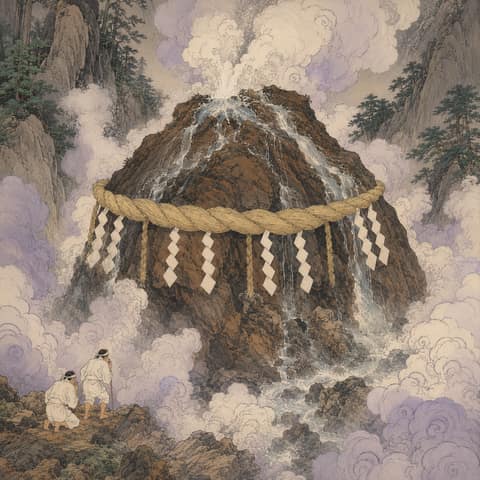
    Yudonosan-daigongen does not have a tangible statue form; instead, a giant, brownish-red sacred rock spewing hot water serves directly as the object of worship, preserving the oldest form of nature worship in Japanese mountain faith. The Dewa Sanzan are considered a trinity of ascetic training grounds: Mount Haguro symbolizes worldly happiness in the present, Mount Gassan represents the afterlife, and Mount Yudono signifies the future of rebirth. Therefore, Mount Yudono, as the inner sanctuary, is positioned as the final destination of the three-mountain pilgrimage. The object of worship has neither a shrine building nor a roof. Pilgrims must take off their footwear and walk barefoot on the approach mixed with earth and stones to climb the sacred rock. The strict taboo against disclosing one's experiences on the mountain—"Do not speak of it, do not ask of it"—is still observed today, and photography is strictly prohibited. Although it lost the title of "gongen" during the Meiji era's anti-Buddhist movement and became a shrine dedicated to deities like Ōyamatsumi-no-Mikoto, the faith itself—pressing one's hands together in prayer to the silent sacred rock—has never been broken. It is the silent divine entity of Dewa that presides over rebirth and *sokushin-jōbutsu*.

  • Zhong Kui (Shōki)

    Zhong Kui (Shōki)

    Divine

    SHOH-kee

    Traditional Iconography Shoki, Warding Demon-Queller

    Deities & Divine SpiritsKyoto

    Shoki, a demon-quelling deity spread across East Asia from Tang dynasty lore, took root in Japan as a talismanic power against calamity and smallpox. He is depicted as a bearded martial figure in official robes and cap, glaring with fierce eyes and wielding a sword in one or both hands. He often appears hunting, trampling, or bagging small demons. At New Year and Boys’ Festival he is displayed on hanging scrolls, banners, and screens, and many townhouses placed ceramic Shoki figures on eaves or roof corners. In Japan the earliest examples trace back to late Heian apotropaic paintings; from the Muromachi period the theme became established, and by late Edo he also appeared as May Festival dolls. Images and figures were hung at entrances, gates, or the upper seat of reception rooms to stop plague deities and malign spirits. Although dedicated shrines are limited today, regional folk belief since early modern times continues, and rooftop Shoki statues are still found from Kinki through the Chubu region. His powers are symbolized by the subduing glare and swordplay that drive off evil sprites, functioning as amulets against drug harm and epidemics.

Showing 25 - 47 of 47 yokai