YOKAI.JP

Traditional Yokai Encyclopedia

Yokai passed down through the ages

473 Yokai|15 Category|Page 7 of 20
Localization in Progress - More content available in Japanese version
View Japanese
Sort by: NameAscending
Hitodama (Human Soul Fire)

Hitodama (Human Soul Fire)

Epic

hee-toh-DAH-mah

Hitodama (Traditional Tale Version)

Ghosts & SpiritsVarious regions across Japan

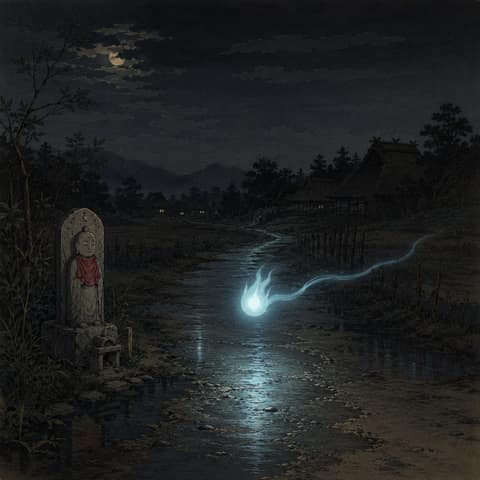
A depiction based on the traditional understanding of hitodama. It is a spirit flame that appears in answer to impending death or powerful emotions, said to fly to one’s family line or close relations. It drifts lower than shoulder height with a faint trailing tail. Though it seems to be carried by the wind, it is also said to travel as if toward a destination. Its color is often pale blue, but varies by region, with many reports of orange or red. Sightings cluster near places of passage or boundary—temple and shrine grounds, graveyards, old roads, field ridges, and pond edges. Early modern essays, local gazetteers, and modern folklore collections mention it as a “greeting flame before death” or “parting flame,” and distinguish it from onibi and kitsunebi, which have different origins. Scientific explanations have been attempted, yet tradition regards it as a sign of a soul’s coming and going.

Hiyori-bō (Fair-Weather Monk)

Hiyori-bō (Fair-Weather Monk)

Rare

hee-YOH-ree-boh

Sekien’s Illustrated Edition: Hiyori-bō

Weather & Calamity SpiritsIbaraki

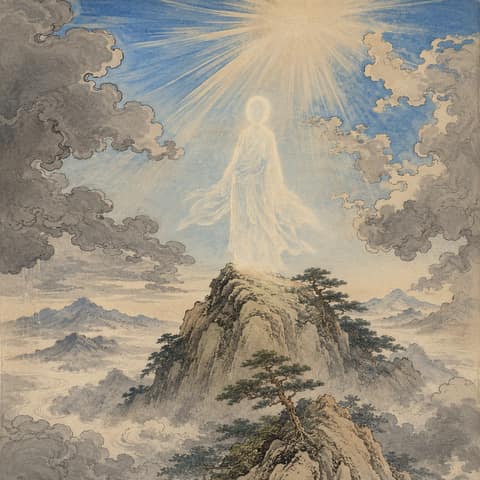
An interpretation based on Toriyama Sekien’s image in Konjaku Gazu Zoku Hyakki of a yokai that governs fair weather. Said to be sighted in the mountains during sunny days and absent when it rains. Historical field lore is scant; the figure seems to layer folk weather prayers (teru-teru-bōzu, hiyori-bōzu) and the image of weather-working ascetics or monks onto a yokai form. Identification with Chinese drought deities is a modern scholarly view without direct evidence. Thus its form is told as a simple monk-like silhouette, a symbolic bearer of prayer for clear skies and the act of watching for good weather.

Hoichi the Earless

Hoichi the Earless

Legendary

miminashi-hoichi

The Earless Biwa Priest Reciting Dan-no-ura

Spirit / GhostYamaguchi

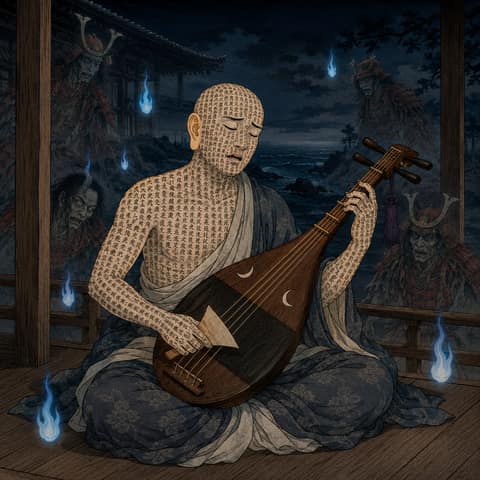
It is deepest to read Hoichi in this version not as a yokai, but as a "narrator who was almost taken to the side of anomalies." He himself does not appear to threaten humans. Rather, his body was forced to become a boundary line precisely because he was chosen by the Taira ghosts. The dead wanted to claim his voice for themselves because his recitation of Dan-no-ura was so magnificent. Hoichi's power is inseparable from his blindness. Unable to confirm the palace with his eyes, he perceives the world through sounds, presences, voices, and the formality of orders. The ghosts' banquet does not begin as a visual anomaly, but through a calling voice and the performance of the biwa. The unseeing man is called by the unseen dead. This double invisibility elevates Hoichi's tale from a simple haunted house story to an acoustic ghost story. The relationship with the Tale of the Heike is the backbone of this version. The Tale of the Heike is the story of the defeated, and through the recitation of the biwa priest, the destruction of the samurai was repeatedly called back to the present. Hoichi bears this tradition entirely, performing the story of the dead for the dead. Therefore, his fear is not only the fear of being attacked by unknown ghosts. It is the fear of the narrator being swallowed by the very story he is telling. The protection of the sutras is also a scene where writing seals sound. The sutras written all over Hoichi's body erase his figure from the ghosts. In other words, the writing becomes a barrier blocking the gaze of the dead. However, because the ears were left behind, only the entrance of sound did not disappear. For a biwa priest, the ears are the root of his art and the connection port to the dead. The development of having that very part snatched away is cruel, but terrifyingly accurate as a story. Losing his ears does not merely end Hoichi's art. He becomes the subject of narration himself through the name "Hoichi the Earless." The person who originally narrated the Taira is now narrated as a ghost story. This inversion is the beauty of the Hoichi tale. The narrator seems to be outside the story, but at some point enters it. Hoichi's flawed body demonstrates the thinness of that boundary. In modern YOKAI.JP, there is value in establishing Hoichi as a symbol of performing arts ghost stories, rather than merely a part of the ghost pages. He connects the vengeful spirits of the Taira, Buddhist talismans, the locality of Akamagaseki, Hearn's adaptation, and the symbolism of the body part that is the "ear" into a single thread. If made into a card, the background should feature a biwa, sutras, sea breeze, and ghosts in red armor, while Hoichi himself is better suited turning his ears toward a voice he shouldn't hear, rather than screaming in terror. Hoichi's anomalous nature depends on whether the writing on his body is read or not. The ghosts cannot see the body written with sutras. However, because only the ears lack writing, only that part remains in the world. This mechanism is extremely precise, concentrating the relationship between the seen, the heard, the written, and the spoken into a single scene. Furthermore, the tale of Hoichi is also a story of the "reward of narration." A masterful recitation gathers an audience, but that audience is not always the living. The higher the art, the further the narrator reaches the distant dead. Hoichi is saved by his talent, and falls into crisis because of his talent. Therefore, it is appropriate to treat this version as a figure who simultaneously holds the blessing and the curse of performing arts.

Horned Washbasin Hanzō

Horned Washbasin Hanzō

Rare

TSOO-noh-HAHN-zoh

Gazu-tan, Sekien Edition

Animated Objects & UndeadKyoto Prefecture (associated tradition)

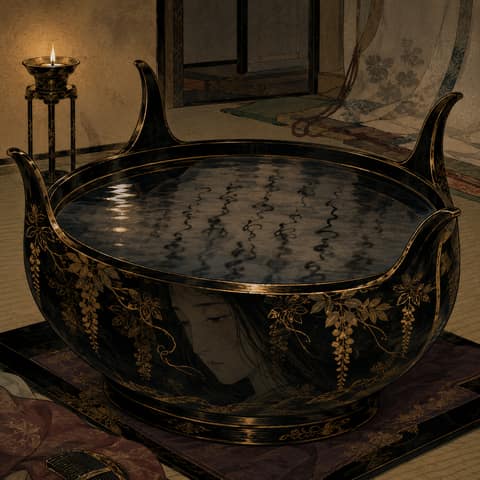
An interpretation centered on Toriyama Sekien’s depiction of the horned washbasin figure. The rim of the jet-black basin rises like horns, and when lamplight is reflected on the clear surface, only deceitful characters added to a paper will blur and eventually dissolve away. As a tsukumogami of implements, it values human care and decorum, revealing its strange nature only when treated rudely. Rather than causing harm, it is said to expose hidden falsehoods. Echoing Noh and classical poetry, it is often shown alongside courtly cosmetics and writing instruments. Regional lore is scarce, with mentions largely confined to early modern picture compendia and encyclopedias.

Horse Possession

Horse Possession

Uncommon

OO-mah-TSOO-kee

Tradition-Tale Variant

Ghosts & SpiritsAcross Japan (Mikawa, Tōtōmi, Awa, Musashi, and elsewhere)

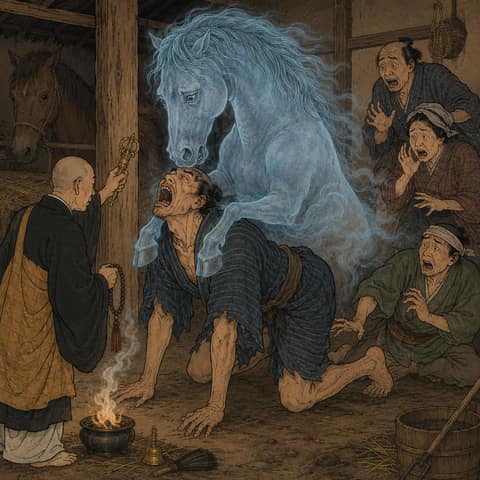
A collective term found in early modern anecdotes and essays for possessions by the vengeful spirits of horses. It warns against violating precepts against killing and neglecting animal care ethics, with triggers including abuse, death from overwork, and callous disposal. Symptoms include neighing, involuntary movements of the limbs, craving foul water, self-biting, reports of seeing as a horse sees, and voicing curses against abusers. The possessing agent may be the spirit of a specific horse or generalized as retribution within the realm of beasts. Recorded remedies include esoteric rites, posthumous memorial services, tending graves and making offerings, though efficacy varies by case. Cases appear in Mikawa, Tōtōmi, Awa, Musashi, and Harima, affecting horse-handlers, samurai, and farmers. While some tales are highly embellished, overall they function as didactic narratives promoting animal memorials and ethics.

Hossumori, the Fly-Whisk Guardian

Hossumori, the Fly-Whisk Guardian

Rare

HOSS-soo-MOH-ree

Sekien Iconography Standard

Animated Objects & UndeadEdo period; derived from picture scrolls

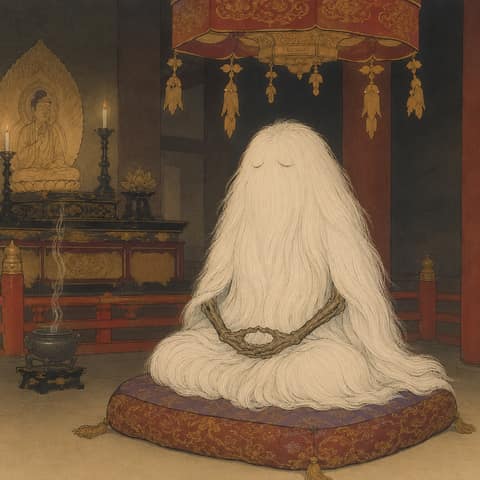
Based on the tsukumogami of the fly-whisk as depicted in Toriyama Sekien’s Hyakki Tsurezure Bukuro. Seated cross-legged beneath a canopy, it embodies the purity of a ritual implement and the quietude of a spirit matured through long use. Strong Zen symbolism underlies it, with an allusion to “the Buddha-nature of the dog,” implying that Buddha-nature manifests beyond sentient and insentient distinctions. In China the fly-whisk was said to dispel demonic hindrances, leading to the idea of a tool-spirit that allows nothing to obstruct enlightenment. Though a tool-yokai, it is not told to cause disturbances like other Hyakki creatures; instead it sits in composure, contemplating its own nature. Its image is chiefly tied to places where ritual implements gather within temples—main halls, monks’ quarters, and storerooms—rather than to specific local legends.

Houki (Fengxi)

Houki (Fengxi)

Uncommon

FOO-kee

Houki, the Foreign Beast of Sanglin

Animal ShapeshifterA foreign beast originating from the Chinese "Classic of Mountains and Seas" (Shanhaijing). Mentioned only by name in Edo-period tales of foreign lands, without tying into Japanese geographical folklore.

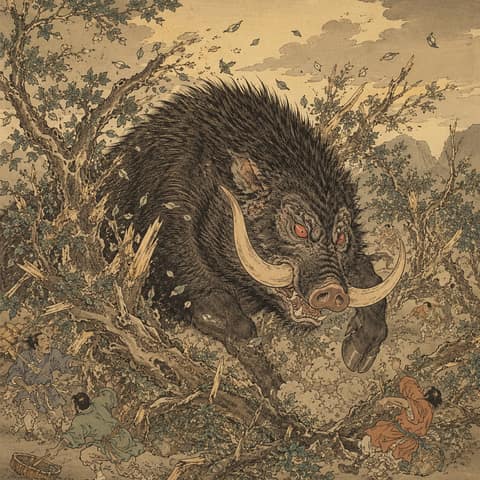
This is an interpretation of the "foreign beast of Sanglin," imported from Chinese classics and long dormant within natural histories. In this version, Houki is not a human-sized anomaly like Japanese yokai that "frighten people on dark roads" or "settle in homes to bring wealth," but is positioned as a "mythological-scale raging god (symbol of natural disasters)" that brings destruction on a national scale. Its thick, hard skin repels all physical attacks; its charges can flatten forests into plains; and it summons torrential rains when immersed in water. In ancient China, the uncontrollable fury of nature itself (such as floods and beast plagues) manifested in the form of a "gigantic boar." The legend of its extermination by Hou Yi functions as a mythological device narrating the victory of civilization—humanity's hero subjugating overwhelming natural violence through "culture (archery)" and bringing it completely under human control by "eating it (making it an offering)." In Japan, such continental-scale monsters were difficult to localize and were merely filed away as "bizarre foreign beasts." However, when modern entertainment unearthed its attributes of being "hard, gigantic, and possessing near-invincible charging power" to reinterpret it as a motif for the ultimate enemy character, the "despair and awe toward overwhelming violence" held by ancient Chinese toward Houki was inadvertently shared as genuine terror by modern people. It is a highly dramatic case in the history of yokai reception, where a monster with a severed lineage reclaimed its original intimidation through the power of pop culture.

House Groans (Yanari)

House Groans (Yanari)

Epic

yah-NAH-ree

Ienari (Traditional Depiction)

Household SpiritsVarious regions of Japan

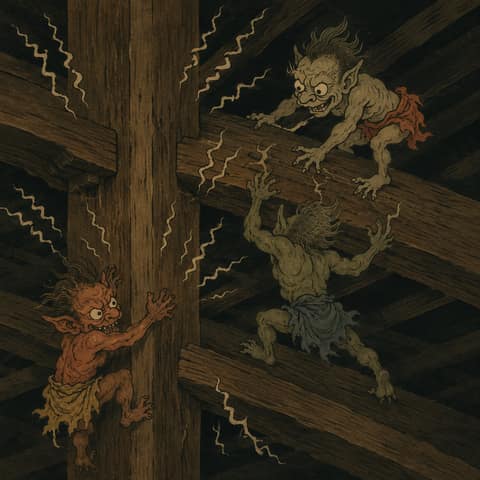
In picture scrolls it appears as little goblins shaking beams and pillars, a visual rendering of the intangible phenomenon of creaks and tremors within a house. In actual lore it is often told as the house itself rumbling without a fixed cause, though in some regions it is tied to animal curses, the misdeeds of residents, or signs of spirits lingering on the estate. It is said to occur late at night, especially around the Dead of Night, and noises arising at vital spots such as the hearth, storehouse, or armory were feared as ominous. Quiet sitting or sutra chanting, checking and offering for the crawlspace, and purifying beams and pillars are said to calm it, but if it persists, moving house is sometimes recommended. Traditional advice warns against hasty causal claims, urging first a review of the property’s lineage and proper rites to ancestral and household deities.

Human-Faced Tree

Human-Faced Tree

Rare

neen-MEN-joo

Illustrated Compendium Tradition—Sekien Design Edition

Natural Phenomena SpiritsUnknown; said in sources to grow in the distant land of Dashi ("Great Food" country) to the southwest

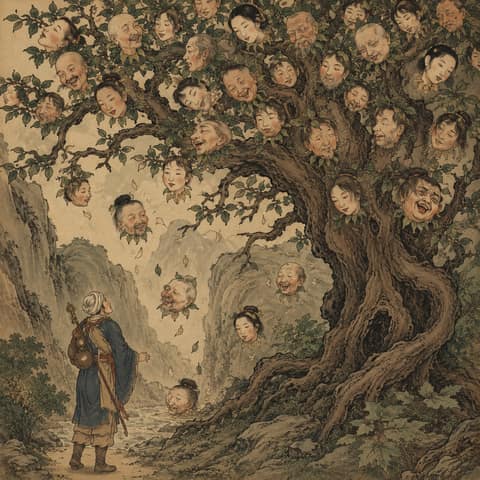
Based on Edo-period natural history notes and shaped by Toriyama Sekien’s pictorial intent. It is a tree that grows thick in mountain valleys and bears blossoms at the tips of its branches that resemble human faces. The flowers do not understand human speech, but are said to smile at calls or sounds. When laughter overlaps, the petals lose strength and eventually wither and fall. In Japan it was received as a tale of foreign curiosities, lacking specific local toponyms or anecdotes. The faces vary from old to young, often depicted grinning with teeth as they sway in the wind. Its true nature is unclear—treated either as a plant spirit or a rare anomalous tree—and it was recorded more as a curiosity than a source of fear.

Hyakume (Hundred-Eyed Demon)

Hyakume (Hundred-Eyed Demon)

Rare

HYAH-koo-meh

Iconographic Origin, Modern Interpretation

Half-Human BeingsJapanese folklore

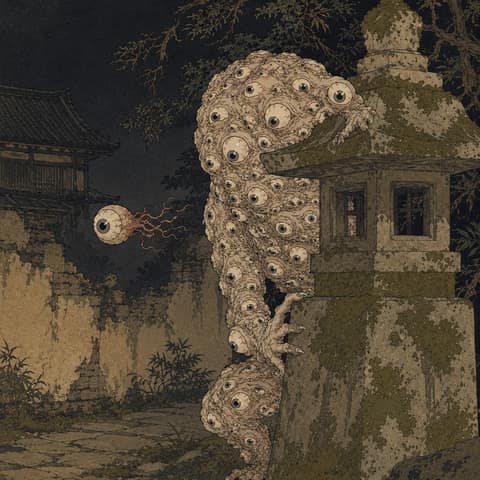
Rooted in multi-eyed demon images circulated from late Edo to Meiji, this form was given traits by modern yokai compendia. It shuns bright light and hides in night’s cover, avoiding notice. When it senses people, it is said to detach a single eye to probe its surroundings, while the indeterminate mouth only heightens its eeriness. With no fixed locale of tradition, it is treated as a conceptual being known nationwide through the spread of its imagery.

Hyousunbo

Hyousunbo

Rare

Hyousunbo

The River Kappa of Hyuga: Hyousunbo

Water ApparitionsMiyazaki

Among the many kappa legends nationwide, the hyousunbo stands out as a water apparition of Hyuga renowned as "the kappa that keeps promises." Although a dangerous being that drags children playing in the river to their deaths, it made a pact with the villagers—"I will not take their lives until a certain rock rots away"—and faithfully touched the rock countless times to check on it, thereby polishing it smooth. The detail of this "Hyosubo Rock" transcends a simple ghost story, conveying the memory of a negotiation between humans and a water god. The belief in its seasonal migration—living in the river during spring and autumn and the mountains in winter—reflects the southern Kyushu folk view of kappa as avatars of water and mountain gods. The dedicatory sumo matches held annually at the Suijin-buchi of the Tsuboya River are remnants of local rituals to pacify a raging water god through wrestling. Connected to the garappa and kawantaro of southern Kyushu's kappa culture, the hyousunbo remains a unique entity with a name and legend native to Hyuga, telling the story of the boundary between water and humans.

Hyōsube

Hyōsube

Uncommon

hyō-su-be

Hyōsube, the Hairy Riverside Kappa of Kyushu

Water spiritSagaKumamoto

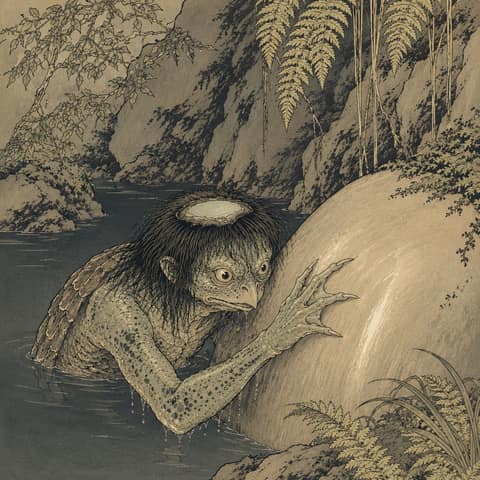
This version looks at Hyōsube as a distinctly Kyushu kind of kappa, one tightly bound to the taboos of the home. Where most kappa tales unfold at rivers and deep pools, Hyōsube's stories push indoors—into the bathroom, the bathhouse, and the stable. The water a hairy Hyōsube has used is held to be defiled, fouled with floating hair; a horse that touches it collapses, and anyone who drains the water without leave is cursed and loses his horse. Stories of this kind are told all across the region. When to drain the bath, who may use it—such admonitions about the manners of everyday life were voiced in the form of Hyōsube's curse. In the fields it is said to love and ravage eggplant, and people offered the first of the crop to keep it content. Its birdlike cry of "hyō-hyō" is said to be the very origin of its name. The hairy, bald-crowned, comical figure drawn in the Edo-period Hyakkai Zukan and Gazu Hyakki Yagyō conveys less a thing of terror than a familiar creature living right beside human life.

Hyōtan Kozō (Gourd Boy)

Hyōtan Kozō (Gourd Boy)

Rare

HYOH-tahn koh-ZOH

Iconographic Tradition–Tsukumogami Interpretation

Animated Objects & UndeadJapanese folklore

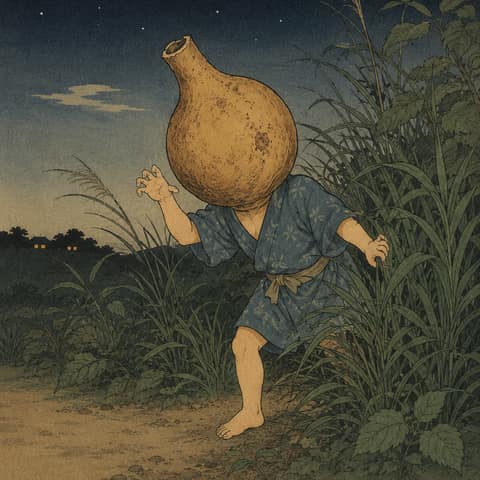
An interpretation based on Toriyama Sekien’s Hyakki Tsurezure Bukuro and related Hyakki Yagyō iconography. Gourds served as containers for water or sake and as percussion in festivals, and after long use were believed to acquire spirit in line with the tsukumogami view. The Gourd Boy appears as a human figure with a gourd for a head, briefly emerging from a night path or from grass to make passersby flinch, and little more. Its nature, name, and any definite harm are not fixed in sources, and alongside utensil-yokai like the Mortar Monk it is read as an allegorical old tool given life. Local oral lore is scant, with paintings and later commentaries as the main sources.

Hōsōshi (Exorcist of the Great Exorcism)

Hōsōshi (Exorcist of the Great Exorcism)

Epic

HOH-soh-shee

Hōsōshi of the Courtly Tsuina Rite

神霊・神格Imperial court (continental ritual imported to Japan)

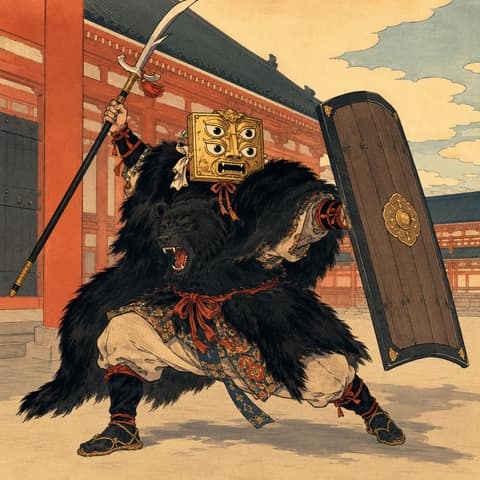
In the imperial court’s Great Tsuina exorcism, this figure confronts and drives out pestilential oni. Wearing a four-eyed square mask, bear hide, and armed with a halberd and great shield, he leads pages and tsuina attendants to circuit the four directions of the palace. The rite follows set forms—onmyoji invocations, drum cues, and expulsion beyond the gates—and later influenced demon-chasing observances at temples and shrines. By the late Heian period, shifts in the term tsuina saw him at times enact a visible “oni role.” Though attire, implements, and routes changed with ceremonial norms, the core purpose remained the banishment of epidemics and ill fortune.

Ibaraki-dōji

Ibaraki-dōji

Legendary

ee-bah-RAH-kee DOH-jee

Ibaraki-dōji

Half-Human BeingsOsakaNiigata

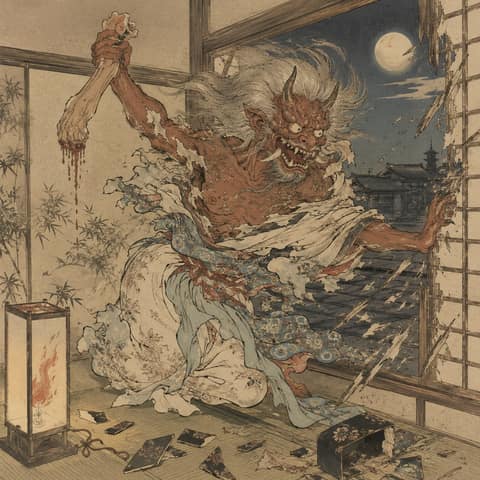
An interpretation shaped by medieval war tales, otogizōshi storybooks, and early modern theater. As Shuten-dōji’s foremost lieutenant, Ibaraki-dōji held Mount Ōe and was routed by Raikō’s ruse. Later tales tell of Watanabe no Tsuna cutting off and reclaiming an arm at Ichijō Modoribashi or at Rashōmon. Accounts vary on birthplace and even gender, with traces in Settsu and Echigo traditions. This version follows the most widely circulated storyline in the sources and avoids embellishment.

Ichikishima-hime

Ichikishima-hime

Divine

ichikishima-hime

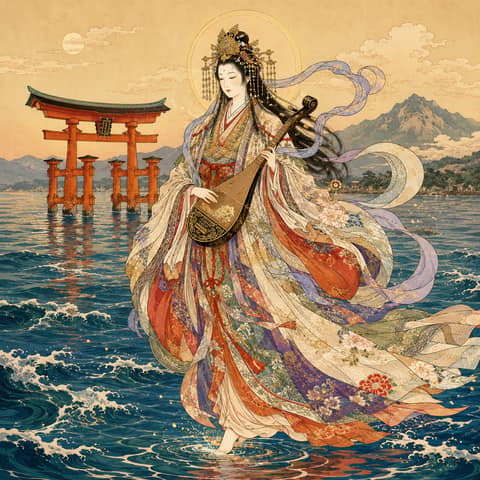
Goddess of the Sacred Island Guarding the Sea, Ichikishima-hime

Deity/Divine SpiritHiroshimaFukuoka

The core of Ichikishima-hime's divine nature lies in being the "Princess of the Enshrined Island"—a goddess residing in the island itself where deities are worshipped. In Munakata (the Genkai Sea), she protects maritime traffic with the continent, and in Aki (the Seto Inland Sea), she guards the inner sea routes. As indicated by the divine decree regarding the "sea route," she is positioned as a boundary-protecting goddess connecting the nation and the sea. Through her syncretism with Benzaiten, her virtues of water, wealth, performing arts, beauty, and wisdom are layered. The majestic stage setting of Itsukushima Shrine's marine pavilions and vermilion Otorii gate symbolizes her divinity. The landscape itself, where the shrine appears to float on the high tide and connects to the land at low tide, is a manifestation of the goddess governing the boundary between sea and land, the sacred and the profane. She shares deep divine connections with her sister goddesses of the Munakata triad (Tagori-hime and Tagitsu-hime), her syncretized counterpart Benzaiten, and Ebisu, who is also a deity of the sea and good fortune.

Iizuna Saburō

Iizuna Saburō

Legendary

Iizuna Saburō

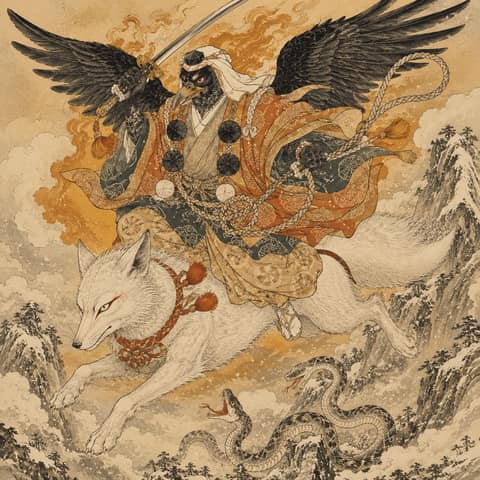
The War-God Who Rides a White Fox — Iizuna Saburō

Mountain & Wilderness SpiritsNagano

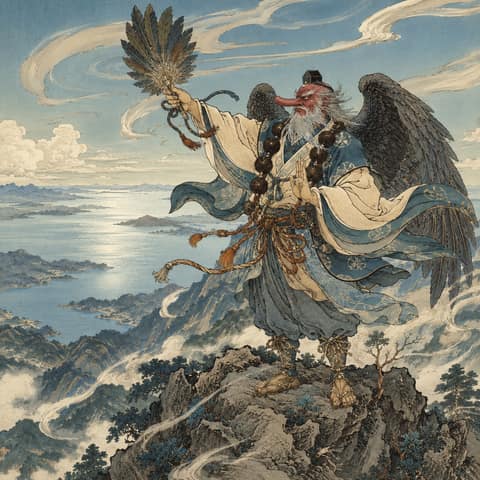
To read Iizuna Saburō, one must overlay three strata: the syncretic honzon-image of "Izuna Gongen," the heterodox art of the "Izuna method," and the devotion of the Warring-States commanders. The antiquity of this faith is backed by the texts. The Asabashō of the first year of Kenji (1275) carries the name of Mt. Iizuna and its founding ascetic; the Togakushi-san Kenkō-ji Ruki (1458) records "Izuna Saburō" and "the third tengu of Japan"; the Iizuna-san Meguri Saimon (1546) gives the origin as the Chira Tengu come from Tenjiku; and the Iizuna-san Ryaku Engi transmits the honji-butsu and the lineage of the Sennichi-dayū. From Kamakura to Edo, it is a faith handed down in layers. The iconography of the honzon is profoundly distinctive. A crow-tengu holding a sword and a rope rides upon a white fox, with a snake often coiling about the fox. Its honji-butsu is expounded now as Fudō Myōō, now as Dakini-ten, varying by source. It is precisely this composite character—"tengu, fox, Fudō and Dakini" joined in a single body—that is the reason Izuna Gongen, surpassing a mere mountain tengu, became a point of concentration of esoteric ritual power. At Takaosan Yakuō-in, the Iizuna Shrine of Shinshū, Jinya-ji on Mt. Kano in Chiba and elsewhere, the faith is especially deep in Kantō and to the north. The "Izuna method" is the practical face of this ritual power. This sorcery, which employs tengu and kuda-gitsune to heal illness and, by possession, to deliver oracles, was counted a heterodox art alongside the Atago Shōgun-hō and the Dakini-ten-hō, and those who wielded it were called Izuna-tsukai. The folk belief that one kept and employed kuda-gitsune within a bamboo tube made the very name "Izuna" a byword for witchcraft. And it was the devotion of the warrior houses that raised Iizuna Saburō to a war-god. It is famous that the crest of Uesugi Kenshin's helmet was an image of Izuna Gongen; there is also the case of Takeda Katsuyori granting the name Nishina to the adopted son of the Sennichi-dayū, and commanders such as Hosokawa Masamoto who practiced the Izuna method itself. As a god who governs victory in war, Iizuna Saburō is, even among the forty-eight tengu of the Tengu-kyō, the seat most bound to this-worldly benefit. Chigiri Kōsai of tengu scholarship placed this many-sided Iizuna Saburō within the system of the great tengu of the many mountains.

Ijū (Strange Beast)

Ijū (Strange Beast)

Uncommon

ee-JOO

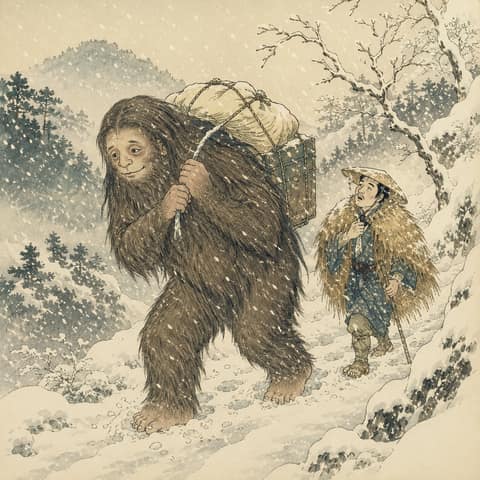
Ijū (Hokuetsu Seppu Version)

Animal ShapeshiftersNiigata

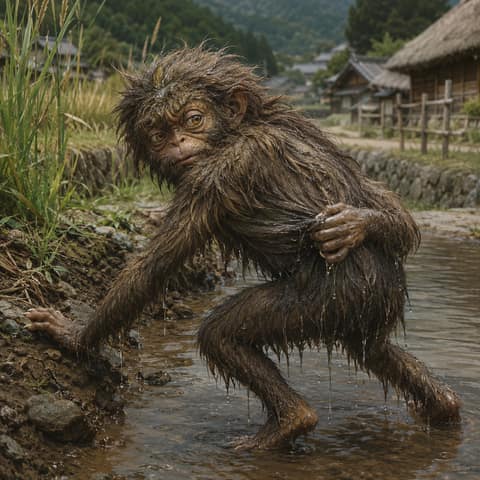
This version follows the figure recorded in the Tenpō-era compendium Hokuetsu Seppu. Its form is ape-like yet larger than a human, with long hair flowing from crown to back, appearing after parting the dwarf bamboo in mountain ravines. It shows no intent to attack homes, chiefly begs for cooked rice, and repays alms by carrying loads and similar deeds. It is closely tied to the weaving culture of Echigo-chijimi, and in tales of loom maidens it intervenes amid household work rules and notions of ritual purity, turning the tide so deadlines are met. Such accounts treat it as a mountain spirit observing human industry and bringing harmony to cycles of trade and production, akin to food offerings made to mountain deities or guest spirits. Later it was reportedly seen at times but returned to the mountains, leaving only its name. Though an unidentified beast, its refusal to harm and habit of repaying kindness place it on the boundary between uncanny and blessed in local lore.

Ikijama (Living Jinx)

Ikijama (Living Jinx)

Uncommon

EE-chee-JAH-mah

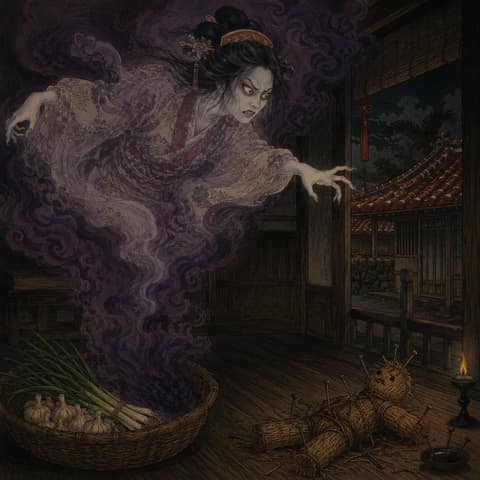
Nama-Jama (Folkloric Sketch)

Ghosts & SpiritsOkinawa Prefecture

A strand of Okinawan beliefs about living spirits. When hatred or envy swells, a person’s spirit may slip out while retaining their form and afflict the target with illness or malaise. Reports describe several modes: possession via gifts, attachment through a curse-doll known as the Nama-Jama Buddha, and even obsession achieved by will alone. Harm was said to strike not only people but also livestock and fields. Communities responded with yuta prayers, apotropaic fouling, and even driving it off through scolding and insults. Some accounts say the lineage passes matrilineally, leading to recorded cases of avoided marriages. Early modern records note accusations, lawsuits, and punishments for alleged use.

Ikiryō (Living Spirit)

Ikiryō (Living Spirit)

Legendary

ee-kee-RYOH

Ikiryō

Ghosts & SpiritsAcross Japan

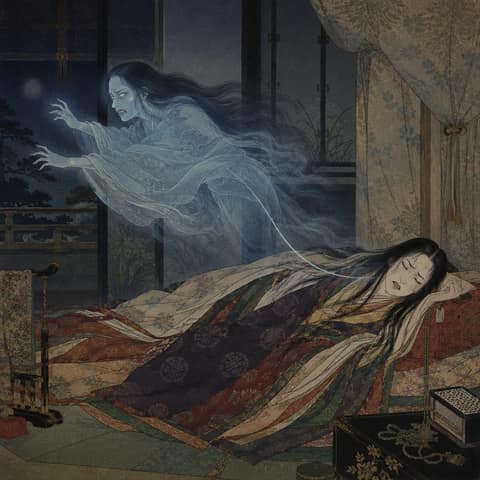
The image of the ikiryō holds two faces: a curse born of resentment, and gentler visitations tied to parting before death or to acts of gratitude. In Heian beliefs, overpowering thought left the body as a “shadow,” appearing at bedchambers, ox-drawn carriages, or gates. In the medieval and early modern eras, scenes witnessed in dreams, will-o’-the-wisps, and flying heads were taken as proof of the soul’s separation. In medical views it was classed as a disorder of the departing soul or of the shadow, with reports of people seeing their own double. The cursing rite of the Hour of the Ox is often linked as a willed sending of intent by the living, though not identical. Regional lore varies in name and form, with some places recording it as a footfall-making human shadow. Overall, it is understood as the coagulation of thought taking shape, a spiritual action of the living set against the dead.

Inugami

Inugami

Legendary

EE-noo-GAH-mee

Inugami (Traditional Form)

Animal ShapeshiftersTokushimaKochi

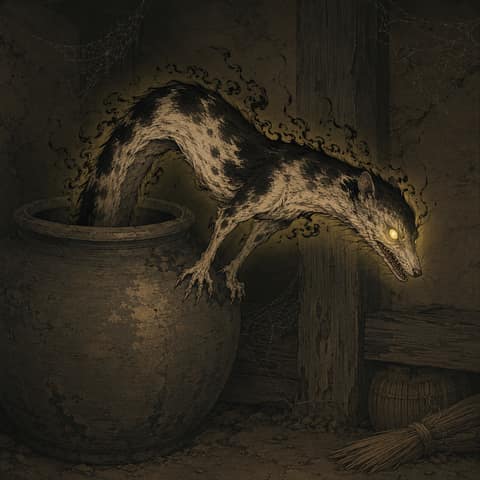
Inugami are feared as hereditary possessing spirits tied to certain lineages, bringing wealth and prosperity yet shunned as curse gods. Rites and keeping methods vary by region, with offerings made in storerooms, under floorboards, or at water jars. Their form is not fixed: accounts describe a mottled mouse-like creature, a black-and-white weasel-like shape, a long-mouthed rat, or something bat-like. Houses said to keep inugami were believed to have as many spirits as family members, and the spirits were rumored to run to other homes to obtain desired goods. The possessed might bark, tremble in the shoulders, or gorge themselves, and even cattle, horses, and tools were said to be possessed. Exorcism was performed through prayers and esoteric rites, with shrines in Tokushima particularly noted. Origins are variously traced to sorcery, legal taboos, and rites that turn a dog’s head into a fetish, differing by locale.

Inugami Gyōbu

Inugami Gyōbu

Uncommon

EE-noo-GAH-mee GYOH-boo

Kodan Tradition Version

Animal ShapeshiftersEhime

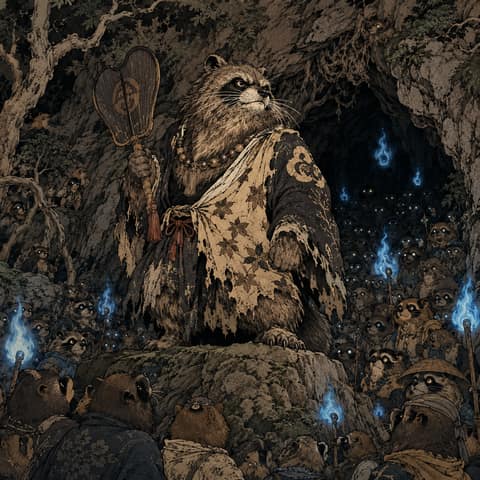
The image of Inugami Gyobu should be understood through the lens of how the Matsuyama tanuki tales were reshaped by kodan storytelling. Across Shikoku, dense beliefs in tanuki and transformation legends spread, and in Matsuyama both “guardian” and “trickster” aspects were told of beings dwelling at the boundary between the castle town and the wilds. The title Gyobu signals a bond with the castle, emphasizing a guardian role, while kodan added favored conflicts—such as inviolable pacts and ambushes during internal clan strife—producing varied plotlines. In every variant, the rock shelters and caves of Mt. Kuma form the final stage, where sealing or pacification brings closure. The appearance of Ino Budayu also became standard, linking in a known monster-slaying tale from other sources and lending a higher authority of supernatural judgment to the Matsuyama tanuki narrative. His spiritual power and many retainers match regional views of a tanuki chieftain leading a band, serving as a framework to explain wonders at annual castle-town events and at passes or shrine precincts. Though today’s lore bears kodan embellishments, at its core remains the figure of a tanuki lord guarding the liminal zone between castle and mountain.

Ipetam (The “Eating Blade”)

Ipetam (The “Eating Blade”)

Uncommon

EE-peh-tahm

Tradition-Faithful Cursed Sword Image

住居・器物Hokkaido

This version consolidates images of the Ipetam found across Ainu traditions. The blade rings of its own accord and shows hunger by the act described as “eating” stone or leather. Once drawn it will not rest until it sees blood, and tales say it may fly on its own to cut people. Its curse threatens households and kotan, inviting disaster beyond the owner’s will, so it is contained through rites and taboos or by sinking it in water. In Asahikawa and Kamikawa, after casting it into a bottomless bog, a rock in the shape of a sword is said to appear, tying requiem to place names and landscape origins. In Saru, a wit tale survives in which imitating the sword’s sound repels bandits, showing its fearsome name worked as a deterrent. In Kiritoi, Kushiro, an alias tale engraves taboo violation and harm into the sword’s very name, marking it as a remembered calamity object. Related types include the man-eating spear Ipe-op and the self-defense knife Sōsamusipe, suggesting a systematic view of baleful blades and weapons. This reconstruction avoids creative embellishment and adheres to regional records of the cursed sword.

Ippon-Datara

Ippon-Datara

Epic

EE-pohn dah-TAH-rah

Kii–Kumano Tradition Variant

Mountain & Wilderness SpiritsWakayamaNara

A portrayal of the Ippon-datara based on records from Kii and Kumano through Nara. It is said to be one-eyed and one-legged, but firsthand sightings are rare; in many regions a single large track left after snowfall is taken as proof of its presence. Its most notable trait is appearing on December 20, the “Hate-no-Hatsuka,” a day overlapping taboos of mountain deities and roads, effectively discouraging entry into the mountains. In its link to smithing, folklore explains the one-leg one-eye form as derived from the tatara blower treading the bellows with one foot and watching the furnace with one eye. In the Obagatōge lineage it is equated with the oni-god Inosasao, once a terror of the peak but sealed by a monk and released only once a year. In Kumano and Itsukushima it is said “only footprints appear, not the body,” feared yet seldom directly harmful. While stories of one-legged snow spirits (such as Yuki-nyūdō and Yukibō) have blended with it, this entry centers on the Kumano–Nara stream, emphasizing three points: the taboo day, the single track, and the blacksmith-origin theory.

Showing 145 - 168 of 473 yokai