YOKAI.JP

Traditional Yokai Encyclopedia

Yokai passed down through the ages

473 Yokai|15 Category|Page 6 of 20
Localization in Progress - More content available in Japanese version
View Japanese
Sort by: NameAscending
Great Tonsure

Great Tonsure

Rare

OH-kah-BOO-roh

Sekien Iconography Standard

General ClassificationsEdo period

A Daikatsura interpreted strictly through Toriyama Sekien’s original imagery. Rather than a concrete monster, it functions as a satirical figure borrowing the iconography of brothel pages and the immortal youth Kikujidō. The chrysanthemum-patterned long-sleeved robe evokes tales of longevity and coded slang, while the shaved scalp suggests a paradox of childlike form and senescent decay. Mentions of Nachi and Kōya serve as metaphors for the contradiction between ascetic rule and transgression. The oversized childlike body in the picture imparts an uncanny yet comic effect. Historical sources list no specific powers or harms, and its appearances are confined to the pictorial frame. Despite the similar name, it is a different lineage from the later “Ōkamuro.”

Great Zato (The Blind Masseur Yokai)

Great Zato (The Blind Masseur Yokai)

Epic

OH-zah-TOH

Sekien Zue Version

人妖・半人半妖Edo period

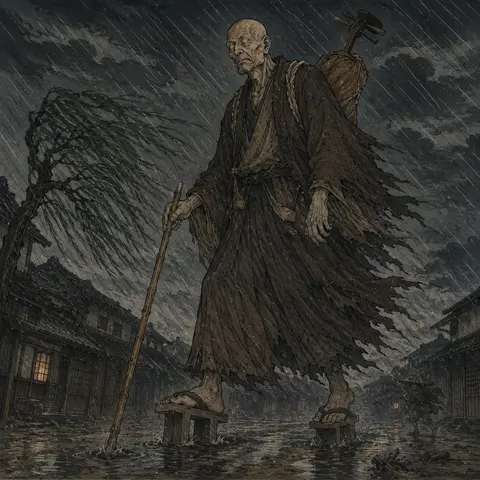
An interpretive version based on one plate from Toriyama Sekien’s Konjaku Hyakki Shūi. It depicts a blind lute-priest in tattered hakama and wooden clogs, staff in hand, traveling the roads on stormy nights. A marginal note mentions plucking the shamisen in brothels, reflecting ties between early modern urban pleasure quarters and performing guilds. Folklorically, it blends visual othering with social satire, presenting a visage of the age more than a tale of uncanny powers. Kenji Murakami notes the othered image of the nocturnal zatō, while Katsumi Tada reads a “demonic” aura of enforcement from their shogunal protection and involvement in finance. Neither grants concrete supernatural powers, emphasizing a presence that appears on rainy nights and overawes the heart.

Guiding Lantern (Okuri-chōchin)

Guiding Lantern (Okuri-chōchin)

Uncommon

oh-KOO-ree CHOH-cheen

Honjo Seven Wonders Tale: Okuri-Chochin (Guiding Lantern)

Mountain & Wilderness SpiritsTokyo

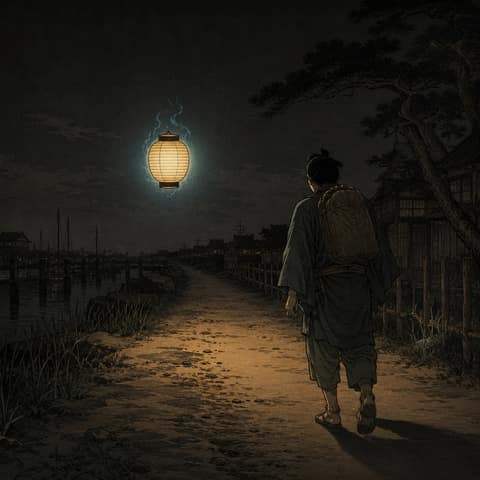
Passed down around Edo’s Honjo district, the Okuri-Chochin is understood as a strange guiding fire that appears between safety and dread on night roads. Its light sways with a person’s steps and breath, keeps its distance while leading ahead, yet never allows touch. At times it slips to one’s rear or flank to upset direction, and when accompanied by a clapper-like sound it is recorded under the alias “Okuri Hyojiki.” The “Lantern Boy” of Ishihara Warigesui is a formless Odawara-lantern flame that circles on all sides and vanishes when approached, regarded as the same phenomenon as the Okuri-Chochin. In Mukojima it is called the “Okuri-Chochin Fire,” believed to light one’s footing and ensure safe passage, with cases linked to offerings at Ushijima Myojin. Though it rarely causes direct harm, it can lead travelers astray, so locals advise not to chase it, to keep a set distance and pass it by, or to bow at a shrine or temple to seek protection.

Hachirotaro

Hachirotaro

Legendary

Hachirotaro

Hachirotaro, Dragon God of the Three Lakes

Water YokaiAkita

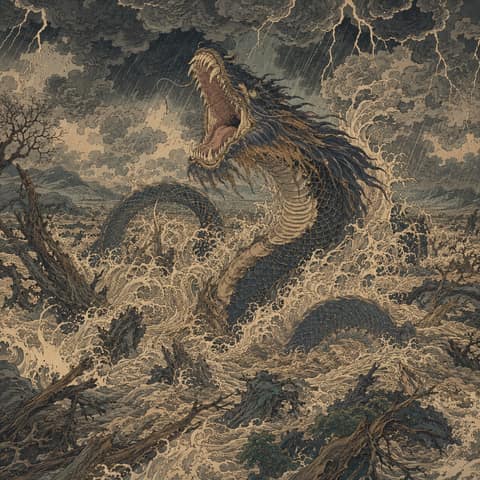
The core of Hachirotaro's story lies in 'transformation brought about by breaking a rule' and 'resurgence after defeat.' The minor taboo of hoarding three char invited an uncontrollable thirst, turning a human into a dragon. This karmic retribution has been passed down in the hunting and fishing culture of the Tōhoku region as a warning against monopolizing nature's bounty. Although Hachirotaro claimed Lake Towada as a dragon, he lost it in a struggle against Nansobō. Yet, he went on to carve out a new body of water, Hachirōgata, to rule. This narrative arc—where the vanquished becomes the sovereign of a new realm—binds the vast geography spanning the three lakes into a single epic. His union with Princess Tatsuko and his seasonal migrations offer a mythic explanation for the real natural phenomenon of Hachirōgata freezing while Lake Tazawa remains unfrozen. It reveals how the people interpreted the physical behavior of the lakes through the lens of a dragon god's romance.

Hair Oni (Kamikki)

Hair Oni (Kamikki)

Rare

KAH-mee-oh-nee

Sekien Zukai Edition

Animated Objects & UndeadJapanese folklore

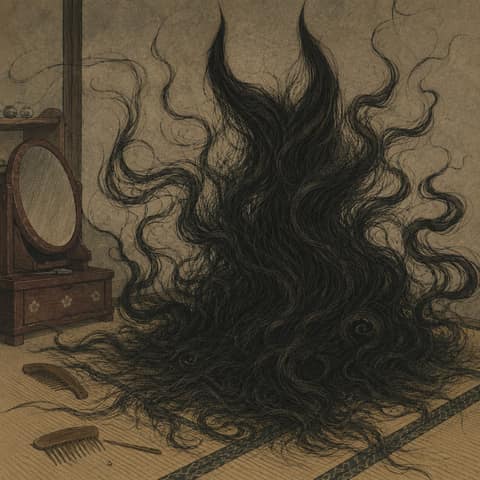
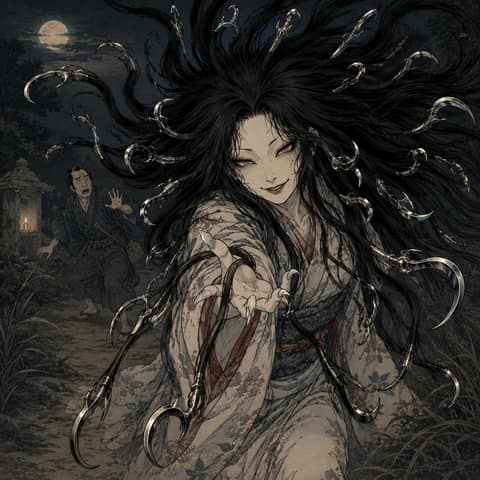
An iconographic reading of the Hair Demon as depicted in Toriyama Sekien’s Hyakki Tsurezure Bukuro. A woman’s hair, infused with its owner’s passions, becomes autonomous, standing on end at midnight as its locks extend and contract like living things. Cutting it offers only brief respite, for it regrows and multiplies at once. Rooted in a dual folk view that both sanctifies and shuns hair, it is shown as a being where tsukumogami traits cross with vengeful-spirit nature. Its body is a mass of hair without face or limbs, asserting menace through motion and shifting length. Memorial offerings and proper hair-cutting rites are said to calm it, yet no certain banishment method is recorded.

Hair in the Hemp Bucket

Hair in the Hemp Bucket

Uncommon

ah-sah-OH-keh-no-keh

Traditional Record Edition (Awa Curious Tales)

Household SpiritsTokushima

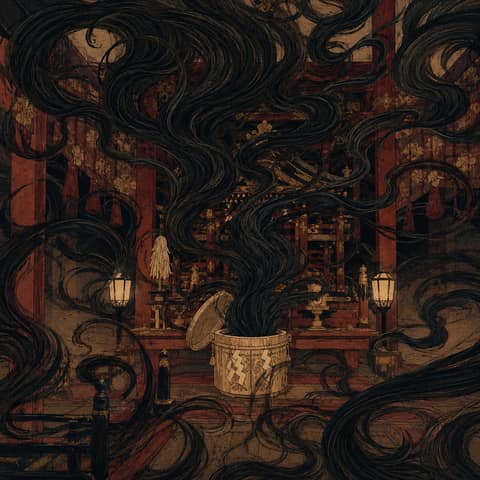
Based on an old Awa record. Hair kept in a hemp bucket acts as part of the deity’s body or a manifestation of divine power, restraining anyone who disrupts shrine order. It is understood to activate within the shrine precincts rather than roaming independently. The core image is hair that quietly elongates, splits into strands, and entangles targets one by one, reacting to acts like defilement or theft rather than attacking onlookers indiscriminately. Shigeru Mizuki depicted it as a massive hair mass under the name “Asaokege,” but the actual tradition emphasizes function over appearance. Often read as a symbol of in-shrine norms encouraging observance of faith and taboos.

Hair-Cutter

Hair-Cutter

Uncommon

KAH-mee-KEE-ree

The Hair-Cutter of Edo Streets

山野の怪MieTokyo

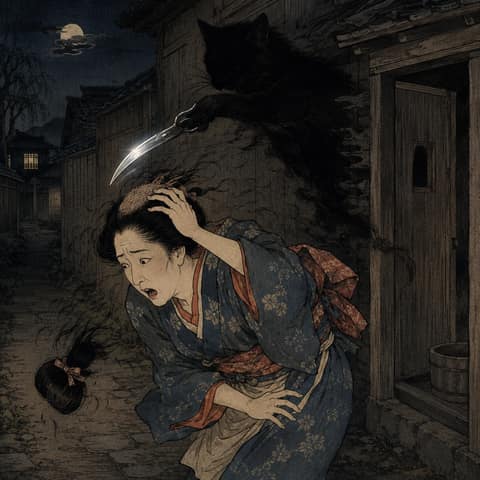
An amalgam of hair-cutting incidents reported from Edo and other early modern towns. At night, in the street or at the threshold of an indoor privy, there is a sudden brush of contact, and moments later the victim’s hair falls away still neatly tied, without their noticing. Witnesses describe a figure black from head to toe, catlike, or with the feel of velvet, yet its true form remains uncertain. Servant girls and maids were often noted as victims, with rumor-mongering and official crackdowns recorded side by side. Folklorically, taboos surrounding hair as part of the body overlap with notions of impurity tied to night roads and privies, casting an unseen assailant as a yokai. Its method and motive are never stated in tradition, placing it among urban horrors shaped by fear and unease.

Hakutaku (White Marsh)

Hakutaku (White Marsh)

Divine

hah-koo-TAH-koo

Iconographic Tradition Conformant

Deities & Divine SpiritsIntroduced from China (widely circulated across Japan as apotropaic images)

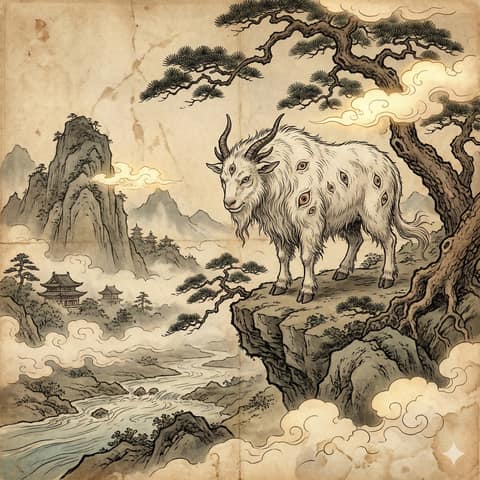
The image of the Hakutaku varies across eras and texts. In the Sancai Tuhui and the Wakan Sansai Zue it appears as a white lion-like auspicious beast symbolizing lucid and orderly governance. Edo painter Toriyama Sekien employed multi-eyed motifs, adding an eye on the brow to heighten its power to perceive calamities, though older depictions sometimes show only two eyes. Prints of the Hakutaku served as apotropaic images posted on doors or carried as charms, invoked for protection during travel and epidemics. The design also appeared on imperial procession flags and on temple and shrine door panels as talismanic emblems of authority and sanctity, examples of which can be seen at the shrines and temples of Nikkō in Japan. The tradition is sometimes read as a personification of ethics and disaster lore, venerated as a being that classifies anomalies and teaches countermeasures.

Hand from a Kosode Sleeve

Hand from a Kosode Sleeve

Rare

koh-SOH-deh no TEH

Iconographic Tradition, Based on Sekien Toriyama

住居・器物Edo period

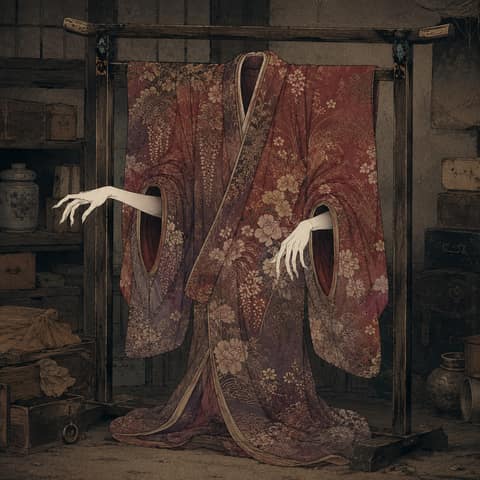
An interpretation aligned with Toriyama Sekien’s imagery and accompanying text. Only a white feminine hand emerges from the sleeve opening, while the absent owner is signified by the garment itself as the main subject. The kosode was a fine everyday robe of the time; whether it became a keepsake, was dedicated to a temple, or sold marks the branching fate, with spiritual disturbance manifesting as attachment residing in the clothing. It layers commentary on courtesans’ circumstances and the irony of buyout money with an aesthetic for dress and a sense of impermanence, functioning less as a concrete monster than as a “visible metaphor.” In folktales, illness after acquiring secondhand clothes and nightly apparitions of a white hand often cease once the robe is offered to a temple and sutras are chanted. Situated at the crossroads of possessed objects and ghost lore, it can be read as tsukumogami, yet its focus remains the emotions of the garment’s former owner.

Hand-Eyes

Hand-Eyes

Uncommon

TEH-no-meh

Traditional Picture-Scroll Reference Edition

Mountain & Wilderness SpiritsKyoto

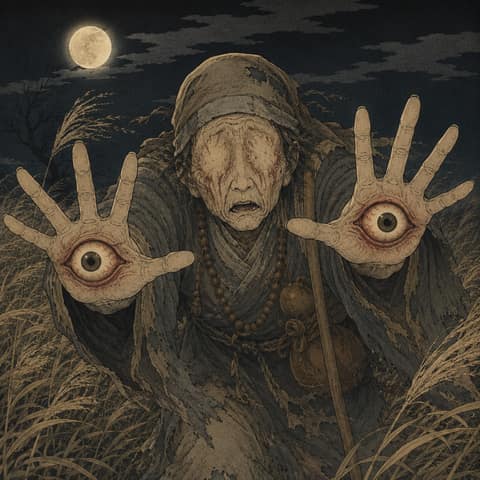
An interpretation grounded in the imagery found in Sekien’s Gazu Hyakki Yagyō and night-parade picture scrolls from the Tenpō era onward. It is depicted as a shaven-headed figure like a blind monk, with large eyeballs set in both palms, standing in a moonlit wasteland. Narrative explanations are sparse, but linked to the illustration and tale in Shokoku Hyaku Monogatari, it is assumed to locate targets in darkness with the eyes in its hands and to sniff out those who have fled and hidden. In collected folklore it sometimes connects to vengeful spirits of the blind, and is often read as a symbol of exchanged sight and touch, witnessing and exposure. Etymological wordplay has been suggested (raising a hand-eye, bald monk), but none is definitive.

Hannya

Hannya

Epic

HAHN-nyah

Noble Living Ghost - White Hannya (Lady Rokujo)

Oni / Giant SpecterNaraKyoto

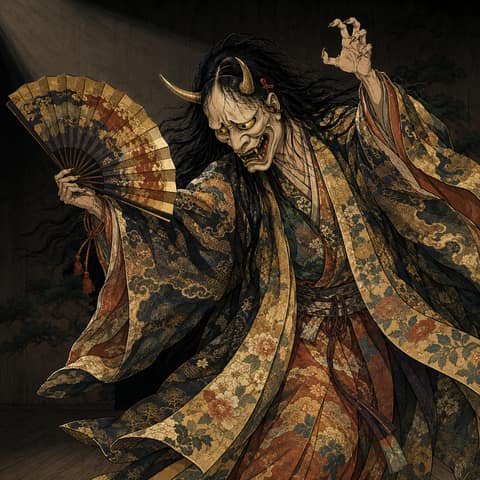
Among the numerous variations of Hannya, this is an interpretation of the 'White Hannya (Shiro-hannya)', which embodies the highest dignity and the deepest psychological terror. The prototype for this version is the spiritual form of Lady Rokujo, a royal consort appearing in *The Tale of Genji* and the Noh play *Aoi no Ue*. She was a noble lady possessing peerless beauty, exceptionally high culture well-versed in waka and Chinese poetry, and immense pride. However, loneliness from the waning visits of her beloved Hikaru Genji, combined with a decisive, public humiliation suffered at the hands of the attendants of Genji's lawful wife, Aoi no Ue, during a 'carriage dispute' (a fight for viewing space for oxcarts) at a festival, birthed jealousy and resentment within her heart that exceeded her limits. Terrifyingly, even though Lady Rokujo herself tried to maintain her reason and not hate Genji, the massive passions suppressed in her subconscious slipped out of her body night after night as a 'living ghost (ikiryo)', standing by Aoi no Ue's bedside to curse her to death. This White Hannya is fundamentally different from the savage demons living deep in the mountains. The paleness of her face represents the nobility unique to aristocratic women, while simultaneously expressing the pale agony of having her blood drained and life force whittled away by the flames of jealousy. She does not use violent physical attacks, but slowly erodes the target's mind and body in the form of illness and nightmares. On the Noh stage, the figure of the White Hannya appearing in a broken carriage is a symbol of her shattered pride and deep sorrow. Swords and military might are entirely useless to defeat this noble living ghost. She can only be countered when high-ranking monks like Yokawa no Kohijiri sound the strings of an azusa-yumi (catalpa bow) to ward off evil and fiercely recite the Lotus Sutra or the Heart Sutra. And ultimately, the White Hannya retreats not because she was exorcised (overpowered by force) through prayer, but because the voice of the sutra chanting makes her realize her own hideous demonic form (the sin of attachment), allowing her to attain religious ecstasy (Buddhist salvation) and calm her heart. She perfectly dramatizes the spirituality of Japanese Buddhism: the fragility where humanity's highest intellect can so easily fall into becoming a monster, and the eventual salvation through enlightenment.

Hanzaki Daimyojin

Hanzaki Daimyojin

Rare

はんざきだいみょうじん

The Curse-Deity of Ryuzu no Fuchi: Hanzaki Daimyojin

Water YokaiOkayama

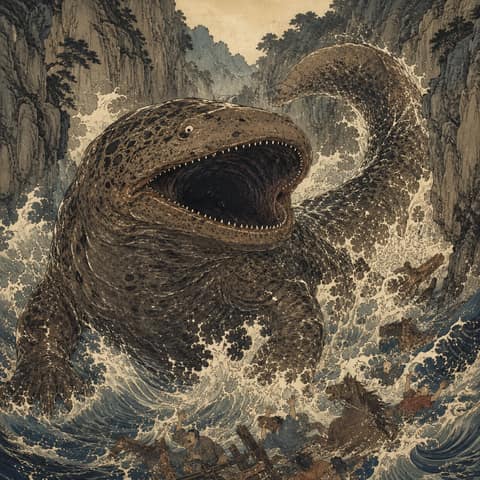
It is not a half-human, half-yokai, but rather a "half-god, half-beast" monster whose core is a highly realistic slaying tale recorded in the Mimasaka topography *Sakuyo-shi*. The biological Japanese giant salamander is an actual Special Natural Monument inhabiting the Asahi River system; its bizarre appearance and longevity sparked the imaginative belief that it was immortal and "wouldn't die even if torn in half." Its gigantified form was feared as the master of Ryuzu no Fuchi. The causal chain wherein the slain creature's curse wiped out the Mitsui family speaks of the beast's grudge destroying even the victorious slayer, ultimately only quieted by enshrinement. It possesses a rare structure combining a monster-slaying tale, a curse tale, a deification tale, and a festival origin. At the Hanzaki Center in Yubara Onsen, live giant salamanders are still protected and exhibited today, making it a land where legend and reality exist side-by-side.

Hashihime (Bridge Princess)

Hashihime (Bridge Princess)

Epic

HAH-shee-HEE-meh

Hashihime of Uji (Traditional Form)

Half-Human BeingsKyoto

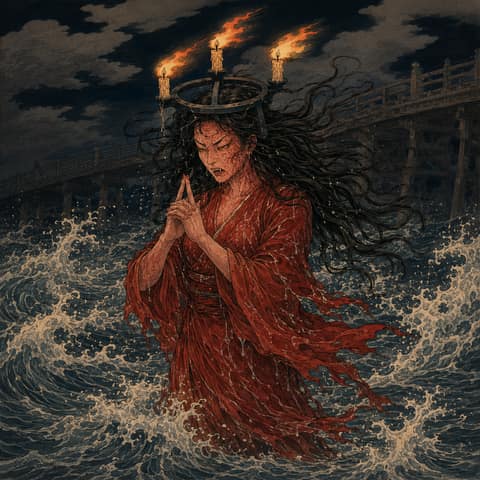
An integrated portrayal of Hashihime as a local divinity of Uji Bridge on the Uji River and as the jealous demon-woman of medieval war tales and Noh. As a local deity she was venerated at the bridgehead as a water and land guardian, protecting crossings and safe passage. Traditions forbid praising other regions or singing lines that stir jealousy upon the bridge, reflecting the belief that local gods dislike talk that exalts elsewhere. In the later tale, a woman visits Kifune, undergoes purificatory austerities in the Uji River, becomes a demon, and encounters a warrior at Ichijō Modori-bashi. Toriyama Sekien noted the shrine at Uji Bridge, and the Noh play Kanawa fixed the image of a demon-woman crowned with an iron trivet. Folklorically, bridges are liminal spaces, linked to water deities, female divinities, and warnings against jealousy, so ritual and storytelling long coexisted. While invented details vary by source, devotion to Uji Bridge, the Modori-bashi encounter, and the dual nature of taboo and protection form the core.

Hatahiro

Hatahiro

Rare

HAH-tah-HEE-roh

Emaki Source – Sekien Edition

付喪神・骸怪Japanese folklore

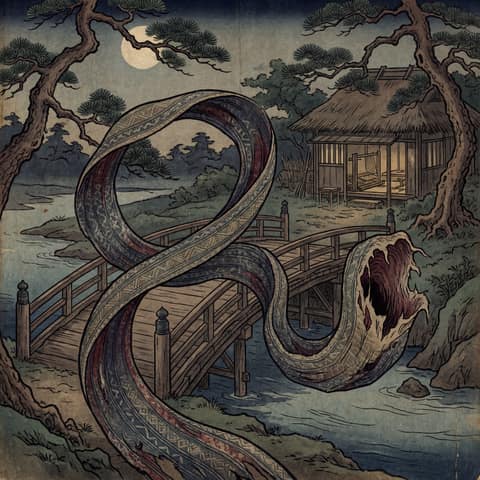
A version based on the conceptual monster Toriyama Sekien presented through painting and notes. Resentment dwelling in a cloth takes serpentine form and wanders in search of its master, merging the symbolism of tool-spirits and snakes. As folklore data, independent oral accounts are scarce, so it remains a pictorial taxonomy that links tsukumogami tales with legends of loom sounds heard near water. Etymological notes mention associations with the performance term “nijūhiro” and wordplay, but firm sources are limited. Visually, a long bolt of cloth writhes into a snake shape, its tip commonly rendered like a tongue or a slit.

Heaven-Descending Maiden

Heaven-Descending Maiden

Uncommon

AH-moh-roh-nah-goo

Lore-Faithful Version

Ghosts & SpiritsKagoshima

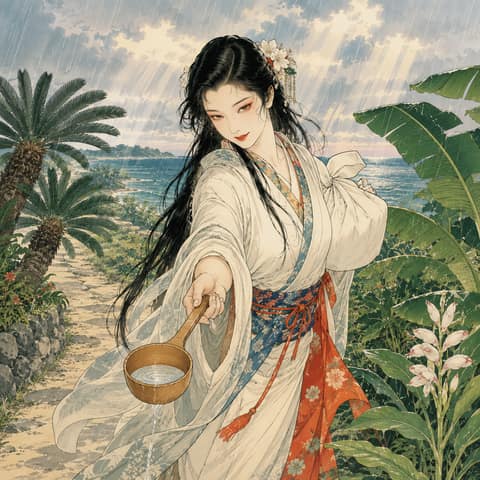
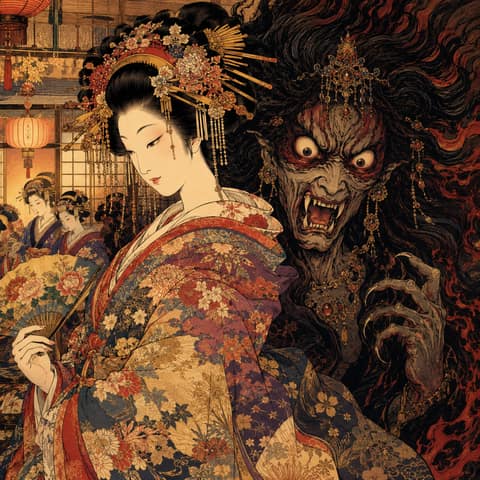
Amakudari-Onna is recorded in Amami Ōshima as a variant of celestial maiden tales, emphasizing the visiting woman who steals human souls. She may appear even under clear skies with a light drizzle, marked by unusual attire carrying a white furoshiki. Her targets are mainly young men; she approaches with smiles and sensual allure, and if they comply, she takes their life or soul. A ladle of water serves as the medium, with taboos warning that drinking it lets her carry victims to the heavens. Folk defenses include staring her down and observing proper drinking etiquette, tying the tale not only to the uncanny but also to admonitions against nighttime wandering, illicit affairs, and improper hosting. Names vary—Amagari-onna, Amore-onna, Hagoromo beauty—reflecting regional shifts, yet the core remains consistent: a woman descending from heaven, fine rain, seduction, soul theft. Though mingled with later hagoromo legends, it strongly retains the imprint of Amami’s visiting-deity beliefs.

Heiroku

Heiroku

Rare

HAY-roh-koo

Iconography-Concordant Version

Animated Objects & UndeadJapanese folklore

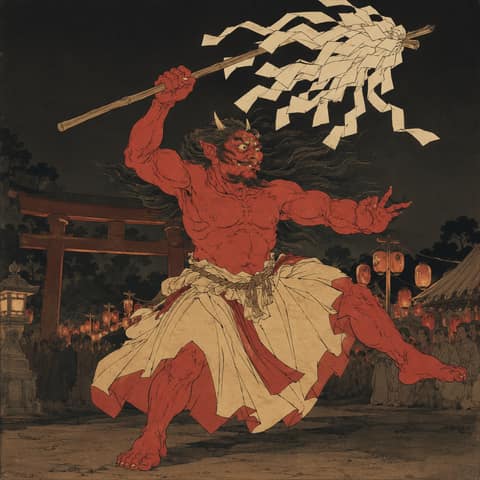
An interpretation grounded in Toriyama Sekien’s examples and Muromachi picture scrolls, taking the aberrant figure bearing a gohei as its standard. The paper-streamer wand signals ritual purity, yet Henroku brandishes it as an emblem of turmoil. It is not tied to any specific land or person, and is understood as an allegorical presence that appears where festivals or shrine order falter. Later traditions sometimes read it as a tsukumogami inhabiting the gohei, but firsthand accounts are scarce, and it is discussed chiefly within the lineage of visual iconography.

Hichigee

Hichigee

Rare

hichigee

The Visiting God Touring the Island at the Turn of Seasons: Hichigee

Gods / SpiritsKagoshima

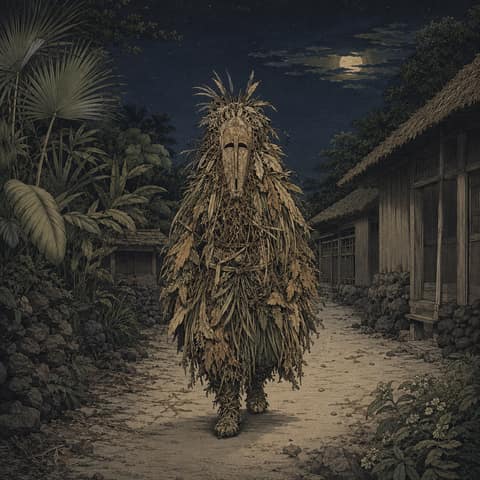
Rather than a specific singular *yokai*, *Hichigee* is a concept that collectively refers to the time, the phenomenon, and the divine spirit itself when 'gods come to the island at the change of seasons'. In the Tokara calendar, there are several turning points in a year, and on those nights, the boundary between the human realm and the divine realm was said to thin, and the gods would silently tour the island. The reason people refrained from going out, lowered their voices, and purified fire and doorways was to avoid hindering the unseen visitors and to prevent impurities from being brought in. On Akusekijima, this time of awe took the form of a masked god, surviving to this day as *Boze* appearing on Bon nights. While *Boze* is a 'visible' visiting god with Livistona leaves and grotesque masks, *Hichigee* was originally an 'invisible' god to be feared, situated in the oldest geological layer of the Tokara visiting god beliefs. The duality of entertaining while fearing the gods, and the structure of ancestral spirits (*Shichito Shogatsu*) and gods (*Hichigee*) visiting the island alternately, resonates deeply with the maritime worldview of the otherworld found in the southern islands.

Hidden Hamlet

Hidden Hamlet

Rare

kah-koo-reh-ZAH-toh

Sekien Zue Version: Hidden Village

山野の怪Japanese folklore

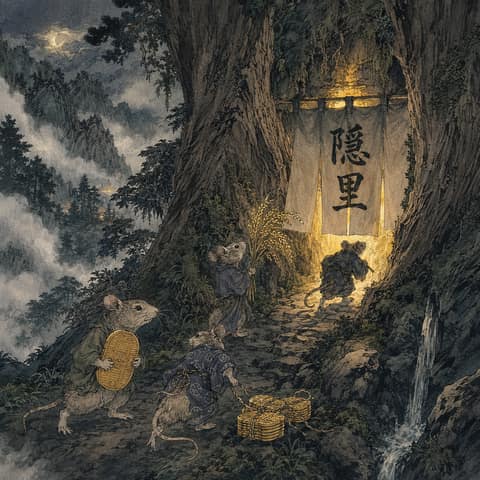
An interpretation based on Toriyama Sekien’s Konjaku Hyakki Shūi entry “Kakurezato” (Hidden Village). The mouse and koban coins at the lower right recall tales in which subterranean mice carry wealth (the so‑called Nezumi Jōdo legend), hinting at ties between the village and chthonic or underworld realms. The shop curtain reads “Kakurezato,” expressing a boundary that opens suddenly as an extension of the everyday. The Hidden Village is not a single yokai but a boundary acting as if it has will, repeating wayfinding confusion, temporal slippage, the granting of fortune, and cycles of manifestation and disappearance. Outcomes swing with a visitor’s conduct and greed, from generous hospitality to wealth turning into leaf-litter, resonating with mountain otherworld tales and views of the beyond.

Hidden Zato (Kakurezatō)

Hidden Zato (Kakurezatō)

Uncommon

kah-KOO-reh-zah-TOH

Tradition-Faithful

Mountain & Wilderness SpiritsŌu and Kantō regions (Hokkaidō, Akita, Kantō)

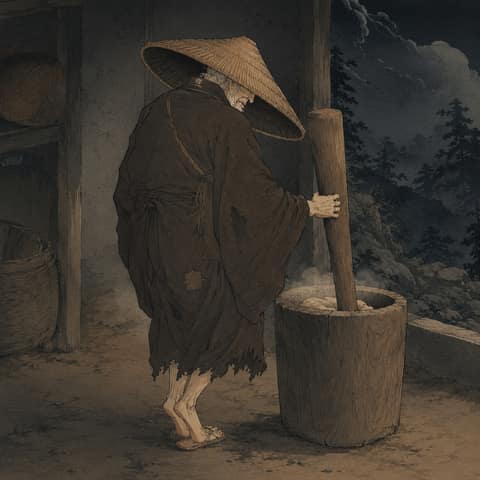
This version frames the Hidden Zato as a blind minstrel-yokai lurking in the mountains and caverns of Tohoku and Kanto. At midnight it pounds out sounds like a foot-operated mortar or rapid rice polishing, yet the source stays unseen and household tools are said to be “borrowed.” In some tales, peeking reveals the noise coming from a neighbor’s house. Some regions call it a child-snatcher, while others give it a benevolent face as a dispenser of mochi or treasure to the honest, making them prosperous. From early modern times, the idea of hidden villages merged with a mystique around blind guilds, recasting it as an unseen people dwelling in caves. Modern folk explanations liken the racket to insect wingbeats, but as a bearer of the uncanny it endures as a spirit in the form of a zato.

Hienma

Hienma

Rare

hee-EN-mah

Didactic Tale, Classical Iconography Adherent

Half-Human BeingsEdo period

Rather than a concrete monster, the Hienma is a name that visualizes ruin born of lust. It belongs to the lineage of religious admonitions found in early modern yomihon and kaidan, and is often depicted in two aspects, bodhisattva-like and yaksha-like. More than appearing directly before a person, the original usage names incidents in which demonic hindrance intrudes upon human bonds. Later ages sometimes conflated it with vampiric or life-draining femme fatales, but in classical sources the moral lesson is central, and few fixed tales tie it to specific places or persons. Here it is framed within the classical scope as a symbolic presence that triggers a chain of temptation, delusion, and the decline of household fortunes.

Hihi (Demon Baboon)

Hihi (Demon Baboon)

Epic

HEE-hee

Hihi (Traditional Accounts)

Animal ShapeshiftersNagano

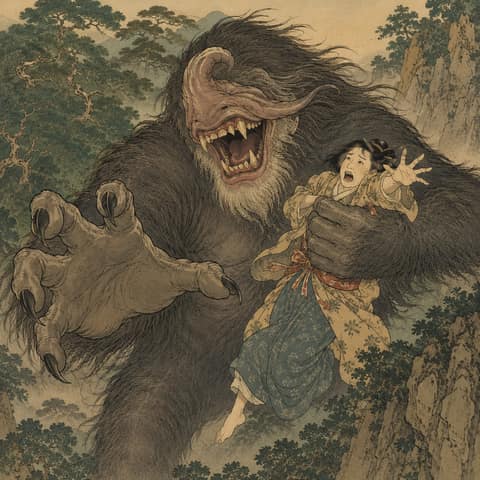
A depiction of the hihi based on Edo-period images and folklore. Said to dwell in mountains, it is an aged monkey transformed into a giant, powerfully built being. Many regions tell that it bursts into loud laughter, and when its long upturned lips roll back to cover its eyes, it leaves an opening to strike. Tales include the abduction of women, bouts with woodcutters, and raising wind and storm to hurl people. Natural history compendia such as Wakan Sansai Zue report black hair, large size, and hearsay of human speech, though exact locales and physical evidence remain uncertain. Its name is commonly linked to its laugh. It is sometimes conflated with yama-warawa or monkey deities, but is often distinguished as an ape-shaped mountain monster.

Hiko-san Buzenbō

Hiko-san Buzenbō

Legendary

Hiko-san Buzenbō

Chief of the Tengu of Kyūshū — Hiko-san Buzenbō

Mountain & Wilderness SpiritsFukuoka

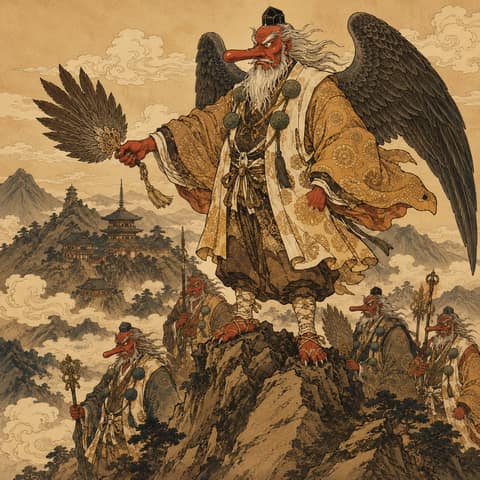
The key to reading Hiko-san Buzenbō lies in Hikosan—the vast sacred site that is one of the three great centers of Shugendō in Japan—and in the tengu's character of two faces, reward and punishment. The history of Hikosan Shugendō issues from the Nara-period monk Hōren. Taking as founder this monk, whom the Shoku Nihongi records as having been granted forty chō of field in Buzen Province in the third year of Taihō (703), Hikosan grew into a great center of Shugendō ranking with the Dewa Sanzan and Ōmine. The name of Buzenbō appears with certainty in the Kamakura-period engi the Hikosan Ruki (1213). This work likens the forty-nine grottoes bored into the peaks of Hikosan to Miroku's Tosotsu Heaven and made the eighteenth the "Buzen-kutsu," the seat of Buzenbō. This very system of grottoes is the matrix of the faith in Buzenbō as chief of the tengu of Kyūshū. The Edo-period scale of the "Three Thousand Eight Hundred Bō of Hikosan" tells of this sacred site's prosperity. What characterizes the tengu Buzenbō is the sternness of his reward and punishment. As the history of Takasumi Shrine transmits, upon those of greedy and evil heart he carries off children and sets fire to houses in chastisement. Conversely, the wishes of the upright and deeply devout he hears and grants, and them he guards. These two faces of reward and punishment symbolize, as a tengu's judgment, the strict precepts that a Shugendō mountain imposes and the grace shown to those who keep them. The dread of a child-snatching tengu and the faith of parents praying for their children's safety were the front and back of one and the same Buzenbō. The separation of Shintō and Buddhism in the first year of Meiji and the prohibition of Shugendō in Meiji 5 (1872) scattered the yamabushi of Hikosan and dismantled the world of the three thousand eight hundred bō. The institution of Shugendō was lost, but the tengu faith of Buzenbō lives on at Takasumi Shrine; chanted in the Muromachi Noh play Kurama Tengu and standing among the forty-eight tengu of the Tengu-kyō as the great tengu of Kyūshū, he is still feared as one who sits upon the peak of Hikosan. Chigiri Kōsai of tengu scholarship, too, placed him within the system of the great tengu of the many mountains.

Himamushi Nyūdō

Himamushi Nyūdō

Rare

HEE-mah-moo-shee nyoo-DOH

Toriyama Sekien Iconography Reference

Household SpiritsEdo period

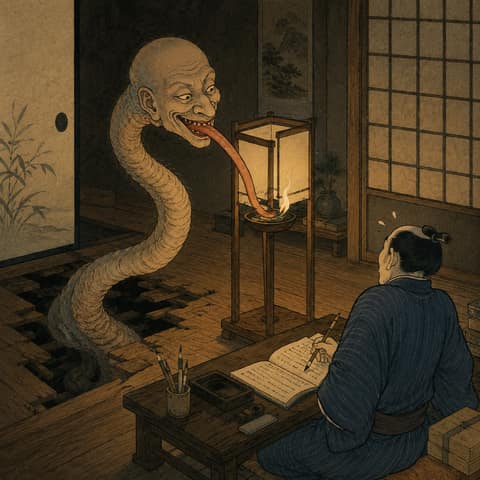
A reference edition compiled from the illustration and note in Toriyama Sekien’s Konjaku Hyakki Shūi. From beneath the floorboards extends the gaunt upper body of a nyūdō, lips slick, tongue reaching toward the saucer of an andon lamp. Its core origin is a didactic reading: the spirit of one who shirked labor appears nightly to lick the lamp oil, weakening the flame and hindering brushwork and needlework. The name connects to the letter-picture pun “Hemamushiyo Nyūdō,” suggesting a background in doodle play. In lived experience it overlaps with oil-loving bugs seen around hearths and kitchens, told as a being lured by darkness and the smell of oil. It causes no grave harm, preferring to make the flame waver, dampen the wick, and sap one’s focus. When spotted and scolded it shrinks back, a creature strongly inclined to hide in the shadows.

Hira-san Jirōbō

Hira-san Jirōbō

Legendary

Hira-san Jirōbō

The Second-Seat Great Tengu — Hira-san Jirōbō

Mountain & Wilderness SpiritsShiga

The key to reading Hira-san Jirōbō lies in the meaning of the rank "second seat, next after Tarōbō," and in the medieval sources particular to Mt. Hira. In the tengu hierarchy, Jirōbō is held to be the second after Atago-san Tarōbō. This ordering appears almost in common both in the forty-eight tengu of the Tengu-kyō and in the Eight Great Tengu framework, and the very names Tarōbō and Jirōbō derive from the ordinals "one" and "two." Rather than being told of alone, Jirōbō appears more often paired with Tarōbō as the twin pillars of the tengu world. The firm ancient layer of Hira's tengu lies in the Hirasan Kojin Reitaku (by Keisei, 1239). This dialogue, in which the aged tengu of Mt. Hira answers Keisei's questions and speaks of the tengu world and the afterlife, is a primary source particular to Mt. Hira, showing that Hira held a firm place as a tengu sacred mountain in the medieval age. Here one common confusion should be set right. Jirōbō is often bound to the tale of the Chinese tengu Chira Eiju (= Zegaibō), but the original story in the Konjaku Monogatarishū, Book 20 runs on the plot of a tengu of Shintan defeated by a monk of Mt. Hiei, and does not name Mt. Hira as the seat of the Japanese tengu. Making Chira Eiju the tengu of Hira is a later arrangement; the tradition proper to Mt. Hira itself should rather be sought in the aforementioned Kojin Reitaku. The tale of relocation from Mt. Hiei is likewise understood not as historical fact but as a later narrative telling the changeover of a sacred mountain's leadership. Based at Mt. Hira, the sacred peak of Ōmi, fearing Buddhist law while testing human conceit—this coexistence of modesty and fortitude is the image of Jirōbō. Chigiri Kōsai of tengu scholarship, too, set Jirōbō in the place next after Tarōbō.

Showing 121 - 144 of 473 yokai