YOKAI.JP

Traditional Yokai Encyclopedia

Yokai passed down through the ages

473 Yokai|16 Category|Page 5 of 20
Localization in Progress - More content available in Japanese version
View Japanese
Sort by: NameAscending
Furu-Utsubo (Aged Quiver Spirit)

Furu-Utsubo (Aged Quiver Spirit)

Rare

FOO-roo OOT-soh-boh

Toriyama Sekien Iconography Standard

Animated Objects & UndeadJapanese folklore

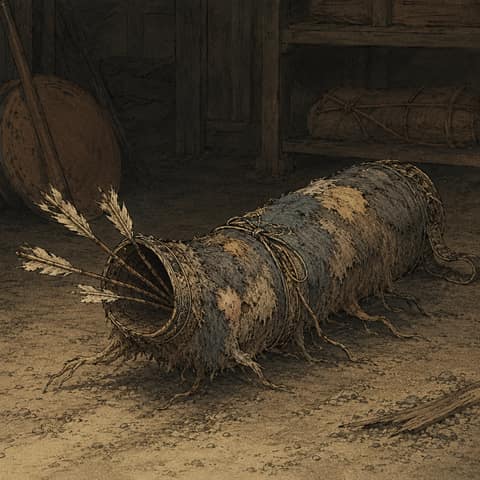
Grounded in the classic image from Toriyama Sekien’s Hyakki Tsurezure Bukuro, it is understood as an aged leather or fur-covered utsubo quiver that raises its mouth and creeps along the ground. Its origin is not from a clear oral tale but from the tsukumogami belief that objects become ensouled with age. The accompanying text names the warrior who shot the field fox of Nasu no Hara (Tamamo-no-Mae), hinting that a quiver once emblematic of martial glory turns yokai after being forgotten. An earlier prototype is presumed in Muromachi-period Night Parade scrolls depicting object-spirits bearing bow and arrows, which Sekien reinterpreted and named. By night it slowly roams deserted roadsides and house shadows, said to make a sound like fletchings brushing. It is not strongly malicious, but when treated roughly it creaks and cries in warning, stirring memories of its former master.

Fusuma

Fusuma

Uncommon

Fusuma

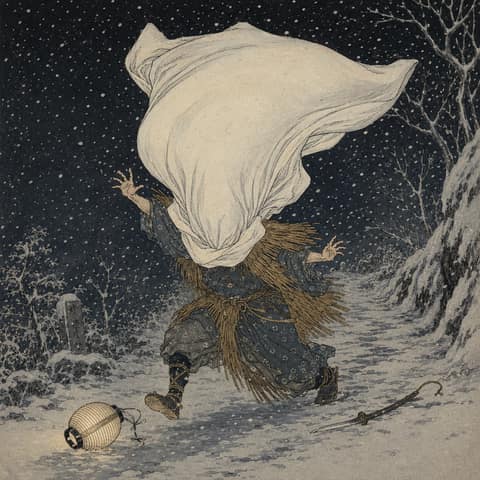
The White Cloth of the Night Road: Sado Fusuma

Dwelling / household objectSado Island, Niigata Prefecture (main form) / Tosa, Kōchi Prefecture (variant)

This version focuses on the better-known white-cloth type from Sado, rather than the Tosa form. It centers on the circumstances in which Fusuma appears on night roads, the method of resisting it with ohaguro, and the legendary connection to the custom of men using kane tooth dye. In Sado, on night roads, snowy paths, or around inns, a white cloth about the size of a wrapping cloth is said to drift down without sound, as if floating in the moonlight, and cover a person from head to shoulders. Blades cannot cut it. Only when someone with ohaguro in their mouth bites through one edge does the apparition wither and fall away. It is true that some men on Sado used kane tooth dye into the Meiji period, and elders preserved the explanation that this was a remnant of measures against Fusuma. Yet the male ohaguro custom also has other possible motives, including festival dress and rites of adulthood. The claim that it existed specifically to defeat Fusuma should be read as partly containing later rationalization. In winter Sado, when wind rises over snowy fields, white cloth from eaves or drying racks can be swept up and blown across one's view. Such natural experiences may also have been retold locally under the name Fusuma.

Futakuchi-onna (Two-Mouthed Woman)

Futakuchi-onna (Two-Mouthed Woman)

Epic

foo-tah-KOO-chee OHN-nah

Futakuchi-onna

Half-Human BeingsChibaTokyo

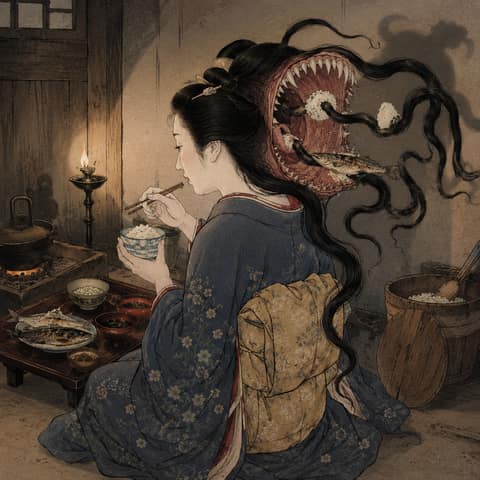
Aligned with Edo-period strange tales, this type’s true hunger is amplified by a mouth on the back of the head. The front mouth feigns daintiness, while the rear mouth manipulates the hair to pull dishes close. It secretly devours nearby food, sowing domestic discord and appearing in stories about household budgets and shame. In art, a fanged mouth peeks from between coiffed hair. Said to be keen to sounds and smells, it hides its nature deftly in public.

Futon-kabuse

Futon-kabuse

Rare

Futon-kabuse

Weight Falling on the Bed: Sakushima Futon-kabuse

Dwelling / household objectAichi

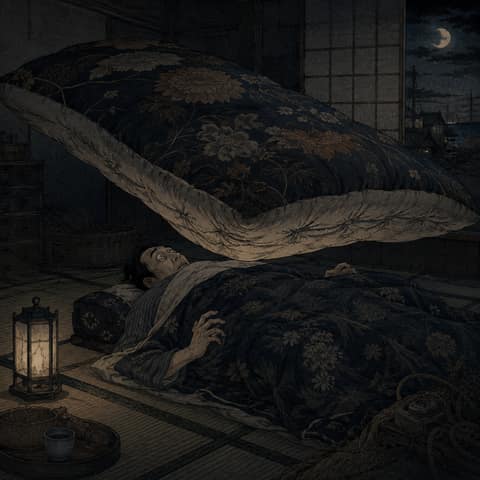
This version focuses on the process of retelling through which modern yokai encyclopedias have shaped this apparition. The primary source preserves only the bare structure: "it comes softly, slips over the person, and suffocates them." Postwar yokai encyclopedias, including lines descending from Mizuki Shigeru's Nihon Yōkai Taizen and illustrated references edited by Kyōgoku Natsuhiko and Tada Katsumi, took that single sentence as a starting point and added details such as "a futon that feels light gradually becomes heavy" or "it falls silently while the person is asleep." These are later embellishments not grounded in the primary record. At the same time, they work well as a way to convey to modern readers the nighttime bodily sensations of a fishing village: the weight of bedding dampened by sea wind, sleep paralysis from exhaustion, and the cold dampness of the tide creeping in from the sea. The fact that it has no counterpart in Toriyama Sekien - a modern coastal-folklore apparition that does not fit inside Edo picture-scroll yokai - has also left later artists and writers room to imagine its form freely. That openness is part of Futon-kabuse's modern character.

Fūri (Wind Tanuki)

Fūri (Wind Tanuki)

Uncommon

FOO-ree

Bibliographic-Transmission Composite (Edo Natural History Lineage)

動物変化Imported from China (accounts found across Japan)

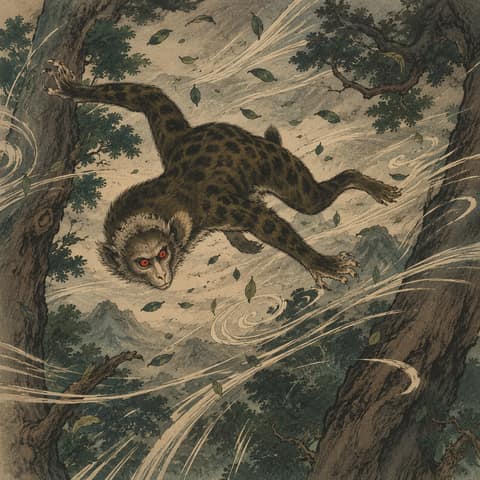
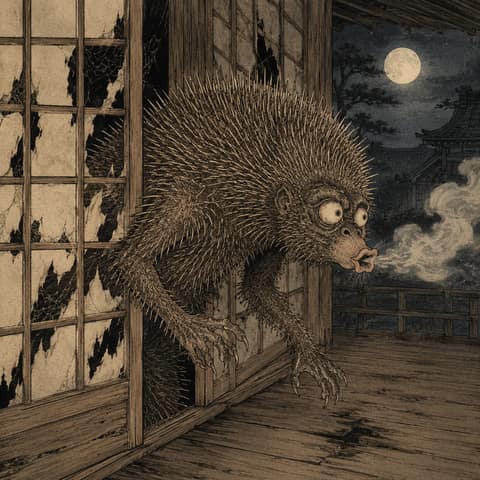
A synthesis based on Chinese natural-history accounts transmitted in the Edo period, organized against Japanese essays and illustrated compendia. Said to be the size of a small monkey or a marten or tanuki, with a short tail, red eyes, and a dark coat mottled with spots. It appears with the wind to startle people and livestock or leave sudden grazing wounds, without the heavy harm stressed for demons. Its existence wavered in Japan: Wakan Sansai Zue argued it was unborn, Mimi-nashi Hoichi’s Miminashi? (Mimibukuro) recorded rare encounters, and Kō Wahonzō compared the creature 狤𤟎 to the kamaitachi. Thus, though the name is foreign, early modern scholars’ efforts at comparison and identification converged on the idea of a wind-borne beastly apparition, an unseen thing that inflicts slashing grazes. Details of ecology and form vary by text, likely arising from layered readings of local animals—marten, tanuki, monkey, otter—and wind-related mishaps.

Gaki Possession (Starving-Ghost Affliction)

Gaki Possession (Starving-Ghost Affliction)

Uncommon

GAH-kee TSOO-kee

Traditional Version: Gaki Possession of the Mountain Pass

Demons & GiantsVarious regions (Kanagawa, Wakayama, Kochi, Niigata, and elsewhere)

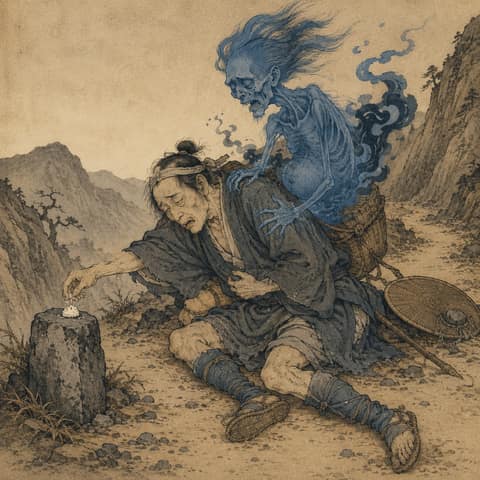
A classic image of gaki possession said to occur on mountain passes and in the hills. It is understood to stem from the spirits of those starved to death in battles or as wayfarers, so travelers carried a little food and offered it to the pass before crossing to avert harm. Onset is sudden, marked by fierce hunger, weakness in the limbs, and feet that refuse to move, often leaving one unable to rise in shade or where wind passes through. The remedy is simple: even a single grain of rice, a pinch from a salty rice ball, or a scrap of dried fish in the mouth is said to loosen the grip. As prevention, people scattered a bite of their lunch to the mountain deity or the spirits of the unburied dead, or made offerings at roadside Jizo. One should avoid heavy meals at once, easing the stomach with rice porridge or zosui. Though names vary—Iso-gaki on the coast, Hidarugami in basins and farm villages, Jikitori in Shikoku—the symptoms and remedies are nearly identical and closely tied to local practices of memorial and roadside offerings for the dead.

Gambari Nyūdō

Gambari Nyūdō

Uncommon

GAHN-bah-ree nyoo-DOH

Tradition-Concordant Version

Aquatic SpiritsVarious regions (Edo, Kinai, Sanyōdō, etc.)

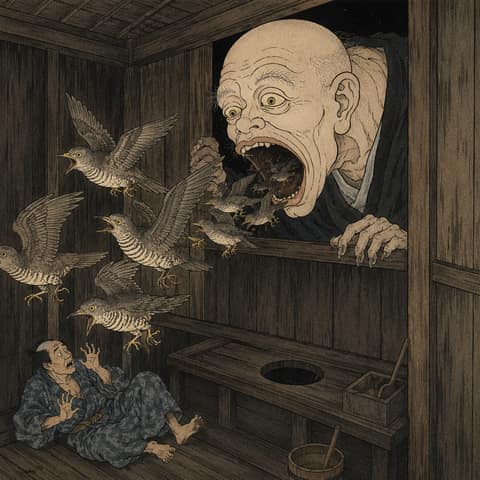
A synthesis based on Toriyama Sekien’s imagery and regional taboos and chants tied to privies. Since antiquity, latrines were seen as thresholds where impurity and boundary meet, with apparitions said to appear at liminal times such as midnight and New Year’s Eve. Sekien depicts a monk-like figure vomiting a bird and notes a charm invoking “Gambari Nyūdō Cuckoo.” Folklore records chants that decide fortune or misfortune, tales of transmutation to gold or koban alongside ominous encounters marked by hearing the cuckoo. Scholars note punning links with the graph for cuckoo and Chinese toilet deities, and strong regional variation and name fluidity, including Wakayama’s “Setsuin-bō” and blending with Okayama’s Mikoshi-nyūdō. Practices on how and when to enter the privy, cautions on time, and children’s nerve-testing customs intertwine with taboos over what to say and tales of invited luck.

Gangi Kozō

Gangi Kozō

Uncommon

GAHN-ghee koh-ZOH

Archaic Illustration-Concordant Form

Aquatic SpiritsUncertain (appears in Edo-period picture books)

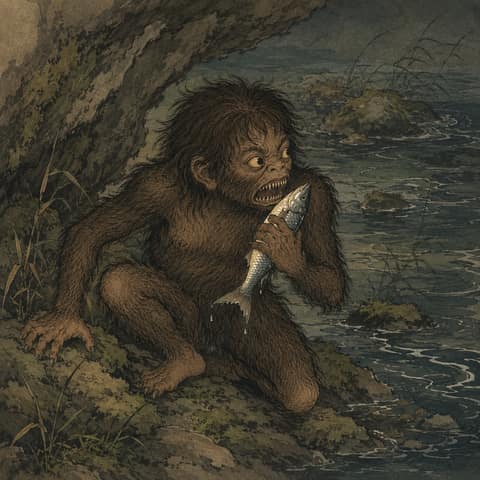
A reconstruction based on Toriyama Sekien’s image and its brief note. It lurks along riverbanks and in shallow pools beneath cliffs, seizing fish when the moment is right. Its body is close to a small boy’s in build but covered in coarse hair, and its teeth are file-like, said to rasp flesh from its catch. While traits recalling the kappa (such as webbing and a waterside life) come to mind, definitive attributes like a carapace or head-dish are not attested and are therefore omitted. The “bank” and “cliff” elements in the name are read as descriptive of its haunt, not a regional or clan identifier. Modern commentary notes a cautious link to beings bearing “cliff” in mountain-怪 lexicon (e.g., Takiwaro), but stops short of identification. Extant primary sources are Sekien’s picture and text; no behavior, curse, or offering rites are transmitted. Here it is treated as a small waterside uncanny, silently stalking fish.

Garappa

Garappa

Epic

Garappa

The Deposed Water God of Southern Kyushu

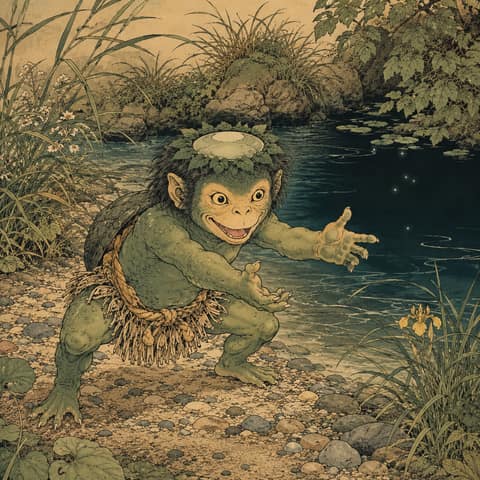
As pointed out by folklorist Kunio Yanagita in works like *Yokai Dangi* (Discussions on Japanese Monsters), the Garappa is perhaps the most vivid surviving example among all Japanese kappa legends of a "former water deity that has degenerated into a yokai over time." Their seasonal metamorphosis—entering the mountains in winter to become *yamawaro* and returning to the rivers in spring—is the very embodiment of the cyclical rotation of the mountain god and the rice paddy god in traditional rice-farming culture. They are frequently feared as symbols of water-related disasters, prone to playing vicious pranks and occasionally claiming human lives. Yet, if treated with the proper respect, they transform into "reliable neighbors" who bless fishermen with bountiful catches and work through the night to assist with grueling rice planting. This dual nature is the very core of animism. Understanding the Garappa requires seeing beyond a simple river monster; in the harsh natural environment of southern Kyushu, bounded by rugged mountains and fierce rivers, the Garappa is a projection of the local people's "awe of nature" and their "prayer for coexistence," making them an indispensable presence in the regional community.

Garei (Spirit of the Painting)

Garei (Spirit of the Painting)

Uncommon

GAH-ray

Garei (Ochikuri Monogatari Edition)

Animated Objects & UndeadKyoto (anecdote from the Kanjuji household)

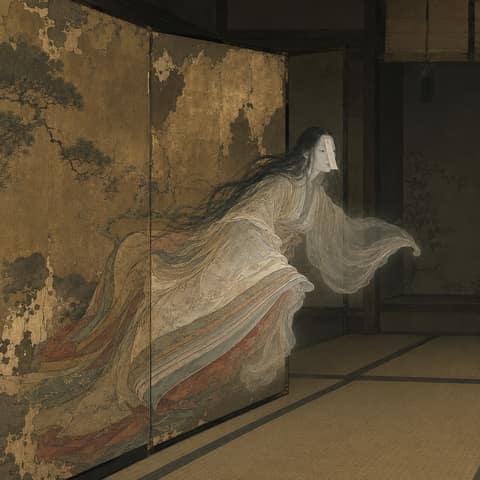
An image-spirit as portrayed in a late Edo essay. A woman steps forth from an old screen painting, and any treatment applied to the picture manifests as real-world phenomena—the core motif is the linkage between image and reality. Signs caused by the aging of the object are perceived as hauntings, yet they subside through repair and reverent care, fitting within tsukumogami tradition. The writer names specific places and households, but the entity’s purpose is unstated, its warnings and appearances are brief, and the events end once the piece is appraised and restored. Rather than the painter’s fame empowering a spirit, the tale chiefly cautions against mistreating fine works. Harm to people is rare; its hallmarks are visual manifestation and a return to its locus, vanishing before the screen. Later readings cite it as an exemplar underscoring the importance of memorial rites for objects.

Gashadokuro

Gashadokuro

Legendary

gah-shah-doh-KOO-roh

Great Skeleton of Assembled Vengeful Spirits: Gashadokuro (Complete Memorial Version)

Spirit / GhostFictional Origin (Created in the mid-Showa period; a giant skeleton figure)

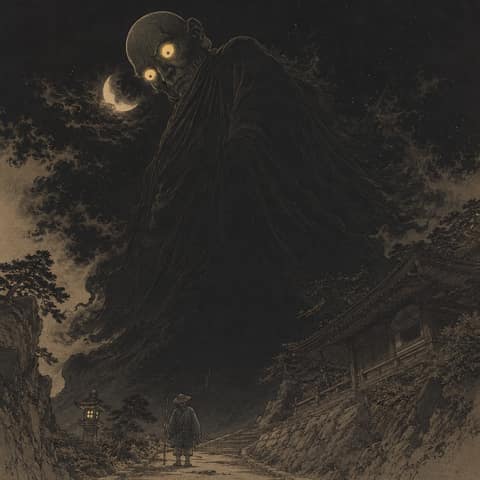
This is an interpretation of the "most terrifying nocturnal great anomaly," born from the countless remains of those dead by war or starvation, their intense lingering attachments to this world, and the despair of being left unappeased, which have solidified in the depths of darkness. The Gashadokuro in this version transcends the bounds of a mere giant bone monster; it is depicted as a moving disaster itself—a physical manifestation of the "weight of death" and the "sorrow of the unmourned dead" that human society has concealed. Its appearance is so immense that when it stands, it blocks even the moonlight, entirely covering deep night fields and deserted graveyards in a giant black shadow. Despite lacking muscles or skin, countless grudges act as a magical force that binds the bones together, producing astonishing physical strength. The omen of its approach is an ear-splitting friction sound of giant bones going "gasha, gasha," echoing alongside a chilling aura of death that freezes the surrounding air. When this sound is heard, escaping is said to be almost impossible. The Gashadokuro uses no magic or sorcery whatsoever. Instead, it attacks with extremely primitive and pure violence, nonchalantly snatching living humans with its giant, tree-trunk-like bony arms, lifting them directly to its massive jaws, and crushing their heads alive to slurp their fresh blood. However, behind that terrifying cruelty lies a fundamental "hunger and thirst (the agony of a hungry ghost)" that can never be satisfied. Every single bone that makes up the Gashadokuro belongs to a helpless human who perished in loneliness, begging for water and food. Their pursuit of living blood is the flip side of their thirst for life; yet, no matter how much blood they drink, it simply spills through the gaps in their bones, so their hunger is eternally unhealed. Therefore, using "physical attacks" with swords, bows, or modern weaponry against this great anomaly is almost entirely meaningless. This is because the opponent is merely an aggregation of already-dead bones. Even if one arm is chopped off, bones carrying other grudges will quickly gather to seamlessly repair it. If there is a single means to "vanquish" this tragic monster, it is not violence but "compassion (kuyo/memorial service)." Only through earnest sutra chanting by a high priest and the Buddhist requiem ritual of respectfully returning the remains to the earth can their raging grudges be pacified, returning the bones to ordinary skeletons. It could be said that this questions the responsibilities the surviving must fulfill toward the dead.

Gataro

Gataro

Uncommon

gataro

The Kappa of Goto that Became a God of Fire Prevention: Gataro

Water YokaiNagasaki

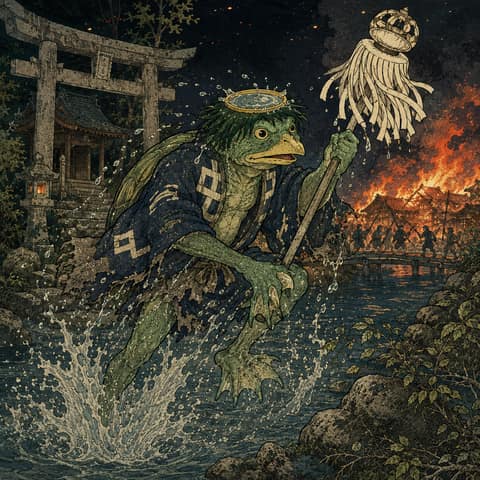
While the *Gataro* is a lineage of the Kyushu *kappa*, its image unique to Goto lies in the fact that it formed an independent belief as a guardian deity of fire prevention. The legend that the general of the *kappa* of Goto dwells in the Mizu-jinja on the Daienji River in Fukue Island, and that *kappa* firefighters protected the Goto domain's mansion in Edo during a fire in Kyoho 8 (1723), connected with the nationwide Suitengu belief of 'water god = fire prevention,' and became known even in Edo via the Goto domain's mansion. Its form possesses the typical features of Kyushu *kappa*, such as the dish on the head, detachable arms, love of sumo, and human possession. However, it has thick traditions linked to local place names, such as the differences in island names like Gaataro, Kyataro, and Gappadon, and the kappa footprints remaining on Bentenjima in Shiraragahama, Miiraku. Sometimes spoken of as the alter ego of the *Yamawaro* that switches places seasonally, the *Gataro*, in Goto—surrounded by the sea and with limited clear streams—is a *kappa* rooted in island life, harboring the contrasts of water and fire, mischief and protection within a single body.

Genbu (Black Tortoise)

Genbu (Black Tortoise)

Divine

Genbu

Genbu, the Black Tortoise, Guardian of the North

Animal TransformationsNara

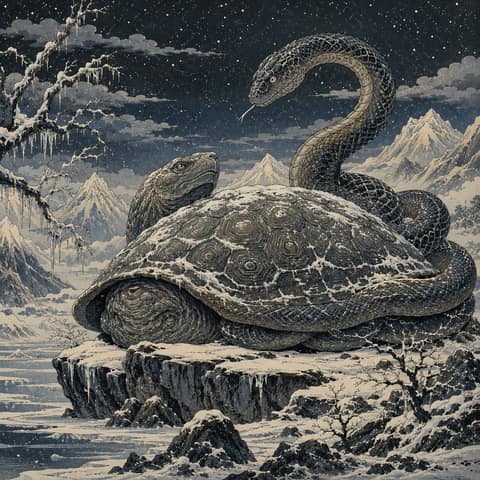
Genbu is the numinous beast of the north, Water, and winter, bearing the most singular form among the Four Symbols—the entwined form of tortoise and snake. This edition traces the meaning of that iconography and the notion of "land matching the Four Symbols" in Japan. Its origin is in the stars of heaven. The chain of the seven northern mansions (Dipper, Ox, Girl, Emptiness, Rooftop, Encampment, Wall) likened to a tortoise wrapped by a snake is Genbu. The Huainanzi's "Treatise on the Patterns of Heaven" makes the emperor of the north Zhuanxu and its beast Genbu, assigning it to Water, winter, and the dark (black). The dark is the color of the Water phase, figuring the northern winter sky into which all things withdraw. Two meanings overlay the tortoise-and-snake form. The first is the original sense—the figure of the stars of the seven northern mansions. The second is the symbol expounded by the Later Han Cantong qi, which sees the entwined form of tortoise (longevity) and snake (procreation) as the harmony of yin and yang, female and male. The latter is an interpretation overlaid on the original sense, and the two must not be confused. Genbu, too, was anthropomorphized in Daoism into "Xuantian Shangdi (Zhenwu Dadi)," but this is a development of a separate lineage from the directional-guardian Four Symbols of Japan. In Japan, Genbu was spoken of most concretely within the geomantic reading of "land matching the Four Symbols"—terrain backed by a mountain to the rear is held to be the auspicious position of Genbu. Yet the identification that "Heian-kyō is land matching the Four Symbols (the north, Genbu = Mount Funaoka, etc.)" is not a certainty from the time of the capital's founding, but a later interpretation organized and settled into doctrine around the 1970s, with even the identified sites differing among researchers. What is certain reaches only as far as the existence of the geomantic notion of "land matching the Four Symbols" in the Heian period. The Four Symbols' banners of the Shoku Nihongi are the literary first appearance, and the iconography keeps the tortoise-and-snake-intertwined form in the Genbu on the northern wall of the Kitora Tomb.

Giant Centipede

Giant Centipede

Epic

OH-oh-MOO-kah-deh

Giant Centipede (Mikami-yama Tradition)

Demons & GiantsShigaTochigi

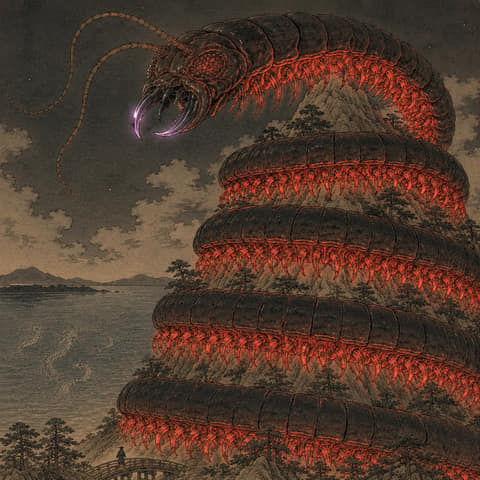
A famed form tied to legends of Mount Mikami in Ōmi and the shores of Lake Biwa. Said to coil around the mountain seven and a half times, its shell is as hard as metal or stone, impervious to arrows and blades. At night its legs gleam crimson, casting a long shadow over the lake and mountain skirts. Tales of its slaying are linked to martial valor and understood in relation to dragon-god worship and the numinous power of bridges. Connections to mining and blacksmith lore have been noted, though details remain unclear.

Goho-doji (Ototen & Wakaten)

Goho-doji (Ototen & Wakaten)

Rare

ごほうどうじ(おとてん・わかてん)

The Two Youths Protecting Shoku Shonin: Ototen and Wakaten

Deities / Divine SpiritsHyogo

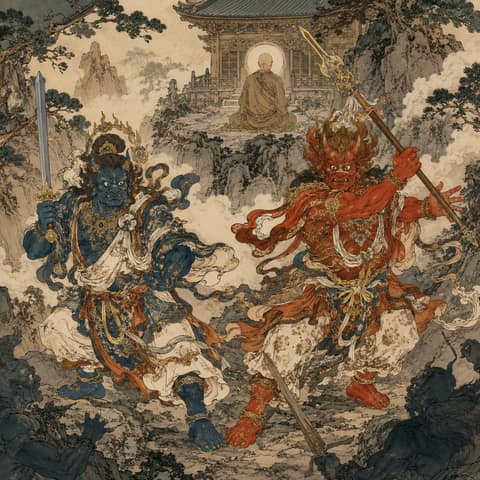
Ototen and Wakaten are a pair of *Goho-doji* (Dharma-protecting youths) who attended Shoku Shonin, the founder of Engyoji Temple on Mount Shosha. Ototen is said to be an incarnation of Fudo Myoo and Wakaten an incarnation of Bishamonten. In the forms of a blue ogre and a red ogre respectively, they protected the holy man on his left and right, fetching firewood and water and repelling enemies during his mountain asceticism. They embody the inherent duality of *Goho-doji*—fierce ogre-deities who nevertheless submit to a holy monk and protect the Buddhist teachings—within the context of Harima's mountain Buddhism. They are still enshrined today in the Ototen Shrine and Wakaten Shrine (built in 1559, Important Cultural Properties) next to the Okunoin of Engyoji Temple. Subjugating fierce power and turning it toward good—these child-formed ogre-deities commanded by highly virtuous ascetics reflect the religious imagination of medieval Japan.

Golden Crow

Golden Crow

Rare

KEEN-oo (Kin-ū)

Golden Crow

Animal ShapeshiftersChinese origin; transmitted to Japan

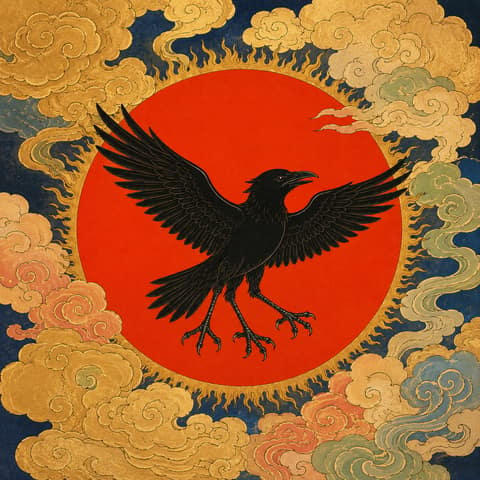
Rooted in ancient China, this iconographic Golden Crow took hold in Japan from the medieval period through religious art and Onmyōdō interpretations. It rarely appears in concrete怪談 and functions chiefly as a symbol. Its three legs are read as the yang number three, marking the sun’s course, authority, and auspice. In Japanese examples, a black crow is placed upon the solar disk held by the Sun Deva, with vermilion and gold backgrounds. Early modern texts sometimes liken it to solar sunspots, but its original nature is mythic and ritual. It recurs on imperial ceremonial garments, temple and shrine banners, and paintings, and in folk events crows may be used with archery targets or sun emblems. Later explanations sometimes confuse it with Yatagarasu, but their origins and roles are distinct.

Gongo

Gongo

Rare

ごんご

The Water Deity of Nozoki-buchi: Gongo

Water ApparitionsOkayama

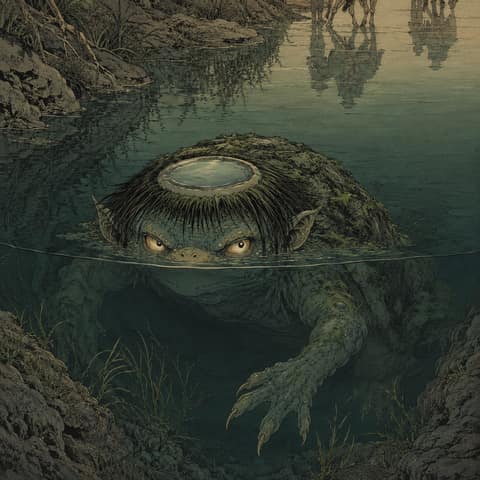
Gongo is a kappa whose home territory is "Nozoki-buchi" in the Yoshii River of Tsuyama. While possessing the general characteristics of a kappa (a dish on its head, a shell, a love for sumo, and a habit of dragging people and horses underwater), it is distinguished from kappa of other regions by its Mimasaka dialect name and the local lore of Nozoki-buchi. Its name is said to be either a corruption of "Kawako" (river child) or derived from the water deity "Kongo," embodying both the divine nature of governing water and the monstrous nature of causing drowning accidents. By dwelling in the river pools that flow through the castle town, it stands on the boundary between the urban space of Tsuyama and the waterside, acting as the narrator of taboos that keep children away from water hazards. Since the modern era, it has transformed into a festival icon and a mascot-like symbol, becoming the face of the local region.

Gooseflesh Specter

Gooseflesh Specter

Rare

MEE-no-keh-DAH-chee

Emaki Iconographic Type: Hair-Raising Figure

Household SpiritsJapanese folklore

An image-based yokai originating from picture scrolls without accompanying text, making its function and temperament hard to define. Its bristling, hair-standing posture suggests a visual motif of fear or dread, yet sources provide no explanation and no firm conclusion can be drawn. Names vary by source, and related figures may appear under different titles. Here, characterization is kept minimal, grounded only in the image’s form and the extant manuscripts.

Gotoku Neko (Trivet Cat)

Gotoku Neko (Trivet Cat)

Rare

GOH-toh-koo NEH-koh

Iconographic Tradition, Sekien-Centered Version

Animal ShapeshiftersJapanese folklore

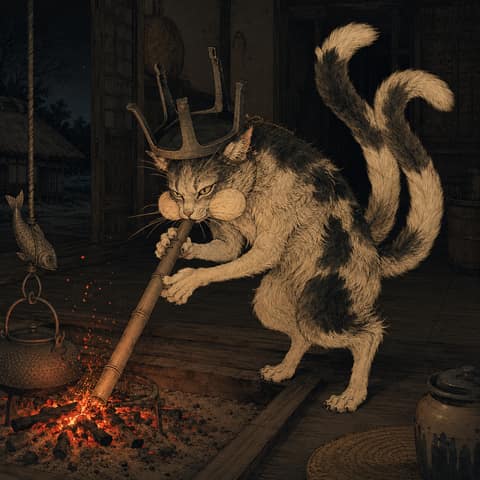
This version reconstructs the Gotoku-neko based on Toriyama Sekien’s original image and earlier iconography. An aged cat with a forked tail wears a trivet like a crown and lingers at the hearth’s edge. In Hyakki Tsurezure Bukuro, Sekien plays with the boundary between tool-spirits and animal-spirits, citing Tsurezuregusa’s “Crowned Trivet” and offering a punning interpretation. Thus the Gotoku-neko is not merely a monster cat but a symbolic being linking utensils and literary sources. The Muromachi-period Night Parade scrolls show a yokai bearing a trivet among figures balancing tools on their heads; Sekien follows that lineage while giving it a feline form. The postwar notion that it “kindles fire by itself” derives from later guesses about the depicted blowpipe; older records do not specify such acts. Accordingly, in this version it is restrainedly treated as an apparition seen by the hearth, attended by the presence of fire.

Grave Fire

Grave Fire

Rare

HAH-kah-noh HEE

Traditional Iconography Edition

Natural Phenomena SpiritsGraveyards across Japan, notably Kyoto Prefecture

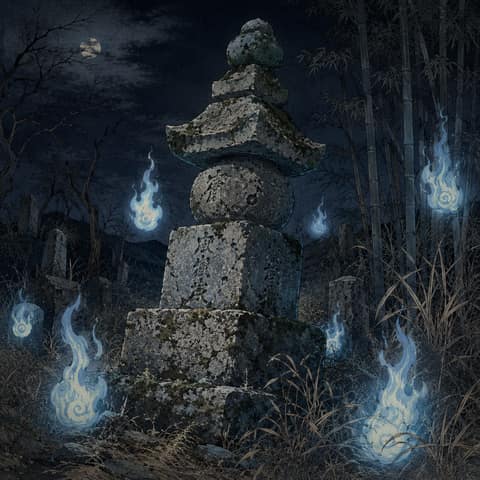
A grave-fire image based on Sekien’s iconography. The pairing of a ruined graveyard, overgrown thickets, and a five-ring stupa with worn Sanskrit letters symbolizes the idea of fire dwelling in places without kin or proper memorials. Early modern tales describe it as a phosphorescent flame rising from human fat or grave soil, yet also tell of cases where chanting sutras or repairing the stupa makes it vanish, showing the overlap of religious practice and naturalistic views. The flame drifts as if following human silhouettes, but slips away when touched. Malice is rare, and it is rumored to light the path ahead like a guide.

Great Catfish

Great Catfish

Epic

oh-nah-MAH-zoo

Traditional Version: The Great Catfish Subdued by the Keystone

Weather & Calamity SpiritsIbaraki

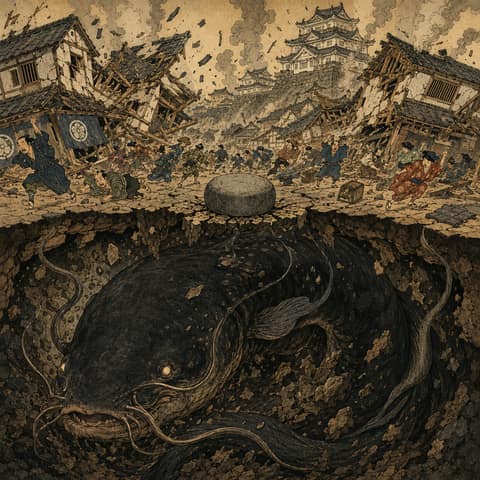
An image based on the early modern belief that a great catfish causes earthquakes and is held down by the keystones of Kashima and Katori Shrines. The ancient notion of an underworld dragon-serpent was reworked in early modern urban society into imagery for interpreting disasters and critiquing the times. After the Ansei Earthquake, many namazu-e prints were published, adding allegories of recovery and debt relief. Here the great catfish lies in the subterranean mud, at times shuddering to cause quakes, yet is pacified when pressed by the keystone. Regional lore links it to origin tales of stones, landforms, and river courses, serving as markers of shrine-temple origins and local spiritual power. It appears in early modern documents, broadsides, and origin tales without fixed personal names or lineage, told as a symbolic personification of earthquakes rather than an observed creature, with a yokai framework for interpreting calamities at its core.

Great Head

Great Head

Epic

OH-oh-KOO-bee

Hybrid Sources, Record-Grounded Version

Ghosts & SpiritsVarious provinces (attested in Edo, Kaga, Nagato, and elsewhere)

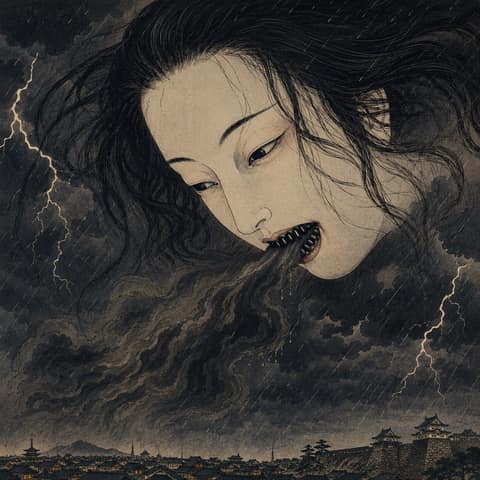
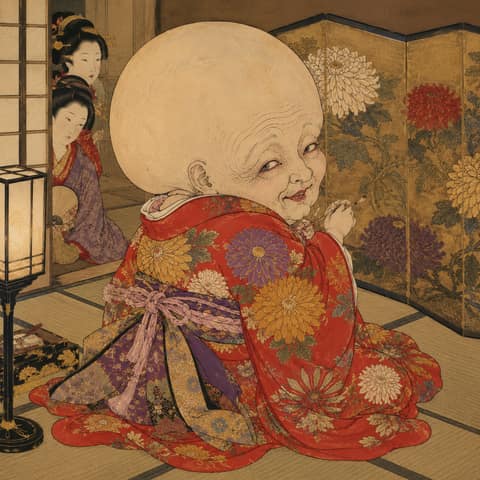
The Okubi is a type formed where images and records intersect. While Sekien’s depiction is noted for satire, Edo-period tales and essays contain many independent accounts of a gigantic woman’s head appearing. Common traits include manifesting during shifts in the heavens such as rainy nights, thunder, or moonrise, fixing itself to walls, doorways, or midair, the depiction of blackened teeth indicating a married woman, and a chill, stench, and dampness when approached. Its true nature is unsettled, described either as a spirit shaped by grudge or as fox or tanuki sorcery. Malice varies, from mockery, glaring, and breath that causes malaise to mere display before vanishing. Physical attacks rarely take effect, with reports of little resistance when stabbed. It is widespread in regions such as Chubu, Chugoku, and Kanto, without becoming a localized deity. The modern image of a “flying Okubi” owes much to Sekien, yet old texts also record appearances on the ground and indoors.

Great Nyūdō (Giant Priest Apparition)

Great Nyūdō (Giant Priest Apparition)

Epic

oh-oh-nyoo-DOH

Annotated Traditional Edition: Ōnyūdō (Giant Priest)

Demons & GiantsMie

The Ōnyūdō is defined by its sheer size and piercing glare. Reports range from a monk-like giant with a topknot to a vague shadowy figure, appearing in liminal places such as night roads, temple and shrine grounds, mountain passes, and lakesides. It draws the gaze of onlookers and, the instant they look up, grows taller to assert its might. Explanations of its nature vary by locale: a transformed animal, the spirit of an old stone pagoda or boulder, or an unclassified anomaly. Harmful cases include people collapsing under its stare or developing fever afterward, yet in places like Awa it is also told as a semi-guardian that helps with labor. Countermeasures follow traditional banishment methods: do not fear or avert your eyes, break its menace with arrows or prayer beads, or expose the true form of the shapeshifter. Historical sources sometimes mix names like Ōbōzu and Ōnyūdō, so it is best understood within local traditions.

Great Spider

Great Spider

Epic

OHH-goo-moh

Great Spider of Mountain and Wilds

Animal ShapeshiftersNagano

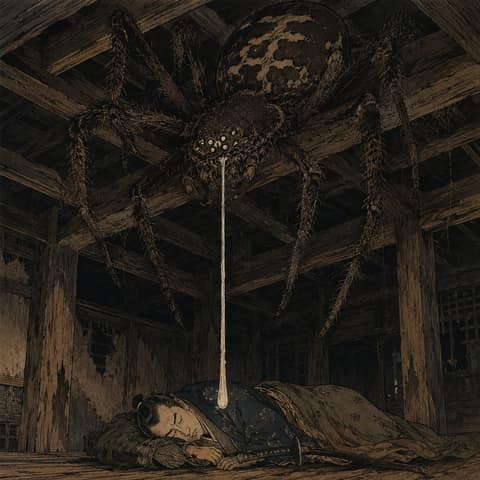
A tradition-grounded composite of spider apparitions said to gain occult power through great age, lurking in mountain passes, temple rafters, and caves. Appearances range from an ordinary spider grown enormous, to a hairy arm extending from the ceiling, to an old woman in human guise. Avoiding notice, it moves by night, saps vital energy, and binds victims with silk. In slaying tales it often retreats after its limbs are severed by blades, or reveals its true form and is later found as a corpse. Names and lairs vary; reports surface sporadically in local curiosities and essays. Though terms like yamagumo and tsuchigumo sometimes overlap, here it refers broadly to eldritch old spiders.

Showing 97 - 120 of 473 yokai