YOKAI.JP

Traditional Yokai Encyclopedia

Yokai passed down through the ages

473 Yokai|17 Category|Page 2 of 20
Localization in Progress - More content available in Japanese version
View Japanese
Sort by: NameAscending
Bake no Kawagoromo

Bake no Kawagoromo

Rare

ba-ke no ka-wa-go-ro-mo

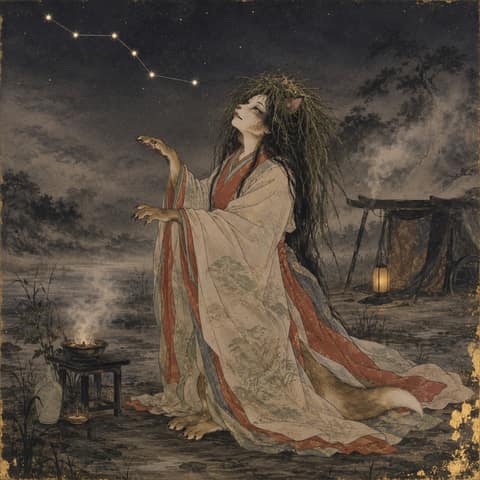
The Dipper-Worshipping Fox of Transformation — Bake no Kawagoromo

Animal ShapeshiftersUnknown (a fox-transformation figure recorded in Sekien’s Hyakki Tsurezure Bukuro)

This version reads the Bake no Kawagoromo through a single point — the fox that transforms by worshipping the Dipper — and follows the rite of its making and the layers of wit folded into the picture. The passage in the Nuogaoji of the Youyang Zazu, the other source, speaks of more than a skull and the Dipper. There the wild fox is called the “purple fox,” and it is said that “when it strikes its tail at night, fire comes forth.” This stroke of fire from a fox’s tail runs continuous with the foxfire so familiar in Japan; behind the Bake no Kawagoromo, too, stands a fox that should by rights be eerie — kindling fire at its tail in the dark, a skull upon its head. When Sekien exchanged that skull for algae, the dread of the bones faded, and in its place came the comedy and pathos of a creature crowned with weed from the water’s floor. That the picture of transformation leans toward the droll rather than the uncanny is the effect of this single substitution. The word “kawagoromo” itself carries the literary turn Sekien favored. Speak of a kawagoromo, and the most famous in the classics is the “fire-rat’s robe” of the Tale of the Bamboo Cutter — that treasure which burns when set to flame and, if counterfeit, betrays the fraud. It and this fox, whose disguise is about to peel, answer one another twice over through the words “kawagoromo” and “bake no kawa.” There is no written proof that Sekien meant to invoke the allusion, but given how thoroughly his picture-books tread upon classical puns, it is hard to take for mere chance. The placement of the image, too, shows the author’s intent. In the first volume it sits between the “Kutsutsura” and the “Kinu-danuki.” Flanked on both sides by transforming beasts, this run forms a small province set within a book of tool-spirits, given over to the transformations of animals. A fox could crowd in among the spirits of old utensils only because “kawagoromo” could be read as a garment, a thing; and by closing with “mused within a dream,” Sekien made this forced pairing follow, naturally enough, the logic of dreams. Its powers and its failings, too, are all rooted in this one picture. The rite of transformation requires prayer toward the Dipper and a vessel borne on the head (a skull, or algae); should the vessel fall, the change does not take. Dressed though it is as a beautiful woman, it cannot quite clear away the beast in its tail, its paws, its attendants — and that “about to peel” is this fox’s appointed weakness. The lowly wild fox, striving three thousand years to reach the figure of a beautiful woman, bears in itself all the longing and all the shortfall of that road.

Bake-jizo

Bake-jizo

Rare

ばけじぞう

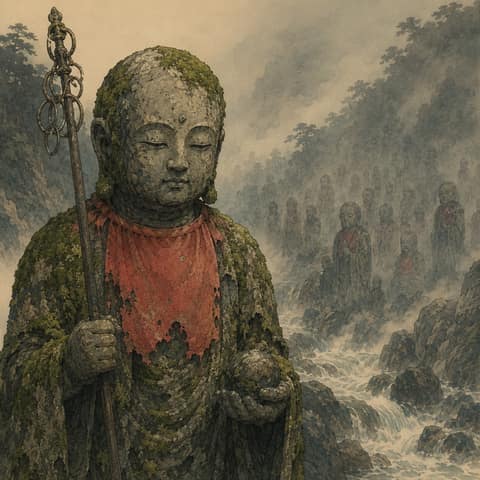
Narabi Jizo of Kanmangafuchi Abyss, Whose Number Changes Every Time They Are Counted

Spirit/GhostTochigi

Along the banks of Kanmangafuchi Abyss, Jizo statues wearing red bibs line the river. Walking while counting them one by one, and counting them once more on the way back, the numbers somehow do not match—hence they are called Bake-jizo (Ghost Jizo) and Narabi Jizo (Lined-up Jizo). The sight of moss-covered stone Buddhas quietly sitting in this rugged gorge carved from the lava of Mount Nantai evokes a sense of time distortion unique to sacred grounds. Many Jizo were washed away by a flood during the Meiji era, and only their pedestals remain here and there in the broken lines. In the single aspect of not being able to determine their number, this is indeed an anomaly, while simultaneously remaining a place of deep prayer.

Bakeneko

Bakeneko

Legendary

bah-keh-NEH-koh

Bakeneko

Animal ShapeshiftersSagaTokushima

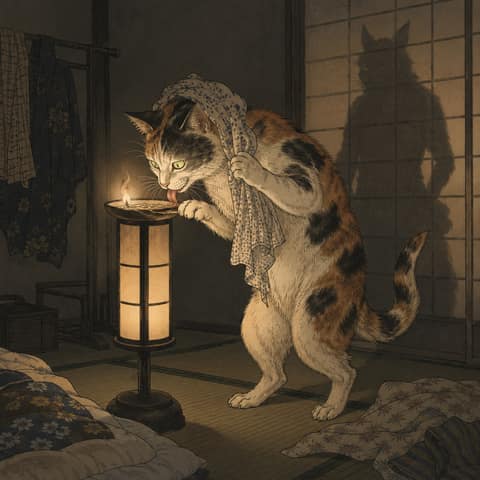
A consolidated image of the bakeneko based on Edo-period woodblock prints, printed books, and oral tradition. An aged house cat, or one abused by humans, becomes a yokai imbued with vengeful spirit. Portents include licking lamp oil, standing on two legs, and taking human form to slip into a home. Its curses typically target owners or abusers, manifesting as illness, strange deaths, or household decline. Interfering with funerary rites and desecrating corpses are recurring motifs, and tales often end with pacification by monks or ritual prayers. Early modern folk beliefs feared long-tailed cats as gaining occult power, leading to taboos about tail length. Boundaries with the nekomata are blurry, and when the forked tail is not emphasized, the creature is commonly called bakeneko. Urban entertainment refined the monster-cat image, even linking it with courtesan motifs, yet at its core lies awe of a familiar animal and a worldview of gratitude and retribution.

Bakezōri (Haunted Straw Sandal Tsukumogami)

Bakezōri (Haunted Straw Sandal Tsukumogami)

Uncommon

bah-keh-ZOH-ree

Tsukumogami Sandal Spirit

Animated Objects & UndeadJapanese folklore

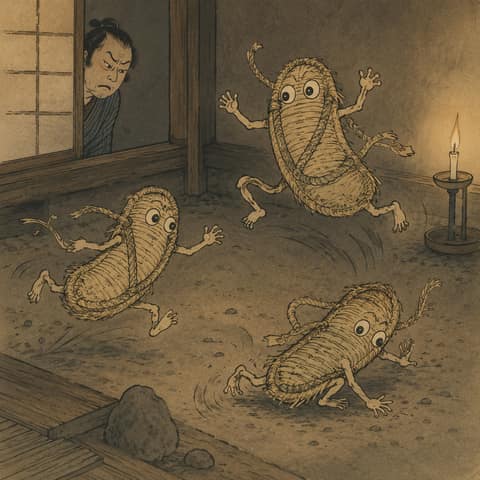
A reconstructed image based on medieval to early modern depictions of sandal tsukumogami. Straw sandals were everyday items that wore out quickly and were often discarded, so after a certain number of years they were thought to gain a resident spirit. It reveals itself with noisy nighttime footsteps and aimless hopping, yet causes little harm. The “singing footwear” anecdote found in modern yokai encyclopedias likely conflates a geta folktale and lacks firm evidence as a distinct tradition of the straw-sandal specter. In folklore studies it is understood as a visual emblem of the norm “do not treat tools carelessly,” and is classed as one type within the broader category of tsukumogami.

Bakotsu

Bakotsu

Uncommon

Bakotsu

The Walking Bakotsu of Tosa

Tsukumogami / Skeletal YokaiKochi

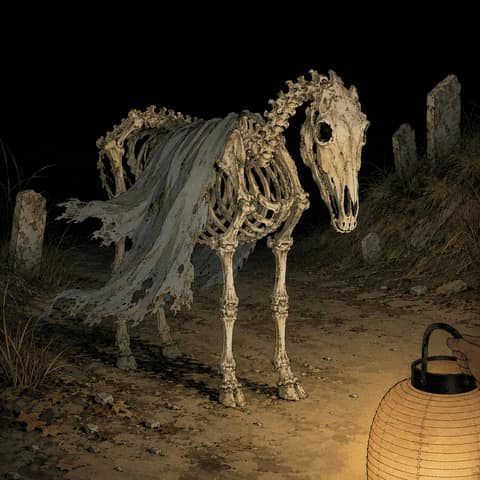
The visual depiction of Bakotsu in the *Tosa Obake Zoshi* adopts an extremely unique and theatrical narrative composition among Japanese yokai art. In a dimly lit room, separated by a torn and sagging old mosquito net, the bipedal, skeletal "Bakotsu" and a giant toad yokai named "Yadomori" are seated facing each other, as if quietly recounting their respective life stories. Though Bakotsu is a complete skeleton with its ribcage and skull entirely exposed, it wears a crude cloth wrapped around its waist, displaying remarkably human-like gestures. This bizarre confrontation hides deep folkloric roots specific to the Tosa region. "Yadomori" is the regional Shikoku dialect for a toad, which was originally revered as a beneficial creature and a "guardian deity of the house" that ate pests, and thus was strictly forbidden to kill. However, the scroll's explanatory text establishes that this particular toad was cruelly killed by humans and turned into a yokai out of sheer resentment. In other words, both the "Bakotsu" (burned to death in a fire and left on the roadside) and the "Yadomori" (unreasonably murdered by human hands) share a common background: they are "the grudges of animals that lost their lives due to the selfish convenience of humans and were denied proper burial." Their conversing within the boundaries of a mosquito net—a symbol of human daily life—can be deeply interpreted as expressing the tragic solidarity of "beasts" cast aside into the dark corners of human society. Additionally, in the Edo period, there was a custom of extracting fat (bone fat) by boiling horse bones to make extremely cheap, poor-quality candles, which were referred to in slang as "horse bones" . The coincidence between the remains of a horse used as a cheap candle to light the dark, and a yokai born from being burned to death in the disaster of a "fire," is by no means accidental. The practical wisdom of the people at the time and the dark underbelly of a society that thoroughly exploited life are sharply projected onto the visual design of the Bakotsu yokai. Standing up not to curse humans, but simply to assert its existence, its figure is the very embodiment of the anguished cries of voiceless animals.

Baku (Dream Eater)

Baku (Dream Eater)

Uncommon

ba-ku

The Baku of the Pillow

Divine SpiritsChinese in origin; nationwide in Japan (Edo-period dream-warding custom)

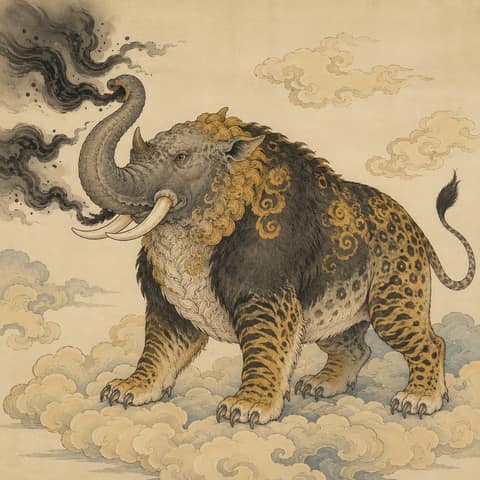
The name “Baku of the Pillow” comes from this beast having been cherished, above all, as a guardian charm at the bedside. Here, rather than the tale of eating dreams, let us turn to the baku drawn upon the pillow itself. A baku pillow is a pillow on whose box-shaped side a picture of the baku or the character for baku was drawn, or on which a baku was worked in maki-e lacquer; rest your head on it to sleep, it was believed, and through the whole night nothing evil would draw near. According to Yano Ken’ichi’s study of the pillow, the baku pillow was no mere ornament but a practical charm, made to guard the most defenseless stretch of time — the hours of sleep. Trace the baku’s form to its roots and two streams run mingled within it. One is the figure transmitted by the Shuowen Jiezi and the commentary on the Erya: a bear-like body mottled black and white that eats even copper, iron, and bamboo. This derives from a real beast of Sichuan in China (most likely the panda). The other is the figure in the text Bai Juyi attached to a screen painting — “trunk of an elephant, eyes of a rhinoceros, tail of an ox, feet of a tiger.” Japanese painters and encyclopedias drew the baku by joining these two. That familiar figure — a black-and-white mottled bear’s body with a long trunk and short legs — is the result of the two becoming one. The baku was drawn on more than pillows and charm-cards. Carvings of the baku are often found on shrine and temple buildings as well. On the kibana that support the roof and on the kaerumata (the gable-shaped member above the beam), baku were carved, charged with keeping fire and calamity at a distance. As the baku at the bedside guards sleep, the baku on the building guards the house. Both arise from the same idea — placing a baku at the threshold where evil would enter — and so it appears on pillow and on building alike. The baku is often mistaken for another spirit-beast, the baize, and here too I would make the difference plain. The baize is a beast said to understand human speech and to know every yokai in the world — originally a thing apart from the baku. The trigger for the confusion lay in the line Bai Juyi added about the baku, that “in common speech this is called the baize.” Because both were alike in being “beasts that drive off evil,” the mix-up occurred in pictures too, and there is even a known case where an image called the “Baku King” was in fact a baize to begin with. The baku and the baize are best kept apart in thought as separate beasts — alike in office, but different in origin. Seen this way, the Baku of the Pillow is neither a monster that steals dreams nor a yokai that attacks people. It is a sentinel, charm-like, set at the “gaps where evil slips in” — the bedside as one sleeps, the doorway of the house. Together with the way the Wakan Sansai Zue spread the baku’s form and its evil-warding power through the world, people drew the baku on pillows, on charms, and on the beams of shrines and temples, setting it to keep watch over bad dreams and calamity without end. What the name “pillow-beast” reflects is this face of the baku as a quiet keeper of watch.

Banana-Plant Spirit

Banana-Plant Spirit

Rare

bah-SHOW-noh-SAY

Tradition-Faithful, Sekien Illustrated Edition

Natural Phenomena SpiritsNagano

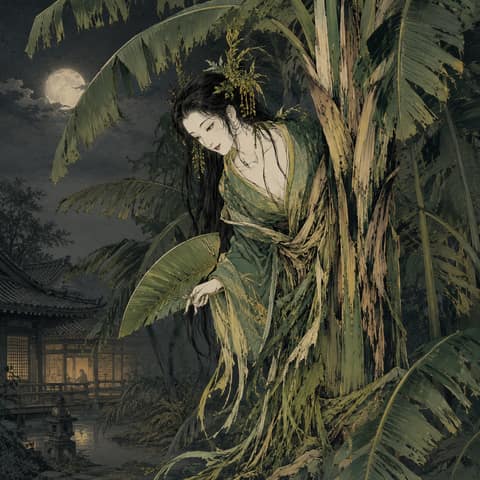
A整理 based on the plant-spirit of banana (bashō) as pictured in Toriyama Sekien’s Konjaku Hyakki Shūi. The broad leaves rustle and cast uncanny shadows in wind and rain, thought to summon the strange, with the belief that an aged clump comes to harbor a spirit. It takes the form of a beautiful woman to unsettle both clergy and laity, posing the riddle of whether grasses and trees can attain Buddhahood, and vanishes depending on one’s response. Tales include encounters in Ryukyuan banana groves, an apotropaic rule that those who carry blades are spared, and Shinano stories where striking it leaves the bashō stalk wounded by morning. It is not consistently harmful, more often serving as a warning through shock and confusion. Typical settings are temple gardens, banana plots, and manor yards.

Basan

Basan

Epic

BAH-sahn

Tradition-Faithful Iyo Type

Animal ShapeshiftersEhime

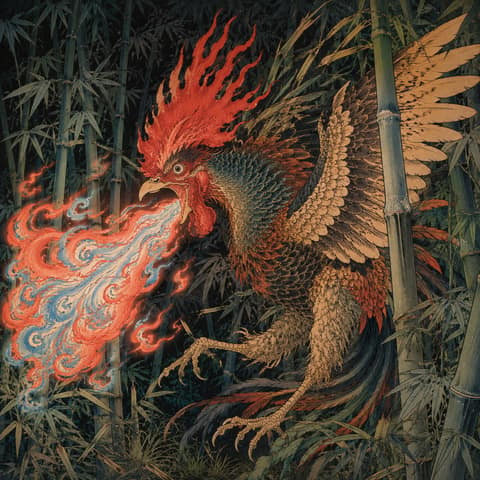
This version follows accounts from Iyo, portraying it as a monstrous bird lurking in mountain bamboo thickets. It resembles a chicken with a striking red comb, and in the dark only the comb and the fire it exhales are visible. Its expelled fire is a will-o’-the-wisp without heat that does not ignite objects, said to flicker suddenly along night roads and village borders, leaving a strong memory of beating wings. Nocturnal in habit, it reacts sharply to signs of doors opening or moving lights such as torches, and retreats into the thicket at once. Reports of harming people are scarce, with encounters mostly limited to startling passersby, and villages regarded it as an ambiguous sign of the mountain’s presence—neither auspicious nor ill-omened. Early modern sources also note views likening it to a fire-eating bird and names derived from its wingbeat, blending natural-history notes with tales of the uncanny. In folk belief it is placed among boundary spirits marking the divide between mountain and settlement, a gentle anomaly linked to both ghost-light lore and bird-yokai traditions.

Batsu (Hiderigami)

Batsu (Hiderigami)

Epic

BAHT-soo (hee-DEH-ree-gah-mee)

Bibliographic Transmission Batsu (Hiderigami) of the Wakan Zukai Lineage

Deities & Divine SpiritsChinese tradition (transmitted to Japan through texts)

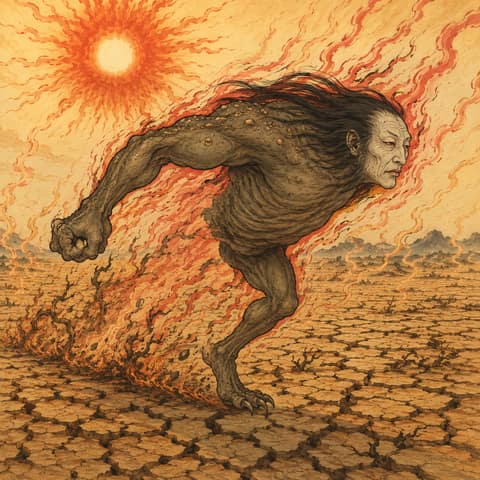
In Japan, images of the batsu (Hiderigami) were received mainly through later Chinese writings and bibliographic transmission. The Wakan Sansai Zue cites Sancai Tuhui, Bencao Gangmu, and Shenyijing, explaining that the batsu, called the “drought god,” has a human face and beastly body with a single hand and a single foot, runs like the wind, and wherever it dwells no rain will fall. Toriyama Sekien’s Konjaku Gazu Zoku Hyakki visualizes this composite form and notes the alias “Hanmu.” Rather than native Japanese yokai lore, these accounts reflect learned reception of Chinese views on calamities and calendrical omens, treating the batsu as an ideational symbol of drought more than an eyewitnessed apparition. Its form is not fixed, with a goddess aspect (Bo) and a beast-shaped aspect coexisting, though Japanese sources tend to emphasize the latter. Religious responses align with general drought countermeasures such as rain prayers and water-deity rites, and clear cases of direct worship of the batsu itself are not well attested. As a calamity deity, its approach was thought to wither plants and exhaust human spirits.

Battlefield Will-o'-Wisp

Battlefield Will-o'-Wisp

Uncommon

koh-SEN-joh-bee

Battlefield Will-o’-the-Wisp (Classical Form)

Demons & GiantsOsaka

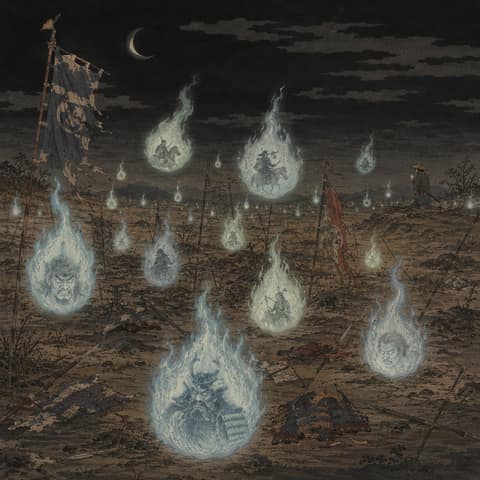
A standardized image of the battlefield will-o’-the-wisp as seen in Edo-period picture scrolls and ghost tales. Most appear as multiple pale fireballs at midnight, drifting low as if against the wind. They are thought to rise as spirit-fire from the defilement of blood and corpses saturating the ground, each flame regarded as a fragment of the aura of soldiers and horses. Accounts describe repetitive behavior—circling fixed spots, appearing and vanishing, crossing rice-field ridges—rather than chasing people. Witnesses would recite prayers to withdraw, and villages calmed them with memorial services. Sekien used the term “Kosenjō-bi” to group uncanny fires at battle sites, framing many postwar fire tales found in works like Yadonokigusa. Malice is rarely attributed; they were respected as signs of unsettled souls.

Betobeto-san

Betobeto-san

Epic

betobeto-san

The Footsteps Echoing on the Night Road

Mountain/Field YokaiNaraShizuoka

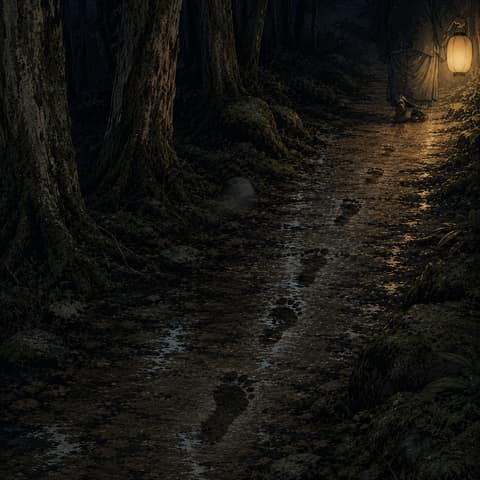
In this version, we interpret Betobeto-san as an "invisible companion of footsteps." While there are many unseen yokai, it is rare to find one like Betobeto-san that is established solely by the sense of distance in sound. The footsteps seem to be right behind you, yet they never catch up. Turn around, and they vanish; start walking, and they begin again. Through this repetition, the walker is forced to harbor the unshakable sensation that "I am not alone," a feeling they can neither prove nor deny. It is crucial that the stage for this yokai is the "road." A mysterious sound inside a house would be a phantom of the parlor or ceiling, but Betobeto-san clings to the body in transit. On a night road, a person has no choice but to move forward; they cannot continuously check behind them. When footsteps occur in this context, fear is locked just outside the field of vision. Because the sound from behind approaches from the place the human body finds hardest to verify, it generates a far more sustained anxiety than a yokai with a physical form. The phrase "Please go ahead" (Osaki e okoshi) is the central etiquette of this version. Betobeto-san is not exterminated, but rather given a turn to pass. This concept reflects a folkloric attitude of treating the yokai not as an enemy, but as a fellow traveler encountered on the road. By calling out, the invisible footsteps transform from a threat behind into a companion walking ahead. Changing the position of the fear is the best way to handle this anomaly. Shigeru Mizuki's iconography converted a formless sound into an approachable yokai. The figure resembling a small shadow wearing a hat was easy even for children to remember, popularizing Betobeto-san as a character. However, in this version, the focus is placed heavily on sound rather than imagery. If seeing a round figure puts one at ease, then half of Betobeto-san's original power is lost. Precisely because it is unseen, it expands and contracts within the imagination of the listener. Despite being a yokai of little harm, Betobeto-san alters the very nature of solitary walking. On a path that should be empty, another rhythm that mimics one's own stride overlaps. Ignore the sound, and it stays behind; acknowledge it and yield, and it moves ahead. In other words, this anomaly teaches the minimum folkloric manners required to walk a road alongside the unseen. In this version, the footsteps are read not only as the "presence of an other," but also as the "echo of one's own anxiety." Betobeto-san's sound appears to come from the outside, yet it syncs perfectly with one's own walking. If it were completely an other, the distance should fluctuate, but because it continues at exactly the same interval, the listener cannot separate the external anomaly from their internal unease. Therefore, the phrase "Please go ahead" is simultaneously a greeting directed at an external yokai and a physical gesture of sending one's own anxiety forward. By shifting what is stuck to one's back to the front, a person is finally able to keep walking. Betobeto-san is not a monster to be slain, but a yokai that realigns the physical and mental rhythm of the walker. What remains at the end of this version is the small ethic of yielding the road. Rather than forcefully pushing forward while ignoring the unseen, one offers a brief word to the presence that might be there. Betobeto-san seems like a weak anomaly, but it serves as a reminder that humans do not monopolize the dark roads.

Big-Headed Boy

Big-Headed Boy

Uncommon

oh-AH-tah-ma koh-ZOH

Edo Kibyoshi and Picture-Book Source Edition

General ClassificationsEdo period

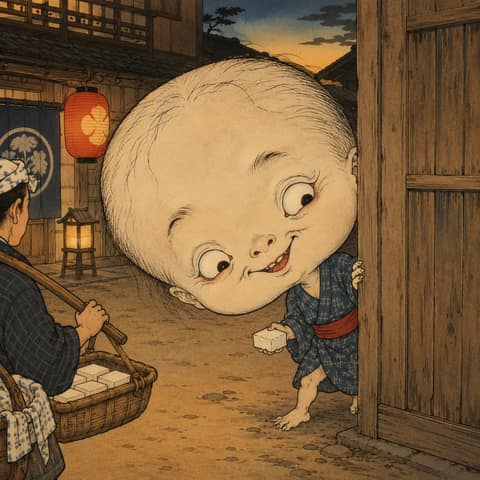
Organized around depictions found in kibyoshi and picture-books from the Tenmei to Kansei eras. In Yohkai Chakutōchō it is placed as a grandson of the Mikoshi-nyūdō, with lines stating it bullied a tofu seller to obtain tofu, and its image features an oversized head on a childlike body. A similarly big-headed boy appears in Bakemono Yofuke Omi-se under a different name, and scholars note its word-proximity to the sideshow and street performance “Choroken.” In modern times it is often confused with the Tofu-kozo, but folklorists advise against conflation and favor respecting each source’s naming and design differences. Shigeru Mizuki emphasized its beast-like bare feet and huge head and presented it as distinct from the Tofu-kozo.

Biwa Bokuboku

Biwa Bokuboku

Epic

BEE-wah BOH-koo-BOH-koo

Canonical Iconography

Animated Objects & UndeadJapanese folklore

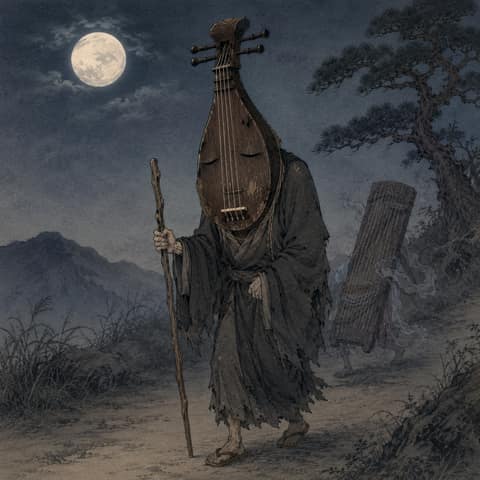
A standard reading grounded in Sekien’s imagery and the lineage of Muromachi picture scrolls. A biwa long played and cherished attains spirit, joins the night parade clad like a blind lute priest. Its tone captivates the heart and carries an allegory urging awe and respect for venerable instruments. It does not hinge on particular biographies or local lore; praise of crafted objects and cautionary reverence are its themes. Tales tied to famed instruments such as Genjō and Makiba serve only to frame the tsukumogami worldview, while the conduct of the Biwa Moku-moku itself survives chiefly in pictorial form. In images it walks with eyes closed, leaning on a staff, sometimes paired on the same spread with a koto tsukumogami.

Black Hand

Black Hand

Uncommon

KOO-roh-teh

Lore-Faithful

Household SpiritsIshikawa

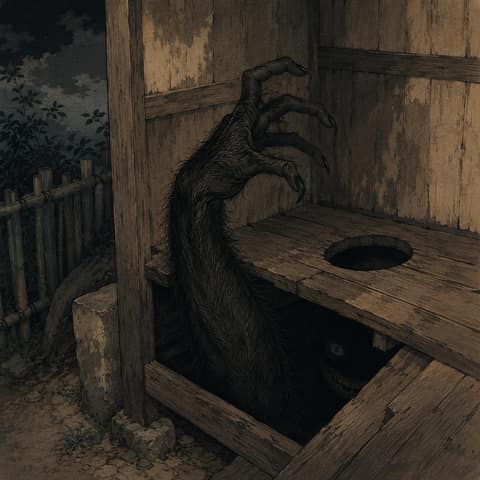
An image organized from the account “Kurote-giri” in volume six of Shifugoroku. The Black Hand dwells in household privies, extending only a black, shaggy hand to harry people. Its true form can disguise itself and once, in the guise of a monk, retrieved its severed hand. When it shed the disguise it was said to stand nearly nine shaku tall, possessed great strength, and displayed a strange power that enveloped a person. It combines motifs common in early modern toilet ghost tales—“the hand,” “a smothering presence,” and “a transforming monk.” Though often confused with fox or raccoon-dog tricks, the text explicitly names it “Kurote.” Visual depictions are not fixed, and Mizuki Shigeru’s portrayal is thought to reflect other traditions, so features like three fingers or simian traits should not be generalized.

Blue Heron Fire

Blue Heron Fire

Epic

ah-oh-SAH-gee-bee

Canonical Folklore Version

Animal ShapeshiftersNaraNiigata

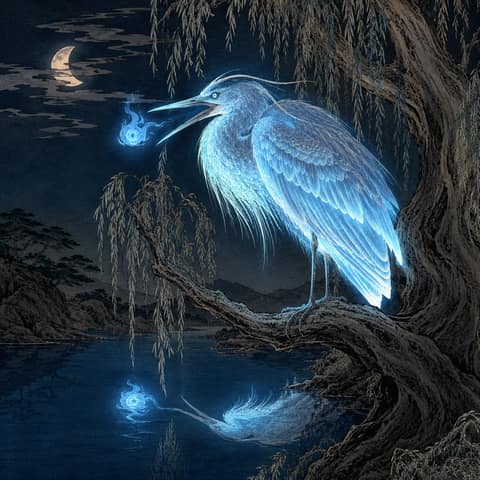
Aosagibi is told as the pale blue glow seen around night‑active herons such as the black‑crowned night heron, appearing above water or against the night sky. In the Edo period it was depicted by Sekien and recorded widely in essays. Willows and ancient plum trees, river mouths and inlets, and shrine and temple precincts—places where “ki gathers”—were feared as haunts where mysterious fires would linger, and cases are told where a shot “ghost light” proved to be a heron. Explanations noted since early modern times include moonlight and water reflections, the sheen of wet feathers, the glare from white breast plumage, or microorganisms at the waterside, showing how people moved between natural causes and yokai tales. Other strands say old night herons faintly glow by season, turn into fireballs, or breathe fire, letting tales of ghost lights, strange birds, and dragon lamps intersect. Though eerie, many stories end with the creature merely being a bird once brought down, emphasizing its nature as a misperceived apparition.

Blue Lady-in-Waiting

Blue Lady-in-Waiting

Rare

AH-oh NYOH-boh

Emaki and Sekien Lineage Iconography

Half-Human BeingsJapanese folklore

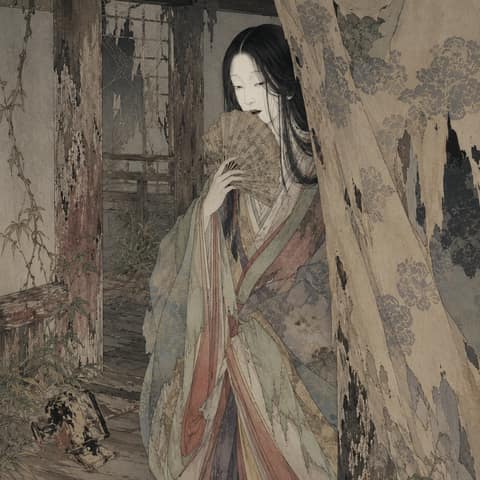
Aonyōbō here is less a creature of a fixed tale than a court lady’s image turned uncanny and circulated as iconography. Sekien paints her as a lady-in-waiting haunting a ruined old palace, exaggerating obsolete rites and cosmetics—ohaguro and painted brows—to give her a ghostly air. In Night Parade scrolls she often appears with ladies’ accoutrements such as curtains, mirrors, and fans, quietly following the procession. The name derives from the social title aonyo (young lady-in-waiting), making the yokai label largely retrospective. While a record of an “aonyo” exists in the Azuma Kagami, identification is cautious, sharing only the appearance of a young court woman. Local lore offers few concrete episodes, and the setting is typically a decayed palace or the parlor of an old house. Despite its creative coloring, this is a leading example of a pictorial yokai that renders the afterimage of court culture as the uncanny.

Bone Woman

Bone Woman

Rare

HOH-neh-ON-nah

Bone Woman (after Sekien Toriyama)

Half-Human BeingsEdo period (print tradition)

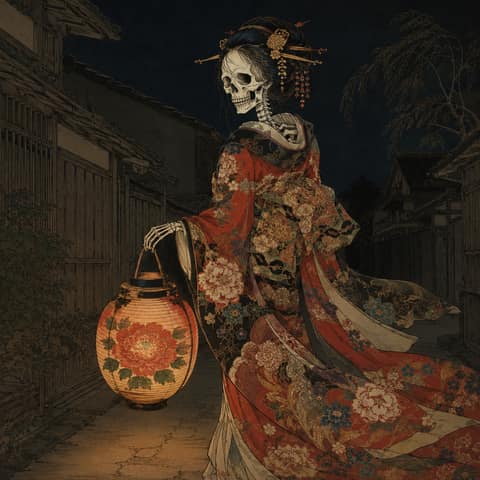
This version is based on the Bone Woman image in Toriyama Sekien’s Konjaku Gazu Zoku Hyakki. She is a skeletal woman who carries a peony-patterned lantern and visits the home of her beloved in the late night. The source is the ghost tale “Peony Lantern” in Asai Ryōi’s Otogi-bōko. Sekien visualized its core motifs—the inversion of a lovely face and a skeletal body, and the link between lamplight and erotic affection. Rooted in Edo-period notions of vengeful fixation and shifting appearances common to yomihon and kaidan, the figure is an iconographic type rather than a legend tied to specific locales or persons: not a land deity or beast, but a visualization of a passion-bound revenant. Peonies, lanterns, and night roads are its key nodes. While later lore speaks broadly of walking skeletons, this image stresses appearances born of yearning and nocturnal trysts.

Boroboroton

Boroboroton

Rare

boh-roh-boh-roh-TOHN

Sekien Zufu Edition

Animated Objects & UndeadEdo period, Japan

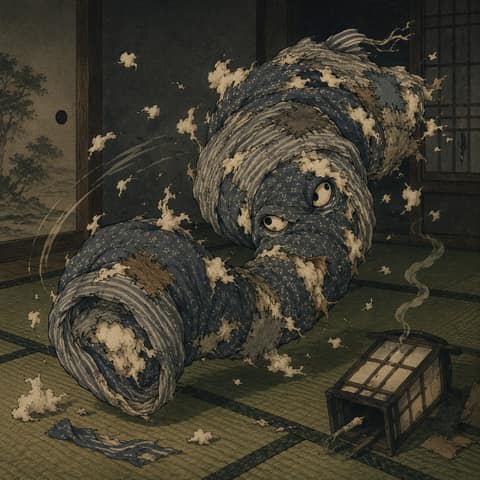
An image based on Toriyama Sekien’s Hyakki Tsurezure-bukuro. A futon long used and then cast aside rises at night, bounding about the room to startle its former owner. Its malice is mild, acting mainly as a chastening presence that creates a commotion to spur repentance. The name is often read as a play on the tattered fabric’s “boro-boro” and the term for Fuke Zen monks, intertwining beliefs about spirits inhabiting tools with literary wit. Though local folk attestations are scarce, iconographically it is treated as a link in the lineage of tsukumogami tales.

Borrowed Sieve Hag

Borrowed Sieve Hag

Uncommon

mee-KAH-ree bah-BAH

Lore-Faithful Edition

Mountain & Wilderness SpiritsKanagawa

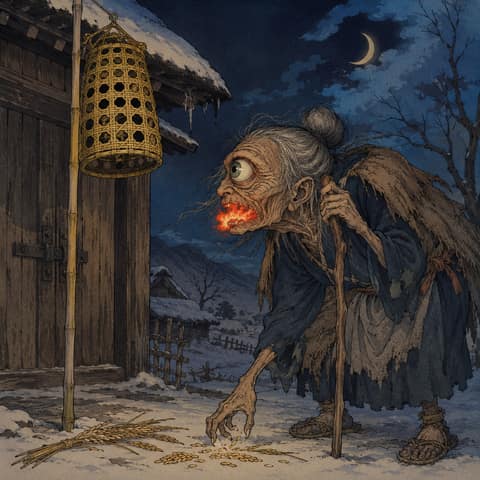
A整理 of the Mikari-bā (Mikakari-bā) yokai as preserved in folklore. She appears on Koto-yōka (the eighth days of the month) as a one-eyed crone, enforcing restraint on housework and outings. Her act of “borrowing” winnowing baskets and human eyes links to avoidance of mesh-patterned tools and symbols with many eyes, giving rise to countermeasures like placing baskets or sieves at the gate, or fixing a mesh basket to a pole on the roof ridge. In the Kōhoku, Yokohama accounts, her greed extends to gleaning even fallen ears of grain, and depictions of her carrying fire in her mouth serve as a caution against conflagration. In southern Chiba, customs of taboo and house-seclusion called “Mikari” (body-substitution) recast pre-festival liminality as a yokai rule. Despite regional variation, these tales share a framework that transmits norms of household safety, fire prevention, and labor abstinence at seasonal thresholds from winter to spring. Creative embellishments are set aside in favor of points attested in Kanto eyewitness reports and folklore records.

Boze

Boze

Common

Boze

The Visiting Deity of Akusekijima

Gods & SpiritsKagoshima

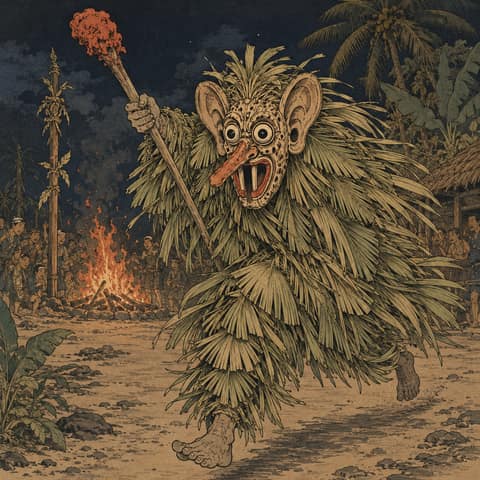
It is believed that the Boze was once widely worshipped across the various islands of the Tokara archipelago, but today, Akusekijima is the only place where its original form survives. During the Obon period, this deity not only guides the spirits of the dead (ancestors) who have returned to this world back to the other shore, but also infuses the living with vitality. This ritual deeply preserves the extremely primitive form of Japan's ancient *raihoshin* (visiting deity) faith. By visualizing a "visitor from the other world" through masks and costumes, this event functions as a crucial spiritual foundation for living in harmony with the harsh nature of the southern islands and strengthening the solidarity of the community.

Broom Spirit (Hōkigami)

Broom Spirit (Hōkigami)

Epic

HOH-kee-gah-mee

Folk Belief Version – Broom Deity

Deities & Divine SpiritsVarious regions across Japan

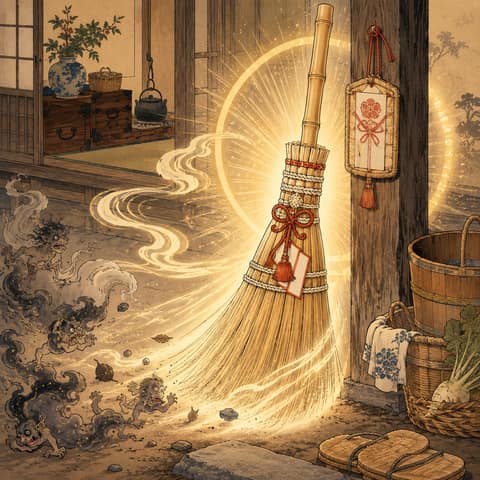
Emphasizing the household cult image of the broom deity, this spirit uses the broom as a sacred vessel to govern domestic purity and the safety of childbirth. Sweeping is seen as a rite of purification that orders boundaries and drives out misfortune and impurity, while the power to gather scattered things back together also symbolizes recalling souls and inviting good fortune. At life’s turning points—New Year, moving house, pregnancy and postpartum—people renew the broom and dispose of the old one with thanks. Mistreating a broom is taboo, and stepping over it, treading on it, or leaving it upside down is inauspicious. Yet the upside-down broom can be used deliberately as a charm to gently send lingering guests home. In art, Toriyama Sekien depicts it as a tsukumogami in Hyakki Tsurezure Bukuro, but in folk practice it is revered as a divine presence dwelling in the tool, a household deity, both practical implement and object of faith. Regional details vary, but it is understood as a local guardian of cleansing and boundaries.

Bunagaya

Bunagaya

Uncommon

ぶながや

Bunagaya, Forest Spirit of Yanbaru

Mountain and Field ApparitionsOkinawa

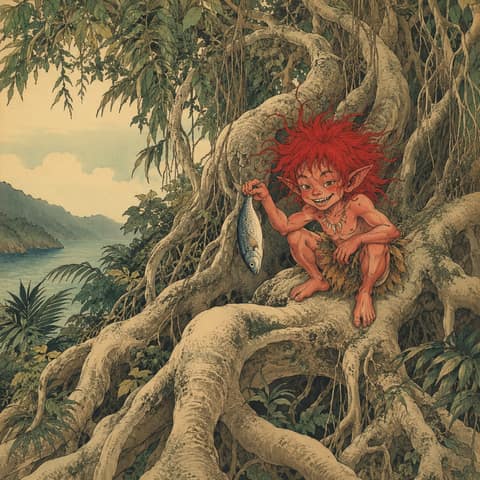
The Bunagaya is a red-haired spirit dwelling in the deep forests and mountain streams of Yanbaru. Appearing as a semi-naked child, it lights fires (Bunagaya fire) in the mountains at night, and people would once test their courage by going to view these flames in a custom known as *arami*. While closely related to the [[yokai:kijimuna]], which resides within ancient trees, the Bunagaya is distinguished by being a master of the forests and rivers themselves, as well as by its ability to manipulate fire. It loves sumo and catching fish, and although it is known to trick humans, it readily curses those who harm its trees. Today, Ogimi Village embraces this red-haired spirit as the symbol of the "Village of the Bunagaya."

Bungo Kawatarō

Bungo Kawatarō

Uncommon

bun-go no kawa-ta-rō

Bungo Kawatarō, the Hairy Kappa of Bungo

Water spiritOita

This version turns to the local color that Bungo Kawatarō carries within the broad category of the kappa. Across Kyushu the kappa is widely called "kawatarō," and Bungo Kawatarō is one of these. Against the frog- and turtle-like kappa so often pictured on the main island, the kappa of Bungo and the rest of Kyushu are usually described as hairy and monkeylike in build—a vivid reminder of how greatly the kappa’s form varied from region to region. Its nature is true to the kappa: it claims the waterside as its territory and delights in sumo and pranks, yet retains a regard for courtesy. To those who bring offerings and keep their promises, it was said to grant the practical wisdom useful to people who live by the water—how to read the currents, how to manage irrigation, how to sense the turn of the weather. Rather than dwelling too heavily on grisly horrors like pulling out entrails, Bungo Kawatarō was spoken of as a being met with both fear and reliance; that is its distinctive flavor. The eyewitness records in Hita’s Kappa Kikiawase convey that such a kawatarō was no mere fancy but a living presence within the life of the land.

Byakko (White Tiger)

Byakko (White Tiger)

Divine

Byakko

Byakko, the White Tiger, Guardian of the West

Animal TransformationsNara

Byakko is the divine beast of the west, Metal, and autumn, spoken of as forming a pair with the Azure Dragon of the east. This edition traces its astronomical origin and the paired structure with Seiryū. Its origin is in the stars of heaven. The chain of the seven western mansions (Legs, Bond, Stomach, Hairy Head, Net, Turtle Beak, Three Stars) likened to the form of a tiger is Byakko. The Huainanzi's "Treatise on the Patterns of Heaven" makes the emperor of the west Shaohao and its beast the White Tiger, assigning it to Metal, autumn, and white. The western palace of heaven in the Records of the Grand Historian' "Treatise on the Celestial Offices" stands in the same system. The form of a fierce white-furred tiger figures the white of the Metal phase, corresponding to the western sky of autumn, which bears the air of ripening and harvest, and of withering severity. The pairing of Byakko and Seiryū is old. That the early Warring States lacquer garment chest from the tomb of Marquis Yi of Zeng (c. 433 BCE) draws the azure dragon and the white tiger to left and right alongside the names of the twenty-eight mansions shows that the composition of the Four Symbols, setting east (Seiryū) and west (Byakko) face to face, was already established twenty-four centuries ago. In Japan, Byakko was received as a marker of directional protection and of wards. In the Four Symbols' banners of the first year of Taihō (701) in the Shoku Nihongi, Byakko was set to the west (right). Though native tales are scarce, within the geomantic reading of land matching the Four Symbols it was made the guard of the west, and in iconography the White Tiger facing the Azure Dragon still remains on the western wall of the Kitora Tomb. The dragon of the east and the tiger of the west—this symmetry is the very skeleton of the system of the Four Symbols.

Showing 25 - 48 of 473 yokai