YOKAI.JP

Traditional Yokai Encyclopedia

Yokai passed down through the ages

473 Yokai|14 Category|Page 3 of 20
Localization in Progress - More content available in Japanese version
View Japanese
Sort by: NameAscending
Byōbu-Nozoki (Screen-Peeker)

Byōbu-Nozoki (Screen-Peeker)

Rare

BYOH-boo no-ZOH-kee

Iconographic Tradition–Conforming Version

Animated Objects & UndeadJapanese folklore

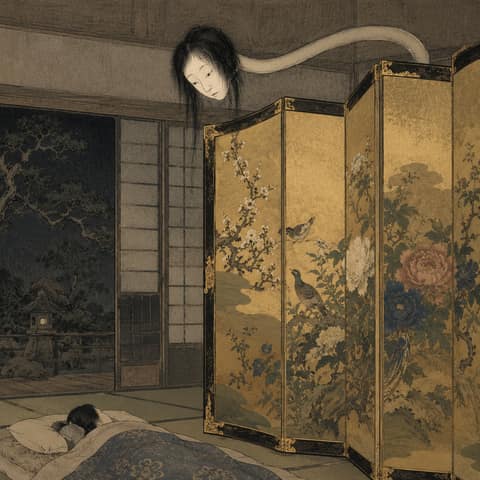
Centered on the commentary in Toriyama Sekien’s Konjaku Hyakki Shūi, this reading emphasizes the habit of peering in from beyond the folding screen. Rather than causing harm directly, it primarily spies on hidden affairs. Some note that the image of lofty screens in Chinese classics shaped its formation, while in Japan it became linked to the belief that bedroom furnishings can accrue spirit, with a folding screen that has long reflected human lives aging into a yokai. It is not a fixed local deity but is understood as a type of haunted implement tale (tsukumogami).

Cat Maiden

Cat Maiden

Uncommon

NEH-koh-moo-SOO-meh

Cat-Girl of Early Modern Sideshow and Eyewitness Reports

Half-Human BeingsTokyoTokushima

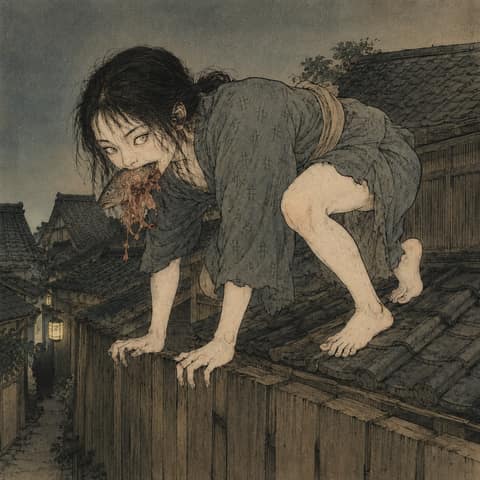
The cat-girl refers to accounts of human oddities in early modern urban sideshows and reportage, describing feline tastes (fondness for fish entrails, chasing rats), movements (traversing walls and rooftops), and mannerisms (likened to a rough, tongue-like texture). In the Horyaku and Meiwa eras, she was occasionally billed in Asakusa and similar venues, but her fame was short-lived, and even amid the An’ei and Tenmei vogue she never became a major headline act. In yomihon and kyoka collections she appears as a curiosity under labels like “cat-girl” or “licking woman,” not as a transforming yokai. Late Edo miscellanies include an anecdote of a girl near Ushigome praised for catching rats, material that reflects community responses to rodent damage, a taste for spectacle, and the gaze cast upon the strange.

Ceiling Licker

Ceiling Licker

Epic

TEN-joh-NAH-meh

Traditional Interpretation (after Sekien Toriyama)

Household SpiritsEdo period

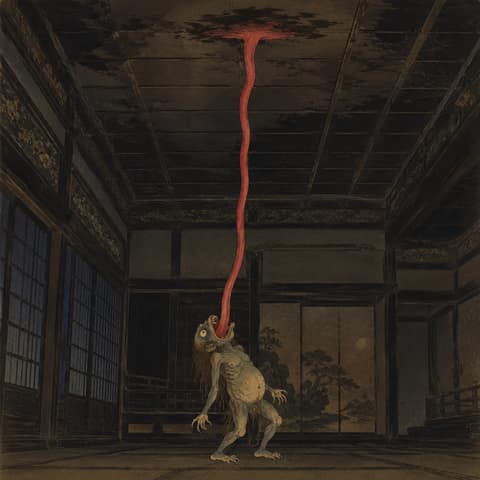
An interpretation based on Toriyama Sekien’s picture book: a being that lets a long tongue hang down and roams old houses licking the ceiling. Rather than harming people directly, it is portrayed as bringing chill, gloom, and dampness into rooms. Its iconography is traced to a Muromachi-period Night Parade of One Hundred Demons scroll showing a creature extending its tongue upward, and later Edo-to-modern compendia ascribed to it the habit of licking away stains, soot, and cobwebs from ceilings. No proper name, lineage, or origin myth survives; it is taken as a symbol of household hauntings in general. Tradition places it in sparsely occupied buildings such as old temples and mansions, with wet streaks and speckles appearing on boards at night cited as its traces, though a firm regional folklore core is hard to confirm.

Ceiling-Dropper

Ceiling-Dropper

Rare

TEN-joh-KOO-dah-ree

Sekien Gazu Edition

Household SpiritsEdo period

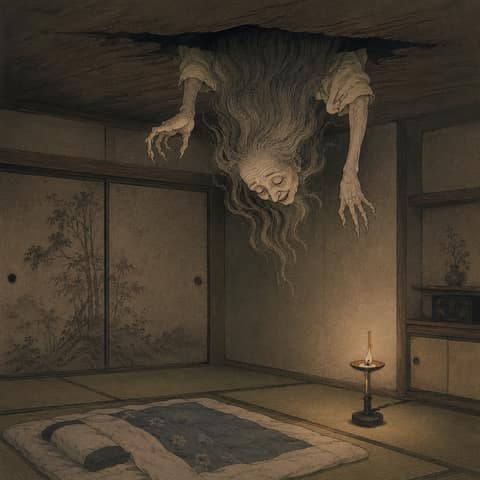
An interpretation grounded in Toriyama Sekien’s iconic prototype. The house ceiling marks a boundary between inside and outside, the mundane and the otherworld; its upside‑down descent symbolizes an inversion of that threshold. It appears mostly at midnight when human activity has stilled, and is said to cause visual shock without actual harm. Early modern readers linked it to wordplay and household safety, reading it as an allegory that quietly warns of neglect, filth, and hazards in the crawlspace above. Later traditions reinterpreted creaks, drafts, and animal sounds in the ceiling as this apparition, placing it within the broader lineage of domestic yokai.

Chochin-obake (Lantern Ghost)

Chochin-obake (Lantern Ghost)

Epic

chochin-obake

The Typical Lantern Ghost with a Long Tongue

Artifact / TsukumogamiTokyo

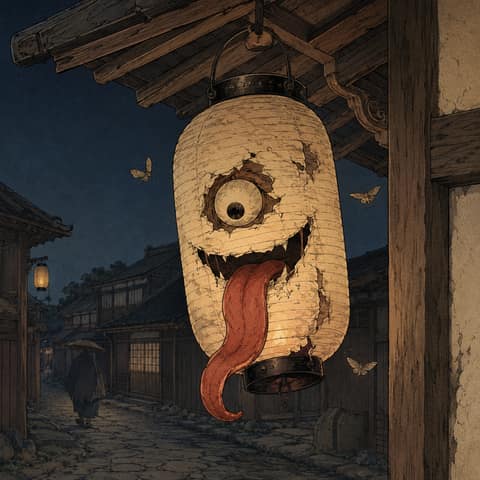
This version focuses on the most classic image of the Chochin-obake, possessing large eyes and a long tongue, frightening humans with a humorous demeanor. It does not bring deep terror or disaster, but rather plays small pranks on humans after an everyday tool gains life. This casualness is precisely the charm of the Chochin-obake. Opening a large mouth where the lantern is torn and sticking out a red tongue is a pop design that symbolizes the visual culture of the Edo period. Lanterns were originally tools to illuminate the darkness and provide peace of mind. However, when it transforms into a yokai, the flame inside overlaps with the fire of life, flickering in the wind. Although there are no clear folktales stating that it harms humans, the sight of a lantern suddenly opening its eyes and sticking out its tongue on a dark night road undoubtedly brings a sense of surprise, allowing one to intuitively realize that the tool they thought was under their control actually possesses its own will. This is a small but tangible anomaly. This version of the Chochin-obake can be seen as a guiding light connecting humans and the world of yokai. It does not carry a tragic grudge like the Oiwa-chochin. It merely emerges in the darkness of the night, using pranks to make humans aware of the existence of the otherworld. In YOKAI.JP, it is highly appropriate to treat it as such an iconic existence representing the unique humor and approachability of Tsukumogami. If made into a card, the background should depict a dim Edo period night road or a dilapidated temple, with the Chochin-obake's own flame flickering in the wind and its long tongue exaggeratedly extended. Rather than horror, the comicality that makes one want to laugh should be emphasized. It will teach people that not all yokai are terrifying enemies, and that there are yokai like this that just play with humans in the night.

Chokuboron

Chokuboron

Rare

CHOH-koo-BOH-ron

Conforming to Traditional Iconography

Animal ShapeshiftersEdo period

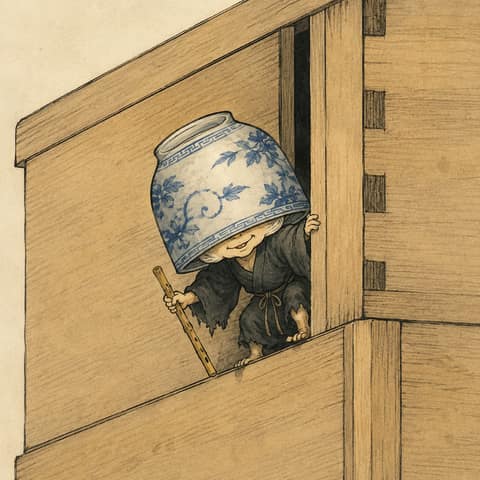
Guided by Sekien’s imagery and captions, this reading foregrounds its nature as a tsukumogami, a spirit of aged utensils. The little goblin, komusō-like with a sake cup as a hat, emerging from a box accords with the belief that long-used drinking vessels and tools gain spirit and appear at set times. The caption’s citation of Xuanzong and the Spirit of Ink bolsters the idea that spirits arise in objects such as calligraphy, painting tools, and sake ware, with Chokoburo composed pictorially as one of that kind. It does not point to a concrete religious entity of komusō or boro, but playfully borrows half-monk, half-lay visual cues, with a name born of puns and association. No locale of oral tradition is identifiable; its character is chiefly that of a visual怪 within Edo print culture.

Chōchin-bi (Lantern Fire)

Chōchin-bi (Lantern Fire)

Uncommon

CHOH-cheen-bee

Chochin-bi (Lantern-Flame, regional will-o’-the-wisp type)

Natural Phenomena SpiritsAcross Japan (notably Shikoku, Yamato, and Ōmi traditions)

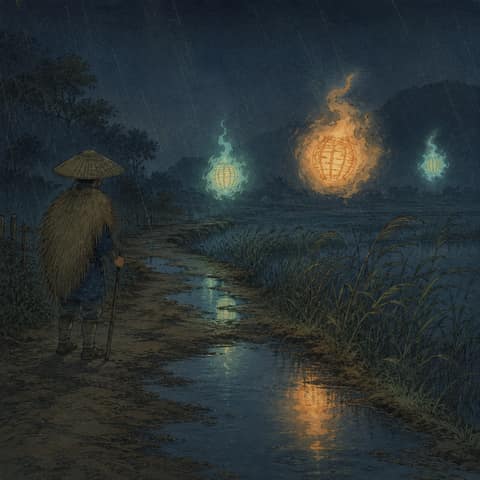
A regional catch-all name for ghostly lights about the size of a paper lantern. In some areas it is conflated with kitsune-bi and tanuki-bi, its name stemming from the idea of monsters lighting lanterns. It appears on rainy nights along riverbanks, dikes, and graveyards, drifting at a fixed height. Accounts vary by era and locale: vanishing when approached, splitting when struck, or marching in clusters. In folklore it portends untimely death or a curse and marks taboos along the roadside, anchoring tales that warn against pursuit or striking it. It appears in early modern essays and kaidan, sometimes gaining proper names (such as Koemon-bi) and lodging in local memory. Natural ignition and animal-origin theories coexist, and its true nature remains unsettled.

Court-Entering Sparrow

Court-Entering Sparrow

Uncommon

NYOO-nai SOO-zoo-meh

Court-Entering Sparrow (Traditional Tale)

Animal ShapeshiftersKyoto

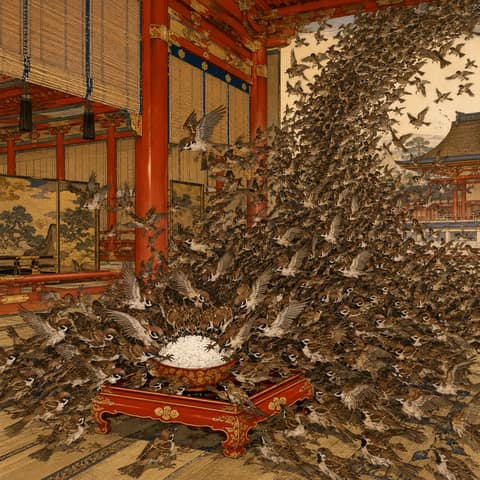
The Court-Entering Sparrow is often cited as a case where personal grudge takes the form of a small bird that slips in and out of the imperial palace. Its pecking at offerings in the Seiryōden symbolizes trespass into forbidden precincts and the ill omen of defiling sacred food, feared for disrupting court ritual. It was taken as the metamorphosis of Fujiwara no Sanekata’s exile to Mutsu and his unresolved yearning for the capital, and used to explain calamities and blights. A revelatory dream at the Kangakuin and the raising of a Sparrow Mound reflect medieval rites of pacifying vengeful spirits through Buddhist memorials. Real sparrows’ migrations, flocking, and seasonal crop damage underlie the tale, which fused with the idea of visiting birds as vessels for souls. The tradition appears across various records, but details and dates differ, leaving much uncertain.

Crab Monk

Crab Monk

Epic

KAH-nee-BOH-zoo

Crab Monk (Chogenji Tradition, Classical Version)

Half-Human BeingsYamanashi

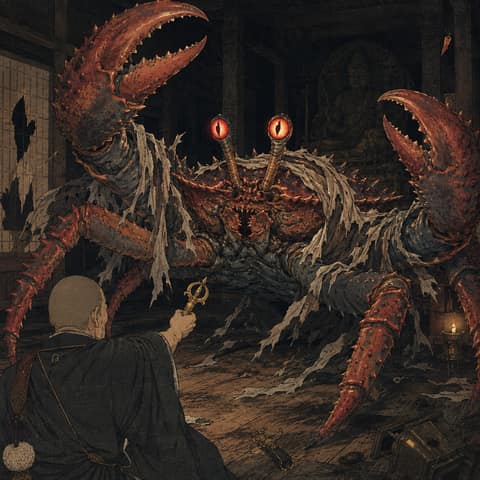
A figure centered on the monstrous crab legend of Chogenji at Manriki in Kai Province. Disguised as an itinerant monk, it comes to the temple at midnight and borrows Zen phrases, tossing hints like “freely side-walking” and “two legs eight legs” to suggest a crab while testing its counterpart’s wit. It retains human form until its identity is pierced, but when pressed with ritual implements or mantras it reveals its carapace and flees, said to span a two-ken square or reach four meters across. Local lore preserves place names like Crab-Chasing Slope and Crab Marsh, a holed “claw-mark” stone, and tales of thrown stones. Across regions the same tale type shares an empty temple, late night, Q and A, exposure of the true form, and retreat or slaying, with the kyogen play “Crab Yamabushi” often cited as an influence. Devotional aftertales may stress the ritual implements used in subduing it—vajra pestles or iron fans—and devotion to Kannon, though details vary. The version told from the Kyoho era onward forms today’s backbone, and a Meiji hanging scroll attests to the tale’s settlement. Stripped of later embellishment, it is a moral tale of a shape-shifting crab that tests a monk and yields to sacred power.

Daidarabotchi

Daidarabotchi

Rare

Daidarabotchi

The Terrain-Shaping Giant Who Trampled the Lands of Musashi

Oni / Giant MonstersSaitamaTokyo

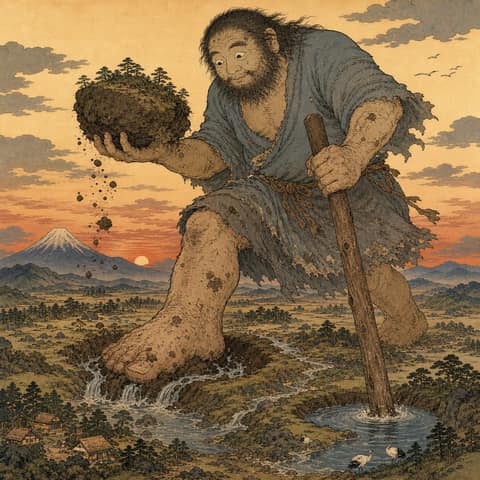
Daidarabotchi is not so much a terrifying monster as a giant whose existence serves to explain the origins of the land. He has been debated both as a degraded folk version of the nation-building deities from the *Kojiki* and *Nihon Shoki* myths, and as a product of ancient peoples' imagination trying to explain Jomon period shell mounds or natural terrain features. Musashi Province is one of the areas where these legends are particularly strong, dotted with origin stories of place names—such as "Ootakubo" in Saitama City—where his footprints turned into depressions, marshes, and wells. Even massive geographical features like Mount Fuji, Lake Biwa, and Lake Haruna are attributed to this giant's deeds, operating on a scale far exceeding a single prefecture. Ever since Kunio Yanagita compiled the footprint legends from across the country, Daidarabotchi has become a "giant bearing the memory of place names and terrain," blending seamlessly into the very landscape of Japan.

Daija

Daija

Epic

だいじゃ

The Water God Disputing Lake Chuzenji: Daija of Senjogahara

Divine SpiritTochigi

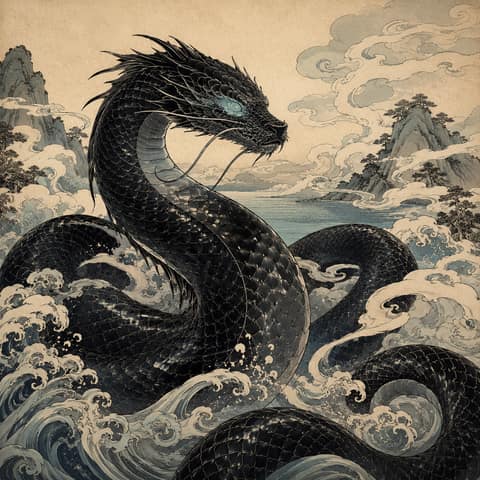
The Daija of Senjogahara is the avatar taken by the god of Mount Nantai (Futarasan) to fight for dominion over the lake. When uncoiled, it is long and massive enough to cover half of Lake Chuzenji. Its scales shine like wet obsidian, and its eyes harbor the phosphorescent glow of the lake bottom. It summons water, raises fog, and stirs waves upon the lake's surface to hinder its foes. Initially pressed hard by the giant centipede of Mount Akagi, it is said to have turned the tide by borrowing an arrow from a human master archer—preserving a form of worship where mountain and village intersect, showing a god winning through human assistance. The traces of this victory and defeat became the place names Akanuma, Shobugahama, and Senjogahara, which are etched into the landscape of Oku-Nikko to this day.

Dancing Head

Dancing Head

Uncommon

oh-DOH-ree-KOO-bee

Classical Tale-Conforming

Ghosts & SpiritsHyogo

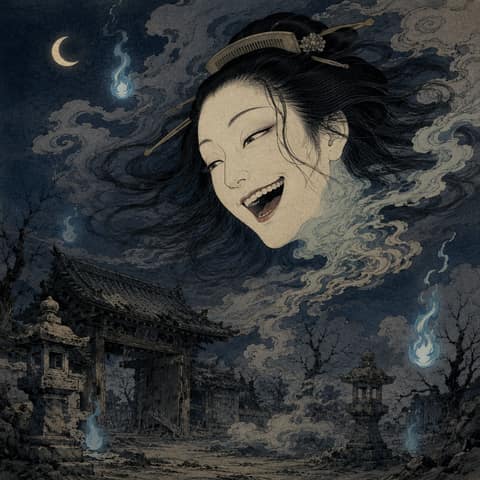
A depiction of the Dancing Head based on scenes found in classical ghost stories and collections of strange tales. A powerful will from life takes form, with only the head detaching and swelling as it appears. It opens and closes its mouth to moan, laugh, or chatter its teeth, emphasizing an auditory menace. Direct physical harm is not always clear, yet it is said to bring misfortune such as falls from fright or sudden fever. Sightings cluster at old temples, graveyards, crossroads, and at the foot of bridges, places where human presence thins or around the hours of a wake. Lineage or personal names are rarely specified, and the strangeness of the incident itself is what lingers in the telling.

Dancing Heads

Dancing Heads

Epic

MAI-koo-bee

Canonical Folklore Standard

Ghosts & SpiritsKanagawa

A standard interpretation based on the vengeful spirit of Manazuru’s sea as recorded in Picture Book of One Hundred Ghost Stories (Ehon Hyaku Monogatari). The severed heads of fallen warriors refuse to relinquish their grudges and are told to bite one another while spewing fire. Two origins are given in parallel: a sword fight born from a quarrel during a festival, or execution for gambling crimes. In either case, the heads move on their own, dance, raise whirlpools and ghostly flames above the sea, and link to local place-name lore. Artwork depicts three heads joined and dancing, a motif echoed in later kibyōshi and yomihon. Framed as a sea-deep and rocky-shore apparition, the tale warns of fear toward severed heads, the curses of war and private duels, and the perils of watersides.

Danzaburō-danuki

Danzaburō-danuki

Uncommon

dahn-zah-BOO-roh dah-NOO-kee

Dansaburō-tanuki

Animal ShapeshiftersNiigata

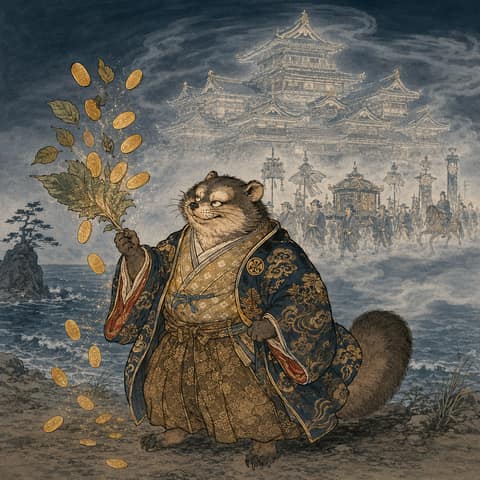
Dansaburō-tanuki is remembered as the grand chieftain of Sado’s raccoon dogs, famed for masterful trickery and deep ties to local society. His illusions create mirages, phantom processions, and sudden walls to confound wayfarers, especially on night roads, mountain passes, and by the sea. Tales of lending money to the needy connect him to the mining town culture of Aikawa, reflecting folk notions of contracts sealed by IOUs. His lair is said to be a burrow in Shimogoe, masked by glamour to appear as a grand residence. Stories of driving out foxes explain local fauna and blend motifs of fox–tanuki contests, the taboo against spectating spirit processions, and battles of wit. Eventually enshrined as Futatsu-iwa Daimyōjin, he is appeased out of fear of wrath while also invoked for protection. Disguising himself as a physician to make clinic visits shows his skill at blending among people and hints at a spirit-beast who can also bear illness. Overall, the lore favors chastening and moral lessons over wanton harm, making practical benefit and illusion the core duality of his legend.

Datsue-ba

Datsue-ba

Legendary

Datsueba

The Hag of the Sanzu River

霊・亡霊偽経発祥の三途の川の老婆、日本成立だが在地発祥地なし

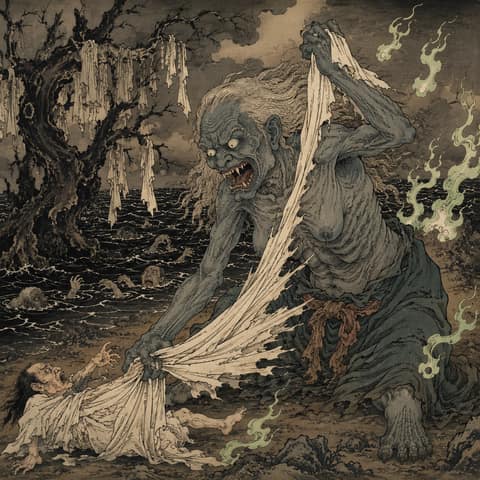
Her Place in Religious History as an Apocryphal Figure. The base description mentioned that the *Sutra of Jizo and the Ten Kings* marks Datsue-ba's first appearance; here, we delve into her status as an "apocryphal" figure. Though apocryphal sutras (gikyo) were not officially canonized in the Buddhist Tripitaka, they were mass-produced at the crossroads of folk religion, esoteric Buddhism, and Pure Land ideology. While the *Sutra of Jizo and the Ten Kings* was based on a Chinese Tang Dynasty text, it underwent meticulous Japanese localization by introducing Datsue-ba, Kenne-o, and the Eryoju tree. Apocryphal texts should not be dismissed merely as "fake sutras"; today, they are re-evaluated as vital religious resources that absorbed the masses' thirst for a comprehensible afterlife and salvation, significantly propelling the development of medieval Japanese Buddhism. The Technology of Visualizing Underworld Judgment. The entire apparatus—Datsue-ba, Kenne-o, the Eryoju tree, the six-mon toll, the Sanzu River—is a brilliant epistemological design by ancient Buddhism to materialize and translate the abstract concept of "karma." The three-stage translation—stripping the clothes → hanging them on a tree → weighing the sin by how much the branch bends—converted "invisible karma" into "the visible bending of a tree branch." This became an indispensable visual asset for medieval Buddhist monks when conducting *etoki* (picture explaining) with narrative scrolls. Preachers from the Pure Land, Ji, and Zen sects would point to these scrolls, explaining the mechanics of judgment to the common people. This historical practice forms the very core of Japan's collective view of life and death. A Comparison of East Asian River-Crossing Underworld Views. The structure of the Sanzu River and Datsue-ba is positioned as a variant of the East Asian "river-crossing" underworld motif. Stories of the dead crossing a river exist in China and Korea, but the Japanese trinity of Datsue-ba, Kenne-o, and the Eryoju tree exhibits extraordinary originality. It is fascinating to compare this with the River Styx and the ferryman Charon in Greek mythology, serving as material to explore the anthropological universality of river-crossing underworlds. The imagination that "the dead must cross a river" shares a common matrix in human societies built around large river basins, yet each culture carved out its own unique, localized judgment machinery. The Hayarigami Phenomenon at Shoju-in: A Social History of Urban Buddhism. The massive popularity of the Datsue-ba statue at Shoju-in (Naito Shinjuku) from 1849 through the Meiji era is a crucial case study for understanding the social history of urban Buddhism in the Edo period. Edo was a world-class metropolis with over a million residents; infectious diseases like tuberculosis and cholera were rampant, meaning the urban poor lived side-by-side with the fear of sudden death. The rumor that Datsue-ba possessed the miraculous power to "stop coughs" exploded as a folk remedy for respiratory illnesses, drawing endless lines of worshippers to her wooden statue. At the end of the Edo period, Datsue-ba was not the only figure to become a *hayarigami* (fad deity); O-Take Dainichi Nyorai and Mimeguri Shrine also experienced similar booms, serving as key phenomena for deciphering the collective psychology of the masses during times of political and social turmoil. The "Cotton Hag" and the Symbolism of Cloth. The Datsue-ba statue at Shoju-in was dubbed the "Cotton Hag" because worshippers draped cotton over her head and shoulders. This presents a fascinating inversion of the symbolism of cloth for a hag whose very name means "clothes-stripper." Datsue-ba is fundamentally a monster that *takes* clothes, yet the masses reversed this by *offering* her cotton (new cloth) in exchange for curing their coughs and ensuring good health. The binary opposition of "stripping clothes" versus "offering clothes" was masterfully reconciled in folk religion. If illness is something that "strips away health," then the folk logic dictates: "I offer you clothes, so please take my illness away." The statue brilliantly completed a flexible religious metamorphosis from a strict underworld judge in Buddhist scripture to a benevolent scapegoat deity in local folklore. Late Edo Woodblock Prints and Publishing Culture. Throughout the Kaei, Ansei, Man'en, and Bunkyu eras of the late Edo period, the Datsue-ba of Shoju-in was heavily depicted in nishiki-e (color woodblock prints). Edo's publishing culture swiftly commercialized the fad deity, building an industrial structure that tightly linked plebeian faith with consumer culture. The Datsue-ba prints functioned simultaneously as religious souvenirs, proof of pilgrimage, and media for spreading information, driving the gears of Edo's urban economy. At the intersection of Buddhist philosophy, folk religion, urban consumerism, and the publishing industry, Datsue-ba transcended the realm of a mere "underworld hag" to become a master key for decoding the collective mindset of Edo society. Datsue-ba's Rebirth in Modernity. In post-war yokai literature, horror, anime, and games, Datsue-ba has been repeatedly reshaped. The apocalyptic panics, pandemic fears, and confusion regarding life and death in the 21st century share a structural resonance with the anxieties of medieval and early modern people. The visceral imagery of Datsue-ba "stripping clothes to measure sins" retains a formidable evocative power. Resurrected in the modern weird fiction of authors like Natsuhiko Kyogoku, Baku Yumemakura, and Fuyumi Ono, as well as in subcultures like the game *Okami* and the *Touhou Project*, Datsue-ba continues to serve as a vital nexus connecting the religious imagination of the past with the pop culture of modern Japan.

Demons of Mt. Ichiya

Demons of Mt. Ichiya

Rare

ichiyazan-no-oni

The Demons of Kinasa Who Built a Mountain in One Night

Demons / Giant MonstersNagano

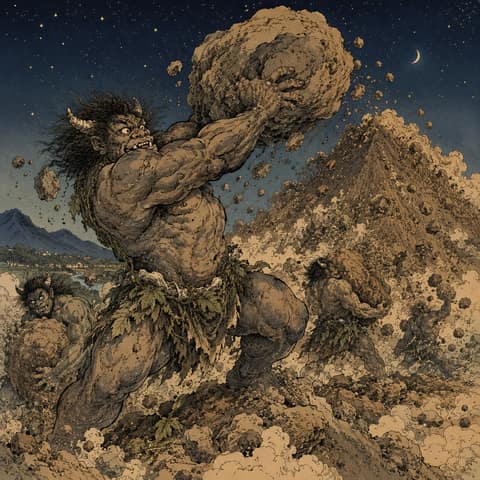
Unlike the demoness Momiji, who was refined on the Noh and Kabuki stages, the demons of Mt. Ichiya are indigenous demons who bear the very origin of the place name. Their action is singular—to build a mountain overnight and block the arrival of the capital. The desperation of a local existence refusing to be stripped of its home is condensed into this single point. While the Momiji legend is a story of descent—'a noblewoman exiled from the capital falls into a demon'—the demons of Mt. Ichiya are depicted as entities that existed in the village from the beginning and resist the capital coming from the outside. The name of the real-life general Abe no Hirafu overlaps with the quasi-historical framework of Emperor Tenmu's capital relocation, giving the legend a strange sense of reality. The conclusion, where the demons are defeated and the name 'Kinasa' is born, is also a story of renaming the land from the perspective of the victor (the center), and the bitter aftertaste of this legend lies in the fact that the defeat of the demons itself was permanently carved as a place name. The cluster of Kyoto-derived place names remaining in Kinasa are scattered in the valley even today, serving as evidence of the victor's memory.

Demons of Tateyama Jigoku

Demons of Tateyama Jigoku

Rare

Tateyama-jigoku-oni

Demonic Jailers of the Tateyama Mandala Hells

Oni / Giant MonstersToyama

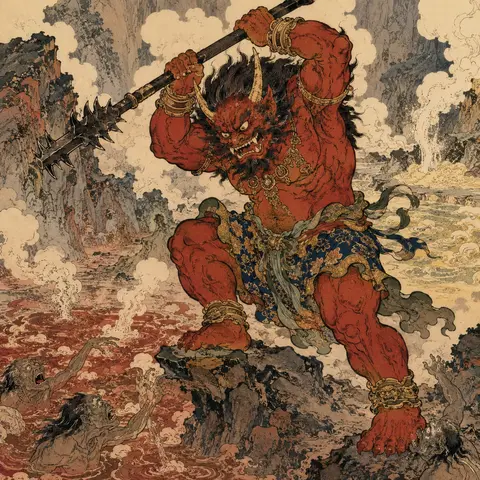
Rather than being a single, independent yokai, the Demons of Tateyama Jigoku are an ensemble cast constituting the underworld as projected onto the sacred Mount Tateyama. The Tateyama Mandala consists of five elements: the founding legend, hell, the Pure Land, the ascetic climbing path, and the Nunobashi Kanjō-e ritual. In the scenes of hell, it is these demons who stoke the cauldrons, herd the dead up the Mountain of Swords, and drown them in the Blood Pool. Notably, Tateyama's hell was not purely a product of imagination, but was based on the actual landscape of Hell Valley—its fumaroles, sulfur springs, and desolate volcanic plains. With Mikurigaike as the Blood Pool Hell and Mount Tsurugi as the Mountain of Swords Hell, the visible natural world was directly translated into the iconography of hell, giving the Demons of Tateyama Jigoku a palpable sense of reality as denizens of that very landscape. The etoki preaching tours by Ashikuraji guides flourished in the late Edo period under the patronage of the Kaga domain, spreading the image of these demons to villages nationwide through the mandala. The tortures inflicted by the demons of hell serve to accentuate the salvation offered by their counterparts, Ubagami and Amida Buddha. The view of the underworld in the Tateyama faith is thus constructed upon this tension between punishment and salvation.

Dodomeki

Dodomeki

Epic

DOH-doh-MEH-kee

Sekien Iconography Standard

Half-Human BeingsTokyoTochigi

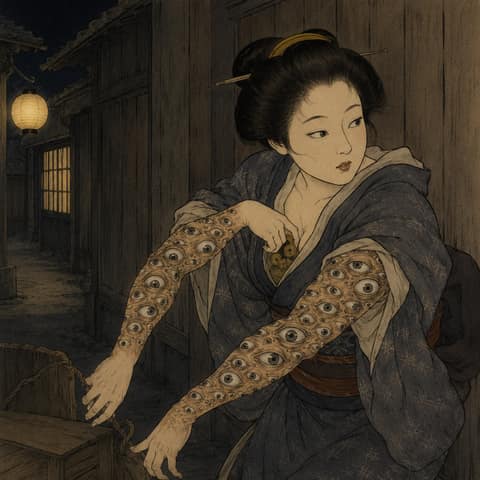
Following Toriyama Sekien’s note, this version centers on a moralizing motif warning against theft. The many eyes along the arm relate to a pun likening the holes of copper coins to birds’ eyes, externalizing the habit of hands reaching to steal. The source Sekien cites, “Kankangai-shi,” is of uncertain reality; his wordplay on Hakone as a boundary and his own remark calling it a curious book suggest the citation itself is part of the artistic conceit. The Dodomeki’s image concentrates on a female form, yet no concrete personal names, family lines, or local legends are preserved, pointing to an urban allegory where image and wordplay outweigh regional lore. Postwar explanations vary in reading and interpretation, but the archetype is traced to Sekien’s original.

Doro-danbō (Mud Rice-Field Wraith)

Doro-danbō (Mud Rice-Field Wraith)

Rare

DOH-roh-dahn-BOH

Sekien Iconography Conformant Edition

山野の怪Uncertain (Toriyama Sekien notes “the northern provinces”); otherwise Japanese folklore

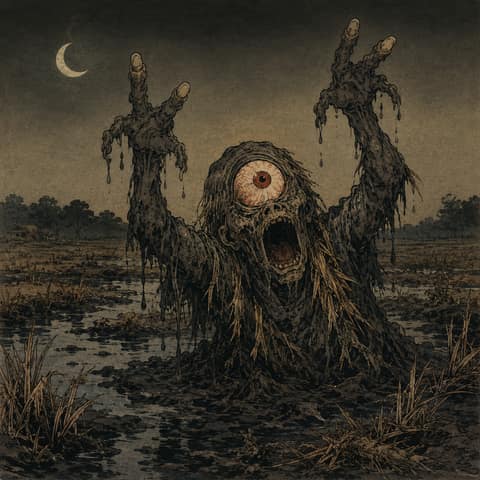
This version adheres to Toriyama Sekien’s image and brief note, centering on a one-eyed, three-fingered figure rising upper-body first from a muddy paddy. It avoids expanding later folkloric claims and emphasizes allegory. It appears as a voice rebuking impiety and neglect of farming after fields are sold off, standing by the paddy ridge at night and repeating in a low voice, “Return the fields.” Given the scant early modern corroboration, this is a reconstruction mindful that Sekien may have intended wordplay and social satire, without asserting ties to specific places or people. Visual traits include a mud-smeared monk-like upper body, a single eye, a wide mouth, and three-fingered hands.

Dragon Maiden

Dragon Maiden

Uncommon

RYOO-joh

Dragon Maiden of the Water’s Edge

Aquatic SpiritsJapanese folklore

A folkloric type distilled from tales of a dragon maiden who appears to travelers and fishers near waters. She speaks in human form and asks for offerings or vows. If covenants are kept, she wards off floods and draws shoals of fish; if broken, she chastens with turbid torrents and tempests. She stands not in opposition to deities or Buddhism and is often revered as a rain-bringing dragon god. She shifts between human and dragon shape, with clues to her true nature felt in scales or the damp texture of her garments.

Dust-Heap Demon King

Dust-Heap Demon King

Rare

chee-ree-ZOO-kah KAI-oh

Iconographic Origin – Sekien Edition

Animated Objects & UndeadJapanese folklore

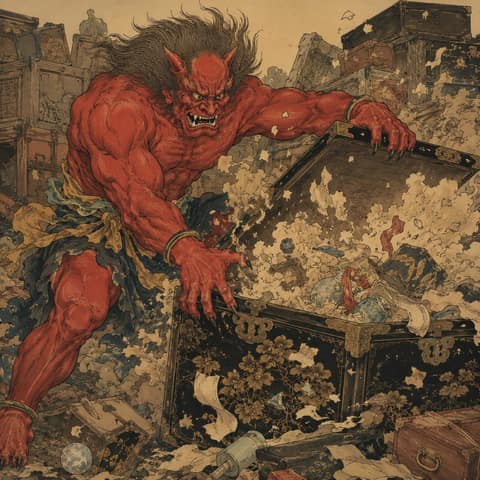
In literature, Chinzuka Kaiō is known chiefly from Toriyama Sekien’s Hyakki Tsurezurebukuro image, with no concrete deeds or sayings recorded. The painting shows a strongly muscled, red-hued oni prying open a kara-bitsu chest as dust and paper scraps swirl. Sekien appended a note calling it the “chief of the mountain hags formed from piled-up dust,” echoing the Noh play Yamanba’s line “clouds’ dust piles up and becomes a mountain hag.” However, no tradition directly links this yokai to Yamanba, leaving its placement ambiguous. Similar images appear in Meiji-era copies and anonymous picture scrolls, sometimes renamed as “kaiki” (monstrous oni). Since the Heisei era, some explain it as “king of dust and garbage tsukumogami,” but this is a later interpretation without proof in older sources. Iconographically, it is viewed as an early modern creation merging the “splitting the treasure chest” motif from Night Parade of One Hundred Demons scrolls with phrasing quoted from Essays in Idleness.

Echo-Worm

Echo-Worm

Uncommon

OHH-seh-ee-choo (ohh-OH-seh-ee-choo)

Edo Essays and Anecdotes Edition

Half-Human BeingsIntroduced from China; recorded across Japan

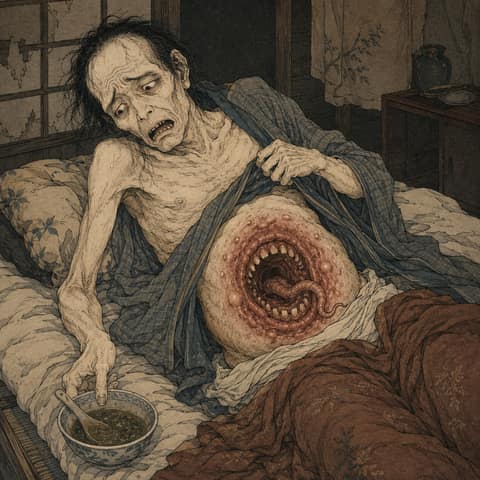
A portrait of the Echo-Answering Worm from Edo-period essays and tales. Marked by high fever and a sore like a mouth on the abdomen, its voice echoes the host’s words and at times spews curses. It craves food and drink, and refusal is said to raise the fever. Cures attempted include prayers and decoctions, especially a method of selecting and combining drugs it dislikes, then administering them so the creature weakens and later exits the body. Some accounts describe a lizard-like form with horns, though appearances vary widely. Chinese lore of the echoing parasite merged with Japan’s notion of the human-faced sore, emphasizing a mouth opening in the belly. Attempts to exhibit the illness for profit were recorded, though families often refused for shame. Its origins span materia medica and storytelling, long understood as a disorder set at the boundary of medicine and the uncanny.

Elder Shamisen

Elder Shamisen

Rare

SHAH-mee-CHOH-loh

Sekien Zue Version

Animated Objects & UndeadEdo period

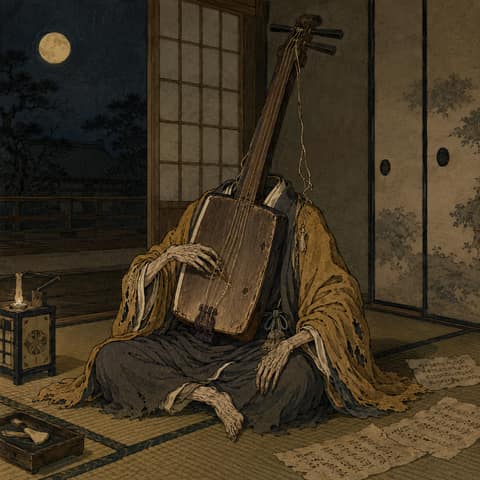
An interpretation grounded in the pictorial tradition of Toriyama Sekien’s Hyakki Tsurezure-bukuro. A shamisen that has gained a soul through long use is depicted like an aged monk, with robe-like garb and staff-like fittings. It plays on the proverb “a novice cannot leap straight to elder,” reinforcing the lesson that one must advance step by step in the arts, and it also cautions against mistreating tools. Similar images appear in Tsukioka Yoshitoshi’s prints, and later yokai encyclopedias introduce it as a representative tsukumogami. Lacking many named folktales, it spread chiefly through paintings and printed books.

Emperor Sutoku

Emperor Sutoku

Epic

Emperor Sutoku

Emperor Sutoku, the Vengeful Spirit Exiled to Sanuki

Spirits & GhostsKagawa

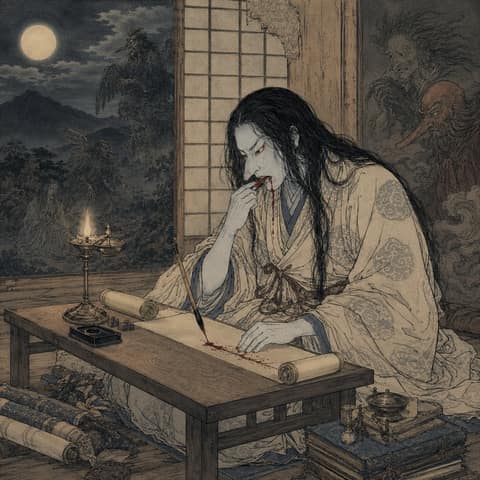
This edition follows in close detail—discerning the boundary between history and the legend that runs from the Hōgen Monogatari onward—how a single deposed emperor turned into the Great Tengu and Great Demon-Bond called the greatest in Japanese history. First, the history must be grasped. Sutoku's misfortune lay in the political exclusion of being shunned by the cloistered emperor Toba as an "uncle-child" and being made to abdicate without ever holding the power of cloistered rule. After the early death of Emperor Konoe, that his younger brother Go-Shirakawa, rather than his own son Prince Shigehito, was set up became the trigger for the Hōgen Rebellion (1156). On the defeated Sutoku's side, Minamoto no Tameyoshi and Taira no Tadamasa were put to public execution for the first time in roughly four hundred years, and Sutoku himself was exiled to Sanuki. Up to here it is history grounded in records. The uncanny is born beyond that, in the stratum of legend. Both the curse said to have been written in blood—"I shall become the Great Demon-Bond"—after biting off his tongue, and the figure of him turning into a tengu with nails and hair grown long, are stories transmitted not by contemporary records but by the Kamakura-period Hōgen Monogatari. Yet this legend spread with great persuasive force, and the great fires, forceful appeals, and upheavals that struck the capital from the Angen years onward—indeed, the Jishō-Juei War leading to the fall of the Taira—came to be read as Sutoku's curse. The events themselves are history; the interpretation that ascribes them to Sutoku's rancor is goryō belief—the two must be seen as sharply distinct. What fixed Sutoku's tengu image was literature. "Unkei Miraiki," book twenty-seven of the Taiheiki, depicts Sutoku as a demon-king ruling the throngs of tengu and demon-bonds, and in the early-modern era "Shiramine" in Ueda Akinari's Ugetsu Monogatari gave vivid form to Sutoku's vengeful spirit confronting Saigyō—not as a long-nosed tengu but as a golden kite. The image of Sutoku told of as "the foremost Great Tengu of Japan" and "the greatest vengeful spirit in Japanese history" stands upon this accumulation of literature. What deserves attention is that his pacification reached even into the modern era. In the first year of Meiji (1868), the Meiji government welcomed Sutoku's divine spirit, resting in Sanuki, to the capital and enshrined it at Shiramine Jingū. That at the outset of a new reign they still feared the curse of a deposed emperor seven hundred years past tells how deep-rooted the dread of Sutoku's vengeful spirit was. A poet who left a famous verse in the Hyakunin Isshu, and a great demon-king who curses the throne—this very gulf is what pushed Retired Emperor Sutoku to the apex of goryō belief.

Showing 49 - 72 of 473 yokai