Yokai Encyclopedia

Encyclopedia of Japanese Yokai

49 Yokai|14 Category|Page 2 of 3
Localization in Progress - More content available in Japanese version
View Japanese
Sort by: NameAscending
水の怪
  • Kyūsenbō

    Kyūsenbō

    Rare

    kyū-sen-bō

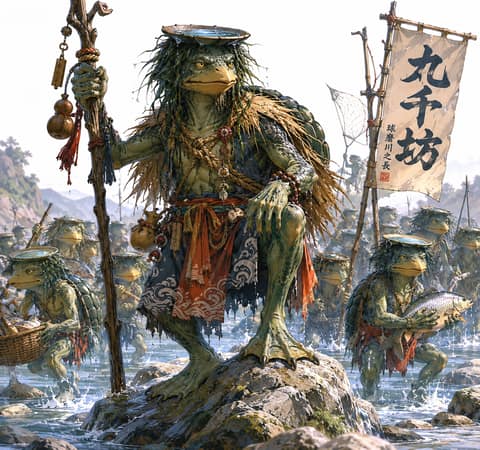
    The Grand Chief Who Commands the Kappa of Kyushu — Kyūsenbō

    Water SpiritsKumamotoFukuoka

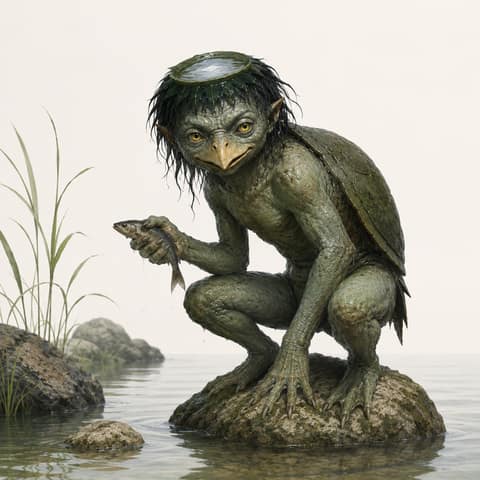
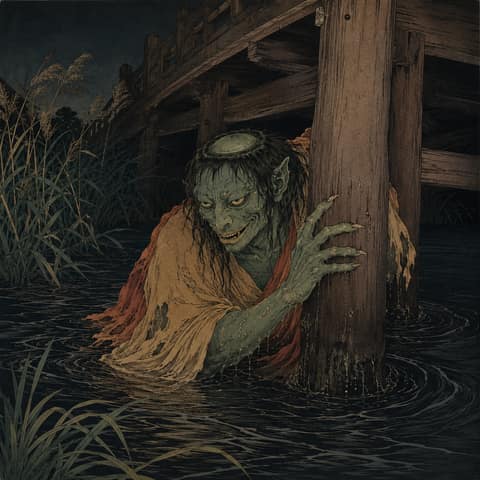
    This version looks closely at Kyūsenbō’s singular standing — less a single yokai than the chief of the whole kappa kind. The kappa is by nature a yokai that changes its name from place to place, told of scattered across the rivers of each region. Among them, Kyūsenbō is drawn as the “head” who governs nine thousand kappa across Kyushu with a single hand. This is unlike the fox’s tenko — a vertical ladder up which a single fox climbs through cultivation. The seat Kyūsenbō holds is a horizontal command over many kappa: in plain terms, the authority of a general over an army. That authority is tested in the contest with Katō Kiyomasa. The single battle handed down by the Honchō Zokugenshi reflects at once the kappa’s strength and its weakness. With nine thousand familiars in hand, he is yet helplessly defeated the moment he faces the monkey the kappa has dreaded since of old. The outcome is settled not by force of arms but by the logic of the natural enemy — and in this the kappa’s true nature is laid plainly bare. What comes after defeat is his turn toward the water-god. The Kyūsenbō who moved to the Chikugo River changed from a man-attacking demon into a guardian against flood. His bond of serving Suitengū at Kurume shows the kappa to be a being that bears both meanings at once — the peril of water and the bounty of water. The monument at the Place of the Kappa’s Arrival in Yatsushiro, the kappa masks of Suitengū, and the kappa clan Hino Ashihei founded in the Shōwa era — the tale of Kyūsenbō lives on still, from an Edo miscellany to the town-building of today, as a thread of memory the people of Kyushu have spun together with the river.

  • Medochi

    Medochi

    Uncommon

    me-do-chi

    The Kappa Lurking in Tsugaru’s Waters — Medochi

    Water SpiritsFukushima

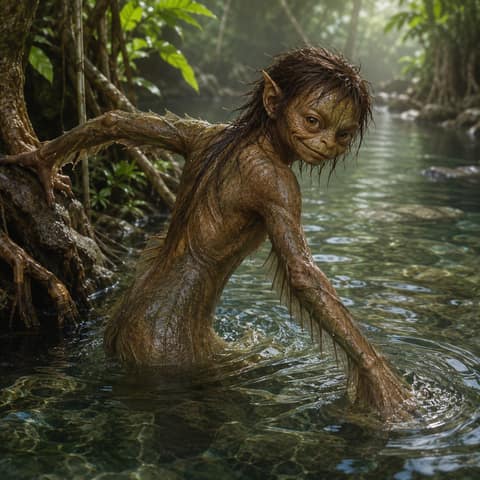
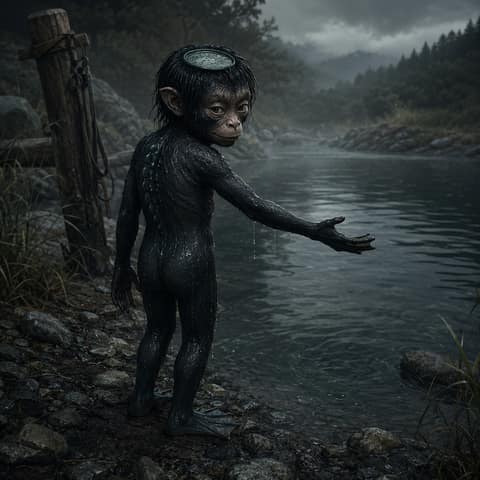
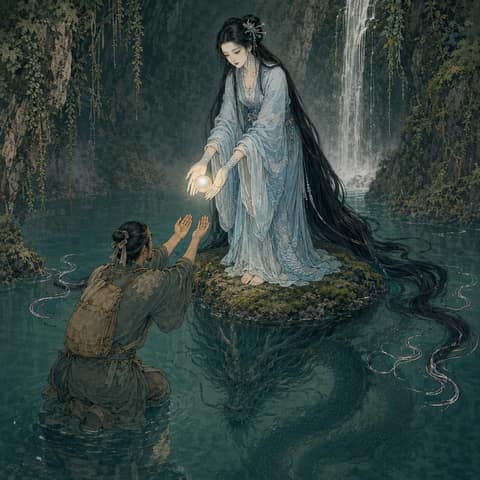
    This version looks closely at how the medochi, though merely “a dialect name for the kappa,” carries a face all its own, belonging to the land of Tsugaru. Begin with the name. Medochi derives from mizuchi (蛟), which once meant a water-serpent deity. How it came to be the name of the kappa traces a larger current in waterside belief — a water-god declining over the ages, descending step by step from a revered deity into a dreaded yokai. The name medochi carries that memory of decline down to the present day. In its image, too, the Tsugaru medochi stands apart. Where the Edo artists drew the kappa with a beak and a shell, the people of Tsugaru told of a monkey face and a black body. Around Towada they say the medotsu has a red face; color and form waver from place to place. All that holds constant is the stature of a child, and that eerie pull toward the water. What must not be overlooked in matters of belief is its two-sidedness with Suiko-sama. In Tsugaru, the medochi that drags people under (the demon) and the Suiko-sama that quells it (the water-god) are often spoken of as two faces of one same being. In 1934 Orikuchi Shinobu saw with his own eyes the Suiko image at Nagata, had a copy made of it, and held a river festival at Kokugakuin. The figure of “one Suiko-sama for forty-eight” has no scholarly grounding, yet the sense of rank — the medochi governed by a “chief” — is truly rooted in the water-god belief of Tsugaru. Its weaknesses, and the means of quelling it, all come back to its bond with the river. It dissolves at the touch of a hemp stalk; offer the first cucumber of the season and it takes no one; enshrine Suiko-sama and the deep pool grows calm. The people of Tsugaru lived by the water and feared it too — and the medochi, this kappa, is something like the knot they tied of those days in their hearts.

  • Metsuhō Shell (Metsuhō-gai)

    Metsuhō Shell (Metsuhō-gai)

    Uncommon

    MEH-tsu-hoh-gai

    Emaki-Accurate Depiction

    Aquatic SpiritsJapanese folklore

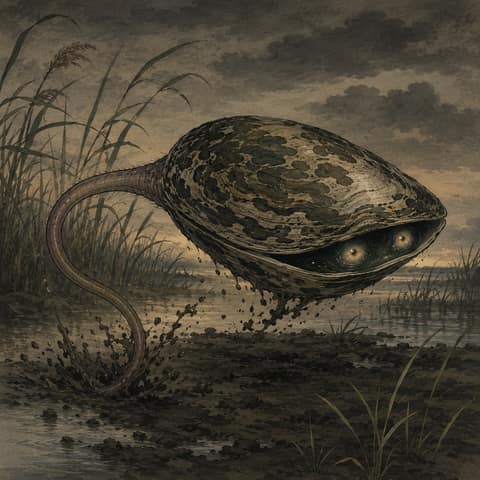
    In texts, the Metsuhō Shell appears solely as an image: an enigmatic shell-dwelling creature that emerges around rivers, marshes, and ponds. Eyes peer from the rim of its shell, and a tail-like appendage sways as if propelling it. Its behavior, malice, and omens are not recorded. Late Edo picture scrolls omit explanatory captions, inviting readers to infer origins from its name and form, and set it alongside other water spirits. The term metsuhō evokes a sense of lawlessness or being out of bounds, but no firm source, orthographic variants, or toponymic links are attested. Accordingly, this entry confines itself to minimal notes based on iconographic traits and extant sources.

  • Mill-Bearing Hag

    Mill-Bearing Hag

    Uncommon

    OO-soo-oh-ee BAH-bah

    Sado Shukunegi Tradition

    Aquatic SpiritsNiigata

    A maritime apparition told along the coves of southern Sado Island. It appears as a white-haired old woman who rises to the surface at dusk when weather breaks and dimness falls. Her hands are held behind her back as if bearing a burden, though the original account names no specific object. Sightings are said to occur once every two to five years, and merely seeing her is not believed to bring illness or immediate disaster. Modern yokai encyclopedias place her in the lineage of Iso-onna and Nure-onna, yet tales of luring or predation are absent; instead she is spoken of as a harbinger of poor catches or sudden shifts in weather. The name is rarely attested outside local ghost-story collections and is likely a region-specific term.

  • Mōryō

    Mōryō

    Epic

    MOH-ryoh

    Mōryō (Classical Depiction)

    Aquatic SpiritsUncertain (concept from ancient China, adopted in Japan)

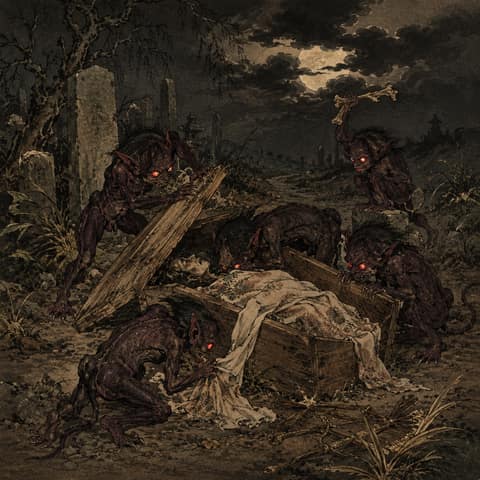
    A generalized classical image of the mōryō based on historical sources. The term was used for uncanny phenomena tied to watersides, graveyards, ancient trees, and great stones, and is understood to be linked with disasters that defile corpses and the spread of death impurity. Its form is not fixed—some accounts call it childlike, others say it manifests only as a vapor or miasma. In Japan, the word came to denote corpse-stealing spirits and served to justify funerary taboos and rites of purification.

  • Ningyo

    Ningyo

    Rare

    ningyo

    The Water Yokai Evolving from Ancient to Modern Times

    水の怪FukuiShiga

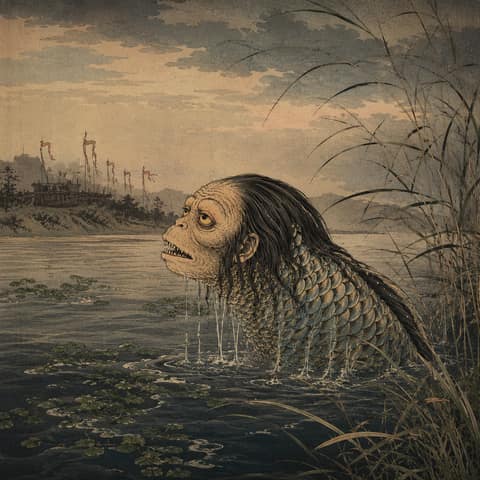
    Iconographic Disconnect from Western Mermaids. The image of a Ningyo that modern Japanese people envision—a "beautiful female upper body and a fish lower body"—is a product of Western mermaid legends (such as Hans Christian Andersen's *The Little Mermaid*) being imported and taking root from the modern era onward. Prior to this, traditional Japanese Ningyo iconography, as depicted in texts like the *Kaikoku Heidan*, was exceedingly bizarre and grotesque: "a human-like (or monkey-like) face on a scale-covered fish body." The facial features were not necessarily those of a beautiful woman; they were generally depicted as terrifying men, women, young, or old, bearing sharp fangs. The sheer ugliness of this design emphasized the visceral reality of the Ningyo as a "creature from the Other World" and the taboo, grotesque nature of the act of eating its flesh. Biological Models and the Natural History Perspective. The core of Japanese Ningyo folklore is believed to contain no small amount of misidentification of actual biological creatures. For example, a prevalent theory suggests that sirenians like dugongs and manatees, or pinnipeds like sea lions and seals, served as the models for the Umibozu and Ningyo. Additionally, in inland (river or swamp) Ningyo legends, there are cases where the true identity is speculated to have been the Japanese giant salamander. Edo period herbalists (Honzogakusha) meticulously collected and classified records of these unknown marine creatures washing ashore, attempting to re-examine yokai through the lens of "science" (natural history). The Curse of "Eternal Life". The "eternal youth and longevity" brought about by Ningyo meat is a universal human desire, yet in Japanese folklore, it is always depicted as two sides of the same coin alongside "tragedy." As the legend of Yao-bikuni demonstrates, one who obtains eternal youth by eating Ningyo meat must repeatedly watch their beloved family members and husbands age and die, forcing them to experience unbearable loneliness and despair (temporal isolation). The Ningyo is a yokai that acts as a cruel mirror, thrusting the "terror of escaping death" directly in humanity's face.

  • Nure-onna

    Nure-onna

    Epic

    NOO-reh-OHN-nah

    Nure-onna (Tradition-Faithful Version)

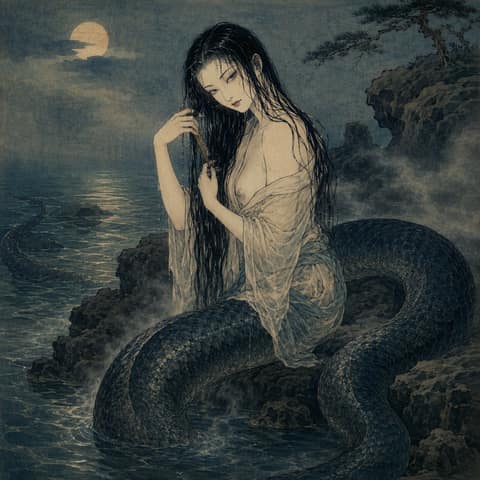
    Seen along seashores and riverbanks as a woman with long wet hair. Depending on the region, she either lures victims by making them hold a baby and then immobilizes them, or appears as a menacing aquatic entity evocative of a serpent’s body and a massive tail. Edo-period yokai art often depicts a serpentine woman, though narrative sources offer scant confirmation. In Iwami she is classed as a water spirit linked to the gyuki, with advice to never hold her burden barehanded. She is sometimes conflated with the iso-onna, and both name and traits vary by locale.

  • Oitekebori

    Oitekebori

    Uncommon

    oh-EE-teh-keh-BOH-ree

    Ochikohori (Curated Traditional Tales Version)

    Aquatic SpiritsTokyo

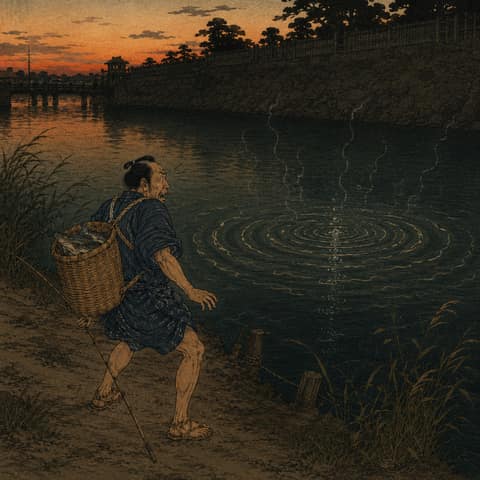
    Spoken of as a haunting tied to canals and irrigation ditches in Edo’s low wetlands, it functioned as both a warning against greedy overfishing and a folkloric device marking taboos on the water. The entity has no fixed form and is often only a voice, though in some regions it is identified with known shapeshifters like kappa or tanuki. Its stage centers on Honjo’s Kinshi-bori and Sendai-bori and along the Sumida River, with variants in Kameido, Horikiri, and Kawagoe. A typical pattern is the three-step “big catch—departing voice—loss of fish,” accompanied by etiquette tales that aver misfortune can be avoided by sharing the catch or releasing a few fish. It appears in curious tale collections and local lore around the Kansei era and later took root through rakugo storytelling. Natural sounds and animal behavior became the raw material of the uncanny, and the tale served to symbolize rules for ditch maintenance and norms for shared resources.

  • Red Ray (Akaei)

    Red Ray (Akaei)

    Epic

    AH-kah-eh-ee

    Legend-Concordant Sea Giant Fish Tale

    Aquatic SpiritsChiba

    Based on the account in Ehon Hyaku Monogatari, this version frames it as a sea monster whose massive body surfaces like an island. Its back bears sand and pebbles, so from afar it is mistaken for an uninhabited isle. When sailors draw near it sinks, spawning whirlpools and heavy seas that damage or capsize ships. The tales strongly warn against navigational hazards and errors of sea-line sighting. Reported as a firsthand sighting off Awa, it is discussed alongside records of giant fish off Ezo and curiosities like the “Capital of the Red Ray,” collectively naming common sea-borne anomalies. Natural-history notes mingle with怪談, with little concrete ecology, but three cores recur: immensity, floating and sinking, and stormy waves.

  • Salmon Daisuke

    Salmon Daisuke

    Uncommon

    SAH-keh noh OH-oh-skay

    Legendary Tale: Daisuke of the Salmon

    Aquatic SpiritsTohoku region; Shinano River basin (Niigata Prefecture) and across eastern Japan

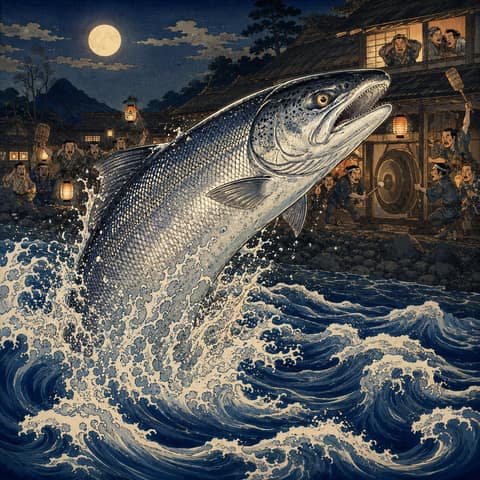
    Known as the King of the River, Daisuke of the Salmon marks forbidden periods and seasonal rites during the salmon run. On set dates—such as the fifteenth of the Frost Month and the twentieth of the Twelfth Month—Daisuke and his consort Kosuke are said to proclaim in loud voices. Anyone who directly hears them dies three days later, so riverside communities kept those days as no-fishing days, ringing gongs, singing, and pounding rice cakes to block out the sound. In tales along the Shinano River, a powerful elder who forces taboo-breaking meets a water authority in the guise of an old woman and dies suddenly with the run’s onset, embodying awe of nature and adherence to proper conduct. The old woman is read as a personified river spirit or Daisuke’s avatar, though never revealed outright. The name varies between “Daisuke of the Salmon” and “Daisuke the Salmon,” and his wife is called Kosuke. Recorded from the early modern period in surveys and folktale collections, this motif spreads across the salmon culture zone of eastern Japan beyond specific locales. Creative variants are few, and the core points—voice, dates, taboo, and fatal retribution—remain consistent.

  • Sea Person (Kaijin)

    Sea Person (Kaijin)

    Uncommon

    KAI-jin

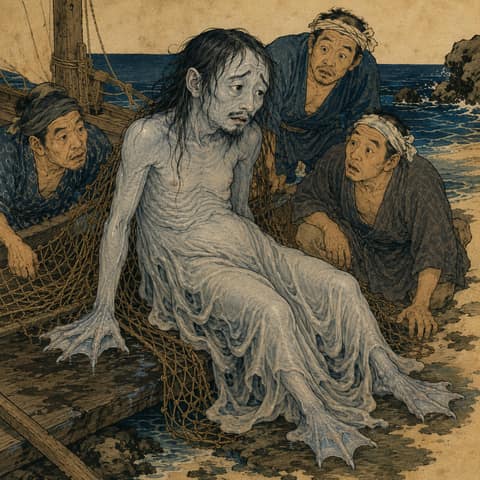
    Textual Tradition Version Amajin (Sea Person)

    Aquatic SpiritsNagasaki

    The image of the Amajin took shape where early modern Japanese natural histories intersected with imported Western reports. Accounts describe a figure largely human in form, marked by webbing between the fingers and loose hanging skin over the body, repeatedly noting draped folds around the waist that resemble a hakama. Speech is uncertain: some say it neither understands nor responds to human language, though variant tales claim survival on land for extended periods. Its diet is unclear, and it often refuses food offered by people. Captured specimens reportedly weaken when kept away from water and die within a few days. Explanations range from misidentified sea mammals such as sea lions or seals to seaweed accretions mistaken for clothing, but none are conclusive. The tradition blends shipborne reports through Nagasaki with local observations, and specifics such as names and dates vary by source, defying firm generalization. It is treated as a typical case of encounters with uncanny beings along the shore.

  • Sea Zato (Blind Lute Priest of the Sea)

    Sea Zato (Blind Lute Priest of the Sea)

    Rare

    OO-mee-zah-TOH

    Iconography-Based Tradition

    Aquatic SpiritsJapanese folklore

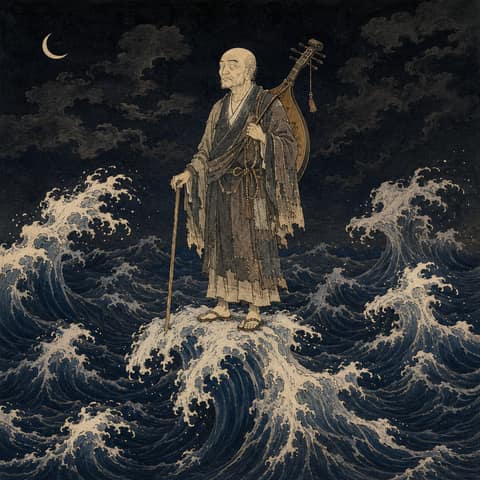
    Umizatō survives only as an image in Edo-period picture scrolls and yokai paintings, with no transmitted nature or behavior. The motif shows a blind lute player standing upright amid waves, emphasizing the biwa and cane. From its visual traits, it is often read as representing the uncanny of encounters at sea and the absurdity of standing on unstable water. Kenji Murakami classifies it as a “yokai existing only in paintings,” noting possible overlap with sea-monk imagery. Accordingly, this entry is limited to iconographic details; concrete harms, benefits, rites, or banishment methods are not recorded.

  • Shiranui (Mysterious Sea Fires)

    Shiranui (Mysterious Sea Fires)

    Uncommon

    shee-rah-NOO-ee

    Parent Fire Guide of Hassaku

    Aquatic SpiritsKumamotoSaga

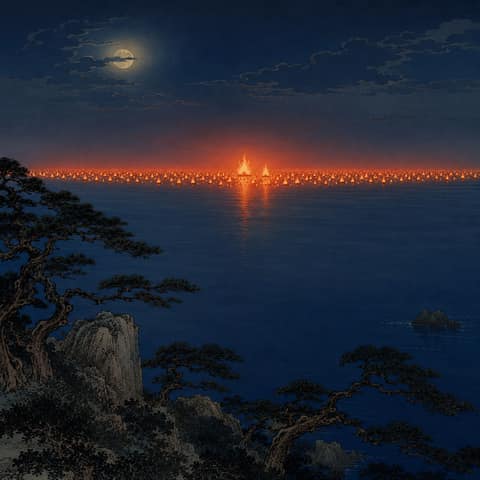
    Among the shiranui, the Parent Fire Guide of Hassaku is a high-ranking variant that appears before dawn on the first day of the eighth lunar month. A single reddish light, sometimes two, first kindles several kilometers offshore, called the parent fire by villagers. It then splits to either side birthing child lights, until hundreds and thousands form a single horizontal line. People say the line may stretch four to eight ri, invisible from the surf but clearly seen from headlands or heights a few ken above the tide wind. When the ebb runs deepest, about the hour around midnight, the flames breathe in unison, and distant watchers see a shimmer like dragon scales flickering beneath the waves. If chased the lights retreat, if neared they draw away. Launch a boat to seize them and they slip aside with the shadow of the current, allowing no approach while indicating only the heading home. Old records tell that when Emperor Keikō’s boat was wrapped in darkness, this parent fire rose far ahead and turned his prow toward shore. For this reason villagers revered the nameless fire, ceasing their nets and resting their oars at midnight on Hassaku, waiting for the line to unspool. The Parent Fire Guide is linked to the presence of a stormy dragon god, yet it shuns harming people and instead warns against arrogance and haste. Boats that grasp for quick profit wander bewildered along the line and must furl their sails, while those who heed the tide climb a shore pine to read the fire’s breathing and slip out quietly with the break in the lights. Offshore shoals then prove gentler than expected, and on the return the embers sway by the coastal shadow to welcome the boat. So pure is the parent fire that villagers murmur Thousand Lanterns or Dragon Lantern and press their hands in prayer, but if people call it coarsely and jeer, the line breaks at once and scatters into beach fog. Wind does not fan it larger, it waxes and wanes only by the pulse of the tide. Thus from capes and mounds it appears a tidy band, while from the wave edge it cannot be seen. They say the Parent Fire Guide can even shift the angle of shrine shimenawa by the sea and the hue of lighthouse flames, and when the sacred rope bows slightly seaward at night, it is a sign that far offshore the lights are being born. Elders who know this tell young crews, Today the tide falls and the fire will rise, refrain from sailing. Unlike man-made flames it leaves no ash or smoke. Only at one hour after dawn do shells on the flats shine pale rose, and dew on reed tips holds the fire’s afterglow. On such mornings villagers cast salt upon the beach and give thanks for the lives guided by the fire. The Parent Fire Guide opens the way to those who know awe and courtesy, withdraws from the overproud, and quietly redraws the boundary between sea and humankind.

  • Shrine Princess

    Shrine Princess

    Uncommon

    JEEN-jah-HEH-meh

    Traditional Lore Version (Hizen, Bunsei Appearance)

    Aquatic SpiritsSaga

    An image based on a block-printed text copied in Kato Hekioan’s Warekoromo. It bears a human face, two horns, a crimson belly, and a triple-sword tail, and is said to have appeared as a messenger from the Dragon Palace to foretell abundance and the spread of disease. Copies of its likeness were promoted as amulets for averting calamity and prolonging life when pasted on doorways or viewed in devotion, leading to widespread circulation of the image. Parallels from Hirado’s “Himeuo” and cases in Echigo show close similarities in iconography and captions, marking a nexus of popular epidemic countermeasures, folk practice, and print distribution. Some propose origins in specific animals, but no proof exists; folklorically it functions alongside prophetic beasts like Amabie and Amabiko.

  • Shōkichi Kappa

    Shōkichi Kappa

    Uncommon

    shō-kichi kappa

    Shōkichi Kappa, the Sumo-Loving Kappa of Bungo

    Water spiritOita

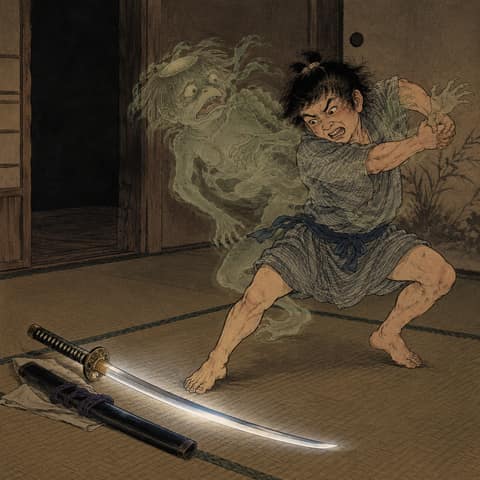
    This version turns to the phenomenon of "kappa possession" that the Shōkichi tale conveys. Most kappa stories play out at the water’s edge, but here the river sumo is carried right into the home. Brought back by his family, Shōkichi went on raging as if locked in a grapple with an unseen opponent—exactly the work, people said, of a kappa that had possessed a human being. A water-spirit climbing onto dry land by borrowing a human body: there lies the spine-chilling fascination of this tale. The means of quelling it, too, reflects the faith of the land. What first took effect was the power of Gō Yoshihiro’s signed blade. The belief that the kappa dreads a keen edge is found in many regions, and the detail that it raged again once the sword was removed shows that power plainly. What finally settled the disturbance was the prayer of a shugenja, an ascetic who trains secluded in the mountains. Quelling kappa possession with these two—the power of the blade and the ascetic’s spiritual force—is a hallmark of Kyushu kappa tales. Hita has gathered many kappa stories, the Hita Gunshi foremost among them, and together with the "Bungo Kawatarō" of the same Bungo, they attest to the depth of this region’s kappa beliefs.

  • Suiko (Water Tiger)

    Suiko (Water Tiger)

    Epic

    sui-ko

    The Scaled Suiko, Child-Sized

    Water SpiritsHubei, China (introduced to Japan through Edo-period texts)

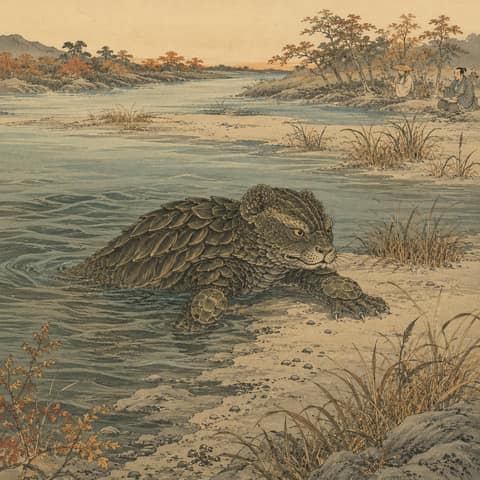
    This version digs into what sets the suiko apart: it is not a creature of oral legend but one shaped within the pages of books. Where the kappa was born from the fears of riverside life and took on countless forms and names from region to region, the image of the suiko travelled almost entirely through citations in Chinese materia medica and gazetteers. That is why its defining features stay remarkably consistent — a body the size of a small child, hard scales, the habit of baring its carapace on the autumn sand, and the trick of showing only its knees above the water. Japanese scholars cited these Chinese accounts while puzzling over how to square them with the kappa right in front of them. The *Wakan Sansai Zue* placed the two side by side and cautiously judged them "alike yet not the same," while the *Suiko Kōryaku* tried to file reports of water creatures from across the land under the heading "suiko." Toriyama Sekien's illustration in the *Gazu Hyakki Yagyō* is likewise a picture drawn from this continental learning. There are articles touting ways to capture it or its medicinal uses, but interpretations differ from book to book, and the truth remains unclear. The suiko, in the end, is a second face of the water spirit — the trace left by an early-modern attempt to reinterpret the familiar kappa through the lens of Chinese scholarship.

  • The Kesa-Monk of Igusa

    The Kesa-Monk of Igusa

    Uncommon

    ee-GOO-sah no keh-SAH-boh

    Folkloric Record Edition

    Aquatic SpiritsSaitama

    The Kesa-bō of Igusa is told as a kappa belonging to the local waters, marked by a monkly appearance symbolized by a priest’s kesa stole. Its pranks cause real harm, such as obstructing passage or adding weight, and at times tie into sacrificial notions surrounding the intestines. The listing of neighboring kappa names typifies kappa groups distributed along each water system, accompanied by ideas of mutual visits and marriage ties. The setting centers on the channels near Ochiai Bridge, where nighttime travel was shunned. Later records sometimes confuse it with examples from Miyagi Prefecture, but locally the tradition is firmly fixed under the name Igusa.

  • Tomokazuki

    Tomokazuki

    Uncommon

    toh-moh-kah-ZOO-kee

    Shima Coastal

    Aquatic SpiritsMieShizuoka

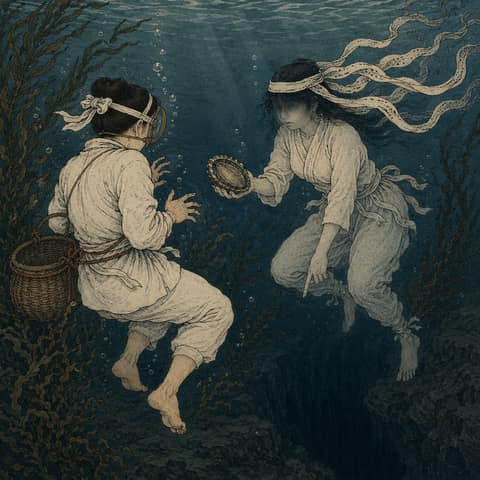
    This version follows coastal ghost lore from Shima through Izu to Echizen centered on the idea of a diver’s double. It appears identical to the witness, notably with the tail of the headband hanging unusually long. It manifests in overcast or dim seas, approaches offering abalone or other shells, and lures victims toward the dark. Traditional countermeasures include keeping one’s gaze and routine steady, not accepting offerings with the leading hand, and using hand towels or garments marked with protective sigils, though results vary, and some tell of a net-like shroud being cast over them. Encounters skew toward those working alone, while many locales say group operations avert it. Some tell it as a revenant or sea-haunting apparition that draws people into the water, yet others long held it to be delirium or visions from prolonged diving and fatigue. Ama divers dyed Seiman-Doman patterns on clothing and towels for protection. In Echizen’s Anjima, it is said to move counter to expectations and cannot be clearly seen.

  • Umibōzu (Sea Monk)

    Umibōzu (Sea Monk)

    Legendary

    oo-mee-BOH-zoo

    Umi-bōzu (Fishermen’s Lore)

    Aquatic SpiritsNagasakiEhime

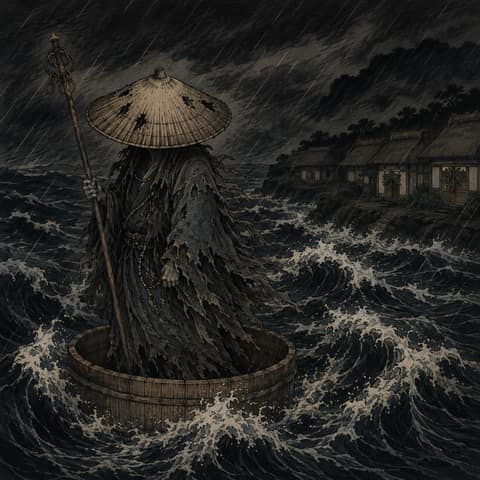
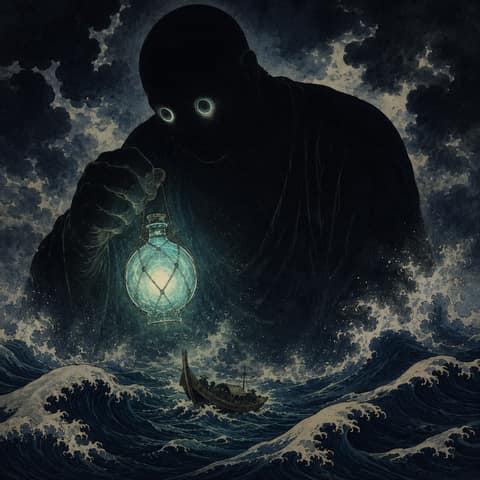
    Umi-bōzu is a yokai said to embody the fear and unease sailors feel at sea. Its form is not fixed, sometimes appearing as a mere black shadow, other times rising from the waves as a colossal monk-like figure. Tales tell of it approaching boats and whispering, “Lend me oil,” and if given, it ignites flames and sinks the vessel. In more recent lore, it is said to collect sunken boats and nets and stack them on the seafloor, and at times appears holding a glowing bottle or lantern. Both a frightener of humans and a symbol of the sea’s mystery, it is regarded with awe.

  • Umibōzu (Sea Monk)

    Umibōzu (Sea Monk)

    Legendary

    oo-mee-BOH-zoo

    Sea Monk of Kyushu and Shikoku

    Aquatic SpiritsNagasakiEhime

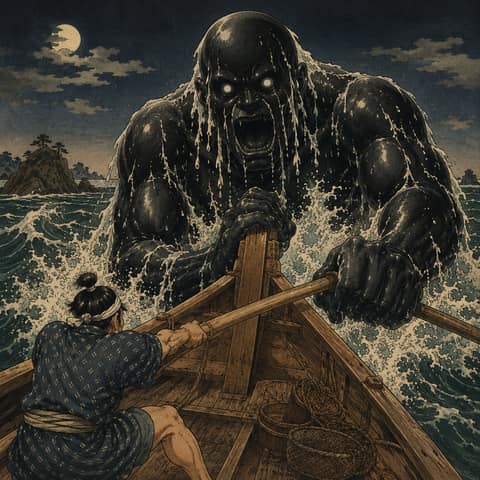
    A Sea Monk told along the coasts of Kyushu and Shikoku. It appears on boats and asks for a ladle, yet it never climbs aboard from the stern, always emerging at the bow. When it clings to the oar, if the crew keeps rowing, the oar bites in like a blade and it cries out “Aitata!” In Uwajima, many tales say it harms people, yet those who see a Sea Monk are also said to live long lives.

  • Umibōzu (Sea Monk)

    Umibōzu (Sea Monk)

    Legendary

    oo-mee-BOH-zoo

    Sea Monk of the Chugoku Region

    Aquatic SpiritsNagasakiEhime

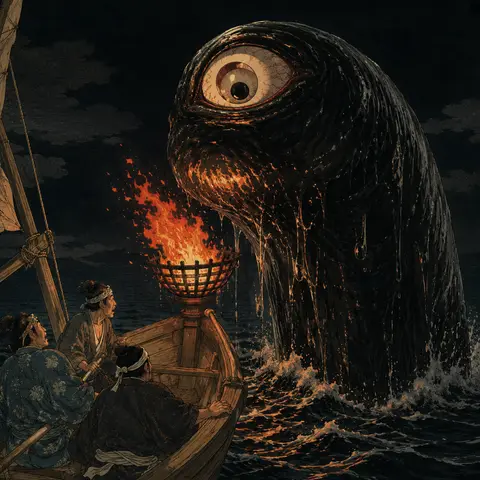
    A sea monk told across the Chugoku region. In Nagato it appears to snuff out watch fires, while in Okayama’s Bisan Seto it is called “Nurarihyon,” taking a bead-like form to bewilder people. Along the San’in coast it clings to beachgoers and tries to pull them into the sea. The Tottori collection Inaba Kaidan-shu recounts a one-eyed, post-like sea monk that torments people with its slick, slimy body.

  • Void Drum

    Void Drum

    Uncommon

    koh-KOO DIE-koh

    Void Drum (Suō-Ōshima Tradition)

    Aquatic SpiritsYamaguchi

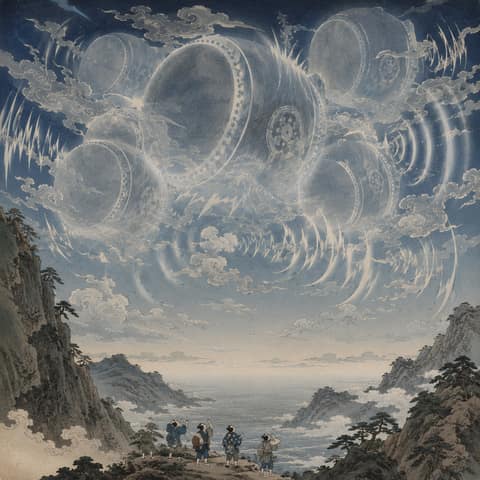
    The Void Drum is told as a phenomenon that is sound without form. On Suō-Ōshima’s beaches and capes it is heard most around June, especially from dusk as the wind shifts until midnight. Locals relate it to sea roars and echoes among rocks, recording it as a case where natural sound and a spiritual event are inseparable. Oral lore says a troupe of performers once had their boat swallowed by a storm. They beat their drums desperately for rescue but never returned, and in that season ever after the drum’s resonance rose again over the sea. Some describe the tone as light, rapid strokes like a rope-tension drum, others as a single broad beat like a shrine drum, with reports varying by listener. In some areas people press their hands together to console the sea spirits and avoid treating it as an ill omen. Dates and names are unknown and remain in the realm of oral tradition, yet it stands as a classic sea-village sound apparition.

  • Wave Sprite (Nami-kozō)

    Wave Sprite (Nami-kozō)

    Uncommon

    NAH-mee koh-ZOH

    Tradition-Aligned Wave Herald of Enshū-nada

    Aquatic SpiritsShizuoka

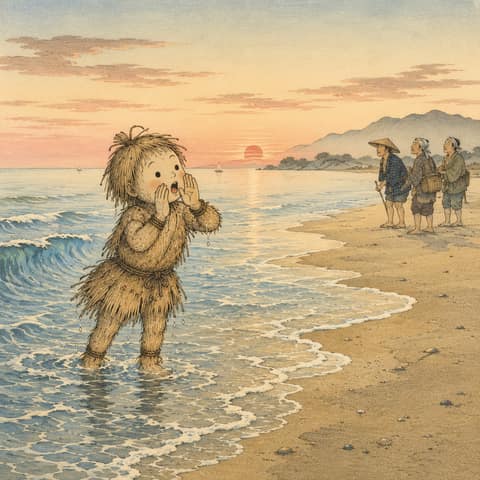
    A folkloric figure tied to the coasts and estuaries of former Tōtōmi Province, said either to descend from a straw doll set adrift by the monk Gyōki or to have signaled drought-stricken farmers with the sound of waves. It appears as a small child or tiny doll, with no fixed features. Its role is to foretell weather by wave-sound, indicating the approach of rain and wind by direction and intensity, allowing fishers to judge whether to launch and farmers to plan their work. It overlaps with ideas of water and dolls, kappa tales, and accounts under the name umibōzu, yet all remain within a frame that reads sea-roar as folk knowledge. Rather than an object of worship, it is a personification of awe-inspiring natural signs, and offerings or rites vary by region. Records rely on local materials and oral tradition, with details often uncertain.

  • Yonatama

    Yonatama

    Rare

    Yonatama

    Yonatama, the Tsunami-Summoning Sea Spirit

    Water SpiritOkinawa

    This is a sea spirit of Miyako, often depicted as a mermaid or a talking fish. Legend has it that on the night it was caught by Shimojishima fishermen and roasted over a net, it answered a call from the deep sea, begging for a tsunami to save it. Only a mother and child managed to escape to Irabu Island, and the sunken crater left where the fishermen's home once stood is said to be the origin of the famous Toriike pond. Embodying both the ocean's boundless bounty and its terrifying wrath, its very name is a fusion of the words "sea" and "spirit." Intertwined with the tragic memory of the Great Meiwa Tsunami of 1771, the Yonatama remains a stark warning passed down across the islands to those who would disrespect the sea.

Showing 25 - 48 of 49 yokai