Yokai Encyclopedia
Encyclopedia of Japanese Yokai
珍しい 
Konpeika, the Golden Ogre of Kumano
kohn-PAY-kah
Kumanō Onigajō Legend Variant
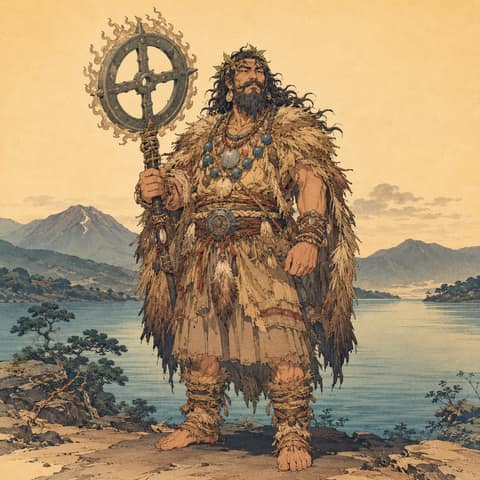
Demons & Giants Kii Province (Kumano), Japan A compiled variant portraying the ogre-general aspect of Kanekira Shika within Tamuramaro-style oni-slaying tales along the Kumanonada coast. He is said to have ruled from the ogres’ sea-eroded cavern known as the Demon’s Rock Dwelling, commanding a band of oni to disrupt maritime routes. In the clash with Tamuramaro, he feared Kannon’s protection, tightened his wards, and barred the stone door to endure a siege. Entranced by the dance led by a child avatar of Senju Kannon, he peered through the doorway and was fatally shot in the left eye. After his defeat, the head was buried in a ravine and ritually pacified. Local lore sometimes names him the pirate chief Tagamaru, with traces preserved in temple-shrine origin tales and toponyms such as Mamigashima, Tomari Kannon (Seimizu-dera), Ōma Shrine, and Onimoto. Historicity is uncertain; some see memories of suppressing revolts or local powers in Kumano later recast into Tamuramaro legend, yet all survive as narrative tradition.
稀少 
Kanazuchibō
kah-nah-ZOO-chee-boh
Iconographic Reconstruction (According to Tradition)
Household Spirits Japanese folklore Reconstructed after the iconography seen in the Matsui Library Hyakki Yagyō handscroll and other monster scrolls held by institutions such as the National Museum of Japanese History: a bird-faced figure brandishing a raised hammer. Following the sources, its name is noted as Kanezuchibō, with a comment on its affinity to the cognate form Daichiuchi; its deeds and origins remain unknown. While the hammer suggests a tool-turned-tsukumogami reading, no explicit statement in the sources confirms this. It is most often depicted as a member of a procession, one of the recurring motifs in Hyakki Yagyō imagery. Later metaphorical readings (e.g., caution or self-effacement) are treated as secondary interpretations and not conflated with the original tradition.
稀少 
Golden Crow
KEEN-oo (Kin-ū)
Golden Crow
Animal Shapeshifters Chinese origin; transmitted to Japan Rooted in ancient China, this iconographic Golden Crow took hold in Japan from the medieval period through religious art and Onmyōdō interpretations. It rarely appears in concrete怪談 and functions chiefly as a symbol. Its three legs are read as the yang number three, marking the sun’s course, authority, and auspice. In Japanese examples, a black crow is placed upon the solar disk held by the Sun Deva, with vermilion and gold backgrounds. Early modern texts sometimes liken it to solar sunspots, but its original nature is mythic and ritual. It recurs on imperial ceremonial garments, temple and shrine banners, and paintings, and in folk events crows may be used with archery targets or sun emblems. Later explanations sometimes confuse it with Yatagarasu, but their origins and roles are distinct.
名妖 
Kinrei (and Kintama)
kee-NREH
Kinrei • Kintama, Curated Tradition Edition
Ghosts & Spirits Across Japan (noted in Edo, the Kanto region, and Suruga) Kinrei appears in Edo-period art and commentary as a spiritual notion symbolizing the reward for moral practice, with household prosperity explained as part of a heaven-given order. Rather than a visitor like a tangible kami, it is understood as the auspicious aura born of selflessness and good deeds. Kintama, by contrast, is told across regions as a strange fire or orb-like visitant that brings luck to a home when respectfully enshrined, yet turns ominous if scraped or damaged, a taboo tied to its form. Early chapbooks and ghost collections depict swarms of coin-spirits drifting in the evening sky, or a roaring sphere flying in to enter the honest. Postwar retellings often link it to the rise and fall of household fortunes, but older records stress symbolic meaning and will-o’-wisp tales. Because names and traits overlap among regional traditions, sources differ in how they use “Kinrei” and “Kintama.”
一般 
Goldfish Lantern
KEEN-gyoh-toh
Modern Version
Household Spirits Summer festivals, goldfish scooping, lantern culture Kingyo-akari is a yokai said to be born from the dream of a goldfish trapped inside a summer festival lantern. At night it drifts softly through the air, scattering light with its glowing red tail. It appears before lost children and gently lights their way, but if one becomes too enchanted, it may lead them far from the festival’s bustle. Though small and endearing, when its light flickers out, people say it heralds the end of summer.
珍しい 
Tsurube-bi (Bucket Fire)
TSOO-roo-beh-bee
Traditional Aspect (Kaika Will-o’-Wisp)
Natural Phenomena Spirits Kyoto (Saiin) and mountain woods across Shikoku and Kyushu A traditional reading of the Tsurube-bi based on Edo-period ghost tales and Sekien’s imagery. Told across Japan as a tree-born will-o’-wisp, its bluish-white fire-orbs dangle from branch tips and bob up and down like a well bucket’s pulley, misleading travelers. The flame is weaker than it looks and is said not to catch on clothes or vegetation. Early-modern accounts cite fire apparitions around Saiin in Kyoto, and later yokai encyclopedias file it as a will-o’-wisp akin to Tsurube-otoshi or as a separate kind. Sightings are said to peak on moonless or misty nights; when approached it slips away, when left it drifts back. A shadowed face sometimes appears, causing confusion with hitodama, yet it is remembered as a local, earthbound fire spirit.
稀少 
Suzu-hiko-hime
SOO-zoo-HEE-koh-hee-meh
Based on Sekien Toriyama Plates
Household Spirits Japanese folklore A reconstruction grounded in Toriyama Sekien’s illustration and notes. Shown as a woman bearing a kagura suzu, she serves as a symbolic presence moving between summoning spirits and soothing souls. Rather than a concrete monster, she personifies the numinous power tied to the ritual bell, evoking the Ama-no-Iwato myth while remaining distinct from its deities. Edo painters placed her within the Night Parade lineage, and Tsukioka Yoshitoshi offered a comparable image to Suzuhiko-hime. No fixed haunt is recorded; she is thought to appear in the imagination at kagura offerings, festival floats, and shrine fairgrounds.
珍しい 
Tesso
TEH-soh
Edo Picture-Book Standard, Traditional Iconography
Ghosts & Spirits Ōmi Province (modern Shiga Prefecture) Based on Toriyama Sekien’s “Tesso” motif, it appears as a giant rat draped in robe-like shadows, with red eyes and teeth said to be iron-hard. Its origin lies in the vengeful spirit tale of Raigō tied to disputes over the ordination platform at Onjōji, where rivalry between Enryakuji’s Sannō faction and the Miidera side was cast into story and overlapped with real rat damage to temple sutras and treasures. Names vary by period and source, with “Raigō Nezumi” and “Miidera Nezumi” coexisting. Medieval war tales exaggerate its numbers into a calamity of swarming rats, while from early modern times it links to shrine legends of pacification and blessings. Chronologies in records do not always align and the tale is highly narrative, yet shrine and temple names, linked verse, and oral lore support a core tradition. In some regions, extermination stories feature a great cat of Mount Hiei or guardian deities, reflecting the boundary-conscious rivalry between two religious centers.
稀少 
Shōgorō (the Gong Spirit)
SHOH-goh-ROH
Sekien Plate Edition (Toriyama Sekien-Inspired)
Animated Objects & Undead Edo period, Kamigata tradition (Osaka) An interpretive reconstruction based on Shōgorō from Toriyama Sekien’s Hyakki Tsurezure Bukuro, linking the tsukumogami notion of spirits inhabiting tools with the muromachi-era Waniguchi bell monster seen in Night Parade picture scrolls. Because the name plays on words, it cannot be conclusively read as the vengeful spirit of any specific person. In the Kansai region it has been read against the Yodoya “Golden Rooster” legend, serving as an image that warns against the pursuit of wealth and fame. It is depicted as a round temple gong or waniguchi bell sprouting limbs, sounding of its own accord to give warning. No field sightings survive, and primary sources are picture scrolls, yokai paintings, and their notes.
神格 
Zhong Kui (Shōki)
SHOH-kee
Traditional Iconography Shoki, Warding Demon-Queller
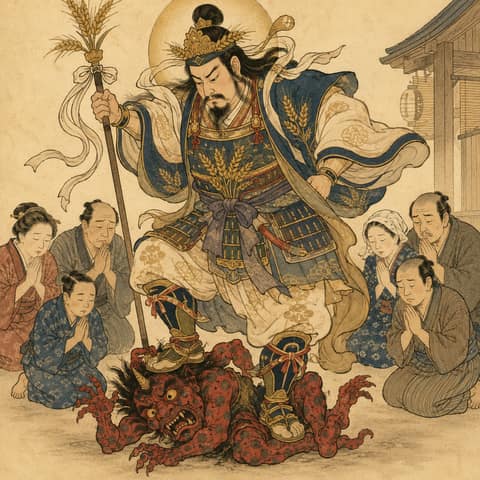
Deities & Divine Spirits Chinese origin; spread throughout Japan Shoki, a demon-quelling deity spread across East Asia from Tang dynasty lore, took root in Japan as a talismanic power against calamity and smallpox. He is depicted as a bearded martial figure in official robes and cap, glaring with fierce eyes and wielding a sword in one or both hands. He often appears hunting, trampling, or bagging small demons. At New Year and Boys’ Festival he is displayed on hanging scrolls, banners, and screens, and many townhouses placed ceramic Shoki figures on eaves or roof corners. In Japan the earliest examples trace back to late Heian apotropaic paintings; from the Muromachi period the theme became established, and by late Edo he also appeared as May Festival dolls. Images and figures were hung at entrances, gates, or the upper seat of reception rooms to stop plague deities and malign spirits. Although dedicated shrines are limited today, regional folk belief since early modern times continues, and rooftop Shoki statues are still found from Kinki through the Chubu region. His powers are symbolized by the subduing glare and swordplay that drive off evil sprites, functioning as amulets against drug harm and epidemics.
伝説 
Kama-itachi
kah-mah-ee-TAH-chee
Kama-itachi
Animal Shapeshifters Central Japan, Kinki, and Shin’etsu regions (various locales) Kama-itachi is a name for a wind-borne anomaly found in Edo-period art, essays, and oral lore, referring both to the phenomenon and its alleged agent. It is tied to whirlwinds and chill gusts in northern and mountainous regions, noted for razor-like lacerations when one stumbles on the road, delayed pain or bleeding, and frequent injuries to the legs. Its true nature varies across sources: invisible minor spirits, beasts riding the wind, or acts of deities coexist as explanations. In Shin’etsu it is said to strike those who break calendrical taboos, and in Hida a three-stage action is told. In parts of Chubu and Kinki, the whirlwind itself is called kama-itachi, while Edo essays report beast tracks left after a dust devil. Under regional aliases like Tosa’s “Field Sickle,” funerary tools turned uncanny are blamed for similar wounds. In haiku it settled as a winter season word and a sign of wind-borne calamity. This version limits itself to attested sources, avoids overlinking to specific places or persons, and presents regional types side by side.
稀少 
Abumikuchi
ah-BOO-mee-KOO-chee
Sekien Zue Conformant
Animated Objects & Undead Japanese folklore An abumiguchi depicted per Toriyama Sekien’s Illustrated Bag of a Hundred Tools. An ancient stirrup sprouts eyes and a mouth, shown lying on the ground or dragging its straps. A quoted line from the Noh play Tomonaga invites readings of battlefields and fallen warriors in the background, yet no concrete deeds or harms are recorded. Following tsukumogami conventions, it is the resentment and lingering attachment of a tool long used then discarded given form. This aligns with Edo-period essays that teach “cherish your implements,” and likely reflects the Tsurezuregusa passage warning about horse gear, echoed in its pairing with the Saddle Fellow. The modern retelling that it “awaits its master,” seen in Mizuki Shigeru’s notes, lacks support in older sources and is not adopted here. No verified field traditions are known, and no region is specified.
稀少 
Long Crown
oh-sah-KOH-buh-ree
Iconographic Tradition Version
Household Spirits Japanese folklore Based on Sekien’s image and caption, the crown is shown as if it stands on its own and walks with proper manners, a satire aimed at minds fixated on authority. A crown should rightly regulate decorum and rank, yet when one refuses to remove it for selfish ends, the vessel is said to curse its master, gain form, and wander. Firsthand accounts are scarce; it appears mostly in paintings and texts as an unspoken warning, paired with Kutsuhō as a lesson in suspect behavior and knowing one’s proper place. Later artists like Yoshitoshi echoed this by adding a crown-spirit to Hyakki Yagyō processions. Among early modern aficionados, it was treated as an example of tsukumogami, in which ceremonial items like crowns and scepters acquire spirits as they age.
名妖 
Osakabe-hime
oh-sah-KAH-beh-hee-meh
Osakabe-hime (Traditional Tale Version)
Half-Human Beings Harima Province (modern-day Himeji, Hyōgo Prefecture) Based on the image of a castle-deity linked to Himeji Castle’s main keep, centered on the kimon northeastern quarter. Known as Osakabe as well as Koshogobu or Shogobu, she appeared through the early modern era as a shifting “castle specter” before settling into the form of an aged princess or female apparition. Her pedigree ties to shrine relocations during construction and the founding of Hattendo, understood as a spiritual force intervening in the castle’s ritual order. She sees into human hearts, sometimes proving herself by producing tangible tokens such as combs or helmet scales, and is also recorded to assume a grand oni-like form in response to prayers or provocation. Her true nature is variously attributed to an ancient fox, the castle’s tutelary deity, an unknown noblewoman’s spirit, or a human sacrifice legend, with no single origin fixed. She protects when the lord governs justly and brings calamity when order falters, embodying a guardian of the boundary between castle and community.
一般 
Flash-Spinner Oni
SEN-kyoo-kee
Modern Version
Household Spirits Festival night stalls; schoolyards Senkūki is a yokai born when a well-worn yo-yo from a summer festival absorbs moonlight. It moves with lightning speed, leaving trails of light each time it is cast. Sometimes it tangles its string around a person’s wrist, sometimes it dances in the night sky with an eerie glow, enchanting onlookers. In the hands of the unskilled, its string runs wild, tripping its owner and knocking things over in mischievous pranks.
稀少 
Onmoraki
ohn-moh-RAH-kee
Onmoraki
Animal Shapeshifters Japan (tradition derived from Chinese sources) Following Toriyama Sekien’s Konjaku Gazu Zoku Hyakki, it bears a crane-like black body, eyes that gleam like lamplight, and a cry that trembles through its wings. Said to arise from the qi of a fresh corpse, it appears when sutra recitations or memorial services are neglected at temples. Framed by Chinese lore adapted in Japan and retold in Edo-period strange tales, it manifests less from rancor than from circumstances such as unfinished rites or temporarily laid-out bodies, serving as a cautionary apparition upholding temple norms. Sightings are momentary, vanish when approached, and leave scant trace. Its very form is an alarm, understood as a sign of improper or incomplete memorial observances.
珍しい 
Hidden Zato (Kakurezatō)
kah-KOO-reh-zah-TOH
Tradition-Faithful
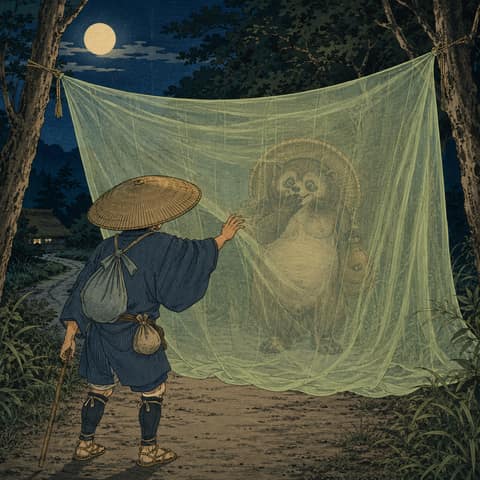
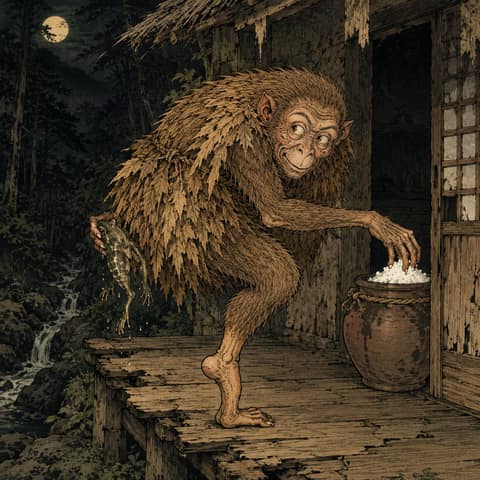
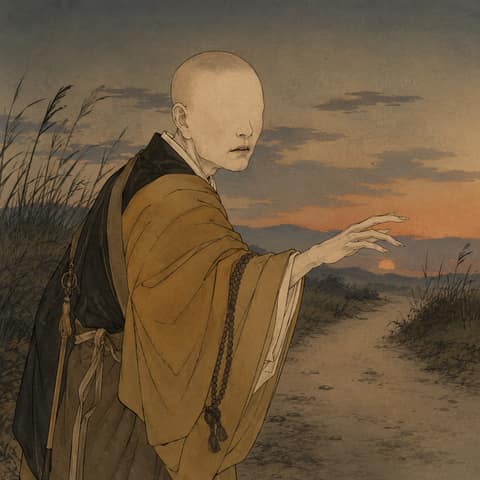
Mountain & Wilderness Spirits Ōu and Kantō regions (Hokkaidō, Akita, Kantō) This version frames the Hidden Zato as a blind minstrel-yokai lurking in the mountains and caverns of Tohoku and Kanto. At midnight it pounds out sounds like a foot-operated mortar or rapid rice polishing, yet the source stays unseen and household tools are said to be “borrowed.” In some tales, peeking reveals the noise coming from a neighbor’s house. Some regions call it a child-snatcher, while others give it a benevolent face as a dispenser of mochi or treasure to the honest, making them prosperous. From early modern times, the idea of hidden villages merged with a mystique around blind guilds, recasting it as an unseen people dwelling in caves. Modern folk explanations liken the racket to insect wingbeats, but as a bearer of the uncanny it endures as a spirit in the form of a zato.
珍しい 
Inugami Gyōbu
EE-noo-GAH-mee GYOH-boo
Kodan Tradition Version
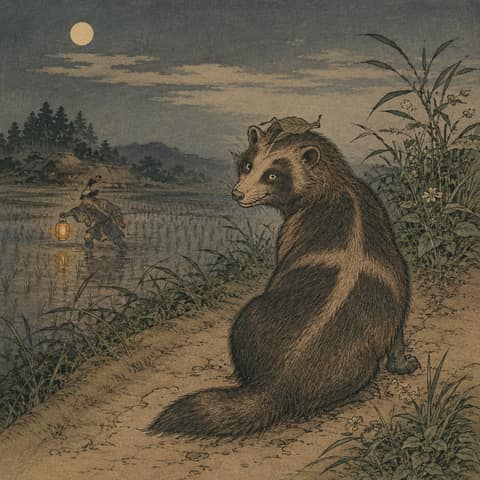
Animal Shapeshifters Iyo Province (modern Matsuyama, Ehime Prefecture) The image of Inugami Gyobu should be understood through the lens of how the Matsuyama tanuki tales were reshaped by kodan storytelling. Across Shikoku, dense beliefs in tanuki and transformation legends spread, and in Matsuyama both “guardian” and “trickster” aspects were told of beings dwelling at the boundary between the castle town and the wilds. The title Gyobu signals a bond with the castle, emphasizing a guardian role, while kodan added favored conflicts—such as inviolable pacts and ambushes during internal clan strife—producing varied plotlines. In every variant, the rock shelters and caves of Mt. Kuma form the final stage, where sealing or pacification brings closure. The appearance of Ino Budayu also became standard, linking in a known monster-slaying tale from other sources and lending a higher authority of supernatural judgment to the Matsuyama tanuki narrative. His spiritual power and many retainers match regional views of a tanuki chieftain leading a band, serving as a framework to explain wonders at annual castle-town events and at passes or shrine precincts. Though today’s lore bears kodan embellishments, at its core remains the figure of a tanuki lord guarding the liminal zone between castle and mountain.
稀少 
Hidden Hamlet
kah-koo-reh-ZAH-toh
Sekien Zue Version: Hidden Village
山野の怪 Japanese folklore An interpretation based on Toriyama Sekien’s Konjaku Hyakki Shūi entry “Kakurezato” (Hidden Village). The mouse and koban coins at the lower right recall tales in which subterranean mice carry wealth (the so‑called Nezumi Jōdo legend), hinting at ties between the village and chthonic or underworld realms. The shop curtain reads “Kakurezato,” expressing a boundary that opens suddenly as an extension of the everyday. The Hidden Village is not a single yokai but a boundary acting as if it has will, repeating wayfinding confusion, temporal slippage, the granting of fortune, and cycles of manifestation and disappearance. Outcomes swing with a visitor’s conduct and greed, from generous hospitality to wealth turning into leaf-litter, resonating with mountain otherworld tales and views of the beyond.
名妖 
Rain Woman
AH-meh-ON-nah
Rain-Summoning Female Spirit
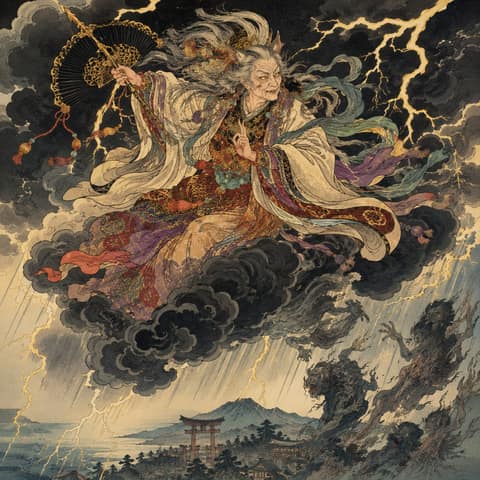
Weather & Calamity Spirits Various regions of Japan (notably Shinshū/Nagano and the Kantō area) In historical sources, Ame-onna first appears in Toriyama Sekien’s illustrations, though his entry leans on an allegory from Chu, leaving the standalone monster image faint. In oral traditions nationwide two types stand out. One is a female apparition on rainy nights that targets children (such as Shinshu’s “Ame-onba”), with motifs like approaching crying children on night roads and carrying a sack. The other is a numinous being that summons rain in drought, tied to rain-invoking rites and shrine prayers, venerated as a symbol of blessed showers. Rather than contradicting each other, these reflect a folk reading of rain’s dual gifts and perils. From early modern times, a nickname meaning “one who brings rain” also stuck to individuals, but that is a social label, not a yokai image. Sources vary widely by region, and many tales leave names and citations unspecified.
珍しい 
Rainfall Page-Boy
ah-meh-FOO-ree koh-ZOH
Rain-Attendant Page
Household Spirits Edo period Based on Toriyama Sekien’s imagery, this version foregrounds the character of a page serving the Rain Master. It appears with a Japanese umbrella stripped of its ribs worn like a hood and a lantern in hand. Its origins lie more in printed books than in oral folk tradition, and in yellow-covered comic books it shows up as a menial helper. The ideas of rain and service to nobility converge, shaping it as an attendant akin to small child-deity retainers. It does not wield an explicit divinity that summons rain, remaining subordinate to a being that governs rain’s power. Depictions vary—one eye, hat, lantern—depending on period and source, with no single fixed image. Lacking a known local provenance, it spread notably through Edo’s publishing culture.
伝説 
Yuki-onna
YOO-kee OH-nah
Yuki-onna (Traditional Folklore)
Natural Phenomena Spirits Snow country regions of Japan A hauntingly beautiful woman with snow-white skin and long black hair. She appears on winter nights across snowy fields, singing songs that are as beautiful as they are sad. Her beauty captivates the heart, yet it also conveys a profound loneliness. Ever seeking love yet untouchable, she wanders the snow forever.
珍しい 
Snow Elder
YOO-kee-jee-jee
Elder of Snow Standing in the Mountains
Natural Phenomena Spirits Mountain regions of Tohoku, Hokuriku, and Koshin (uncertain) When the curtain of a blizzard falls, the Snow Elder appears as an old man in white robes, calling from afar to strip travelers of their sense of direction. He belongs to the lineage of snow-related apparitions, overlapping in role with Yuki-onna and Yuki-nyūdō, yet marked by his elder form. His figure is indistinct, fading the closer one approaches, while only his voice is said to echo from behind. In folklore he is understood as a symbolic warning against the perils of winter weather.
珍しい 
Yuki-warashi (Snow Child)
YOO-kee WAH-rah-shee
Echigo Traditions Type Snow Child
Natural Phenomena Spirits Echigo Province (modern Niigata Prefecture) Based on the Snow Child figure from Echigo Province. It appears as a small child on snowy days, visiting from the doorway on blizzard nights to warm itself by the hearth. When cared for, it comforts the household and may help with chores, yet with the first signs of spring it loses strength and fades. It shows no malice and instead bears the character of a guest deity, a seasonal visitor heralding winter’s presence. Its visits recur but never last, and finally cease, reflecting the impermanence of snow. It is also called “Yuki-warashi” or “Yukiko,” names that all link snow with a childlike form.
Showing 281 - 300 of 404 yokai