Yokai Encyclopedia
Encyclopedia of Japanese Yokai
珍しい 
Sanuki Heike Crab
sah-NOO-kee HAY-keh-gah-nee
Sanuki Heike Crab (Linked to Yashimaura)
Household Spirits Sanuki Province (around Yashimaura near the Awa border) An image based on folk belief that crabs with human-like patterns on their carapaces washed up on Sanuki shores embody the vengeful spirits of the defeated Taira clan. Historical sources tie these crabs to various locales, with Sanuki famed due to memories of the Battle of Yashima. As a yokai, it is said not to harm people directly, but to make onlookers recall the karma of the battle and feel awe. It is distinctly linked with acts of memorial service and consolation for the dead, and differences from other regional names are considered nominal only.
珍しい 
Bungo Kawatarō
bun-go no kawa-ta-rō
Bungo Kawatarō, the Hairy Kappa of Bungo
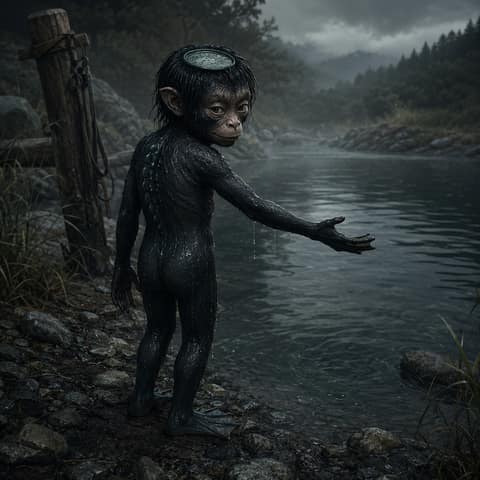
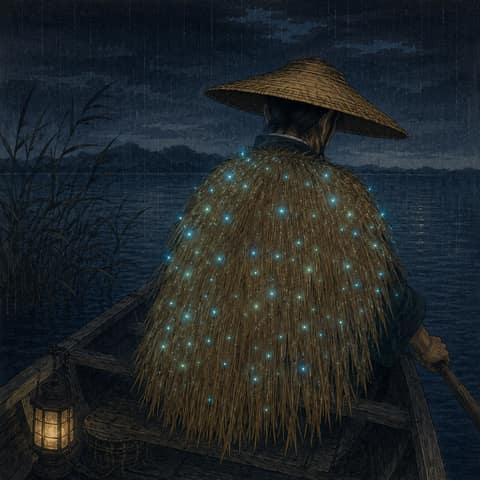
Water spirit Ōita Prefecture (the old province of Bungo; a kind of kappa) This version turns to the local color that Bungo Kawatarō carries within the broad category of the kappa. Across Kyushu the kappa is widely called "kawatarō," and Bungo Kawatarō is one of these. Against the frog- and turtle-like kappa so often pictured on the main island, the kappa of Bungo and the rest of Kyushu are usually described as hairy and monkeylike in build—a vivid reminder of how greatly the kappa’s form varied from region to region. Its nature is true to the kappa: it claims the waterside as its territory and delights in sumo and pranks, yet retains a regard for courtesy. To those who bring offerings and keep their promises, it was said to grant the practical wisdom useful to people who live by the water—how to read the currents, how to manage irrigation, how to sense the turn of the weather. Rather than dwelling too heavily on grisly horrors like pulling out entrails, Bungo Kawatarō was spoken of as a being met with both fear and reliance; that is its distinctive flavor. The eyewitness records in Hita’s Kappa Kikiawase convey that such a kawatarō was no mere fancy but a living presence within the life of the land.
稀少 
Shell Child
KAI-chee-go
Iconographic and Encyclopedic Interpretation
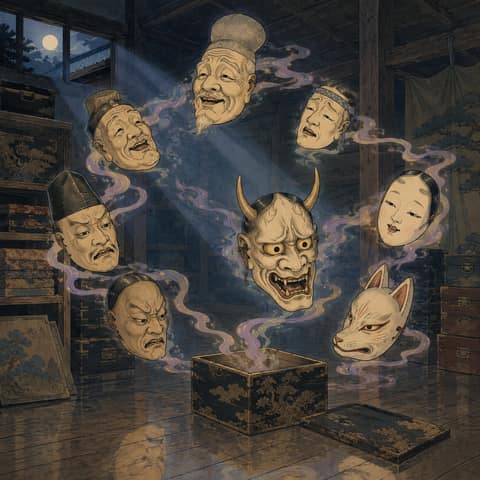
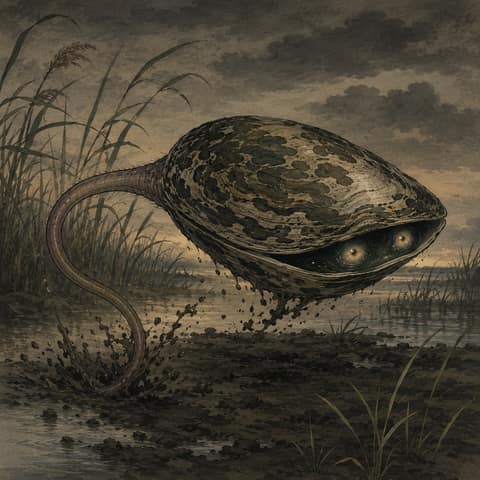
Household Spirits Japanese folklore Rooted in Toriyama Sekien’s illustration and brief caption, this lineage reads the shell box through the history of kaiawase shells and bridal trousseau chests. Lacking firsthand anecdotes, it stays within the general tsukumogami frame, overlaying the folk view that long-serving objects acquire feeling. Its form is childlike, with a key association to crawling baby dolls. Late at night in a silent tatami room, the lid of the shell box is said to open slightly, and a small childlike figure peeks out. It causes little harm, and is said to vanish when household goods are treated carelessly.
珍しい 
Poverty God
BEEN-boh-gah-mee
Classical Folktale-Concordant
Household Spirits Across Japan The Binbōgami traces its roots to the personification of medieval poverty and began to be named explicitly from the Muromachi period onward. It commonly appears as a gaunt old man carrying a plain paper fan, believed to dwell in closets or the corners of tatami rooms. Banishment is not easy, and ritual sending-off is preferred over force. Saishōshi records guiding it outside the gate with a branch on the last night of the month, Tankai describes setting grilled rice and roasted miso on a wooden tray and letting them drift downriver from the back door, and Nihon Eitaigura tells of honoring it respectfully on the Night of the Seven Herbs so that, appeased, it turns to bring fortune. Numerous folk beliefs link it with fire and household order, as in Niigata’s New Year’s Eve hearth customs and Ehime’s taboos against disturbing the fire. Miso, said to be its favorite, is cited both as an attractant and a taboo, with roasted miso rites preserved in many regions. Though a punitive deity, it is said to grow uncomfortable where diligence, cleanliness, and frugality are observed, and in folk religion it functions as the counter-concept to household gods of fortune, serving as a barometer of family luck.
名妖 
Red Ray (Akaei)
AH-kah-eh-ee
Legend-Concordant Sea Giant Fish Tale
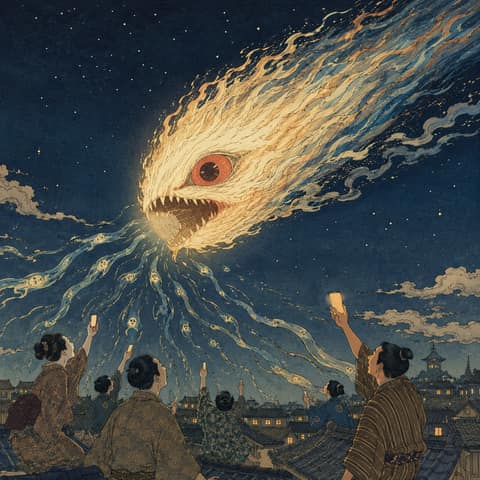
Aquatic Spirits Awa Province (modern southern Chiba Prefecture) Based on the account in Ehon Hyaku Monogatari, this version frames it as a sea monster whose massive body surfaces like an island. Its back bears sand and pebbles, so from afar it is mistaken for an uninhabited isle. When sailors draw near it sinks, spawning whirlpools and heavy seas that damage or capsize ships. The tales strongly warn against navigational hazards and errors of sea-line sighting. Reported as a firsthand sighting off Awa, it is discussed alongside records of giant fish off Ezo and curiosities like the “Capital of the Red Ray,” collectively naming common sea-borne anomalies. Natural-history notes mingle with怪談, with little concrete ecology, but three cores recur: immensity, floating and sinking, and stormy waves.
名妖 
Red Tongue
AH-kah-shah
Iconographic Tradition: Akazashita (Toriyama Sekien lineage)
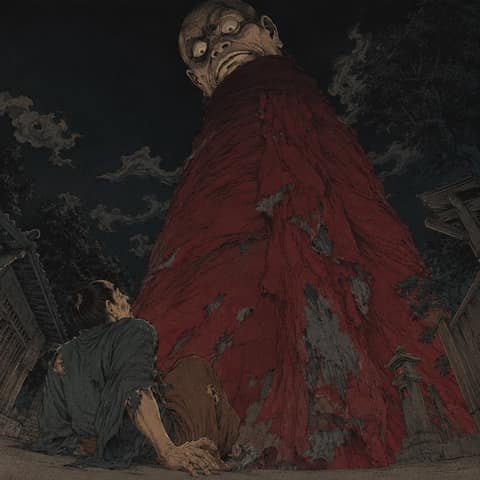
General Classifications Various regions of Japan (sources uncertain) Akazashita is a rare case where imagery precedes textual records. Its core features are a colossal tongue thrusting from black clouds and a bestial face. Toriyama Sekien placed this figure over a sluice gate, and later scholars offered symbolic readings drawing on notions of filth such as scum and grime and on proverbs that cast the mouth and tongue as gates of calamity, but Sekien left no notes. In many early modern sources the sluice gate is absent, and the name wavers between Akazashita and Akakuchi. Links to the Onmyodo guardian name Akazashita-shin of the Grand Duke direction or to the Rokuyo day Akakuchi have been noted but cannot be firmly genealogized. Since the Showa era, fable-like explanations and local tales have spread, yet statements beyond the base sources should be avoided.
珍しい 
Aka-ashi (Red Foot)
AH-kah AH-shee
Aka-ashi
General Classifications Various regions of Japan (Shiwaku Islands in Kagawa, Fukuoka Prefecture, Hachinohe in former Mutsu) Based on records from various regions, in places where it shows itself only a pair of red feet jut from the roadside, startling passersby and throwing off their pace. Where it remains unseen, a dry, cottony or cobweb-like touch clings to the shins, shortening strides and increasing fatigue. It is not lethal, yet it is feared for causing falls and leading people off the road. Its relation to the Red-Hand Child is noted in sources but not assumed to be identical. Encounters are told at crossroads, mountain paths, and brush edges in sparsely peopled spots, most often from dusk to midnight. As remedies, some regions pass down practical measures: breathe deeply and steady your steps, sit to retie sandal thongs, brush aside the roadside grass, though details vary locally and remain uncertain.
珍しい 
Red-Head
AH-kah-gah-shee-rah
Red-Head
Mountain & Wilderness Spirits Kagase, Agawa District, Tosa Province (present-day Ino, Agawa District, Kochi Prefecture) A red-haired apparition said to appear in the fields and hills of Katsugase in Tosa Province. It walks upright like a human, yet hides among tall bamboo grass and reeds, making its full form elusive. Its most striking trait is hair that shines like the sun; approaching and staring directly at it is said to dazzle the eyes and cause temporary visual impairment. Tales rarely attribute malice to it, focusing instead on discomfort caused by its visual impact. It is named in the late Edo to early Meiji Tosa Bakemono Picture Book, listed alongside local figures such as the Laughing Woman of Yamakita and the White Crone of Motoyama. The “Aka-gashira” in Hyakki Yagyo picture scrolls is sometimes cited as iconography, though identification remains cautious. Sightings are told of at dusk through dawn in the open country and survive mainly in local oral tradition.
珍しい 
Foot-Washing Manor
ah-shee-AH-rah-ee yah-SHEE-kee
Ashiarai Mansion (Edo Odd Tale Traditional Type)
Household Spirits Honjo, Musashi Province (modern Sumida, Tokyo) In Honjo, Edo, this house-bound tsukumogami-like apparition manifests as a single gigantic foot descending from the ceiling to demand washing. It speaks human words and subsides when the ritual act of washing is performed, aligning with household notions of purification. Its true identity is left undefined and has been variously told as demon, monster, beastly shapeshifter, or a transformed house deity. Though threatening, some variants include a protective role that crushes thieves, and tales warn that forced exorcism angers it, reflecting urban ghost lore that prizes proper response over rash banishment. Regional lore varies—ending after a house change, or requiring a woman to do the washing—but the core remains: only the foot appears, and washing makes it withdraw.
稀少 
Ashinaga Tenaga (Long-Legs and Long-Arms)
ah-shee-NAH-gah teh-NAH-gah
Wakan Zu-e Lineage: Long-Leg and Long-Arm Pair
Half-Human Beings Uncertain (ancient foreign lands as reported in early geography) Grounded in the accounts of Sancai Tuhui and the Wakan Sansaizue, this depiction centers on the paired action of the Long-Leg (Ashinaga) and Long-Arm (Tenaga). The Long-Leg wades far into shallow seas, straddling reefs between waves to provide stable footing, while the Long-Arm extends his reach beneath the surface to gather fish and shellfish and to handle nets and baskets. They are recorded as foreign peoples, unattached to specific locales or clans. Dimensions are often given as legs three jo and arms two jo, though sources vary and no single physique is fixed. In Japan they appear in palace screen paintings, caricatures, and kusazoshi, where a set piece of the two cooperating against rough seas became standard. Religiously, they are sometimes placed in Dragon Palace tales as orderly retainers of the sea deity. As folklore, they symbolize otherworldly labor and the extension of reach across distance, and were consumed as images for maritime safety and plentiful catches. Reports of a solitary “Long-Leg” appearing as a weather portent are a separate tradition borrowing the name and should be distinguished from this paired form with Long-Arm.
珍しい 
Dancing Head
oh-DOH-ree-KOO-bee
Classical Tale-Conforming
Ghosts & Spirits Across Japan (records in Harima Province and Ōmi) A depiction of the Dancing Head based on scenes found in classical ghost stories and collections of strange tales. A powerful will from life takes form, with only the head detaching and swelling as it appears. It opens and closes its mouth to moan, laugh, or chatter its teeth, emphasizing an auditory menace. Direct physical harm is not always clear, yet it is said to bring misfortune such as falls from fright or sudden fever. Sightings cluster at old temples, graveyards, crossroads, and at the foot of bridges, places where human presence thins or around the hours of a wake. Lineage or personal names are rarely specified, and the strangeness of the incident itself is what lingers in the telling.
稀少 
Gooseflesh Specter
MEE-no-keh-DAH-chee
Emaki Iconographic Type: Hair-Raising Figure
Household Spirits Japanese folklore An image-based yokai originating from picture scrolls without accompanying text, making its function and temperament hard to define. Its bristling, hair-standing posture suggests a visual motif of fear or dread, yet sources provide no explanation and no firm conclusion can be drawn. Names vary by source, and related figures may appear under different titles. Here, characterization is kept minimal, grounded only in the image’s form and the extant manuscripts.
一般 
Headlamp Oni
shah-TOH-kee
Modern Edition
Household Spirits Urban arterial roads; late-night expressways Kurutōki lurks behind the glass and manipulates dazzling light to mislead travelers. It appears most readily when a driver panics or grows drowsy, and its silhouette is said to flicker within afterimages of light. Yet it is not purely malevolent; at times it flashes a fleeting shadow to warn of danger and snap drivers awake. It embodies both a guardian dwelling in light and a trickster that beguiles the eye.
名妖 
Wanyūdō
wah-nyoo-DOH
Traditional Iconography, Sekien School
Household Spirits Kyoto area (notably the Tōin-dōri legend) An interpretation grounded in Toriyama Sekien’s depiction. On night roads and at crossroads, a blazing wheel cruises low to the ground, its axle set with a monk-demon mask that fixes passersby with an unblinking stare. Meeting its gaze or succumbing to fear is said to drain one’s vital spirit, leaving the victim stupefied. Its origins trace to Kyoto wheel-ghost tales and likely overlap with the katagiriguruma motif, yet Sekien adopted a nyūdō mask and fixed it as a male figure. The source is uncertain, defying a firm label as vengeful spirit, tsukumogami, or will-o’-the-wisp. Countermeasures include posting a paper charm reading “This is the village of Katsumo” at the doorway, or avoiding eye contact and hiding. Few variants name specific places or people; the core image remains a plain yokai preserved in classical records.
珍しい 
Accompanying Hyōshigi
oh-KOO-ree hyoh-SHEE-ghee
Tradition-Faithful Version
Household Spirits Honjo, Musashi Province (modern Sumida, Tokyo) Aligned with the clapper-wood anomaly counted among the Seven Wonders of Honjo. Understood less as a corporeal yokai and more as a name for an aural phenomenon. It appears in step with the steady rhythm of night-watch clappers, most notable at corners, near water, and in rain. Visual sightings are scarce, and turning back reveals only a lingering presence. An urban ghost tale tied to local customs of community patrols, paired with the kindred “Okuri Chochin.” The lore resists heavy anthropomorphism, and its hallmark is that sound itself becomes the act of “seeing-off.”
珍しい 
Guiding Lantern (Okuri-chōchin)
oh-KOO-ree CHOH-cheen
Honjo Seven Wonders Tale: Okuri-Chochin (Guiding Lantern)
Mountain & Wilderness Spirits Honjo, Musashi Province (modern Sumida, Tokyo) Passed down around Edo’s Honjo district, the Okuri-Chochin is understood as a strange guiding fire that appears between safety and dread on night roads. Its light sways with a person’s steps and breath, keeps its distance while leading ahead, yet never allows touch. At times it slips to one’s rear or flank to upset direction, and when accompanied by a clapper-like sound it is recorded under the alias “Okuri Hyojiki.” The “Lantern Boy” of Ishihara Warigesui is a formless Odawara-lantern flame that circles on all sides and vanishes when approached, regarded as the same phenomenon as the Okuri-Chochin. In Mukojima it is called the “Okuri-Chochin Fire,” believed to light one’s footing and ensure safe passage, with cases linked to offerings at Ushijima Myojin. Though it rarely causes direct harm, it can lead travelers astray, so locals advise not to chase it, to keep a set distance and pass it by, or to bow at a shrine or temple to seek protection.
珍しい 
Escorting Sparrow
oh-KOO-ree soo-ZOO-meh
Systematized Folklore Edition
Mountain & Wilderness Spirits Kii and Yamato Provinces (Wakayama Prefecture; Higashiyoshino, Yoshino District, Nara Prefecture) Okuri-suzume has been framed as a harbinger and ill omen warning of dangers on mountain roads. Its calls precede, and are said to lead into, appearances of wolves or the escorting wolf, forming a narrative that encourages careful footing and avoiding delays in the wilds. The name “kuzusuzume” aligned with the real bird Black-faced Bunting (Aoji) is recorded, though its supposed nocturnality is debated. Sightings of its form are scarce, leaving its appearance unsettled, and in parts of Nara it is conflated with the night sparrow. Stories place it around Myohosan in Wakayama, and it is said to draw near lantern light. More than a threat itself, the lore centers on its “foreboding call,” giving it a strong character as a sound-based apparition.
名妖 
Reverse Pillar
sah-kah-BAH-shee-rah
Traditional Kaidan Edition Gyakubashira (Inverted Pillar)
Household Spirits Various regions of Japan A post–early modern belief that a pillar installed upside down, defying carpenters’ respect for a tree’s natural root spread, brings mishaps to a house. Persistent midnight house-settling, creaking beams, and uncanny whispers were read as the “curse of the inverted pillar,” prompting reinstallation or prayer. Shigeru Mizuki notes leaves birthing a spirit from the reversed wood, or the pillar itself transforming, yet older records more often treat it as signs of noise, misfortune, and ill omen. Deliberate inverted motifs used as apotropaic design (e.g., Yomeimon) belong to the ritual idea of intentional imperfection and are distinct from this yokai. As a taboo rooted in building folklore, it appears in regional carpenters’ lore, temple and shrine records, and essays.
珍しい 
Ōmagatoki – The Bewitching Hour of Dusk
OHH-mah-gah-TOH-kee
The Witching Hour (Traditional Narrative)
Half-Human Beings Various regions across Japan Though lacking a concrete form, the Witching Hour has long been understood as the effect of dusk’s dimness upon landscape and mind. Households would shut doors, call children inside, and avoid wandering, linking daily rules to this time. Toriyama Sekien depicted a hundred specters gathering at twilight, framing the hour itself as a stage that summons the uncanny. Folklore notes that the difficulty of recognizing faces stirs fear, and mishaps—losing one’s way, waterside accidents, and mountain village straying—were cautioned against as “meeting demons.” Dialects across Japan share this semantic field, often referring to twilight in general without explicit monstrosity. Thus it is not a combative yokai but a sense of peril dwelling in a liminal hour, preserved as a warning tied to the rhythm of daily life.
稀少 
The Dōjōji Bell
doh-JOH-jee no kah-NEH
Sekien Zue – The Dōjōji Bell
住居・器物 Kii Province (Dōjōji, Yura, Hidaka District, Wakayama Prefecture) An iconographic reading of the Dōjōji bell as depicted in Toriyama Sekien’s Konjaku Hyakki Shūi. While a note alludes to a variant in which the woman, transformed into a serpent, coils around the bell hiding Anchin and heats it until it melts into scalding liquid, hearsay also holds that the bell itself survived in historical record. Its “yokai nature” here is less an ensouled object than a visualization of folk belief in obsession possessing a vessel and causing anomalies. It represents Edo-period reception where Noh, sekkyō, and engi traditions intermingle.
稀少 
Jami (Evil Miasma Spirit)
JAH-mee
Iconographic Interpretation Version
Half-Human Beings China This version organizes the image of the Jami as an example of Sekien aligning a Chinese-origin demonic concept within Japan’s yokai system. Its original sense is “pernicious enchantment,” classed among chimi, a noxious presence born from the gloom of mountains and wastelands that harms body and mind. Its form is not fixed in classical texts, and images function more as visualizations of an idea. The effects fall between illness and invisible curse—fever, hallucination, frenzy—sometimes triggered by contact with resentment or defilement. Countermeasures include bans, talismans, and wards; traditions speak of drawing a prison on the ground to summon and seal, binding it by asking its name, or transferring it into a vessel. In Japan it rarely became an object of distinct cult, often treated as a generic term alongside more-ryo. In folk terms it is distinguished from miasma, mononoke, and tsukumogami, a high-abstraction yokai appearing where the chill of wild places intersects with human grudge.
伝説 
Shuten-dōji
SHOO-ten DOH-jee
Shuten Dōji of Mount Ōe
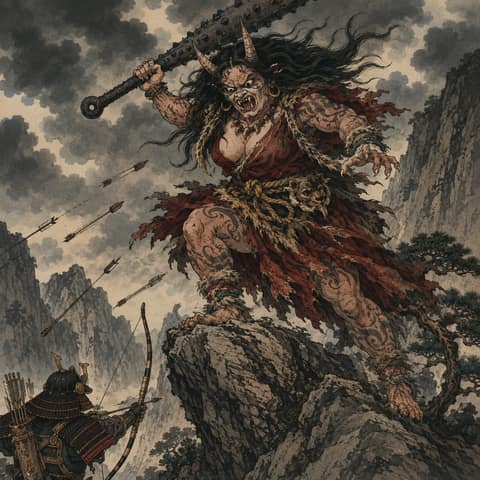
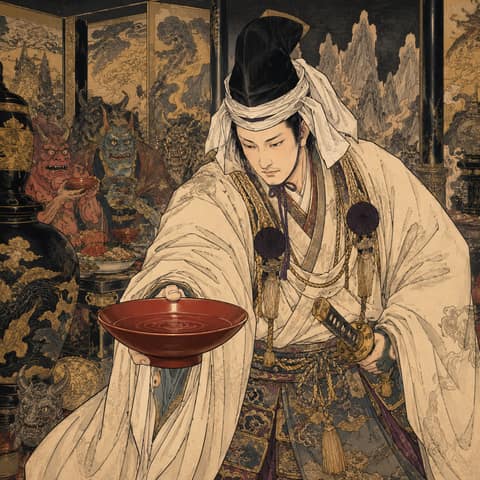
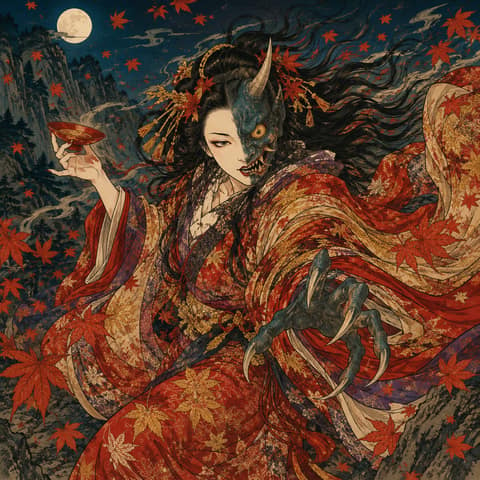
Half-Human Beings Tamba Province and Yamashiro Province (Mt. Ōe, Mt. Atago; various theories) Modeled on the chieftain who ruled ogres from Mount Ōe. He descends to villages disguised as a monk or young warrior, exploiting lust, drink, and human weakness. At banquets he feigns hospitality, but in truth he is a raging ogre who abducts people. In the slaying tale, his foes turned a sacred oath against him and sapped his strength with poisoned sake. Letting in guests dressed as mountain ascetics proved fatal.
珍しい 
Yako (Field Fox)
ya-ko
The Yako — Low Fox of the Kyushu Packs
Animal Shapeshifters Northern Kyushu, Izumi, and elsewhere (a low-ranking fox spirit) This version turns to how the Yako was spoken of in the Buddhist world, and in Zen in particular. Zen has the term yako-zen, "wild-fox Zen." It is a word of admonition for a half-finished state in which one has not truly attained enlightenment yet believes oneself enlightened. Its source is the famous tale "Hyakujō and the Wild Fox," recorded in the Song-dynasty Zen collection of dialogues, the Mumonkan. An old man came to listen each time the Tang Zen master Baizhang Huaihai (Hyakujō Ekai) preached. One day the old man revealed his story. Long ago, when he had been abbot of this very temple, he was asked whether one who has attained enlightenment still falls subject to cause and effect (karmic retribution), and he answered, "He does not fall (into cause and effect)." For that single mistaken word he had been cast into the body of a wild fox through five hundred rebirths. The old man begged Hyakujō for the correct answer. When Hyakujō rephrased it as "He does not obscure cause and effect," the old man was freed of his delusion on the spot, shed the wild-fox body, and attained buddhahood. Here the wild fox becomes a symbol of admonition—the form into which one who has fallen into half-baked enlightenment is transformed. Quite apart from the village field fox that deceives people, the Yako has lived on at length within the language of Zen as well, as "where shallow cleverness ends up."
珍しい 
Field Matchlock (Nodeppō)
noh-DEHP-poh
Canonical Folklore Version
Animal Shapeshifters Mountain forests of Japan’s northern provinces Based on images from illustrated Edo-period strange tales. It hides in northern mountains and fields and moves from twilight into early night. It appears as a small beast like a badger or a giant flying squirrel, and when attacking it blinds a person to sow confusion. Sources describe two modes: one covers the victim’s face with its whole body, the other spits a bat-like thing that clings to the face. Some accounts say it drinks blood, while later interpretations suggest it steals carried food while the victim’s sight is blocked. Historical conflation with badgers, tanuki, nobusuma, and bats led to shifting names and traits. A simple defense recorded is to keep rolled ear-shaped leaves in one’s bosom, though details vary by region and era. Avoids modern embellishment and follows classical picture compendia.
Showing 261 - 280 of 404 yokai