Yokai Encyclopedia
Encyclopedia of Japanese Yokai
名妖 
Funayūrei (Boat Ghosts)
foo-nah-YOO-ray
Mouren Yassa, the Vengeful Sea Ghost (Tales of Choshi and Kaijo District)
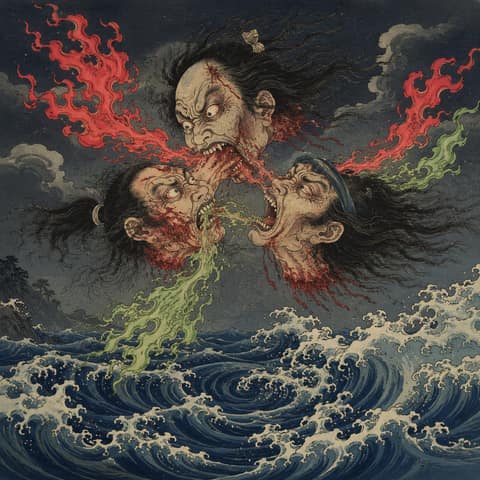
Aquatic Spirits Across Japan (coastal and island regions) A variant of the funayurei remembered along the coast from Choshi City through the old Kaijo District. On stormy nights when fog smothers the sea and whitecaps rise, it approaches from the offshore dark chanting “mōren yassa mōren yassa” in the rhythm of oar beats. The voice rises and falls with wind and current, then stops just beneath the gunwale. A moment later a black dripping arm reaches up from the water and croaks, “Lend a scoop.” Locals gloss mōren as “restless dead,” inaga as “water ladle,” and yassa as the chant for bringing boats in line. When these three arrive together, it portends a surge of drowning souls trying to board. They are a collective of those lost to the sea who have no shore to return to, strongest on the 16th of Obon and on the monthly death-days of the unlaid. Their aim is to sink the boat and add new hands to their wet rail. With the borrowed ladle they tap in seawater, and to the yassa beat they shift the water’s weight toward the bilge until the boat is swallowed. Time-honored countermeasures are set. First, hand over a ladle with the bottom knocked out. Showing a vessel that takes from the sea but not the boat convinces the dead that “water will not enter the hull” and breaks their rhythm. Second, fix them with a stare and hold the boat still. Do not steer, face the wave crests, breathe short, and the swarm loses its heading and melts into the fog. Third, throw ash or rice balls. Ash, as the remnant of shore-fire, points a way home, and rice balls salted for the sea serve as an offering to calm the tide. In Choshi, the one who calls the first haul keeps a guarded tongue, for Mouren Yassa is keen to a skipper’s words. Taboos are strict: putting out to sea on Obon’s 16th, scorning the foghorn and not sounding it, or laughing with the tide-waiting torii at your back will summon them. Their form shifts: they may pace you as a ghost ship under a furled white sail, or press the prow like the shadow of an umibozu. Yet what lingers in the ear is always the beat of “mōren yassa,” and when it fades, the danger passes. Early modern picture books paint them as vengeful spirits, but elder fishers call them “the voice that restates the sea’s law.” If flowers or dumplings are set afloat at the shore, by morning the prow-weed is shed and net frays are stilled. The name later was written as “Fierce Spirits, Eight Calamities,” a dread title of wild might, but at root they are a drifting host. If you hear them offshore, knock out the ladle’s bottom, set your prow straight, and mind your words—that is the shorewise rule kept at Choshi.
名妖 
Funayūrei (Boat Ghosts)
foo-nah-YOO-ray
Namōrei, Black Little-Craft of Kosode
Aquatic Spirits Across Japan (coastal and island regions) A variant of the funayurei from Kosode in Ube Village, Kunohe District, Iwate (now Kosode, Kuji City), whispered locally as the Namōrei. During night squalls or heavy sea fog, a small black-painted boat with a high stern and low prow appears soundlessly, as if running back along a tide line offshore. Its silhouette parts no waves, only blurs the surface like ink, and though no oar or sail is seen, it glides forward. One or several shadowy figures in glossy black garments stand along the gunwale, and only their voices slice through the wind. In a low, lingering tone they demand, “Hand over an oar,” or “Answer,” and if one replies, they at once sheer alongside and seize the other boat’s heading and helm. The Namōrei are the remnants of those who perished at sea and could not return home, craving oars and sculls—the “power to bring one back.” Elders warn that answering opens the mouth of one’s soul, and lending an oar is akin to yielding a boat’s lifeline. Thus in Kosode, when called from the sea at night, one must never respond, but either stand at the rail and glare steadily, or keep one’s hat brim pulled low in silence. The Namōrei are weak to the eye; met with a powerful gaze, they and their black boat melt into the tide fog. If they ask for an oar and are given a bottomless ladle, a split oar, or a holed bamboo scoop—“useless things”—their fixation breaks as seawater spills out at once. This is the widespread funayurei art of “passing the empty,” and along the Tohoku coast, refusing to answer and never handing over anything of substance were especially prized. The black boat appears when the stars hang low, on the sixteenth night of Obon, or when the offshore singing sands cry. White handprints multiplying on the rail and the gunwale growing heavy and low foretell their clinging approach. In contrast, scattering a pinch of rice or ash from one’s palm and sweeping it thrice to sea is said to dissolve the prints into the tide. In Kosode’s rocky coves, sailors shun picking up driftwood oars and loading them, and before setting out they tie a single thread to the oar’s handle to mark a “way home.” The Namōrei are keen to advantage, following slips of speech and bonds of lending to insinuate themselves, so banter and calling across boats are taboo. At a break in the morning fog the black craft vanishes at once, leaving only a chill tang of brine and dark water-spots on the rail. Those who see it refrain from offshore nets that year and offer incense, flowers, and dumplings to the beach deity, as old custom dictates.
稀少 
Banana-Plant Spirit
bah-SHOW-noh-SAY
Tradition-Faithful, Sekien Illustrated Edition
Natural Phenomena Spirits Across Japan (notably Ryukyu and Shinshu traditions) A整理 based on the plant-spirit of banana (bashō) as pictured in Toriyama Sekien’s Konjaku Hyakki Shūi. The broad leaves rustle and cast uncanny shadows in wind and rain, thought to summon the strange, with the belief that an aged clump comes to harbor a spirit. It takes the form of a beautiful woman to unsettle both clergy and laity, posing the riddle of whether grasses and trees can attain Buddhahood, and vanishes depending on one’s response. Tales include encounters in Ryukyuan banana groves, an apotropaic rule that those who carry blades are spared, and Shinano stories where striking it leaves the bashō stalk wounded by morning. It is not consistently harmful, more often serving as a warning through shock and confusion. Typical settings are temple gardens, banana plots, and manor yards.
稀少 
Oni of Hemp Fiber (O-uni)
OH-oo-NEE
Iconographic Tradition, Sekien Lineage
Mountain & Wilderness Spirits Uncertain (derived from an Edo-period picture scroll) Rather than arising chiefly from oral accounts, Ouni has been recognized through a lineage of images in picture scrolls. A precursor appears as the “Wau-wau” type in Sawaki Suushi’s Hyakkai Zukan (1737), and in the late Edo Hyakki Yagyō Emaki (Oda Gōchō, 1832) it is rendered as “Uwan-uwan.” Toriyama Sekien drew on this visual genealogy, exaggerating the hair and emphasizing a fiber-bundle texture suggestive of o, then named the figure accordingly. The term o denotes a tufted bundle of ramie or hemp fibers, serving as a visual sign tied to the creature’s mass of body hair. From the Heisei era onward, commentators increasingly connected Ouni with folktales of mountain hags who comb and spin fibers, treating it as a subtype of yama-uba. Yet Sekien gives no locality or deeds, and evidence for attaching it to specific place-based traditions is scant. It is safest to regard Ouni as a yokai defined by the iconographic core of a shaggy demon-woman appearing in the mountains, loosely linked to ideas surrounding women’s fiber work in upland communities.
珍しい 
The Kettle of Morinji
moh-RIN-jee no KAH-mah
Derived from the Legend of the Guardian Crane Kettle
Animal Shapeshifters Kōzuke Province (modern-day Tatebayashi, Gunma) A portrayal based on the tale of the Guardian Crane at Morinji Temple in Jōshū. The ever-boiling teakettle symbolizes almsgiving and joy in the Dharma, and sharing tea with monks and visitors is understood as spreading virtue. The guardian is a long-lived tanuki who lives among humans while bound by Buddhist ties. When its true nature is exposed, it leaves the temple, but at parting uses illusion to show scenes of ancient battles and Buddhist rites, teaching people impermanence and the virtue of the Law. Later, this tradition split into two strands: one reshaped into the folktale Bunbuku Chagama with showy acrobatics, and one remaining within the temple’s origin legend. Locally, it is told in connection with the temple’s treasured kettle, influenced by tanuki worship, storytelling, and essays, yet its core reduces to two points: the inexhaustible hot water and the departing wise tanuki.
伝説 
Ibaraki-dōji
ee-bah-RAH-kee DOH-jee
Ibaraki-dōji
Half-Human Beings Said to be from Settsu Province or Echigo Province An interpretation shaped by medieval war tales, otogizōshi storybooks, and early modern theater. As Shuten-dōji’s foremost lieutenant, Ibaraki-dōji held Mount Ōe and was routed by Raikō’s ruse. Later tales tell of Watanabe no Tsuna cutting off and reclaiming an arm at Ichijō Modoribashi or at Rashōmon. Accounts vary on birthplace and even gender, with traces in Settsu and Echigo traditions. This version follows the most widely circulated storyline in the sources and avoids embellishment.
神格 
Sugawara no Michizane
Tenman Daijizai Tenjin: Michizane
Divine Spirits & Deities Kitano Tenmangū (Kyoto) and Dazaifu Tenmangū (the enshrined spirit of Sugawara no Michizane) This edition follows, in close detail and bound to chronology and iconography, how a single man of letters became a thunder god and then turned into the god of learning—those two transformations. Michizane's becoming a vengeful spirit did not begin immediately upon his death. In the eighth year of Engi (908) his former disciple Fujiwara no Sugane died; the next year, the ninth of Engi (909), the very author of his exile, Fujiwara no Tokihira, died at thirty-nine; and in the twenty-third year of Engi (923) the crown prince Yasuakira passed away. That year the court restored Michizane to Minister of the Right and posthumously granted him the junior first rank, absolving him of guilt—yet the calamities did not cease, and in the third year of Enchō (925) even the next crown prince, Yoshiyori-ō, left the world at only five. The process by which this chain of deaths came to be felt by the people of the capital as the curse of the innocent Michizane is the very genesis of goryō belief. Its apex was the lightning strike on the Seiryōden in the eighth year of Enchō (930). The lightning that struck the palace in the midst of a rain-prayer council killed Fujiwara no Kiyotsura, who had watched over Michizane at Dazaifu, instantly, and burned the nobles present one after another. The reading of lightning as Michizane's will became decisive here, and the spirit, surpassing a mere vengeful ghost, was exalted into a dread godhead called Karai-Tenjin, Tenman Daijizai Tenjin, and Nihon Daijō Itoku-ten—a deity who commands the thunder. The Kamakura-period Kitano Tenjin Engi Emaki depicts this scene of becoming a thunder god as the masterpiece of the scroll, and the image of Tenjin driving the thunderclouds cast its shadow even upon the later wind-and-thunder-god paintings of Tawaraya Sōtatsu and others. The iconography of Tenjin has two contrasting lineages. One is the raging Fire-and-Thunder Deity of the engi scrolls, mounted on thunderclouds and hurling lightning. The other is the composed image of a man of letters and official in court robes holding a baton (shaku), accompanied by a plum at his side—and this became the standard image of the god of learning. The "Tang-crossing Tenjin" (Totō Tenjin), clad in Chinese robes, bearing a sack and holding a sprig of plum, is a variant based on a Zen monastic tale that Michizane crossed in a single night to a Song-dynasty Zen master to receive his teaching. The shift of weight from vengeful spirit to god of learning advanced gradually. Already in the mid-Heian period he was praised in ritual prayers as a merciful god presiding over letters and honesty, and in the fourth year of Shōryaku (993) the posthumous senior first rank and the office of Chancellor were conferred, fully restoring his honor. But his popular establishment as the god of academic success came far later, in the Edo period, with the spread of terakoya schools. The image of Michizane the outstanding scholar in life was hung in the places of penmanship, and as the guardian of reading, writing, and learning, Tenjin shed the dread of the thunder god and spread to Tenmangū shrines across the land.
珍しい 
The Oak That Never Shed Its Leaves
oh-chee-bah-NAH-kee SHEE-ee
Honjo Seven Mysteries – Traditional Lore Version
Natural Phenomena Spirits Honjo, Musashi Province (modern Sumida, Tokyo) A recorded marvel revered and feared as the very phenomenon of an ancient chinkapin that shed no leaves. Understood less as a personified will and more as the ambience of the land or the work of a tree spirit, it is told alongside other Honjo Seven Mysteries such as Okehazubori and the Foot-Washing Mansion as an enigma that reveals no cause. Named in Mimibukuro and in local gazetteers and collections of strange tales, it is not remembered for direct harm but for an uncanny presence that keeps people away. It aligns with tree veneration and the notion of household guardian trees, with hyperbole like needing no sweeping of fallen leaves to emphasize the marvel. The identification of the actual tree is debated and unconfirmed.
珍しい 
Minobi (Rain-cloak Fire)
MEE-noh-bee
Canonical Folklore Standard
自然現象・自然霊 Omi Province (modern Shiga Prefecture), around Hikone and Lake Biwa Typified by records tracing to Lake Biwa, it is a collective form of strange lights that cling in faint specks to rain cloaks, umbrellas, and garments on rainy nights. They carry no heat and increase in brightness and number when brushed at, yet disperse naturally when garments are removed, a flame is lit, or time passes. Names and interpretations vary by region, with some seeing them as spirits of drowning victims, others as animal tricks or natural bioluminescence. Rather than causing harm, they are said to bewilder and unsettle, and are often visible only to solitary individuals.
稀少 
Straw-Raincoat Sandals
MEE-noh WAH-rah-jee
Iconographic Tradition Edition
Animated Objects & Undead Japanese folklore A reimagining of the straw raincoat and straw sandals yokai based on Toriyama Sekien’s imagery. The straw raincoat serves as a protective emblem akin to visiting-deity garb, while the sandals take on the role of roadside boundary charms. Weathered by long use and harsh storms, they are believed to have gained spiritual potency and slipped into the human world. The act of shouldering a hoe evokes farm labor and service to local land deities, and the snowy bamboo grove setting suggests purity and deep quiet. Specific deeds go unrecorded, but it was likely feared as creaking sandal steps at midnight or a walking cloak’s silhouette in a blizzard, with little emphasis on malice. An emblematic member of the early modern tsukumogami ensemble, it reflects reverence for the lifespan and toil of tools.
珍しい 
Fujiwara no Chikata’s Four Oni
fooj-ee-WAH-rah no chee-KAH-tah no yohn-kee
Taiheiki Tradition Version: The Four Oni
Demons & Giants Ise Province (around modern Tsu City, Mie Prefecture) This version follows the Taiheiki, Book 16 “Affairs of Japan’s Enemies.” The Four Oni serve under Fujiwara no Chikata with clearly divided roles, complementing each other’s arts in battle. The Gold Oni forms the vanguard with a body that repels blades and arrows, the Wind Oni scatters ranks with gales, the Water Oni summons flood and torrent across any terrain, and the Hidden Oni erases form and presence to handle scouting and ambush. Their might is framed less as stratagem than as a tendency to yield before kotodama and prayer, epitomized by their dispersal through a waka by Ki no Asao. Later legends of Sakanoue no Tamuramaro and Kumano slayings alter their order and exploits, yet the core remains: four disparate powers combine to overmatch human effort, but bow to righteous words. The notion of ninja origins is a later reading; in folklore studies this is a case of war-epic demon tales binding to local toponymic lore. Creative variants abound, but this version keeps to gunki conventions and limits places and figures to sources within the epic.
稀少 
Koinryō
koh-EEN-ryoh
Edo Iconography Conformant
Animated Objects & Undead Japanese folklore A reconstructive reading based on Toriyama Sekien’s compositional layout and notes. The主体 is a leather coin pouch that, with age, has become a tsukumogami. Its rake-like implement echoes motifs from medieval picture scrolls and likely implies the act of sweeping up or gathering, though sources do not state this conclusively. It moves with great speed, dashing like a herald at the head of a procession, and is imagined merging with the motley ranks of the Night Parade of Haunted Tools. Its name suggests echoes of “tiger hide” and “inrō,” yet no citation is given and the origin remains unknown. No region-specific lore survives; from its placement alongside Yarikechō and Zenkamanasu within the work, it is understood as one among a group of antiquated implements. The entry avoids embellishment, limiting traits to Sekien’s notes and comparable iconography.
珍しい 
Void Drum
koh-KOO DIE-koh
Void Drum (Suō-Ōshima Tradition)
Aquatic Spirits Suō-Ōshima (Yashiro Island), Yamaguchi Prefecture The Void Drum is told as a phenomenon that is sound without form. On Suō-Ōshima’s beaches and capes it is heard most around June, especially from dusk as the wind shifts until midnight. Locals relate it to sea roars and echoes among rocks, recording it as a case where natural sound and a spiritual event are inseparable. Oral lore says a troupe of performers once had their boat swallowed by a storm. They beat their drums desperately for rescue but never returned, and in that season ever after the drum’s resonance rose again over the sea. Some describe the tone as light, rapid strokes like a rope-tension drum, others as a single broad beat like a shrine drum, with reports varying by listener. In some areas people press their hands together to console the sea spirits and avoid treating it as an ill omen. Dates and names are unknown and remain in the realm of oral tradition, yet it stands as a classic sea-village sound apparition.
珍しい 
Mosquito-Net-Hanging Tanuki
kah-yah-TSOO-ree dah-NOO-kee
Mosquito-Net-Hanging Tanuki (Traditional Tale)
Animal Shapeshifters Mima City, Tokushima Prefecture (former Minoshima Village, Mainakajima) A classic example of illusion craft attributed to the tanuki of Awa. It presents indoor furnishings incongruously outdoors and compels the target to keep “lifting” or “peeking,” eroding their sense of direction and time. The number thirty-six is sometimes linked to shugendō numerology, but local tales give no strict rationale, instead advising a practical countermeasure: stay calm and brace the belly. It causes no harm, and at dawn the spell breaks and the path appears as if nothing happened.
稀少 
Snake-Obi
jah-TIE
Sekien Zukai Version
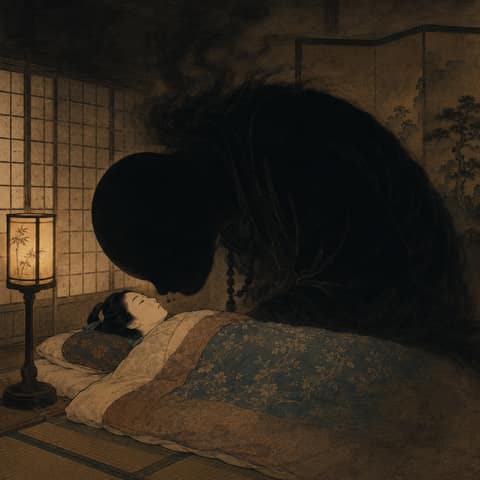
住居・器物 Edo period; derived from painted sources A version based on Toriyama Sekien’s interpretation of the obi in Konjaku Hyakki Shūi. Though an everyday garment, the obi was said to turn into a serpent at the threshold of sleep and dream. This draws on the Natural History note that sleeping on a sash brings dreams of snakes, a belief also known in Japan. Sekien further composed that the triple sash of a jealous woman coils into a sevenfold venomous snake, punning on the kinship of malice and serpent-body, and presenting a visual reading in which emotion is projected onto objects. In folk terms, it warns that keeping a sash by the pillow invites ominous dreams, admonishes jealousy, and entwines concepts of sleep, dreams, and taboo. Rather than a literal attacker, the Snake-Obi is a symbolic specter that mirrors the viewer’s heart and reminds proper handling of sashes and bedding within the home.
珍しい 
Serpent Queen Princess
jah-OH-hee-meh
Chokeiji Tradition: The Serpent Queen Princess
Half-Human Beings Izumi Province (present-day Sennan, Osaka Prefecture) Said to be a female great serpent dwelling in the pond of Chokeiji in Izumi Province. Leading many snakes, she was styled the “Serpent King,” quietly watching over people near the temple grounds. Around the Bunsei era, she fell for the beauty of the abbot, Zen monk Shoyama, and slipped into the temple disguised as a lost woman. Sensing something amiss, the abbot struck her with a blade. As she lay dying, the serpent vowed to protect Chokeiji. Thereafter the pond became a place of memorial offerings and reverence, tied to taboos against harming snakes and to prayers for rain and abundant harvests. The origin of her title and its rank remain unclear, likely influenced by regional worship of serpent kings (Ja-o, Ja-o Gongen). Though the pond was later filled in and no visible remains survive, her image endures in local oral tradition and temple lore.
名妖 
Snake-Bone Hag
jah-KOHTS-bah-bah
Sekien Iconography Standard
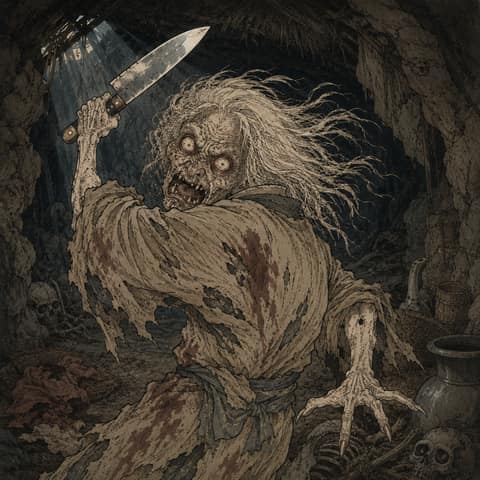
General Classifications Japanese folklore Jakotsubā is a name based on the image and brief note in Toriyama Sekien’s Konjaku Hyakki Shūi (late 18th century), without any specific oral tradition attached. The picture shows an old woman wreathed in snakes. The note mentions the Shanhai Jing’s account of the Wuxian people in the Overseas West Classic, citing those who hold a blue snake in the right hand and a red snake in the left, yet it stops short of directly identifying this old woman. The term itself appears in early modern chapbooks and theater as a derogatory label for an old woman, which Sekien likely molded into a yokai. Later encyclopedias claim she is the wife of “Snake Goemon,” that the blue snake freezes and the red snake burns, but these are embellishments inspired by Sekien’s wording, not grounded in cited tradition. Folklorically it visually aligns with the lineages of “oni-baba” and “snake bride,” but because no rites, taboos, or place-names unique to Jakotsubā are identified, academic treatments handle it as source-undetermined.
名妖 
Mirage (Shinkirō)
shin-kee-ROH
Mirage Pavilions Breathed by the Shink (Sekien lineage image)
Natural Phenomena Spirits Coastal regions across Japan In the lineage attributed to Toriyama Sekien’s Konjaku Hyakki Shūi, the shink—an enormous clam—exhales a vapor at the shore, which fills the sky and forms images of towers and palace gates. The imagery depicts inverted or elongated castles and gatehouses drifting above the sea, sometimes shown alongside the shink itself or a dragon. In the late Edo period the motif was repeated in surimono and ukiyo-e and became a popular topic among spectators. The tradition is not fixed to a single locale, with sightings told from coasts and tidal flats such as Etchū. As a yokai it lacks a stable body, appearing and vanishing to beguile onlookers while causing little harm.
名妖 
Crab Monk
KAH-nee-BOH-zoo
Crab Monk (Chogenji Tradition, Classical Version)
Half-Human Beings Kai Province (modern Yamanashi) and various regions of Japan A figure centered on the monstrous crab legend of Chogenji at Manriki in Kai Province. Disguised as an itinerant monk, it comes to the temple at midnight and borrows Zen phrases, tossing hints like “freely side-walking” and “two legs eight legs” to suggest a crab while testing its counterpart’s wit. It retains human form until its identity is pierced, but when pressed with ritual implements or mantras it reveals its carapace and flees, said to span a two-ken square or reach four meters across. Local lore preserves place names like Crab-Chasing Slope and Crab Marsh, a holed “claw-mark” stone, and tales of thrown stones. Across regions the same tale type shares an empty temple, late night, Q and A, exposure of the true form, and retreat or slaying, with the kyogen play “Crab Yamabushi” often cited as an influence. Devotional aftertales may stress the ritual implements used in subduing it—vajra pestles or iron fans—and devotion to Kannon, though details vary. The version told from the Kyoho era onward forms today’s backbone, and a Meiji hanging scroll attests to the tale’s settlement. Stripped of later embellishment, it is a moral tale of a shape-shifting crab that tests a monk and yields to sacred power.
稀少 
Fukuro Mujina (Bag Badger)
FOO-koo-roh MOO-jee-nah
Annotated Iconography Edition (Seiyan-Toriyama Based)
Animated Objects & Undead Edo period A version grounded in the image and brief annotation from Toriyama Sekien’s Hyakki Tsurezure Bukuro. It appears as a womanly mujina carrying a night-duty bag over her shoulder, yet from another angle the bag itself may be the yokai, with the porter’s pose serving as a metaphor. Its conduct lures people into rash judgments and lays bare the absurdity of empty speculation. Actual harm is slight, limited to confronting those who “rummage in the bag” of guesswork on night roads or in parlors and leaving them disgraced. True to picture-scroll lineage, no fixed era or locale is given, favoring witty identification and playful satire.
稀少 
Raised-Collar Robe
eh-ree-TAH-teh-goh-ROH-moh
Ittan of Sekien Iconography
Household Spirits Japanese folklore A reconstruction based on the designs in Toriyama Sekien’s Hyakki Tsurezure Bukuro. The monk’s robes are a dull brown, layered thickly, with the collar hanging before the face to cast a beaklike shadow. Beads are held in one hand, a censer is set before it. Movements are unhurried; with each step the rustle of cloth sounds and a faint scent of incense drifts. Hints linking it to tengu remain only in the captions of the image, with no direct wings or long nose. It maintains autonomy as a tsukumogami, its tears and seams perceived as bearing will. It appears not where reverence for sacred implements is lacking, but shows signs near neglected robes and ritual tools, prompting awe rather than harm.
名妖 
Mikoshi-nyūdō (Looming Priest)
mee-KOH-shee nyoo-DOH
Mikoshi-nyūdō (Edo Kaidan Record Type)
Demons & Giants Various regions of Japan (especially Kantō, Tōkai, Shinshū, and Chūgoku) An Edo-period anecdotal and ghost-story variant in which a giant priest-like figure blocks the night road, chilling the heart of anyone who looks up. In some regions it is treated as a plague-bringing deity that can cause fever or sudden death, and is taboo to step over. Its true nature is left unclear, sometimes taken as a disguise of a shape-shifting animal or a haunted object. Methods of banishment emphasize conduct unshaken by fear, such as calling it out by name, looking down on it, or pretending to measure its height.
名妖 
Satori
sah-TOH-ree
Traditional Version: Kakku of Hida and Mino
Mountain & Wilderness Spirits The deep mountains of Hida and Mino (present-day Gifu Prefecture) A simian-form apparition modeled on Sekien Toriyama’s Konjaku Gazu Zoku Hyakki entry and natural-historical notes in Sino-Japanese texts. It appears on remote mountain paths, instantly voices the thoughts of woodcutters and travelers, and gauges their behavior. Disinclined to harm humans, it withdraws swiftly when sensing danger, in line with Sekien’s text. In folktales its figure varies by region—monkey, mountain man, tengu, or tanuki—but its core is “mind reading” and retreating at sudden noises. Its mind reading mirrors the other’s thoughts and repeats them, closer to a warning than provocation. It reads presences in mountain stillness yet proves vulnerable to the unexpected—sparks from a campfire or a flying splinter. The name Kakku is linked to the character 玃 through phonetic conflation, from which an independent yokai image emerged. Traditions span Chubu to Kanto, Tohoku, Chugoku, and Kyushu, telling of a being that measures the boundary between people and the otherworld in the mountains.
稀少 
Horned Washbasin Hanzō
TSOO-noh-HAHN-zoh
Gazu-tan, Sekien Edition
Animated Objects & Undead Kyoto Prefecture (associated tradition) An interpretation centered on Toriyama Sekien’s depiction of the horned washbasin figure. The rim of the jet-black basin rises like horns, and when lamplight is reflected on the clear surface, only deceitful characters added to a paper will blur and eventually dissolve away. As a tsukumogami of implements, it values human care and decorum, revealing its strange nature only when treated rudely. Rather than causing harm, it is said to expose hidden falsehoods. Echoing Noh and classical poetry, it is often shown alongside courtly cosmetics and writing instruments. Regional lore is scarce, with mentions largely confined to early modern picture compendia and encyclopedias.
Showing 241 - 260 of 404 yokai