Yokai Encyclopedia
Encyclopedia of Japanese Yokai
稀少 
Zen-Gama-no-Shō (Zen Kettle Monk)
ZEN-gah-mah-noh SHOH
Iconographic Tradition: Tsukumogami Kettle
Animated Objects & Undead Japanese folklore Based on examples by Toriyama Sekien, this image depicts an aged tea kettle manifesting with spiritual authority. Its posture and arrangement inherit compositional methods akin to the Night Parade of One Hundred Demons scrolls, often shown marching alongside Torakakushi and Yarinaga. The name plays on the kinship between chanoyu and Zen, hinting at a caricature of a Buddhist priest. By the logic of mononari, tools long used or neglected accrue ki, appear before people, and inspire awe. Meiji painters continued this iconographic lineage, and yokai catalogues and dictionaries classify it as a type of tsukumogami, though specific local legends are scant. Later commentaries add anecdotes of startling humans, but early records offer little confirmation, so it is understood chiefly through its iconographic tradition.
珍しい 
Kūko (Sky Fox)
kū-ko
The Kūko — High Fox Just Below the Tenko
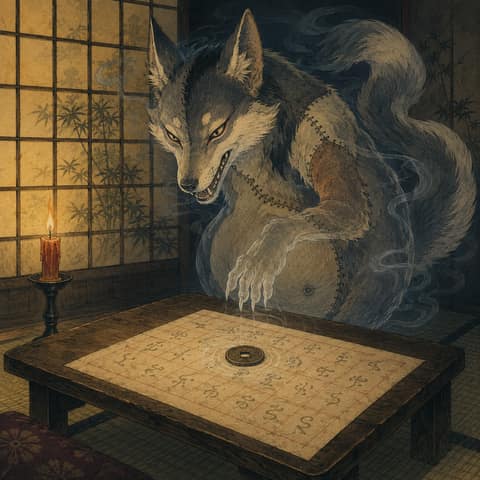
Animal Shapeshifters Throughout Japan (a high-ranking fox, just below the Tenko) This version looks a little more closely at what kind of being the Kūko actually is. In the Edo-period ranking of foxes, only the lowest, the Yako, was thought to possess a visible body of flesh; from the Kiko upward, foxes were believed to become formless spiritual beings. Because the Kūko ranks just below the Tenko, its shape as an ordinary beast has lost almost all meaning, and it manifests instead as a presence or an influence. By its very nature it differs from the Yako, which stands before people’s eyes to deceive them. A high-ranking fox is closer to one that protects and guides than to one that harms. Overlapping with the lineage of white foxes regarded as messengers of Inari, the Kūko and Tenko were revered in the world of belief as wise foxes that serve the gods. The reason the Kūko so rarely causes any concrete incident is not weakness but that it has long since outgrown the stage of meddling with people out of vanity. Even so, because it wields immense supernatural power, it was thought that to slight it might invite calamity. Gentle toward those who revere it, showing a glimpse of its power only before the arrogant, the Kūko has been spoken of as a mature fox that knows exactly the right distance to keep from human beings.
珍しい 
Smiling Hannya
wah-RAH-ee HAHN-nyah
Edo Painting Traditions Edition
Demons & Giants Shinano Province (Higashichikuma District, Nagano Prefecture), and elsewhere An edition distilled from late Edo-period ukiyo-e and comic prints depicting the smiling Hannya. Horns, fangs, bristling hair, wide staring eyes, and a strained grin form its core. Objects in its hands often allude to life and death, unsettling viewers with deliberate motifs. The demon-woman is understood to have once been human, transformed by accumulated jealousy, resentment, and attachment, aligning with the concept behind the Hannya mask. Specific local legends are sparse, yet it was treated in night-time tales and picture books as a symbol of fear and admonition, preserved as an image of the extreme of a woman’s grudge. In local oral tradition sometimes only the name remains, with the transmission of its form relying mainly on pictorial sources.
名妖 
Broom Spirit (Hōkigami)
HOH-kee-gah-mee
Folk Belief Version – Broom Deity
Deities & Divine Spirits Various regions across Japan Emphasizing the household cult image of the broom deity, this spirit uses the broom as a sacred vessel to govern domestic purity and the safety of childbirth. Sweeping is seen as a rite of purification that orders boundaries and drives out misfortune and impurity, while the power to gather scattered things back together also symbolizes recalling souls and inviting good fortune. At life’s turning points—New Year, moving house, pregnancy and postpartum—people renew the broom and dispose of the old one with thanks. Mistreating a broom is taboo, and stepping over it, treading on it, or leaving it upside down is inauspicious. Yet the upside-down broom can be used deliberately as a charm to gently send lingering guests home. In art, Toriyama Sekien depicts it as a tsukumogami in Hyakki Tsurezure Bukuro, but in folk practice it is revered as a divine presence dwelling in the tool, a household deity, both practical implement and object of faith. Regional details vary, but it is understood as a local guardian of cleansing and boundaries.
珍しい 
Borrowed Sieve Hag
mee-KAH-ree bah-BAH
Lore-Faithful Edition
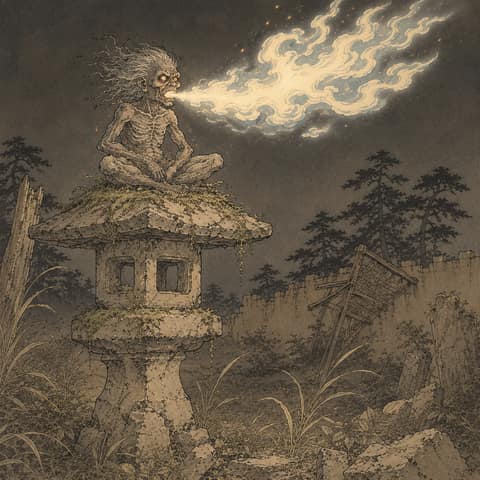
Mountain & Wilderness Spirits Kantō region (Kanagawa, Chiba, Tokyo) A整理 of the Mikari-bā (Mikakari-bā) yokai as preserved in folklore. She appears on Koto-yōka (the eighth days of the month) as a one-eyed crone, enforcing restraint on housework and outings. Her act of “borrowing” winnowing baskets and human eyes links to avoidance of mesh-patterned tools and symbols with many eyes, giving rise to countermeasures like placing baskets or sieves at the gate, or fixing a mesh basket to a pole on the roof ridge. In the Kōhoku, Yokohama accounts, her greed extends to gleaning even fallen ears of grain, and depictions of her carrying fire in her mouth serve as a caution against conflagration. In southern Chiba, customs of taboo and house-seclusion called “Mikari” (body-substitution) recast pre-festival liminality as a yokai rule. Despite regional variation, these tales share a framework that transmits norms of household safety, fire prevention, and labor abstinence at seasonal thresholds from winter to spring. Creative embellishments are set aside in favor of points attested in Kanto eyewitness reports and folklore records.
珍しい 
Shōrōkaze (Spirit-Wind)
SHOH-roh-kah-zeh
Spirit Wind (Folkloric Version)
Weather & Calamity Spirits Goto region, Nagasaki Prefecture Spirit Wind is spoken of as an invisible wind that brings sudden chills, fever, and lightheadedness to those it touches. Its timing on the morning of the sixteenth day of Bon is emphasized, and the “spirits” here are the souls of ancestors or the unconnected dead. The wind is understood as carrying the aura of spirits crossing the boundary between return and departure. In the Goto Islands, people strictly avoid graves and grave roads on that day and refrain from going out. On Iki Island, illness is seen as a possessing wind, with graveyard-origin termed dead-spirit wind and grievance-origin termed living-spirit wind. It aligns with regional beliefs in malign winds, where seasonal fatigue and sudden gusts intersect with folk explanations and are remembered as spirit afflictions. It is not told as a yokai with active malice, but as a taboo that warns of misfortune for those who mistake the date or place.
珍しい 
Thread-Spinning Maiden
EE-toh-hee-kee MOO-soo-meh
Traditional Account
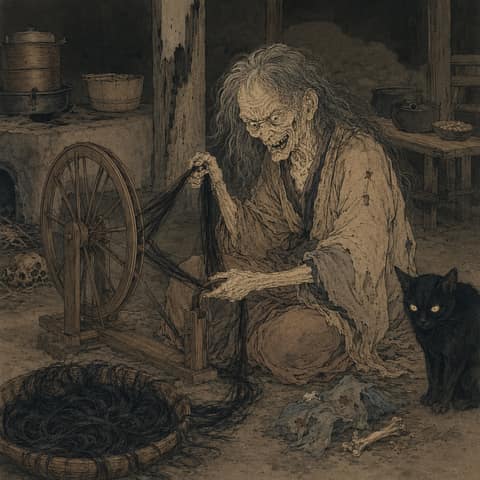
Mountain & Wilderness Spirits Horie Village, Itano District, Awa Province (modern Naruto City, Tokushima Prefecture) Based on records from Horie Village in Awa Province, this version organizes the image of the Itobiki-Musume as a young woman operating a spinning wheel by the roadside. The moment someone looks her way, she transforms into an old crone and bursts into loud laughter. No harm beyond revealing her true form is reported, and she neither touches nor pursues people. Stories most often place her from dusk to midnight in spots where foot traffic thins—village outskirts, field paths, and crossroads. Folklorically she belongs to roadside怪異 tales, told as a warning not to be deceived by looks and not to dawdle off one’s route. The trigger for the change is acts like “staring” or “approaching,” and the silent switch to an old-woman figure is the core of the fright. The spinning wheel is an everyday tool, and her realistic working motions heighten the uncanny shock of a chance encounter. Parallels exist outside the region, but the named example from Awa is the best known.
珍しい 
Momijigari (The Demon of the Maple Viewing)
moh-MEE-jee-GAH-ree
Demoness Momiji (Performing Arts Tradition)
鬼・巨怪 Togakushi Mountain, Shinano Province (Nagano), Japan A demoness archetype fixed in Noh, joruri, and kabuki from the Muromachi to Edo periods. She appears under the pretext of autumn leaf viewing as a courtly lady-in-waiting or princess’s attendant, lulling suspicion with music and dance. At the feast she inebriates warriors, but near midnight her nature is exposed by divine protection or a sacred blade, and she reveals her true form in the wilds of Mount Togakushi. Commonly called Momiji, she bears aliases such as Princess Sarashina depending on the work. Her slaying tales extol martial virtue and reflect awe of the mountains, inheriting Togakushi worship and the rhetoric of oni-hunting lore. On stage, the contrast between the elegant disguise of the first act and the ferocious demon visage of the second is emblematic.
珍しい 
Paper Dance
KAH-mee-mai
Documentary Compilation Edition
Household Spirits Japanese folklore Rather than an independent entity, Kamimai is a later整理 as a label for a household anomaly in which paper moves and scatters on its own. Fujisawa Eihiko is cited as authority and places its appearance in the tenth lunar month, yet his illustration reuses a scene from Ino Mononoke Roku, and the original source does not limit it to any particular month. Since the Showa era, folklore and ghost-story collections have introduced cases of contracts or manuscripts lifting and swirling, naming them “Kamimai,” but firsthand credibility and regional distribution remain unconfirmed. Accordingly, this entry treats Kamimai as a generic yokai image signifying inexplicable motions tied to dwellings and objects, specifically the self-propulsion or levitation of paper, with no fixed form or clear place of origin. In lore it rarely harms people or livestock, tending instead toward startling or teasing behavior.
珍しい 
Kyōrinrin (Scripture Spirit)
KYOH-reen-reen
Tradition-Faithful Edition
Animated Objects & Undead Kyoto Prefecture Based on Sekien’s design, it is portrayed as a frayed Buddhist scroll that unrolls by itself, its ends moving like limbs. It sidles up without a sound and quivers in response to chanting. If someone desecrates a venerable sutra—tearing it, trampling it—then late at night the rustle of paper and faint sutra-recitation are said to echo, while characters from the scripture drift within lamplight. Conversely, if the sutra is purified and properly stored, it settles down and remains harmless, even dusting the study. This figure stands at the crossroads of early modern book-veneration and tsukumogami belief. Its association with the bird-headed figure in the Night Parade scrolls is understood through the beak’s symbolism as a bearer of words and spell-power, though exact locales and names are unknown beyond scattered sources.
伝説 
Jorōgumo (Enchanting Spider)
jo-ROH-goo-moh
Tradition-Faithful Jorōgumo Archetype
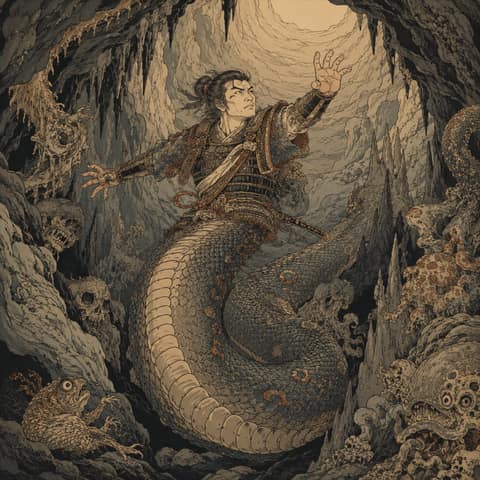
Animal Shapeshifters Various regions across Japan (notably Izu and Sendai) A Jorōgumo based on the canonical image found in Edo-period sources. A great spider, having aged into a yokai, assumes the form of a young woman or a mother and child to exploit lapses in human judgment. She appears at liminal places such as waterfalls, deep pools, verandas at the edges of mountain villages, and abandoned houses, casting many layers of silk to bind victims and dull their judgment through sleep or enchantment. Toriyama Sekien depicted her commanding fire-breathing spiderlings, helping fix motifs of acting in groups and fleeing into the upper parts of houses such as the attic. In some regions she is deified as a protector against drowning, with stones or small shrines raised in her honor. Many tales end with her being thwarted by human wit—cutting her threads and tying them to a stump, or seeing through her disguise—while others warn of taboos where breaking a vow of secrecy brings death, or of fatal infatuations that drain one’s life. This profile avoids modern embellishment and stays within the breadth of existing tradition.
珍しい 
Spirit of the Ema Plaque
EH-mah no SAY
Ema Spirit (Traditional Tale)
Household Spirits Japanese folklore A spiritual presence dwelling in votive ema plaques, known from shrine and temple origin tales and ghost stories. It appears most often at dusk or in dreams, and its form is thought to reflect the donor’s wish or the plaque’s artwork. As an old man it teaches or warns, and as a woman it may invite or manifest. It is not a deity itself, but a spirit residing in an offering, revealed through the power of the sacred precinct. It shuns being taken home without cause, defiled, or thrown into fire, and favors proper return or ritual burning. Encounters can be auspicious or ominous, with fortune depending on one’s conduct.
稀少 
Kinutanuki
kee-noo-tah-NOO-kee
Based on Sekien’s Illustrated Compendium
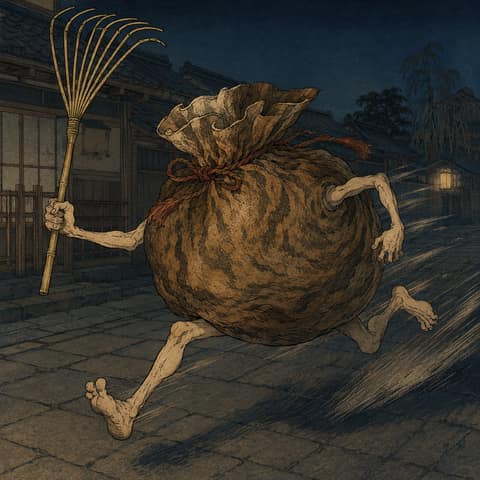
Animated Objects & Undead Edo (place of publication) The Silk Tanuki is a yokai born from printed books, a visual conceit that overlays vocabulary from Hachijo silk (Kihachijo) with tales of shape-shifting tanuki. In Sekien’s example, a tanuki draped in silk patterns is paired with a caption that evokes both the name Hachijo and popular lore of trickster tanuki. Independent oral traditions are scarce; later readings add the sound of fulling blocks and cloth-beating gestures, but these remain reinterpretations of the image. Its nature aligns with object-spirits and a mitate-based tsukumogami, more a crystallization of wordplay and design in print culture than a field-reported apparition. It is described as wearing the yellow-striped Kihachijo motif and revealing itself less by appearance than by nocturnal cloth-beating sounds, yet such traits are interpretive and no fixed image is established.
稀少 
Net-Cutter
AH-mee-kee-ree
Iconographic Standard, Traditional Interpretation
General Classifications Japanese folklore An interpretation grounded in Sekien’s depiction, tempered by later commentaries that popularized the trait of cutting nets and mosquito screens. Concrete behaviors are sparsely recorded in local sources, and it is often understood as a personification of wear, tear, and fraying. It appears with a carapace-like body and large pincers, shows up at night, and quietly severs its target, with no clear evidence of direct harm to people.
珍しい 
Oitekebori
oh-EE-teh-keh-BOH-ree
Ochikohori (Curated Traditional Tales Version)
Aquatic Spirits Honjo, Musashi Province (modern Sumida, Tokyo) Spoken of as a haunting tied to canals and irrigation ditches in Edo’s low wetlands, it functioned as both a warning against greedy overfishing and a folkloric device marking taboos on the water. The entity has no fixed form and is often only a voice, though in some regions it is identified with known shapeshifters like kappa or tanuki. Its stage centers on Honjo’s Kinshi-bori and Sendai-bori and along the Sumida River, with variants in Kameido, Horikiri, and Kawagoe. A typical pattern is the three-step “big catch—departing voice—loss of fish,” accompanied by etiquette tales that aver misfortune can be avoided by sharing the catch or releasing a few fish. It appears in curious tale collections and local lore around the Kansei era and later took root through rakugo storytelling. Natural sounds and animal behavior became the raw material of the uncanny, and the tale served to symbolize rules for ditch maintenance and norms for shared resources.
名妖 
Oni of Rajōmon (Rashōmon Demon)
rah-JOH-mohn no OH-nee
Canonical Lore: Oni of Rashomon Gate
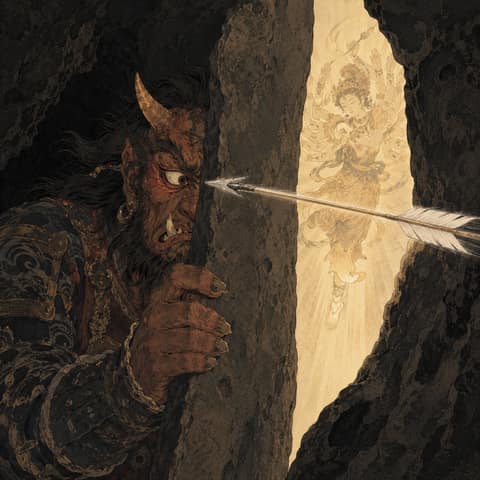
Demons & Giants Yamashiro Province, Heian-kyō (Rajōmon Gate) An oni that appears at Rashomon Gate and on the outskirts of the capital, serving to highlight a warrior’s valor. Medieval war tales and Noh plays preserve multiple versions with differing stages and details, but the core remains: a lone warrior meets an oni at a gate or bridge and severs its arm. The arm is treated as a symbol of impurity and numinous power, leading to later tales of its recovery. Its conflation with Ibaraki-dōji intensified in early modern retellings, shifting names and locales, yet overall it embodies a liminal threat haunting the edges of the capital. Iconography shows an iron staff, horns, red-black skin, and wild hair, often set amid stormy weather and black clouds. Representations rooted in warrior lore, Noh, and picture scrolls continue to shape its image today.
珍しい 
Meat-Sucker
NEE-koo-soo-ee
Draining Beggar of Lantern Fire in the Mountains
General Classifications Kii Province (Kumano and the Hatenashi Mountains) Based on types recorded around Kumano and Mount Kuanashi, this yokai takes the form of a young woman, asks for a light from a lantern, then steals it and slips into the dark to drain the victim’s flesh or vital essence. In encounter tales, brandishing strong flame from a matchcord or fire striker drives it off, and bullets engraved with Buddhist names expose its true form as a skeletal fiend—mountain taboos and carry-on wisdom are emphasized. Although later images show it slipping indoors to steal vitality while nestled close, this version centers on wilderness meetings and warnings for night travel, noting that lanterns, live embers, and recitation of Buddhist names function like protective charms. It avoids conflation with foreign lore and follows Kii oral traditions and records.
珍しい 
Mill-Bearing Hag
OO-soo-oh-ee BAH-bah
Sado Shukunegi Tradition
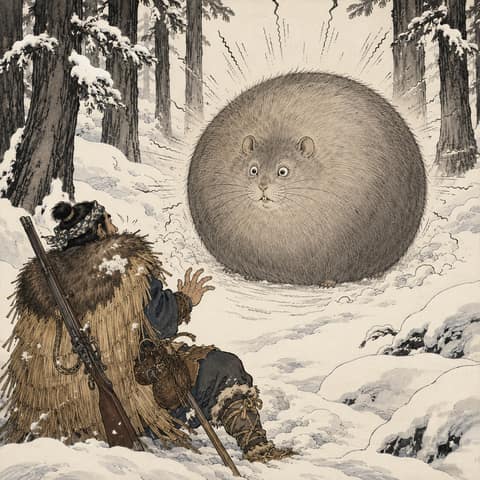
Aquatic Spirits Sado Island, Niigata Prefecture (Ogi and Shukunegi area) A maritime apparition told along the coves of southern Sado Island. It appears as a white-haired old woman who rises to the surface at dusk when weather breaks and dimness falls. Her hands are held behind her back as if bearing a burden, though the original account names no specific object. Sightings are said to occur once every two to five years, and merely seeing her is not believed to bring illness or immediate disaster. Modern yokai encyclopedias place her in the lineage of Iso-onna and Nure-onna, yet tales of luring or predation are absent; instead she is spoken of as a harbinger of poor catches or sudden shifts in weather. The name is rarely attested outside local ghost-story collections and is likely a region-specific term.
名妖 
Dancing Heads
MAI-koo-bee
Canonical Folklore Standard
Ghosts & Spirits Manazuru, Ashigarashimo District, Kanagawa Prefecture A standard interpretation based on the vengeful spirit of Manazuru’s sea as recorded in Picture Book of One Hundred Ghost Stories (Ehon Hyaku Monogatari). The severed heads of fallen warriors refuse to relinquish their grudges and are told to bite one another while spewing fire. Two origins are given in parallel: a sword fight born from a quarrel during a festival, or execution for gambling crimes. In either case, the heads move on their own, dance, raise whirlpools and ghostly flames above the sea, and link to local place-name lore. Artwork depicts three heads joined and dancing, a motif echoed in later kibyōshi and yomihon. Framed as a sea-deep and rocky-shore apparition, the tale warns of fear toward severed heads, the curses of war and private duels, and the perils of watersides.
名妖 
Hannya
HAHN-nyah
Hannya of the Traditional Noh Mask
Demons & Giants Kyoto, Nara, and other regions of Japan The Hannya visage fixed in Noh and Kyogen emerged where Heian-era vengeful-spirit beliefs intersected with medieval performance aesthetics. Horns, fangs, and upturned eyes signal rage, while shadows around the mouth and cheeks carry grief; on stage the expression shifts with angle. Tales repeat the pattern of a woman bound by attachment turning into a demon and being released through temple rites and chanting, stressing the idea of passion given form. Local names are not consistent, and it usually appears as a role within shrine-temple origin tales or Noh scripts. Though homophonous with the Buddhist term prajñā (hannya, wisdom), on stage the word denotes a demon-like visage. Mask colors such as white, red, and black mark deepening obsession, with details varying by school.
名妖 
Funayūrei (Boat Ghosts)
foo-nah-YOO-ray
Beggar of Teigo at Dan-no-ura
Aquatic Spirits Across Japan (coastal and island regions) An uncanny variant of the funayurei said to be the ruined shades of the Taira clan sunk at the Battle of Dan-no-ura. On nights of shifting tides and sea mist in the western straits, they draw alongside a boat, armor dripping, and beg, “Give us a teigo ladle.” Their faces are pale, eyes reddened by salt, voices hoarse yet mannered with samurai courtesy. Keeping the discipline of their former camp, they form ranks even at sea, a herald calls out, and many hands clutch the gunwale. If given a ladle with an intact bottom, they silently bail seawater into the boat until it founders. Those who know the old ways cross the sea with bowls and ladles whose bottoms are pierced, tied ready at the rail. When the ghosts accept them, water runs through and does not stay aboard, and only the weight of their rancor scatters on the tide. Priests sometimes hold services, and then the shadow of war hats melts into the mist, chains of armor return to the sound of waves. They do not drown people at random but approach those ignorant of sea rites or proud souls who scorn the ocean, marking their own downfall upon the world. On the sixteenth of Obon, on equinoctial days, and on battle anniversaries, their tread comes nearest when the sea is unnaturally still, and ghostly fires line the surface like beacons, mirroring the fleets of old. Offerings of ash, rice cakes, incense and flowers, and dumplings soothe their fixation; cast them from the bow and a wave like a shirabyōshi’s sleeve returns once and pushes the boat onward. A hard stare may make them withdraw, not by force of gaze but because the living truly behold the dead and the knotted ki loosens. As Yamaoka Genrin told, their true form is congealed rancor, soot-like grudge given shape upon the current; when winds shift, sutras resound, and offerings sink, the loosened ki disperses into the sea. Thus this version of funayurei can be stilled not only by fear but by memorial rites. Sometimes the outline of a child appears among their ranks, its voice thinner still, never asking for “water,” only hooking small fingers over the rail. If you hear the faint chime of armor bells, correct your helm, take the Hayatomo Rapids on the slant, and let a murmured nembutsu ride the wind. The slayers’ spirits drifting in the western dark yield only to proper forms and compassion.
名妖 
Funayūrei (Boat Ghosts)
foo-nah-YOO-ray
Inada-Kase Boat Ghost
Aquatic Spirits Across Japan (coastal and island regions) A variant of the boat ghost that appears with the call of “Inada-kase” along the Fukushima coast. On calm nights, in drifting fog, or before a squall, pale hands and wet sleeves line the gunwale, and a chill voice repeats “lend the inada” from the waves. The inada is a bailer ladle for scooping water from a boat; once lent, the spirit pours seawater back into the craft to sink it. It rarely shows its face head-on, the visage veiled in sea mist, only dripping cuffs and black eyes glinting in the lamp’s edge. Reasonable at heart yet tasked with judging neglect and breaches of maritime order, it favors the sixteenth day of Obon, the dark of the moon, and fishing grounds where memorial rites have lapsed. Traditional countermeasures say to hand over a ladle with its bottom removed; the spirit accepts out of courtesy, but the water spills back to the sea. A pinch of rice ball, hearth ash, or salt-purified rice cake cast with the words “this is an offering” also satisfies its claim. If met with turmoil or shouting, it flies into a rage, unseen hands weighing the oars, dimming the compass, and warping the tide lines. They are a host of the drowned, a balance of the sea, and a mirror of neglected tools and unkept rites. Thus fishers notch their bailer, tie a sprig of shiso or a straw, purify it, and bow to the boat spirit before setting out. Because the ghost returns borrowed tools to the sea, the ladle may wash ashore by morning crusted with salt flowers. On windless nights when the helm grows heavy and water sounds along the side, add no lights, raise no voice, and quietly offer the inada; then the spirit cannot fulfill its debt and slips away in shame.
名妖 
Funayūrei (Boat Ghosts)
foo-nah-YOO-ray
Murasa (Nigashio-Lodged of Tsuma Village)
Aquatic Spirits Across Japan (coastal and island regions) A variant of the funayurei recorded in Tsuma Village, Oki District, Shimane. On nocturnal seas, clusters of faint lights gathering are called Murasa. Locals call the countless drifting sea sparkle nigashio. When that flow blurs into a single round mass that pulses like a pale blue breath, it is feared not as mere sea gleam but as remnants of the drowned lodging in the tide, namely Murasa. It will suddenly gather before a bow to bar the way, dimly lighting the surface and throwing off the sense of course. If a boat rides over it, the light scatters at once to the four directions, shadows on deck and gunwale sway strangely, and though the helm bites, the hull feels as if spinning uselessly on the sea. Not individual ghosts grasping with limbs, but a swarm of lights stroking the hull and upsetting the rhythm of the waves to lure toward grounding, they say. Late at night, when the sea flashes “chik” bright as day for a beat and all falls still, villagers say one is “possessed by Murasa,” stop the rudder, lash a dagger or kitchen knife to a pole, and cut the surface three times. At the sound of blade parting tide, the light thins like unwinding thread and scatters back into ordinary nigashio. Local lore holds that passing a bottomless dipper or throwing rice balls or ash has little effect here, while quietly setting incense flowers or dumplings adrift makes the light keep its circle, skirt the boat, and open a path. Murasa raises no voice, nor demands a bailer. Yet on the sixteenth of Obon the rings double and triple, drawing near and away, harboring an inner dark like a ghost ship’s shadow. Working the sea then is forbidden, for even a veteran skipper is dazzled and drawn to the cape’s black rocks. Its color is cold yet clear, and when met with shouts and disorder it flickers as if with a thin smile. Before those who ravage or foul the sea, the ring narrows and only the water at one’s feet grows unnaturally bright, leaving no escape. Conversely, for those who mourn kin lost at sea and make offerings, it lays a guiding streak in the offshore dark and sets distant whitecaps in relief to lead to safe water veins. Thus Murasa is both a drowning ghost and a guiding ghostlight. On Tsuma’s shore, the custom remains on the first catch night to chant words that calm both sea gods and the dead, then cut the tide with a blade before casting the nets. The light cannot be scooped by hand, nor a voice seized, yet it readily dissolves its form in answer to the threefold cutting rite and quiet offerings, returning to mere nigashio.
名妖 
Funayūrei (Boat Ghosts)
foo-nah-YOO-ray
Ugume (Kyushu West Coast Variant)
Aquatic Spirits Across Japan (coastal and island regions) Across the west coast of Kyushu—especially from Hirado in Nagasaki to Amakusa and Goshoura Island—a variant of the funayurei is known as the Ugume. It appears in night fog or under a windless overcast stillness: an old sailboat with bellied sails despite no wind, or a small unmanned skiff, gliding up silently from behind. Its lights are faint, wavering along the gunwales like something between flame and fireflies. The closer it comes, the farther the sound of waves recedes; though the vessel seems to move forward, the surface of the sea slips backward. This is the sign of possession: cold water seeps into the bilge, oars grow heavy, and the compass drifts a hair off. The Ugume has no fixed form, sometimes turning into the silhouette of an island to lure boats, sometimes showing a non-existent cove offshore to run them aground. From the shadow of a rotted mast it will murmur, “Give me a bilge-scoop,” asking for a scoop or ladle to bail. One must hand over a scoop with a hole in the bottom; give a sound one by mistake and it will pour water over the gunwale without cease, weighing the boat down to sink. In Hirado they say a pinch of ash cast upon the sea will lift the fog. On Goshoura, one calls out “Dropping anchor!” throws a stone first, then casts the anchor—a ritual aligning words and action to tell what lies below, “We intend to stay here,” whereupon the Ugume loosens its hold. A thread of tobacco smoke will also thin it, sending it retreating toward the stern. Offerings include rice balls, rice cakes, and a small amount of ash, and special caution is urged on the sixteenth day of Obon. The Ugume are less indiscriminate vengeful ghosts than a host of those who slipped outside the sea’s order, drawn by lapses in shipboard manners, careless speech, or neglected greetings to the sea gods. If faced squarely, with proper names and rites observed, they slip back into the shadow of the tide. The fear that “it disguises itself as boats or islands” along Kyushu’s west coast reflects memories rooted in fickle currents and tangled shoals—an embodiment of losing one’s way at sea. Ugume also portend maritime misfortune; in fishing villages it is said that on nights they draw near, someone somewhere has lost the path home.
Showing 221 - 240 of 404 yokai