Yokai Encyclopedia
Encyclopedia of Japanese Yokai
稀少 
Hyōtan Kozō (Gourd Boy)
HYOH-tahn koh-ZOH
Iconographic Tradition–Tsukumogami Interpretation
Animated Objects & Undead Japanese folklore An interpretation based on Toriyama Sekien’s Hyakki Tsurezure Bukuro and related Hyakki Yagyō iconography. Gourds served as containers for water or sake and as percussion in festivals, and after long use were believed to acquire spirit in line with the tsukumogami view. The Gourd Boy appears as a human figure with a gourd for a head, briefly emerging from a night path or from grass to make passersby flinch, and little more. Its nature, name, and any definite harm are not fixed in sources, and alongside utensil-yokai like the Mortar Monk it is read as an allegorical old tool given life. Local oral lore is scant, with paintings and later commentaries as the main sources.
稀少 
Kameosa
KAH-meh-OH-sah
Iseya Toriyama Plate Edition
Animated Objects & Undead Edo period An interpretation based on Toriyama Sekien’s Hyakki Tsurezurebukuro image and inscription. The water jar faces forward, its rim becomes the mouth, and patterns on the body are read as eyes and nose. The inscription pivots on the phrase “calamity turns to good fortune,” entrusting the vessel with the idea that blessings fill after adversity. Placed at the end of the volume to serve a congratulatory cadence, its nature is read as leaning more toward good than ill. Though grouped with tsukumogami familiar to early modern life, independent oral lore or怪談 are scarce. Later retellings expand the “inexhaustible when drawn” motif into control over water’s increase, decrease, and measured pouring, but the original is a symbolic painting with verse, and narrative deeds are limited.
名妖 
Amazake Hag
ah-mah-ZAH-keh BAH-bah
Traditional Folklore Aligned
Half-Human Beings Tohoku and Kanto regions Amazake-babaa was told as a visitor who heralds the arrival of epidemics. She knocks at midnight and asks whether there is sweet sake; the very act is a test of taboo, and answering is understood as a conduit for misfortune. People hung apotropaic symbols—cedar sprigs, nandina, and chili peppers—at their gates and avoided replying. Across Edo, people visited images of an old woman said to calm coughs, linking petitions to folk belief. The tradition overlaps memories of smallpox outbreaks; some view her as a guise of the smallpox deity, while others absorbed the image of a peddler woman on cold nights, creating regional variation. The yokai is transmitted with the taboo structure of “answer and you fall ill,” accompanied by threshold-warding rites, and is positioned as a portent tale that signals the presence of disease.
珍しい 
Ikijama (Living Jinx)
EE-chee-JAH-mah
Nama-Jama (Folkloric Sketch)
Ghosts & Spirits Okinawa Prefecture A strand of Okinawan beliefs about living spirits. When hatred or envy swells, a person’s spirit may slip out while retaining their form and afflict the target with illness or malaise. Reports describe several modes: possession via gifts, attachment through a curse-doll known as the Nama-Jama Buddha, and even obsession achieved by will alone. Harm was said to strike not only people but also livestock and fields. Communities responded with yuta prayers, apotropaic fouling, and even driving it off through scolding and insults. Some accounts say the lineage passes matrilineally, leading to recorded cases of avoided marriages. Early modern records note accusations, lawsuits, and punishments for alleged use.
伝説 
Ikiryō (Living Spirit)
ee-kee-RYOH
Ikiryō
Ghosts & Spirits Across Japan The image of the ikiryō holds two faces: a curse born of resentment, and gentler visitations tied to parting before death or to acts of gratitude. In Heian beliefs, overpowering thought left the body as a “shadow,” appearing at bedchambers, ox-drawn carriages, or gates. In the medieval and early modern eras, scenes witnessed in dreams, will-o’-the-wisps, and flying heads were taken as proof of the soul’s separation. In medical views it was classed as a disorder of the departing soul or of the shadow, with reports of people seeing their own double. The cursing rite of the Hour of the Ox is often linked as a willed sending of intent by the living, though not identical. Regional lore varies in name and form, with some places recording it as a footfall-making human shadow. Overall, it is understood as the coagulation of thought taking shape, a spiritual action of the living set against the dead.
名妖 
Ubume (Ghost of a Dead Mother)
OO-boo-meh
Ubume (Traditional Form)
Ghosts & Spirits Various regions of Japan (especially Tōhoku, Kantō, and Kyūshū) A spirit formed from the regrets of a woman who died in childbirth, said to appear along night roads, crossroads, and riverbanks. Early modern tales and illustrated books depict her with blood soaking her lower body, cradling a baby and asking passersby to mind the child. Outcomes vary: the helper discovers they held a stone or Jizo statue, receives great strength or wealth as recompense, or suffers misfortune such as being bitten by the infant. Regional variants include Fukushima’s “Obo,” where distracting her with a strip of cloth is advised, and Kyushu’s “Ugume,” whose true nature is revealed at dawn. Edo scholars compared her with nocturnal bird-like portents in Chinese records and reasoned that the qi of those who die in childbirth becomes a yokai. Temple and shrine legends tell of salvation through nembutsu or daimoku, linking her to prayers for childrearing and safe delivery. Ubume is both feared and revered, a spiritual figure embodying a mother’s enduring love.
珍しい 
Garei (Spirit of the Painting)
GAH-ray
Garei (Ochikuri Monogatari Edition)
Animated Objects & Undead Kyoto (anecdote from the Kanjuji household) An image-spirit as portrayed in a late Edo essay. A woman steps forth from an old screen painting, and any treatment applied to the picture manifests as real-world phenomena—the core motif is the linkage between image and reality. Signs caused by the aging of the object are perceived as hauntings, yet they subside through repair and reverent care, fitting within tsukumogami tradition. The writer names specific places and households, but the entity’s purpose is unstated, its warnings and appearances are brief, and the events end once the piece is appraised and restored. Rather than the painter’s fame empowering a spirit, the tale chiefly cautions against mistreating fine works. Harm to people is rare; its hallmarks are visual manifestation and a return to its locus, vanishing before the screen. Later readings cite it as an exemplar underscoring the importance of memorial rites for objects.
珍しい 
Ijū (Strange Beast)
ee-JOO
Ijū (Hokuetsu Seppu Version)
Animal Shapeshifters Uonuma District, Echigo Province (modern Uonuma region, Iketani area of Tōkamachi City, Niigata Prefecture) This version follows the figure recorded in the Tenpō-era compendium Hokuetsu Seppu. Its form is ape-like yet larger than a human, with long hair flowing from crown to back, appearing after parting the dwarf bamboo in mountain ravines. It shows no intent to attack homes, chiefly begs for cooked rice, and repays alms by carrying loads and similar deeds. It is closely tied to the weaving culture of Echigo-chijimi, and in tales of loom maidens it intervenes amid household work rules and notions of ritual purity, turning the tide so deadlines are met. Such accounts treat it as a mountain spirit observing human industry and bringing harmony to cycles of trade and production, akin to food offerings made to mountain deities or guest spirits. Later it was reportedly seen at times but returned to the mountains, leaving only its name. Though an unidentified beast, its refusal to harm and habit of repaying kindness place it on the boundary between uncanny and blessed in local lore.
名妖 
Epidemic God
yahk-BYOH-gah-mee
Gyōekishin, Plague-Deity
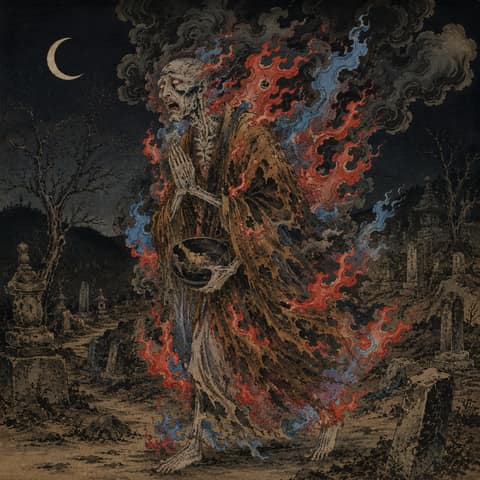
Deities & Divine Spirits Across Japan (many records from the Kinai/Kyōki region) An archaic image of the plague deity recognized in both court ritual and folk belief. Usually unseen, it gains force at seasonal turnings and when blossoms fall, entering through village bounds, crossroads, and riverbanks, spreading illness by seizing on household impurity and neglect. In paintings it appears as bands of oni-like or uncanny figures on the move, while tales say it stands at the door as a traveling old man or woman, disliking lapses in almsgiving or proper etiquette. Communal countermeasures include boundary festivals, rites of purification, offerings, displaying talismans, and sending off dolls, with porridge or other set foods prepared on fixed dates to ward it away. Its forms and names are not fixed, appearing in step with local customs and annual rites, so it varies by region, yet it is always told in connection with practices that “set the boundary and purge defilement.”
伝説 
Shiramine Sagamibō
Shiramine Sagamibō
The Tengu Who Guards the Mausoleum of Sutoku — Shiramine Sagamibō
Mountain & Wilderness Spirits Shiramine, Sanuki Province (Sakaide, Kagawa) Shiramine Sagamibō is, among the Eight Great Tengu, the tengu most firmly bound to a single person—the Retired Emperor Sutoku. His image cannot stand apart from the story of Sutoku's vengeful spirit. The Retired Emperor Sutoku, defeated in the Hōgen Rebellion (1156), was exiled to Sanuki and died in the second year of Chōkan (1164) without ever being permitted to return to the capital. At his place of exile he copied out the five Mahāyāna sutras and sent them to the capital, but, suspected of a curse, had them flung back at him; in fury he swore an oath written in blood and is said to have become, while still living, a great tengu and a great demon (daimaen). Sagamibō guards the Shiramine mausoleum of this Sutoku, whom Yoritomo called "the greatest tengu in Japan." Shiramine-ji is the eighty-first station of the eighty-eight temples of Shikoku, the Shiramine mausoleum is the only imperial tomb in Shikoku, and beside it stands the Tonshō-ji-den, which enshrines the spirit of Sutoku-in. It was literature that made Sagamibō immortal. Its original source is the mid-Kamakura Senjūshō, attributed to Saigyō, whose "On the New Retired Emperor's Tomb at Shiramine" carries a tale of Saigyō mourning Sutoku's tomb at Shiramine. The Noh play Matsuyama Tengu, which dramatized it, takes Sutoku-in as the shite and Saigyō as the waki, and depicts Sagamibō as a tengu attending Sutoku. Further, the "Shiramine" of Ueda Akinari's Ugetsu Monogatari is a story in which Saigyō mourns Sutoku's spirit at the Shiramine mausoleum and converses with the wrathful Sutoku-in; Sagamibō became the being running through this lineage since the Senjūshō. The vengeful spirit and the tengu who stays beside it—the relation of Sutoku and Sagamibō is a rare point where the faith in goryō (vengeful spirits) and the faith in tengu meet. There are two theories on Sagamibō's origin: that it derives from Sagami Ajari Shōson, who sided with Sutoku in the Hōgen Monogatari, and that he was a tengu who came from Mt. Ōyama in Sagami. The latter forms a pair with the seat-transfer tradition arranged by Chigiri Kōsai—that the Sagamibō of Ōyama, in devotion to Sutoku, removed to Sanuki, and Hōkibō entered the vacant Sagami Ōyama. Either way, Shiramine Sagamibō sits at the western end of the Eight Great Tengu, transmitted at Shiramine in Sanuki as the tengu who keeps guarding the soul of Sutoku, one of Japan's three great vengeful spirits.
神格 
Hakutaku (White Marsh)
hah-koo-TAH-koo
Iconographic Tradition Conformant
Deities & Divine Spirits Introduced from China (widely circulated across Japan as apotropaic images) The image of the Hakutaku varies across eras and texts. In the Sancai Tuhui and the Wakan Sansai Zue it appears as a white lion-like auspicious beast symbolizing lucid and orderly governance. Edo painter Toriyama Sekien employed multi-eyed motifs, adding an eye on the brow to heighten its power to perceive calamities, though older depictions sometimes show only two eyes. Prints of the Hakutaku served as apotropaic images posted on doors or carried as charms, invoked for protection during travel and epidemics. The design also appeared on imperial procession flags and on temple and shrine door panels as talismanic emblems of authority and sanctity, examples of which can be seen at the shrines and temples of Nikkō in Japan. The tradition is sometimes read as a personification of ethics and disaster lore, venerated as a being that classifies anomalies and teaches countermeasures.
名妖 
Shirōneri
shee-ROH-neh-ree
Based on Sekien’s Illustrations
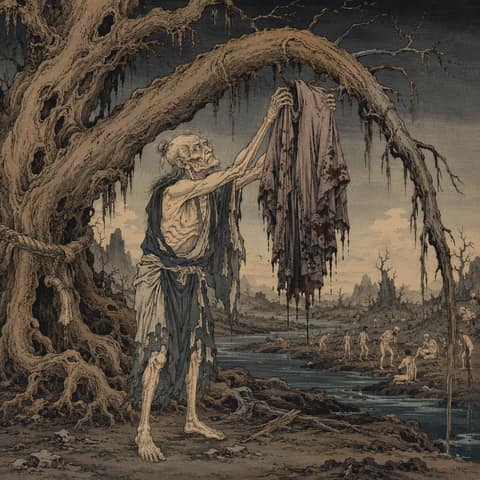
Animated Objects & Undead Japanese folklore Anchored in Toriyama Sekien’s imagery, this version sees an aged dishcloth trailing long and fluttering in the wind, reimagined as a yokai. The original illustration offers little about harming humans, so it is understood as a symbol of attachment to old objects and the impermanence of things. Aggressive traits found in later ghost tales should be kept separate; here the focus is the eerie nature of a “moving old cloth” and the visual impression of it gliding between walls under a night lamp.
名妖 
Powdered-Hag
oh-shee-ROH-ee bah-BAH
Powder-Faced Hag of the Snowy Night
Half-Human Beings Snowbound northern regions of Japan (exact distribution uncertain) On snowy nights she appears at the door, face pale as if dusted with powder, wearing a torn straw hat and carrying a sake flask. She asks for sake or sweet sake, thanks the giver even for a small portion, and leaves. If refused, she troubles the household with knocking and calls. She blends the idea of a winter visiting deity with eerie folktales, remembered as a figure embodying customs of sharing and proper hospitality.
神格 
Byakko (White Tiger)
Byakko
Byakko, the White Tiger, Guardian of the West
Animal Transformations China (guardian of the west among the Four Symbols; depicted in the Kitora Tomb and elsewhere) Byakko is the divine beast of the west, Metal, and autumn, spoken of as forming a pair with the Azure Dragon of the east. This edition traces its astronomical origin and the paired structure with Seiryū. Its origin is in the stars of heaven. The chain of the seven western mansions (Legs, Bond, Stomach, Hairy Head, Net, Turtle Beak, Three Stars) likened to the form of a tiger is Byakko. The Huainanzi's "Treatise on the Patterns of Heaven" makes the emperor of the west Shaohao and its beast the White Tiger, assigning it to Metal, autumn, and white. The western palace of heaven in the Records of the Grand Historian' "Treatise on the Celestial Offices" stands in the same system. The form of a fierce white-furred tiger figures the white of the Metal phase, corresponding to the western sky of autumn, which bears the air of ripening and harvest, and of withering severity. The pairing of Byakko and Seiryū is old. That the early Warring States lacquer garment chest from the tomb of Marquis Yi of Zeng (c. 433 BCE) draws the azure dragon and the white tiger to left and right alongside the names of the twenty-eight mansions shows that the composition of the Four Symbols, setting east (Seiryū) and west (Byakko) face to face, was already established twenty-four centuries ago. In Japan, Byakko was received as a marker of directional protection and of wards. In the Four Symbols' banners of the first year of Taihō (701) in the Shoku Nihongi, Byakko was set to the west (right). Though native tales are scarce, within the geomantic reading of land matching the Four Symbols it was made the guard of the west, and in iconography the White Tiger facing the Azure Dragon still remains on the western wall of the Kitora Tomb. The dragon of the east and the tiger of the west—this symmetry is the very skeleton of the system of the Four Symbols.
稀少 
Momonji (the Hundred-Old Man)
MOH-mohn-jee
Iconographic and Textual Standard (Sekien Line)
Mountain & Wilderness Spirits Uncertain; depicted in Edo-period picture scrolls Based on Toriyama Sekien’s image and notes, this version frames the entity as an old man–shaped specter appearing on open fields at midnight. Its name is taken as a blended form of child language like “momon-ga” and “gagoji,” embodying generalized fear of monsters. The belief that witnesses fall ill aligns with older notions that contact with the uncanny brings impurity and sickness, with no concrete acts of harm described. Early modern taboos against eating game and the euphemism “momonjii” may have encouraged its visualization through name association. Later readings place it as dwelling in mountains yet appearing at street corners to startle people, or as the city-going form of the nobusuma, but primary tradition is scant and no broad folktale type is attested. Accordingly, this version treats specifics as unclear, emphasizing its scenic traits—encounters on nighttime fields, fog, and wind—and its feared power to bring illness.
名妖 
Dodomeki
DOH-doh-MEH-kee
Sekien Iconography Standard
Half-Human Beings Edo period Following Toriyama Sekien’s note, this version centers on a moralizing motif warning against theft. The many eyes along the arm relate to a pun likening the holes of copper coins to birds’ eyes, externalizing the habit of hands reaching to steal. The source Sekien cites, “Kankangai-shi,” is of uncertain reality; his wordplay on Hakone as a boundary and his own remark calling it a curious book suggest the citation itself is part of the artistic conceit. The Dodomeki’s image concentrates on a female form, yet no concrete personal names, family lines, or local legends are preserved, pointing to an urban allegory where image and wordplay outweigh regional lore. Postwar explanations vary in reading and interpretation, but the archetype is traced to Sekien’s original.
稀少 
Hyakume (Hundred-Eyed Demon)
HYAH-koo-meh
Iconographic Origin, Modern Interpretation
Half-Human Beings Japanese folklore Rooted in multi-eyed demon images circulated from late Edo to Meiji, this form was given traits by modern yokai compendia. It shuns bright light and hides in night’s cover, avoiding notice. When it senses people, it is said to detach a single eye to probe its surroundings, while the indeterminate mouth only heightens its eeriness. With no fixed locale of tradition, it is treated as a conceptual being known nationwide through the spread of its imagery.
名妖 
Mokumokuren
MOH-koo-moh-koo-REN
Toriyama Sekien Zue–Conformant Edition
Household Spirits Japanese folklore Reconstructed from Toriyama Sekien’s imagery and captions as a swarm of disembodied eyes gathering on the shoji of a ruined dwelling. Rather than inflicting direct harm, it unsettles by staring. It is mediated by domestic neglect and unappeased sentiments, yet belongs to a generalized lineage of house-haunts not tied to specific individuals or locales. This reading also aligns with later variations in collected names and with links to visual illusion phenomena.
稀少 
Eye Standoff
MEH-koo-RAH-beh
Sekien Iconography Standard
Ghosts & Spirits Settsu Province (Fukuhara) An image systematized from Toriyama Sekien’s iconography and the Heike Monogatari’s accounts of the uncanny. Multitudes of bones unite into a single giant skull, its countless sockets facing the living as if to pierce them. Individual dead bear no names; their fused gaze is read as a trial of the powerful. It appears most at daybreak or in hushed gardens, amplifying fear through sheer visual pressure. The countermeasure is to hold steady and return its gaze. Ritual banishments are poorly attested, and some speak of it as a kind of psychic vision. Said to be memory given form from mass deaths in war and upheaval, its size shifts with the onlooker’s nerve.
稀少 
Spirit of the Inkstone
sue-ZOO-ree no tah-mah-SHEE
Stationery Spirit of the Inkstone
Animated Objects & Undead Shimonoseki, Yamaguchi Prefecture (Akamagaseki) An interpretation based on Sekien’s illustration and accompanying text. The Akamagaseki stone inkstone is famed as a choice scholar’s tool and is linked to memories of the Heike clan’s fall. When one immerses oneself in reading or copying texts, the inkstone’s surface opens like a seashore, upon which minute warriors appear to wage battle. This likens the inkstone to a “sea,” where the pooled ink becomes an ocean that bears up the echoes of history, a gesture of literati imagination. Later yokai commentaries sometimes add that using this inkstone sharpens brushwork, or that wave-sounds and murmurings can be heard, yet the core lies in Sekien’s note and the vision, seen in Xu Xuan–style tales, of tiny soldier hosts upon a desk implement. As a tsukumogami, a long-used inkstone accrues numinous power and, mediating between its owner’s reading life and the land’s memory, reveals scenes of the past.
名妖 
Iso-onna (Shore Woman)
EE-soh-OHN-nah
Toma-Shunning Nure-Onna
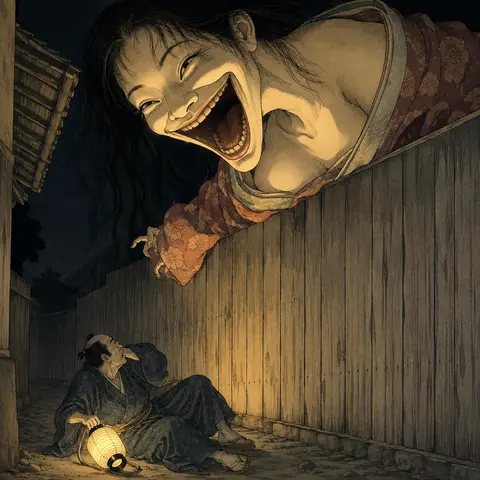
Aquatic Spirits Coastal Kyushu (Nagasaki, Kumamoto, Fukuoka) Among the coastal Nure-onna of northwestern Kyushu, a variant that particularly despises the handling of reed mats and thatch is called the Toma-Shunning Nure-Onna. On windless nights she appears on the beach without leaving footprints, a young woman from the waist up with black hair slicked by brine, shell-pale skin holding the moon, and eyes that reflect the distant whitecaps offshore. Below the waist she is indistinct like sea-mist, and if trod upon there is only sand with no true form. From behind she bears a jagged, craglike shadow like a collapsed rock face, and if one’s gaze falters she seems nothing more than a shore rock. Drawn by the hush of a calm, she stares seaward; if her name is called or a careless voice is thrown at her back, she answers with a shrill cry. The scream overlaps the roar of the tide and cuts the ears, her loosened hair stretching like wet seaweed to entangle the caller. Each briny strand bites the skin like the barb of a fishhook and is said to draw up warm blood along the hair. Yet if three old thatch stems from a reed mat are placed over the chest not as a cross but in the shape of the character for river, her hair recoils from the thatch, and she cannot step on the edge of the mat, only drip seawater in frustration from the gunwale. She favors boarding boats by their stern line; if a stranger’s harbor leaves the stern line set, at midnight she will crawl up it, slip in over the rail, and drape her hair over sleepers’ faces to steal their breath. Thus old fishermen followed the rule of taking in the stern line when calling at a port, dropping only the anchor and keeping watch at the bow while reading the wind. She is susceptible to the human-made ideas of knots and naming in ropes; if the rope is cinched hard while whispering the owner’s name three times, she cannot unravel that name and cannot travel along the line. Though drawn by the grudges of the drowned, she does not harm indiscriminately. When she sees discarded reed mats or thatch, or cut ropes drifting in the tide, she scents the neglect of the hands that wove them and approaches their owner’s boat. Conversely, those who dry nets and mats without letting the ends trail into the sea or blocking the tide’s path may find her invisible presence come near and, by the creak of moorings, warn of a calm about to break, old skippers say. In parts of the Fukuoka coast, it is said she walks the water not for lack of feet, but because she avoids reed mats, stepping only on the thinnest skin of the waves. Northern Kyushu has a crab-incarnation theory, but this Nure-Onna does not hate crabs; rather, when shore crabs scuttle, she draws in her hair and returns to rock. Her name varies by place—Iso-Onna, Nure-Onna, Sea Princess—but her ties to the etiquette of thatch and rope are constant. To avoid her: do not call to a woman’s back on a night beach, do not leave a stern line fast in unfamiliar ports, and place three thatch stems in a river shape where you sleep. Keep these and she will only turn her white offshore eyes toward you, then blend into rock-shadow and unravel into the tide mist, leaving only her presence to be told as footprints that were never there by morning.
名妖 
Iso-onna (Shore Woman)
EE-soh-OHN-nah
Isonna of the Aft-Rope Crossing
Aquatic Spirits Coastal Kyushu (Nagasaki, Kumamoto, Fukuoka) A feared variant along Amakusa and the Shimabara Peninsula, named for slipping aboard by following the aft mooring rope. She appears as the upper body of a young woman scented with the sea, while her lower half is hazy and shifting like wave-shadows. Her long wet black hair constantly streams from her chest to the floor, branching into fine threads that cling to human skin. When a hush falls over the harbor at midnight, she stands in the lee of the shore or at a stern’s tip staring seaward, and will either echo the name of anyone who calls to her or answer with a piercing scream. At that cry she reaches a white hand to the aft rope, crosses soundlessly onto the boat, shrouds a sleeper’s face with her hair, and twists up blood strand by strand. By morning only a tide stain and a thin ring of hair remain at the pillow. Said to be the shape taken by the regrets of the drowned or a love unfulfilled by one who waited at the harbor, she is known as an isonna and also as nure-onna. The practice of avoiding the aft rope comes from this variant’s habit of treating ropes as roads. So long as she touches a line she can climb anywhere, but she does not swim about recklessly and prefers calm surfaces. On thin-moon nights some have seen her walk the water from shore, but only when the harbor tide lies asleep. She is weakened by light and prayer, so fishermen in unfamiliar ports avoid taking the aft rope, drop only the anchor, and keep the gunwale light burning. In Shimabara it is said that placing three dry thatch reeds from a roof upon one’s kimono while sleeping prevents tangling and wards her off. Those who touch her hair are seized by chill and lethargy, and the roar of the sea lingers in their ears for days. She is merciless toward mockery and rudeness, targeting first those who call her name without honorifics or taunt her with whistles. Conversely, she is said to avoid boats whose crews offer prayers for the lost at sea. Some tales claim that if you move behind her she resembles a rock shadow, and under moonlight her back becomes the outline of a wet reefs tone to let waves pass. The Isonna of the Aft-Rope Crossing is a grudge born at the liminal space of the harbor, hard to approach for those who keep the code and unforgiving toward arrogance, dropping her hair without mercy.
名妖 
Isonade
EE-soh-NAH-deh
Iso-nade (Traditional Accounts)
Aquatic Spirits Off the coast of western Japan, notably around Hizen-Matsuura A consolidated portrayal of the Iso-nade based on Edo-period strange tales and materia medica notes. It approaches without ruffling the sea’s surface, signaling itself only through shifts in sea color and wind. Its body is shark-like, said to bear coarse protrusions and needle-like organs from tail to back. It most often appears in seasons of cutting cold winds and was especially feared on days of strong northerlies. Seafarers avoided boisterous work, stowed nets and ropes, and kept away from the rail—customs passed down as seamanship to prevent disaster. Names and details vary by region, but the core remains an unseen approach that is noticed too late and the terror of being swept overboard by a single strike of the tail. Early modern records also frame it as a narrative of maritime hazard awareness and caution.
珍しい 
Shrine Princess
JEEN-jah-HEH-meh
Traditional Lore Version (Hizen, Bunsei Appearance)
Aquatic Spirits Hizen Province (modern Nagasaki and Saga Prefectures) An image based on a block-printed text copied in Kato Hekioan’s Warekoromo. It bears a human face, two horns, a crimson belly, and a triple-sword tail, and is said to have appeared as a messenger from the Dragon Palace to foretell abundance and the spread of disease. Copies of its likeness were promoted as amulets for averting calamity and prolonging life when pasted on doorways or viewed in devotion, leading to widespread circulation of the image. Parallels from Hirado’s “Himeuo” and cases in Echigo show close similarities in iconography and captions, marking a nexus of popular epidemic countermeasures, folk practice, and print distribution. Some propose origins in specific animals, but no proof exists; folklorically it functions alongside prophetic beasts like Amabie and Amabiko.
Showing 201 - 220 of 404 yokai