sakata-no-kintoki
The Herculean Boy of Mt. Ashigara: Sakata no Kintoki
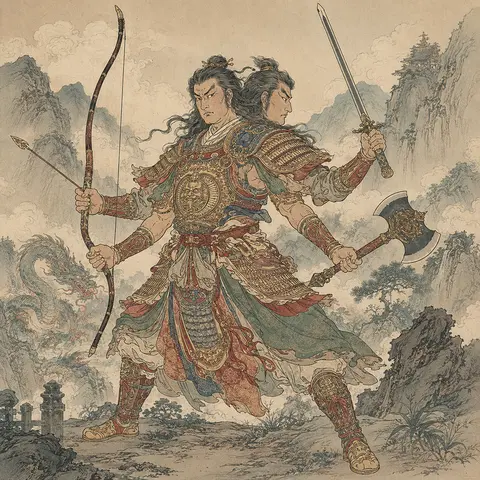
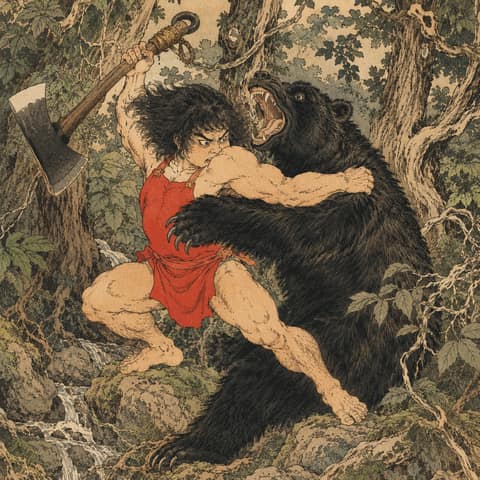
In this version, we read Sakata no Kintoki as "the warrior who brings the power of Mt. Ashigara back to the capital." Kintoki does not appear as a polished samurai from the start. As Kintaro, he is a boy of superhuman strength raised by a yamanba, intimate with bears and beasts, carrying a broadaxe. This childhood image retains the strangeness of a child raised outside human society.
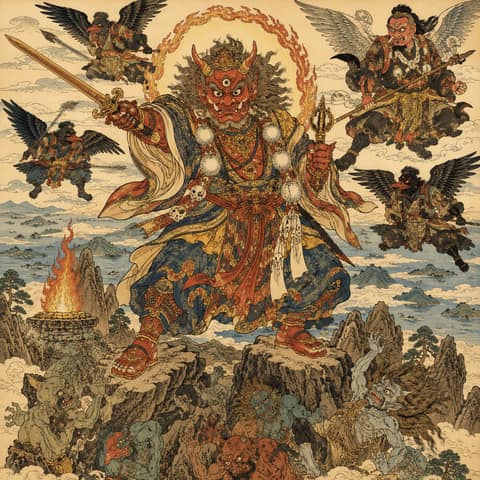
The scene where he is discovered by Yorimitsu is the moment the direction of Kintoki's power changes. The superhuman strength naturally exerted in the mountains is converted into the abilities of a warrior serving a lord. This is also a story of civilizing wild power. Kintoki does not discard the otherworldly realm of the mountains, but enters the Four Heavenly Kings carrying that power. Because of this, he possesses an exceptional body within the samurai band of the capital.
In the subjugation of Shuten-doji, Kintoki is a figure who confronts the demons of the mountains using the power of the mountains. The demons of Mt. Oe are anomalies secluded outside the capital, and Kintoki likewise possesses power from the otherworldly realm of Mt. Ashigara. The two can be seen as entities that have distributed the same mountain power to different sides. If the demon is the otherworldly power threatening human society, Kintoki is the warrior who has reclaimed that power for the human side.
The brightness of Kintaro's image was greatly emphasized in its reception in later eras. In May dolls and children's songs, Kintaro becomes a symbol of health, robustness, and growth. However, if we only look at that healthy boyish image, yokai-like elements such as the yamanba, beasts, and superhuman strength fade away. In this version, we read him while retaining the outline of the prodigy raised in the mountains behind the cheerful folk character.
Sakata no Kintoki is not a yokai, but he represents "supernatural ability on the human side" in yokai tales. He does not confront the demons from completely within human society; he confronts them with a power nurtured in a place close to mountain anomalies. Therefore, even among Yorimitsu's Four Heavenly Kings, he is a presence standing on the boundary between the capital and the mountains, child and warrior, hero and abnormality.
Kintoki's superhuman strength is not just about being strong; it raises the question of where that power came from. Is he strong because he was raised with beasts on Mt. Ashigara, or did he gain otherworldly power through the yamanba's blood or upbringing? The legends do not answer clearly. That ambiguity places Kintoki on the border between humans and yokai.
Being summoned by Yorimitsu is a socialization for Kintoki. He, who was a free boy of superhuman strength in the mountains, gains a lord, a name, and becomes a member of the Four Heavenly Kings. The power of the otherworldly realm changes into the power of a samurai family by being given a name and a role. Herein lies the great transformation from Kintaro to Sakata no Kintoki.
In this version, we also do not take the brightness of the Boys' Festival lightly. When households wishing for their children's growth display Kintaro dolls, the superhuman strength of the mountains turns into a blessing. Yokai-like power, rather than being feared, becomes a symbol of protecting and raising children. Kintoki is also a rare example where otherworldly power was gently converted into domestic wishes.
The story of Kintoki is not one of eliminating otherworldly power, but of re-nurturing it. The power nurtured under the yamanba does not disappear even when he comes to the capital. Rather, by gaining a role under Yorimitsu, it turns into the power necessary for demon subjugation. This is where the fascination of bringing yokai-like elements to one's own side lies.
This gentle transformation is what makes Kintoki an intimately familiar hero even today.