YOKAI.JP

Traditional Yokai Encyclopedia

Yokai passed down through the ages

473 Yokai|14 Category|Page 14 of 20
Localization in Progress - More content available in Japanese version
View Japanese
Sort by: NameAscending
Otoroshi

Otoroshi

Epic

oh-toh-ROH-shee

Iconography from Picture Scrolls (Early Modern Tradition)

総称・汎称Unknown

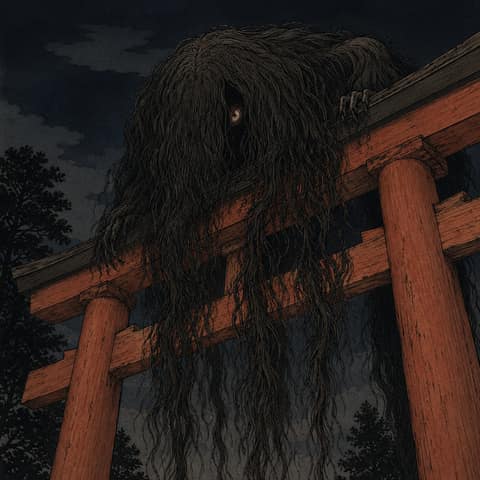
Organized around forms depicted in Edo-period picture scrolls and picture sugoroku. Long hair covers the entire body, with bangs hanging down to obscure the face. In works like Hyakkai Zukan and Gazu Hyakki Yagyō it appears on the same page as Waira, suggesting a shared sound and sense of fear. Names such as Otoroshi, Odoro-odoro, and Keiippai are listed together, implying variation from differing readings of repeating marks. Specific locales, deeds, or omens cannot be inferred from the images; some show it atop a torii, but no sources conclusively assign it a punitive divine role. In folk thought, it is seen as a form shaped by the notion of odorogami (bristling hair) and the language of fear.

Otsuyu

Otsuyu

Legendary

おつゆ

Otsuyu of the Peony Lantern

Spirit / GhostOriginally from 'The Tale of the Peony Lantern' in the Chinese text 'Jiandeng Xinhua'; later adapted by Asai Ryoi and San'yutei Encho

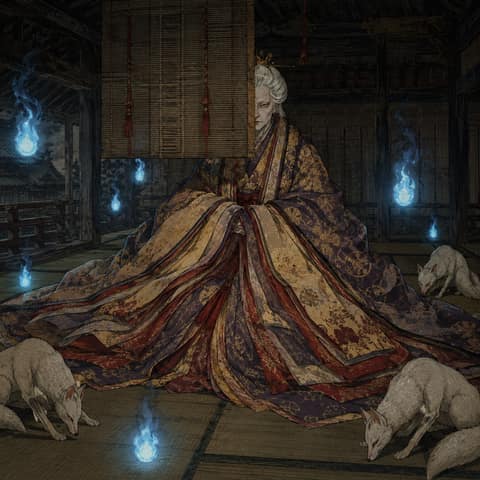
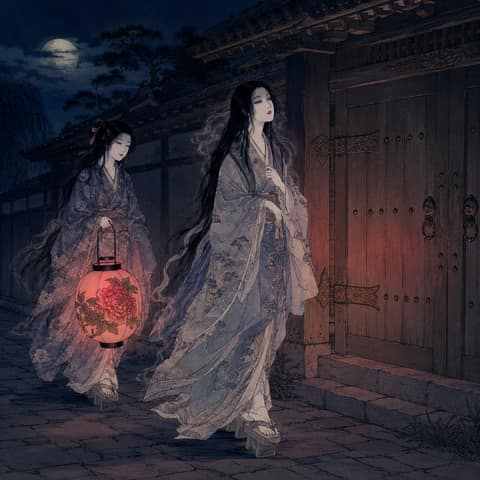
Otsuyu of the Peony Lantern is a ghost who embodies 'love continuing after death' rather than sheer terror. Raised as the daughter of a hatamoto, she fell in love at first sight with the ronin Hagiwara Shinzaburo, whom she visited under the guidance of the doctor Yamamoto Shijo. However, due to family circumstances, they were unable to meet again, and it is said she died of lovesickness while yearning for him. Yet, her attachment could not be erased by death. Starting on the night of her first Obon (festival of the dead), accompanied by her maid Oyone, she begins visiting Shinzaburo every night, holding a lantern painted with peonies and making her clogs ring out with a 'clippity-clop' sound. Believing she is alive, Shinzaburo meets her repeatedly, but his neighbor Tomozo sees through their true nature—they are actually buried dead spirits. Terrified, Shinzaburo places talismans of Kaion Nyorai on every door and wears a solid gold statue of Kaion Nyorai on his person to set up a ward. Blocked by the talismans, Otsuyu cannot enter the house and stands outside the gate every night, calling Shinzaburo's name reproachfully and sorrowfully. The tragedy of the story is sealed here by the intervention of human greed. To fulfill Otsuyu's desire, the ghosts bribe the married couple Tomozo and Omine with one hundred ryo. Tomozo replaces the Kaion Nyorai statue with a fake clay one and strips away the protective talismans. Losing his wards, Shinzaburo finally lets Otsuyu inside. The next morning, he is found as a white skeleton, embraced around the neck by a skull, his face contorted in terror. Otsuyu's essence is not a curse or grudge, but her unwavering devotion, persistently seeking her beloved even after death without reward. The sheer purity of this devotion has elevated her to one of the foremost ghosts in early modern Japanese ghost stories. Through the three layers of the Chinese original 'The Tale of the Peony Lantern', Ryoi's adaptation *Otogiboko*, and Encho's rakugo, Otsuyu's image gradually crystallized into a ghost of tragic romance that brings Japanese audiences to tears.

Painted Buddha

Painted Buddha

Epic

NOO-ree-boh-TOH-keh

Canonical Traditional Iconography

Household SpiritsJapanese folklore

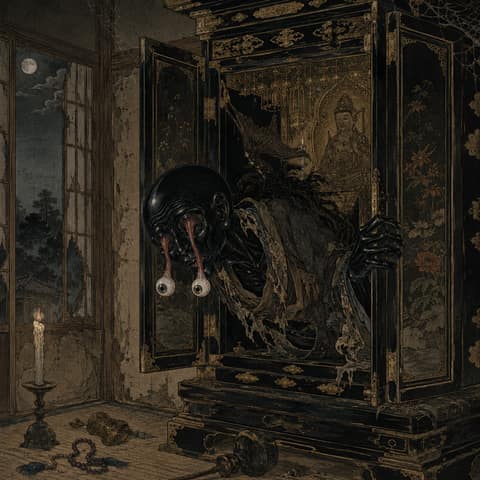
Based on Edo-period yokai picture scrolls: a monk-like figure lacquer-black in color with protruding drooping eyes, accompanied behind by hairlike or fishtail-like elements. Most sources lack commentary, leaving its nature and origins unclear. In Sekien’s depiction it emerges from within a household Buddhist altar, which later encouraged reinterpretations as a possessed object or tool-spirit, though the original intent is uncertain. Accordingly, it is treated as an image embodying anxieties and awe surrounding domestic ritual spaces, with abilities limited to what the images suggest.

Paper Dance

Paper Dance

Uncommon

KAH-mee-mai

Documentary Compilation Edition

Household SpiritsJapanese folklore

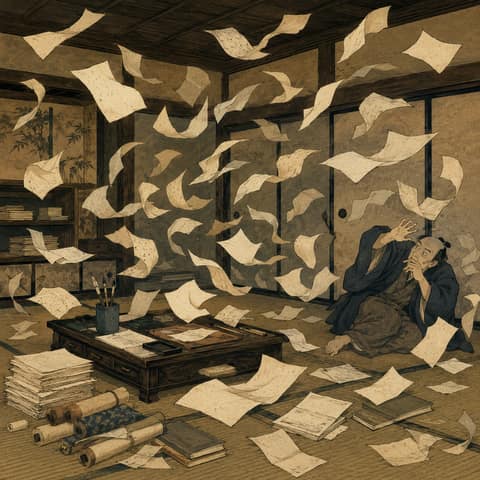
Rather than an independent entity, Kamimai is a later整理 as a label for a household anomaly in which paper moves and scatters on its own. Fujisawa Eihiko is cited as authority and places its appearance in the tenth lunar month, yet his illustration reuses a scene from Ino Mononoke Roku, and the original source does not limit it to any particular month. Since the Showa era, folklore and ghost-story collections have introduced cases of contracts or manuscripts lifting and swirling, naming them “Kamimai,” but firsthand credibility and regional distribution remain unconfirmed. Accordingly, this entry treats Kamimai as a generic yokai image signifying inexplicable motions tied to dwellings and objects, specifically the self-propulsion or levitation of paper, with no fixed form or clear place of origin. In lore it rarely harms people or livestock, tending instead toward startling or teasing behavior.

Penghou

Penghou

Uncommon

POONG-hoh

Edo-Period Scholarly Edition (Bibliographic and Picture Scroll Tradition)

Natural Phenomena SpiritsIntroduced from China (appearing in Japanese bibliographies and picture scrolls as a foreign yokai)

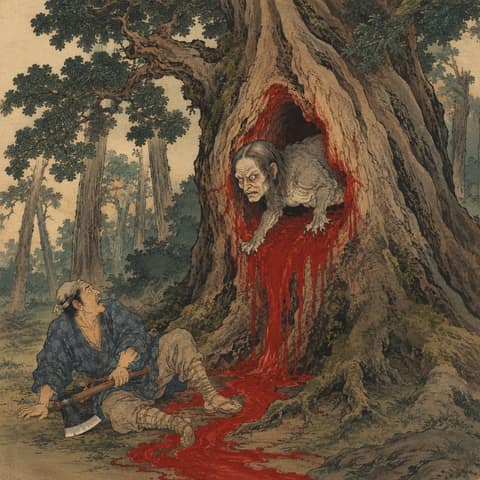
An Edo-period rendering of Penghou, organized within the Japanese concept of kodama after scholars and painters absorbed Chinese narratives. It is depicted as a dog with a human face, tied to venerable camphors and other old trees. Echoes in the mountains were taken as the work of tree spirits, and notes on Penghou informed dog-shaped variants within yamabiko imagery. Early modern natural histories cite Chinese texts explicitly, layering foreign entries atop local lore rather than reporting concrete regional怪談, so place-specific tales are scarce. Japanese accounts treat it as a “tree spirit,” equating kimoki with kodama, linking it to taboos on felling and the cult of ancient trees. Details vary across sources, but two elements persist: it appears bleeding from an old tree, and it bears a human-faced canine form. This version eschews embellished fiction to show how Chinese originals were received in Japanese encyclopedias.

Phantom Locomotive

Phantom Locomotive

Uncommon

nee-SEH-kee-shah

False Locomotive (Traditional Type)

General ClassificationsTokyoEhime

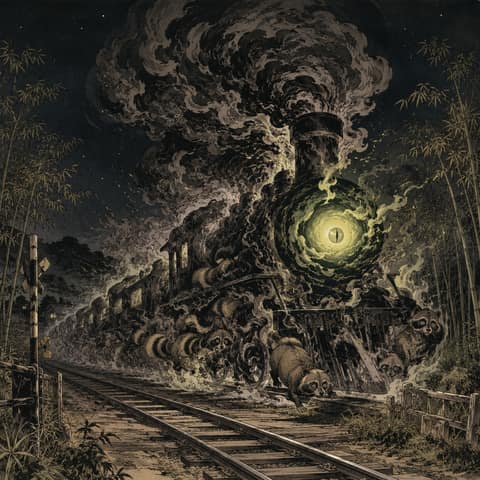
Accounts of the False Locomotive cluster around the era when the alien sounds and sights of steam engines entered rural life, understood through beliefs in beastly transformations and mimicry. Across regions the plot is similar: at night a whistle and pounding wheels approach from ahead, even lights are seen, but everything vanishes just before impact. Soon after, a dead tanuki or badger is found and given memorial rites. Folklorists place it alongside beings like Azukiarai and Sand-Throwers, extending the idea that uncanny noises are the work of animals. Rumors spread not only by word of mouth but also via newspapers, producing uniform distribution and content. Even when tied to specific locales or temples, the core remains threefold: the match of sound and phantasm, and the tangible animal corpse. It declined as modern transport expanded, yet survives in trackside ghost tales.

Pillow-Flipper

Pillow-Flipper

Uncommon

mah-koo-rah-GAH-eh-shee

Traditional Type – Temple and Shrine Anomaly Affiliation

Household SpiritsAcross Japan

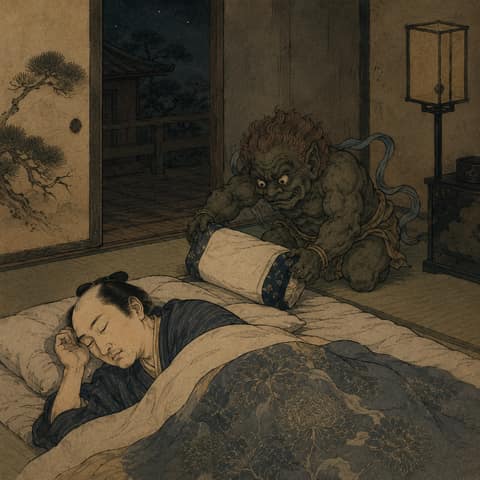
A pillow-flipping subtype rooted in old beliefs that pillows are linked to the movement of the soul and to boundaries. It manifests at thresholds between sacred and secular spaces such as certain parlors, pillars, or Buddhist rooms, turning sleepers’ heads toward a Buddha or principal icon, or simply inverting the pillow to signal a reversal of order. Noted in essays and picture scrolls from the Edo period onward, it often ties into temple Seven Wonders and scroll-haunt tales. In some regions it is read as the play of a zashiki-warashi, the sign of a spirit of someone who died in the house, or a guise of a shapeshifting animal. The fear it inspires has shifted over time: once viewed as a portent of deadly curse, in modern times it tends to be treated as a lighter bedroom haunting and prank.

Poverty God

Poverty God

Uncommon

BEEN-boh-gah-mee

Classical Folktale-Concordant

Household SpiritsAcross Japan

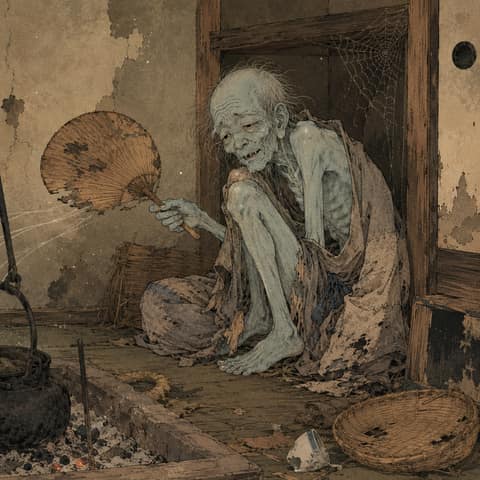
The Binbōgami traces its roots to the personification of medieval poverty and began to be named explicitly from the Muromachi period onward. It commonly appears as a gaunt old man carrying a plain paper fan, believed to dwell in closets or the corners of tatami rooms. Banishment is not easy, and ritual sending-off is preferred over force. Saishōshi records guiding it outside the gate with a branch on the last night of the month, Tankai describes setting grilled rice and roasted miso on a wooden tray and letting them drift downriver from the back door, and Nihon Eitaigura tells of honoring it respectfully on the Night of the Seven Herbs so that, appeased, it turns to bring fortune. Numerous folk beliefs link it with fire and household order, as in Niigata’s New Year’s Eve hearth customs and Ehime’s taboos against disturbing the fire. Miso, said to be its favorite, is cited both as an attractant and a taboo, with roasted miso rites preserved in many regions. Though a punitive deity, it is said to grow uncomfortable where diligence, cleanliness, and frugality are observed, and in folk religion it functions as the counter-concept to household gods of fortune, serving as a barometer of family luck.

Powdered-Hag

Powdered-Hag

Epic

oh-shee-ROH-ee bah-BAH

Powder-Faced Hag of the Snowy Night

Half-Human BeingsNara

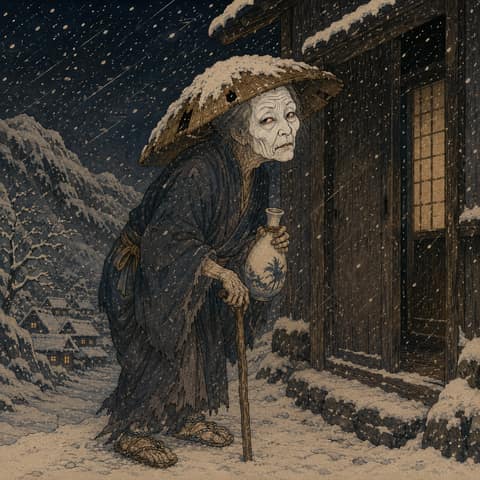
On snowy nights she appears at the door, face pale as if dusted with powder, wearing a torn straw hat and carrying a sake flask. She asks for sake or sweet sake, thanks the giver even for a small portion, and leaves. If refused, she troubles the household with knocking and calls. She blends the idea of a winter visiting deity with eerie folktales, remembered as a figure embodying customs of sharing and proper hospitality.

Prince Sawara

Prince Sawara

Epic

SAH-wah-rah shin-NOH

Emperor Sudō as Vengeful Spirit – Traditional Goryō Version

Ghosts & SpiritsNaraKyoto

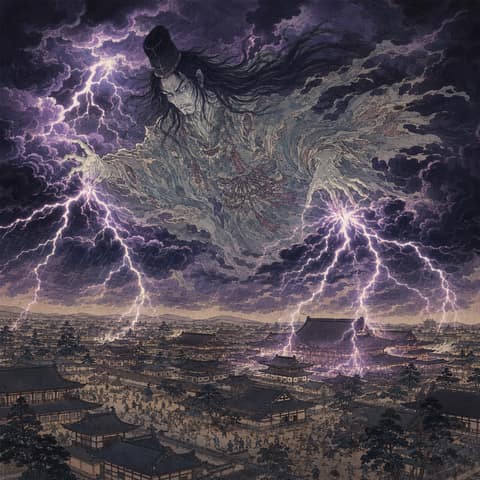
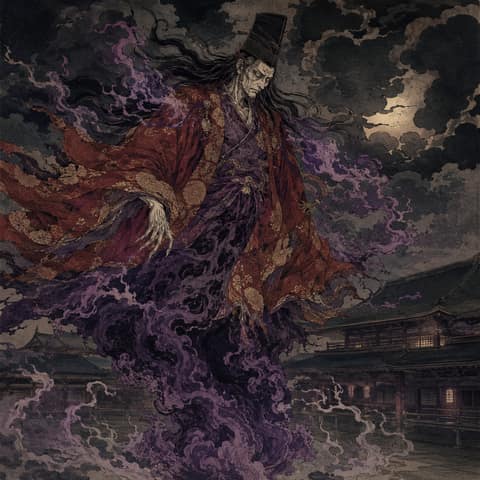
An image grounded in local and court memories that Prince Sawara’s resentment manifested as a goryō. Amid suspicion over his alleged crimes he died by fasting, and later plagues, famine, and illnesses afflicting the imperial line were seen as his curse. The court sought reconciliation through land donations, sutra recitations and esoteric rites, reburial, and posthumous honorific titles, carefully enshrining him as a goryō. Revered as a power that judges right and wrong, he received offerings at shrines and temples, seasonal services, and apologies at his mausoleum. In later years, rites centered on the Sudō Tennō Shrine took form, spreading protective faith between the capital and Yamato. His grudge was understood not as private spite but as a warning against political disorder and calumny, prompting rulers to vow purity and justice with sacrifices, written oaths, and sutra offerings. The spirit bears a wild aspect, yet when appeased turns to guardianship.

Raigō

Raigō

Epic

RAI-goh

Iron Rat (Raiyō’s Vengeful Spirit Tale)

Ghosts & SpiritsShiga

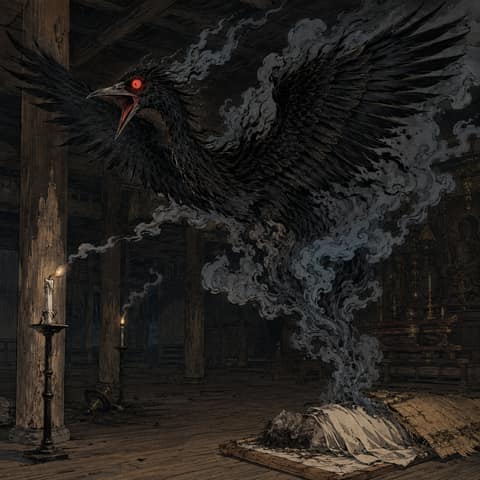
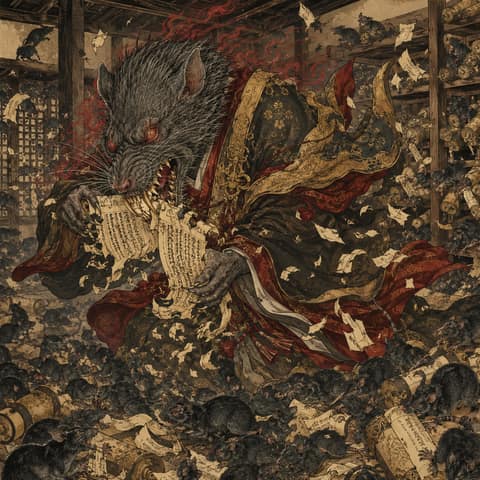
A version grounded in medieval tales where the spirit of the monk Raiyō becomes a swarm of rats or a monstrous iron-furred rat known as the Tesso and gnaws through the sutra repository of Enryaku-ji. Rivalries among temple powers are projected onto a narrative of vengeful deification, linking ritual efficacy with retribution. In literature it appears mainly in war chronicles, blending a real monk’s biography with a settled ghost-vengeance legend. Later yomihon and paintings amplified this image, symbolizing rat blight and the ruin of sutra scrolls, yet at its core lies a folk pattern of a rancorous spirit bringing calamity upon sacred objects and scriptures.

Raijū

Raijū

Legendary

RYE-joo

Thunder Beast of Kuji District Lore

Animal ShapeshiftersIbarakiAkita

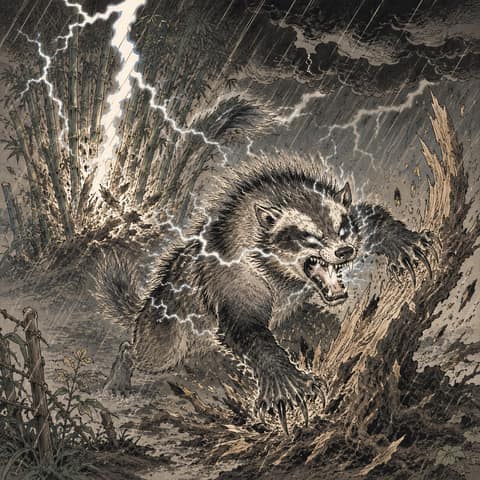
A local apparition said to descend with peals of thunder during the seedbed season, feared for ravaging paddies. Rites to drive it off include cracking split bamboo, and folk custom sets bamboo poles in fields to mark a safe return path. It is understood less as a human-harming monster than as a personification of lightning disaster, and those who approach are said to have their vitality sapped and fall stupefied. Its diet and appearance are inconsistent, with traditions likening it to a weasel, a tanuki, or a cat.

Rain Woman

Rain Woman

Epic

AH-meh-ON-nah

Rain-Summoning Female Spirit

Weather & Calamity SpiritsNagano

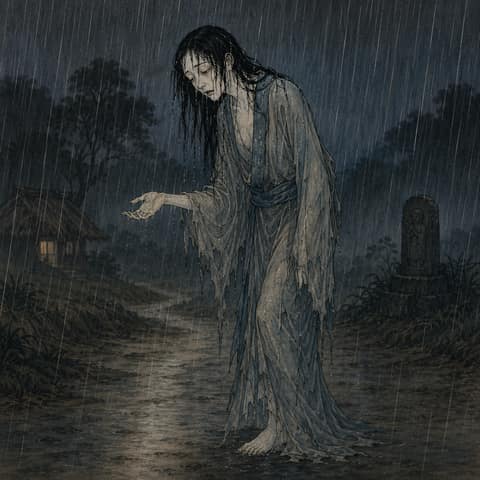
In historical sources, Ame-onna first appears in Toriyama Sekien’s illustrations, though his entry leans on an allegory from Chu, leaving the standalone monster image faint. In oral traditions nationwide two types stand out. One is a female apparition on rainy nights that targets children (such as Shinshu’s “Ame-onba”), with motifs like approaching crying children on night roads and carrying a sack. The other is a numinous being that summons rain in drought, tied to rain-invoking rites and shrine prayers, venerated as a symbol of blessed showers. Rather than contradicting each other, these reflect a folk reading of rain’s dual gifts and perils. From early modern times, a nickname meaning “one who brings rain” also stuck to individuals, but that is a social label, not a yokai image. Sources vary widely by region, and many tales leave names and citations unspecified.

Rainfall Page-Boy

Rainfall Page-Boy

Uncommon

ah-meh-FOO-ree koh-ZOH

Rain-Attendant Page

Household SpiritsEdo period

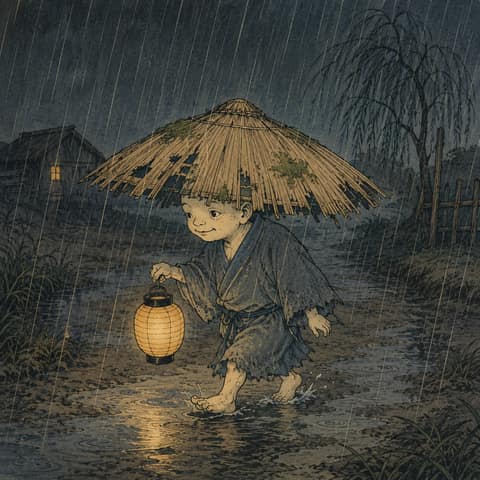
Based on Toriyama Sekien’s imagery, this version foregrounds the character of a page serving the Rain Master. It appears with a Japanese umbrella stripped of its ribs worn like a hood and a lantern in hand. Its origins lie more in printed books than in oral folk tradition, and in yellow-covered comic books it shows up as a menial helper. The ideas of rain and service to nobility converge, shaping it as an attendant akin to small child-deity retainers. It does not wield an explicit divinity that summons rain, remaining subordinate to a being that governs rain’s power. Depictions vary—one eye, hat, lantern—depending on period and source, with no single fixed image. Lacking a known local provenance, it spread notably through Edo’s publishing culture.

Raised-Collar Robe

Raised-Collar Robe

Rare

eh-ree-TAH-teh-goh-ROH-moh

Ittan of Sekien Iconography

Household SpiritsJapanese folklore

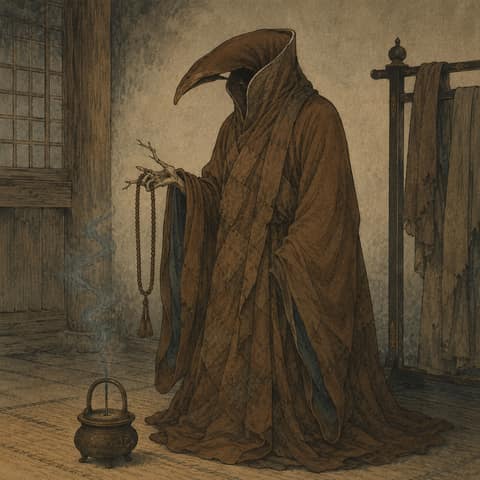
A reconstruction based on the designs in Toriyama Sekien’s Hyakki Tsurezure Bukuro. The monk’s robes are a dull brown, layered thickly, with the collar hanging before the face to cast a beaklike shadow. Beads are held in one hand, a censer is set before it. Movements are unhurried; with each step the rustle of cloth sounds and a faint scent of incense drifts. Hints linking it to tengu remain only in the captions of the image, with no direct wings or long nose. It maintains autonomy as a tsukumogami, its tears and seams perceived as bearing will. It appears not where reverence for sacred implements is lacking, but shows signs near neglected robes and ritual tools, prompting awe rather than harm.

Red Ray (Akaei)

Red Ray (Akaei)

Epic

AH-kah-eh-ee

Legend-Concordant Sea Giant Fish Tale

Aquatic SpiritsChiba

Based on the account in Ehon Hyaku Monogatari, this version frames it as a sea monster whose massive body surfaces like an island. Its back bears sand and pebbles, so from afar it is mistaken for an uninhabited isle. When sailors draw near it sinks, spawning whirlpools and heavy seas that damage or capsize ships. The tales strongly warn against navigational hazards and errors of sea-line sighting. Reported as a firsthand sighting off Awa, it is discussed alongside records of giant fish off Ezo and curiosities like the “Capital of the Red Ray,” collectively naming common sea-borne anomalies. Natural-history notes mingle with怪談, with little concrete ecology, but three cores recur: immensity, floating and sinking, and stormy waves.

Red Tongue

Red Tongue

Epic

AH-kah-shah

Iconographic Tradition: Akazashita (Toriyama Sekien lineage)

General ClassificationsVarious regions of Japan (sources uncertain)

Akazashita is a rare case where imagery precedes textual records. Its core features are a colossal tongue thrusting from black clouds and a bestial face. Toriyama Sekien placed this figure over a sluice gate, and later scholars offered symbolic readings drawing on notions of filth such as scum and grime and on proverbs that cast the mouth and tongue as gates of calamity, but Sekien left no notes. In many early modern sources the sluice gate is absent, and the name wavers between Akazashita and Akakuchi. Links to the Onmyodo guardian name Akazashita-shin of the Grand Duke direction or to the Rokuyo day Akakuchi have been noted but cannot be firmly genealogized. Since the Showa era, fable-like explanations and local tales have spread, yet statements beyond the base sources should be avoided.

Red-Head

Red-Head

Uncommon

AH-kah-gah-shee-rah

Red-Head

Mountain & Wilderness SpiritsKochi

A red-haired apparition said to appear in the fields and hills of Katsugase in Tosa Province. It walks upright like a human, yet hides among tall bamboo grass and reeds, making its full form elusive. Its most striking trait is hair that shines like the sun; approaching and staring directly at it is said to dazzle the eyes and cause temporary visual impairment. Tales rarely attribute malice to it, focusing instead on discomfort caused by its visual impact. It is named in the late Edo to early Meiji Tosa Bakemono Picture Book, listed alongside local figures such as the Laughing Woman of Yamakita and the White Crone of Motoyama. The “Aka-gashira” in Hyakki Yagyo picture scrolls is sometimes cited as iconography, though identification remains cautious. Sightings are told of at dusk through dawn in the open country and survive mainly in local oral tradition.

Resurrection Incense

Resurrection Incense

Uncommon

hahn-GOHN-koh

Canon-Conforming Incense Apparition

Household SpiritsUnknown

Rather than a physical substance, the reviving incense is told in narrative tradition as a medium for reunion with the dead. The Chinese motif of seeing a figure within smoke was adopted into early modern Japanese literature and theater, where the handling of censers, incense wood, and ash is rendered with ritual care. In yokai picture compendia it sometimes appears as a type of tool-born apparition, with set-piece depictions of a visage forming in the incense smoke. It is often interpreted not as recalling a spirit itself, but only as manifesting a semblance or shadow. Medicinal virtues are mentioned as apocrypha in materia medica, yet Edo-period notes record skepticism and file it among curious tales. In Kamigata and Edo rakugo, a tryst lasts only until the incense or stick burns out, making the quantity and duration of incense a key stage device.

Reverse Pillar

Reverse Pillar

Epic

sah-kah-BAH-shee-rah

Traditional Kaidan Edition Gyakubashira (Inverted Pillar)

Household SpiritsVarious regions of Japan

A post–early modern belief that a pillar installed upside down, defying carpenters’ respect for a tree’s natural root spread, brings mishaps to a house. Persistent midnight house-settling, creaking beams, and uncanny whispers were read as the “curse of the inverted pillar,” prompting reinstallation or prayer. Shigeru Mizuki notes leaves birthing a spirit from the reversed wood, or the pillar itself transforming, yet older records more often treat it as signs of noise, misfortune, and ill omen. Deliberate inverted motifs used as apotropaic design (e.g., Yomeimon) belong to the ritual idea of intentional imperfection and are distinct from this yokai. As a taboo rooted in building folklore, it appears in regional carpenters’ lore, temple and shrine records, and essays.

Roaring Cauldron (Narigama)

Roaring Cauldron (Narigama)

Uncommon

nah-ree-GAH-mah

Ringing Cauldron (Hyakki Tsurezurebukuro)

Household SpiritsOkayama

Based on the belief that tools become spirited after a hundred years, this yokai is depicted with an old iron cauldron for a head. It lingers in the night, issuing faint tremors and steam that produce low sounds. The ringing is read as an omen of fortune or misfortune, falling silent if met with careless clamor, and responding when approached with reverence. It embodies divinatory function and the memorial veneration of well-used objects.

Rokuemon

Rokuemon

Rare

Rokuemon

Rokuemon, Supreme Commander of the Awa Tanuki

ShapeshifterTokushima

This is Rokuemon, the supreme commander of the Awa tanuki residing in Tsuda-ura. Ruling as the grand general over all tanuki in Shikoku, he stands as the veteran leader at the pinnacle of the tanuki hierarchy, where they fiercely compete for the title of "Senior First Rank." He once took in Kincho as his disciple and attempted to have him inherit his legacy through a marriage to his daughter. However, after Kincho fled, Rokuemon eventually faced him as a mortal enemy on the banks of the Katsuura River. Following a massive three-day and three-night battle involving over six hundred tanuki, it is said he fell in a final one-on-one duel. Yet his name has been passed down through storytelling, films, and animation, and he remains vividly remembered today as the indispensable co-protagonist of the Awa Tanuki War.

Rokurokubi

Rokurokubi

Legendary

ROH-koh-ROH-koo-bee

Hitouban/Nukekubi (Lafcadio Hearn Interpretation)

Human-Yokai / Half-Human Half-YokaiAll over Japan -- A human village apparition without a specific location

This is the interpretation introduced to the world by Lafcadio Hearn, which most strongly inherits the lineage of the Chinese 'Hitouban', presented as a gruesome and ferocious 'nukekubi' (flying head). It completely breaks away from the comical image of the 'neck-stretching ghost' popularized in Edo-period sideshows, positioning it as a terrifying monster that devours human flesh and insects. In this version, the Rokurokubi disguises itself as a perfectly normal human during the day. However, at night, when it falls asleep, only the head detaches from the torso and flies through the air to attack prey. Hidden at the base of the neck are red streaks or eerie scars resembling 'Sanskrit characters' indicating the severance. The body is completely defenseless while the head is away, and if the body is moved to another location during this time, or if the severed surface of the neck is hidden, the returning head will be unable to recombine with the flesh and will fall to the ground and die. Its nature is extremely cruel and deeply vindictive; upon finding prey, it bares its teeth and attacks in swarms. However, at the same time, it possesses the aspect of a pitiful victim burdened with 'deep karma' whose head slips out night after night regardless of their own will. It is the manifestation of magical and psychological horror, where the 'bestiality' and 'uncontrollable repressed passions' lurking within humans escape the cage of the flesh to materialize as physical violence.

Ryōmen Sukuna

Ryōmen Sukuna

Legendary

RYOH-men SKOO-nah

Hida's Two-Faced Sukuna: Chronicle and Local Tradition

Demons & GiantsGifu

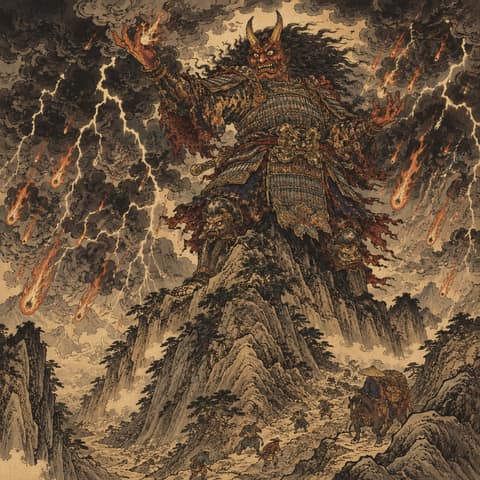
The original text of the Nihon Shoki etches Sukuna's body in remarkable concreteness: "one body with two faces, each turned away from the other; their crowns joined so that there is no nape; limbs on either side; knees, yet no hollows behind them and no heels." One torso, two faces set back to front, no nape where the heads meet, and limbs on each side—read plainly, four hands and four feet alike, an eight-limbed marvel. Yet most of the images that survive locally are carved as "two faces, four arms"—two faces, four arms, two legs. That the Shinsen Mino-shi records the founder of Nichiryūbu-ji as a "two-faced, four-armed stranger" belongs to the same strain, and the discrepancy between the textual description (eight limbs) and the iconographic tradition (four arms, two legs) is not to be overlooked in reading the Sukuna image. It was Enkū who raised that iconography into art. The seated Ryōmen Sukuna at Senkō-ji sets its two faces side by side rather than front and back, one wearing wrath, the other compassion. This form, salvation glimmering within fury, resonates with the belief that Sukuna was an incarnation of Guze or Senju Kannon. His historical reality demands caution. Naniwa no Neko Takefurukuma, named as his vanquisher, properly belongs to the section on Empress Jingū, so his placement in the Nintoku chronicle is itself anachronistic. That a Kannon-incarnation tale should attach to Nintoku's reign—supposedly before Buddhism's arrival—is likewise a later construction, and the view that the whole account is a fabrication of the editorial stage carries weight (Nagafuji Yasushi). Nagafuji reads Sukuna as the original deity of Mt. Kurai, a hero hidden away by the central histories, while Hōga Toshio traces him genealogically to the ancestor of the Hida no Miyatsuko. As for the monstrous body, Haga Susumu reads it as the misperceived and exaggerated gear—shin guards and the like—of Hida's mountain folk. The name, too, invites many theories. From the sound "Sukuna," some traditions argue a tie to Sukunabikona, and Ōbayashi Taryō offered a comparative-mythology framework treating Sukunabikona as Ōkuninushi's "second self." The motif of a god who appears in pairs chimes with the two-faced form of Sukuna. Some also overlay the image of the uncanny Sukuna onto the fact that ancient Hida was a singular "land of craft" that sent its artisans (Hida no Takumi) to the center, though there is no direct documentary link between the two. What is certain is that a single name has been handed down in opposite directions by center and province, and that this very split is what gives the being called Ryōmen Sukuna its shape.

Showing 313 - 336 of 473 yokai