YOKAI.JP

Traditional Yokai Encyclopedia

Yokai passed down through the ages

479 Yokai|17 Category|Page 13 of 20
Localization in Progress - More content available in Japanese version
View Japanese
Sort by: NameAscending
Nurarihyon

Nurarihyon

Legendary

Nurarihyon

Supreme Commander Nurarihyon

Half-Human YokaiOkayama

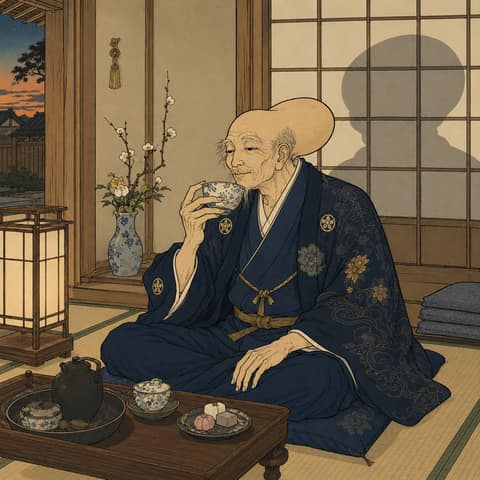
This version represents Nurarihyon as the "Supreme Commander of Yokai," the persona most widely recognized in modern pop culture. The unidentified old man who simply stood silently in the Edo-period *Gazu Hyakki Yagyo* has, through decades of cross-media adaptations, transformed into the absolute mastermind holding the balance of power in the yokai realm. The lore added in the early Showa period—"sneaking into houses unnoticed and acting like the master"—has been sublimated into high-level "abilities" of illusion and mind control, such as "manipulating others' recognition," "completely erasing his presence," or conversely, "dominating the space." The reason he is depicted as so incredibly "strong" in manga, anime, and games is rarely due to mere physical strength or raw demonic power. Instead, his might stems from a charismatic leadership that commands the loyalty of countless yokai, a bottomless cunning that allows him to seamlessly blend into the dark underbelly of human society, and the profound wisdom accumulated over centuries. He is portrayed variously as a cunning arch-nemesis plaguing Kitaro in *Gegege no Kitaro*, a strict and devoted aide supporting Lord Enma in *Yokai Watch*, and an overwhelmingly despair-inducing foe capable of unimaginable transformations (such as a giant female amalgamation or skeleton) in *GANTZ*. The core trait shared across all these works is his elusive, utterly ungraspable nature. Beneath the facade of a mild-mannered old man lies cold, calculating intellect capable of crossing the boundaries between humans and yokai with ease, along with a mysterious charm that ensures his true intentions remain forever hidden. Born from nothingness and grown to colossal proportions by feeding on human imagination, he can truly be called one of the strongest yokai of the modern era.

Nure-onna

Nure-onna

Epic

NOO-reh-OHN-nah

Nure-onna (Tradition-Faithful Version)

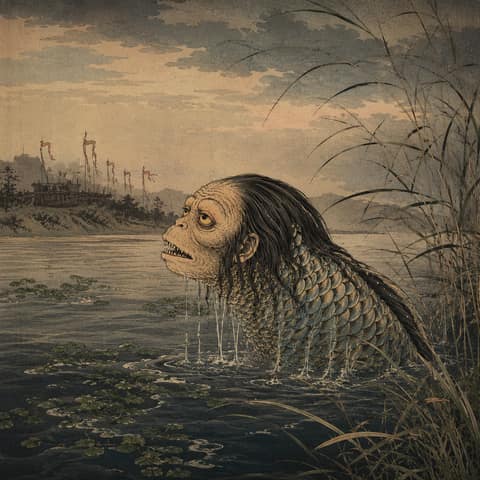
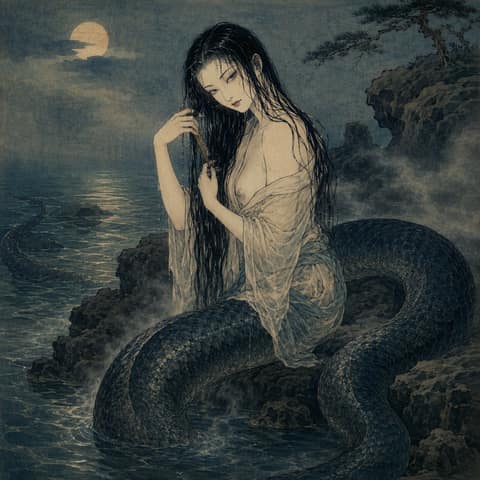
Seen along seashores and riverbanks as a woman with long wet hair. Depending on the region, she either lures victims by making them hold a baby and then immobilizes them, or appears as a menacing aquatic entity evocative of a serpent’s body and a massive tail. Edo-period yokai art often depicts a serpentine woman, though narrative sources offer scant confirmation. In Iwami she is classed as a water spirit linked to the gyuki, with advice to never hold her burden barehanded. She is sometimes conflated with the iso-onna, and both name and traits vary by locale.

Nurikabe

Nurikabe

Epic

NOO-ree-KAH-beh

Nurikabe

General ClassificationsFukuokaOita

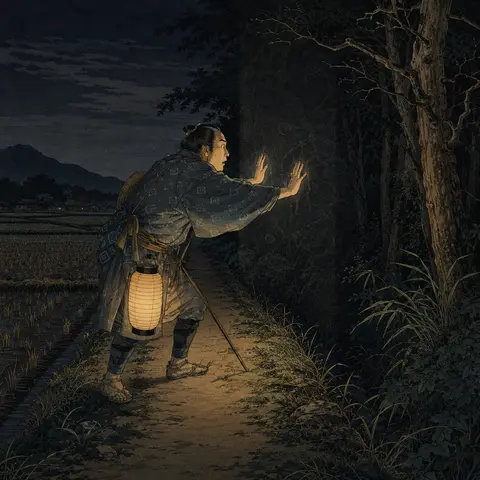
Invisible to the eye yet felt as a solid wall, this form matches northern Kyushu tales of travelers led astray. It does little harm and specializes in halting progress. The obstruction spreads from ankle to shoulder height, denying head-on passage. Stepping to the side, pausing to rest, or probing the ground and roadside with a stick weakens it. It is understood as a road spirit that tests those who travel.

Nyoi Jizai (Will-at-Will Scepter Spirit)

Nyoi Jizai (Will-at-Will Scepter Spirit)

Uncommon

NYOH-ee jee-ZAI

Emaki Edition

Animated Objects & UndeadJapanese folklore

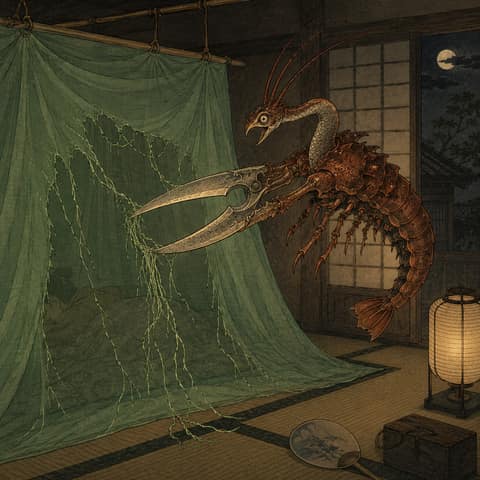
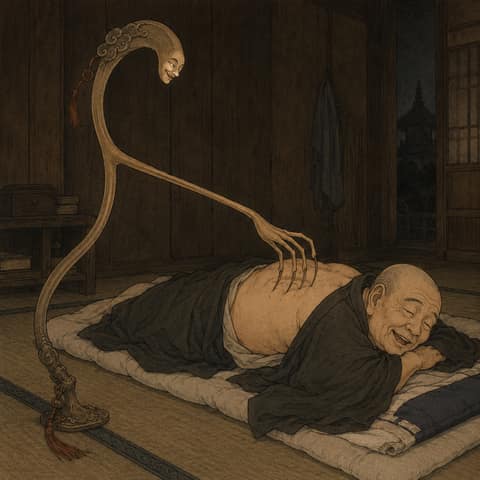
A consolidation based on the nyoi monster depicted in Muromachi-period Night Parade of One Hundred Demons scrolls and on Toriyama Sekien’s Hyakki Tsurezure Bukuro images and captions. Following the tsukumogami belief that tools gain spirit with age, the nyoi’s original function of “reaching at will” is exaggerated as occult power. Two iconographic lines exist: one shows a humanoid with a tea-brown body and long claws that scratch a person’s back with extended arms, the other shows the nyoi itself sprouting wings and drifting in midair. Both appear late at night in bedrooms or Buddhist rooms, said to seek out itchy spots and places the hand cannot reach. Some readings hold that the morally wanting are left with claw marks, yet region-specific oral lore is scant, and the figure relies mainly on pictorial sources and later yokai commentaries.

Nyūbachibō

Nyūbachibō

Rare

nyoo-bah-chee-BOH

Emaki Seigan Iconography Version

Household SpiritsJapanese folklore

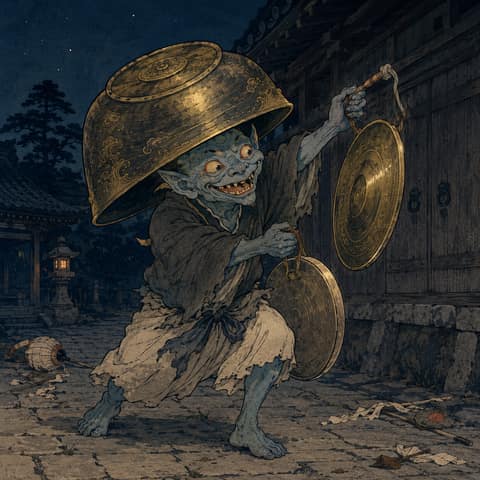
Taking as precedent the disc-like apparition found in Muromachi-period Night Parade of One Hundred Demons scrolls, the Edo artist Toriyama Sekien shaped it in Hyakki Tsurezure Bukuro as a human figure bearing a bronze plate. Sekien frequently depicted utensils turned yokai, and Nyūchibō is one of these, yet the textual notes are brief and its conduct remains undefined. Amid overlapping names and forms—nao-bachi, dōbachi, and surigane used in temple rites and theater orchestration—later commentators supplied the trait of startling people by sounding. No specific regional lore is attached; it is recognized iconographically within the broader class of utensil-spirits. Its qualities today largely reflect fragments of folk materials and modern reinterpretations in yokai handbooks.

Oboroguruma (The Hazy Carriage)

Oboroguruma (The Hazy Carriage)

Rare

oh-BOH-roh-goo-ROO-mah

Oboroguruma (after Sekien’s Iconography)

Household SpiritsKyoto

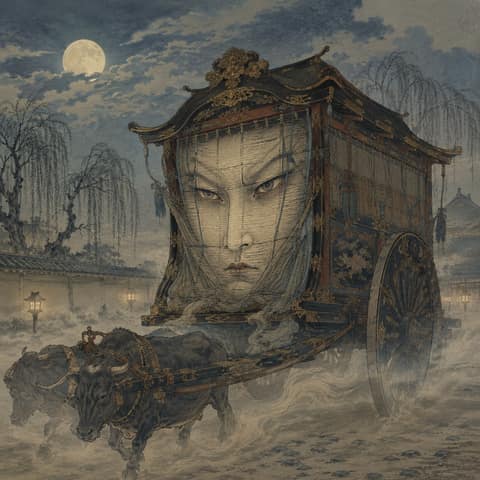
A depiction of the Oboroguruma based on Toriyama Sekien’s image and Edo-period readings: a half-transparent ox-drawn carriage appears on a hazy night, its blinds blocked by an enormous face. It is said to echo rancor from Heian-era carriage quarrels, yet avoids naming individuals or tying to single incidents, instead embodying social tensions from festivals and spectacles that possess objects. It is also understood as part of the Night Parade of One Hundred Demons, startling people through a double sign of sound (creaking wheels) and form (an ox cart with a face). Direct harm is not always told; it manifests as a token of dread and ill omen, prompting witnesses to recoil. As an object-yokai, old carts and festival gear set the stage, and disputes over space or viewing cause the tale to arise. Excess specifics are avoided, with the hazy night and cart sounds serving as its marks of appearance.

Oguchi-no-magami

Oguchi-no-magami

Divine

Oguchi-no-magami

The Divine Messenger of Chichibu Mitsumine: Oinu-sama

Divine Spirits / DeitiesSaitamaTokyo

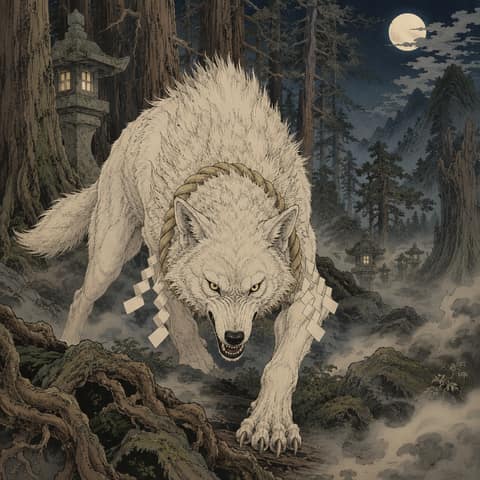
Oguchi-no-magami is not merely a beastly yokai, but the crystallization of a faith that enshrined the Japanese wolf—a real, apex predator of the mountains—as a "True God." Centered around Mitsumine Shrine in Chichibu, Musashi Province, and extending to sanctuaries like Musashi Mitake Shrine and Hodosan Shrine, it is a guardian deity that permeates the wolf-worshipping sphere of the Kanto region. Its essence lies in "purification and exorcism." The fire that attacks a house, the thief that sneaks in, the evil spirits that possess people—the divine nature of a "watchdog" capable of sniffing out and driving away unseen disasters was strongly sought after by the commoners of the early modern period. The unique practice of *Gokensoku Haishaku* is an intense form of faith where the deity itself is welcomed into the home for a year. Through repeated cycles of returning and renewing the amulet, the bond between the deity and the household is maintained. The fact that an extinct beast is still treated as a god today demonstrates the deep-rooted strength of this faith.

Oil Baby

Oil Baby

Rare

AH-boo-rah AH-kah-go

Sekien Iconography Edition

Household SpiritsShiga

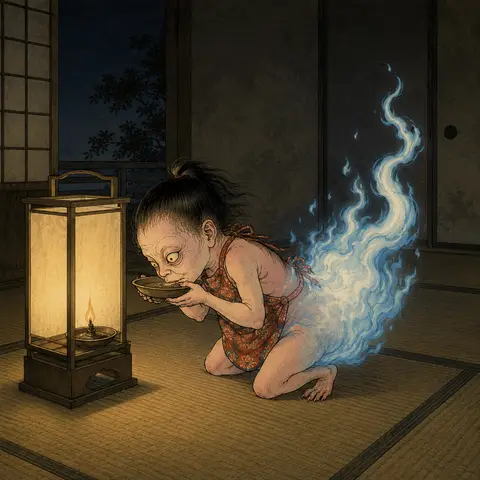
This version is grounded in Toriyama Sekien’s imagery and the Edo-period essays cited in his notes, interpreting the infant form as a minimal personification of a ghostly fire. Its core is the idea of an oil-thieving flame, with the baby figure best read as Sekien’s visual cue. Lamp oil was a daily necessity, and offerings of oil at temples and shrines were held in special regard. Stealing oil violated religious and ethical taboos and was told as a fire that wanders after death. Later handbooks retell it as a fireball entering a house, becoming a baby, and licking oil, but region-specific oral examples are scarce and no widespread template is certain. Accordingly, this version presents a three-step pattern—phantom fire appears (at crossroads or within shrine-temple precincts), the infant image manifests (gesturing as if licking oil before a lamp), then departs again as flame—while avoiding unverified details and foregrounding its symbolism as a warning against defiling offered oil.

Oitekebori

Oitekebori

Uncommon

oh-EE-teh-keh-BOH-ree

Ochikohori (Curated Traditional Tales Version)

Aquatic SpiritsTokyo

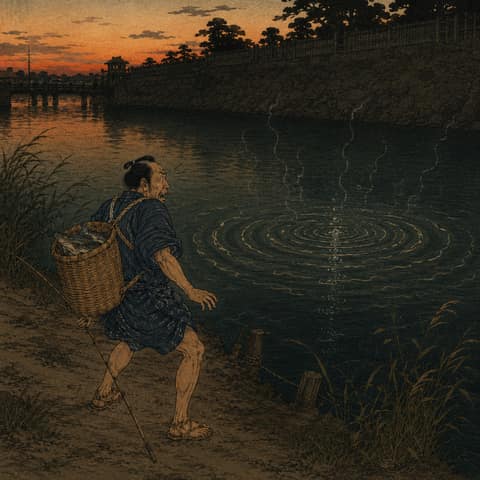
Spoken of as a haunting tied to canals and irrigation ditches in Edo’s low wetlands, it functioned as both a warning against greedy overfishing and a folkloric device marking taboos on the water. The entity has no fixed form and is often only a voice, though in some regions it is identified with known shapeshifters like kappa or tanuki. Its stage centers on Honjo’s Kinshi-bori and Sendai-bori and along the Sumida River, with variants in Kameido, Horikiri, and Kawagoe. A typical pattern is the three-step “big catch—departing voice—loss of fish,” accompanied by etiquette tales that aver misfortune can be avoided by sharing the catch or releasing a few fish. It appears in curious tale collections and local lore around the Kansei era and later took root through rakugo storytelling. Natural sounds and animal behavior became the raw material of the uncanny, and the tale served to symbolize rules for ditch maintenance and norms for shared resources.

Oiwa

Oiwa

Legendary

Oiwa

Oiwa of Yotsuya Kaidan

Spirit / GhostTokyo

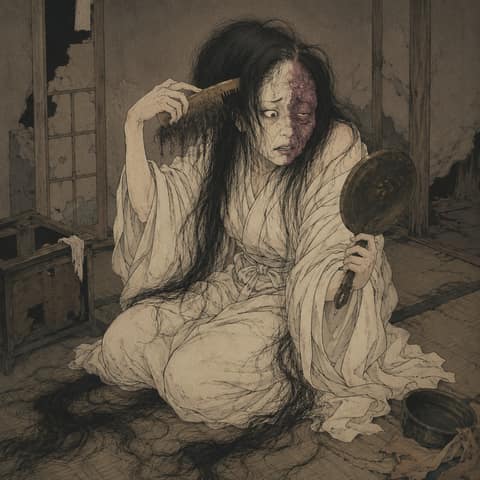
Oiwa in the kabuki play "Tokaido Yotsuya Kaidan" debuted in July 1825 at the Edo Nakamura-za, staged as a mixed, two-day performance intertwined with "Kanadehon Chushingura". The ronin Kamiya Iemon of the Enya clan, despite having Oiwa as his wife, seeks to switch to a marriage proposal from a neighboring family for the sake of his career, feeding Oiwa a poisonous concoction. In the second act, the scene known as "Kamisuki" (hair-combing)—where Oiwa, half her face grotesquely swollen from the poison, dies in agony upon seeing her altered reflection while combing her falling hair—became the Kikugoro family's most polished and renowned spectacle. In the third act at Sunamura Onbobori, the corpses of Oiwa and Kobotoke Kohei wash ashore nailed to the front and back of a wooden door. The "Toitagaeshi" (door-flipping) scene, where the door turns over before Iemon's eyes—with a single actor playing both roles through lightning-fast costume changes—is the pinnacle of stage mechanism. In the final act at the Heikiyama hermitage, countless stage tricks (keren) are rapidly deployed, including the "Chochin Nuke" (lantern escape), where the ghost emerges from a burning lantern, and the "Butsudan Gaeshi" (altar flipping), where someone is pulled into a Buddhist altar. These bizarre phenomena are purely theatrical fiction with no connection to the historical virtuous wife Tamiya Iwa, yet their compelling realism led people to fear Oiwa as though she were an actual vengeful spirit. The story's framework hinges on the selfishness of a man who discards his wife for social advancement and the helpless desperation of a woman whose sincerity has been trampled. Oiwa is not an evil spirit cursing without reason; she is formulated as an existence whose lingering love for the husband who poisoned her has been violently inverted. Evoking both sympathy and terror in the audience simultaneously is the true essence of Nanboku's drama. A custom arose whereby the cast and crew, centered around the actor playing Oiwa, would visit Oiwa Inari in Yotsuya to pray for success and safety before the performance. This tradition continues to this day in modern kabuki, film, and theater (by ancient custom, the actor playing the betrayer Iemon does not visit, as doing so is said to anger the spirit instead). The very fact that accidents and injuries occurring on stage have often been passed down as "Oiwa's curse" stands as a rare case where a fabricated vengeful spirit attracted real-world religious belief. Ironically, the source of that belief, Oiwa Inari, was originally an auspicious shrine dedicated to the virtuous wife Oiwa who had restored her family's prosperity.

Okiku

Okiku

Legendary

okiku

Okiku of Sarayashiki

Spirit / Vengeful GhostHyogoTokyo

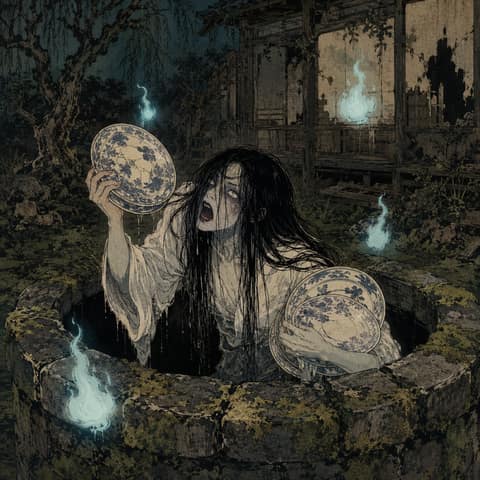
"Okiku of Sarayashiki" is a vengeful spirit shaped as a creature of repetition, eternally counting her broken plates. Her terror lies primarily in her voice and numbers rather than her appearance—counting low in the darkness, "One... Two..." and unleashing a bloodcurdling scream upon reaching the ninth and missing the last. This structure of loss and repetition is the core of the Sarayashiki tales, causing the audience to cringe in anticipation of the inevitable dread of the "ninth." Okiku's grudge erupts from the absurdity inflicted upon the weak in early modern society: false accusations, class disparities, and the unreasonableness of masters. Here, the two major lineages must be strictly distinguished from their modern adaptations. First is the Banshu lineage—set in Himeji, where the maid Okiku is caught in Aoyama Tetsuzan's conspiracy to usurp the household. Tricked by Machitsubo Danshiro, she is framed for losing one heirloom plate, tortured to death, and sunk into a well. Second is the Bancho lineage—at the Edo Ushigome mansion of hatamoto Aoyama Shuzen, the maid Okiku is slain for breaking a plate (or for rejecting her master's unwanted affections), or throws herself into the well, becoming a well-dwelling haunt. Both are "Ghost Okiku," nurtured by early modern ghost stories, storytelling, and joruri. These must be sharply separated from the third layer—Kidō Okamoto's *Bancho Sarayashiki* (1916). Okamoto wrote this not as a ghost story but as a modern drama (New Kabuki), discarding the clan dispute plot and reimagining it as a tragic cross-class romance between the hatamoto Aoyama Harima and the maid Okiku. Okiku deliberately breaks the heirloom plate to test Harima's love; upon learning this, Harima, enraged that his true feelings were doubted, strikes her down—no ghost appears here, and the tale is elevated into a drama of tragic love and human psychology. In short, the "ghost Okiku counting from the well" is an image from early modern ghost stories, whereas Okamoto's Okiku is a distinct literary creation reinterpreted by a modern intellectual. The two must never be conflated.

One-Eared Pig

One-Eared Pig

Uncommon

kah-tah-KEE-rah-OO-wah

Consolidated Folklore Edition

Animal ShapeshiftersKagoshima

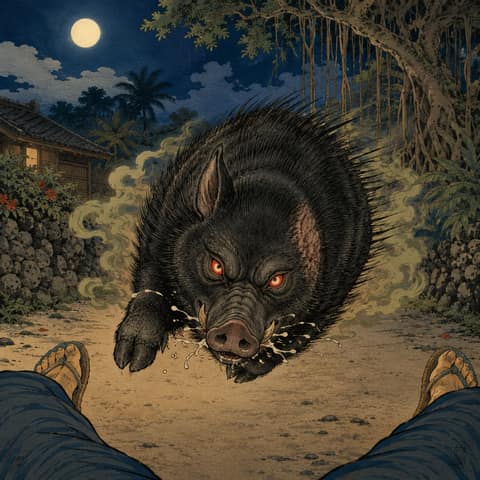
An organized synthesis of the one-eared pig yokai found in Amami strange tales, presented alongside related lore of earless pigs and one-eyed pigs. The shared core is soul extraction by “passing through the crotch,” in which it closes the distance with a sudden leap and slips through from behind. It is told as a local, site-bound apparition that emits a strong animal-like stench and casts no shadow. Some accounts say it appears before lone women or pairs of women. Practical know-how to avoid it includes standing or walking with legs crossed to prevent it from passing through the crotch. Capture is said to be difficult, as it escapes pursuit with speed and powerful leaps.

One-Eyed Boy Monk

One-Eyed Boy Monk

Epic

hee-TOH-tsu-meh koh-ZOH

Traditional Aspect (Hitotsume-bō)

山野の怪Across Japan (Edo, Aizu, Tanba, Bizen, etc.)

A整理 based on Edo-period picture scrolls such as Hyakkai Zukan and Bakemono-zukushi depicting the figure known as Hitotsume-bō. It takes the form of a shaven-headed child monk, appearing suddenly in parlors, on bridges, slopes, and crossroads, then vanishing once satisfied with the onlooker’s reaction. Though often associated by inference with the one-eyed, one-legged monk of Mount Hiei, direct identification is avoided. Folklore links it to food by claiming it dislikes beans, and later images show it carrying tofu, yet it rarely intends harm to people or livestock. Its appearances vary by season and weather; in some regions, its single eye is said to glow dimly on rainy nights in late autumn. Names vary by locale, including “Hitotsu-managu” in Ōshū and the widespread “Hitotsume-kozō” and “Hitotsume-bō.”

Oni

Oni

Legendary

OH-nee

Oni (Traditional Folklore Form)

Demons & GiantsKyoto

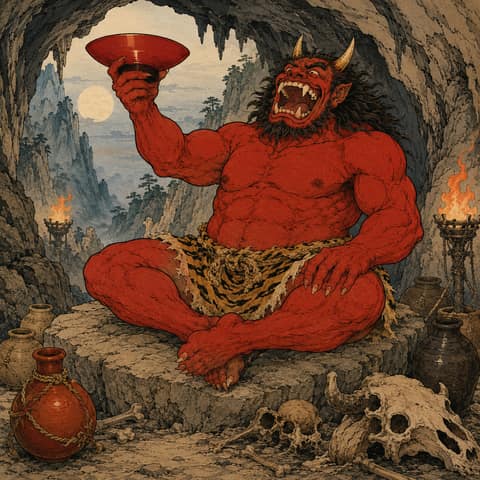
A classic oni with red skin, proud horns, and a tiger-skin loincloth. Despite the fearsome look, he carries a warm heart. His booming laughter echoes through the mountains, and he treasures bonds with his comrades above all. Though terrifying when roused to anger, he is usually jovial and a dependable, big-brother figure.

Oni Bear

Oni Bear

Uncommon

OH-nee KOO-mah

Tradition-faithful Oni-Bear

Animal ShapeshiftersNaganoHokkaido

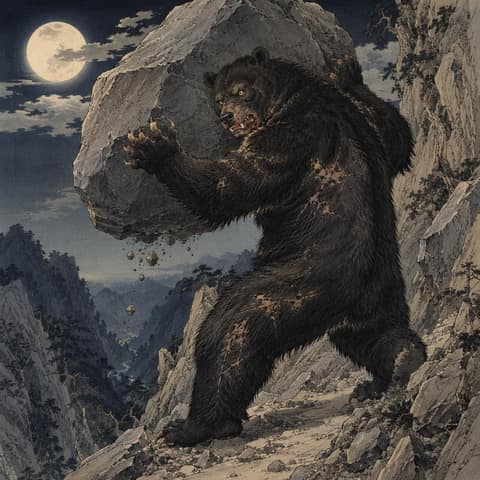
Based on Edo-period sources, this depicts an old bear transformed into a yokai. It usually keeps to deep mountains and avoids human presence, but during famines or seasonal shifts it slips down to villages under cover of night to carry off livestock. Its upright gait can be mistaken for a human silhouette, and its tracks mingle human and bear prints. Tales of great strength tie it to local megalith lore, serving as an unspoken boundary marker for dangerous mountain zones. In slaying legends, communal coordination, selective use of hunting tools, and reverence for the mountain deity are emphasized, and the Oni-Bear is told as more than a mere beast—a symbol that brings calamity to those who break the laws of the mountain. Descriptions in early modern illustrated compilations heighten its uncanny nature while reflecting memories of real bear attacks, showing the intersection of folk environment and ghostly tale.

Oni Hitokuchi

Oni Hitokuchi

Uncommon

OH-nee HEE-toh-KOO-chee

Tradition-Faithful Edition

Demons & GiantsOsaka

Oni Hitokuchi appears in pre-medieval tales less as a fixed figure than as a term for a demonic being that fells a human with a single bite. It typically emerges in liminal scenes—at night, in thunderstorms, near storehouses or by the roadside—often intruding upon lovers’ trysts or flights. In The Tales of Ise (the Akutagawa episode), thunder drowns out the screams, and the lack of remains underscores the instantaneous “one bite.” Nihon Ryōiki and Konjaku Monogatari depict its mimicry as a man, serving as a warning against deviating from social bonds such as marriage or vows. After Sekien’s imagery fixed the name, folklore used it to reframe wartime, famine, and disaster disappearances as otherworldly devourings. Thus “Oni Hitokuchi” here is a type-name: its form is not fixed, and its essence is speed of consumption and absence of traces.

Oni of Gango-ji

Oni of Gango-ji

Epic

GAHN-goh-jee no OH-nee

Canonical Folkloric Tradition

Ghosts & SpiritsNara

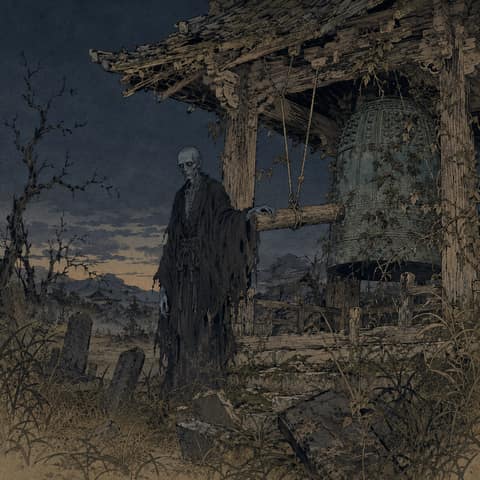
This version follows storylines found in Heian-period tale collections and represents the type fixed as the bell-tower apparition of Gangoji. The demon’s true form is the restless spirit of a servant connected to the temple, manifesting as a figure that frightens monks and children. It appears at midnight, and accounts say its form can be verified by lamplight, reflecting a folk view that sacred beings hide yet reveal themselves under certain conditions. A preceding thunder-god episode is linked as a strong-child birth tale, reinforcing the idea that the power of thunder can dwell in a person. The subjugation is not by beheading but by tactile restraint—“grabbing the hair,” “tearing it out”—with the hair remaining as a relic treasured by the temple. Thereafter the monster is calmed, and the child takes vows and is known as Dōjō Hōshi. Words like Gagoze and Gagoji appear regionally as generic terms for yokai, but their etymology is debated and left unspecified.

Oni of Hemp Fiber (O-uni)

Oni of Hemp Fiber (O-uni)

Rare

OH-oo-NEE

Iconographic Tradition, Sekien Lineage

Mountain & Wilderness SpiritsUncertain (derived from an Edo-period picture scroll)

Rather than arising chiefly from oral accounts, Ouni has been recognized through a lineage of images in picture scrolls. A precursor appears as the “Wau-wau” type in Sawaki Suushi’s Hyakkai Zukan (1737), and in the late Edo Hyakki Yagyō Emaki (Oda Gōchō, 1832) it is rendered as “Uwan-uwan.” Toriyama Sekien drew on this visual genealogy, exaggerating the hair and emphasizing a fiber-bundle texture suggestive of o, then named the figure accordingly. The term o denotes a tufted bundle of ramie or hemp fibers, serving as a visual sign tied to the creature’s mass of body hair. From the Heisei era onward, commentators increasingly connected Ouni with folktales of mountain hags who comb and spin fibers, treating it as a subtype of yama-uba. Yet Sekien gives no locality or deeds, and evidence for attaching it to specific place-based traditions is scant. It is safest to regard Ouni as a yokai defined by the iconographic core of a shaggy demon-woman appearing in the mountains, loosely linked to ideas surrounding women’s fiber work in upland communities.

Oni of Rajōmon (Rashōmon Demon)

Oni of Rajōmon (Rashōmon Demon)

Epic

rah-JOH-mohn no OH-nee

Canonical Lore: Oni of Rashomon Gate

Demons & GiantsKyoto

An oni that appears at Rashomon Gate and on the outskirts of the capital, serving to highlight a warrior’s valor. Medieval war tales and Noh plays preserve multiple versions with differing stages and details, but the core remains: a lone warrior meets an oni at a gate or bridge and severs its arm. The arm is treated as a symbol of impurity and numinous power, leading to later tales of its recovery. Its conflation with Ibaraki-dōji intensified in early modern retellings, shifting names and locales, yet overall it embodies a liminal threat haunting the edges of the capital. Iconography shows an iron staff, horns, red-black skin, and wild hair, often set amid stormy weather and black clouds. Representations rooted in warrior lore, Noh, and picture scrolls continue to shape its image today.

Onmoraki

Onmoraki

Rare

ohn-moh-RAH-kee

Onmoraki

Animal ShapeshiftersJapan (tradition derived from Chinese sources)

Following Toriyama Sekien’s Konjaku Gazu Zoku Hyakki, it bears a crane-like black body, eyes that gleam like lamplight, and a cry that trembles through its wings. Said to arise from the qi of a fresh corpse, it appears when sutra recitations or memorial services are neglected at temples. Framed by Chinese lore adapted in Japan and retold in Edo-period strange tales, it manifests less from rancor than from circumstances such as unfinished rites or temporarily laid-out bodies, serving as a cautionary apparition upholding temple norms. Sightings are momentary, vanish when approached, and leave scant trace. Its very form is an alarm, understood as a sign of improper or incomplete memorial observances.

Onryō (Vengeful Spirit)

Onryō (Vengeful Spirit)

Legendary

ohn-RYOH

Goryo Cult

Ghosts & SpiritsKyotoFukuoka

A framework that enshrines vengeful spirits as goryo to pacify their curses and turn them into sources of blessing. Epidemics and natural disasters were seen as manifestations of resentment, and reconciliation was sought through founding shrines, conferring divinity, and institutionalizing festivals. Curse deities bear a dual aspect of fear and veneration, and their wild power was believed to transform into communal guardianship through proper requiem rites. Practices ranged from state rituals to village memorials, including era name changes, imperial envoys, Goryo-e, and Hojō-e. For individuals, memorial offerings, sutra copying, nenbutsu, and esoteric prayers were performed, while restoring honor and granting divine ranks were means to ease a spirit’s grievances. Narratives and origin legends explained why resentment arose, giving social memory to causes such as false accusation, untimely death, and broken lineages. A vengeful spirit’s power was not indiscriminate but signaled its intent according to causes, believed to speak through dreams, oracles, thunder and fire, and plague. Pacification was not a one-time act but continued through annual festivals and shrine upkeep, with warnings that neglect would invite resurgence.

Ootakemaru

Ootakemaru

Legendary

おおたけまる

Ootakemaru, the Demon King God Holed Up in Mount Suzuka

Oni / Giant MonsterMieKyoto

This version's Ootakemaru is not treated as a game-like "strongest demon," but as a demon king god born from the boundary space of the Suzuka Mountains. His terror lies not only in his massive size or martial prowess. By blocking the pass connecting the capital and the eastern provinces, halting tributes and traffic, and stalling armies with black clouds, lightning, and rain of fire, he disrupts the very pathways of the state. That is why Tamuramaru's victory is told not just as a feat of individual swordsmanship, but as a tale of pacifying the deities of the pass through the protection of Kiyomizu Kannon, the cunning of Suzuka Gozen, and the spiritual power of the sacred sword. Furthermore, Ootakemaru is not confined solely to Suzuka. In the *Tamura Sandaiki* lineage, the story moves to the Tohoku region, resonating with names like Akuro-o, Ootakemaru, Mount Kiri, and Takkoku-no-Iwaya. Here, Ootakemaru becomes not so much a demon sleeping in one land, but a core for the Tamuramaro legend to travel while absorbing the origins of various regional shrines and temples. If Shuten-doji carries the burden of the feast and severed head at Mount Oe, and Tamamo-no-Mae carries the court and the Sessho-seki, then Ootakemaru is the yokai who bears the "path of subjugation tales" stretching from the Suzuka Pass to Tohoku.

Osakabe-hime

Osakabe-hime

Epic

oh-sah-KAH-beh-hee-meh

Osakabe-hime (Traditional Tale Version)

Half-Human BeingsHyogo

Based on the image of a castle-deity linked to Himeji Castle’s main keep, centered on the kimon northeastern quarter. Known as Osakabe as well as Koshogobu or Shogobu, she appeared through the early modern era as a shifting “castle specter” before settling into the form of an aged princess or female apparition. Her pedigree ties to shrine relocations during construction and the founding of Hattendo, understood as a spiritual force intervening in the castle’s ritual order. She sees into human hearts, sometimes proving herself by producing tangible tokens such as combs or helmet scales, and is also recorded to assume a grand oni-like form in response to prayers or provocation. Her true nature is variously attributed to an ancient fox, the castle’s tutelary deity, an unknown noblewoman’s spirit, or a human sacrifice legend, with no single origin fixed. She protects when the lord governs justly and brings calamity when order falters, embodying a guardian of the boundary between castle and community.

Osaki-gitsune

Osaki-gitsune

Rare

osaki-gitsune

The Small Fox Clinging to Family Lineages: Osaki-gitsune

Animal YokaiSaitamaTokyo

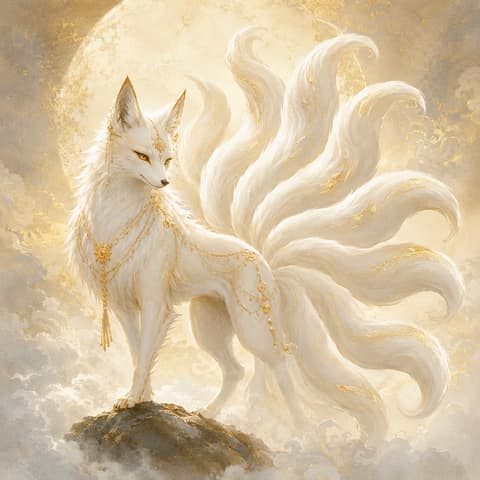
In this version, we read the Osaki-gitsune as the "small fox clinging to family lineages." The terror of the Osaki-gitsune is not that it suddenly jumps out on a mountain path. Its terror lies in the fact that by being spoken of as possessing a house for generations—that the family is an "Osaki holder"—it completely alters the reputation of the entire family. The yokai does not appear before the individual; it rides upon the family name. The Osaki-gitsune functioned as an explanation for wealth. In village societies, when only a specific family became wealthy, the reason was sometimes spoken of not merely as effort or luck, but as the invisible power of a fox. This narrative contains both envy and fear. A wealthy family has power, but whether that power is legitimate is doubted. The Osaki-gitsune is an entity that translates economic imbalance into the form of a yokai. As an explanation for illness or possession, the Osaki-gitsune also played a major role. Unexplained ailments, sudden madness, and abnormal appetites were spoken of as fox possession, becoming subjects for prayers and exorcisms. Here, the fox does not just enter the sick person's body; it spreads the suspicion of "Who sent it?" and "Which family has it?" The belief in spirit possession expands bodily issues into issues of the family and the community. The proximity to the Kuda-gitsune enriches the reading of this version. Both are small fox spirits that possess houses and are tied to wealth and disease. However, while the Kuda-gitsune easily takes on the sorcerous image of bamboo tubes or Izuna magic, the Osaki-gitsune functions more strongly as a family's reputation. Whether they actually keep a fox cannot be confirmed. Even so, simply being said to "have it" sways marriage prospects and social interactions. The invisible fox has visible effects socially. The Osaki-gitsune in this version is less a yokai with the appearance of a small animal, and more a suspicion dwelling in a house. While the shape of its tail or the size of its body changes depending on the teller, the feeling that "there is something in that house" never disappears. The outline of the Osaki-gitsune is clearest when we shift our eyes from searching for yokai in the fields and mountains, to looking at family reputations. The power of the Osaki-gitsune lies not in visible possessions, but in the suspicion of invisible possession. Even without evidence of actually keeping a fox, if it is said that "that house has Osaki," the attitudes of those around them change. Before showing its form, the yokai begins to operate as a reputation. In this version, we read the Osaki-gitsune as a memory device of the village. A certain family has been rich since the old days, produces sick people, or is avoided in marriage. Such memories are bundled under the name of the fox. The Osaki-gitsune has the function of transforming individual incidents into the narrative of a single family lineage. Therefore, the cute image of a fox is insufficient for the Osaki-gitsune. Even though it is small, it sways the evaluation and future of a family. Though it is a fox yokai, what it truly bites into are human relationships. The small fox lurking in the house becomes largest in the eyes of the community. Precisely because it is invisible, this fox enters deep into the house. The fewer people who have seen its form, the harder it is to deny. Something no one can verify sways the judgments of marriage and association. The Osaki-gitsune demonstrates very sharply the process by which a yokai becomes a social fact. That slight invisibility is what makes the Osaki-gitsune remain for a long time.

Showing 289 - 312 of 479 yokai