YOKAI.JP

Traditional Yokai Encyclopedia

Yokai passed down through the ages

480 Yokai|13 Category|Page 12 of 20
Localization in Progress - More content available in Japanese version
View Japanese
Sort by: NameAscending
Mokumokuren

Mokumokuren

Epic

MOH-koo-moh-koo-REN

Toriyama Sekien Zue–Conformant Edition

Household SpiritsJapanese folklore

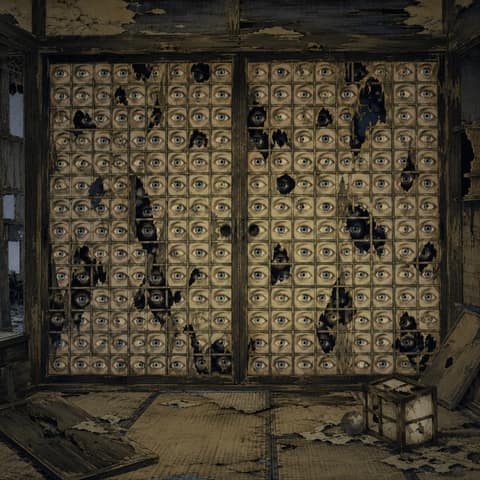
Reconstructed from Toriyama Sekien’s imagery and captions as a swarm of disembodied eyes gathering on the shoji of a ruined dwelling. Rather than inflicting direct harm, it unsettles by staring. It is mediated by domestic neglect and unappeased sentiments, yet belongs to a generalized lineage of house-haunts not tied to specific individuals or locales. This reading also aligns with later variations in collected names and with links to visual illusion phenomena.

Momijigari (The Demon of the Maple Viewing)

Momijigari (The Demon of the Maple Viewing)

Uncommon

moh-MEE-jee-GAH-ree

Demoness Momiji (Performing Arts Tradition)

鬼・巨怪Nagano

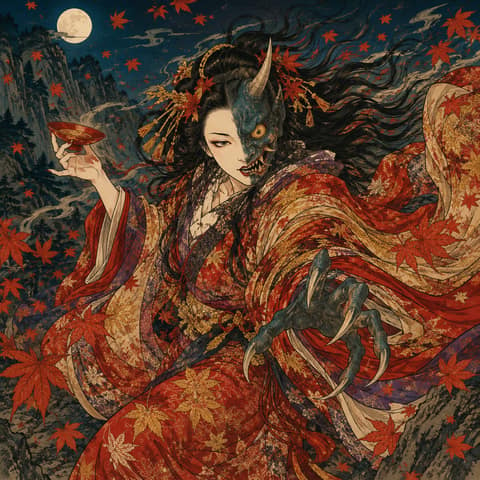
A demoness archetype fixed in Noh, joruri, and kabuki from the Muromachi to Edo periods. She appears under the pretext of autumn leaf viewing as a courtly lady-in-waiting or princess’s attendant, lulling suspicion with music and dance. At the feast she inebriates warriors, but near midnight her nature is exposed by divine protection or a sacred blade, and she reveals her true form in the wilds of Mount Togakushi. Commonly called Momiji, she bears aliases such as Princess Sarashina depending on the work. Her slaying tales extol martial virtue and reflect awe of the mountains, inheriting Togakushi worship and the rhetoric of oni-hunting lore. On stage, the contrast between the elegant disguise of the first act and the ferocious demon visage of the second is emblematic.

Momongaa

Momongaa

Rare

moh-mohn-GAH-ah

Momongaa (Print-Illustration Variant)

General ClassificationsJapanese folklore

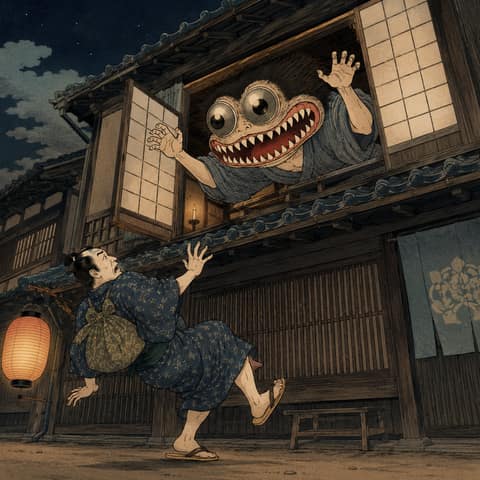
An image based on what appears in Edo-period prints. It thrusts out huge round eyes and a split mouth from an upstairs doorway or by a paper screen, baring sharp teeth to bluff and frighten, or writhes on all fours as a white lump of flesh with stubby limbs. Its name has the ring of a shouted call, and it is depicted as a specter that turns away nighttime visitors. It claims no personal name or lineage, emphasizing a showy display of monstrous features.

Momonji (the Hundred-Old Man)

Momonji (the Hundred-Old Man)

Rare

MOH-mohn-jee

Iconographic and Textual Standard (Sekien Line)

Mountain & Wilderness SpiritsUncertain; depicted in Edo-period picture scrolls

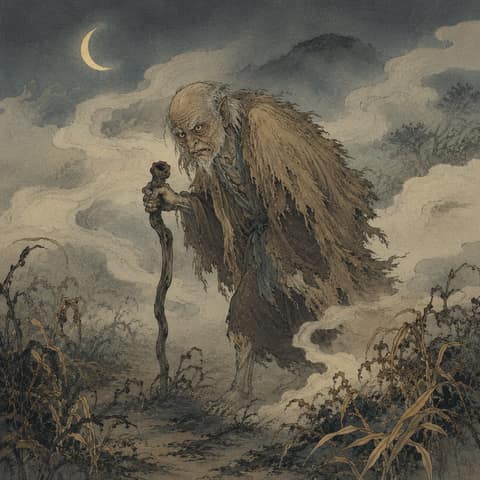
Based on Toriyama Sekien’s image and notes, this version frames the entity as an old man–shaped specter appearing on open fields at midnight. Its name is taken as a blended form of child language like “momon-ga” and “gagoji,” embodying generalized fear of monsters. The belief that witnesses fall ill aligns with older notions that contact with the uncanny brings impurity and sickness, with no concrete acts of harm described. Early modern taboos against eating game and the euphemism “momonjii” may have encouraged its visualization through name association. Later readings place it as dwelling in mountains yet appearing at street corners to startle people, or as the city-going form of the nobusuma, but primary tradition is scant and no broad folktale type is attested. Accordingly, this version treats specifics as unclear, emphasizing its scenic traits—encounters on nighttime fields, fog, and wind—and its feared power to bring illness.

Moon Rabbit

Moon Rabbit

Epic

TSOO-kee-noh oo-SAH-ghee

Moon Rabbit Pounding Mochi

Animal ShapeshiftersAcross Japan (widespread after the arrival of Buddhism)

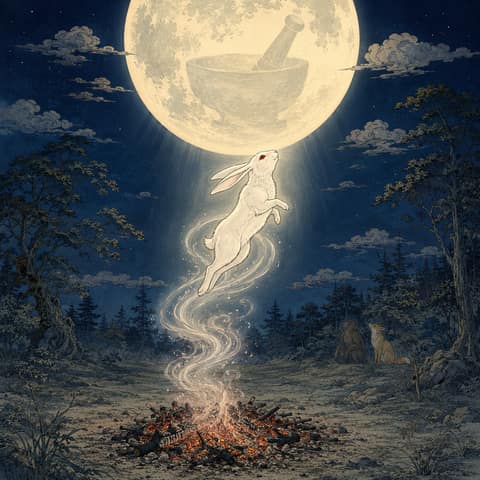
An image of the Moon Rabbit grounded in Japanese iconography. From Asuka-period examples onward, the rabbit within the lunar disk was paired with the solar crow in medieval Buddhist painting and received as a bearer of celestial phenomena. In early modern times, depictions of a rabbit using a Chinese-style mortar and pestle spread through books and prints, and by the eighteenth century the mortar shifted into a characteristically Japanese hourglass shape. The rabbit came to be understood not as compounding an elixir of immortality but as pounding mochi, linking it through wordplay to moon viewing and full-moon festivals. In lore, a self‑sacrificing rabbit ascends to the moon by Indra’s grace, with the lunar shadows and smoke-like markings read as its traces. In folk practice, people gazed at the moon seeking the rabbit’s silhouette, and the theme persisted in moon‑vigil gatherings and storytelling, overlapping with other celestial yokai and lunar deities.

Mosquito-Net-Hanging Tanuki

Mosquito-Net-Hanging Tanuki

Uncommon

kah-yah-TSOO-ree dah-NOO-kee

Mosquito-Net-Hanging Tanuki (Traditional Tale)

Animal ShapeshiftersTokushima

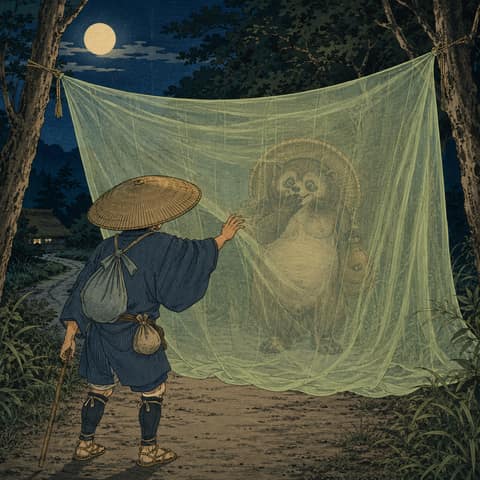
A classic example of illusion craft attributed to the tanuki of Awa. It presents indoor furnishings incongruously outdoors and compels the target to keep “lifting” or “peeking,” eroding their sense of direction and time. The number thirty-six is sometimes linked to shugendō numerology, but local tales give no strict rationale, instead advising a practical countermeasure: stay calm and brace the belly. It causes no harm, and at dawn the spell breaks and the path appears as if nothing happened.

Mountain Sprite (Sansei)

Mountain Sprite (Sansei)

Rare

SAHN-say

Traditional Account (Wakan Sansai Zue and Sekien Lineage)

Mountain & Wilderness SpiritsChina – around Anguo County, Hebei Province

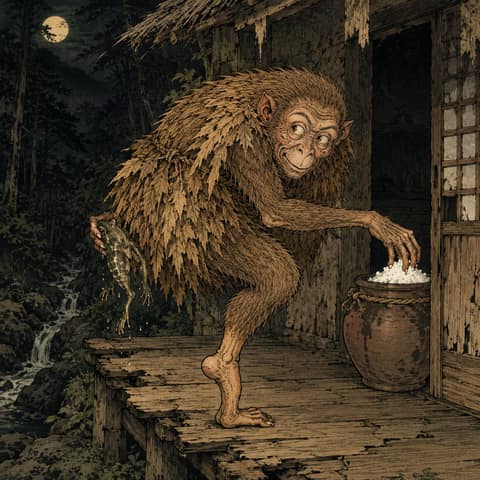
This version draws on Chinese materials cited in the Edo-period encyclopedic Wakan Sansai Zue and on Toriyama Sekien’s pictorial interpretation. The mountain spirit lurks in the hills, watching mountain huts where salt is set out for cooking or work and edging closer to them. Sources differ on size, some saying about one shaku while others claim three to four shaku. Its hallmark is a single leg with a heel set backward, making its tracks hard to read. It favors small wetland creatures like crabs and frogs and appears along stream gullies. It is said to bring lustful harm at night, but will retreat if the drought deity’s name “Batsu” (Hatsu/Boatsu, the Chinese demoness Ba) is spoken, a type of name-utterance apotropaic. Those who harm or consort with it suffer illness or fires, functioning as a cautionary taboo against contact. In Japan, Sekien labeled it “Yamaki” (mountain demon) and depicted it peering into a hut with a crab in hand, providing visual cues; local oral lore is scant, and treatment remains largely bibliographic. Modern reinterpretation is restrained, keeping to the contours of old records.

Mugidono Daimyōjin

Mugidono Daimyōjin

Divine

MOO-gee-doh-noh dye-MYOH-jin

Measles Iconography: Demon-Trampling Aspect

Deities & Divine SpiritsEdo period

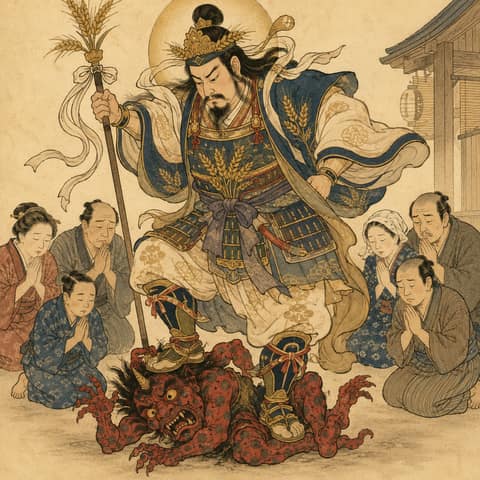
A canonical image of Muginodo Daimyojin found in measles prints. A formidable deity subdues a red-black oni under both feet while onlookers press their hands in prayer. Though the god’s origins are unclear, the image renders the disease visible and calms anxiety through the act of trampling. The accompanying text lists convalescent care, dietary restrictions, and prayers for recovery, blending devotion with practical guidance. The design reflects the plain sincerity of folk belief.

Mujina

Mujina

Epic

MOO-jee-nah

Traditional Tale Compliant – Trickster Mujina

General ClassificationsFukushimaChiba

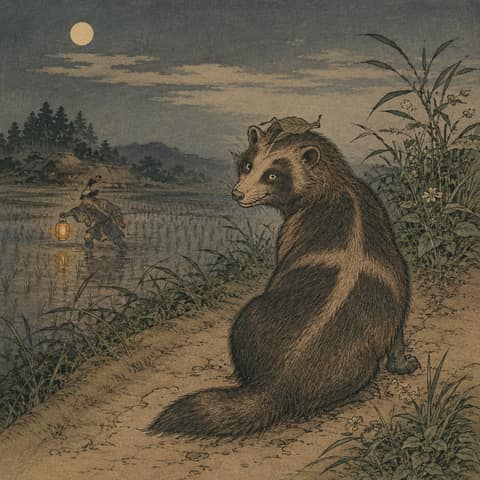
A trickster figure based on mujina tales from across Japan. It appears as a beast about the size of a dog with slightly short forelegs; elders are said to show a cross-shaped patch of fur on the back. Skilled at disrupting attention and sense of direction, it makes travelers mistake fields for rivers, ridges for water surfaces, and straw stacks for human figures on night roads. Malicious ones disguise food and latrines as other things, causing shame or misfortune. When taking human form it favors inconspicuous looks such as a boy, a traveler, or a village woman, and may lure with voice alone. In many regions its lore blends with tanuki and fox tales, with the name “mujina” used regardless, but it broadly belongs to the class of beasts that bewitch. Rather than being repelled by martial arts or spells, most stories end with it vanishing once its true nature is seen through, after which it avoids the area. The proverb “mujina of the same hole” means birds of a feather, combining the observation that they share burrows with associations from trickster tales. Traditions are rich in eastern Japan, and Edo-period paintings depict it under the title “Mami” or “Badger.”

Muku-Mukabaki (Awakened Gaiters)

Muku-Mukabaki (Awakened Gaiters)

Uncommon

MOO-koo MOO-kah-bah-kee

Traditional Edition

Household SpiritsEdo period

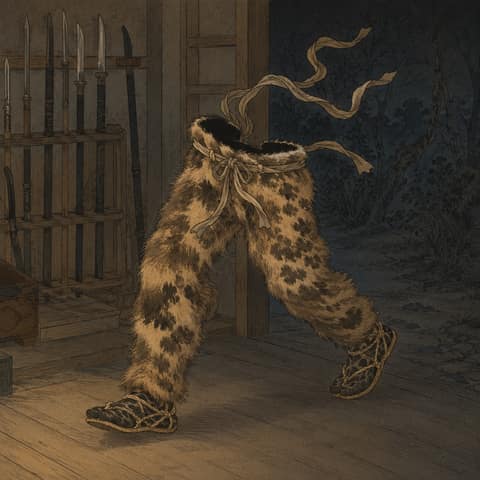
An edited version consolidating Edo-period pictorial sources of the “Inugake” apparition. Inugake are fur leggings worn from the waist to the legs for warmth and protection in hunting gear, placed within the lineage of tool-spirits that gain sentience after long use or separation from their owner. In Sekien’s illustration only the legs seem to walk independently, with the caption evoking the inugake of Kawazu Saburō in The Tale of the Soga. This is a literary hint by the artist rather than evidence of a specific vengeful-ghost tale. In early modern Night Parade of One Hundred Demons and tsukumogami scrolls, yokai wearing inugake appear, emphasizing the uncanny form of the gear. Its nature is generally to show up at night and startle people, with no clear record of harm or benefit. Localized traditions are scant, and most examples belong to urban pictorial culture. It is understood as a classic example of the idea that aged implements come to house spirits.

Myobu

Myobu

Rare

myobu

The White Divine Messenger of Inari Okami, Myobu

Animal TransformationKyoto

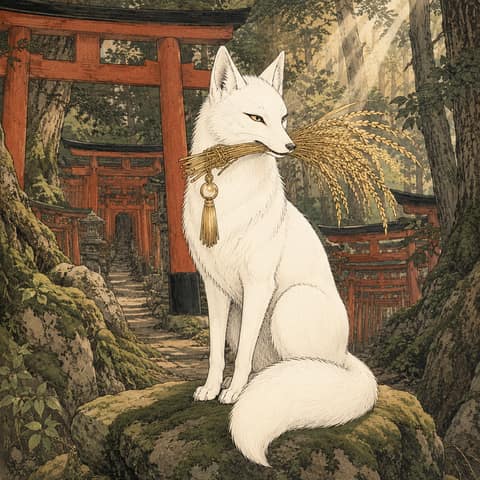
Myobu is the deified form of the white foxes serving as the familiars of Inari Okami, enshrined as "Myobu Tome-no-Kami" at Byakkosha, a subordinate shrine of Fushimi Inari Taisha. Unlike secular beliefs that worship foxes themselves as gods, the essence of Myobu lies in its reference to white foxes acting as divine messengers attending closely to the deity. "Myobu" is a title derived from the ranks of court ladies under the Ritsuryo system. Because they serve Inari Okami, who holds the Senior First Rank, the white foxes were likened to high-ranking court ladies of the imperial palace. The shrine building of Byakkosha, built during the Kan'ei era in the one-bay Kasuga-zukuri style with a cypress bark roof, is an Important Cultural Property. Initially called "Oku-no-Myobu" or "Myobusha," it is said in Harumitsu Harada's "Inari Jinja Engi" to enshrine Akomachi and Osusukiroku, originating from a court lady named Susumu Myobu. The statues of white foxes holding rice ears, scrolls, keys, and jewels in their mouths are an iconographic expression showing that Myobu is a pure divine messenger mediating the harvest of fields, words, storehouses, and treasures.

Myōtaraten

Myōtaraten

Epic

myoh-tah-rah-ten

Myōtaraten, Local Guardian Deity

Deities & Divine SpiritsShiga

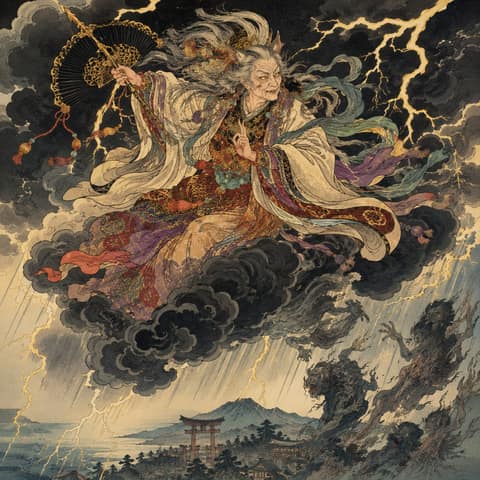
A compiled version of the Myōtaraten images rooted in local faiths of Echigo Yahiko and Okitama in Dewa. Their origin tales involve transformations of an old woman, an ogre, or a shapeshifting cat, whose ferocity is quelled when enshrined, after which they call rain and protect children and the virtuous as village guardian deities. Though bearing a Buddhist-style celestial name, the being is essentially a deified female presence embodying the numinous power of mountains and borders, centered on faith around Mount Yahiko and the Ichihon-yanagi wayside shrine. One tradition says thunder roars once a year when she returns to Sado, aligning agrarian views that link thunderstorms with harvests. Names and forms vary—old crone, celestial maiden, demoness—but the core is a turn toward benevolent protection.

Mōryō

Mōryō

Epic

MOH-ryoh

Mōryō (Classical Depiction)

Aquatic SpiritsUncertain (concept from ancient China, adopted in Japan)

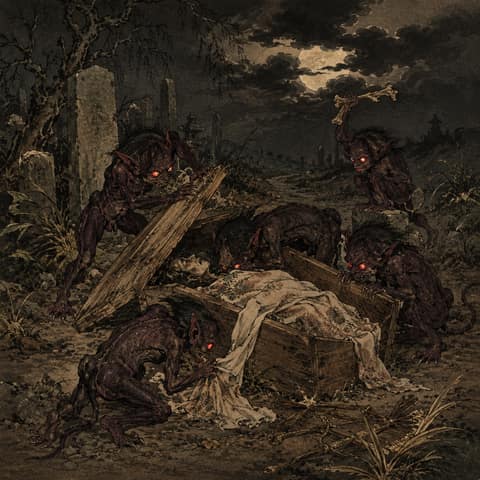
A generalized classical image of the mōryō based on historical sources. The term was used for uncanny phenomena tied to watersides, graveyards, ancient trees, and great stones, and is understood to be linked with disasters that defile corpses and the spread of death impurity. Its form is not fixed—some accounts call it childlike, others say it manifests only as a vapor or miasma. In Japan, the word came to denote corpse-stealing spirits and served to justify funerary taboos and rites of purification.

Nadezatō (the “Smoothing” Blind Monk)

Nadezatō (the “Smoothing” Blind Monk)

Rare

NAH-deh-zah-TOH

Iconography-Based Version

General ClassificationsYatsushiro, Kumamoto Prefecture (Matsui Collection)

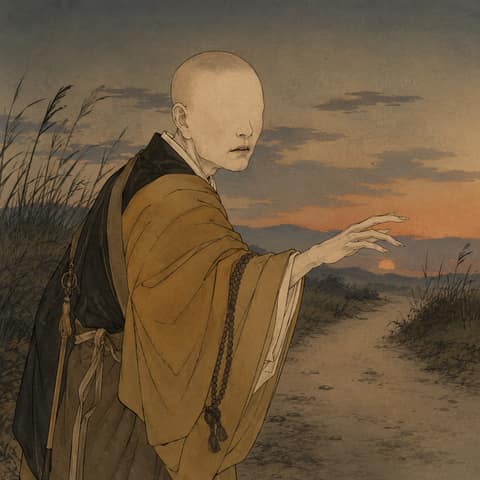
This version relies solely on images from picture scrolls with minimal notes. Nade-zato has a transmitted name and appearance, but the textual account is missing, so its nature and conduct cannot be fixed. The iconography shows a shaven-headed, blind masseur-like figure with eyes left undrawn; some depictions emphasize long fingers or claw-like hands. Related imagery includes an identical type titled “Mugan” (No-Eyes) in Edo-period Hyakki-zu, suggesting variant naming. Tada Katsumi notes that nade may connect to nademono, which transfers defilement by touch, and to an old byname for “cat,” hinting at a being that feigns meekness to hide its true nature; however, this is scholarly interpretation, not a firm local tradition. Accordingly, abilities, weaknesses, and habits are scarcely recorded and should be treated as unknown.

Namahage

Namahage

Legendary

Namahage

Namahage, the Visiting Deity of the New Year

Divine Spirits / DeitiesAkita

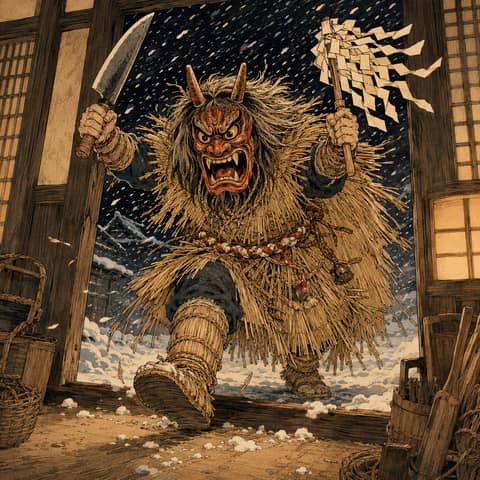
The true essence of the Namahage lies in "blessings through awe." The act of clashing knives and storming into a house with loud voices is meant to engrave a powerful admonition upon children and the lazy; the violence itself is not the goal. Through a dialogue with the head of the household, the Namahage extracts a promise of diligence for the coming year, exorcises misfortune, and departs. This series of rituals has functioned as a mechanism to spiritually brace the entire village at the turning of the year. The design and color of the masks, the movements, and the spoken lines differ from village to village. Some areas receive visits in pairs, while others have strict rules for the visiting order and the etiquette of the dialogue. The straw that falls from their kede garments is picked up as a lucky charm for good health, demonstrating how the folk tradition links the deity's visit to practical, worldly benefits in various locales. The core of the Namahage event is not merely fearing them as demons, but treating them as "guest deities" (marōdogami) complete with rituals of welcome and farewell.

Nekomata

Nekomata

Legendary

neh-koh-MAH-tah

Split-Tailed Old Cat Nekomata

Animal TransformationTochigi

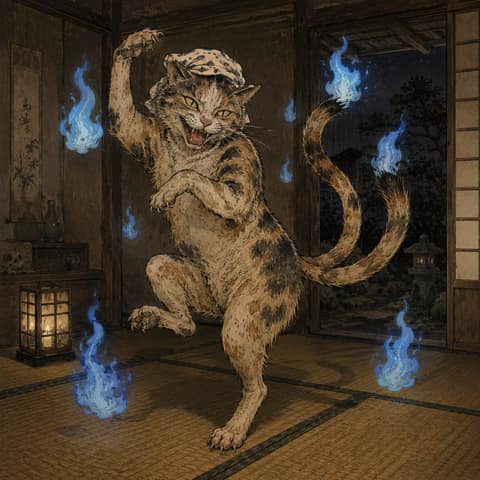
The form of a cat kept in a human home for many years, aging until its tail splits into two, thereby "ascending" to acquire the power to speak and manipulate ghostly flames. Discarding the "mountain beast" aspect spoken of for the species as a whole, this is an interpreted version that maximizes its nature as a "house yokai" (kayou) sharing living space with humans. In this version, the Nekomata is said to stand on its hind legs late at night, place a towel on its head, and dance wildly in the shadows of the hearth. This bizarre dance, originating from the depiction in Toriyama Sekien's "Gazu Hyakki Yagyo", added a somewhat comical and human-like charm to what was originally a terrifying monster cat legend. Furthermore, this Nekomata skillfully mimics the faces and voices of people to deceive family members. It often takes the form of an old woman, which is sometimes interpreted as a projection of the power and underlying intimidation of the matriarch who managed the household for years, superimposed onto the image of an old cat. The folklore presents a clear duality: if the homeowner treats the cat roughly or kills it unreasonably, it becomes a vindictive curse deity, setting ghostly fires (Nekomata fire) in the house and ruining the family lineage. On the other hand, a carefully cherished Nekomata uses its demonic powers to "protect the house." As depicted in works like Sawaki Suushi's "Hyakkai Zukan", there are benevolent tales of them shapeshifting into a shamisen-playing geisha to save a benefactor in a crisis, or using their demonic fire to intimidate and burn away other evil spirits or diseases (impurity) attempting to enter the home. To them, the split tail is not merely a sign of monstrosity; one tail serves as an antenna symbolizing "gratitude (or resentment) toward humans," and the other symbolizes "the demonic nature of a beast."

Nekomata

Nekomata

Legendary

neh-koh-MAH-tah

Hearth-Guarding Old Nekomata

Animal TransformationTochigi

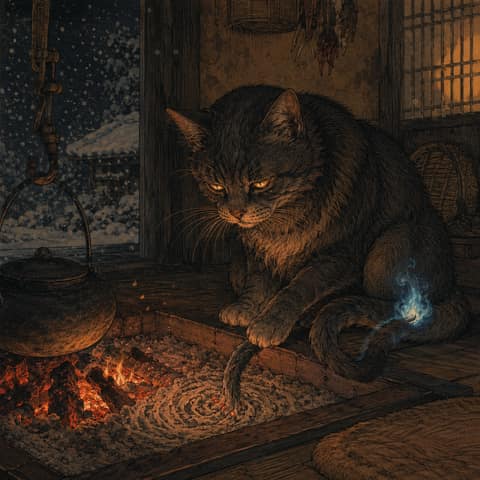
The Hearth-Guarding Old Nekomata is a version of a cat that has been kept in one place for many years, growing old by the hearth stained with soot and ash, until one night it suddenly manifests with a tail split in two. Positioned at the opposite extreme from the violent Nekomata that attacks humans in the mountains (as noted in texts like "Meigetsuki"), this being inhales the breath of the house and its generations of life, absorbing the spirit of fire and cooking smoke, and thus behaves much like a household deity (or Zashiki-warashi). While it is an extension of the folk belief that "a pet cat transforms" cited in "Tsurezuregusa", it carries a much more protective nature. Even without using human words, it signals by clinking the pot lid or drawing patterns in the ash. The pale ghostly fire (Nekomata fire) that darts in the corner of the parlor late at night is not a curse fire to be feared as in "Yamato Kaiiki", but is rather considered a purifying mark where this old Nekomata preemptively licks away the house's fire hazards and burns off evil energies. In some villages, it is believed that one tail connects "the lineage of the family" and the other "the divine spirit of fire," making the split not a mere deformity but a sacred sign holding dual duties. The Old Nekomata always draws near when the family gathers around a corpse. There is a common fear that cats resurrect the dead, often causing confusion with the Kasha (the monster cat depicted snatching corpses in works like "Gazu Hyakki Yagyo"). However, this version never causes a disturbance; it merely sniffs the ragged breath with its nose and lights a small spark to dispel lingering earthly attachments. Therefore, the proper etiquette is for the family not to brandish blades before the Nekomata, but instead to burn a single stick of incense as a "farewell fire." If a long-kept cat is treated roughly, the stove will burn empty in the dead of night, and overlapping wet footprints will appear on the walls. Conversely, in homes that mourn respectfully, folklore akin to the "urban legends" pointed out by Kunio Yanagita survives: on a snowy morning, only the space under the shoji is warm, and the shadows of mice vanish entirely from the rice bin. This version is sometimes spoken of as an old cat that once disappeared into the mountains returning out of longing for the house, or as an old indoor cat whose tail split naturally over time. The custom of cutting tails to prevent transformation (the origin of the bent-tail cat) also exists, but in areas protected by the hearth-guard, this is taboo, with strict warnings that "injuring the tail will also split the family's fortunes." In appearance, its back skin droops to look like a cloak, casting a shadow-like figure in dimly lit rooms. This is why it is mistakenly thought to shapeshift into the dead, but the Old Nekomata dislikes unnecessary transformation. When it occasionally borrows the appearance of a grandmother, it is only to lull a child to sleep, making no sound and leaving behind only the scent of soot and ash. Though it does not show itself to travelers, during milestones of the house—such as taking in a groom or the first night in a newly built home—it taps its claws lightly under the floorboards to foretell fortunes. Three taps mean good luck; two mean beware of fire. If the lamp wick is damp, it smoothes it with its tongue; if the stove fire is too strong, it fans it weaker with its tail. In exchange for taking on these small daily troubles, a custom remains for the family to share the "edges of the meal" with it. Three grains of rice, a pinch of salt, and a little steam. As long as these are observed, the Nekomata will not bewilder humans, and the strange noises at night will be dismissed as mere "house creaks."

Net-Cutter

Net-Cutter

Rare

AH-mee-kee-ree

Iconographic Standard, Traditional Interpretation

General ClassificationsJapanese folklore

An interpretation grounded in Sekien’s depiction, tempered by later commentaries that popularized the trait of cutting nets and mosquito screens. Concrete behaviors are sparsely recorded in local sources, and it is often understood as a personification of wear, tear, and fraying. It appears with a carapace-like body and large pincers, shows up at night, and quietly severs its target, with no clear evidence of direct harm to people.

Night Sparrow

Night Sparrow

Uncommon

YOH-soo-ZOO-meh

Night Sparrow (Tosa, Iyo, Kii Consolidated Tradition)

Animal ShapeshiftersKochi

The Night Sparrow is a nocturnal attendant yokai widely told of in the mountains of western Japan, marked by revealing itself through its call. In Tosa it is said to look like a small bird, in Kitagawa and Iyo like a moth or butterfly, and its appearance is not fixed. When someone walks alone, it alternates between the rear and the front, chirping close to the ear and throwing off the walker’s rhythm. In Toyama Village a banishing chant is preserved, and people are warned that rashly trying to catch it brings night blindness. In Wakayama, by contrast, it is taken as a sign that wolves are near and as a protective omen against mountain evils. Related tales include the “okuri-suzume” of Nara and Kii and the “tamutori-suzume” of Kochi and Ehime. In Tsunoyama and Johen they are treated as the same, and avoidance methods include gripping one’s sleeve, setting three twigs upright, or reciting specific mantras. Its folkloric traits are its ambiguous visual form, interference through sound, and regional differences in whether it is seen as ill or auspicious.

Nine-Tailed Fox

Nine-Tailed Fox

Legendary

Kyubi no Kitsune

White-Faced, Golden-Furred Nine-Tailed Fox

Animal shapeshifterKyotoTochigi

The "white-faced, golden-furred nine-tailed fox" is exactly what the name says: a fox-spirit with a white face, golden hair, and nine tails. Today it is almost automatically understood as Tamamo-no-Mae's true form, but that image did not appear fully formed. It grew from several lines that merged over time: the nine-tailed fox of Chinese classics, the tale of Daji becoming a nine-tailed fox, the Japanese Tamamo-no-Mae legend, and the Sesshoseki tradition of Nasu. The older nine-tailed fox was not necessarily evil. The Shan Hai Jing makes the Qingqiu fox a man-eating beast, yet the nine-tailed fox was also treated in ancient China as an auspicious creature, and Japan received the idea that the nine-tailed fox could be a sacred beast. Nine tails, in other words, did not originally mark simple wickedness. They marked the extremity of otherworldly power. That power might bless kingship or destroy it; the uneasiness lies in that doubleness. Nor was Tamamo-no-Mae always the white-faced, golden-furred nine-tailed fox. Shinmei-kyo records her name, and Tamamo no Soshi gives the story of a beauty serving Retired Emperor Toba who is exposed as a fox. But in the older form the fox has two tails. Terashima Shuichi's account stresses that almost four centuries of rewriting stand between that tale and the tight identification of Tamamo with the Nine-Tailed Fox. Without that gap, the history of the legend's remaking disappears. The decisive change was the joining of Daji's fox to Tamamo. The story that Daji, beloved of King Zhou of the Shang, became a nine-tailed fox was amplified through Chinese commentaries and fiction and reached Japan early. In the late Edo period, Japanese yomihon connected Daji, the Indian Kayo-fujin, and Tamamo-no-Mae as previous bodies and incarnations of one fox. Ehon Sangoku Yofuden was especially important: it made a single fox-spirit bewitch rulers in India, China, and Japan, and fixed Tamamo-no-Mae as the Japanese manifestation of the white-faced, golden-furred nine-tailed fox. The Sesshoseki gave the fox a story after death. In the noh play Sesshoseki, the stone is not merely poisonous rock but the dwelling place of a fox-spirit still bound by obsession. A monk breaks and pacifies the stone through ritual power, changing fox-slaying into an act of salvation. Nasu Town's official tradition likewise says that the stone is the transformed fox that flew from India and China, joining the legend to the sulfurous landscape Basho described in Oku no Hosomichi. Tamamo-no-Mae does not end when she is exposed at court. She remains in Nasu as stone. Painting and performance made this doubleness visible. After the 1751 puppet play Tamamo-no-Mae Asahi no Tamoto, Tamamo appeared repeatedly in joruri and kabuki as a role that was both peerless beauty and fox-spirit. In Utagawa Kuniyoshi's Abe Yasuchika Praying over Tamamo-no-Mae, nine beams of light open behind the beauty, placing courtly grace and vulpine truth in the same image. Mirrors, reflected water, halos that become tails: all are devices for showing that Tamamo is a being who can be seen through. The terror of the white-faced, golden-furred fox lies not in teeth or claws, but in the fact that she first appears as beauty and intellect. She knows Buddhist texts, Chinese classics, waka, and court music; she answers questions without hesitation and earns trust and affection. She does not invade from outside. She is invited into the center. For that reason, force alone cannot expose her. Divination, prayer, mirrors, water, and the stories that keep retelling her are what bring the hidden fox into sight. At the same time, she is not an entirely foreign enemy. She arises from the same fox imagination as Inari's white fox, the hierarchies of tenko and kuko, the tenderness of fox-wife stories, and the fear of fox possession. As Tamamo-no-Mae she may tilt royal power; as the Sesshoseki she leaves poison in the land. Yet people pacify her, enshrine her, paint her, perform her, and keep her in memory. The white-faced, golden-furred nine-tailed fox is not evil that has been erased. It is evil that remains speakable after defeat.

Ningyo

Ningyo

Rare

ningyo

The Water Yokai Evolving from Ancient to Modern Times

水の怪FukuiShiga

Iconographic Disconnect from Western Mermaids. The image of a Ningyo that modern Japanese people envision—a "beautiful female upper body and a fish lower body"—is a product of Western mermaid legends (such as Hans Christian Andersen's *The Little Mermaid*) being imported and taking root from the modern era onward. Prior to this, traditional Japanese Ningyo iconography, as depicted in texts like the *Kaikoku Heidan*, was exceedingly bizarre and grotesque: "a human-like (or monkey-like) face on a scale-covered fish body." The facial features were not necessarily those of a beautiful woman; they were generally depicted as terrifying men, women, young, or old, bearing sharp fangs. The sheer ugliness of this design emphasized the visceral reality of the Ningyo as a "creature from the Other World" and the taboo, grotesque nature of the act of eating its flesh. Biological Models and the Natural History Perspective. The core of Japanese Ningyo folklore is believed to contain no small amount of misidentification of actual biological creatures. For example, a prevalent theory suggests that sirenians like dugongs and manatees, or pinnipeds like sea lions and seals, served as the models for the Umibozu and Ningyo. Additionally, in inland (river or swamp) Ningyo legends, there are cases where the true identity is speculated to have been the Japanese giant salamander. Edo period herbalists (Honzogakusha) meticulously collected and classified records of these unknown marine creatures washing ashore, attempting to re-examine yokai through the lens of "science" (natural history). The Curse of "Eternal Life". The "eternal youth and longevity" brought about by Ningyo meat is a universal human desire, yet in Japanese folklore, it is always depicted as two sides of the same coin alongside "tragedy." As the legend of Yao-bikuni demonstrates, one who obtains eternal youth by eating Ningyo meat must repeatedly watch their beloved family members and husbands age and die, forcing them to experience unbearable loneliness and despair (temporal isolation). The Ningyo is a yokai that acts as a cruel mirror, thrusting the "terror of escaping death" directly in humanity's face.

Noppera-bo

Noppera-bo

Epic

nopperabo

The Faceless Anomaly of Kii-no-kuni-zaka

Humanoid/Half-Human YokaiTokyo

In this version, we interpret the Noppera-bo as a "mujina-type ghost story of facial erasure." The reason Lafcadio Hearn's "Mujina" is so powerful is that it doesn't end with merely showing the faceless woman; it has the man at the soba stand—the supposed sanctuary—perform the exact same action. The first encounter is an anomaly of the dark road; the second encounter is an anomaly where the very systems of everyday life collapse. Despite moving from the dark slope to the illuminated street stall, the horror draws closer, turning the very person one is conversing with into a blank void. The terror of this ghost story is rooted not in the physical design of the face, but in the "failure of confirmation." The man attempts to confirm that the crying woman is human, and fails. He then attempts to confirm that the soba stand is a safe human society, and fails again. The Noppera-bo does not physically attack, but it shatters the viewer's judgment process twice. The face is a screen for reading identity, emotion, and the presence or absence of hostility; when it vanishes completely, a person is left paralyzed, unable to know how to interact with the other. The connection to the "mujina" is the deep focus of this version. Hearn's title was "Mujina," and the name "Noppera-bo" was strongly foregrounded by later adaptations. In folklore, mujina, tanuki, and foxes are shape-shifting beasts that frequently interchange, frightening humans while keeping their true identities ambiguous. By maintaining this ambiguity, the Noppera-bo emerges not as a "person without a face," but as "something disguised as what appears to be a person." Precisely because its true identity remains unknown, the terror cannot be cleanly resolved through explanation. The illustrated Noppera-bo condensed the ambiguity of folklore into a single, powerful image. In Shigeru Mizuki's yokai encyclopedias, the outline of a faceless humanoid became so distinct that readers now immediately picture a smooth visage just by hearing the name. Yet behind this clear iconography lies an inherent obscurity: "we don't know whose face it is" and "we don't know what is shape-shifting." It is visually simple, but narratively, it is doubly unstable. While this version of the Noppera-bo lacks direct lethal force, it robs the victim of the ability to "read" the other. If fear arises from "finding a dangerous enemy," the Noppera-bo conversely creates a state where one "cannot even determine if it is an enemy." With a faceless entity, one cannot tell if it is angry or smiling, looking at them or turning away. The white blankness left behind is both the face of the anomaly and an empty canvas reflecting the viewer's own profound anxiety. What is crucial in this version is that the Noppera-bo performs an "erasure of identity," not just a "lack of expression." If it were an angry or smiling face, one could still read the emotion. But without eyes, nose, or mouth, the clues of age, gender, gaze, feeling, and even the possibility of speech are all eradicated. Because every cue for treating the entity as human vanishes, the viewer is stranded, unable to decide whether they are facing a person, an object, or a monster. Furthermore, by having the soba shopkeeper reveal the same face, the anomaly gains multiplicity. The victim doesn't feel they have escaped a single monster; instead, it feels as if the rules of the world itself have shifted to ones where faces can simply be erased. Herein lies the modern terror of the Noppera-bo tale. What has lost its face is not just the woman or the shopkeeper, but the very mechanism by which humans confirm one another's existence.

Nue

Nue

Legendary

NOO-eh

The Beast Shot Down by Minamoto no Yorimasa, Nue

Animal ShapeshifterKyotoOsaka

This is the interpretation of the chimera clad in black clouds, shot down by Minamoto no Yorimasa. In this version, the Nue is not simply a physical beast of prey; it functions as a kind of "sorcerous cyborg," the incarnate coagulation of the "indefinable anxiety" and "political pathology" that gripped the aristocratic society of its time. From the perspective of modern yōkai studies and Onmyōdō (the Way of Yin and Yang), the animals comprising the Nue are said to symbolize the "four corners (boundaries)" in the directional system of the Chinese zodiac. Specifically, the monkey represents the "Southwest (Hitsujisaru)," the tiger represents the demon gate of the "Northeast (Ushitora)," and the snake represents the "Southeast (Tatsumi)." While the cardinal directions represent a world of stable order, the four corners are considered unstable boundaries leading to the otherworld. The Nue is the embodiment of chaos, a patchwork assembled from the "outside of order." Even more fascinating is that the beasts corresponding to the final direction, the "Northwest (Inui)"—namely, the "boar (Inoshishi)" and the "dog (Inu)"—are absent from the creature's physical body. However, in the *Tale of the Heike*, the retainer who rushed to the Nue shot down by Yorimasa and thrust the finishing blade into it was named "Ino Hayata" (whose name contains the character for boar). Some interpret this as an exceptionally exquisite symbolism: it is only through the addition of the missing final direction (the boar) that the sorcerous spatial construct of the Nue is completed and thereby annihilated. The means by which the Nue plunged the Emperor into sickness was not direct violence, but rather the pollution of "ki" (life force) caused by its scream-like "hyo-hyo" cries and the visual pressure of the black clouds. The Nue is essentially one of Japan's greatest political monsters—a manifestation of the waning royal authority and the turbulent atmosphere of the late Heian period, an era when the samurai rose to power and the world of the aristocracy began to crumble, taking the physical form of a "synthetic beast."

Nuppefuhofu

Nuppefuhofu

Epic

NOOP-peh-FOH-hoh-foo

Traditional Image (E-maki Source Fidelity)

General ClassificationsJapanese folklore

A typical form based on Edo-period yokai picture scrolls. A one-head-tall, white, wrinkled mass stands upright with stumpy limbs and indistinct facial features. Only its name and image are preserved, so its behavior and intent are unsettled. In texts it is sometimes read as a prototypical faceless ghost (nopperabo), or noted as a transformation of an old toad or of foxes and raccoon dogs. Satirical books mention it “drinking the fat of the dead” or “disguising itself as a doctor,” but a broad regional tradition is hard to confirm. Claims of temple hauntings or a corpse-like stench likely stem from later interpretations, and firsthand accounts are limited. Its look is marked by powdery white skin and continuous folds of wrinkles.

Showing 265 - 288 of 480 yokai