🏛️ Traditional Yokai Encyclopedia

Yokai passed down through the ages

391 Yokai|12 Category|Page 11 of 17
Localization in Progress - More content available in Japanese version
View Japanese
伝説
Shiramine Sagamibō

Shiramine Sagamibō

Shiramine Sagamibō

The Tengu Who Guards the Mausoleum of Sutoku — Shiramine Sagamibō

Mountain & Wilderness Spirits
Shiramine, Sanuki Province (Sakaide, Kagawa)

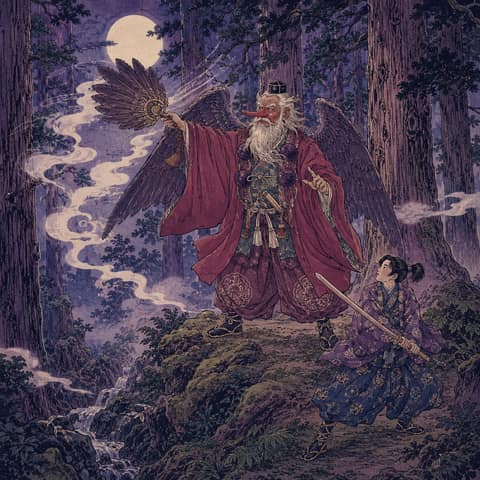
Shiramine Sagamibō is, among the Eight Great Tengu, the tengu most firmly bound to a single person—the Retired Emperor Sutoku. His image cannot stand apart from the story of Sutoku's vengeful spirit. The Retired Emperor Sutoku, defeated in the Hōgen Rebellion (1156), was exiled to Sanuki and died in the second year of Chōkan (1164) without ever being permitted to return to the capital. At his place of exile he copied out the five Mahāyāna sutras and sent them to the capital, but, suspected of a curse, had them flung back at him; in fury he swore an oath written in blood and is said to have become, while still living, a great tengu and a great demon (daimaen). Sagamibō guards the Shiramine mausoleum of this Sutoku, whom Yoritomo called "the greatest tengu in Japan." Shiramine-ji is the eighty-first station of the eighty-eight temples of Shikoku, the Shiramine mausoleum is the only imperial tomb in Shikoku, and beside it stands the Tonshō-ji-den, which enshrines the spirit of Sutoku-in. It was literature that made Sagamibō immortal. Its original source is the mid-Kamakura Senjūshō, attributed to Saigyō, whose "On the New Retired Emperor's Tomb at Shiramine" carries a tale of Saigyō mourning Sutoku's tomb at Shiramine. The Noh play Matsuyama Tengu, which dramatized it, takes Sutoku-in as the shite and Saigyō as the waki, and depicts Sagamibō as a tengu attending Sutoku. Further, the "Shiramine" of Ueda Akinari's Ugetsu Monogatari is a story in which Saigyō mourns Sutoku's spirit at the Shiramine mausoleum and converses with the wrathful Sutoku-in; Sagamibō became the being running through this lineage since the Senjūshō. The vengeful spirit and the tengu who stays beside it—the relation of Sutoku and Sagamibō is a rare point where the faith in goryō (vengeful spirits) and the faith in tengu meet. There are two theories on Sagamibō's origin: that it derives from Sagami Ajari Shōson, who sided with Sutoku in the Hōgen Monogatari, and that he was a tengu who came from Mt. Ōyama in Sagami. The latter forms a pair with the seat-transfer tradition arranged by Chigiri Kōsai—that the Sagamibō of Ōyama, in devotion to Sutoku, removed to Sanuki, and Hōkibō entered the vacant Sagami Ōyama. Either way, Shiramine Sagamibō sits at the western end of the Eight Great Tengu, transmitted at Shiramine in Sanuki as the tengu who keeps guarding the soul of Sutoku, one of Japan's three great vengeful spirits.

神格
Hakutaku (White Marsh)

Hakutaku (White Marsh)

hah-koo-TAH-koo

Iconographic Tradition Conformant

Deities & Divine Spirits
Introduced from China (widely circulated across Japan as apotropaic images)

The image of the Hakutaku varies across eras and texts. In the Sancai Tuhui and the Wakan Sansai Zue it appears as a white lion-like auspicious beast symbolizing lucid and orderly governance. Edo painter Toriyama Sekien employed multi-eyed motifs, adding an eye on the brow to heighten its power to perceive calamities, though older depictions sometimes show only two eyes. Prints of the Hakutaku served as apotropaic images posted on doors or carried as charms, invoked for protection during travel and epidemics. The design also appeared on imperial procession flags and on temple and shrine door panels as talismanic emblems of authority and sanctity, examples of which can be seen at the shrines and temples of Nikkō in Japan. The tradition is sometimes read as a personification of ethics and disaster lore, venerated as a being that classifies anomalies and teaches countermeasures.

名妖
Shirōneri

Shirōneri

shee-ROH-neh-ree

Based on Sekien’s Illustrations

Animated Objects & Undead
Japanese folklore

Anchored in Toriyama Sekien’s imagery, this version sees an aged dishcloth trailing long and fluttering in the wind, reimagined as a yokai. The original illustration offers little about harming humans, so it is understood as a symbol of attachment to old objects and the impermanence of things. Aggressive traits found in later ghost tales should be kept separate; here the focus is the eerie nature of a “moving old cloth” and the visual impression of it gliding between walls under a night lamp.

名妖
Powdered-Hag

Powdered-Hag

oh-shee-ROH-ee bah-BAH

Powder-Faced Hag of the Snowy Night

Half-Human Beings
Snowbound northern regions of Japan (exact distribution uncertain)

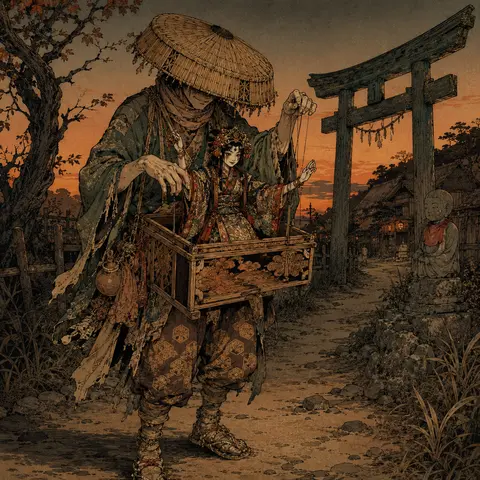
On snowy nights she appears at the door, face pale as if dusted with powder, wearing a torn straw hat and carrying a sake flask. She asks for sake or sweet sake, thanks the giver even for a small portion, and leaves. If refused, she troubles the household with knocking and calls. She blends the idea of a winter visiting deity with eerie folktales, remembered as a figure embodying customs of sharing and proper hospitality.

神格
Byakko (White Tiger)

Byakko (White Tiger)

Byakko

Byakko, the White Tiger, Guardian of the West

Animal Transformations
China (guardian of the west among the Four Symbols; depicted in the Kitora Tomb and elsewhere)

Byakko is the divine beast of the west, Metal, and autumn, spoken of as forming a pair with the Azure Dragon of the east. This edition traces its astronomical origin and the paired structure with Seiryū. Its origin is in the stars of heaven. The chain of the seven western mansions (Legs, Bond, Stomach, Hairy Head, Net, Turtle Beak, Three Stars) likened to the form of a tiger is Byakko. The Huainanzi's "Treatise on the Patterns of Heaven" makes the emperor of the west Shaohao and its beast the White Tiger, assigning it to Metal, autumn, and white. The western palace of heaven in the Records of the Grand Historian' "Treatise on the Celestial Offices" stands in the same system. The form of a fierce white-furred tiger figures the white of the Metal phase, corresponding to the western sky of autumn, which bears the air of ripening and harvest, and of withering severity. The pairing of Byakko and Seiryū is old. That the early Warring States lacquer garment chest from the tomb of Marquis Yi of Zeng (c. 433 BCE) draws the azure dragon and the white tiger to left and right alongside the names of the twenty-eight mansions shows that the composition of the Four Symbols, setting east (Seiryū) and west (Byakko) face to face, was already established twenty-four centuries ago. In Japan, Byakko was received as a marker of directional protection and of wards. In the Four Symbols' banners of the first year of Taihō (701) in the Shoku Nihongi, Byakko was set to the west (right). Though native tales are scarce, within the geomantic reading of land matching the Four Symbols it was made the guard of the west, and in iconography the White Tiger facing the Azure Dragon still remains on the western wall of the Kitora Tomb. The dragon of the east and the tiger of the west—this symmetry is the very skeleton of the system of the Four Symbols.

稀少
Momonji (the Hundred-Old Man)

Momonji (the Hundred-Old Man)

MOH-mohn-jee

Iconographic and Textual Standard (Sekien Line)

Mountain & Wilderness Spirits
Uncertain; depicted in Edo-period picture scrolls

Based on Toriyama Sekien’s image and notes, this version frames the entity as an old man–shaped specter appearing on open fields at midnight. Its name is taken as a blended form of child language like “momon-ga” and “gagoji,” embodying generalized fear of monsters. The belief that witnesses fall ill aligns with older notions that contact with the uncanny brings impurity and sickness, with no concrete acts of harm described. Early modern taboos against eating game and the euphemism “momonjii” may have encouraged its visualization through name association. Later readings place it as dwelling in mountains yet appearing at street corners to startle people, or as the city-going form of the nobusuma, but primary tradition is scant and no broad folktale type is attested. Accordingly, this version treats specifics as unclear, emphasizing its scenic traits—encounters on nighttime fields, fog, and wind—and its feared power to bring illness.

名妖
Dodomeki

Dodomeki

DOH-doh-MEH-kee

Sekien Iconography Standard

Half-Human Beings
Edo period

Following Toriyama Sekien’s note, this version centers on a moralizing motif warning against theft. The many eyes along the arm relate to a pun likening the holes of copper coins to birds’ eyes, externalizing the habit of hands reaching to steal. The source Sekien cites, “Kankangai-shi,” is of uncertain reality; his wordplay on Hakone as a boundary and his own remark calling it a curious book suggest the citation itself is part of the artistic conceit. The Dodomeki’s image concentrates on a female form, yet no concrete personal names, family lines, or local legends are preserved, pointing to an urban allegory where image and wordplay outweigh regional lore. Postwar explanations vary in reading and interpretation, but the archetype is traced to Sekien’s original.

稀少
Hyakume (Hundred-Eyed Demon)

Hyakume (Hundred-Eyed Demon)

HYAH-koo-meh

Iconographic Origin, Modern Interpretation

Half-Human Beings
Japanese folklore

Rooted in multi-eyed demon images circulated from late Edo to Meiji, this form was given traits by modern yokai compendia. It shuns bright light and hides in night’s cover, avoiding notice. When it senses people, it is said to detach a single eye to probe its surroundings, while the indeterminate mouth only heightens its eeriness. With no fixed locale of tradition, it is treated as a conceptual being known nationwide through the spread of its imagery.

名妖
Mokumokuren

Mokumokuren

MOH-koo-moh-koo-REN

Toriyama Sekien Zue–Conformant Edition

Household Spirits
Japanese folklore

Reconstructed from Toriyama Sekien’s imagery and captions as a swarm of disembodied eyes gathering on the shoji of a ruined dwelling. Rather than inflicting direct harm, it unsettles by staring. It is mediated by domestic neglect and unappeased sentiments, yet belongs to a generalized lineage of house-haunts not tied to specific individuals or locales. This reading also aligns with later variations in collected names and with links to visual illusion phenomena.

稀少
Eye Standoff

Eye Standoff

MEH-koo-RAH-beh

Sekien Iconography Standard

Ghosts & Spirits
Settsu Province (Fukuhara)

An image systematized from Toriyama Sekien’s iconography and the Heike Monogatari’s accounts of the uncanny. Multitudes of bones unite into a single giant skull, its countless sockets facing the living as if to pierce them. Individual dead bear no names; their fused gaze is read as a trial of the powerful. It appears most at daybreak or in hushed gardens, amplifying fear through sheer visual pressure. The countermeasure is to hold steady and return its gaze. Ritual banishments are poorly attested, and some speak of it as a kind of psychic vision. Said to be memory given form from mass deaths in war and upheaval, its size shifts with the onlooker’s nerve.

稀少
Spirit of the Inkstone

Spirit of the Inkstone

sue-ZOO-ree no tah-mah-SHEE

Stationery Spirit of the Inkstone

Animated Objects & Undead
Shimonoseki, Yamaguchi Prefecture (Akamagaseki)

An interpretation based on Sekien’s illustration and accompanying text. The Akamagaseki stone inkstone is famed as a choice scholar’s tool and is linked to memories of the Heike clan’s fall. When one immerses oneself in reading or copying texts, the inkstone’s surface opens like a seashore, upon which minute warriors appear to wage battle. This likens the inkstone to a “sea,” where the pooled ink becomes an ocean that bears up the echoes of history, a gesture of literati imagination. Later yokai commentaries sometimes add that using this inkstone sharpens brushwork, or that wave-sounds and murmurings can be heard, yet the core lies in Sekien’s note and the vision, seen in Xu Xuan–style tales, of tiny soldier hosts upon a desk implement. As a tsukumogami, a long-used inkstone accrues numinous power and, mediating between its owner’s reading life and the land’s memory, reveals scenes of the past.

名妖
Iso-onna (Shore Woman)

Iso-onna (Shore Woman)

EE-soh-OHN-nah

Toma-Shunning Nure-Onna

Aquatic Spirits
Coastal Kyushu (Nagasaki, Kumamoto, Fukuoka)

Among the coastal Nure-onna of northwestern Kyushu, a variant that particularly despises the handling of reed mats and thatch is called the Toma-Shunning Nure-Onna. On windless nights she appears on the beach without leaving footprints, a young woman from the waist up with black hair slicked by brine, shell-pale skin holding the moon, and eyes that reflect the distant whitecaps offshore. Below the waist she is indistinct like sea-mist, and if trod upon there is only sand with no true form. From behind she bears a jagged, craglike shadow like a collapsed rock face, and if one’s gaze falters she seems nothing more than a shore rock. Drawn by the hush of a calm, she stares seaward; if her name is called or a careless voice is thrown at her back, she answers with a shrill cry. The scream overlaps the roar of the tide and cuts the ears, her loosened hair stretching like wet seaweed to entangle the caller. Each briny strand bites the skin like the barb of a fishhook and is said to draw up warm blood along the hair. Yet if three old thatch stems from a reed mat are placed over the chest not as a cross but in the shape of the character for river, her hair recoils from the thatch, and she cannot step on the edge of the mat, only drip seawater in frustration from the gunwale. She favors boarding boats by their stern line; if a stranger’s harbor leaves the stern line set, at midnight she will crawl up it, slip in over the rail, and drape her hair over sleepers’ faces to steal their breath. Thus old fishermen followed the rule of taking in the stern line when calling at a port, dropping only the anchor and keeping watch at the bow while reading the wind. She is susceptible to the human-made ideas of knots and naming in ropes; if the rope is cinched hard while whispering the owner’s name three times, she cannot unravel that name and cannot travel along the line. Though drawn by the grudges of the drowned, she does not harm indiscriminately. When she sees discarded reed mats or thatch, or cut ropes drifting in the tide, she scents the neglect of the hands that wove them and approaches their owner’s boat. Conversely, those who dry nets and mats without letting the ends trail into the sea or blocking the tide’s path may find her invisible presence come near and, by the creak of moorings, warn of a calm about to break, old skippers say. In parts of the Fukuoka coast, it is said she walks the water not for lack of feet, but because she avoids reed mats, stepping only on the thinnest skin of the waves. Northern Kyushu has a crab-incarnation theory, but this Nure-Onna does not hate crabs; rather, when shore crabs scuttle, she draws in her hair and returns to rock. Her name varies by place—Iso-Onna, Nure-Onna, Sea Princess—but her ties to the etiquette of thatch and rope are constant. To avoid her: do not call to a woman’s back on a night beach, do not leave a stern line fast in unfamiliar ports, and place three thatch stems in a river shape where you sleep. Keep these and she will only turn her white offshore eyes toward you, then blend into rock-shadow and unravel into the tide mist, leaving only her presence to be told as footprints that were never there by morning.

名妖
Iso-onna (Shore Woman)

Iso-onna (Shore Woman)

EE-soh-OHN-nah

Isonna of the Aft-Rope Crossing

Aquatic Spirits
Coastal Kyushu (Nagasaki, Kumamoto, Fukuoka)

A feared variant along Amakusa and the Shimabara Peninsula, named for slipping aboard by following the aft mooring rope. She appears as the upper body of a young woman scented with the sea, while her lower half is hazy and shifting like wave-shadows. Her long wet black hair constantly streams from her chest to the floor, branching into fine threads that cling to human skin. When a hush falls over the harbor at midnight, she stands in the lee of the shore or at a stern’s tip staring seaward, and will either echo the name of anyone who calls to her or answer with a piercing scream. At that cry she reaches a white hand to the aft rope, crosses soundlessly onto the boat, shrouds a sleeper’s face with her hair, and twists up blood strand by strand. By morning only a tide stain and a thin ring of hair remain at the pillow. Said to be the shape taken by the regrets of the drowned or a love unfulfilled by one who waited at the harbor, she is known as an isonna and also as nure-onna. The practice of avoiding the aft rope comes from this variant’s habit of treating ropes as roads. So long as she touches a line she can climb anywhere, but she does not swim about recklessly and prefers calm surfaces. On thin-moon nights some have seen her walk the water from shore, but only when the harbor tide lies asleep. She is weakened by light and prayer, so fishermen in unfamiliar ports avoid taking the aft rope, drop only the anchor, and keep the gunwale light burning. In Shimabara it is said that placing three dry thatch reeds from a roof upon one’s kimono while sleeping prevents tangling and wards her off. Those who touch her hair are seized by chill and lethargy, and the roar of the sea lingers in their ears for days. She is merciless toward mockery and rudeness, targeting first those who call her name without honorifics or taunt her with whistles. Conversely, she is said to avoid boats whose crews offer prayers for the lost at sea. Some tales claim that if you move behind her she resembles a rock shadow, and under moonlight her back becomes the outline of a wet reefs tone to let waves pass. The Isonna of the Aft-Rope Crossing is a grudge born at the liminal space of the harbor, hard to approach for those who keep the code and unforgiving toward arrogance, dropping her hair without mercy.

名妖
Isonade

Isonade

EE-soh-NAH-deh

Iso-nade (Traditional Accounts)

Aquatic Spirits
Off the coast of western Japan, notably around Hizen-Matsuura

A consolidated portrayal of the Iso-nade based on Edo-period strange tales and materia medica notes. It approaches without ruffling the sea’s surface, signaling itself only through shifts in sea color and wind. Its body is shark-like, said to bear coarse protrusions and needle-like organs from tail to back. It most often appears in seasons of cutting cold winds and was especially feared on days of strong northerlies. Seafarers avoided boisterous work, stowed nets and ropes, and kept away from the rail—customs passed down as seamanship to prevent disaster. Names and details vary by region, but the core remains an unseen approach that is noticed too late and the terror of being swept overboard by a single strike of the tail. Early modern records also frame it as a narrative of maritime hazard awareness and caution.

珍しい
Shrine Princess

Shrine Princess

JEEN-jah-HEH-meh

Traditional Lore Version (Hizen, Bunsei Appearance)

Aquatic Spirits
Hizen Province (modern Nagasaki and Saga Prefectures)

An image based on a block-printed text copied in Kato Hekioan’s Warekoromo. It bears a human face, two horns, a crimson belly, and a triple-sword tail, and is said to have appeared as a messenger from the Dragon Palace to foretell abundance and the spread of disease. Copies of its likeness were promoted as amulets for averting calamity and prolonging life when pasted on doorways or viewed in devotion, leading to widespread circulation of the image. Parallels from Hirado’s “Himeuo” and cases in Echigo show close similarities in iconography and captions, marking a nexus of popular epidemic countermeasures, folk practice, and print distribution. Some propose origins in specific animals, but no proof exists; folklorically it functions alongside prophetic beasts like Amabie and Amabiko.

稀少
Zen-Gama-no-Shō (Zen Kettle Monk)

Zen-Gama-no-Shō (Zen Kettle Monk)

ZEN-gah-mah-noh SHOH

Iconographic Tradition: Tsukumogami Kettle

Animated Objects & Undead
Japanese folklore

Based on examples by Toriyama Sekien, this image depicts an aged tea kettle manifesting with spiritual authority. Its posture and arrangement inherit compositional methods akin to the Night Parade of One Hundred Demons scrolls, often shown marching alongside Torakakushi and Yarinaga. The name plays on the kinship between chanoyu and Zen, hinting at a caricature of a Buddhist priest. By the logic of mononari, tools long used or neglected accrue ki, appear before people, and inspire awe. Meiji painters continued this iconographic lineage, and yokai catalogues and dictionaries classify it as a type of tsukumogami, though specific local legends are scant. Later commentaries add anecdotes of startling humans, but early records offer little confirmation, so it is understood chiefly through its iconographic tradition.

珍しい
Kūko (Sky Fox)

Kūko (Sky Fox)

kū-ko

The Kūko — High Fox Just Below the Tenko

Animal Shapeshifters
Throughout Japan (a high-ranking fox, just below the Tenko)

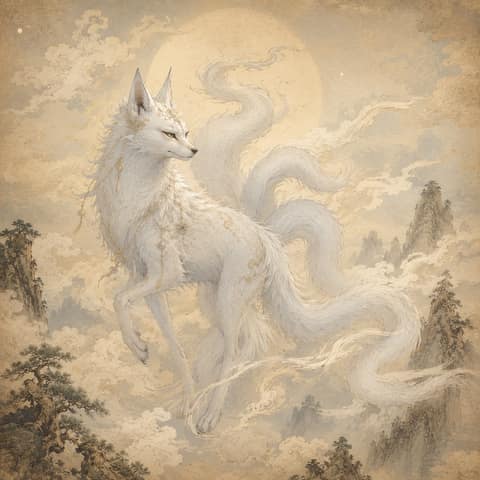
This version looks a little more closely at what kind of being the Kūko actually is. In the Edo-period ranking of foxes, only the lowest, the Yako, was thought to possess a visible body of flesh; from the Kiko upward, foxes were believed to become formless spiritual beings. Because the Kūko ranks just below the Tenko, its shape as an ordinary beast has lost almost all meaning, and it manifests instead as a presence or an influence. By its very nature it differs from the Yako, which stands before people’s eyes to deceive them. A high-ranking fox is closer to one that protects and guides than to one that harms. Overlapping with the lineage of white foxes regarded as messengers of Inari, the Kūko and Tenko were revered in the world of belief as wise foxes that serve the gods. The reason the Kūko so rarely causes any concrete incident is not weakness but that it has long since outgrown the stage of meddling with people out of vanity. Even so, because it wields immense supernatural power, it was thought that to slight it might invite calamity. Gentle toward those who revere it, showing a glimpse of its power only before the arrogant, the Kūko has been spoken of as a mature fox that knows exactly the right distance to keep from human beings.

珍しい
Smiling Hannya

Smiling Hannya

wah-RAH-ee HAHN-nyah

Edo Painting Traditions Edition

Demons & Giants
Shinano Province (Higashichikuma District, Nagano Prefecture), and elsewhere

An edition distilled from late Edo-period ukiyo-e and comic prints depicting the smiling Hannya. Horns, fangs, bristling hair, wide staring eyes, and a strained grin form its core. Objects in its hands often allude to life and death, unsettling viewers with deliberate motifs. The demon-woman is understood to have once been human, transformed by accumulated jealousy, resentment, and attachment, aligning with the concept behind the Hannya mask. Specific local legends are sparse, yet it was treated in night-time tales and picture books as a symbol of fear and admonition, preserved as an image of the extreme of a woman’s grudge. In local oral tradition sometimes only the name remains, with the transmission of its form relying mainly on pictorial sources.

名妖
Broom Spirit (Hōkigami)

Broom Spirit (Hōkigami)

HOH-kee-gah-mee

Folk Belief Version – Broom Deity

Deities & Divine Spirits
Various regions across Japan

Emphasizing the household cult image of the broom deity, this spirit uses the broom as a sacred vessel to govern domestic purity and the safety of childbirth. Sweeping is seen as a rite of purification that orders boundaries and drives out misfortune and impurity, while the power to gather scattered things back together also symbolizes recalling souls and inviting good fortune. At life’s turning points—New Year, moving house, pregnancy and postpartum—people renew the broom and dispose of the old one with thanks. Mistreating a broom is taboo, and stepping over it, treading on it, or leaving it upside down is inauspicious. Yet the upside-down broom can be used deliberately as a charm to gently send lingering guests home. In art, Toriyama Sekien depicts it as a tsukumogami in Hyakki Tsurezure Bukuro, but in folk practice it is revered as a divine presence dwelling in the tool, a household deity, both practical implement and object of faith. Regional details vary, but it is understood as a local guardian of cleansing and boundaries.

珍しい
Borrowed Sieve Hag

Borrowed Sieve Hag

mee-KAH-ree bah-BAH

Lore-Faithful Edition

Mountain & Wilderness Spirits
Kantō region (Kanagawa, Chiba, Tokyo)

A整理 of the Mikari-bā (Mikakari-bā) yokai as preserved in folklore. She appears on Koto-yōka (the eighth days of the month) as a one-eyed crone, enforcing restraint on housework and outings. Her act of “borrowing” winnowing baskets and human eyes links to avoidance of mesh-patterned tools and symbols with many eyes, giving rise to countermeasures like placing baskets or sieves at the gate, or fixing a mesh basket to a pole on the roof ridge. In the Kōhoku, Yokohama accounts, her greed extends to gleaning even fallen ears of grain, and depictions of her carrying fire in her mouth serve as a caution against conflagration. In southern Chiba, customs of taboo and house-seclusion called “Mikari” (body-substitution) recast pre-festival liminality as a yokai rule. Despite regional variation, these tales share a framework that transmits norms of household safety, fire prevention, and labor abstinence at seasonal thresholds from winter to spring. Creative embellishments are set aside in favor of points attested in Kanto eyewitness reports and folklore records.

珍しい
Shōrōkaze (Spirit-Wind)

Shōrōkaze (Spirit-Wind)

SHOH-roh-kah-zeh

Spirit Wind (Folkloric Version)

Weather & Calamity Spirits
Goto region, Nagasaki Prefecture

Spirit Wind is spoken of as an invisible wind that brings sudden chills, fever, and lightheadedness to those it touches. Its timing on the morning of the sixteenth day of Bon is emphasized, and the “spirits” here are the souls of ancestors or the unconnected dead. The wind is understood as carrying the aura of spirits crossing the boundary between return and departure. In the Goto Islands, people strictly avoid graves and grave roads on that day and refrain from going out. On Iki Island, illness is seen as a possessing wind, with graveyard-origin termed dead-spirit wind and grievance-origin termed living-spirit wind. It aligns with regional beliefs in malign winds, where seasonal fatigue and sudden gusts intersect with folk explanations and are remembered as spirit afflictions. It is not told as a yokai with active malice, but as a taboo that warns of misfortune for those who mistake the date or place.

珍しい
Thread-Spinning Maiden

Thread-Spinning Maiden

EE-toh-hee-kee MOO-soo-meh

Traditional Account

Mountain & Wilderness Spirits
Horie Village, Itano District, Awa Province (modern Naruto City, Tokushima Prefecture)

Based on records from Horie Village in Awa Province, this version organizes the image of the Itobiki-Musume as a young woman operating a spinning wheel by the roadside. The moment someone looks her way, she transforms into an old crone and bursts into loud laughter. No harm beyond revealing her true form is reported, and she neither touches nor pursues people. Stories most often place her from dusk to midnight in spots where foot traffic thins—village outskirts, field paths, and crossroads. Folklorically she belongs to roadside怪異 tales, told as a warning not to be deceived by looks and not to dawdle off one’s route. The trigger for the change is acts like “staring” or “approaching,” and the silent switch to an old-woman figure is the core of the fright. The spinning wheel is an everyday tool, and her realistic working motions heighten the uncanny shock of a chance encounter. Parallels exist outside the region, but the named example from Awa is the best known.

珍しい
Momijigari (The Demon of the Maple Viewing)

Momijigari (The Demon of the Maple Viewing)

moh-MEE-jee-GAH-ree

Demoness Momiji (Performing Arts Tradition)

鬼・巨怪
Togakushi Mountain, Shinano Province (Nagano), Japan

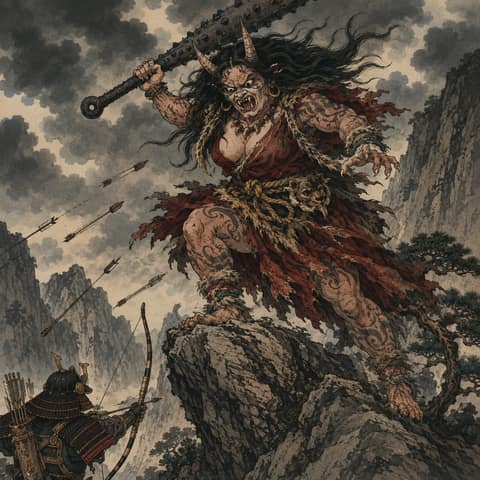
A demoness archetype fixed in Noh, joruri, and kabuki from the Muromachi to Edo periods. She appears under the pretext of autumn leaf viewing as a courtly lady-in-waiting or princess’s attendant, lulling suspicion with music and dance. At the feast she inebriates warriors, but near midnight her nature is exposed by divine protection or a sacred blade, and she reveals her true form in the wilds of Mount Togakushi. Commonly called Momiji, she bears aliases such as Princess Sarashina depending on the work. Her slaying tales extol martial virtue and reflect awe of the mountains, inheriting Togakushi worship and the rhetoric of oni-hunting lore. On stage, the contrast between the elegant disguise of the first act and the ferocious demon visage of the second is emblematic.

珍しい
Paper Dance

Paper Dance

KAH-mee-mai

Documentary Compilation Edition

Household Spirits
Japanese folklore

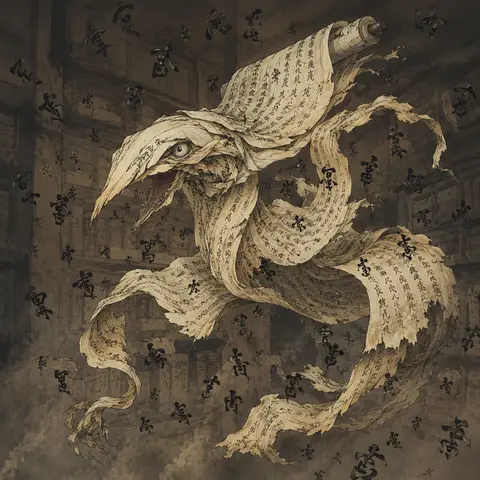
Rather than an independent entity, Kamimai is a later整理 as a label for a household anomaly in which paper moves and scatters on its own. Fujisawa Eihiko is cited as authority and places its appearance in the tenth lunar month, yet his illustration reuses a scene from Ino Mononoke Roku, and the original source does not limit it to any particular month. Since the Showa era, folklore and ghost-story collections have introduced cases of contracts or manuscripts lifting and swirling, naming them “Kamimai,” but firsthand credibility and regional distribution remain unconfirmed. Accordingly, this entry treats Kamimai as a generic yokai image signifying inexplicable motions tied to dwellings and objects, specifically the self-propulsion or levitation of paper, with no fixed form or clear place of origin. In lore it rarely harms people or livestock, tending instead toward startling or teasing behavior.

Showing 201 - 220 of 391 yokai