YOKAI.JP

Traditional Yokai Encyclopedia

Yokai passed down through the ages

473 Yokai|20 Category|Page 16 of 20
Localization in Progress - More content available in Japanese version
View Japanese
Sort by: NameAscending
Shinigami

Shinigami

Legendary

shinigami

The Rakugo Guide Who Shows the Fire of Lifespan

Spirit / GhostTokyo

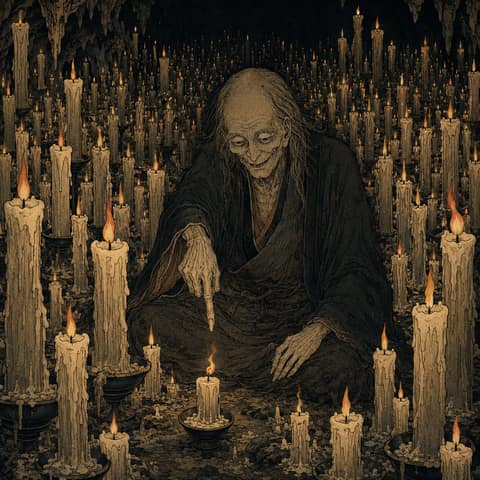
This shinigami is not a monster that attacks with a scythe or as a skeleton, but a storytelling device that turns lifespan into something "visible." In the rakugo play "Shinigami," the most unforgettable scene is where countless candles burn. Human lives line up as individual fires; there are long fires, short fires, and fires about to go out. Because abstract lifespan is converted into the light and dark right before one's eyes, the listener accepts death not through logic, but visually. The core of this version lies in the fact that the shinigami tests human judgment rather than killing humans. The man is taught a technique by the shinigami, learning that if the shinigami is at the patient's feet, they can be saved. The ability itself seems like a gift, but it also means bearing the responsibility of "one who can see." The shinigami does not give many orders; it only hands over rules. It is always the human who breaks them, and the way they break them oozes with attachment to greed, fear, emotion, and fame. The shinigami in rakugo is also a being that converted an imported folktale into Japanese humor. While possessing a skeleton similar to the Grimm tale "Godfather Death," Encho's oral performances push the doctor's rise to success, the slice-of-life feel of the nagaya, and the comical struggle for money to the forefront. Therefore, the shinigami borrows Western allegorical imagery while wearing the breath of Edo-Tokyo's popular entertainment. The duality of it being both scary and funny, of being cornered by the shortness of lifespan while laughing, supports the Japanization of this anomaly. Compared to the kings of the underworld, this shinigami is a mediator, not an administrator. King Enma judges sins after death, and Datsueba strips clothes from the dead, whereas the shinigami enters a person's room while they are still alive. It is because it is before death that negotiations occur, and because negotiations occur, a story is born. Standing in a more ambiguous and precarious place before the system of the afterlife begins is what opened the shinigami up to urban legends and modern creations. The terror of this version lies in the fact that the shinigami does not seem to act solely out of malice. It looks like it is helping the man, and it also looks like it has been luring him to ruin from the start. The ambiguity of being readable both ways distances the shinigami from a simple villain. It is natural for humans to wish to avoid death, but the moment that wish turns toward another's life or a loophole in the rules, the shinigami transforms from a quiet guide into a mirror of judgment. If handling this shinigami on a modern page, it is best not to confine it solely to the image of black robes. The lighting of a hospital room, the remaining amount of fire, a shadow standing at the pillow, an invisible promise, the boundary between medicine and superstition—the essence of the shinigami lies in the combination of these "signs forecasting death." In cards or diagnoses, positioning it as a presence that reflects both the heart that fears the end and the heart that wants to know the end will bring out the depth of this anomaly. When turning the shinigami into a page, one should avoid simply placing a Western-style skeleton and calling it a day. The Japanese "Shinigami" was established by the overlapping of rakugo, adapted folktales, Buddhist views of the underworld, and modern medical anxiety. Therefore, the structure of the transaction surrounding death is more important than its appearance. The fire is short, the position of the sickbed is bad, breaking the rules comes with a price. The combination of such conditions calls the shinigami. This personality is also the reason why the shinigami is repeatedly remade in modern creations. Because it is not fixed to a single classical picture, it can be a young man in black robes, an old man in white, a kind guide, or a cold contractor. Yet at its core remains the human desire to escape death, and the moment that desire inevitably hits a wall. In YOKAI.JP, keeping this mutability while placing the rakugo candle as the central axis is the strongest approach.

Shiramine Sagamibō

Shiramine Sagamibō

Legendary

Shiramine Sagamibō

The Tengu Who Guards the Mausoleum of Sutoku — Shiramine Sagamibō

Mountain & Wilderness SpiritsKagawa

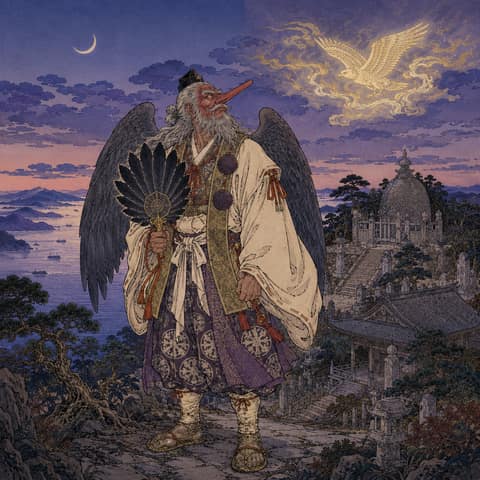
Shiramine Sagamibō is, among the Eight Great Tengu, the tengu most firmly bound to a single person—the Retired Emperor Sutoku. His image cannot stand apart from the story of Sutoku's vengeful spirit. The Retired Emperor Sutoku, defeated in the Hōgen Rebellion (1156), was exiled to Sanuki and died in the second year of Chōkan (1164) without ever being permitted to return to the capital. At his place of exile he copied out the five Mahāyāna sutras and sent them to the capital, but, suspected of a curse, had them flung back at him; in fury he swore an oath written in blood and is said to have become, while still living, a great tengu and a great demon (daimaen). Sagamibō guards the Shiramine mausoleum of this Sutoku, whom Yoritomo called "the greatest tengu in Japan." Shiramine-ji is the eighty-first station of the eighty-eight temples of Shikoku, the Shiramine mausoleum is the only imperial tomb in Shikoku, and beside it stands the Tonshō-ji-den, which enshrines the spirit of Sutoku-in. It was literature that made Sagamibō immortal. Its original source is the mid-Kamakura Senjūshō, attributed to Saigyō, whose "On the New Retired Emperor's Tomb at Shiramine" carries a tale of Saigyō mourning Sutoku's tomb at Shiramine. The Noh play Matsuyama Tengu, which dramatized it, takes Sutoku-in as the shite and Saigyō as the waki, and depicts Sagamibō as a tengu attending Sutoku. Further, the "Shiramine" of Ueda Akinari's Ugetsu Monogatari is a story in which Saigyō mourns Sutoku's spirit at the Shiramine mausoleum and converses with the wrathful Sutoku-in; Sagamibō became the being running through this lineage since the Senjūshō. The vengeful spirit and the tengu who stays beside it—the relation of Sutoku and Sagamibō is a rare point where the faith in goryō (vengeful spirits) and the faith in tengu meet. There are two theories on Sagamibō's origin: that it derives from Sagami Ajari Shōson, who sided with Sutoku in the Hōgen Monogatari, and that he was a tengu who came from Mt. Ōyama in Sagami. The latter forms a pair with the seat-transfer tradition arranged by Chigiri Kōsai—that the Sagamibō of Ōyama, in devotion to Sutoku, removed to Sanuki, and Hōkibō entered the vacant Sagami Ōyama. Either way, Shiramine Sagamibō sits at the western end of the Eight Great Tengu, transmitted at Shiramine in Sanuki as the tengu who keeps guarding the soul of Sutoku, one of Japan's three great vengeful spirits.

Shiranui (Mysterious Sea Fires)

Shiranui (Mysterious Sea Fires)

Uncommon

shee-rah-NOO-ee

Parent Fire Guide of Hassaku

Aquatic SpiritsKumamotoSaga

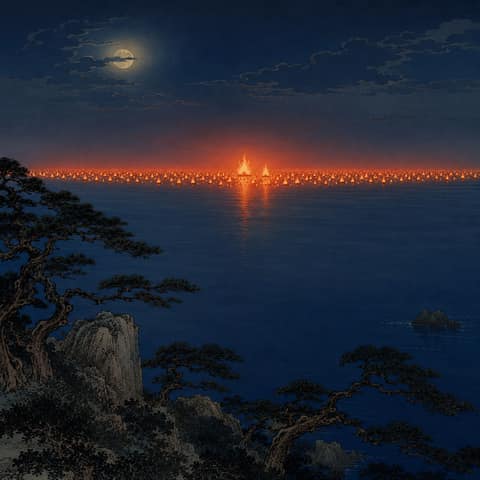
Among the shiranui, the Parent Fire Guide of Hassaku is a high-ranking variant that appears before dawn on the first day of the eighth lunar month. A single reddish light, sometimes two, first kindles several kilometers offshore, called the parent fire by villagers. It then splits to either side birthing child lights, until hundreds and thousands form a single horizontal line. People say the line may stretch four to eight ri, invisible from the surf but clearly seen from headlands or heights a few ken above the tide wind. When the ebb runs deepest, about the hour around midnight, the flames breathe in unison, and distant watchers see a shimmer like dragon scales flickering beneath the waves. If chased the lights retreat, if neared they draw away. Launch a boat to seize them and they slip aside with the shadow of the current, allowing no approach while indicating only the heading home. Old records tell that when Emperor Keikō’s boat was wrapped in darkness, this parent fire rose far ahead and turned his prow toward shore. For this reason villagers revered the nameless fire, ceasing their nets and resting their oars at midnight on Hassaku, waiting for the line to unspool. The Parent Fire Guide is linked to the presence of a stormy dragon god, yet it shuns harming people and instead warns against arrogance and haste. Boats that grasp for quick profit wander bewildered along the line and must furl their sails, while those who heed the tide climb a shore pine to read the fire’s breathing and slip out quietly with the break in the lights. Offshore shoals then prove gentler than expected, and on the return the embers sway by the coastal shadow to welcome the boat. So pure is the parent fire that villagers murmur Thousand Lanterns or Dragon Lantern and press their hands in prayer, but if people call it coarsely and jeer, the line breaks at once and scatters into beach fog. Wind does not fan it larger, it waxes and wanes only by the pulse of the tide. Thus from capes and mounds it appears a tidy band, while from the wave edge it cannot be seen. They say the Parent Fire Guide can even shift the angle of shrine shimenawa by the sea and the hue of lighthouse flames, and when the sacred rope bows slightly seaward at night, it is a sign that far offshore the lights are being born. Elders who know this tell young crews, Today the tide falls and the fire will rise, refrain from sailing. Unlike man-made flames it leaves no ash or smoke. Only at one hour after dawn do shells on the flats shine pale rose, and dew on reed tips holds the fire’s afterglow. On such mornings villagers cast salt upon the beach and give thanks for the lives guided by the fire. The Parent Fire Guide opens the way to those who know awe and courtesy, withdraws from the overproud, and quietly redraws the boundary between sea and humankind.

Shirōneri

Shirōneri

Epic

shee-ROH-neh-ree

Based on Sekien’s Illustrations

Animated Objects & UndeadJapanese folklore

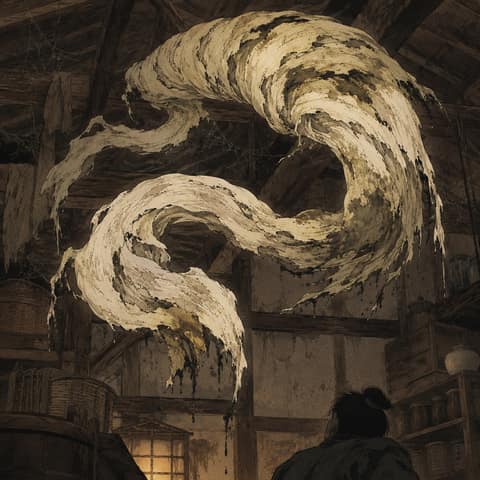
Anchored in Toriyama Sekien’s imagery, this version sees an aged dishcloth trailing long and fluttering in the wind, reimagined as a yokai. The original illustration offers little about harming humans, so it is understood as a symbol of attachment to old objects and the impermanence of things. Aggressive traits found in later ghost tales should be kept separate; here the focus is the eerie nature of a “moving old cloth” and the visual impression of it gliding between walls under a night lamp.

Shojo

Shojo

Rare

しょうじょう

Wine-loving Red-haired Beast, Noh Master of Dance, Shojo

Animal YokaiChinese Classics (Classic of Mountains and Seas, Book of Rites, Chuci, Huainanzi, Commentary on the Water Classic - legendary beast) / Introduced to Japan (Wakan Sansai Zue 1712, Noh play Shojo Muromachi period) / Nagoya, Arimatsu, Tokai City (Shojo giant doll festival, first appearance 1779)

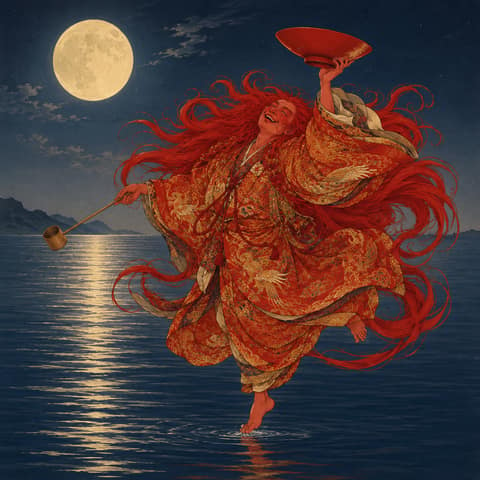
The origins of the Shojo lie in two lineages of lore from Chinese classics. ① The "Speaking Beast" Lineage — In the "Quli" section of the "Book of Rites", it is stated: "The parrot can speak, but it still belongs to the birds; the shojo can speak, but it still belongs to the beasts" (a moralistic quote meaning that even if it understands human speech, it does not transcend the realm of beasts). The "Erya" describes it as "small and fond of howling," while the "Classic of Mountains and Seas" states: "On Mount Zhaoyao, there is a beast whose shape resembles a macaque with white ears; it crouches to walk and runs like a human. Its name is xingxing (=shojo), and eating it makes one a good runner." ② The "Beast Fond of Wine and Blood" Lineage — The "Commentary on the Water Classic" notes that the shojo of Pingdao County in Jiaozhi "looks like a yellow dog or a badger, has a human face with regular features, is good at talking with people, and its voice is as beautiful as a fine woman's." The "Lüshi Chunqiu" considers "the lips of the shojo" a great delicacy, while Li Shizhen's "Bencao Gangmu" (1596) details it as a creature from Jiaozhi (modern-day northern Vietnam) with a human face, beast's body, yellow hair, and a fondness for wine. The modern associations with the orangutan or palm civet are later identifications; academically, the classical shojo is best understood not as a real animal but as a composite image of a legendary sacred beast. Its introduction to Japan occurred before the Middle Ages via Chinese texts and Buddhist scriptures. The "Wamyō Ruijushō" (10th century) introduced it as a "speaking beast" citing the "Erya", and it appeared indirectly in the "Konjaku Monogatarishu". Terajima Ryoan's "Wakan Sansai Zue" (1712) was groundbreaking — it explicitly pointed out that "yellow hair is correct, and the 'red hair' theory circulating in Japan is mistaken." Nevertheless, the image of "red hair" became entrenched in Japan due to the influence of Noh theater, a divergence that forms an interesting point of debate in art history and folklore. The uniquely Japanese image of red hair flowed backward from Noh costumes and became fixed. The Noh play "Shojo" (established in the Muromachi period, author unknown) is a current repertoire piece for all five schools, and is one of the most beloved plays, serving as a fifth-group play and kiri-Noh. Set at the Xunyang River in Tang China, it tells the story of Kofu, a filial son who sells wine in the village of Yangzi, and succeeds after a dream revelation. A red-faced customer who frequents Kofu's shop daily introduces himself as the "Shojo who lives in the sea." Waiting at the Xunyang River on a moonlit night, the Shojo appears, drinks wine, performs a dance, and bestows an "inexhaustible wine jar" — a celebratory theme of rewarding filial piety. The play fuses sources like the "Tang Guo Shi Bu", the "Chuci" (The Fisherman), and Li Bai's poem about the Xunyang River. The costume features a red wig, red Karaori robe, scarlet divided skirts, and a dedicated Shojo mask (painted red, with a smiling mouth and eyes). Its highlight is the "chu-no-mai" dance, or the special performance (kogaki) "midare" — a highly advanced technique where the performer glides over the water with erratic, flowing steps. In the Edo period, because Jurojin and Fukurokuju of the Seven Lucky Gods were identical, a variant Seven Lucky Gods circulated where Jurojin was replaced by the Shojo. Kita Sadakichi's "Study of the Gods of Fortune" (1920) cites primary sources like the "Genroku Gorui Setsuyo", making it academically robust. This variant form also appears in treasure ship paintings by Hokusai, Kuniyoshi, and Yoshitoshi. A "Shojo" giant doll festival has been passed down since the mid-Edo period in Arimatsu and Tokai City in Nagoya. Spreading along the old Tokaido highway, it already appeared in the "Narumi Festival Picture" of 1779. Giant red Shojo dolls chase children, and being tapped by one is believed to ward off summer diseases and epidemics. There are also local legends across the country, such as oral traditions of small Shojo appearing at sea in Toyama, or a ship-ghost variant demanding "give me a barrel" in Yamaguchi. "Shojohi" (Shojo scarlet) is a deep crimson color originating from the red costumes of the Noh play "Shojo". Though popularly called the "color of Shojo's blood," the actual dye was cochineal/kermes, and the "Shojo's blood" is merely a myth. Scarlet woolen cloth imported via the Nanban trade in the late Muromachi to early Edo periods was highly prized by Sengoku warlords for their surcoats. During the Edo period, it was such a rare luxury that the shogunate would confiscate it from merchants, making it a symbol of martial prowess and authority. In modern times, it appeared in Hayao Miyazaki's "Princess Mononoke" (1997) as the "sages of the forest," trying to replant trees to restore the forest but unable to keep up with humans, begging San to "let us eat humans, we want human strength". The red image of the Shojo is also inherited in biological names like the fruit fly (Drosophila, named for its attraction to alcohol), the Shojo dragonfly, and the Shojo-bakama flower.

Shokuin (Zhu Yin)

Shokuin (Zhu Yin)

Epic

SHOH-koo-een

Book-Borne, Picture Scroll Edition

Deities & Divine SpiritsUncertain; derived from the Classic of Mountains and Seas (Shan Hai Jing), transmitted to Japan through texts

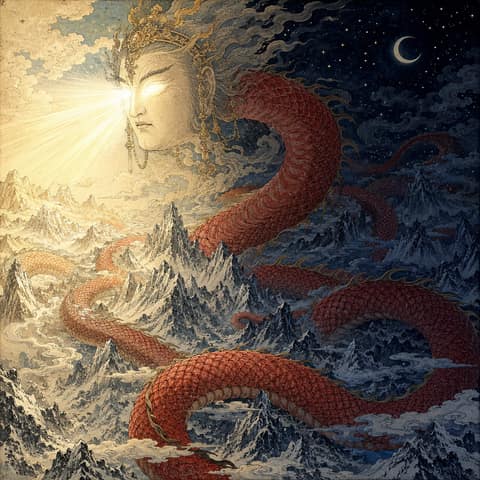
In Japan it is understood as a foreign divinity-spiritoriginating in the Classic of Mountains and Seas and related encyclopedic interests. Imagery follows the key points of a human face upon an immense red serpent body, whose opening and closing eyes divide day from night and whose breathing brings seasonal winds and heat or cold. Confusion with the Torch Dragon appears in early modern commentaries, yet most introductions cautiously note textual loci and descriptive differences, and signs of domestic worship are scarce. Consequently, local rites, taboos, and oral lore are meager, with reception centered on reading, sketching, and use as an art motif. It is often cited as an example of incorporating a foreign divinity into yokai catalogues and is positioned as a personification of time and the seasons.

Shrine Princess

Shrine Princess

Uncommon

JEEN-jah-HEH-meh

Traditional Lore Version (Hizen, Bunsei Appearance)

Aquatic SpiritsSaga

An image based on a block-printed text copied in Kato Hekioan’s Warekoromo. It bears a human face, two horns, a crimson belly, and a triple-sword tail, and is said to have appeared as a messenger from the Dragon Palace to foretell abundance and the spread of disease. Copies of its likeness were promoted as amulets for averting calamity and prolonging life when pasted on doorways or viewed in devotion, leading to widespread circulation of the image. Parallels from Hirado’s “Himeuo” and cases in Echigo show close similarities in iconography and captions, marking a nexus of popular epidemic countermeasures, folk practice, and print distribution. Some propose origins in specific animals, but no proof exists; folklorically it functions alongside prophetic beasts like Amabie and Amabiko.

Shu no Ban

Shu no Ban

Uncommon

SHOO noh BAHN

Classical Sources Version: Vermilion Tray (Watcher of Necks)

Ghosts & SpiritsFukushima

In early modern tales, the Vermilion Tray is depicted as a red-faced monk-like figure, appearing as an accomplice of the Long-Tongued Crone or showing its visage alone, reappearing to unnerve and harm people. The name varies between “Watcher of Necks” and “Vermilion Tray,” commonly read as Shunoban. Classic illustrations and yokai prints note a red face, horns, a split mouth, and a fiery aura, though details differ by source. Encounters occur mainly at night at shrine gates, in wastelands, and in tumbledown shacks, and the harm is told as loss of spirit leading to fainting, lingering illness, or death. Reports span regions such as Aizu and Echigo, not as a fixed local deity but as a circulating tale-type of the uncanny.

Shuten-dōji

Shuten-dōji

Legendary

SHOO-ten DOH-jee

Shuten Dōji of Mount Ōe

Half-Human BeingsKyotoShiga

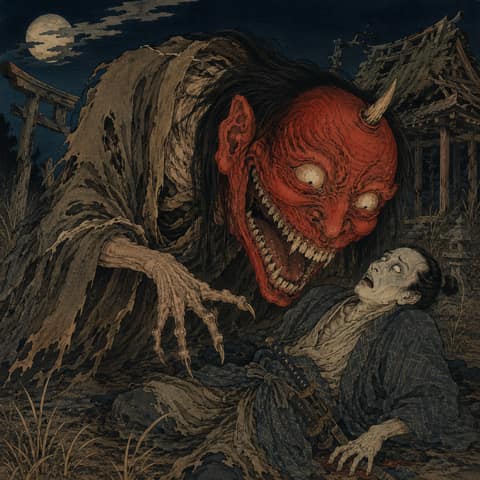
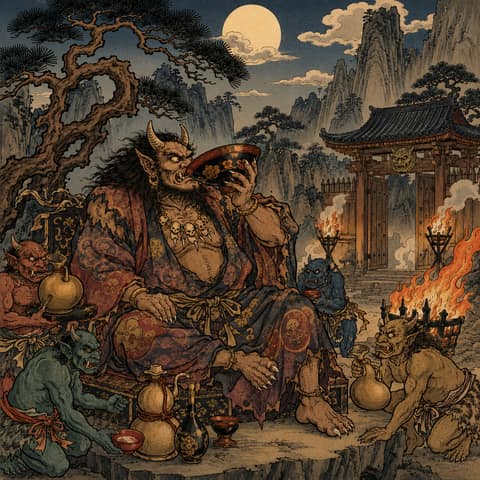
Modeled on the chieftain who ruled ogres from Mount Ōe. He descends to villages disguised as a monk or young warrior, exploiting lust, drink, and human weakness. At banquets he feigns hospitality, but in truth he is a raging ogre who abducts people. In the slaying tale, his foes turned a sacred oath against him and sapped his strength with poisoned sake. Letting in guests dressed as mountain ascetics proved fatal.

Shōgorō (the Gong Spirit)

Shōgorō (the Gong Spirit)

Rare

SHOH-goh-ROH

Sekien Plate Edition (Toriyama Sekien-Inspired)

Animated Objects & UndeadEdo period, Kamigata tradition (Osaka)

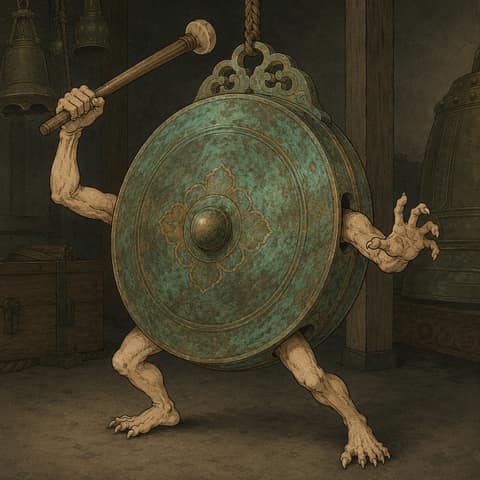
An interpretive reconstruction based on Shōgorō from Toriyama Sekien’s Hyakki Tsurezure Bukuro, linking the tsukumogami notion of spirits inhabiting tools with the muromachi-era Waniguchi bell monster seen in Night Parade picture scrolls. Because the name plays on words, it cannot be conclusively read as the vengeful spirit of any specific person. In the Kansai region it has been read against the Yodoya “Golden Rooster” legend, serving as an image that warns against the pursuit of wealth and fame. It is depicted as a round temple gong or waniguchi bell sprouting limbs, sounding of its own accord to give warning. No field sightings survive, and primary sources are picture scrolls, yokai paintings, and their notes.

Shōkera

Shōkera

Epic

SHOH-keh-rah

Traditional Iconography Interpretation

霊・亡霊Japanese folklore

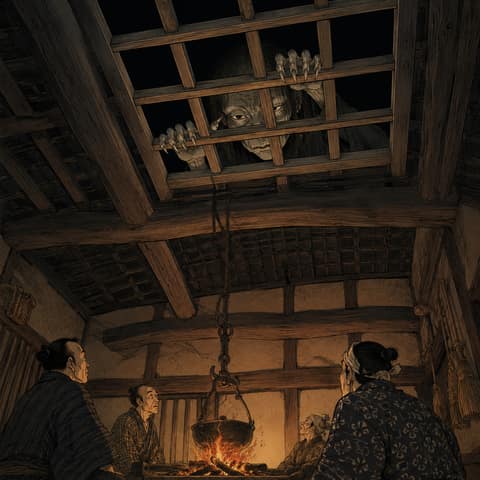
Based on Toriyama Sekien’s depiction, this interpretation frames the yokai as a watchful presence peering through a skylight during Kōshin night. It is identified with the Sanshi or treated as a spiritual agent acting on their behalf, examining human sloth and broken vows and, upon transgression, bringing misfortune with sharp claws. The name also appears in historical kana as “Shaukerá” or “Seukerá,” and its concrete form varies by region and source, yet it is positioned as a yokai that visualizes the normative ethos of Kōshin belief. Early modern sources offer little explanatory text, with later folkloric readings filling the gaps.

Shōkichi Kappa

Shōkichi Kappa

Uncommon

shō-kichi kappa

Shōkichi Kappa, the Sumo-Loving Kappa of Bungo

Water spiritOita

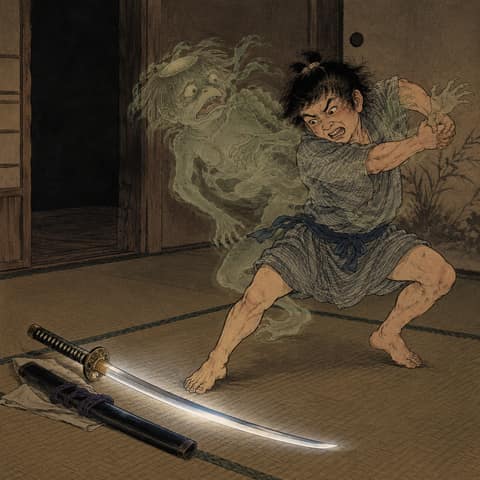
This version turns to the phenomenon of "kappa possession" that the Shōkichi tale conveys. Most kappa stories play out at the water’s edge, but here the river sumo is carried right into the home. Brought back by his family, Shōkichi went on raging as if locked in a grapple with an unseen opponent—exactly the work, people said, of a kappa that had possessed a human being. A water-spirit climbing onto dry land by borrowing a human body: there lies the spine-chilling fascination of this tale. The means of quelling it, too, reflects the faith of the land. What first took effect was the power of Gō Yoshihiro’s signed blade. The belief that the kappa dreads a keen edge is found in many regions, and the detail that it raged again once the sword was removed shows that power plainly. What finally settled the disturbance was the prayer of a shugenja, an ascetic who trains secluded in the mountains. Quelling kappa possession with these two—the power of the blade and the ascetic’s spiritual force—is a hallmark of Kyushu kappa tales. Hita has gathered many kappa stories, the Hita Gunshi foremost among them, and together with the "Bungo Kawatarō" of the same Bungo, they attest to the depth of this region’s kappa beliefs.

Shōrōkaze (Spirit-Wind)

Shōrōkaze (Spirit-Wind)

Uncommon

SHOH-roh-kah-zeh

Spirit Wind (Folkloric Version)

Weather & Calamity SpiritsSaga

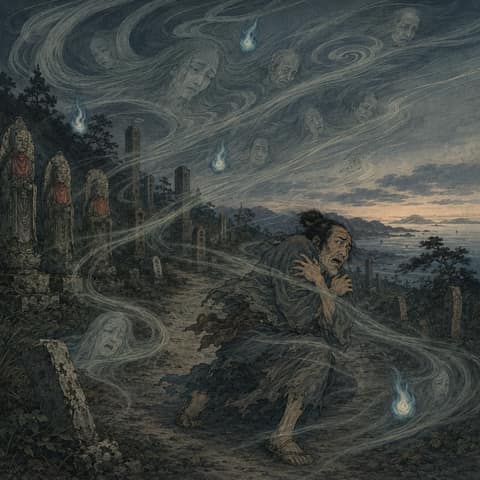
Spirit Wind is spoken of as an invisible wind that brings sudden chills, fever, and lightheadedness to those it touches. Its timing on the morning of the sixteenth day of Bon is emphasized, and the “spirits” here are the souls of ancestors or the unconnected dead. The wind is understood as carrying the aura of spirits crossing the boundary between return and departure. In the Goto Islands, people strictly avoid graves and grave roads on that day and refrain from going out. On Iki Island, illness is seen as a possessing wind, with graveyard-origin termed dead-spirit wind and grievance-origin termed living-spirit wind. It aligns with regional beliefs in malign winds, where seasonal fatigue and sudden gusts intersect with folk explanations and are remembered as spirit afflictions. It is not told as a yokai with active malice, but as a taboo that warns of misfortune for those who mistake the date or place.

Smiling Hannya

Smiling Hannya

Uncommon

wah-RAH-ee HAHN-nyah

Edo Painting Traditions Edition

Demons & GiantsNagano

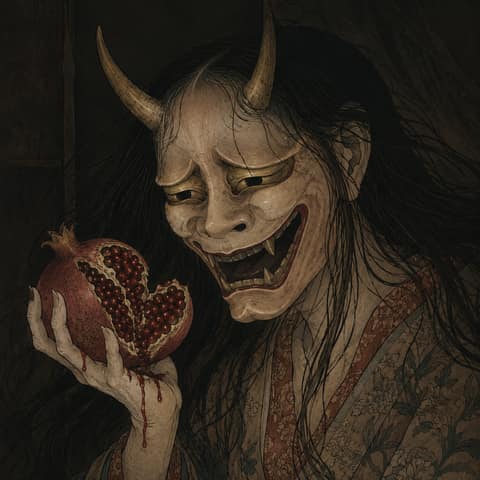
An edition distilled from late Edo-period ukiyo-e and comic prints depicting the smiling Hannya. Horns, fangs, bristling hair, wide staring eyes, and a strained grin form its core. Objects in its hands often allude to life and death, unsettling viewers with deliberate motifs. The demon-woman is understood to have once been human, transformed by accumulated jealousy, resentment, and attachment, aligning with the concept behind the Hannya mask. Specific local legends are sparse, yet it was treated in night-time tales and picture books as a symbol of fear and admonition, preserved as an image of the extreme of a woman’s grudge. In local oral tradition sometimes only the name remains, with the transmission of its form relying mainly on pictorial sources.

Snake-Bone Hag

Snake-Bone Hag

Epic

jah-KOHTS-bah-bah

Sekien Iconography Standard

General ClassificationsJapanese folklore

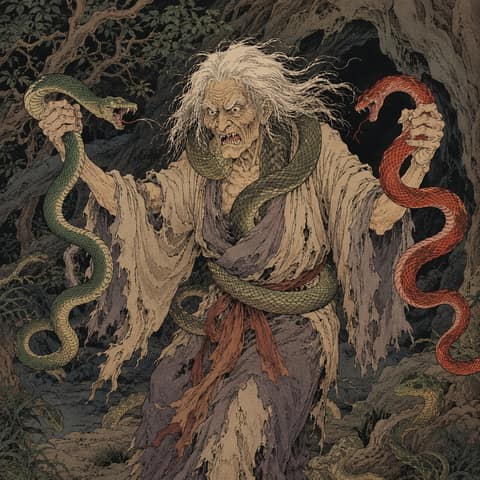
Jakotsubā is a name based on the image and brief note in Toriyama Sekien’s Konjaku Hyakki Shūi (late 18th century), without any specific oral tradition attached. The picture shows an old woman wreathed in snakes. The note mentions the Shanhai Jing’s account of the Wuxian people in the Overseas West Classic, citing those who hold a blue snake in the right hand and a red snake in the left, yet it stops short of directly identifying this old woman. The term itself appears in early modern chapbooks and theater as a derogatory label for an old woman, which Sekien likely molded into a yokai. Later encyclopedias claim she is the wife of “Snake Goemon,” that the blue snake freezes and the red snake burns, but these are embellishments inspired by Sekien’s wording, not grounded in cited tradition. Folklorically it visually aligns with the lineages of “oni-baba” and “snake bride,” but because no rites, taboos, or place-names unique to Jakotsubā are identified, academic treatments handle it as source-undetermined.

Snake-Obi

Snake-Obi

Rare

jah-TIE

Sekien Zukai Version

住居・器物Edo period; derived from painted sources

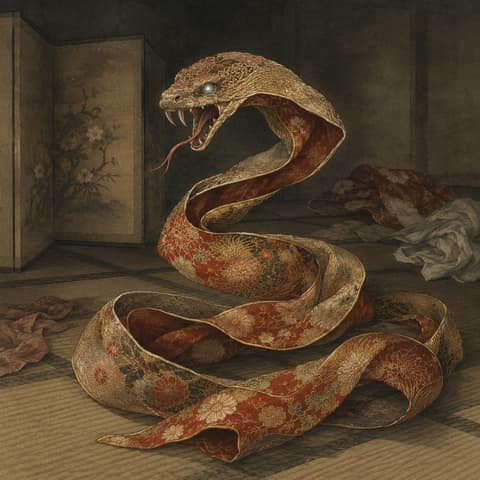
A version based on Toriyama Sekien’s interpretation of the obi in Konjaku Hyakki Shūi. Though an everyday garment, the obi was said to turn into a serpent at the threshold of sleep and dream. This draws on the Natural History note that sleeping on a sash brings dreams of snakes, a belief also known in Japan. Sekien further composed that the triple sash of a jealous woman coils into a sevenfold venomous snake, punning on the kinship of malice and serpent-body, and presenting a visual reading in which emotion is projected onto objects. In folk terms, it warns that keeping a sash by the pillow invites ominous dreams, admonishes jealousy, and entwines concepts of sleep, dreams, and taboo. Rather than a literal attacker, the Snake-Obi is a symbolic specter that mirrors the viewer’s heart and reminds proper handling of sashes and bedding within the home.

Snow Elder

Snow Elder

Uncommon

YOO-kee-jee-jee

Elder of Snow Standing in the Mountains

Natural Phenomena SpiritsMountain regions of Tohoku, Hokuriku, and Koshin (uncertain)

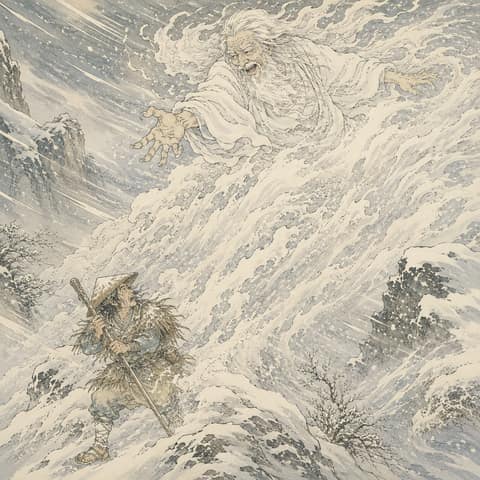
When the curtain of a blizzard falls, the Snow Elder appears as an old man in white robes, calling from afar to strip travelers of their sense of direction. He belongs to the lineage of snow-related apparitions, overlapping in role with Yuki-onna and Yuki-nyūdō, yet marked by his elder form. His figure is indistinct, fading the closer one approaches, while only his voice is said to echo from behind. In folklore he is understood as a symbolic warning against the perils of winter weather.

Sokushinbutsu

Sokushinbutsu

Epic

Sokushinbutsu

Sokushinbutsu, the Living Buddha Enshrined in the Earth

Humans-Turned-Yokai / DemigodsYamagata

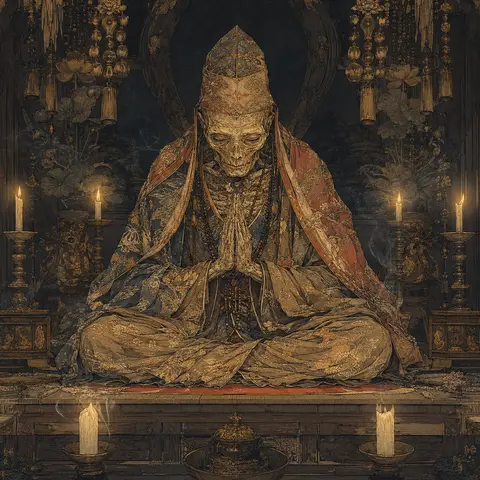
Unlike other yokai that are purely imaginary aberrations, the *sokushinbutsu* is a rare existence—a real, historical ascetic who ascended halfway to godhood through absolute faith. The inner sanctuary of Mount Yudono has no shrine building; instead, a giant, brownish-red sacred rock gushing hot water serves as the object of worship itself, and pilgrims must walk the approach barefoot. In this sacred area that preserves the archetype of nature worship, ascetics aimed for *sokushin-jōbutsu*—becoming a Buddha in this very life. The "tree-eating asceticism" was a preparation for self-mummification: first giving up grains, and eventually restricting salt and water to the absolute limit to wither the body. In the final stage, they confined themselves in an underground stone chamber connected to the outside world only by a bamboo tube with a bell. The moment the sound of the bell ceased, the ascetic was considered to have successfully entered eternal meditation. Exhumed without having decayed, their bodies became Buddhas, enshrined beside the main temple deities to continuously shoulder the suffering of the masses. They are not objects of terror, but the physical incarnations of a will to save humanity that transcended death itself, most vividly demonstrating the Dewa Sanzan region's views on death and the concept of the mountains as the otherworld.

Spirit of Dreams

Spirit of Dreams

Uncommon

YOO-meh no say-RAY-ee

Historical Source-Critical Version

自然現象・自然霊Japanese folklore

The name “spirit of dreams” found in pictorial sources is secondhand and not firmly tied to a specific image. Depictions often show an elderly figure leaning on a staff and beckoning, suggesting a symbolic guide of dreams. Some propose it arose from misread characters for a grass spirit or tree yokai, but this is uncertain. Here it is framed as a nature spirit that mediates dreams and portends good or ill, linked to the role of dreams in divination and omens. Personalization and proper names are avoided, positioning it as a numinous rank residing in the power of dreams themselves.

Spirit of the Ema Plaque

Spirit of the Ema Plaque

Uncommon

EH-mah no SAY

Ema Spirit (Traditional Tale)

Household SpiritsKyoto

A spiritual presence dwelling in votive ema plaques, known from shrine and temple origin tales and ghost stories. It appears most often at dusk or in dreams, and its form is thought to reflect the donor’s wish or the plaque’s artwork. As an old man it teaches or warns, and as a woman it may invite or manifest. It is not a deity itself, but a spirit residing in an offering, revealed through the power of the sacred precinct. It shuns being taken home without cause, defiled, or thrown into fire, and favors proper return or ritual burning. Encounters can be auspicious or ominous, with fortune depending on one’s conduct.

Straw-Raincoat Sandals

Straw-Raincoat Sandals

Rare

MEE-noh WAH-rah-jee

Iconographic Tradition Edition

Animated Objects & UndeadJapanese folklore

A reimagining of the straw raincoat and straw sandals yokai based on Toriyama Sekien’s imagery. The straw raincoat serves as a protective emblem akin to visiting-deity garb, while the sandals take on the role of roadside boundary charms. Weathered by long use and harsh storms, they are believed to have gained spiritual potency and slipped into the human world. The act of shouldering a hoe evokes farm labor and service to local land deities, and the snowy bamboo grove setting suggests purity and deep quiet. Specific deeds go unrecorded, but it was likely feared as creaking sandal steps at midnight or a walking cloak’s silhouette in a blizzard, with little emphasis on malice. An emblematic member of the early modern tsukumogami ensemble, it reflects reverence for the lifespan and toil of tools.

Suiko (Water Tiger)

Suiko (Water Tiger)

Epic

sui-ko

The Scaled Suiko, Child-Sized

Water SpiritsHubei, China (introduced to Japan through Edo-period texts)

This version digs into what sets the suiko apart: it is not a creature of oral legend but one shaped within the pages of books. Where the kappa was born from the fears of riverside life and took on countless forms and names from region to region, the image of the suiko travelled almost entirely through citations in Chinese materia medica and gazetteers. That is why its defining features stay remarkably consistent — a body the size of a small child, hard scales, the habit of baring its carapace on the autumn sand, and the trick of showing only its knees above the water. Japanese scholars cited these Chinese accounts while puzzling over how to square them with the kappa right in front of them. The *Wakan Sansai Zue* placed the two side by side and cautiously judged them "alike yet not the same," while the *Suiko Kōryaku* tried to file reports of water creatures from across the land under the heading "suiko." Toriyama Sekien's illustration in the *Gazu Hyakki Yagyō* is likewise a picture drawn from this continental learning. There are articles touting ways to capture it or its medicinal uses, but interpretations differ from book to book, and the truth remains unclear. The suiko, in the end, is a second face of the water spirit — the trace left by an early-modern attempt to reinterpret the familiar kappa through the lens of Chinese scholarship.

Suiko-sama (Water Tiger Deity)

Suiko-sama (Water Tiger Deity)

Epic

sui-ko-sa-ma

Suiko Daimyōjin of Tsugaru

Deities & Divine SpiritsAomori

This version digs into Suiko-sama as a faith that "raised a yokai all the way to a god." The kappa is by nature a fearsome creature that drags people into the water. The wisdom of the Tsugaru Suiko-sama cult lies in this: rather than slaying the kappa, it made the creature into a god who commands forty-eight of them as their head, entrusting it with the order of the waterside. The faith was bound tightly to the lives of children. The custom of offering cucumbers and floating them downstream in the river-playing season was at once a prayer to the deity and a way of impressing on children the everyday warning, "never let your guard down at the water." Benzaiten's form is borrowed for the sacred image because two water deities naturally merged into one. It shares only its kanji name with the ferocious "suiko" of the Chinese books; in substance the two are nothing alike. Suiko-sama is a water god in the manner of the snow country — one in which people reshaped the local dread of the kappa into an object of prayer. The specific rites and incantations vary greatly from district to district, and many have not survived to the present.

Suiton

Suiton

Uncommon

すいとん

The One-Legged Yokai of Hiruzen: Suiton

Mountain / Field YokaiHiruzen in Mimasaka Province (Present-day Hiruzen, Maniwa City, Okayama Prefecture)

*Suiton* is a one-legged yokai unique to the Hiruzen Highlands, based on local folklore recorded in the *Yatsuka-son Shi*. Its name derives from the way it flies in with a "*sui*" and lands on its single leg with a "*ton*". It belongs to the lineage of mind-reading yokai like the *Satori*, reading human hearts to tear apart and devour only the wicked. On the other hand, it has functioned as a moral guardian of the land, protecting the good and keeping the evil away. The anecdote of it fleeing in terror from the sound of bamboo bursting in a fire adds a touch of comedy—showing that despite its powerful mind-reading ability, it is easily frightened by sudden noises. This perfectly illustrates its character as a local yokai that serves as both a warning and a beloved figure. Today, statues of the *Suiton* are erected in various places as a symbol of Hiruzen tourism.

Showing 361 - 384 of 473 yokai