YOKAI.JP

Traditional Yokai Encyclopedia

Yokai passed down through the ages

473 Yokai|15 Category|Page 17 of 20
Localization in Progress - More content available in Japanese version
View Japanese
Sort by: NameAscending
Sunakake-baba

Sunakake-baba

Legendary

sunakake-baba

The Invisible Sand Hag: Sunakake-baba

山野の怪Nara

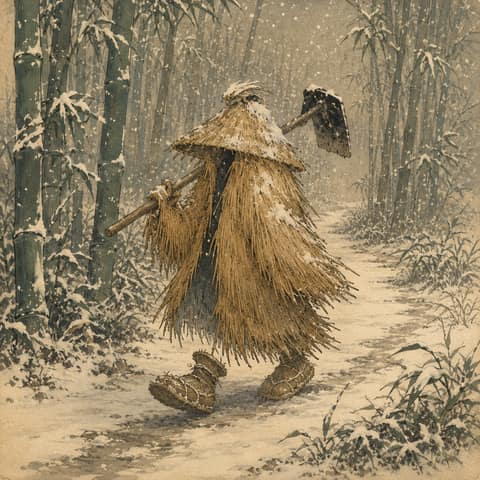
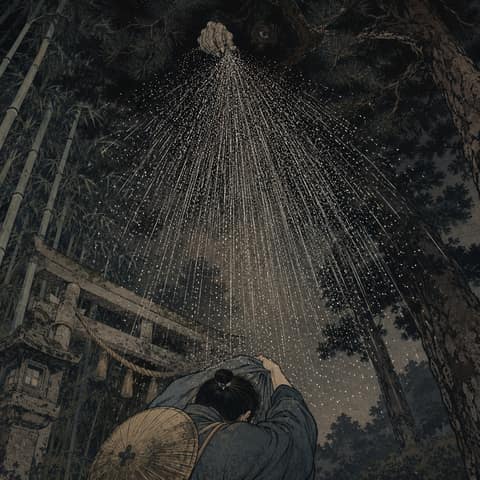
The Folkloric Anomaly of the "Formless Yokai". While the basic overview highlighted the Sunakake-baba's narrative structure, this deep dive explores the profound academic significance of her "lack of visual representation." The mid-to-late Edo period saw a massive wave of yokai visualization (cataloging via illustration), spearheaded by Toriyama Sekien's *Gazu Hyakki Yagyo*. The Sunakake-baba is a remarkably rare entity that entirely missed this wave. She appears in no classical picture scrolls, and prior to Shigeru Mizuki, she was represented solely by "the sound of falling sand and the sand itself." When Kunio Yanagita explicitly noted in *Yokai Dangi* that "no one has ever seen her form," he was recognizing this visual absence as a critical academic subject. The Sunakake-baba holds a vital position in folkloristics because she preserves the primal archetype of the yokai concept: an invisible presence felt only through atmosphere, sound, and touch. Sandbar Topography and Boundary Spiritualism. It is no mere coincidence that the Sunakake-baba's primary lore locations—Nara (the Yamato River basin), Amagasaki (Ebisu Bridge, Josho-ji Temple, which sit on former sandbars), and Nishinomiya (coastal pine groves)—are all areas where "sand is exposed on the earth's surface." Sandbars, beaches, and sandy geological strata have historically commanded a strong folkloric presence as boundaries between water and land, serving as liminal corridors between humans and the otherworld. As highlighted by a Kobe Shimbun field report (December 2022), the phenomenon of sand liquefaction erupting in Amagasaki's former sandbar areas during the 1995 Great Hanshin Earthquake proves that yokai lore is deeply entwined with geological and topographical history. The Sunakake-baba is a textbook case of geographical yokai studies. The Festival Origin Theory: Mechanisms of Yokai Generation. Bintaro Yamaguchi's proposed "Hirose Shrine Sunakake Festival Origin Theory" provides a crucial perspective for unpacking how yokai are generated. A Shinto rainmaking ritual where participants throw sand to simulate rain, playfully jeering "It's the Sunakake-baba!", may have served as the incubator for the legend of a "sand-throwing hag." This illustrates the folkloric process where a yokai is generated on the margins of a festival—a phenomenon similarly observed with Setsubun demons, Obon spirits, and autumn festival tengu. It reinforces the view that religious rituals are not merely ceremonies, but active generators of folkloric imagination. Shirosaku Sawada and the Role of Local Folklorists. Dr. Shirosaku Sawada's *Yamato Mukashibanashi* is a prime example of folklore collection by local intellectuals during the pre-war and wartime eras. The development of Japanese folkloristics relied heavily on a network where local doctors, teachers, and historians collected oral traditions in the field and forwarded them to central figures like Kunio Yanagita and Shinobu Orikuchi. The Sunakake-baba's inclusion in Yanagita's *Yokai Dangi* is the direct result of this "center-periphery" collaborative research system. The excavation of local materials that supports 21st-century yokai studies is built entirely upon the painstaking groundwork laid by these local folklorists. Shigeru Mizuki's "Visual Reconstruction" and Cultural Ethics. Shigeru Mizuki (1922-2015) bestowed the Sunakake-baba with the appearance of an old woman in a kimono, creating a wholly original iconography inspired by the "Ondaiko" demon masks of Sado Island. This is a definitive example of post-war yokai culture, where mass media assigns a visual form to a traditionally formless entity. In *GeGeGe no Kitaro*, she was depicted as a righteous ally of the Kitaro family, completely erasing the localized, malicious trait of "startling humans." This Mizuki intervention sparks divided opinions in the modern history of yokai culture: while lauded for contributing to the national popularization and preservation of local lore, it is simultaneously criticized for altering the fundamental meaning of the original legend. It serves as an excellent case study for examining the ethical dilemmas of cultural production at the intersection of folkloristics and pop culture. Fukusaki, Koryo, and Hanshin: The Modern Geography of Yokai Tourism. In the 21st century, the Sunakake-baba has been aggressively developed into a tourism asset across her legendary homelands. Fukusaki Town in Hyogo Prefecture (Yanagita's birthplace) launched a "Yokai Bench" series, featuring a highly popular Sunakake-baba bench. The Sunakake Festival at Hirose Shrine in Koryo Town, Nara, garners significant tourism attention as an Intangible Folk Cultural Property. In the Hanshin cities of Amagasaki and Nishinomiya, yokai walking tours linking local history with toponymy have been established. In the context of post-war regional revitalization—where yokai function not merely as "old tales" but as modern regional brands, tourism drivers, and educational tools—the Sunakake-baba stands as an iconic symbol alongside Konaki-jiji and Ittan-momen. The Modern Paradigm Shift: From "Yokai Studies" to "Yokai Culture". The contemporary discourse surrounding the Sunakake-baba represents an intersection of two paradigms: the traditional view of treating yokai as academic subjects (folkloristics, historical verification), and the modern view of treating yokai culture as a living, breathing phenomenon (mass media, tourism, education). The modern trajectory—from the collection records of Yanagita and Sawada, through Mizuki's post-war visual reconstruction, and circulating back into 21st-century regional revitalization and tourism—proves that yokai are not "faiths of the past," but "cultural productions in progress." Modern yokai studies demands an approach that does not simply consume her as a "minor legend from Nara and Hyogo," but actively interrogates the history of knowledge, geology, and cultural production that stands behind her.

Suzaku (Vermilion Bird)

Suzaku (Vermilion Bird)

Divine

Suzaku

Suzaku, the Vermilion Bird, Guardian of the South

Animal TransformationsNaraKyoto

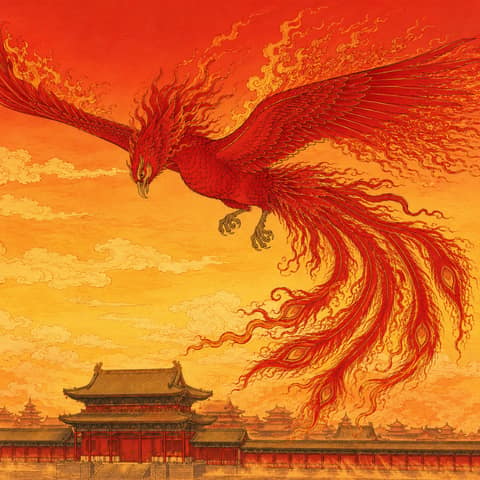
The key to reading Suzaku lies in its directional symbolism as "the fire bird of the south" and in its subtle distinction from the phoenix. Its origin is in the stars of heaven. Chinese astronomy likened the chain of the seven southern mansions (Well, Ghost, Willow, Star, Extended Net, Wings, Chariot) to a bird form, and made this the Vermilion Bird. The Huainanzi's "Treatise on the Patterns of Heaven" makes the emperor of the south the Flame Emperor and its beast the Vermilion Bird, assigning it to Fire, summer, and the color vermilion. The "Vermilion Bird in front, Black Tortoise behind" of the Book of Rites' "Qu Li" and the southern-palace Vermilion Bird of the Records of the Grand Historian' "Treatise on the Celestial Offices" stand in the same system. The vermilion of Suzaku is the color of the Fire phase, figuring the blazing southern sky of summer. The relationship between Suzaku and the phoenix requires care. Because their images and auspicious connotations closely resemble each other the two tend to be identified, but Suzaku belongs to the Four Symbols (of astronomical, directional origin) and the phoenix to the Four Auspicious Beasts (the numinous beasts alongside the qilin, the numinous tortoise, and the responding dragon)—they are numinous birds of originally different categories. Rather than declaring "Suzaku = phoenix," it is more accurate to grasp that they have been spoken of as overlapping because of their close resemblance. In Japan, the notion of south = Suzaku was carved into the capital. The Suzaku Avenue and Suzaku Gate of Heian-kyō are its traces. As for surviving iconography, there were the Four Symbols murals of the Takamatsuzuka Tomb, but the Suzaku of the southern wall was lost to grave-robbing, and four-direction completeness is limited to the Kitora Tomb. The fire bird of the south, so easily lost, still spreads its wings in the stone chamber of Asuka.

Suzu-hiko-hime

Suzu-hiko-hime

Rare

SOO-zoo-HEE-koh-hee-meh

Based on Sekien Toriyama Plates

Household SpiritsJapanese folklore

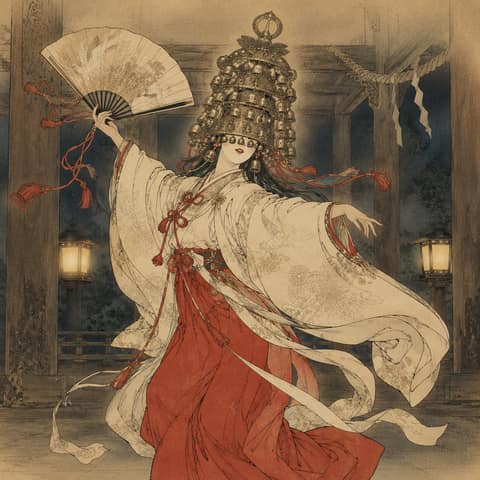
A reconstruction grounded in Toriyama Sekien’s illustration and notes. Shown as a woman bearing a kagura suzu, she serves as a symbolic presence moving between summoning spirits and soothing souls. Rather than a concrete monster, she personifies the numinous power tied to the ritual bell, evoking the Ama-no-Iwato myth while remaining distinct from its deities. Edo painters placed her within the Night Parade lineage, and Tsukioka Yoshitoshi offered a comparable image to Suzuhiko-hime. No fixed haunt is recorded; she is thought to appear in the imagination at kagura offerings, festival floats, and shrine fairgrounds.

Suzuka Gozen

Suzuka Gozen

Legendary

すずかごぜん

Suzuka Gozen, the Heavenly Maiden Guarding the Suzuka Pass

Human-Yokai / Half-Human Half-YokaiMieKyoto

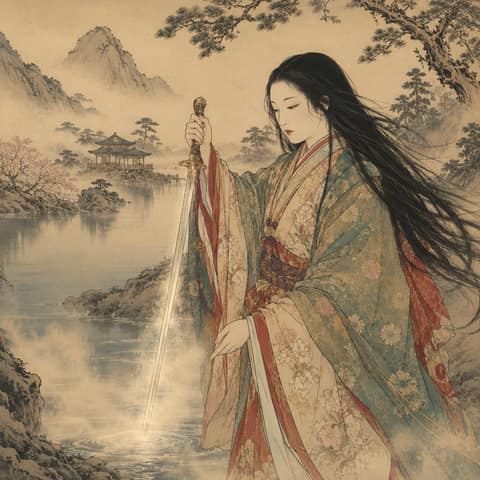
In this interpretation, Suzuka Gozen is not treated as a mere sidekick beside Tamuramaru, but as the protagonist bearing the divine authority of the Suzuka Pass. Her true essence is not a binary choice between goddess or oni woman, heavenly maiden or bandit. On the pass leading from the capital to the eastern provinces, the god who protects travelers and the danger that attacks them dwell in the same mountain. Suzuka Gozen embodies this duality; that is precisely why, in the tale of subjugating Otakemaru, she can teach the outsider Tamuramaru the inner laws of the mountain. From the structural perspective of the Tamura tales, Suzuka Gozen is the key to victory. If Tamuramaru is the hero armed with martial prowess and divine protection, Suzuka Gozen possesses the intelligence of the mountain, the psychology of the demons, and the arts to traverse boundaries. Because of her presence, the demon-slaying ceases to be a mere subjugation and transforms into a narrative of pacifying the mountain by allying with the spirits of the pass. By standing in opposition to Otakemaru, Suzuka Gozen rises not as an 'evil to be defeated', but as 'the wisdom to understand and overcome evil'.

Suzuri-no-tamashii

Suzuri-no-tamashii

Rare

sue-ZOO-ree no tah-mah-SHEE

Phantom of Dan-no-ura / Spirit of the Akama Inkstone

Tsukumogami / GaikaiYamaguchi

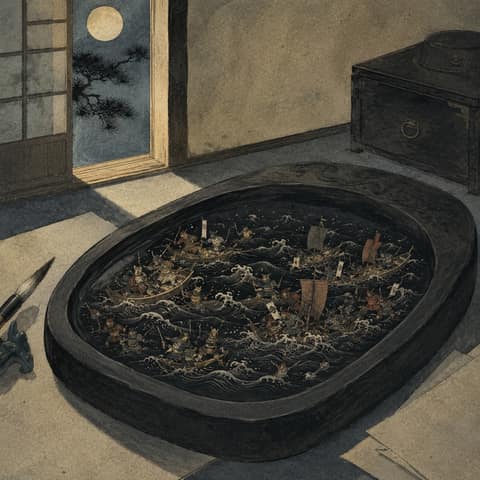
This interpretation remains most faithful to Toriyama Sekien's commentary, transforming the inkstone—a static piece of stationery—into a "screen of phantoms" that projects the dynamism and tragedy of history. This yokai never threatens or curses its owner. It quietly reveals its form only when the owner possesses deep cultivation and a strong empathic connection to history. In a study enveloped in midnight silence, one pours cold water and gently begins to rub the inkstick. The phenomenon occurs when the flickering candlelight illuminates the surface of the black, glistening liquid ink (the sea of the inkstone). Suddenly, mingled with the rich fragrance of the freshly ground ink, the faint "scent of the sea breeze" and "scent of blood" begin to drift through the air. Then, within the mere few centimeters of the ink sea in the inkstone, pure white crests of waves rise, miniature warships crowd together, and Minamoto and Heike warriors—no larger than grains of rice—appear. They cross swords, loose arrows, and fall into the waves one after another, recreating the decisive Battle of Dan-no-ura. If you listen closely, angry shouts, the sound of crashing waves, and the screams of the court ladies of the Heike echo like a distant auditory hallucination. This is a physical vision manifested through the resonance between the "kotodama" (spirit of language) in *The Tale of the Heike* read by the literatus and the hundreds of years of sorrowful memories held by the "Akama stone," which was quarried from the very sea where the Heike perished. The Spirit of the Inkstone is a "spirit of literature" of unparalleled beauty, poetry, and bottomless melancholy, proving how the act of reading is a mystical ritual that transcends time and space to converse with the dead.

Taiba, the Horse-Killing Wind

Taiba, the Horse-Killing Wind

Uncommon

TAI-bah

Taiba (Traditional Record Edition)

Weather & Calamity SpiritsVarious regions across Honshu and Shikoku

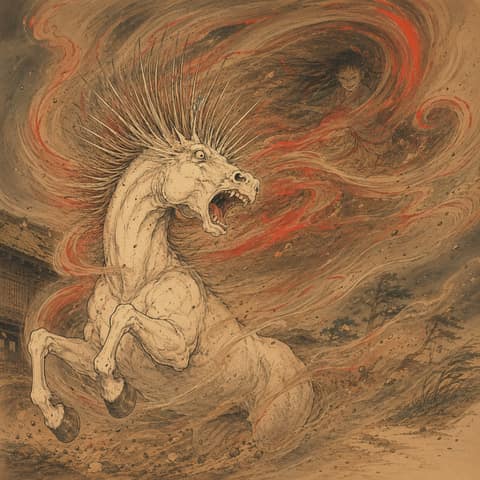
Taiba is recorded as a sudden apparition arriving with wind and blowing sand. It appears from April to July, especially May to June, and travelers were warned on days that shift between sun and cloud. Accounts vary by region regarding the victim horse’s coat and sex: in Mino white horses were targeted, in Enshu chestnut and bay, while old women and mares were said to be spared. Eyewitnesses tell of each mane hair standing on end, a red gleam shining, and when the horse collapses the wind falls still. The Owari and Mino “Giba” is regarded as a personification of Taiba, a small girl who descends from the sky, ensnares a horse, then vanishes with a smile; the chosen horse spins rightward several times and dies. Folk countermeasures include covering the horse’s neck with cloth, fitting deerfly-proof belly guards or bells, and in emergencies letting a little blood from the ear, needling the center of the tailbone, or cutting the air ahead with a sword while reciting the Komyo Mantra. Temples and shrines fostered prayers for quelling horse-plagues, and talismans to horse deities and belly wraps were used as Taiba wards.

Taimatsumaru

Taimatsumaru

Rare

tie-MAHT-soo-mah-roo

Sekien Iconography Edition

Mountain & Wilderness SpiritsJapanese folklore

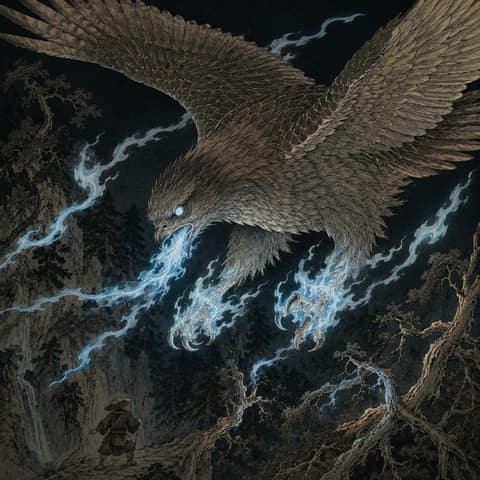
An interpretive version based on Toriyama Sekien’s Hyakki Tsurezurebukuro image and notes. It bears a raptor’s body wreathed in ghostly flame, tongues of fire trailing from beak and talons. Its glow is not a guiding light but a will-o’-the-wisp that scrambles sight and sense of direction. Sekien links it to the glow of “tengu pebbles,” weaving puzzling mountain lights into tengu lore. Said to break the chanting and meditation of yamabushi and devotees, it was feared less for wounds than for unsettling the mind and leading feet astray. Though local oral traditions are scarce, it is understood in line with common notions of phantom fires and tengu fire.

Taira no Koremochi

Taira no Koremochi

Rare

taira-no-koremochi

The Yogo General Who Vanquished the Demoness Momiji

Humanoid Yokai / Half-human Half-yokaiNagano

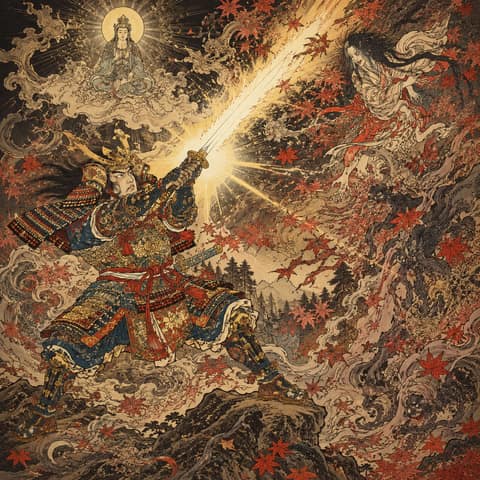
Taira no Koremochi is an entity of the 'demon-slaying hero' archetype who stands not on the side of *yokai*, but on the side that strikes them down. Just as Sakanoue no Tamuramaro subdued Suzuka Gozen and Otakemaru, and Minamoto no Yorimitsu subdued Shuten-doji, Koremochi carved his name in lore as the one who vanquished the demoness Momiji of Togakushi. What makes him a hero is not pure military force, but the fact that the story weaves in 'the limits of human power'—he is initially defeated by Momiji's dark arts and can only conquer the demon after praying to buddhas and deities. The fascination of Koremochi's figure lies in the flexibility with which his protector swaps depending on the medium of the legend. In Noh it is Hachiman, in Bessho-lineage accounts it is Kitamuki Kannon—the same warlord is protected by different divinities depending on local faith and theatrical convenience. This implies that Koremochi is not an entity rigidly tied to a specific god, but rather a vessel carrying the archetype itself of 'the warrior who slays demons with divine protection'. While Kinasa reveres Momiji as a noblewoman, Koremochi is strictly a subjugator executing the orders of the center, and only by combining both does the dual nature of good and evil in the Momiji legend emerge. In this encyclopedia where *yokai* are the main characters, Koremochi is a rare subjugator included as a 'counterpart existence that makes the demon possible'.

Takiyasha-hime

Takiyasha-hime

Epic

takiyasha-hime

The Sorceress Princess of Soma's Ruined Palace: Takiyasha-hime

Spirit / GhostIbarakiChiba

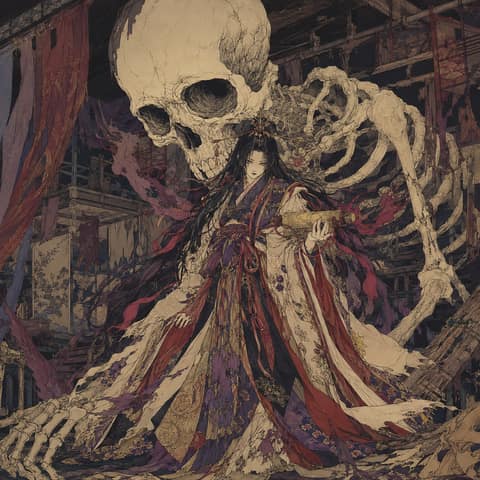
In this version, we read Takiyasha-hime as "the sorceress princess of the ruined palace of Soma." She is not a figure directly copied from the historical daughter of Masakado, but a being born when the imagination of yomihon and theatre seeped into the blanks of the Masakado legend. Therefore, to understand Takiyasha-hime, one must look not only at whether she existed, but why later generations needed her. The story of Takiyasha-hime concentrates the memory of the defeated onto female sorcery. Taira no Masakado is a rebel, a vengeful spirit, and also a hero of the eastern provinces. The princess, said to be his daughter, inherits her father's defeat and aims for a resurgence from the ruins. Here, sorcery works not merely as magic, but as a power to call a lost political dream back to the stage. Kuniyoshi's "Soma no Furudairi" pushed this princess to the center of yokai iconography. The giant skeleton can be read on a narrative level as a summoned beast, but looking deeper, it is also a visualization of the dead and the grudges accumulated in the ruins of Soma. With the skeleton standing behind the princess, personal revenge expands into the memory of a clan and a battlefield. The charm of Takiyasha-hime lies in the fact that fear and beauty are not separated. She does not merely attack like a demoness; she simultaneously wears the pride of a ruined house, the loneliness of a woman, the glamour of sorcery, and the darkness of the ruins. The viewer cannot process her merely as a villain. This is because the story of the defeated side rises up along with the skeleton. Takiyasha-hime in this version is not a historical figure, but a phantom born of history. Departing from historical fact does not mean her value is low. Rather, she is important in showing what people saw in the gaps of history. In the place where the darkness of Soma's ruined palace, Masakado's name, and the iconography of the giant skeleton overlap, Takiyasha-hime transforms the memory of defeat into a yokai-like beauty. Takiyasha-hime is also unique as a female sorcery-user. Instead of a male warrior taking revenge with a sword, the princess uses ruins, curses, and phantoms. This can be read as a story where the defeated, stripped of direct military power, regains power in another form. Her sorcery is not the flip side of weakness, but an alias for lost power. The stage of Soma no Furudairi strongly supports her existence. "Dairi" (palace) is originally a word evoking the center of political power. Yet it has become old, ruined, and a nest of anomalies. Takiyasha-hime is a princess standing in a ruined political space, and with the appearance of the giant skeleton there, the dead of the past return to the stage of power once more. In this version, we do not confine Takiyasha-hime as an "evil woman." She is clad in rebellion and grudges, but behind her is her defeated father, the memory of her clan, and the pride of the eastern provinces. This is precisely why the viewer feels regret along with fear. Takiyasha-hime, before being a sorceress to be struck down, is first and foremost another stage dreamed of by the side defeated by history. Takiyasha-hime, having passed through Kuniyoshi's brush, transcended being a character in a story to become a yokai of the visual itself. The composition of the princess standing before a giant skeleton is unforgettable once seen. There, before the logic of text, defeat, death, and beauty bear down as a single picture.

Tall Woman

Tall Woman

Epic

tah-kah-OHN-nah

Iconography-True (Sekien-Based)

Household SpiritsJapanese folklore

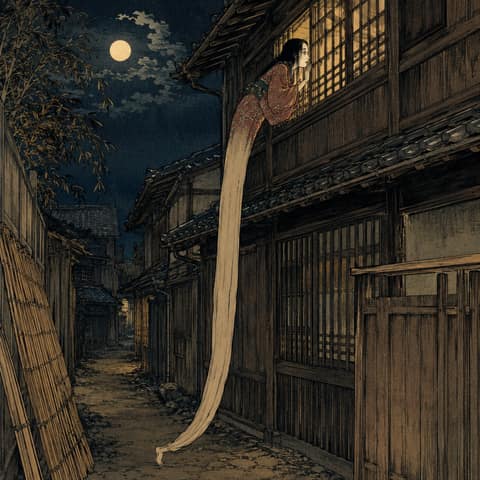
Reconstructed strictly from Sekien’s original image while preserving the absence of contemporaneous commentary. The figure is a gaunt woman whose body from the feet to the hips stretches like a serpent, extending from an alley up to the second-floor lattice of a townhouse to peer inside. Her actions are chiefly to startle, with no fixed malice. Regional proper names are uncertain, and later popular tales (brothels, satire, etc.) are treated as accretions. She is understood as a symbolic apparition that exploits nighttime quiet and architectural features, instilling unease in residents through her gaze.

Tamamo-no-Mae

Tamamo-no-Mae

Legendary

Tamamo-no-Mae

Tamamo-no-Mae, the Nine-Tailed Fox Beloved of Emperor Toba

Animal ShapeshiftersKyotoTochigi

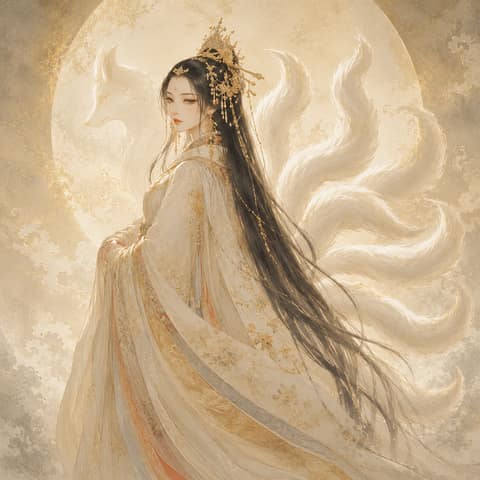
This version turns to the events leading up to Tamamo-no-Mae’s unmasking and defeat. When the retired Emperor Toba’s illness grew at last grave, the onmyōji Abe no Yasunari (modeled on the historical Abe no Yasuchika), ordered to divine the cause, named Tamamo-no-Mae herself as its source. As Yasunari performed rites at court and cornered her, Tamamo-no-Mae could no longer hold her human shape; revealing her fox form, she fled eastward from the capital. The place she fled to was the Nasu Plain in Shimotsuke Province (the area around present-day Nasu in Tochigi Prefecture). To subdue the spirit-fox lurking in the wilds and harming people and livestock, the court dispatched warriors of the eastern provinces, Kazusa-no-suke Hirotsune and Miura-no-suke Yoshiaki. The warriors surrounded the plain, drove the fox out, and at last brought it down with arrows, so the tradition runs. The names of these warriors who slew Tamamo-no-Mae overlap with those of real Bandō warriors of the Genpei era—an intriguing case of legend and history told as one. In the story, Tamamo-no-Mae has usually been drawn as the very type of the “beauty who topples nations”—one who, through her beauty and wit, works her way to the summit of the realm and brings it down from within. Yet at the same time, once slain, she was enshrined in a small sanctuary and worshipped as a deity. Dreadful spirit-fox though she is, one cannot help being drawn to her. It is precisely this duality that keeps Tamamo-no-Mae from ending as a mere villain and makes her a figure beloved for ages.

Tamehachi Fox

Tamehachi Fox

Uncommon

tah-meh-HAH-chee GEE-tsue-neh

Kitayama Village Tradition Version

Animal ShapeshiftersWakayama

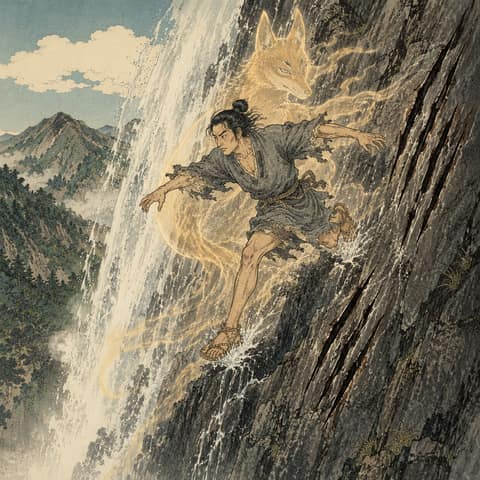
A form rooted in the topographic legends of Kitayama Village. A fox is said to possess a person and display uncanny lightness, leaping across sheer cliffs. Variant tales pit it against serpents or yamabushi ascetics, so rivals and techniques differ by account. Anchored to cliff-line marks cited as physical proof, it serves to evoke the village boundary’s numinous authority and taboos. Ritual details and personal names are not preserved, and narratives remain general in outline.

Tanuki

Tanuki

Common

Tanuki

One Step Beyond Seven: The Tanuki's Eight Transformations

Animal shapeshifterAcross Japan, with bake-danuki legends especially concentrated in western Japan

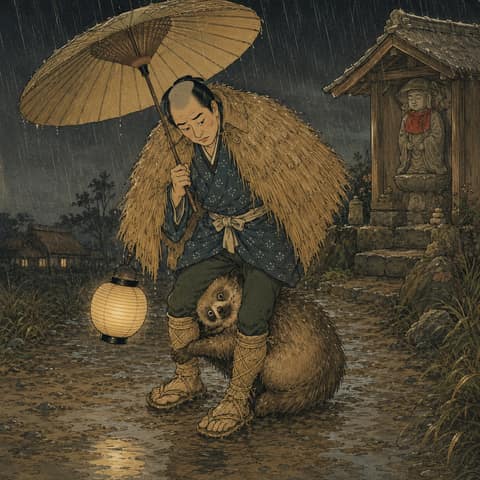
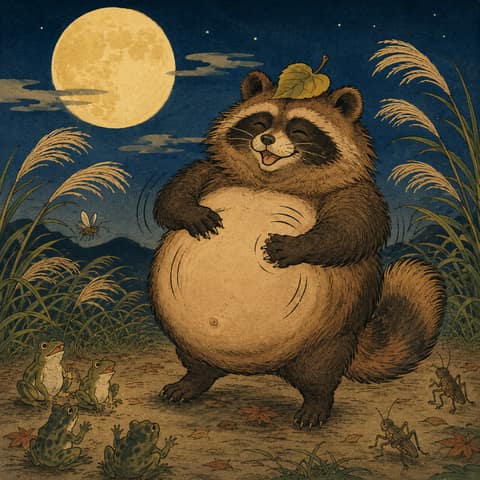
What "fox seven, tanuki eight" means. "Foxes have seven transformations, tanuki have eight" is a familiar Japanese proverb. It says that tanuki surpass foxes by one degree of shapeshifting. An expanded saying, "fox seven, tanuki eight, otter nine, cat ten," orders animal magic into a ladder. Konjaku Monogatari-shu, volume 27, tale 22, where an aged tanuki becomes a demon, expresses the same idea: long-lived beasts awaken stronger powers. Named old tanuki such as Kincho, Danzaburo, Tasaburo, Shibaemon, and Inugami Gyobu may even become daimyojin. The eight-mat scrotum and Edo humor. The tanuki's scrotum is not biology but urban comedy. Edo goldbeaters were said to wrap a small amount of gold in tanuki skin and hammer it out to the size of eight tatami mats. Utagawa Kuniyoshi turned that joke into images of umbrellas, nets, rooms, shamisen, and sumo rings; Tsukioka Yoshitoshi moved toward the uncanny atmosphere of the Morinji kettle. Low-city caricature and temple ghost story together formed the early modern visual tanuki. Three Famous Tanuki and Three Great Legends. The two sets are often mixed up. Japan's Three Famous Tanuki are Danzaburo, Tasaburo, and Shibaemon. The Three Great Tanuki Legends are Inugami Gyobu, Bunbuku Chagama of Morinji, and the Shojoji tanuki-bayashi tale. The Awa Tanuki War, centered on Kincho and Rokuemon and mediated by Tasaburo, belongs to another stream made famous through kodan storytelling and film. The eight auspicious signs of Shigaraki tanuki. Shigaraki tanuki's eight auspicious signs read the statue's hat, eyes, smile, flask, account book, belly, money bag, and tail as blessings for business: avoiding misfortune, watching carefully, welcoming customers, having food and drink, keeping trust, staying calm, gaining wealth, and finishing well. In effect, postwar merchant ethics were projected onto a round, friendly tanuki body. Pom Poko, with tanuki driven out by development, shows the other side of the same postwar consumer society that put Shigaraki tanuki at shop doors. Why tanuki survive. Pom Poko from 1994 makes tanuki displaced local spirits under Tama New Town development and brings together famous tanuki, including Inugami Gyobu. The Eccentric Family from 2007 imagines Kyoto as a city where tanuki, humans, tengu, and foxes overlap. The tanuki endures because it changes with each period: Edo joke, Meiji image, postwar business charm, modern urban fantasy.

Tanuki Bayashi (Raccoon Dog Festival Drums)

Tanuki Bayashi (Raccoon Dog Festival Drums)

Uncommon

tah-NOO-kee bah-YAH-shee

Honjo Baka-bayashi (Edo Tradition)

Mountain & Wilderness SpiritsTokyo

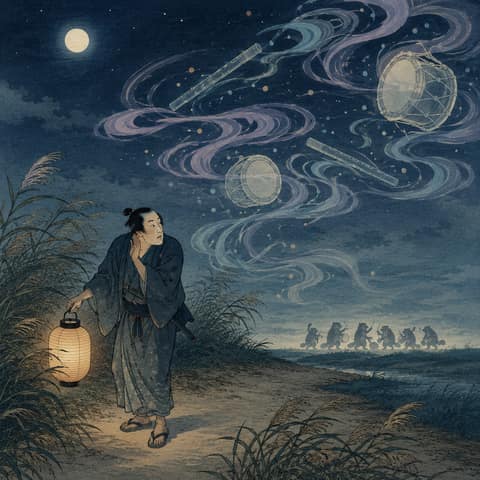
A classic case of tanuki-bayashi reported around Honjo in Edo. The sound layers like flute, drum, and shamisen, seeming to recede as you approach and shifting direction when you turn a corner. It often cuts off abruptly near waterways and moat edges. While common folk sometimes explained it as refraction and echoes caused by wind and terrain, people of the time also took it as the work of tanuki. Counted among the Seven Wonders of Honjo, it was frequently mentioned in sideshows and popular literature, with the names “Baka-bayashi” and “Tanuki-bayashi” used interchangeably. Notably, there are no accompanying sightings of a physical form, making it a sound-only apparition of high record value. Folklore warns that chasing it can leave you lost and wandering into the outskirts by dawn, so one should stop midway and cover the ears.

Temple Woodpecker

Temple Woodpecker

Rare

TEHM-puhl WUUD-peh-ker (teh-rah-TSOO-tsoo-kee)

Temple Woodpecker (Sekien Zufu depiction)

Animal ShapeshiftersOsaka

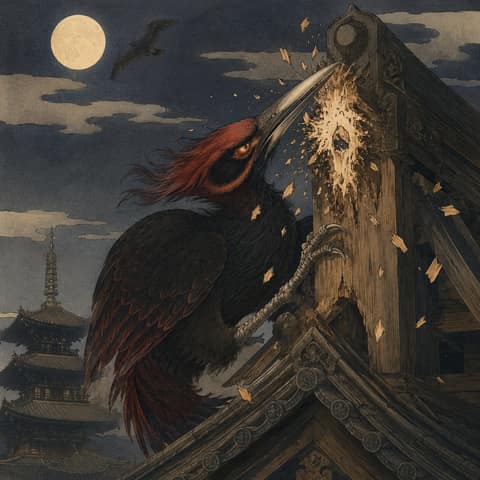
A form based on Toriyama Sekien’s illustration and accounts in war chronicles. It bears the will to hinder the Buddhist Law, pecking at temple timbers late at night as an omen of ill fortune. Tradition ties its origin to the vengeful spirit of Mononobe no Moriya, though its shape follows that of a woodpecker. In strange tales the sound comes first, a shadow is seen, and its true body is rarely caught. Folklorically it fuses bird-borne calamity lore with etiologies for temple damage.

Tengu

Tengu

Legendary

Tengu

What Is a Tengu? An Overview of Types and Iconography

Mountain & Wilderness SpiritsKyotoShiga

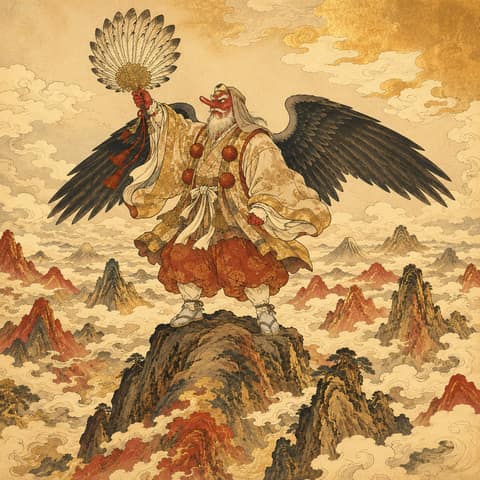
This edition is not about a single seat on a particular sacred mountain, but a general treatise that thoroughly unravels "what a tengu is" from the history of its iconography and types. The individual traditions of each seat are left to the page of each great tengu. The form of the tengu is not uniform. The first type is the long-nosed tengu—ruddy face and high nose, clad in the ascetic's headcloth (tokin) and the suzukake robe, a feather fan in hand and one-toothed high clogs on the feet. The second is the crow tengu, with a crow's beak and wings, grasping a sword or a vajra staff. The third are the lesser tengu called leaf tengu and wood-chip tengu, held to be weak and numerous kin. Rather than a fixed classification, these reflect the breadth of the tengu image across eras and regions. The iconography shifted over time. The Heian-period tengu was first conceived as a bird like a black kite, and the image of the crow tengu retains that vestige. The long nose grows prominent only from the late Kamakura period; the Zegaibō Emaki depicts a scene in which a tengu that had disguised itself as a human has its nose lengthen as it returns to bird form. As for the origin of the long nose, there are theories that derive it from the high-nosed Jidō mask of gigaku and link the crow tengu to the Karura (Garuda) mask, and a view that sees the long nose as an iconographic vestige of a bird's beak—but none can be called settled doctrine. It was overlaid with the god Sarutahiko, described in the Nihon Shoki as having a nose seven hand-spans long, and the custom arose of using a tengu mask for the role of Sarutahiko in festivals. The tengu's dual nature is rooted in the Buddhist notion of the way of the tengu. Because it studies the Buddhist path it does not fall into hell, and because it handles heterodox arts it cannot reach paradise either—an intermediate state, and the one who falls there was held to be the arrogant monk. The Tengu Zōshi depicts this notion as satire of the monks of the seven great temples, yet Chigiri Kōsai too warns that the simplification "only arrogant monks become tengu" goes too far. Demon though it is, once subdued it turns to guardianship, and it was held that if a Shugendō practitioner recites the Tengu Sutra he may summon the tengu of the various provinces to grant his wishes—this amplitude between guardian and demon is the very core of the tengu. The certain medieval source for the grouping called the "Eight Great Tengu" lies in the libretto of the Muromachi-period Noh play Kurama Tengu. The passage in which the great tengu calls up the tengu of the provinces he commands in geographical order—"In Tsukushi, Buzenbō of Hiko-san; in the four provinces of Shikoku, Sagamibō of Shiramine; Hōkibō of Ōyama; Saburō of Iizuna… the host of Zenki of Ōmine, Takama of Katsuragi"—shows that the Eight Great Tengu were rooted in medieval belief and performing arts, not an Edo invention. Still, the composition wavers by source, with a variant that adds Hōkibō of Ishizuchi-san; it is no fixed roster.

Tengu

Tengu

Legendary

Tengu

Hieizan Hōshōbō, Great Tengu of Mount Hiei

Mountain & Wilderness SpiritsKyotoShiga

Hōshōbō of Mount Hiei is a great tengu who ranges the peaks of Hiei, where the capital meets the lake, dwelling between cedar and cypress crowns and the sea of clouds. Cloaked in the ridge winds of the Sannō shrines, he bears crow’s wings and a feather fan like a yamabushi’s ritual tool, said to appear at midnight with the lingering echo of a conch. His face is severe, ruddy with a high nose, eyes keen as if seeing through the ages. Yet his bearing recalls a monk, and the folds of his robes carry the scent of sutras. Named among the forty‑eight tengu of the Tengu Sutra since olden times, he guards Enryakuji’s teachings and the mountain’s vital currents, and in the era of the monastery’s ascendancy was said to guide and correct the conduct of its students both openly and unseen. Hōshōbō is not merely masterful in martial arts but cuts through the frayed edges of words to reveal a thing’s true nature. When a seeker loses their way, he thickens the mist and erases the markers, or lures an unsettled heart into the shadows of halls and pagodas—not to mislead, but to teach that wavering within is what leads one astray. When that is realized, the fog clears at once and Hiei’s ridgeline turns blade‑bright. Conversely, those who climb seeking fame and profit or who slight the Sannō deities are driven off by winds that make leaves into blades, never again permitted a frivolous ascent. Elders of Hiei whisper that Hōshōbō entrusts the essence of Lotus and Esoteric teachings to the wind, marshals flocks of birds to the cadence of chanting, and governs prayers for rain and for clearing skies. If Enryakuji’s bell tolls strangely, it is a sign of his feather fan stirring on the heights, and there were nights when sutra characters trembled across the lake’s ripples. At times he appears at a young ascetic’s bedside, delivering a single thunderous admonition that severs the root of delusion, leaving at dawn a single drop of white dew—medicine when diligence holds, poison when sloth prevails. He most abhors when urban rumors and power struggles spill onto the mountain, and bears an art that stills the blades of speech. When people wound each other with slander, a downslope wind rattles the town eaves and falsehoods collapse under their own weight; thus those who guard their tongues gain his protection. Yet he shows no mercy to those who hide pride behind practice: he lightens their footsteps until they lose the ground and wander forbidden paths of empty theory, and only when they admit their fault do their feet return to earth. On nights when the bush warbler in Hiei’s forest falls suddenly silent and distant thunder rings pure, Hōshōbō is near. If pilgrims bare their heads and pay full respect before the Sannō, the ridge wind softens and a single shaft of light breaks the clouds. This is called the Return of Hōshō—a sign that prayers in the mountain have been rightly answered. Hōshōbō is both guardian of the mountain and tester of the teaching; fear becomes reverence, and reverence opens the way. Only those who grasp this find his wings a sheltering shade for the road.

Tengu

Tengu

Legendary

Tengu

Kakukai-bō of Yokogawa

Mountain & Wilderness SpiritsKyotoShiga

Kakukai-bō of Yokogawa is said to be a tengu variant who turned from human monk to winged guardian of the Dharma from the late Heian into the early Kamakura era. Once a virtuous priest of deep Shingon lineage, he ran himself ragged settling mountain disputes until he grasped a boundary no worldly rule could protect, becoming a winged keeper of sacred law. In Kōya’s inner precincts, they tell how one night a gale whirled through a hall and the middle gate shuddered, then its doors shed their hinges, unfurled as twin feathers, and split the black clouds to fly off. Those doors became Kakukai-bō’s wings. Ever since, he appears with the comings and goings at temple gates, raising a fierce wind before those who disturb the rule and presenting a single line of precept. He resembles a karasu-tengu, yet his face keeps the gaunt trace of an old monk and his long nose curves like a mountain ridge. His feathered robe echoes priestly vestments, layered in cinnabar and ink, its cuffs frayed like the edges of ancient sutras. He carries a feather fan akin to a monk’s staff, and when he sweeps it, seed-syllables rise like chaff off paper, racing along the ground as ropes of warding. He speaks sparingly, but his words hang like a bell’s aftertone, stopping the feet of those who have strayed. He guards the mountain’s thresholds—the shrine and temple gates, the bends of approach paths, the joins of ridge and valley—where human law brushes mountain law, serving as their mediator. When a practitioner keeps purity, he lets fall a single white feather from the cloudbreak as a sign of safe passage. But if pride sprouts, the vigil lamp flickers once and a cold wind runs down the back. Feeling this thrice, one must follow his guidance to descend the mountain or doff one’s robe and return to first intent. He also teaches the ‘Doctrine of Drying’: to clear the heart, remove needless damp—a metaphor tied on the mountain to drying beans for stores and keeping offerings pure. Though unproven, it stands as a sign of turning the mountain’s rigor into daily sustenance. Late at night when mist pools in the valleys, he patrols with a train of crows. They are his eyes and ears, giving short signals to those swayed by rumor. Read rightly, the signs lead one off the wandering path, read wrongly, one circles the same ground three times. This is called Kakukai’s Rounds, and on the third turn, if one straightens the crook in the heart, the eastern ridge pales and the path opens naturally to the main gate.

👹

Tengu

Legendary

Tengu

The Forty-Eight Tengu – The Great Tengu of the Provinces in the Tengu Sutra

Mountain & Wilderness SpiritsKyotoShiga

The tengu do not stop at the Eight Great Tengu. Each of the sacred mountains of the provinces was believed to have its own great tengu, and the early-modern esoteric prayer-scripture the Tengu Sutra lists their representatives as forty-eight seats—the "Forty-Eight Tengu." This edition is an overview that surveys the full roster and the provenance of the scripture itself. The Tengu Sutra is an esoteric, Shugendō-lineage prayer text said to have been compiled in the Edo period. It is not an orthodox sutra of the Buddhist canon, but belongs to the lineage of incantation-scriptures that a yamabushi recites in his devotions to summon (invoke the descent of) the tengu of the sacred mountains of the provinces, borrowing their numinous power to pray for the dispelling of demons, the subjugation of enemies, and the fulfillment of all wishes. The text begins with the chant "Homage to the great tengu and the small tengu," lists the names of the various tengu, then gives the total of the tengu as "one hundred twenty-five thousand five hundred in all," and closes with the mantra "On aromaya tengusumanki sowaka." This "one hundred twenty-five thousand five hundred" is not a real count but a symbolic number representing innumerable tengu, and the forty-eight seats named by their proper names are positioned as the representatives among them. As for the transmission of the manuscripts and printed editions of the Tengu Sutra, there are philological studies such as Takahashi Sei's "The Tengu Sutra: Its Present State and Whereabouts" (2016), and it is difficult to fix the date of compilation strictly to a single point. The roster of the Forty-Eight Tengu runs in the form of "bō" titles (sacred-mountain name + the name of the bō). The opening begins with the great tengu of the Kinai—Atago-san Tarōbō, Hira-san Jirōbō, Kurama-san Sōjōbō—and is followed by the tengu of the Shugendō sacred mountains across the land such as Fuji, Nikkō, Haguro, Akiba, Hikosan, and Ishizuchi. Below are listed all forty-eight seats, collated against two confirmable lines of sources, together with the bō title, sacred mountain, and province (present-day prefecture). ★ marks the Eight Great Tengu that have their own pages in this encyclopedia. 1. ★Atago-san Tarōbō (Mt. Atago, Yamashiro / Kyoto) 2. ★Hira-san Jirōbō (Mt. Hira, Ōmi / Shiga) 3. ★Kurama-san Sōjōbō (Mt. Kurama, Yamashiro / Kyoto) 4. Hiei-zan Hosshōbō (Mt. Hiei, Yamashiro / Kyoto) 5. Yokawa Kakkaibō (Yokawa, Mt. Hiei, Yamashiro / Kyoto) 6. Fuji-san Daranibō (Mt. Fuji, Suruga / Shizuoka) 7. Nikkō-san Tōkōbō (Mt. Nikkō, Shimotsuke / Tochigi) 8. Haguro-san Konkōbō (Mt. Haguro, Dewa / Yamagata) 9. Myōgi-san Nikkōbō (Mt. Myōgi, Kōzuke / Gunma) 10. Tsukuba-san Hōinbō (Mt. Tsukuba, Hitachi / Ibaraki) 11. ★Hiko-san Buzenbō (Mt. Hiko (Hikosan), Buzen / Fukuoka) 12. Ōhara Sumiyoshi Kenbō (Kengamine, Mt. Daisen (disputed), Hōki / Tottori (tentatively identified)) 13. Etchū Tateyama Nawadarebō (Mt. Tate, Etchū / Toyama) 14. Amanoiwafune Dantokubō (Amanoiwafune, location unknown) 15. Nara Ōku Sugisakabō (unknown, location unknown) 16. Kumano Ōmine Kikujōbō (Kiku-no-iwaya, Mt. Ōmine, Yamato / Nara) 17. Yoshino Minasugi Kozakurabō (Mt. Yoshino, Yamato / Nara) 18. ★Nachi Takimoto Zenkibō (Nachi Takimoto, Kii / Wakayama) 19. Kōya-san Kōrinbō (Mt. Kōya, Kii / Wakayama) 20. Niitayama Satokubō (Mt. Niita (disputed), Kōzuke / Gunma (tentatively identified)) 21. Kikaigashima Garanbō (Kikaigashima, Satsuma / Kagoshima (tentatively identified)) 22. Itatōyama Tondonbō (Mt. Itatō, location unknown) 23. Saifu Takagaki Kōrinbō (Mt. Kamado (Mt. Hōman), Chikuzen / Fukuoka (tentatively identified)) 24. Nagato Fumyō Kishukubō (unknown, Nagato / Yamaguchi (tentatively identified)) 25. Tsudoki Oki Fugenbō (Oki Island (disputed), Oki / Shimane (tentatively identified)) 26. Kurokenzoku Konpirabō (Mt. Zōzu, Sanuki / Kagawa) 27. Hyūga Obata Shinzōbō (unknown, Hyūga / Miyazaki (tentatively identified)) 28. Iōjima Kōtokubō (Iōjima, Satsuma / Kagoshima (tentatively identified)) 29. Shiōzan Rikyūbō (Mt. Shibi, Satsuma / Kagoshima (tentatively identified)) 30. ★Hōki Daisen Seikōbō (Mt. Daisen, Hōki / Tottori) 31. Ishizuchi-san Hōkibō (Mt. Ishizuchi, Iyo / Ehime) 32. Nyoigatake Yakushibō (Nyoigatake, Yamashiro / Kyoto) 33. Tenmanzan Sanmanbō (Mt. Tenman (disputed), Mino / Gifu (tentatively identified)) 34. Itsukushima Sankibō (Mt. Misen (Itsukushima), Aki / Hiroshima) 35. Shiragayama Kōshakubō (Mt. Shiraga, Tosa / Kōchi (tentatively identified)) 36. Akiba-san Sanshakubō (Mt. Akiba, Tōtōmi / Shizuoka) 37. Takao Naigubu (Mt. Takao, Yamashiro / Kyoto) 38. ★Iizuna Saburō (Mt. Iizuna, Shinano / Nagano) 39. Ueno Myōgibō (Mt. Myōgi, Kōzuke / Gunma) 40. Higo Ajari (Mt. Kinpō (disputed), Higo / Kumamoto (tentatively identified)) 41. Katsuragi Takamabō (Mt. Kongō (Katsuragi), Yamato / Nara) 42. ★Shiramine Sagamibō (Shiramine, Sanuki / Kagawa) 43. Kōra-san Chikugobō (Mt. Kōra, Chikugo / Fukuoka) 44. Zōzu-san Kongōbō (Mt. Zōzu, Sanuki / Kagawa) 45. Kasagi-san Daisōjō (Mt. Kasagi, Yamashiro / Kyoto) 46. Myōkō-san Adachibō (Mt. Myōkō, Echigo / Niigata) 47. Ontake-san Rokkokubō (Mt. Ontake, Shinano / Nagano) 48. Asamagatake Kinpeibō (Mt. Asama, Kōzuke / Gunma (tentatively identified)) Three cautions are needed in reading this roster. First, the bō titles (the names of each seat) agree across multiple sources and are reliable, but errors mixed into secondary web information mar the identification of the province and prefecture. For instance, Mt. Shibi is in Kagoshima Prefecture (Satsuma), and "Hyūga" is the old province name of Miyazaki Prefecture—misattributions confusing these with places in the Kantō or Tōhoku are in circulation. In this roster, "tentatively identified" is appended to seats whose identification has latitude, and "location unknown" to seats whose whereabouts cannot be confirmed among the sources. Second, there are seats such as Amanoiwafune Dantokubō, Nara Ōku Sugisakabō, and Itatōyama Tondonbō whose location multiple sources hold to be "unknown," and no place name has been forced upon these. Third, there is variation between the bō titles of the Eight Great Tengu and the wording of the Tengu Sutra text. For example, the Ōyama Hōkibō of the Eight Great Tengu appears in the text as "Hōki Daisen Seikōbō," and Ōmine Zenkibō appears in the "Nachi Takimoto Zenkibō" / "Kumano Ōmine Kikujōbō" line of wording. The Eight Great Tengu are commonly explained as eight representative seats drawn from among these forty-eight, but the bō titles do not agree word for word. The framework of the Forty-Eight Tengu shows most plainly that the tengu was not a solitary yokai but a deity of mountain worship seated throughout the sacred mountains of the whole country. Chigiri Kōsai, who compiled the study of tengu, likewise organized these mountain tengu into a single system. Each seat of the Eight Great Tengu (★) is treated in detail on its own page, but they too are simply the especially high peaks within this sea of one hundred twenty-five thousand five hundred tengu.

Tengu Pebble Shower

Tengu Pebble Shower

Uncommon

TEN-goo TSU-boo-teh

Tradition-Faithful Edition

自然現象・自然霊Various regions of Japan (noted in Kaga and Edo records)

Tengu-tsubute is told as a formless anomaly whose cause has been variously ascribed to tengu, foxes, or divine intent. Stones fly from all directions though no thrower is seen, impacts and sounds are real yet no stones are found, no marks remain, and the events repeat at set hours. Cases are recorded widely from Kaga, Kanazawa, and Edo in urban quarters to shrine precincts, and some reports note that crowds of onlookers or official patrols led to its quieting. Morally it serves as a warning against misconduct and as an omen of crop failure or illness, and older records link it with thunder as stones cast by Tenjin. Folklore studies connect it conceptually to stone-throwing rites, mass petitions, and indochi stone fights, understanding it as an expression of a supernatural will.

Tenko

Tenko

Legendary

Tenko

Tenko, the Celestial Fox in Communion with Heaven

Animal transformation (dōbutsu henge)China and Japan (the highest rank of fox spirits)

This version explores why the Tenko is spoken of as “a yōkai yet near to a god,” and where it truly stands. Of the four grades of fox, only the lowest — the Yako — appears before people in a body of flesh to bewitch them. The higher its rank, the more a fox becomes a formless, spiritual presence, and at the summit, the Tenko, it is described less by any shape than by its very workings: seeing for a thousand leagues, communing with the will of heaven. As Yanagita Kunio and Nakamura Teiri have laid out, the Tenko is the utmost extreme of the senko, the spirit fox that has lived a thousand years and accumulated virtue. In neither deceiving people nor leading them astray, but watching over them from above, the Tenko stands at the opposite pole from the Yako. It was this transcendence that drew the Tenko up into religious faith. Just as Dakiniten is attended by a white fox and Izuna Gongen rides one in the guise of a karasu-tengu, the highest fox is enshrined as a familiar of the gods and buddhas, or as a deity in its own right. The power to which warlords prayed for victory, and to which villagers pressed their palms in hope of fire prevention and good fortune, was in the end the power of this fox in communion with heaven. One thing to be wary of is confusing Tenko with tengu. Because an old usage read “shooting star” as amatsu-kitsune, the two have long been mistaken for one another , yet the Tenko is, properly, a fox that has raised its spiritual rank to the utmost limit — a being of a wholly different lineage from the mountain-ascetic tengu.

Tesso

Tesso

Uncommon

TEH-soh

Edo Picture-Book Standard, Traditional Iconography

Ghosts & SpiritsShiga

Based on Toriyama Sekien’s “Tesso” motif, it appears as a giant rat draped in robe-like shadows, with red eyes and teeth said to be iron-hard. Its origin lies in the vengeful spirit tale of Raigō tied to disputes over the ordination platform at Onjōji, where rivalry between Enryakuji’s Sannō faction and the Miidera side was cast into story and overlapped with real rat damage to temple sutras and treasures. Names vary by period and source, with “Raigō Nezumi” and “Miidera Nezumi” coexisting. Medieval war tales exaggerate its numbers into a calamity of swarming rats, while from early modern times it links to shrine legends of pacification and blessings. Chronologies in records do not always align and the tale is highly narrative, yet shrine and temple names, linked verse, and oral lore support a core tradition. In some regions, extermination stories feature a great cat of Mount Hiei or guardian deities, reflecting the boundary-conscious rivalry between two religious centers.

The Dōjōji Bell

The Dōjōji Bell

Rare

doh-JOH-jee no kah-NEH

Sekien Zue – The Dōjōji Bell

住居・器物Wakayama

An iconographic reading of the Dōjōji bell as depicted in Toriyama Sekien’s Konjaku Hyakki Shūi. While a note alludes to a variant in which the woman, transformed into a serpent, coils around the bell hiding Anchin and heats it until it melts into scalding liquid, hearsay also holds that the bell itself survived in historical record. Its “yokai nature” here is less an ensouled object than a visualization of folk belief in obsession possessing a vessel and causing anomalies. It represents Edo-period reception where Noh, sekkyō, and engi traditions intermingle.

The Great Kiseru

The Great Kiseru

Uncommon

oh-oh-gee-SEH-roo

The Great Pipe of Awa (Aoiishise Variant)

Animal ShapeshiftersTokushima

A waterside bake-danuki tale tied to the Aoiishise shallows of the Yoshino River in Awa Province. At midnight, when a boat moors, a colossal pipe is offered and an enormous amount of shredded tobacco is demanded. The motif of a shape that begs tobacco, found across Japan, merges here with Awa’s tanuki beliefs, forming a folk pattern in which lack of offerings brings curse or calamity. The quantity is said to reach ten forty-momme bags—impossible to carry—serving as a practical warning against overnight mooring at the rapids. If the pipe is fully packed, it departs without harm, reflecting a folk sense of boundaries, bargains, and payment. Its form is rarely described, often only a giant hand and pipe are perceived. Boats are threatened by sounds and waves, sometimes said to sink, turning fear of careless conduct aboard and the night waters into story. It warns against excessive curiosity and negligence while transmitting the geographic dangers of the shallows.

Showing 385 - 408 of 473 yokai