YOKAI.JP

Traditional Yokai Encyclopedia

Yokai passed down through the ages

473 Yokai|13 Category|Page 19 of 20
Localization in Progress - More content available in Japanese version
View Japanese
Sort by: NameAscending
Umibōzu (Sea Monk)

Umibōzu (Sea Monk)

Legendary

oo-mee-BOH-zoo

Sea Monk of Kyushu and Shikoku

Aquatic SpiritsNagasakiEhime

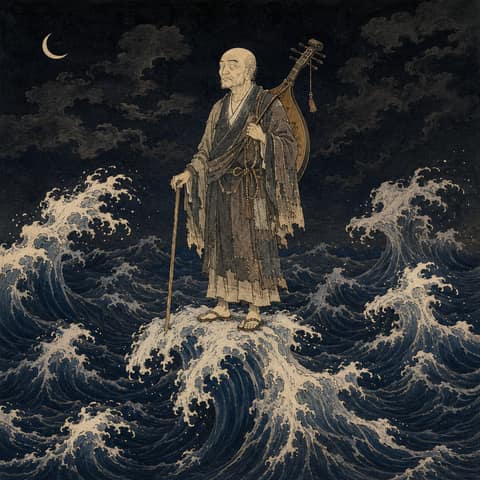
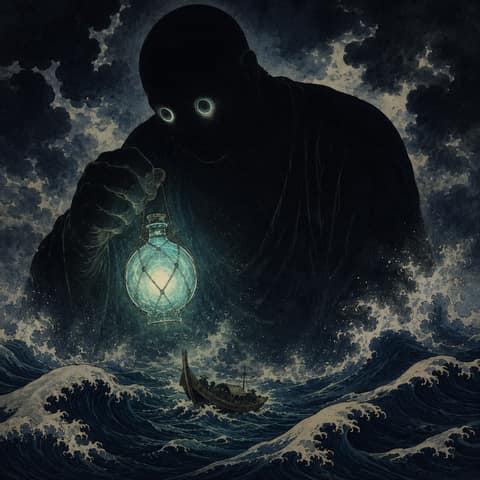
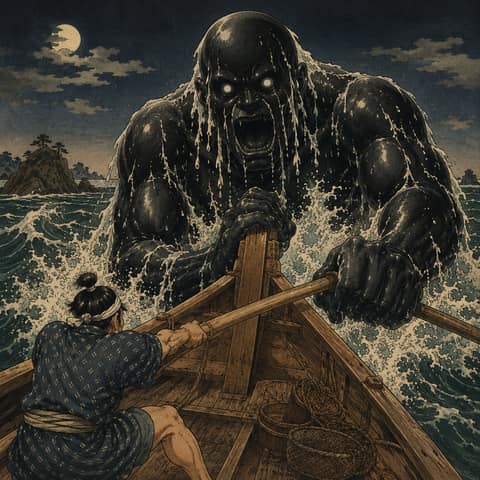
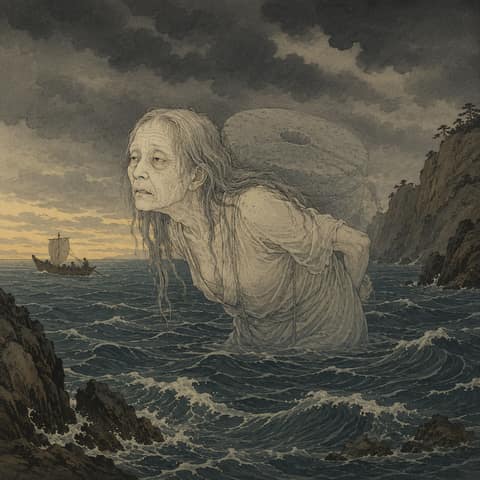
A Sea Monk told along the coasts of Kyushu and Shikoku. It appears on boats and asks for a ladle, yet it never climbs aboard from the stern, always emerging at the bow. When it clings to the oar, if the crew keeps rowing, the oar bites in like a blade and it cries out “Aitata!” In Uwajima, many tales say it harms people, yet those who see a Sea Monk are also said to live long lives.

Umibōzu (Sea Monk)

Umibōzu (Sea Monk)

Legendary

oo-mee-BOH-zoo

Sea Monk of the Chugoku Region

Aquatic SpiritsNagasakiEhime

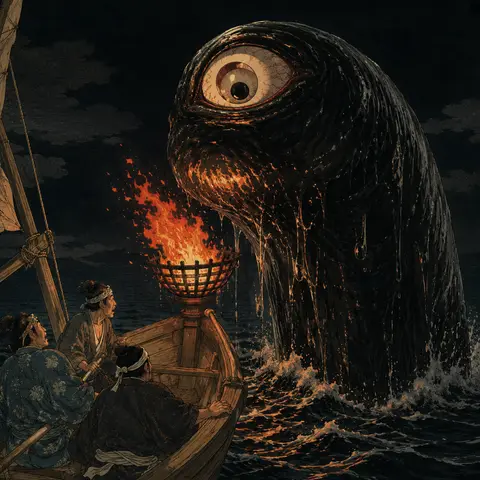
A sea monk told across the Chugoku region. In Nagato it appears to snuff out watch fires, while in Okayama’s Bisan Seto it is called “Nurarihyon,” taking a bead-like form to bewilder people. Along the San’in coast it clings to beachgoers and tries to pull them into the sea. The Tottori collection Inaba Kaidan-shu recounts a one-eyed, post-like sea monk that torments people with its slick, slimy body.

Ungai-kyō (Mirror from Beyond the Clouds)

Ungai-kyō (Mirror from Beyond the Clouds)

Rare

OON-guy-kyo (oon-GAH-ee-kyoh)

Traditional Interpretation (Based on Sekien Toriyama)

Household SpiritsEdo period

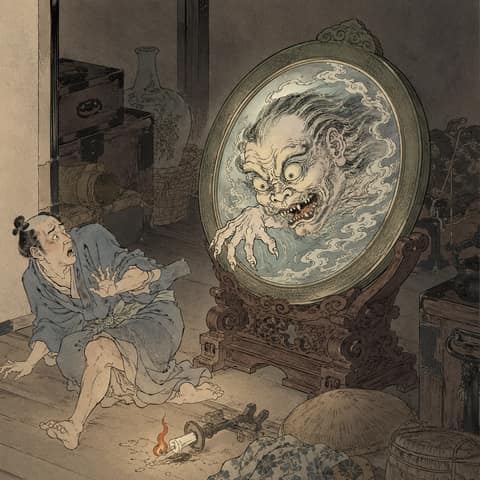
This version is grounded in Toriyama Sekien’s illustration and notes, emphasizing its link to the concept of the demon-revealing mirror. Faces of the uncanny appear on the surface, not necessarily reflecting an external yokai but a spirit residing within the mirror itself. In the lineage of tsukumogami tales, it accords with the belief that long-used implements gain numinous life, sometimes changing mood according to how their owner treats them. Relying on early modern woodblock-book imagery, it has few concrete encounter or harm narratives, and is mostly told in general ghost-story frames such as glimpsing a strange visage when peering into a mirror in a dim room at night. Later depictions of raccoon-dog forms or showy powers are traced to films and children’s books and are set apart from the classical image.

Ushi-no-koku Mairi (Cursing Rite at the Hour of the Ox)

Ushi-no-koku Mairi (Cursing Rite at the Hour of the Ox)

Epic

OO-shee-noh-KOH-koo MY-ree

Ritual Icon of the Cursing Hour

Ghosts & SpiritsKyoto

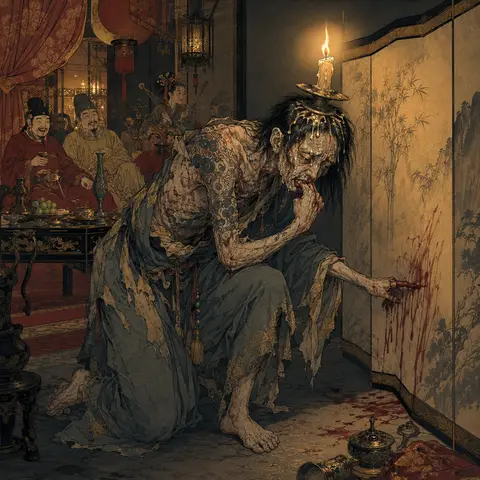
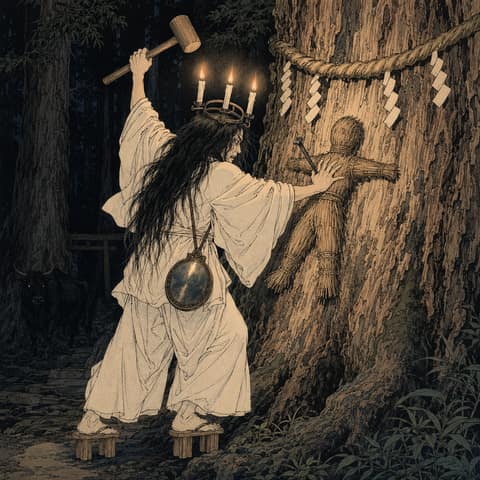
A codified image of the classic Ushi-no-koku mairi centered on Edo-period etiquette. Clad in white burial garb with disheveled long hair, the practitioner inverts an iron trivet as a crown with three candles lit, hangs a mirror on the chest, and moves toward the shrine on single-toothed geta to muffle steps. At the sacred tree, a doll bearing the target’s name is pinned and a five-inch nail is hammered in each night. The witching hour is strictly the third quarter of the Ox Hour, with fulfillment said to come on the seventh night. If witnessed, the rite loses its power, so silence and care to leave no tracks are prescribed. In art, a black ox sometimes accompanies the figure; lore holds that straddling it on the final night brings success, while shrinking back means failure. Straw-doll usage became common in the early modern era, with roots in ancient scapegoat effigy piercings and Onmyodo katashiro rites. Folklore often stops short of asserting curses as real, instead telling that breaking taboos or exposure nullifies the act.

Ushioni

Ushioni

Legendary

OO-shee OH-nee

Cow-Headed, Spider-Bodied Sea Demon: Ushioni

Animal ShapeshifterEhimeKochi

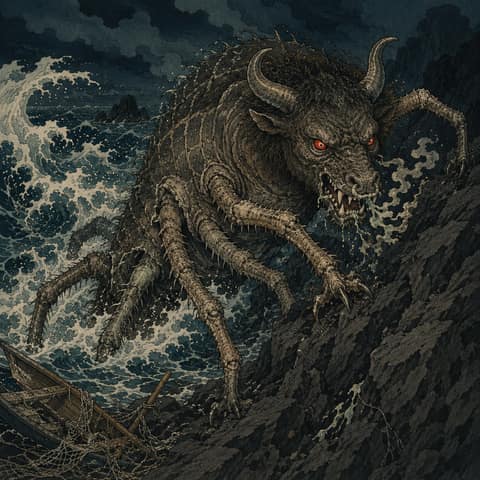
This is the interpretation of the Ushioni depicted in Edo-period yokai picture scrolls and perhaps the most popular in modern yokai encyclopedias: a "sea demon with a cow's head and a spider's body." In this version, the Ushioni visualizes the primal fear of "dark, deep waters" such as seas and pools, combined with the "relentless obsession" of never letting prey escape, symbolized by a spider's web. From a folkloric perspective, the "cow" has been a sacred animal deeply connected to agriculture and flood control in ancient Japan, worshipped as the messenger of water deities, or as the water deity itself (e.g., Gozu Tenno). A prevalent interpretation is that the Ushioni lurking in the abyss is the fallen form of the "fury of nature (water deity)" that people once worshipped and feared, reduced to a yokai as the original faith lost its substance. Its absolute lethality—cursing someone to death simply by licking their shadow—and its cunning in using a Nure-onna as bait to exploit psychological openings surpass the level of a mere low-intelligence beast, strongly retaining the unreasonable divine wrath from when it was a god. Because of its tremendous vitality, driven by malice enough to keep moving even after its head is cut off, ordinary humans cannot hope to stand against it. To quell this overwhelming violence, one had no choice but to either rely on higher Buddhist powers, such as Senju Kannon (the Thousand-Armed Avalokitesvara), or to respectfully incorporate the Ushioni itself into festivals as a vanguard of the portable shrine (a divine familiar), utilizing its "Aramitama" (rough, violent spirit) as a city defense system.

Ushirogami (The Back-Hair Spirit)

Ushirogami (The Back-Hair Spirit)

Rare

oo-SHEE-roh-gah-mee

Iconographic and Literary Tradition Type

Ghosts & SpiritsAcross Japan (primarily Edo-period and Tsuyama traditions)

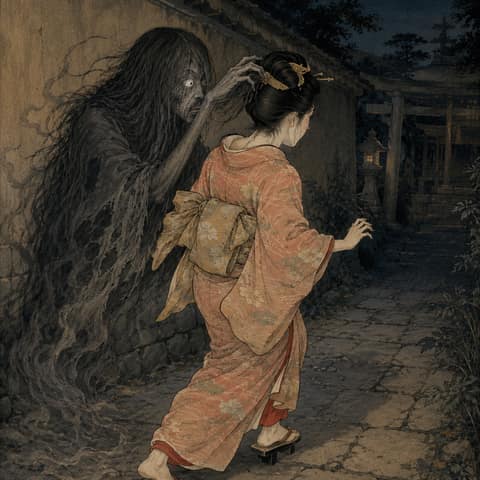
A type shaped by Edo-period print culture, centered on Sekien’s imagery and the psychologized readings in kyoka verse. Rather than a concrete monster, it personifies the feeling of being held back by a tug at one’s trailing hair, dulling decisions through interference from behind. Mizuki Shigeru cites tales from the Tsuyama area that give it a corporeal aspect—ruffling a woman’s hair, breathing hot air—but in all cases it touches from behind and stirs hesitation. It is often grouped with hesitation-inducing yokai such as Okubyogami, Sodehiki-kozō, and Furifuri. Though there are notes of it being enshrined in Ise, specific rites are unknown, and it appears mainly in moral and didactic contexts. Stories survive in both urban and local settings, yet no clear lineage of deity name or object is shown, with wordplay and the concretization of psychology driving its transmission.

Uwan

Uwan

Epic

OO-wahn

Emaki Manifestation Type (Mansion Apparition)

Household SpiritsJapanese folklore

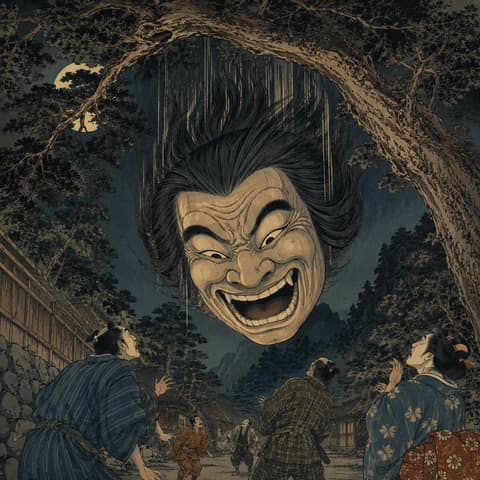
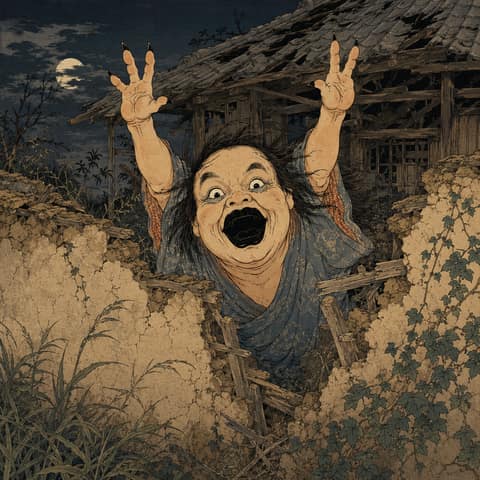
A reconstruction based on Edo-period yokai picture scrolls. Depicted with a humanlike face marked by iron-blackened teeth, raising a three-fingered hand, appearing from behind fences or in ruined houses and shouting “uwan.” No early sources clearly state direct harm to people; its main behavior is appearing and intimidating. Because of similar regional names and frequent mansion backdrops, it is sometimes taken as a house-dwelling entity, but this is unproven and the portrayals are spare. Later creative tales—such as being driven off by a retort or killing victims—should be treated separately from the core record.

Uyauyashi

Uyauyashi

Rare

oo-yah-oo-YAH-shee

Iconographic Tradition Edition

Mountain & Wilderness SpiritsJapanese folklore

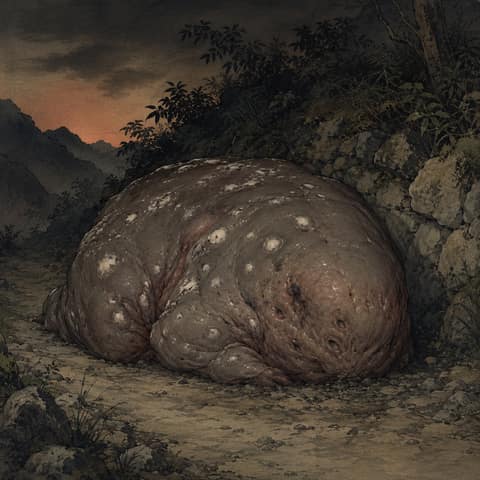
A reconstruction based on imagery from picture scrolls. It kneels low to the ground, the body slack, skin ashen-brown mottled with pale spots. The face is indistinct, the line between mouth and nose blurred, with a damp sheen. In keeping with rare records that preserve little more than its name, no guiding motive is assigned. Said to be seen as a crouching lump by mountain paths or along thickets, it inspires awe and a sense of distance. If approached, it withdraws before its form can be fixed, making pursuit difficult. No confirmed harm is attributed to it, and encounter tales remain general.

Void Drum

Void Drum

Uncommon

koh-KOO DIE-koh

Void Drum (Suō-Ōshima Tradition)

Aquatic SpiritsYamaguchi

The Void Drum is told as a phenomenon that is sound without form. On Suō-Ōshima’s beaches and capes it is heard most around June, especially from dusk as the wind shifts until midnight. Locals relate it to sea roars and echoes among rocks, recording it as a case where natural sound and a spiritual event are inseparable. Oral lore says a troupe of performers once had their boat swallowed by a storm. They beat their drums desperately for rescue but never returned, and in that season ever after the drum’s resonance rose again over the sea. Some describe the tone as light, rapid strokes like a rope-tension drum, others as a single broad beat like a shrine drum, with reports varying by listener. In some areas people press their hands together to console the sea spirits and avoid treating it as an ill omen. Dates and names are unknown and remain in the realm of oral tradition, yet it stands as a classic sea-village sound apparition.

Waira

Waira

Uncommon

WAH-ee-rah

Emaki Tradition Conformant

山野の怪Ibaraki

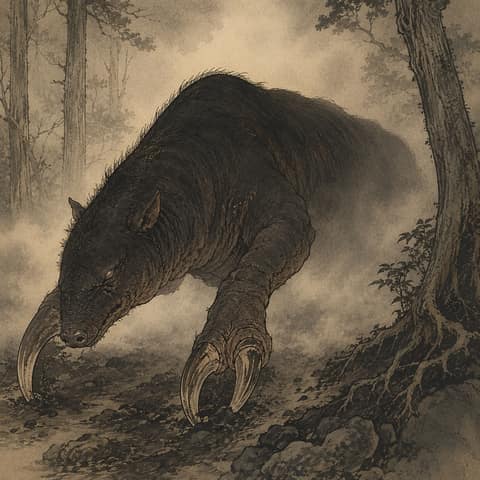
A reference version reconstructed from 18th–19th century yokai picture scrolls that depict the figure without commentary. Only the massive upper body of a beast is shown, bearing large single hooked claws on each forelimb. Color varies by example from dark green to earth tones, with some renderings appearing amphibian. The name is associated with a word meaning fear and is set alongside Otoroshi in works like Hyakkai Zukan and Gazu Hyakki Yagyo. No behavior, ecology, or moral alignment is recorded, presenting it merely as an eerie presence of the mountains. Concrete folk traditions remain unknown, and later embellishments are excluded for lack of sources.

Wanyūdō

Wanyūdō

Epic

wah-nyoo-DOH

Traditional Iconography, Sekien School

Household SpiritsKyoto

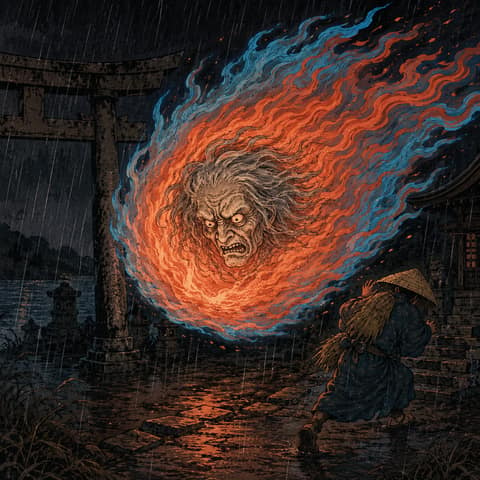
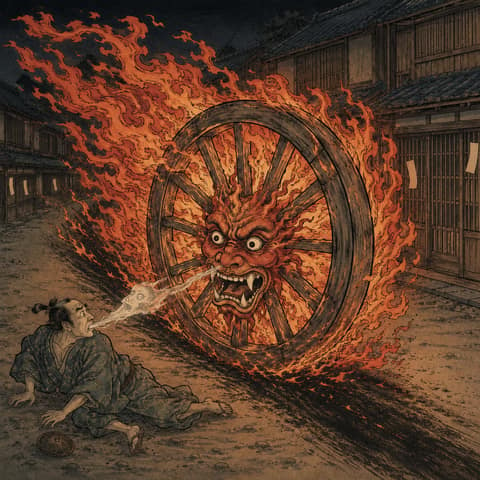
An interpretation grounded in Toriyama Sekien’s depiction. On night roads and at crossroads, a blazing wheel cruises low to the ground, its axle set with a monk-demon mask that fixes passersby with an unblinking stare. Meeting its gaze or succumbing to fear is said to drain one’s vital spirit, leaving the victim stupefied. Its origins trace to Kyoto wheel-ghost tales and likely overlap with the katagiriguruma motif, yet Sekien adopted a nyūdō mask and fixed it as a male figure. The source is uncertain, defying a firm label as vengeful spirit, tsukumogami, or will-o’-the-wisp. Countermeasures include posting a paper charm reading “This is the village of Katsumo” at the doorway, or avoiding eye contact and hiding. Few variants name specific places or people; the core image remains a plain yokai preserved in classical records.

Warei

Warei

Epic

warei

The Goryo of Uwajima: Yamaga Seibee Kinyori

Spirit / GhostEhime

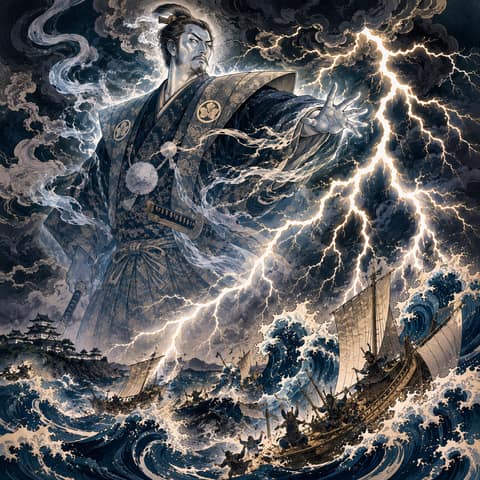
The *Warei* is an entity that embodies the dynamics of *goryo* belief—where a vengeful spirit transforms into an honorable spirit (*goryo*) and then into a guardian deity—within the early modern history of Uwajima. In life, Yamaga Seibee was a retainer who devoted himself to the reform of domain administration. His unnatural death (the Warei Disturbance) and the subsequent chain of lightning strikes and shipwrecks that struck the participants gave people a tangible sense of a curse. The spirit, initially enshrined out of awe and fear, reversed its nature when his innocence was publicly recognized, acquiring the divinity of 'Warei-sama' protecting fishing and industry. The herd of *Ushi-oni* that parades in the Warei Festival at Warei Shrine is a ritual device to comfort and pacify this *goryo*, showing how monsters (*ushi-oni*) and spirits (*warei*) are inextricably linked in Uwajima's festivals.

Watanabe no Tsuna

Watanabe no Tsuna

Epic

watanabe-no-tsuna

The Warrior Who Severed the Demon Arm of Rashomon: Watanabe no Tsuna

Human/Half-YokaiKyotoOsaka

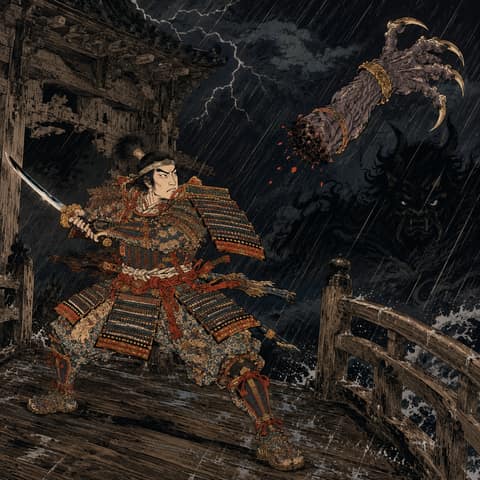
In this version, we read Watanabe no Tsuna as "the boundary warrior who severed the demon's arm." What etched Tsuna's name most strongly in history is the story of him encountering a demon at Rashomon or Ichijo Modoribashi and cutting off its arm. It is no coincidence that the location is a gate or a bridge. A gate divides the inside and outside of the capital, and a bridge connects this shore and the other shore. The demon appears precisely at that boundary. Tsuna's bravery does not completely erase the demon with a single stroke. He can sever the arm, but the demon itself escapes. The remaining arm is both a trophy and evidence that the anomaly has not yet ended. Here lies the fascination of the demon arm tale. The severed arm enters the mansion as an object and is placed under human management, but the demon returns to the human world to take it back. The revisit by the demon disguised as an old woman reveals Tsuna's weakness. He is excellent in martial force, but he finds it hard to lose courtesy toward an opponent taking the form of a relative. The demon strikes at that point. In yokai subjugation tales, the insight to see through anomalies is just as important as martial power. While Tsuna succeeded in cutting the arm, he cannot completely fend off the disguised demon. This imperfection makes him a human-like hero. As one of Yorimitsu's Four Heavenly Kings, Tsuna also occupies an important position in the Mt. Oe subjugation. In his solitary tale, he slashes the boundary demon; in the group tale, he heads for Shuten-doji under Yorimitsu's command. In other words, Tsuna is the figure who connects individual bravery with team demon subjugation. His blade participates in both one-on-one anomaly events and grand subjugation narratives. This version of Tsuna stands between victory and letting the enemy escape. The scene of cutting the demon arm is vivid, but the development of the demon reclaiming the arm shows that anomalies cannot be simply sealed away. Even if the monster is slashed at the boundary, the monster returns inside the house, into the form of a relative, into memories. Watanabe no Tsuna's story simultaneously tells of the exhilaration of demon subjugation and the tenacity with which demons still infiltrate the human world. The demon arm is an object that has crossed boundaries. The moment it is detached from the demon's body, it remains a part of the otherworld while being kept in a human mansion. Tsuna holds the arm as proof of victory, but that arm also serves as a beacon for the demon to return. The trophy is simultaneously a cursed object. The demon disguised as an old woman attacks Tsuna's humanity. A warrior is strong against demons, but cannot discard courtesy toward relatives. Here the story shifts from a contest of strength to a contest of perception. If he knows it is a demon, he can slash it. But when the demon borrows a family member's face, a person cannot easily swing a blade. This version of Tsuna is not a flawless subjugator, but a hero who wins at the boundary and wavers inside the house. That is exactly why the folklore gains depth. Demon subjugation does not end outside; it starts over once back in daily life because of what was brought back, the person trusted, and the seal that was opened. Tsuna's charm lies in his nature as a warrior that includes this wavering. If he were simply strong, the ghost story would end quickly. But he is strong, and at the same time, deceived. Therefore, the story moves from a single stroke of the sword to a conversation in the mansion, deepening from external demon subjugation to internal suspicion. That lingering resonance keeps Tsuna's martial valor from being just a simple victory tale.

Water-Begging Ghost

Water-Begging Ghost

Uncommon

MEE-zoo-koi YOO-ray

Testament Ghost and Water-Begging Ghost (Traditional)

Ghosts & SpiritsAcross Japan (tales circulated mainly in Edo)

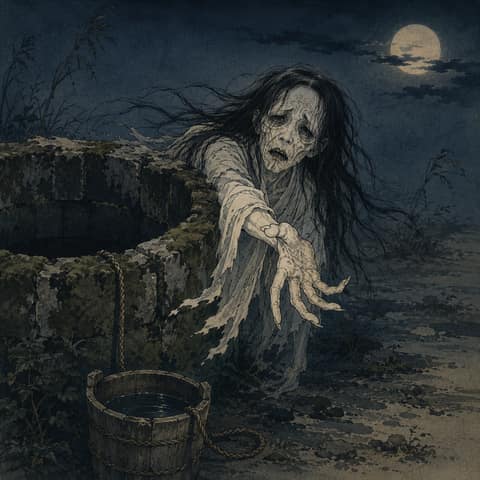
A traditional reading grounded in the side-by-side entries of the Testament Ghost and the Water-Begging Ghost in Ehon Hyaku Monogatari. The spirits of those who died with last words unspoken or burdened by thirst appear at night to plead for water. Individual names and deeds are seldom told; instead they serve as moral parables urging memorial offerings. When monks chant sutras, perform memorial services, feed hungry ghosts, or make alms to the dead, their thirst is said to be soothed with the symbolic “sweet dew” described in scripture. Told in both towns and villages, they appear where people and water meet—by wells, bridges, graves, and roadsides. They stir pity more than terror, and tales warn that rough treatment brings a curse, while respectful rites lay them to rest.

Wave Sprite (Nami-kozō)

Wave Sprite (Nami-kozō)

Uncommon

NAH-mee koh-ZOH

Tradition-Aligned Wave Herald of Enshū-nada

Aquatic SpiritsShizuoka

A folkloric figure tied to the coasts and estuaries of former Tōtōmi Province, said either to descend from a straw doll set adrift by the monk Gyōki or to have signaled drought-stricken farmers with the sound of waves. It appears as a small child or tiny doll, with no fixed features. Its role is to foretell weather by wave-sound, indicating the approach of rain and wind by direction and intensity, allowing fishers to judge whether to launch and farmers to plan their work. It overlaps with ideas of water and dolls, kappa tales, and accounts under the name umibōzu, yet all remain within a frame that reads sea-roar as folk knowledge. Rather than an object of worship, it is a personification of awe-inspiring natural signs, and offerings or rites vary by region. Records rely on local materials and oral tradition, with details often uncertain.

Weeping Stone

Weeping Stone

Uncommon

yo-NAH-kee ee-shi

Legend of Sayo no Nakayama

Mountain & Wilderness SpiritsShizuoka

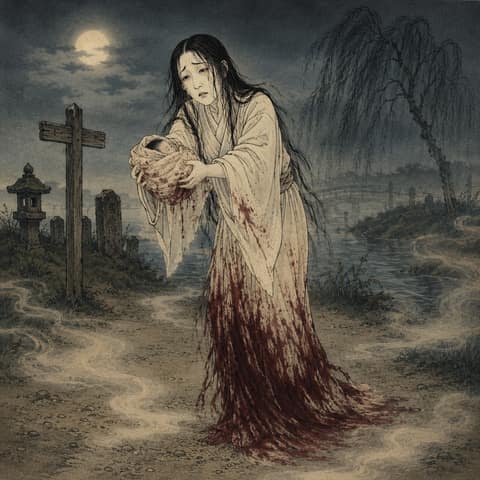
A representative form from the Tokaido’s Sayo no Nakayama. The spirit of a pregnant woman murdered on her journey is said to have possessed a stone and cried each night for her unborn child. People performed memorial rites, and in time the spirit was soothed. Folklorically, it is tied to roadside memorials, Koyasu child-protection faith, and the erection of stone steles, reflecting an older belief that spirits dwell within stones.

Yako (Field Fox)

Yako (Field Fox)

Uncommon

ya-ko

The Yako — Low Fox of the Kyushu Packs

Animal ShapeshiftersNorthern Kyushu, Izumi, and elsewhere (a low-ranking fox spirit)

This version turns to how the Yako was spoken of in the Buddhist world, and in Zen in particular. Zen has the term yako-zen, "wild-fox Zen." It is a word of admonition for a half-finished state in which one has not truly attained enlightenment yet believes oneself enlightened. Its source is the famous tale "Hyakujō and the Wild Fox," recorded in the Song-dynasty Zen collection of dialogues, the Mumonkan. An old man came to listen each time the Tang Zen master Baizhang Huaihai (Hyakujō Ekai) preached. One day the old man revealed his story. Long ago, when he had been abbot of this very temple, he was asked whether one who has attained enlightenment still falls subject to cause and effect (karmic retribution), and he answered, "He does not fall (into cause and effect)." For that single mistaken word he had been cast into the body of a wild fox through five hundred rebirths. The old man begged Hyakujō for the correct answer. When Hyakujō rephrased it as "He does not obscure cause and effect," the old man was freed of his delusion on the spot, shed the wild-fox body, and attained buddhahood. Here the wild fox becomes a symbol of admonition—the form into which one who has fallen into half-baked enlightenment is transformed. Quite apart from the village field fox that deceives people, the Yako has lived on at length within the language of Zen as well, as "where shallow cleverness ends up."

Yamabiko

Yamabiko

Epic

yah-mah-BEE-koh

Traditional Figure (Kodama and Mountain-Deity Retainer Interpretation)

自然現象・自然霊Nagano

Yamabiko is the personification of echoes in the mountains, interpreted as a kodama or a retainer of the mountain deity. Its habit of repeating words back is seen as a boundary-marking reply within the mountain domain, warning against reckless shouting that disrupts the mountain’s vital energy. Early modern images depict it as a small beast akin to a dog or monkey; figures in Hyakkai Zukan and Gazu Hyakki Yagyō have been linked to the yama-ko in Wakan Sansai Zue and to Penghou, said to dwell within trees. Depending on region, intermediaries vary—bird calls like the yobukodori or resonant rocks such as “Yamabiko Rock.” Phenomenon, spirit, and monster imagery overlap in layered tradition.

Yamamoto Gorōzaemon

Yamamoto Gorōzaemon

Uncommon

yah-mah-MOH-toh goh-ROH-zah-eh-mon

Inō Mononoke-roku: Variorum Tradition

Mountain & Wilderness SpiritsHiroshima

This version builds on a record narrative centering on the Miyoshi anomalies of Kan’en 2. The chieftain declares himself in samurai guise at the close of the thirty days of hauntings, mentioning a wager with Kamino Akugorō. He states he is neither tengu nor fox spirit, yet some paintings depict him as a three-eyed crow-tengu, revealing a gap between text and image. Across manuscripts his name varies—Yamamoto Gorōzaemon, Yaman-moto Gorōzaemon, Yamamoto Tarōzaemon—and in alternate strands he bestows different gifts, such as a mallet or a scroll of rites. Around Miyoshi, multiple “trial of the brave” tales persist, sharing a sequence of fixed-term hauntings, the master of the house remaining unshaken, the leader’s appearance and words of praise, and a token left upon departure. His concrete nature and origin remain unsettled, while his role as a demon-king-like commander is emphasized. Given differences among early modern essays and picture scrolls, proper names and details should be treated as variant by text.

Yamaoroshi

Yamaoroshi

Rare

yah-mah-oh-ROH-shee

Based on Sekien Toriyama’s Iconography

Animated Objects & UndeadJapanese folklore

A reconstruction guided by Sekien Toriyama’s image and notes. The head resembles a grater, its surface studs likened to porcupine quills. Though written as “Yamaoroshi,” its nature is not a mountain wind itself but an abstract monster born from combining a utensil (grater) with a bestial image. Daikon radishes and mortars placed nearby signal a tsukumogami-style scene, with no specific harm or blessing described. Rooted in Edo-period paintings, it lacks regional oral lore or cult, and later handbooks often present it as an example of utensil transformation and wordplay.

Yamata no Orochi

Yamata no Orochi

Divine

Yamata no Orochi

Serpent God of Izumo's Hii River: Yamata no Orochi

Divine spirit / serpent deityShimaneHiroshima

Orochi is more than a snake. The old word orochi is often explained as combining a term for peak or ridge with chi, a word for spirit-power. The Kojiki describes moss, cypress, and cedar growing on the serpent and a body spanning eight valleys and eight ridges. That is closer to a living mountain range than to an animal. Other Japanese serpent-slaying tales, from Koga Saburo at Suwa to the Yahiko serpent of Echigo and the Aso traditions around Takeiwatatsu, can be read in the same serpent-deity line. The Kojiki's account of Omononushi in the reign of Sujin, where a god appears as a snake, forms another great pole of ancient Japanese serpent worship. Sand iron and the bloody riverbed. Oku-Izumo was a center of sand iron and tatara smelting. Kanna-nagashi washed mountain soil through channels, separating sand iron and staining riverbeds with red earth and iron. The Kojiki's image of Orochi's belly as always bloody and raw can therefore be read as the mythic language of a red river. Furnace fire, the relative independence of ironworking groups, and the seizure of good blades by central power all make the ironmaking reading persuasive. Mizu no Bunka issue 54 presents this as one of the key local theories. The repeated eight. Yamata, eight heads and eight tails, eight valleys and eight ridges, yashiori sake, eight vats, and the "Yakumo tatsu" poem all make eight the story's organizing number. It may mean literal eight, sacred multiplicity, or both. The eightfold fence around Kushinada-hime gives the number a ritual and spatial force. Even the placement of the tale in book one, section eight of the Nihon Shoki has invited speculation, though that remains an inference about editorial intent. Izumo drawn into Yamato myth. Orochi's defeat can also be read politically. A serpent deity of Izumo is slain by Susanoo from the Takamagahara sphere, and the treasure inside its tail enters the imperial regalia. The later kuni-yuzuri myth of Okuninushi follows the same broad problem: how Izumo is brought into the central mythic order. The Izumo no Kuni no Miyatsuko lineage claims descent in the Susanoo line while serving Okuninushi's cult, so the story survives both as a myth of conquest and as Izumo's own ritual memory. Iwami Kagura keeps the serpent moving. Iwami Kagura's Orochi turns the ancient myth into a present-day bodily performance. Paper-and-bamboo serpent bodies coil and strike across the stage, and several serpents may fight at once. Once an offering at shrine festivals, the performance also became a postwar attraction and regional symbol. What the audience sees is not an abstract myth, but the way Izumo and Iwami continue to tell the serpent story through movement, sound, and spectacle.

Yamauba

Yamauba

Legendary

yah-mah-OO-bah

Yamanba (Traditional Folkloric Form)

Mountain & Wilderness SpiritsKanagawa

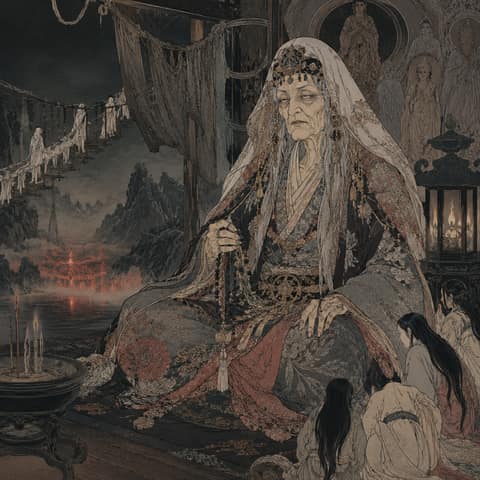
An elderly woman with white hair and a body hardened by life in the mountains, she is famed as the nurturing figure who raised Kintaro. Her deeply lined face reflects priceless life experience, and she offers precise guidance to the lost. Though she may appear strict, a profound love resides beneath the stern exterior.

Yamauba

Yamauba

Legendary

yah-mah-OO-bah

Mother of Kintaro

Mountain & Wilderness SpiritsKanagawa

Deep in the Ashigara Mountains, in a secluded hollow along bamboo ridgelines untrodden by humans, dwells a lineage of yama-uba known as the Yae-giri Mother Form. Bathed at birth in dew gathered on layered paulownia leaves and nourished by the breath of the mountains, this line is said to conceive children through union in dreams with an akairyū—an “red dragon” that appears on nights when crimson vapors gather. They rarely mingle with the human world, opening paths for those who keep the mountain’s order and baring fangs at those who trample its law. The Ashigara Yae-giri Mother Form takes as her charge the raising of children, favoring those with especially strong vital spirit. With few words she teaches how to split firewood, read the presence of beasts, ford streams, follow the courses of stars, and use the virtues of roots, leaves, and bark. When a child stumbles on a stone she watches and smiles, and when blood is drawn she silently applies moss juice. It is not pampering but passing on the mountain’s severity as it is. The crimson vapor seen in the Konjaku Monogatari is her warding veil, a barrier that blinds the eyes of outside gods. When Yorimitsu ascended from Kazusa, he recognized that vapor and sent Watanabe no Tsuna, an act born of the ancients’ intuition about this Mother Form’s power. In a thatched hut lived an old woman and a youth not yet twenty. The old woman called herself a demon-woman and felt no shame for her bond with the dream-red dragon, saying only that the child was born according to the mountain’s law. The boy she raised was later named Sakata Kintoki and became famed, yet once a child enters the world the Yae-giri Mother Form releases attachment and fades like mountain mist, caring nothing for wealth or honor, wishing only that the mountain’s balance remain unbroken. In Edo times, when the Kimpira jōruri was popular, she was portrayed as an ogress, but in old tales of Ashigara, oni signifies awe-inspiring power and is not confined to evil. Stories of bearing a thunder child and of a red dragon entrusting a child to the paulownia atop Mount Kintoki show this lineage’s dual nature of receiving from heaven and nurturing on earth. When sharing the mountain’s bounty she wears the face of an old mother, against ravagers she takes the aspect of a peak-dwelling oni. At midnight, when crimson vapor drapes the ridge, she consults the stars over a child’s fate and, if needed, commands beasts and trees to open the way. She leaves no treasure, only marks carved in wood grain and the remembered weight of a hand-axe in a child’s palm. Even now, on mist-laden mornings deep beyond the Ashigara Pass, she is said to listen for the breath of those who are meant to be raised, hidden within the rustle of bamboo wrens.

Yamawaro

Yamawaro

Rare

yamawaro

The Mountain Child of Kyushu Migrating Between Mountains and Rivers: Yamawaro

Mountain / Field YokaiNagasakiFukuoka

While the *Yamawaro* is a mountain monster unique to the mountainous regions of Kyushu, its greatest originality lies in the fact that it forms two aspects of a single body with the *kappa*. The fact that Terajima Ryoan noted the habitation of *Yamawaro* in Chikuzen and Goto in *Wakan Sansai Zue* is evidence that early modern intellectuals incorporated the folklore of grotesque beings from the western mountains into the framework of natural history, showing that the Goto Islands were designated early on as a land of *Yamawaro* traditions. In the migration belief, it is said that the *kappa* of the river and the *Yamawaro* of the mountain switch places at the boundary of the spring and autumn equinoxes, which is thought to be a crystallization of the agricultural calendar, water god worship, and mountain god worship into a single existential image. Its assistance to woodcutters and the reward of rice balls, its love of sumo, its dietary preference for salt and crabs, and its grotesque form with dog ears, red hair, and a single eye are all supported by the *Wakan Sansai Zue* and the oral traditions of various parts of Kyushu. Amidst life in the Goto Islands, surrounded by sea and mountains, the *Yamawaro* has become inextricably linked to the *kappa* (*gataro*), becoming an entity that embodies the local spirituality penetrating both the waterside and the mountains.

Showing 433 - 456 of 473 yokai