YOKAI.JP

Yokai Encyclopedia

Explore Japanese yokai by name, type, place, and theme

112 Yokai|12 Category|Page 5 of 5
Localization in Progress - More content available in Japanese version
View Japanese
Sort by: NameAscending
神霊・神格
  • Yamata no Orochi

    Yamata no Orochi

    Divine

    Yamata no Orochi

    Serpent God of Izumo's Hii River: Yamata no Orochi

    Divine spirit / serpent deityShimaneHiroshima

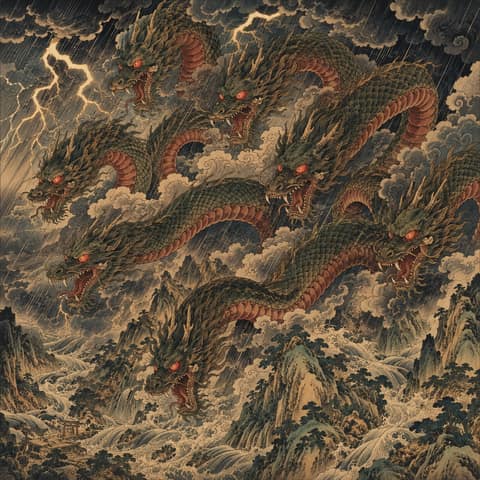
    Orochi is more than a snake. The old word orochi is often explained as combining a term for peak or ridge with chi, a word for spirit-power. The Kojiki describes moss, cypress, and cedar growing on the serpent and a body spanning eight valleys and eight ridges. That is closer to a living mountain range than to an animal. Other Japanese serpent-slaying tales, from Koga Saburo at Suwa to the Yahiko serpent of Echigo and the Aso traditions around Takeiwatatsu, can be read in the same serpent-deity line. The Kojiki's account of Omononushi in the reign of Sujin, where a god appears as a snake, forms another great pole of ancient Japanese serpent worship. Sand iron and the bloody riverbed. Oku-Izumo was a center of sand iron and tatara smelting. Kanna-nagashi washed mountain soil through channels, separating sand iron and staining riverbeds with red earth and iron. The Kojiki's image of Orochi's belly as always bloody and raw can therefore be read as the mythic language of a red river. Furnace fire, the relative independence of ironworking groups, and the seizure of good blades by central power all make the ironmaking reading persuasive. Mizu no Bunka issue 54 presents this as one of the key local theories. The repeated eight. Yamata, eight heads and eight tails, eight valleys and eight ridges, yashiori sake, eight vats, and the "Yakumo tatsu" poem all make eight the story's organizing number. It may mean literal eight, sacred multiplicity, or both. The eightfold fence around Kushinada-hime gives the number a ritual and spatial force. Even the placement of the tale in book one, section eight of the Nihon Shoki has invited speculation, though that remains an inference about editorial intent. Izumo drawn into Yamato myth. Orochi's defeat can also be read politically. A serpent deity of Izumo is slain by Susanoo from the Takamagahara sphere, and the treasure inside its tail enters the imperial regalia. The later kuni-yuzuri myth of Okuninushi follows the same broad problem: how Izumo is brought into the central mythic order. The Izumo no Kuni no Miyatsuko lineage claims descent in the Susanoo line while serving Okuninushi's cult, so the story survives both as a myth of conquest and as Izumo's own ritual memory. Iwami Kagura keeps the serpent moving. Iwami Kagura's Orochi turns the ancient myth into a present-day bodily performance. Paper-and-bamboo serpent bodies coil and strike across the stage, and several serpents may fight at once. Once an offering at shrine festivals, the performance also became a postwar attraction and regional symbol. What the audience sees is not an abstract myth, but the way Izumo and Iwami continue to tell the serpent story through movement, sound, and spectacle.

  • Yamato Takeru

    Yamato Takeru

    Legendary

    Yamato Takeru

    Yamato Takeru, the tragic hero and greatest warrior of ancient Japan

    Divine spirit / deified heroShiga

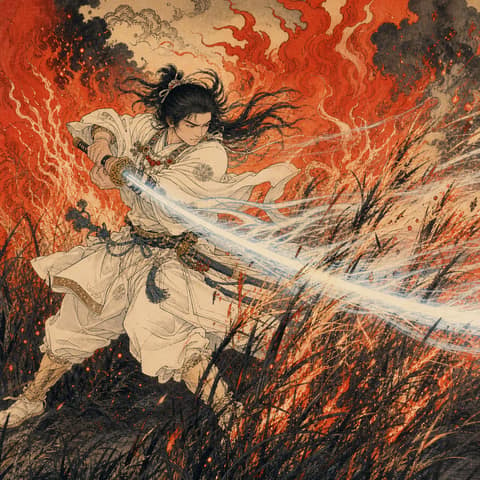
    The ancient mythic type of the tragic hero. The general entry covered Yamato Takeru's myth. Here the focus is the ancient pattern of the tragic hero. Yamato Takeru is a rare heroic deity who unites the tragic hero, short-lived warrior, father-son conflict, sacrificial love, and ascent after death in a single figure. He begins with fratricide, is rejected by his father and sent on campaigns, survives through his wife's sacrifice, and dies from a mountain god's curse. That arc is structurally close to tragic heroes across the ancient world, including Heracles, Sigurd, and Arjuna. It is a Japanese form of a widespread story pattern: the fate, suffering, and heavenly transformation of the hero. Father-son conflict and the myth of heroic exile. Yamato Takeru is estranged from Emperor Keiko and repeatedly ordered to go on distant campaigns. In comparative mythology, this belongs to the broad pattern of a dangerous son being exiled, tested, and made to conquer. Stories in which a father or ruler sends such a figure away are often compared with traditions surrounding David, Sigurd, and Zheng He, and they reflect questions of patriarchy, succession, and kingship. The tale marks the killing of the brother as a failure of human restraint, yet it also shows the father's coldness. That double structure gives the story a tragic intelligence beyond simple good and evil. Disguise as a young woman: strategy turned into myth. In the Kumaso episode, Yamato Takeru disguises himself as a young woman, enters the enemy camp, and kills the chieftain. The scene is a memorable mythic rendering of military strategy, disguise, and surprise attack. Yet the female disguise is more than tactics. In ancient Japanese myth and folklore, reversal, thresholds, and the crossing of gendered boundaries can be sources of ritual power and sacred danger. Yamato Takeru's disguise can therefore be read not simply as deception but as an act that embodies the magical force of inversion. It also stands as a mythic ancestor to later religious and theatrical traditions of cross-gender performance in kagura, noh, and kabuki. The Kusanagi sword and the Three Sacred Treasures. Yamato Takeru receives the Kusanagi sword from Yamato-hime, escapes the Yaizu fire with it, and after his death the sword is enshrined at Atsuta Jingu. Kusanagi is one of the Three Sacred Treasures at the core of ancient Japanese royal legitimacy. Its transmission runs from Susanoo's defeat of Yamata no Orochi, to presentation to Amaterasu, to the heavenly descent of Ninigi, to Yamato-hime, to Yamato Takeru, and finally to Atsuta Jingu. Through that chain, myth, sacred object, and imperial lineage are joined in material and religious form. Yamato Takeru is one of the few figures who actually uses a sacred treasure in battle, making him a symbol of the union of artifact, hero, and state. Ototachibana-hime's sea sacrifice and the origin of Azuma. Ototachibana-hime's self-sacrifice at sea and Yamato Takeru's cry, "Azuma haya," are treated as the mythic origin of Azuma, the eastern lands and eastern Japan. Ancient myth did not only entertain; it gave meaning to names, geography, land, and local custom. Here a woman's sacrifice becomes attached to the name of the entire east. Hashirimizu Shrine in Yokosuka still enshrines Ototachibana-hime, showing that the episode continues not only in texts but also in place names, worship, and local memory. The death poem and ancient Japanese longing for home. The death poem Yamato Takeru sings at Nobono, "Yamato wa kuni no mahoroba," has long been cherished as one of ancient Japan's foundational expressions of homeland, longing, and love of country. Mahoroba means an excellent, beautiful place, and the word condenses an early feeling for the homeland and the land itself. It influenced later waka traditions such as the Man'yoshu, Kokinshu, and Shinkokinshu. The structure is powerful: a hero at the edge of death praises the place he longs to return to. In modern Japan, the poem has continued to appear in education, literature, music, and public speech. The white-bird legend and ancient Japanese ideas of ascent and rebirth. After death, Yamato Takeru becomes a white bird, rises from his tomb, passes through Kotohiki-no-hara in Yamato and Shiki in Kawachi, and flies high into the sky. The legend is a representative example of the ancient Japanese idea that a hero may ascend and be transformed after death. In early Japan, the white bird could be imagined as a bearer of souls or a messenger of the gods. Beliefs in the dead soul becoming a bird and rising to the sky also have affinities with northern Asian, Siberian, and Korean ideas of birds, funerary practice, and the soul. The image later resonated with Pure Land faith, Shinto views of death, warrior ethics, and even the spiritual culture around the kamikaze special attack corps. It is not merely an ending to a hero tale. It is one of the narratives through which ancient Japan thought about death, religion, and beauty. Yamato Takeru in the twenty-first century. Today Yamato Takeru remains a subject of ancient-history research, local tourism, Shinto worship, and popular culture. Visits to Nobono, Kotohiki-no-hara, Atsuta Jingu, Yaizu Shrine, and Hashirimizu Shrine continue. He is repeatedly reshaped in works such as the game Okami, the 1994 film Yamato Takeru, and manga including Demon Slayer. Across more than two millennia of cultural memory, he has remained a symbol of the tragic hero, the short-lived warrior, love and sacrifice, and ascent after death. From political emphasis in prewar State Shinto, through postwar cultural reinterpretation, to plural retellings in the twenty-first century, he is a model case of how an ancient divine figure can keep entering modern culture.
  • Yatagarasu

    Yatagarasu

    Divine

    yatagarasu

    The Sacred Bird Leading from Kumano to Yamato: Yatagarasu

    Divine Spirit / DeityWakayamaNara

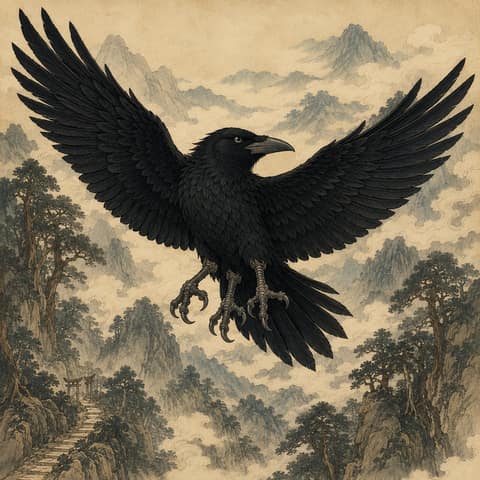
    In this version, we read the Yatagarasu as the "divine messenger who opens the way." The Yatagarasu is not a war god who strikes down enemies, but a presence that indicates where one should go. In the tale of the Eastern Expedition, when the party is lost on the mountain paths of Kumano, the heavenly gods do not increase their army, but send a single crow. Herein lies the essence of this sacred bird. Bestowing direction, rather than power, is the divine virtue of the Yatagarasu. The Yatagarasu in the *Kiki* binds geography and legitimacy simultaneously. The road entering Yamato from Kumano is not a mere mountain path, but a boundary that must be crossed for a new royal authority to be established. The scene in the *Kojiki* where the crow leads the way not only shows the route through the mountains but narrates that Jimmu's progression is approved by the gods. The direction the bird flies directly becomes the political course. The iconography of the three legs vastly expanded later understandings of the Yatagarasu. The three-legged crow overlaps with the East Asian concept of the sun bird, granting Japan's Yatagarasu the meanings of the sun, direction, and heavenly order. However, the strongest aspect in the original text of the *Kiki* is not "three legs" but "guidance." Therefore, this version does not lean too heavily on the splendor of its iconography, but centers on the primal sensation of a black bird flying ahead on a dark mountain road. Within the Kumano faith, the Yatagarasu gained a concrete place of worship as a divine messenger. The crow characters of the Kumano Goou Houin are not mere decorations; they are signs carrying the power of vows and talismans. While crows are often viewed as ominous scavengers of carrion, they also become birds that carry the words of the gods. This duality prevents the Yatagarasu from being reduced to a simple, cheerful mark of victory. The depth of the Kumano mountains and its mythology lies in the fact that a black bird becomes a holy guide. The modern image of the Yatagarasu is also read as a symbol of sports victories and indicating a team's course. Yet, at its root is the experience of a signpost appearing ahead when a lost person can no longer proceed alone. The Yatagarasu of this version does not explain the answer at length. It simply flies ahead. Whether to follow or not is left entirely to the humans. In this version, we also want to draw attention to the Yatagarasu's blackness. Crows are frequently viewed as inauspicious birds, but in the context of Kumano, they become messengers of the gods. Where the ominous and the sacred invert, there lies the profound depth of mountain asceticism. Proceeding without losing sight of the black bird on a dark mountain path is akin to reading divine will in the dark. Furthermore, the Yatagarasu is a guide who speaks few words. It does not stand before them as a god like Sarutahiko, but flies ahead as a bird. Humans must interpret the direction of its flight and advance on their own two feet. Guidance is not forced; it demands reading. Therein lies the quiet severity of the Yatagarasu. Even today, when the three-legged image and the soccer emblem are widely known, the root of this sacred bird remains on that mythological mountain path cutting from Kumano to Yamato. Stripping away the glamorous symbolic layers, what remains at the end is a single, giant crow flying ahead of a lost party. That simple scene is the strongest image of the Yatagarasu. Because of this, the Yatagarasu symbolizes not the destination itself, but the trust required to head toward the destination. When the road is unseen, a person must first believe in the direction they are advancing. The leading flight of the black bird is the mythological gesture that gives form to that trust.

  • Yokkabu-i

    Yokkabu-i

    Common

    Yokkabu-i

    Deity Preaching Warnings of the Water

    Gods & SpiritsKagoshima

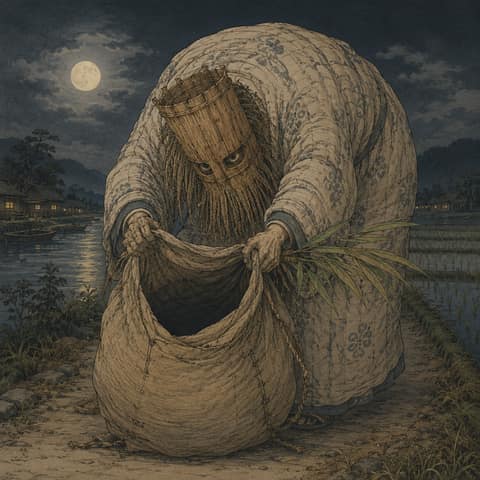
    The Yokkabu-i ritual is a rare folkloric example that beautifully blends water god worship with the discipline of children in the Satsuma Peninsula, where Garappa (kappa) legends remain strong. The method of manifesting an extraordinary "god" using eerie masks made of palm bark and everyday tools like the *yogi* conveys the ancient layers of Japan's masked deity and visiting deity faiths. While the continuation of such traditional events is threatened by a declining and aging population, it has functioned as a crucial cultural mechanism to deepen community bonds and pass down both the terrors and blessings of nature to the next generation.

  • Yomotsushikome

    Yomotsushikome

    Legendary

    よもつしこめ

    Underworld Pursuer of the Kojiki: Yomotsushikome

    Divine Spirit/DeityYomi (Mythology) / Yomotsu Hirasaka Lore Site (Higashi-Izumo-cho Iya, Matsue City, Shimane Prefecture)

    The Position of Grotesque Deities in Kiki Mythology. While the basic description touches on the accounts in the *Kojiki* and *Nihon Shoki*, the deep dive explores Yomotsushikome's position as a "grotesque deity" within the mythological system. Deities in *Kiki* mythology are broadly classified into three layers: (1) Takamagahara lineage (heavenly/pure deities), (2) Ashihara-no-Nakatsukuni lineage (earthly/indigenous deities), and (3) Yomi lineage (deities of the dead/grotesque deities). Yomotsushikome belongs to the third lineage, forming a cohesive system alongside Izanami (the goddess stationed in Yomi), the Eight Thunder Deities, and the Underworld Army. *Kiki* mythology is not a simple dualism of good and evil; it possesses a three-tiered structure of "life, purity, and light" versus "death, impurity, and darkness," where grotesque deities are positioned as essential entities upholding the order of the underworld. Etymology of "Shiko"—The Semantic Field of Ancient Japanese. Interpreting "shiko" as "ugly" is a reductive interpretation from the Middle Ages onwards. In ancient Japanese, "shiko" was a rich word connoting "strength, hardness, and terror." Cognate words like "shikobuchi" (rocky abyss) and "shikofune" (sturdy boat) express the hardness of coastal rocks. "Shikome" was not merely an "ugly woman" but understood as a "hard, strong, and terrifying female demon-deity." The names of ancient deities tended to be based on "spiritual power and function" rather than "visual features," positioning Yomotsushikome as a "female demon-deity with terrifying power governing death." The fixed image of a "flesh-rotting, fanged hideous hag" in medieval picture storytelling is a later reconstruction distinct from her original mythological figure. East Asian Comparison of Peach Warding Beliefs. The episode of Izanagi using peaches to repel Yomotsushikome serves as a key subject in comparative religion regarding East Asian warding culture. In Chinese Taoism, warding off evil spirits using peach wood swords, peach charms, peach seals, and peach offerings was systematized and widely spread to East Asian regions. The magical power of the peach repeatedly used in Japanese court rituals (Tsuina, Tango no Sekku, Momo no Sekku) was formed through the complex intertwining of the Izanagi myth in the *Kojiki* and Chinese Taoist peach worship. This is a classic example of how ancient Japan constructed its unique system while assimilating the religious cultures of the Chinese mainland and the Korean peninsula. The Pursuit Tale as a Narrative Type. A hero escaping from the land of the dead by throwing magical items that transform to delay pursuers—this is known in world mythology as the "Magic Flight" motif, a widely distributed narrative type. Similar tales exist in the Greek myth of Orpheus and Eurydice, Eastern European folklore of Baba Yaga, and Native American creation myths, demonstrating a universal structure of ancient human concepts of the underworld and escape narratives. The tale of Izanagi and Yomotsushikome holds exceptionally high comparative mythological value as one of the oldest literary records of this global narrative type in East Asia. The Geography of Yomotsu Hirasaka—Relationship with the Izumo Belief Sphere. The modern estimated site of Yomotsu Hirasaka in Higashi-Izumo-cho Iya, Matsue City, Shimane Prefecture, is located in the core region of the ancient Izumo belief sphere, alongside the Izumo Kuni-no-Miyatsuko stronghold, Kumano Taisha, and Kamiarizuki legends. In the *Kojiki* and *Nihon Shoki*, Izumo is depicted as the intersection of the three mythological layers—Takamagahara, Ashihara-no-Nakatsukuni, and Yomi—and placing the "entrance to Yomi" in Izumo was no coincidence. It reflects Izumo's status as the religious center for "death, the otherworld, and Ne-no-Katasukuni" in ancient Japan. Myths involving Okuninushi, Susanoo, Izanagi, and Izanami intersect in this region, serving as the key to deciphering ancient religious geography. Reduction Since the Middle Ages and Modern Renewed Interest. In medieval sermons, picture storytelling, Noh, and Joruri theater, Yomotsushikome was fixed into the image of a "flesh-rotting, fanged hideous hag," losing the original ancient semantic field of a "strong female demon-deity." However, since the 2010s, amidst a renewed interest in Japanese mythology, re-evaluations based on findings in ancient linguistics, mythology, and archaeology are progressing. Modern subcultures such as the *Megami Tensei* game series, *Record of Ragnarok* manga, and *Demon Slayer* anime functionally reconstruct ancient mythological materials, thereby reintroducing the mythological worlds of Yomotsushikome, the Underworld Army, and Yomi to younger generations. This is a symbolic example of cultural historical circulation from ancient to modern times. Positioning as "Japan's Oldest Yokai". Yomotsushikome is a female demon-deity appearing in the *Kojiki* (712 CE), Japan's oldest extant book, giving her a unique status not just as a "post-Heian yokai" but as a "grotesque deity recorded in the original texts of Japanese mythology." Predating the yokai systems involving oni, tengu, and kappa that formed from the Middle Ages onwards—in an era where the boundary between ancient gods (kami) and yokai was still undifferentiated—she is a core subject for tracing the origins of yokai studies. Dismantling the binary opposition of "is it a god or a yokai?", she serves as an excellent starting point for examining the rich, multi-layered nature of ancient Japan's grotesque deities.

  • Yudonosan-daigongen

    Yudonosan-daigongen

    Divine

    Yudonosan-daigongen

    The Unspeakable Deity of the Sacred Rock of Mount Yudono

    Divine Spirits / DeitiesYamagata

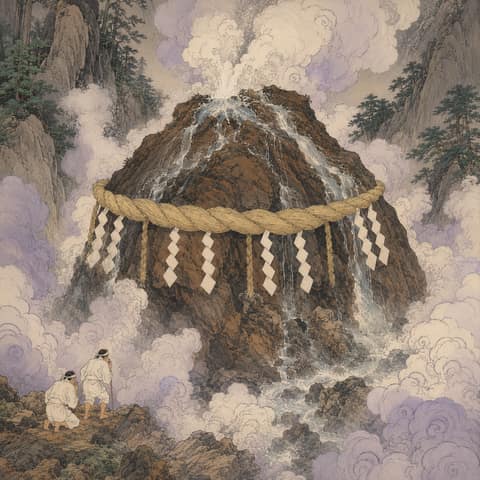
    Yudonosan-daigongen does not have a tangible statue form; instead, a giant, brownish-red sacred rock spewing hot water serves directly as the object of worship, preserving the oldest form of nature worship in Japanese mountain faith. The Dewa Sanzan are considered a trinity of ascetic training grounds: Mount Haguro symbolizes worldly happiness in the present, Mount Gassan represents the afterlife, and Mount Yudono signifies the future of rebirth. Therefore, Mount Yudono, as the inner sanctuary, is positioned as the final destination of the three-mountain pilgrimage. The object of worship has neither a shrine building nor a roof. Pilgrims must take off their footwear and walk barefoot on the approach mixed with earth and stones to climb the sacred rock. The strict taboo against disclosing one's experiences on the mountain—"Do not speak of it, do not ask of it"—is still observed today, and photography is strictly prohibited. Although it lost the title of "gongen" during the Meiji era's anti-Buddhist movement and became a shrine dedicated to deities like Ōyamatsumi-no-Mikoto, the faith itself—pressing one's hands together in prayer to the silent sacred rock—has never been broken. It is the silent divine entity of Dewa that presides over rebirth and *sokushin-jōbutsu*.

  • Zhong Kui (Shōki)

    Zhong Kui (Shōki)

    Divine

    SHOH-kee

    Traditional Iconography Shoki, Warding Demon-Queller

    Deities & Divine SpiritsKyoto

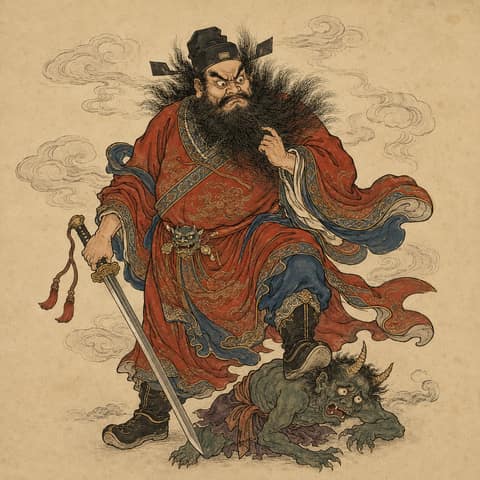
    Shoki, a demon-quelling deity spread across East Asia from Tang dynasty lore, took root in Japan as a talismanic power against calamity and smallpox. He is depicted as a bearded martial figure in official robes and cap, glaring with fierce eyes and wielding a sword in one or both hands. He often appears hunting, trampling, or bagging small demons. At New Year and Boys’ Festival he is displayed on hanging scrolls, banners, and screens, and many townhouses placed ceramic Shoki figures on eaves or roof corners. In Japan the earliest examples trace back to late Heian apotropaic paintings; from the Muromachi period the theme became established, and by late Edo he also appeared as May Festival dolls. Images and figures were hung at entrances, gates, or the upper seat of reception rooms to stop plague deities and malign spirits. Although dedicated shrines are limited today, regional folk belief since early modern times continues, and rooftop Shoki statues are still found from Kinki through the Chubu region. His powers are symbolized by the subduing glare and swordplay that drive off evil sprites, functioning as amulets against drug harm and epidemics.

  • 伊斯許理度売命

    伊斯許理度売命

    Divine

    いしこりどめのみこと

    岩戸に八咫鏡を鋳る鏡作神・伊斯許理度売命

    神霊・神格Wakayama

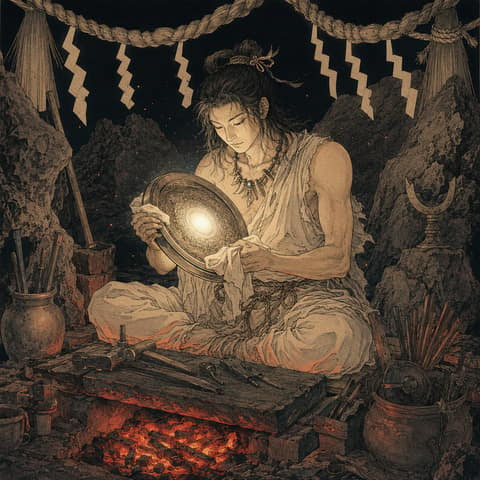
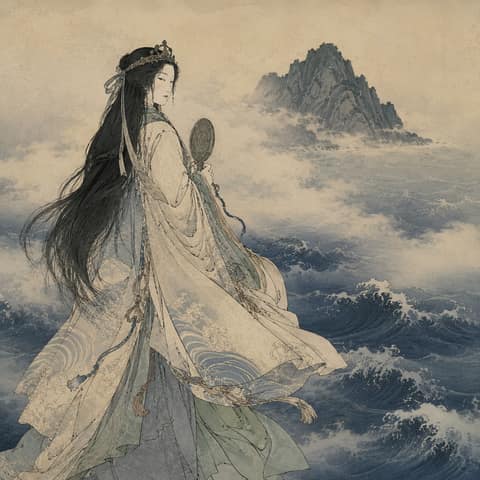
    Ishikoridome, casting the Yata-no-Kagami (Eight-Span Mirror) before the rock cave, is the deity in the Ama-no-Iwato myth who creates the vessel that reflects the lost light back onto itself. When Amaterasu-Omikami hides within the cave, the world goes dark. The gods gather at the Heavenly Tranquil River and prepare according to Omoikane's plan. The *Kojiki* (Ama-no-Iwato II) records that after seeking hard stones, iron, and a blacksmith, they commanded Ishikoridome to make a mirror. This mirror later becomes the central ritual implement used to lure Amaterasu out. The act of "making a mirror" is extremely proactive in the Ama-no-Iwato myth. If they merely wanted to wait for the light to return, the gods could have simply continued praying. However, Omoikane's strategy is to create a surface to catch the light in advance, even while the light is absent. Ishikoridome's mirror is not a trap to catch Amaterasu. It is a location of light, showing that the outside world is still prepared to welcome the deity. The mirrored surface is silent, but within that silence dwells the signal: "It is safe to return here." When Kokugakuin University's commentary reads the Ama-no-Iwato myth as an origin tale of ancient rituals, the mirror is a crucial implement alongside jewels, cloth, and oracle bones. A mirror possesses not only the practical utility of reflecting an image but the power to summon a deity and anchor its presence. As the deity responsible for crafting this implement, Ishikoridome bridges the beautiful surface of mythology with the heavy, gritty reality of metalworking. Fire, metal, stone, molds, and polishing—all of it converges into a single mirror placed before the gods. During the Descent of the Heavenly Grandson, Ishikoridome descends to earth as one of the Five Attendant Deities. The *Kojiki* identifies Ishikoridome as the ancestor of the mirror-making clan. This means the mirror-making technology that guided Amaterasu at Ama-no-Iwato is handed down to earthly clans and integrated into human rituals. Mirror-making is not merely a personal skill; it is a vocation rooted in myth, becoming a part of the ritual technology that supports the heavenly grandson's rule. The official history of Hinokuma Shrine and Kunikakasu Shrine connects Ishikoridome to another story of mirrors. Hinokuma Shrine enshrines the Hizokagami as its sacred body, while Kunikakasu Shrine enshrines the Hibokokagami. The official overview recounts that when Amaterasu hid in the cave, following Omoikane's advice, Ishikoridome acted as the master artisan and cast the sacred mirrors from copper. Here, the function of the mirror-making deity expands into the worship of two major shrines. While the Hizokagami and Hibokokagami belong to a different lineage than the Yata-no-Kagami, they are spoken of as mirrors born from the same darkness of Ama-no-Iwato. The shrines note that these two mirrors are revered by the Imperial Court as sacred treasures second only to the Three Sacred Treasures (which includes the Yata-no-Kagami). Here, Ishikoridome's divine status expands from "the deity who made a mirror" to "the deity who upholds the history of mirrors closely associated with the Imperial ancestors." A mirror is an image of the deity, and at the same time, the vessel (yorishiro) that welcomes the deity itself. Read in a modern context, Ishikoridome is a deity of reflection and recording. Mirrors, lenses, photography, video, measurement, inspection, design, and metal polishing—all are technologies centered on making an object visible without distorting it. The myth of forging a mirror in the darkness resonates with the act of preparing tools that reflect the truth in the midst of confusion. Ishikoridome is not a deity who wields blinding light. When the light returns, Ishikoridome is the deity who silently prepares the surface to catch it, reflect it, and return it to the world. Furthermore, this deity's mirror is a tool for self-recognition. When Amaterasu looks out from the cave, the mirror does not merely reflect the outside world; it returns the deity's own existence back to her. The hidden one sees her own light once more, reconnecting with the world. Ishikoridome creates that catalyst. To forge a mirror was to prepare the surface for a world that had lost its center to regain itself.

  • 倭姫命

    倭姫命

    Divine

    やまとひめのみこと

    五十鈴川へ導いた御杖代・倭姫命

    神霊・神格Mie

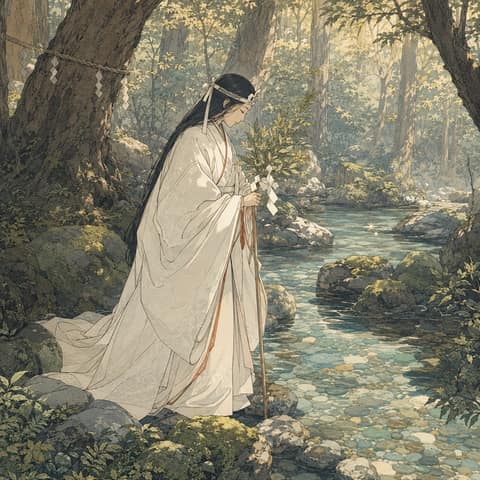
    Yamatohime appears as the mitsueshiro who guided Amaterasu Omikami to Ise. A mitsueshiro is not a vessel that controls the divine, but a being that serves the divine will and receives its destination in the human world. Her journey is not an escape far from the Yamato court. It is a tour to search for where the great goddess should be enshrined, to read the physiognomy of the land, to cross through provinces, and to find the center where the deity can settle in peace. In the official history of the Jingu Administration, Yamatohime left Yamato, passed through Iga, Omi, and Mino, and entered Ise Province. Ise, the endpoint of her journey, is not a mere destination. It was chosen as a land capable of quietly receiving the divine authority of Amaterasu Omikami, where clear water descends from the mountains to form the Isuzu River flowing to the sea, where the ocean opens to Tokoyo, and where the forests envelop the shrine. The expression "the upper reaches of the Isuzu River" found in the history of the Naiku perfectly illustrates Yamatohime's power. She is not a hero who calls back the light, but a deity who searches for a place where the light can remain without becoming muddied. Therefore, Yamatohime's spiritual power resides in "selection" and "order." Dividing the sacred realm from the secular world, maintaining purification and abstinence, and ensuring the rules of offerings and festival days are not disrupted. The Jingu Administration explains that after creating Kotai Jingu, Yamatohime established the systems of rituals and purification, building the foundation of the shrine. There is a different kind of tension here from the sudden bizarre occurrences often found in yokai tales. Unseen things become unruly if not welcomed correctly. Sacred things exhaust people if placed in the wrong location. Yamatohime knows that boundary and measures the distance between the divine and humans. Her presence manifests not as a loud oracle, but as a stillness that makes one stop at a fork in the road. The sound of water suddenly becoming clear, the wind changing at the entrance of a forest, words becoming sparse before an old shrine ground. To those who do not misread such small signs, Yamatohime indicates the next step. Conversely, to those who rush to conclusions, who try to paint over sacred sites with their own desires, or who disregard purification as a troublesome formality, the road will feel long, as if wandering in circles. Her protection is not in speed, but in correct anchoring. When understanding Yamatohime, it is best not to separate the three roles: the priestess who hears oracles, the traveling imperial princess, and the institutionalizer who creates the shrine system. The enumeration of her historical touring sites shows that she is not a deity of a single point, but a being who sanctifies the road itself. A road can be a symbol of being lost, but for Yamatohime, it is a process of discernment. The lands she passed through were not failed places. They were necessary memories to confirm the conditions for welcoming the deity one by one, heading toward the conclusion called Ise. Therefore, her story is better suited to the repetition of stopping, purifying, and walking again, rather than flashy moments of victory. For those who pray, Yamatohime is less a "deity who grants wishes" and more a "deity who teaches where wishes should be placed." When one wishes to rebuild the foundations of work, home, relationships, or study, she does not bring sudden change, but guides people toward preparing the environment, restoring order, and washing away unnecessary impurities. Before asking what to seek before the deity, she makes you question with what state of mind and body you stand before the deity. That strictness is also Yamatohime's gentleness. The Yamatohime-gu in Kusube-cho, Ise City, rests quietly in the forest of Mount Kurata, midway along the Miyuki Road connecting the Naiku and Geku. Although established as a Betsugu (auxiliary shrine) in the Taisho era as a new shrine, the deity enshrined there touches the oldest layers of the Ise faith. This overlapping of old and new befits Yamatohime's figure. She is not a legend closed in the past, but a memory that exists to continuously renew the places where deities are enshrined. The deity who established the shrine at the end of her journey still quietly asks in today's noisy world, "Where should the heart be calmed?" The time spent listening closely to that question itself becomes a pilgrimage to Yamatohime.

  • 天穂日命

    天穂日命

    Divine

    あめのほひのみこと

    出雲へ傾いた天つ穂霊・天穂日命

    神霊・神格Shimane

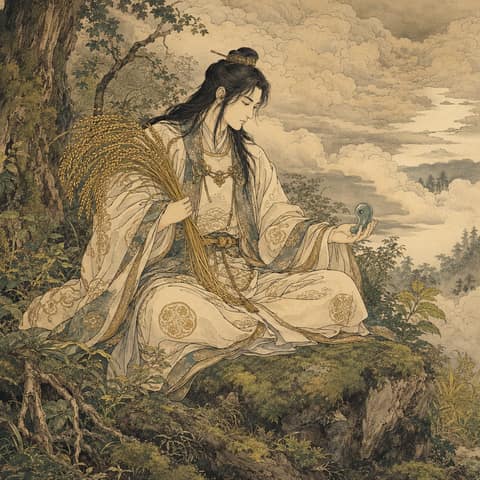
    Ame-no-hohi carries an ambiguity of belonging from the very moment he was born through the 'ukehi' pledge. Ameno-hohi-no-Mikoto emerged from the breath of Susanoo-no-Mikoto, but because the source material was Amaterasu Omikami's jewel, he is considered a child of Amaterasu. This structure anticipates his entire life. The one who sets him in motion and the one to whom he belongs are different. The place where he receives his orders and the place his heart leans toward are different. Ame-no-hohi, despite being born into the lineage of heavenly deities, is a deity who deeply embeds himself into the earthly Izumo. The character of the "rice ear spirit" residing in his divine name is also crucial. Kokugakuin University annotations interpret 'Ho' as rice ear and 'Hi' as spirit, explaining Ame-no-hohi as the heavenly spirit of rice ears. Rice ears are not completed solely in heaven. They must descend to the paddy fields, endure the seasons, and ripen through the moisture of the land and human hands. It is no mere coincidence that Ame-no-hohi is dispatched to Ashihara-no-Nakatsukuni. He is the rice ear meant to transfer the heavenly order to the earth, while simultaneously being a spirit that cannot function unless it touches the earthly soil. During the pacification of Ashihara-no-Nakatsukuni, this character manifests dangerously. The myriad deities and Omoikane nominate Ame-no-hohi as the messenger to pacify the unruly earthly deities. However, he curries favor with Okuninushi and does not report back for three years. Reading this alone, Ame-no-hohi appears to be a deity who abandoned his mission. Yet, in the deeper layers of the myth, the very fact that he was absorbed by the earth is significant. When heaven's command reaches the earth, it does not achieve fruition exactly as commanded; it is transformed by the local deities, human rituals, and the memories of Izumo. Ame-no-hohi embodies this transformation physically. This single point of "not reporting back" elevates Ame-no-hohi from a mere agricultural deity to a pivotal juncture in the story. Reporting back (fukuso) is the words that return what was seen on earth to Takamagahara, closing the loop of command. Because he does not do this, heaven's command is suspended in midair, necessitating a new messenger. Silence is not a void; it is a rift created between heaven and earth. The deities of Izumo enter this rift, eventually opening the stage for the massive negotiation known as Kuni-yuzuri (the transfer of the land). The tradition of the "Izumo-no-Kuni-no-Miyatsuko-no-Kamuyogoto" illuminates this deity in a different light. According to Kokugakuin University annotations, the Kamuyogoto narrates that Ame-no-hohi went to observe the state of the earthly realm, and his son Ame-no-hinadori, along with Futsunushi, pacified the unruly deities. Here, silence is not disloyalty; it is the process of measuring the earth as the ancestral deity of the Izumo governors and establishing ritual legitimacy. Ame-no-hohi's "flattery" is read as political deviation in central mythology, but as an approach to pacify deities in Izumo's rituals. The same act transforms into either betrayal or mediation depending on the observer's position. This deity's power is not the power to submit opponents with a sword. He enters the opponent's side, delays his return, and postpones his words of report. In modern terms, Ame-no-hohi is a deity of the middle ground. From the perspective of those issuing commands, he is difficult to handle; from the perspective of the land, he is easy to accept. That is precisely why stronger messengers and war gods must appear after him. Ame-no-hohi's failure pushes the Kuni-yuzuri myth to its next stage. The sensation of praying to him is closer to re-establishing relationships than seeking victory or punishment. Leaning toward Izumo was a betrayal of orders, but simultaneously the result of listening too closely to earthly voices. Ame-no-hohi stands on the boundary between understanding the opponent and losing his original mission. Therefore, his protection is precarious. He softens people, but also makes them easily swayed. When dealing with the ties of family, community, or organizations, this deity does not say, "Return and report immediately." He prompts one to first enter the land, know the opponent's deities, and then question what words should be returned. For those who pray, Ame-no-hohi is not a deity who grants quick success. Rather, between conflicting worlds, he is a deity who asks how far one should empathize with the other and from where one should return to their original mission. Amidst negotiations and the complex ties of lineage, community, and organization, when simple righteousness alone cannot move things forward, the story of Ame-no-hohi offers profound assistance. Just as rice ears only ripen once they take root in the soil, the protection of this deity also begins with the resolve to set foot on the opponent's land.

  • 布刀玉命

    布刀玉命

    Divine

    ふとだまのみこと

    岩戸に御幣を取り持つ祭具神・布刀玉命

    神霊・神格ChibaTokushima

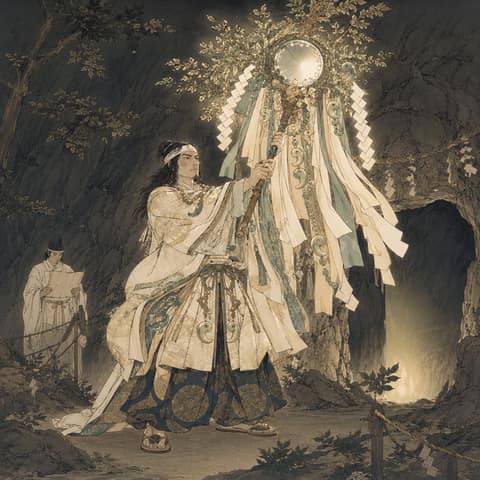
    Futodama, holding the *gohei* (ritual wand) before the Heavenly Rock Cave, is the deity in myth who transforms the objects prepared by the gods into the active power of ritual. When Amaterasu-Omikami hides within the cave, the world sinks into darkness. Following Omoikane's plan, the gods make the long-singing birds cry out, gather hard iron, forge a mirror, craft curved jewels, perform divination with deer bone and *hahaka* wood, and hang jewels, a mirror, and cloth upon a *Sasaki* tree. At the conclusion of these preparations, the *Kojiki* (Ama-no-Iwato II) records: Futodama, holding the grand *gohei*. In this moment, Futodama transitions the completed ritual tools into active divine service. The power of this deity lies in the very act of "holding." The *gohei* is not merely paper or cloth; it is a marker directed toward the divine, a pathway for prayer, and a medium to purify the space. When Futodama takes it in his hands, the jewels, mirror, cloth, and divination are no longer disparate materials, but a singular, unified ritual offered to Amaterasu. If Ame-no-Koyane's prayers form the center of voice, Futodama's *gohei* is the center of physical matter. Voice alone lacks form, and objects alone remain silent. Only when both are present is a space established before the cave to welcome the deity. Kokugakuin University's commentary highlights how the myth is densely layered with elements of ancient ritual. The mirror reflects Amaterasu, the jewels bear sacred adornment and spiritual power, the cloth is an offering, and the oracle bones seek divine will. Within this material worship, Futodama stands at the juncture where ordinary objects are transformed into "sacred offerings." Therefore, viewing him merely as a keeper of props is entirely insufficient. Futodama is the deity who presides over the exact moment when objects enter the sacred order. During the Descent of the Heavenly Grandson, this role is brought down to earth. In the *Kojiki* (Tenson Korin II), Futodama descends as one of the Five Attendant Deities and is named the ancestor of the Inbe clan. The Five Attendant Deities each carry functions such as ritual, dance, mirror-making, and jewel-crafting, demonstrating that the heavenly grandson's rule over the earth relies on more than just military might or lineage. It requires the techniques of worship, creation, and offering. Futodama is the deity who connects heavenly ritual tools to earthly vocations. The official deity description of Awa Shrine makes this connection remarkably concrete. The Upper Shrine's main deity, Ame-no-Futodama, served closely by Amaterasu and is revered as the ancestral god of the Inbe clan. The shrine further explains that because he led the Inbe deities in overseeing the creation of mirrors, jewels, textiles, weapons, and shrine construction, he is worshipped as the founding deity of all industries in Japan. Here, the hands that held the *gohei* before the cave have expanded to encompass crafts, architecture, textiles, and weaponry. The history of Oasahiko Shrine in Awa paints him as the "ancestral god who founds industry" in that region. During Emperor Jimmu's reign, his grandson Ame-no-Tomino-Mikoto is said to have arrived in Awa Province to sow hemp and paper mulberry seeds, producing cloth to establish the region's industry, while enshrining Futodama as a guardian deity. Materials like hemp, paper mulberry, and cloth resonate deeply with Futodama's nature as a deity of ritual implements. The cloth draped before the gods is the same cloth that pioneers new lands and builds industries. Here, we witness an ancient mindset where ritual and production were inseparable. Awa Shrine's traditions continue this narrative, stating that Ame-no-Tomino-Mikoto later led a branch of the Inbe clan from Awa across the sea to the Boso Peninsula, planting hemp and grain, and enshrining Futodama and his consort at Mera Beach. This migration story connects Futodama's divinity to tales of movement and pioneering. The deity who holds ritual tools appears not only before the gods but also at the sites where land is cleared, crops are planted, and shrines are built. Treating physical objects with sacred respect was, in itself, the act of laying the foundation for human life. Read in a modern context, Futodama may be a "behind-the-scenes" deity, but he is by no means a minor one. The preparation of ceremonies, the setting of stages, the management of sacred tools, architecture, paper-making, textiles, metalwork, crafting tools, and the passing down of family trades—to support the voices and dances on stage, one needs the technical skill to gather materials, arrange procedures, and maintain the integrity of the space. Futodama grants divine grace to these very skills. When praying, creating, or inheriting, one must never treat the materials at hand with disrespect. This quiet, steadfast ethic is the true power of Futodama.

  • 湍津姫神

    湍津姫神

    Divine

    たぎつひめのかみ

    大島に鎮まる海中道の女神・湍津姫神

    神霊・神格Fukuoka

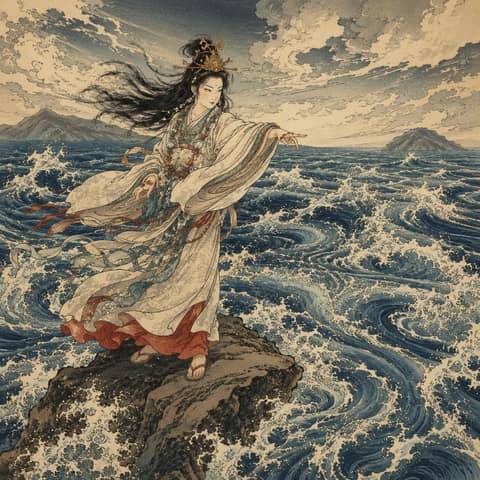
    To understand Tagitsuhime, who resides on Oshima, one must first look at Nakatsu-miya not merely as the "middle of the three shrines," but as a sanctuary situated mid-voyage on the sea. Munakata Taisha links Okitsu-miya on Okinoshima, Nakatsu-miya on Oshima, and Hetsu-miya in Tajima as three shrines, collectively calling them Munakata Taisha. Its official history designates the three goddesses as the daughters of Amaterasu Omikami, layering the memories of state rituals and foreign exchange over the national treasures excavated from Okinoshima. Tagitsuhime of Nakatsu-miya stands at the center of this immense religious sphere, receiving and passing along both the awe of the open ocean and the prayers of the mainland. Today's Nakatsu-miya is treated as Munakata Taisha Nakatsu-miya even in official World Heritage documents. It is situated at 1811 Oshima, Munakata City, Fukuoka Prefecture, and the official Munakata Taisha webpage lists its enshrined deity as Tagitsuhime-no-Kami. Here, Tagitsuhime is not an abstract water deity, but a goddess with a tangible island, shrine buildings, approach paths, and festivals. Oshima is an inhabited island reached by ferry from the mainland, unlike Okinoshima, which generally refuses human entry. Yet simultaneously, Oshima is an island that looks out toward Okinoshima, houses the Okitsu-miya Yohaisho (worship hall for praying from afar), and transmits the taboos of the sea to human settlements. Tagitsuhime's "middle" exists between an accessible sacred site and an inaccessible one. Tracing the pronunciation of her divine name sharpens the contours of this goddess even further. "Tagitsu" encompasses the state of water rushing violently and boiling up. Rather than a deity of a calm lake surface, Tagitsuhime is a deity of places where tides shift, currents change, and a ship's judgment is tested. Guarding a voyage does not simply mean calming the waves. Sometimes it means allowing progress, sometimes ordering a wait, and sometimes forcing a turn back. Tagitsuhime's protection works not as a power to make the sea obey humans, but as a power to return humans to the sea's rhythm. Mount Mitake, behind Nakatsu-miya, is indispensable for considering Tagitsuhime's Aramitama (rough spirit). The official Munakata Taisha webpage notes that Mitake Shrine is located at the highest point on Oshima, enshrining Amaterasu Omikami and the Aramitama of Tagitsuhime, while noting that according to Japanese mythology, it is said to be the site of Tagitsuhime's descent. If Nakatsu-miya at the foot is the shrine that greets worshippers, Mitake at the summit is where the island itself received the deity. The shadow of the mountain visible from the sea, and the sea route viewed from the mountain—these intersecting gazes forge Tagitsuhime's divinity. The history of rituals shown in official World Heritage documents corroborates this duality. It is noted that by the late seventh century, open-air rituals sharing commonalities with Okinoshima rituals were conducted at the Mitakesan ritual site on Oshima and the Shimotakamiya ritual site on the mainland. Furthermore, the *Kojiki* and *Nihon Shoki* from the early eighth century record that the Munakata clan worshipped the three Munakata goddesses across the three shrines. Here, the structure of the three shrines connected by the sea was established. Tagitsuhime bears the intermediate memory within this, linking the ancient rituals of Okinoshima to the shrine-based rituals on the mainland. Discrepancies with classical texts are, in fact, an entryway to reading Tagitsuhime more richly. In the oath-taking section of the *Kojiki*, the name Takitsuhime-no-Mikoto appears, and she is recorded as being worshipped as one of the three Munakata goddesses. On the other hand, in the present Munakata Taisha, Tagitsuhime is the deity of Nakatsu-miya. Reducing this difference to "which is correct" loses the depth of the Munakata faith. The divine names in the classics, the three-shrine rituals preserved by priestly families, and the archaeological landscapes organized as a World Heritage site represent different historical layers. Tagitsuhime is also a deity who traverses these layers. Placing the maritime rituals overseen by the Munakata clan in the background, Tagitsuhime ceases to be merely the "second of the three goddesses." Official World Heritage documents state that the ancient rituals on Okinoshima were carried out by people of the Munakata region who possessed advanced navigational skills and engaged in foreign exchange. The sea was a trade route, a danger zone, a path for diplomacy, and a place to pray to the gods. Nakatsu-miya on Oshima is where all of these are concentrated into a single point. Here, travelers simultaneously feel the awe of heading out to the open sea and the relief of returning to the mainland. If reading this figure in an encyclopedia, Tagitsuhime is the "guardian deity of the flow." Flow is not just water currents. From myth to ritual, from Okinoshima to Oshima, from taboo to worship, from the prayers of the ancient state to modern traffic safety, the faith has flowed down to the present, changing its form. Tagitsuhime reconnects the things that threaten to sever along the way. Calming her Aramitama on the mountain peak, looking up to her Nigimitama (gentle spirit) at Nakatsu-miya, and gazing toward Okinoshima beyond the remote worship hall. Her divine authority manifests itself more as the shifting tides signaling the time to cross, rather than through flashy miracles.

  • 瀬織津姫

    瀬織津姫

    Divine

    せおりつひめ

    速川の瀬に立つ祓戸の水神・瀬織津姫

    神霊・神格Shiga

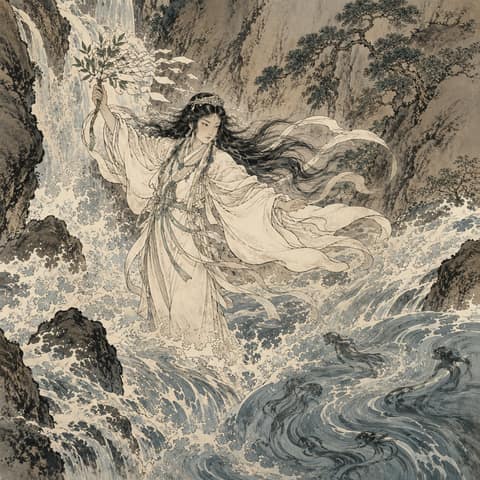
    The key to reading Seoritsuhime lies in placing purification not on "making white" but on "making move." The sins and impurities in the Oharai-no-Kotoba are not things merely to be reflected upon in the mind. They are transferred onto purification objects, named by the incantation, and handed over to the water falling from the mountains. Seoritsuhime is their first carrier. The place she resides is not a calm lake surface, but the rapids of a swift river. In places where water hurries, where currents swirl, where footing becomes unstable, sins are separated from the human domain. The work of this deity differs from gentle comforting. Seoritsuhime does not envelop and preserve impurities. She receives what has been purified and carries it straight out to the great ocean. There is an ancient wisdom here that, rather than continually analyzing sin, one should change its location at a certain point. A human community would break if it only accumulated sins and impurities internally. Thus, purification reveals sins through words, places them on objects, and returns them to the natural cycle. Seoritsuhime is the deity of that switch, the power itself that returns stagnant things to the flow. Observing the chain of the four Haraedo deities makes Seoritsuhime's role even clearer. When she carries them from river to sea, Hayaakitsuhime swallows them in the tide's whirlpool, Ibukidonushi blows them away with his breath to the Root Country and Bottom Country, and Hayasasurahime finally causes them to be lost. In other words, Seoritsuhime is not the completion of eradication, but the initiation of the transfer toward eradication. The deity who handles the first step is often the closest to humans. In the moment a person lets go of a sin or impurity, it has not yet disappeared. However, it is no longer in the owner's hands. Seoritsuhime stands in that suspended time. Seoritsuhime's charm as a water goddess is also born from this. Water is precious not because it is pure, but because it purifies by flowing. It does not reject turbidity; it carries it. It is natural that faiths drawn to waterfalls and rapids turn toward Seoritsuhime. Falling water continuously crosses boundaries: from top to bottom, from mountain to river, from river to sea. The goddess standing there is not the guardian of a fixed sanctuary, but a deity who facilitates passage across boundaries. Her purity is not a halted innocence, but an order maintained by flow. On the other hand, one should keep a distance from the temptation to speak of Seoritsuhime as the "hidden true body" of Amaterasu Omikami. In the official explanation of Ise Jingu, Aramatsuri-no-Miya is the first auxiliary shrine of the Naiku, enshrining the Aramitama of Amaterasu Omikami, and the Aramitama is explained as a particularly conspicuous manifestation of divine power. Seoritsuhime's name is not placed there. Therefore, narratives connecting the two are safely treated as later annotations, folk beliefs, and modern reception. There is no need to deny such layers, but mixing them with the deity's character in the original texts ironically causes Seoritsuhime's own contours to be lost. Seoritsuhime's uniqueness lies not as a shadow name for the sun, but in the procedure of water. If Amaterasu Omikami is the deity who illuminates and orders the world, Seoritsuhime is the deity who hands over the sins and impurities inevitably generated within that order to the water for circulation. A bright order requires a system to process shadows. The place where Seoritsuhime works in the Oharai-no-Kotoba is exactly that location. To maintain a world ruled by light, water must carry the dirt away. She is not an opponent of light, but the waterway ensuring the world of light does not break. Praying to this deity does not mean pretending the dark things inside oneself never existed. Rather, it is about giving them a name, giving them a form, and handing them over to where they should flow. Seoritsuhime does not condemn those holding sins, but she refuses to let them hold onto them forever. Sadness, regret, anger, the turbidity of old relationships. She carries such things to the water's edge and creates a moment to let go. Her purification is not forgetting but transferring, not forgiveness but a flow path. Therefore, before Seoritsuhime is a pure goddess, she is a goddess of movement. In this sense, Seoritsuhime's divine authority is easily reinterpreted into modern emotional organization, but she should not be confined to simplistic psychology. The purification of the Oharai-no-Kotoba was a public word meant to rebuild a grand order encompassing not just the individual's inner self, but the community, officials, and the nation. Seoritsuhime connects that word to the water. She is a deity who hands over what cannot be resolved by the heart alone to space, current, and time.

  • 玉祖命

    玉祖命

    Divine

    たまのおやのみこと

    岩戸に御珠を連ねる玉作神・玉祖命

    神霊・神格Wakayama

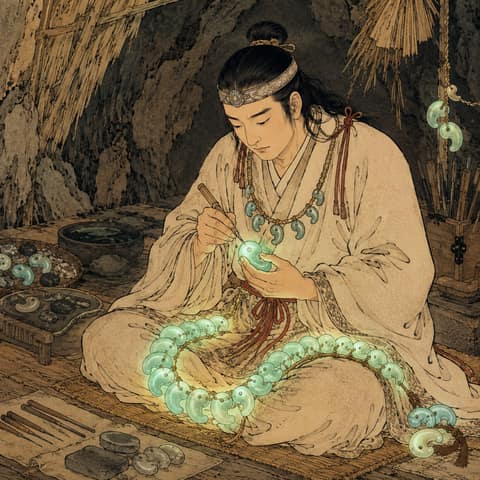
    Tamanooya, who strung the sacred beads at the rock cave, is the deity in the Ama-no-Iwato myth who gathers light into particles and brings them to order. When Amaterasu-Omikami hides in the cave, the gods follow Omoikane's plan: they make a mirror, craft jewels, hang cloth, and perform divination. The *Kojiki* (Ama-no-Iwato II) records that they had Tamanooya make the Yasakani no Magatama and the five hundred stringed Yasumaru beads. What Tamanooya creates here is not a single gem, but a spiritual rosary of many beads strung together to hang before the altar. The jewels stand in pair with the mirror at the Ama-no-Iwato scene. The mirror reflects Amaterasu's figure on one surface, while the jewels fill the sacred space with many particles. If the mirror is an implement for "seeing," the jewels are implements for "tying." By boring holes, threading strings, and aligning the particles without disorder, scattered small lights become a single ritual implement. Tamanooya's work is not merely to make the material beautiful, but to align individual brilliance into an order directed toward the divine. When Kokugakuin University's commentary reads the Ama-no-Iwato myth as an origin tale of ancient rituals, jewels—along with mirrors, cloth, ironware, and oracle bones—are major items that make the ritual possible. Jewels are implements close to the body; they decorate, protect, and indicate the status or spiritual power of the wearer. When hung on the true sakaki tree before the cave, a personal adornment transforms into a sacred symbol. Tamanooya is the deity who makes this transformation possible. In the Descent of the Heavenly Grandson, Tamanooya's vocation is connected to the history of human clans. The *Kojiki* (Tenson Korin II) counts Tamanooya among the Five Attendant Deities and designates him as the ancestor of the Tamanooya clan. This indicates that jewel-making descended to earth not just as manual labor, but as a vocation rooted in heavenly rituals. The techniques of polishing, piercing, and stringing jewels became part of the ritual technology supporting the heavenly grandson's world. In the official overview of Hinokuma and Kunikakasu Shrines, Tamanooya is enshrined in the auxiliary shrine of Kunikakasu Shrine. Kunikakasu Shrine enshrines the Hibokokagami (Sun Spear Mirror) as its sacred body, and the same page transmits the history of two sacred mirrors being cast during Amaterasu's seclusion in the cave. The enshrinement of Tamanooya in a shrine centered on mirror myths clearly shows that the ritual implements of the rock cave myth are not complete with mirrors alone. The jewels string light around the mirror. Tamanooya's power lies in not neglecting the details. Jewel-making requires selecting materials, polishing, boring holes, stringing, and arranging. If any one step is disrupted, the rosary will not take a form fitting for the gods. Rather than creating a massive light all at once, this deity refines small lights one by one, connects them, and makes them into a meaningful sequence. Tamanooya is the deity who teaches the weight of the finest manual labor within a grand ritual that changes the world. Seen in a modern light, Tamanooya resonates well with the senses of jewelry, accessories, rosaries, beads, souvenirs, design, lineage, and matchmaking. The work of polishing, selecting, and connecting small things is inconspicuous but supports people's memories and prayers. Tamanooya, who strung the sacred beads before the rock cave, is a deity who does not waste a single particle of light. He beautifully ties scattered things together and prepares the space to welcome the lost light. Those quiet, steady hands are the very essence of Tamanooya's divinity. Furthermore, Tamanooya is often paired with Ishikoridome. If Ishikoridome gathers light onto a single mirror surface, Tamanooya divides light into many particles and then creates a single chain from them. Concentration and connection, reflection and decoration, a single surface and many particles. Through these two crafts, the Ama-no-Iwato ritual simultaneously possessed light for seeing and light for tying. Tamanooya's jewels were not only beautiful but were implements that turned the gods' collaboration into a visible form. The gods' operation was not a single heroic act, but a collective ritual where wisdom, dance, prayers, cloth, mirrors, and jewels supported each other. Tamanooya is also the deity who symbolizes that collectivity as a chain of particles. The power to tie small things together deeply supports grand divine rituals.

  • 田心姫神

    田心姫神

    Divine

    たごりひめのかみ

    沖ノ島に鎮まる海北道中の女神・田心姫神

    神霊・神格Fukuoka

    The key to understanding Tagorihime lies in the fact that Okinoshima is a "distant island." The three shrines of Munakata Taisha are arranged such that one ventures deeper into the sacred realm the further one crosses the sea: Hetsumiya on the Kyushu mainland, Nakatsumiya on Oshima, and Okitsumiya on Okinoshima in the Genkai Sea. The fact that the deity of Okitsumiya, placed furthest offshore, is Tagorihime clearly illustrates her character. She is not a guardian nestling close to human settlements, but a divine presence that arises when navigators spot the island's silhouette, read the tides, and stand in awe of unseen dangers. In the classic texts, she is born from a sword. The ukehi (oath) section of the Kojiki records that Amaterasu Omikami took Susanoo-no-Mikoto's ten-span sword, rinsed it in the Ame-no-Manai well, chewed it to pieces, and from the narrow mist of her breath blown away, Takiribime-no-Mikoto was formed. The sword is an object of military might and oaths, the well water is a medium of purification, and breath and mist are boundaries without form. Because Tagorihime is born at the intersection of these three, she can be understood not merely as a sea deity, but as the goddess of the very moment when martial force is transformed into prayer. The variations in her divine name indicate that she is a deity who cannot be confined to a single reading. Called Takiribime-no-Mikoto or Okitsushima-hime-no-Mikoto in the Kojiki, she is spoken of as Tagorihime or Tagirihime in the Nihon Shoki lineage. Depending on whether "Takiri" is read as the "surging (tagiru)" of the tides or "Tagiri" as the mist upon the sea, the expression she shows changes slightly. In either case, however, at her core lies the power to alter visibility right in the middle of the water's surface. To navigators, fog was both a danger and a sign signaling the realm of the gods. In the Munakata faith, this mythology is tied to actual sea routes. Okinoshima is a maritime transport hub connecting the Japanese archipelago and the Korean Peninsula, and official World Heritage documents explain that rituals praying for navigational safety and successful exchange were held from the late 4th century to the late 9th century. The evolution of offerings shows a transition of ritual sites from atop giant boulders, to rock shelters, half-rock-shelter half-open-air, and finally open-air locations, narrating how the ancient rituals of Okinoshima are essential in considering the formation of indigenous Japanese faith moving from nature worship to shrine rituals. The taboos surrounding the island reinforce Tagorihime's "invisibility." Official World Heritage documents convey customs such as not speaking of what one sees or hears on Okinoshima, not taking a single tree, blade of grass, or stone, and requiring even Shinto priests to undergo purification in the sea before entering. These are not so much a matter of secrecy as they are a decorum meant to prevent the consumption of the sacred realm. Tagorihime is not a deity who discloses everything within statues or narratives. Through what is not spoken, what is not taken away, and what is left behind on the island, she exists all the more profoundly. On the other hand, she is not confined solely to Okinoshima. The history of Munakata Taisha regards the three goddesses as the three daughters of Amaterasu Omikami, telling how the land of Munakata, which fulfilled the functions of overseas diplomacy, trade, and national defense, became deeply tied to state rituals. The description of "state rituals" seen in the history of Munakata Taisha prevents Tagorihime from remaining merely a deity of maritime safety. In the ancient state, crossing the sea meant trade, diplomacy, warfare, and prayer. Precisely because of this complexity, her stillness resonates not as weakness, but as the posture that both the state and humanity ought to uphold when facing the ocean. Furthermore, in the genealogy of the Kojiki, Takiribime-no-Mikoto bears Ajisukitakahikone-no-Kami and Takahime-no-Mikoto with Okuninushi-no-Kami. This means that the maritime goddess of Munakata also holds a place within the Izumo lineage. Situated in the genealogy of Okuninushi-no-Kami, Tagorihime is a guardian of the northern sea routes, while simultaneously a mother goddess expanding the bloodline of Izumo mythology. The goddess retreating far offshore paradoxically links the myths of the land. This duality is the quiet strength of Tagorihime. The deeper she withdraws into the island, the more she expands as the knot binding the entire mythology together.

  • 高御産巣日神

    高御産巣日神

    Divine

    たかみむすびのかみ

    高木神として命を下す造化神・高御産巣日神

    神霊・神格Tokyo

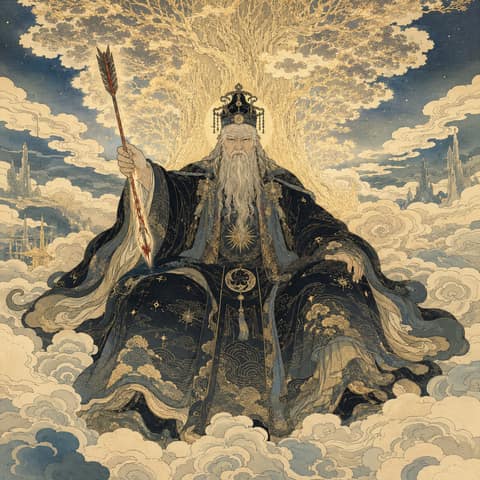
    Takamimusubi, who issues commands as Takagi-no-Kami, has his core in the transformation of an unseen creator god into a political decision-maker. At the beginning of the *Kojiki*, Takamimusubi appears as the second deity to come into being in Takamagahara when heaven and earth began, but immediately hides his form as a solitary deity. Here, the name is placed but the form is not depicted. The power supporting the beginning of the world is shown not as personal martial prowess or emotion, but as the root action that generates existence. However, entering the pacification of Ashihara-no-Nakatsukuni, this hidden deity emerges from silence. When Ame-no-Oshihomimi returns after seeing earthly turmoil, by the command of Takamimusubi and Amaterasu-Omikami, the myriad gods are gathered at Ame-no-Yasukawa. What is important here is that the command is issued not by Amaterasu alone, but jointly with Takamimusubi. If the sun goddess is the visible center, Takamimusubi is the unseen gravity that operates that center as a system. The name Takagi-no-Kami is another entry point for understanding this deity. The *Kojiki* (Ashihara-no-Nakatsukuni Pacification III) explains that Takagi-no-Kami is another name for Takamimusubi in the scene where the returned arrow reaches Amaterasu and Takagi-no-Kami. The official explanation of the enshrined deity at Takagi Shrine also lists the names Takamimusubi (Kojiki), Takamimusubi-no-Mikoto (Nihon Shoki), and Takagi-no-Kami, introducing the understanding that he is the deification of a tall tree. A tall tree stretches vertically from earth to heaven. As an impression of the name, Takagi-no-Kami can be read as an axis passing heavenly commands to the earth. In the story of the returning arrow, Takagi-no-Kami's judgment appears sharply. The arrow Ame-no-Wakahiko used to kill Nakime ascends back to heaven, reaching Takagi-no-Kami's hands stained with blood. Seeing it, Takagi-no-Kami declares that if Ame-no-Wakahiko has no evil heart, it shall not strike him, but if he does, it shall strike him, returning the arrow to earth. The arrow pierces Ame-no-Wakahiko. The fearsomeness of this scene lies in the fact that the deity does not punish out of anger, but reads the evidence, declares conditions, and reverses Ame-no-Wakahiko's own action into a judgment. In the scene of the Kuni-yuzuri, Takagi-no-Kami acts like a signature on a command. When Takemikazuchi descends to Izumo and thrusts the question upon Okuninushi, that authority is expressed as the command of Amaterasu-Omikami and Takagi-no-Kami. This shows that the transfer of rule over Ashihara-no-Nakatsukuni is told not as mere armed force or negotiation, but as a legitimate heavenly decision. Takagi-no-Kami is not a sword-wielding deity, but stands behind the sword-bearing envoy, turning the question into a "mandate of heaven." In the Tenson Korin, Takamimusubi's generative power also enters the lineage. Amaterasu and Takagi-no-Kami try to send Ame-no-Oshihomimi down to the pacified Ashihara-no-Nakatsukuni, but he suggests sending his newborn child, Ninigi-no-Mikoto. The text places Ninigi as the child born from Takagi-no-Kami's daughter, Yorozuhata-Toyoakitsushi-Hime. Takagi-no-Kami not only issues commands but is also involved in the maternal lineage of the heavenly grandson. Here, "generation" and "rule" are not separate. Being born itself creates the legitimacy to descend to earth. The divinity of Takamimusubi resonates well with Omoikane. In the pacification of Ashihara-no-Nakatsukuni, Omoikane confers with the gods and undertakes the judgment of selecting envoys. Takamimusubi calls upon that thinking and stands on the side of convening the heavenly council. The god of wisdom devises the strategy, and the god of creation establishes the space for council and command. Reading this relationship, the politics of Takamagahara appears not as the single shout of a hero god, but as a system where generation, light, wisdom, force, and negotiation overlap and operate. It is natural as a reading of the myth that Takagi-no-Kami is connected to the divine virtues of "creation of all things" and "successful consultations" in modern faith. The official divine virtues of Takagi Shrine list creation of all things, fulfillment of wishes, negotiations, and successful consultations for Takamimusubi. Looking at the generation at the beginning of heaven and earth, the council at Ame-no-Yasukawa, the dispatch of envoys, the Kuni-yuzuri, and the Tenson Korin as a single flow, this deity is not only a god who "births something" but a god who "places what is born into order." Takamimusubi is the generation before light, the consensus behind commands, and the deity who reties the story descending to earth from heaven.

Showing 97 - 112 of 112 yokai