YOKAI.JP

Yokai Encyclopedia

Explore Japanese yokai by name, type, place, and theme

592 Yokai|14 Category|Page 18 of 25
Localization in Progress - More content available in Japanese version
View Japanese
Sort by: NameAscending
  • Red-Head

    Red-Head

    Uncommon

    AH-kah-gah-shee-rah

    Red-Head

    Mountain & Wilderness SpiritsKochi

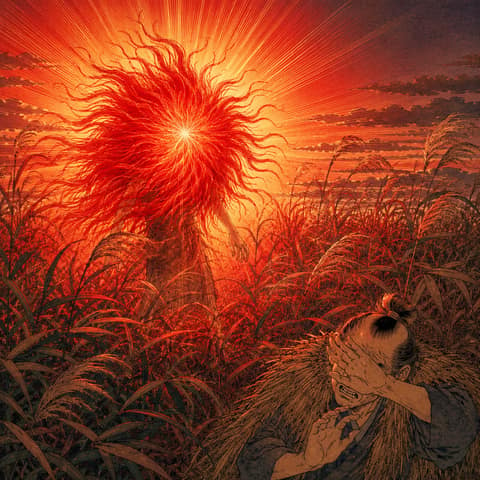
    A red-haired apparition said to appear in the fields and hills of Katsugase in Tosa Province. It walks upright like a human, yet hides among tall bamboo grass and reeds, making its full form elusive. Its most striking trait is hair that shines like the sun; approaching and staring directly at it is said to dazzle the eyes and cause temporary visual impairment. Tales rarely attribute malice to it, focusing instead on discomfort caused by its visual impact. It is named in the late Edo to early Meiji Tosa Bakemono Picture Book, listed alongside local figures such as the Laughing Woman of Yamakita and the White Crone of Motoyama. The “Aka-gashira” in Hyakki Yagyo picture scrolls is sometimes cited as iconography, though identification remains cautious. Sightings are told of at dusk through dawn in the open country and survive mainly in local oral tradition.

  • Resurrection Incense

    Resurrection Incense

    Uncommon

    hahn-GOHN-koh

    Canon-Conforming Incense Apparition

    Household SpiritsUnknown

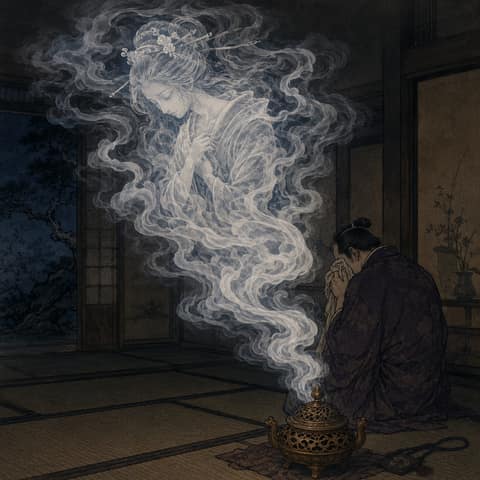
    Rather than a physical substance, the reviving incense is told in narrative tradition as a medium for reunion with the dead. The Chinese motif of seeing a figure within smoke was adopted into early modern Japanese literature and theater, where the handling of censers, incense wood, and ash is rendered with ritual care. In yokai picture compendia it sometimes appears as a type of tool-born apparition, with set-piece depictions of a visage forming in the incense smoke. It is often interpreted not as recalling a spirit itself, but only as manifesting a semblance or shadow. Medicinal virtues are mentioned as apocrypha in materia medica, yet Edo-period notes record skepticism and file it among curious tales. In Kamigata and Edo rakugo, a tryst lasts only until the incense or stick burns out, making the quantity and duration of incense a key stage device.

  • Reverse Pillar

    Reverse Pillar

    Epic

    sah-kah-BAH-shee-rah

    Traditional Kaidan Edition Gyakubashira (Inverted Pillar)

    Household SpiritsVarious regions of Japan

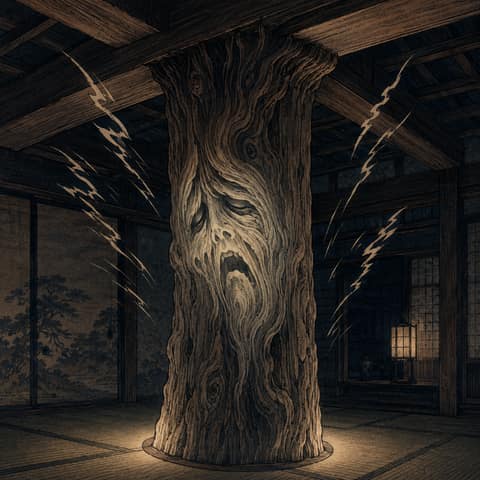
    A post–early modern belief that a pillar installed upside down, defying carpenters’ respect for a tree’s natural root spread, brings mishaps to a house. Persistent midnight house-settling, creaking beams, and uncanny whispers were read as the “curse of the inverted pillar,” prompting reinstallation or prayer. Shigeru Mizuki notes leaves birthing a spirit from the reversed wood, or the pillar itself transforming, yet older records more often treat it as signs of noise, misfortune, and ill omen. Deliberate inverted motifs used as apotropaic design (e.g., Yomeimon) belong to the ritual idea of intentional imperfection and are distinct from this yokai. As a taboo rooted in building folklore, it appears in regional carpenters’ lore, temple and shrine records, and essays.

  • Roaring Cauldron (Narigama)

    Roaring Cauldron (Narigama)

    Uncommon

    nah-ree-GAH-mah

    Ringing Cauldron (Hyakki Tsurezurebukuro)

    Household SpiritsOkayama

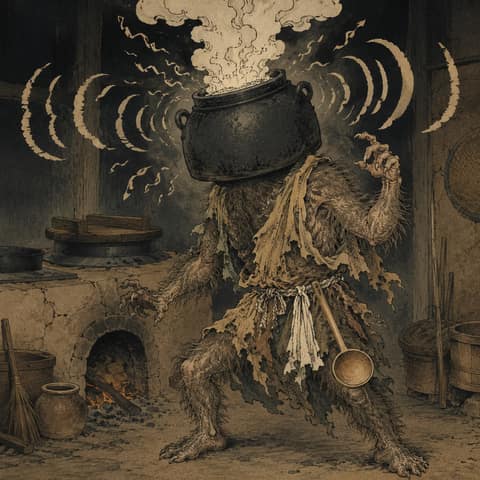
    Based on the belief that tools become spirited after a hundred years, this yokai is depicted with an old iron cauldron for a head. It lingers in the night, issuing faint tremors and steam that produce low sounds. The ringing is read as an omen of fortune or misfortune, falling silent if met with careless clamor, and responding when approached with reverence. It embodies divinatory function and the memorial veneration of well-used objects.

  • Rokuemon

    Rokuemon

    Rare

    Rokuemon

    Rokuemon, Supreme Commander of the Awa Tanuki

    ShapeshifterTokushima

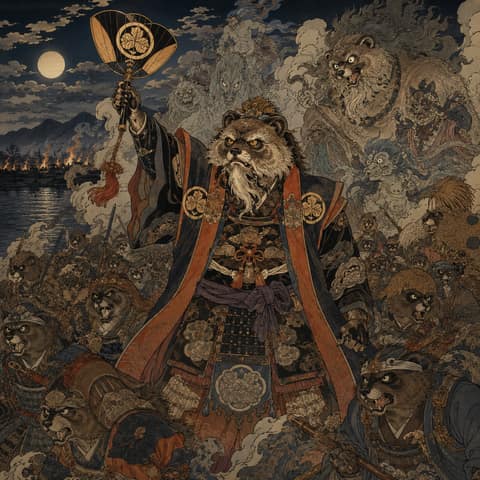
    This is Rokuemon, the supreme commander of the Awa tanuki residing in Tsuda-ura. Ruling as the grand general over all tanuki in Shikoku, he stands as the veteran leader at the pinnacle of the tanuki hierarchy, where they fiercely compete for the title of "Senior First Rank." He once took in Kincho as his disciple and attempted to have him inherit his legacy through a marriage to his daughter. However, after Kincho fled, Rokuemon eventually faced him as a mortal enemy on the banks of the Katsuura River. Following a massive three-day and three-night battle involving over six hundred tanuki, it is said he fell in a final one-on-one duel. Yet his name has been passed down through storytelling, films, and animation, and he remains vividly remembered today as the indispensable co-protagonist of the Awa Tanuki War.

  • Rokurokubi

    Rokurokubi

    Legendary

    ROH-koh-ROH-koo-bee

    Hitouban/Nukekubi (Lafcadio Hearn Interpretation)

    Human-Yokai / Half-Human Half-YokaiAll over Japan -- A human village apparition without a specific location

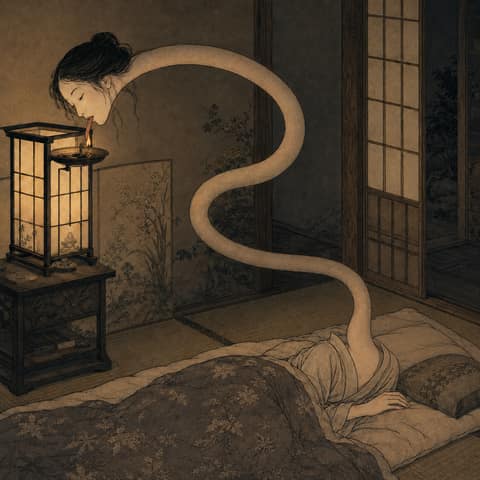
    This is the interpretation introduced to the world by Lafcadio Hearn, which most strongly inherits the lineage of the Chinese 'Hitouban', presented as a gruesome and ferocious 'nukekubi' (flying head). It completely breaks away from the comical image of the 'neck-stretching ghost' popularized in Edo-period sideshows, positioning it as a terrifying monster that devours human flesh and insects. In this version, the Rokurokubi disguises itself as a perfectly normal human during the day. However, at night, when it falls asleep, only the head detaches from the torso and flies through the air to attack prey. Hidden at the base of the neck are red streaks or eerie scars resembling 'Sanskrit characters' indicating the severance. The body is completely defenseless while the head is away, and if the body is moved to another location during this time, or if the severed surface of the neck is hidden, the returning head will be unable to recombine with the flesh and will fall to the ground and die. Its nature is extremely cruel and deeply vindictive; upon finding prey, it bares its teeth and attacks in swarms. However, at the same time, it possesses the aspect of a pitiful victim burdened with 'deep karma' whose head slips out night after night regardless of their own will. It is the manifestation of magical and psychological horror, where the 'bestiality' and 'uncontrollable repressed passions' lurking within humans escape the cage of the flesh to materialize as physical violence.

  • Ryujashin

    Ryujashin

    Rare

    ryujashin

    Ryuja-sama, the Guiding Messenger of the Kamiari Festival

    Divine Spirit / DeityShimane

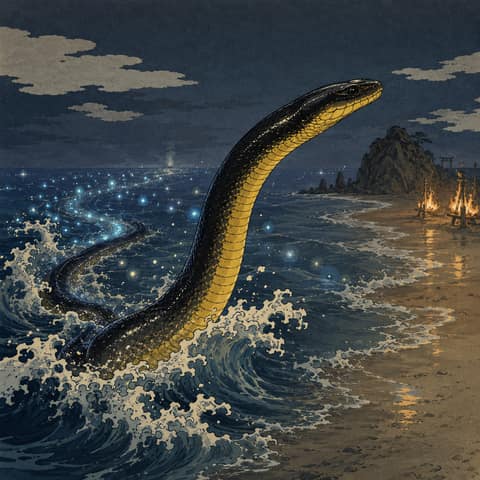
    Ryujashin occupies a unique position as a "divine messenger" functioning within the specific ritual context of Izumo's Kamiari Festival. While general dragon gods (composite water deities governing water, rain, and the sea) are based on nationwide rain-making and rain-stopping beliefs, Ryujashin is strictly a functional deity acting as the guide for the eight million gods, limited to the Kamiari rituals of shrines like Izumo Taisha and Sada Shrine. Its essence is not an abstract concept of faith, but a real marine animal—the yellow-bellied sea snake—that actually washes ashore on the Izumo coast in late autumn. The perfect alignment of a natural phenomenon (warm-water sea snakes drifting on the Tsushima Current) with mythological time (the gathering of gods in the Kamiari month) forms the core of a rare seasonal ritual. The washed-ashore individuals are dedicated to the Grand Shrine, and through the Ryuja-ko of Izumo Taishakyo, it developed into an independent object of worship, with talismans distributed to the common people for protection against fire, water disasters, theft, and for good fortune. By visiting from the Eternal Land and the otherworld beyond the sea, it embodies the ancient worldview that saw Izumo as a passageway to the otherworld.

  • Ryōmen Sukuna

    Ryōmen Sukuna

    Legendary

    RYOH-men SKOO-nah

    Hida's Two-Faced Sukuna: Chronicle and Local Tradition

    Demons & GiantsGifu

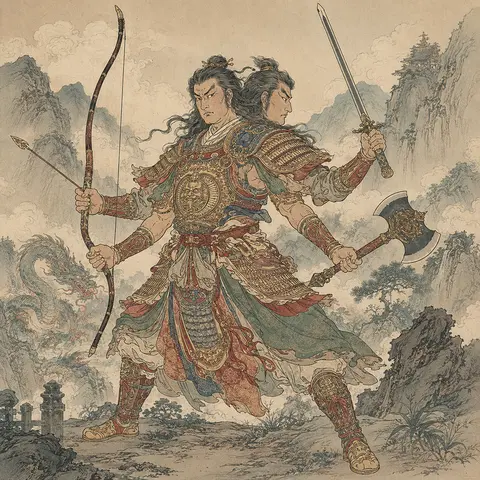
    The original text of the Nihon Shoki etches Sukuna's body in remarkable concreteness: "one body with two faces, each turned away from the other; their crowns joined so that there is no nape; limbs on either side; knees, yet no hollows behind them and no heels." One torso, two faces set back to front, no nape where the heads meet, and limbs on each side—read plainly, four hands and four feet alike, an eight-limbed marvel. Yet most of the images that survive locally are carved as "two faces, four arms"—two faces, four arms, two legs. That the Shinsen Mino-shi records the founder of Nichiryūbu-ji as a "two-faced, four-armed stranger" belongs to the same strain, and the discrepancy between the textual description (eight limbs) and the iconographic tradition (four arms, two legs) is not to be overlooked in reading the Sukuna image. It was Enkū who raised that iconography into art. The seated Ryōmen Sukuna at Senkō-ji sets its two faces side by side rather than front and back, one wearing wrath, the other compassion. This form, salvation glimmering within fury, resonates with the belief that Sukuna was an incarnation of Guze or Senju Kannon. His historical reality demands caution. Naniwa no Neko Takefurukuma, named as his vanquisher, properly belongs to the section on Empress Jingū, so his placement in the Nintoku chronicle is itself anachronistic. That a Kannon-incarnation tale should attach to Nintoku's reign—supposedly before Buddhism's arrival—is likewise a later construction, and the view that the whole account is a fabrication of the editorial stage carries weight (Nagafuji Yasushi). Nagafuji reads Sukuna as the original deity of Mt. Kurai, a hero hidden away by the central histories, while Hōga Toshio traces him genealogically to the ancestor of the Hida no Miyatsuko. As for the monstrous body, Haga Susumu reads it as the misperceived and exaggerated gear—shin guards and the like—of Hida's mountain folk. The name, too, invites many theories. From the sound "Sukuna," some traditions argue a tie to Sukunabikona, and Ōbayashi Taryō offered a comparative-mythology framework treating Sukunabikona as Ōkuninushi's "second self." The motif of a god who appears in pairs chimes with the two-faced form of Sukuna. Some also overlay the image of the uncanny Sukuna onto the fact that ancient Hida was a singular "land of craft" that sent its artisans (Hida no Takumi) to the center, though there is no direct documentary link between the two. What is certain is that a single name has been handed down in opposite directions by center and province, and that this very split is what gives the being called Ryōmen Sukuna its shape.

  • Ryūjin

    Ryūjin

    Divine

    ryūjin

    Ryūjin, the Water God Who Stills the Storm

    Water and Dragon DeityKanagawaKyoto

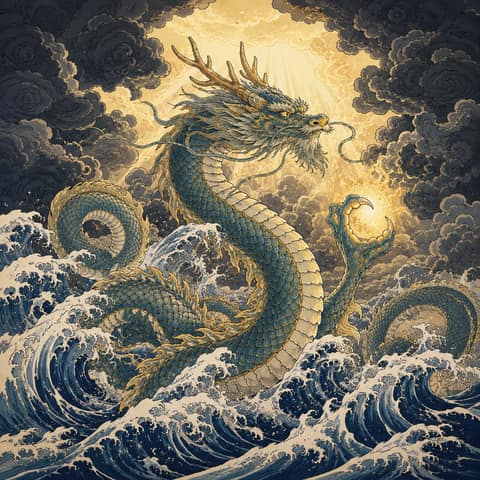
    As the water god who stills storms, Ryūjin stands at the meeting of sea and sky and holds the weather in divine power. Fishers, sailors, and rice-growing communities all prayed to this god in moments of need. That power has two edges: timely rain can nourish a field, while great waves and violent wind can break a ship. People therefore developed rites not simply to obtain power from Ryūjin, but to soothe the raging aspect of water and invite its life-giving one. The sea god's greatest treasures are the tide-flowing and tide-ebbing jewels, which command the rise and retreat of the sea. Yamasachi-hiko receives the pair from the sea god, uses one to overwhelm his elder brother with water, and the other to draw it away and save him. Their control of the tide expresses the heart of Ryūjin's authority. Coastal shrines received prayers for calm weather and a rich catch; inland rites sought rain, offered black horses in drought, or lowered offerings into deep pools. Legends from Lake Ashi and other waters in which a monk subdues a dragon and transforms it into a guardian preserve the close bond between fear and reverence. Ryūjin's role as lord of the Dragon Palace grows from the same divinity of water. Beyond the sea or beneath it lies a realm of wealth and a different measure of time. A visitor may return with treasure, or carry away years that cannot be recovered, as Urashima Tarō does when he opens the jeweled box. Ryūjin is therefore not merely a fabulous beast but the deification of water itself, the source on which life and death both depend. To still the storm is also to renew the fragile covenant between human beings and the natural world.

  • Ryūjo

    Ryūjo

    Uncommon

    ryūjo

    Ryūjo, the Scaled Woman at the Water's Edge

    Dragon and Water SpiritWater traditions across Japan in which a dragon or water deity appears as a woman

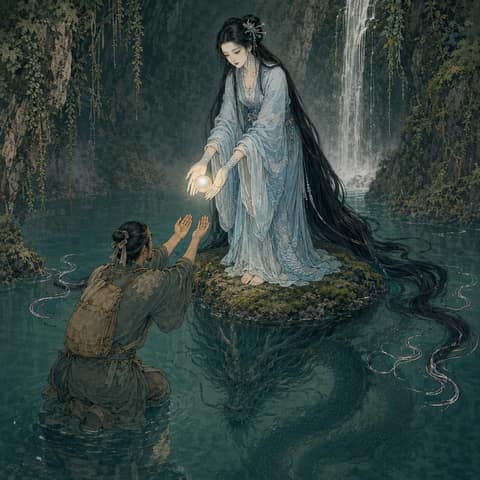
    This form gathers traditions in which a Dragon Maiden approaches a traveler or fisher beside the water. She first speaks as a human woman and asks for an offering or a promise. If the agreement is honored, she holds back floodwater and draws shoals of fish. If it is broken, she answers with a muddy torrent or a violent wind. Ryūjo is not opposed to the gods or to Buddhism. At rainmaking rites she may herself be treated as a dragon deity. She changes freely between woman and dragon, yet her body leaves clues: scales, claw marks, an uncanny fragrance, or the touch of garments that remain damp. The Dragon Maiden is not one named being belonging to a single locality, but a figure shared by many stories of water. She gathers water's two natures into one woman—nourishing life when calm and destroying an embankment when angered. The way to live beside her is not to conquer her, but to respect the water and fulfill the covenant made at its edge.

  • Saddle Fiend

    Saddle Fiend

    Rare

    KOO-rah-yah-ROH

    Toriyama Sekien Plate Conformant

    Animated Objects & UndeadJapanese folklore

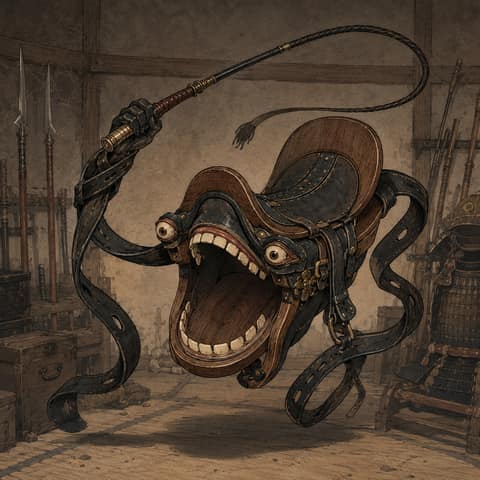
    An image based on Toriyama Sekien’s Hyakki Tsurezurebukuro. The saddle itself forms the torso, accompanied by a caption indicating damage around the front bow. Eyes peer from the base of the stirrup leathers, and the mouth splits at the front bridge to reveal fangs. The hands are rendered as extended girth straps, grasping a whip at the tip. As a tsukumogami, it follows the early modern idea that old implements gain spirit through long use or resentment. The saddle, a nexus between lord and retainer and a vessel of battlefield memory, serves as a moral emblem warning against wrongful deaths and negligence. Paired with the stirrup mouth, it thematizes preparedness and care for one’s tack, with its monstrosity reflecting carelessness and impropriety like a mirror.

  • Sakanoue no Tamuramaro

    Sakanoue no Tamuramaro

    Divine

    さかのうえのたむらまろ

    God of War Pacifying Demons, Tamura Daimyojin

    Divine Spirit / DeityKyotoMie

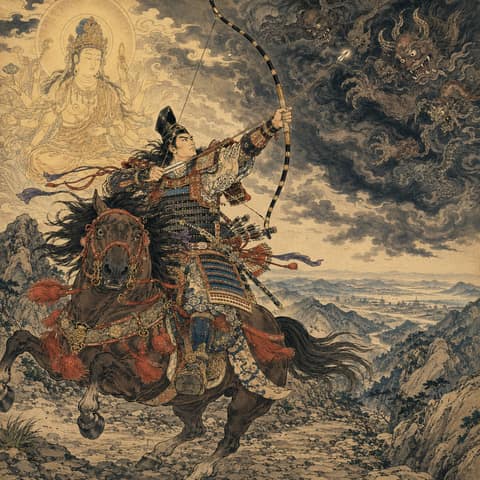
    This version of Sakanoue no Tamuramaro is not treated as the historical military official, but as the deified Tamura Daimyojin of later generations. He is told as a warrior receiving the protection of Kannon at Kiyomizu-dera, a paired husband-and-wife deity with Suzuka Gozen at Suzuka Pass, and as General Tamura subjugating Akuro-o and Otakemaru in Tohoku. A single person's name wandered through the temple origins of Kyoto, the mountain pass faith of Suzuka, and the shrine and temple origins of Tohoku, acquiring different faces in each land. The power of Tamuramaro is not the sword that slashes demons itself. Kiyomizu Kannon, Vaisravana, Suzuka Gozen, the sacred sword, and the gods of the passes support his story, transforming his martial prowess into "protection acknowledged by the gods and buddhas." Therefore, in the Tamura-gatari, rather than the scenes of defeating enemies, what matters more is which gods and buddhas took his side, in what land he was enshrined, and to which mounds or temples the memories were transferred. Sakanoue no Tamuramaro is a hero who defeats yokai, but at the same time, an axis to pass down yokai as stories to later generations.

  • Sakata no Kintoki

    Sakata no Kintoki

    Epic

    sakata-no-kintoki

    The Herculean Boy of Mt. Ashigara: Sakata no Kintoki

    Human / Demi-YokaiKanagawaKyoto

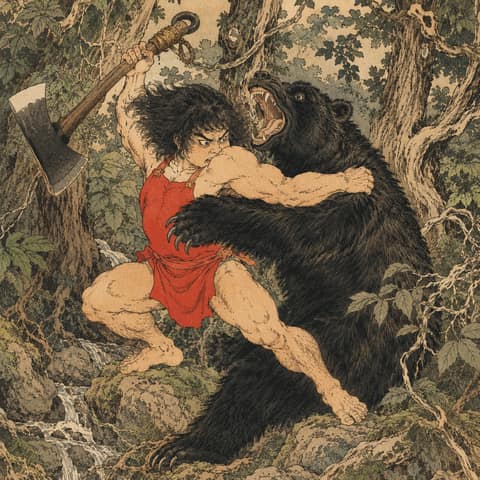
    In this version, we read Sakata no Kintoki as "the warrior who brings the power of Mt. Ashigara back to the capital." Kintoki does not appear as a polished samurai from the start. As Kintaro, he is a boy of superhuman strength raised by a yamanba, intimate with bears and beasts, carrying a broadaxe. This childhood image retains the strangeness of a child raised outside human society. The scene where he is discovered by Yorimitsu is the moment the direction of Kintoki's power changes. The superhuman strength naturally exerted in the mountains is converted into the abilities of a warrior serving a lord. This is also a story of civilizing wild power. Kintoki does not discard the otherworldly realm of the mountains, but enters the Four Heavenly Kings carrying that power. Because of this, he possesses an exceptional body within the samurai band of the capital. In the subjugation of Shuten-doji, Kintoki is a figure who confronts the demons of the mountains using the power of the mountains. The demons of Mt. Oe are anomalies secluded outside the capital, and Kintoki likewise possesses power from the otherworldly realm of Mt. Ashigara. The two can be seen as entities that have distributed the same mountain power to different sides. If the demon is the otherworldly power threatening human society, Kintoki is the warrior who has reclaimed that power for the human side. The brightness of Kintaro's image was greatly emphasized in its reception in later eras. In May dolls and children's songs, Kintaro becomes a symbol of health, robustness, and growth. However, if we only look at that healthy boyish image, yokai-like elements such as the yamanba, beasts, and superhuman strength fade away. In this version, we read him while retaining the outline of the prodigy raised in the mountains behind the cheerful folk character. Sakata no Kintoki is not a yokai, but he represents "supernatural ability on the human side" in yokai tales. He does not confront the demons from completely within human society; he confronts them with a power nurtured in a place close to mountain anomalies. Therefore, even among Yorimitsu's Four Heavenly Kings, he is a presence standing on the boundary between the capital and the mountains, child and warrior, hero and abnormality. Kintoki's superhuman strength is not just about being strong; it raises the question of where that power came from. Is he strong because he was raised with beasts on Mt. Ashigara, or did he gain otherworldly power through the yamanba's blood or upbringing? The legends do not answer clearly. That ambiguity places Kintoki on the border between humans and yokai. Being summoned by Yorimitsu is a socialization for Kintoki. He, who was a free boy of superhuman strength in the mountains, gains a lord, a name, and becomes a member of the Four Heavenly Kings. The power of the otherworldly realm changes into the power of a samurai family by being given a name and a role. Herein lies the great transformation from Kintaro to Sakata no Kintoki. In this version, we also do not take the brightness of the Boys' Festival lightly. When households wishing for their children's growth display Kintaro dolls, the superhuman strength of the mountains turns into a blessing. Yokai-like power, rather than being feared, becomes a symbol of protecting and raising children. Kintoki is also a rare example where otherworldly power was gently converted into domestic wishes. The story of Kintoki is not one of eliminating otherworldly power, but of re-nurturing it. The power nurtured under the yamanba does not disappear even when he comes to the capital. Rather, by gaining a role under Yorimitsu, it turns into the power necessary for demon subjugation. This is where the fascination of bringing yokai-like elements to one's own side lies. This gentle transformation is what makes Kintoki an intimately familiar hero even today.

  • Salmon Daisuke

    Salmon Daisuke

    Uncommon

    SAH-keh noh OH-oh-skay

    Legendary Tale: Daisuke of the Salmon

    Aquatic SpiritsTohoku region; Shinano River basin (Niigata Prefecture) and across eastern Japan

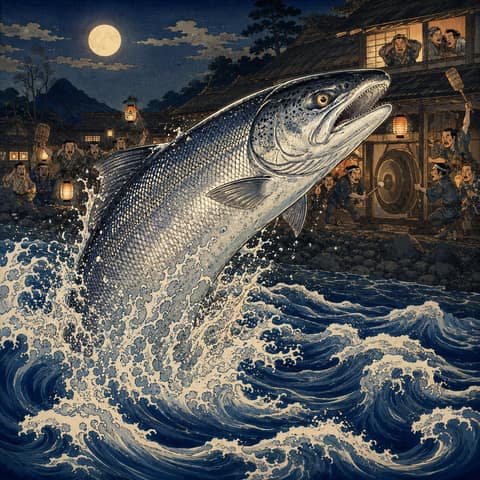
    Known as the King of the River, Daisuke of the Salmon marks forbidden periods and seasonal rites during the salmon run. On set dates—such as the fifteenth of the Frost Month and the twentieth of the Twelfth Month—Daisuke and his consort Kosuke are said to proclaim in loud voices. Anyone who directly hears them dies three days later, so riverside communities kept those days as no-fishing days, ringing gongs, singing, and pounding rice cakes to block out the sound. In tales along the Shinano River, a powerful elder who forces taboo-breaking meets a water authority in the guise of an old woman and dies suddenly with the run’s onset, embodying awe of nature and adherence to proper conduct. The old woman is read as a personified river spirit or Daisuke’s avatar, though never revealed outright. The name varies between “Daisuke of the Salmon” and “Daisuke the Salmon,” and his wife is called Kosuke. Recorded from the early modern period in surveys and folktale collections, this motif spreads across the salmon culture zone of eastern Japan beyond specific locales. Creative variants are few, and the core points—voice, dates, taboo, and fatal retribution—remain consistent.

  • Sandworm

    Sandworm

    Uncommon

    SAHND-wohrm

    Giant Worm Advancing Through Sand - Sandworm

    General TermFictional / Imported Giant Worm Advancing Through Sand (Sandworm)

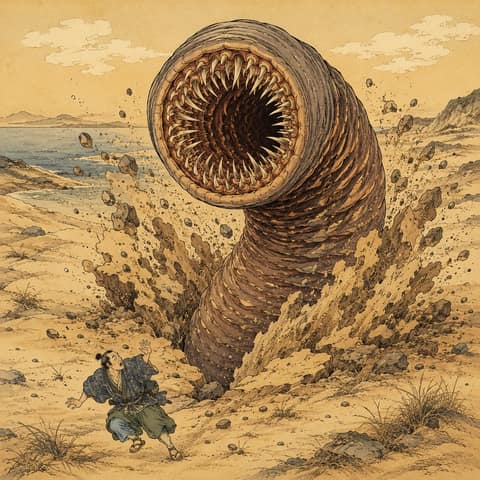
    This is an interpretation of the "apex predator of the sand sea that attacks upon detecting vibrations," burned into the minds of modern people through games and fantasy works. The Sandworm in this version lacks sight; instead, it acutely senses the slightest "footsteps (vibrations)" of humans walking on the surface, embodying the ultimate panic horror as it suddenly opens its massive jaws from underfoot to swallow its prey whole. Speaking of Japan's indigenous subterranean anomalies, there are the "Giant Catfish (Oonamazu)" and "Giant Earthworm" that cause earthquakes, but while they are symbols of "the disaster itself," the Sandworm is strictly set as a "creature reigning at the apex of a harsh ecosystem," reflecting the rationalism of an imported monster. Layers of sharp concentric fangs, an armor-like hard body surface, and overwhelming mass that even swords and magic (or modern weaponry) cannot penetrate. It is the crystallization of the unfathomable terror and romance that the Japanese, living in an island nation surrounded by the sea, harbor toward the "endless desert" they have never once stepped foot in. Precisely because it lacks the background of a local indigenous spirit, it continues to evolve and grow larger in new creative works today as a purely "desperate foe in the struggle for survival."

  • Sanki Daigongen

    Sanki Daigongen

    Epic

    sanki-daigongen

    Japan's Only Demon God Guarding Mount Misen, Sanki Daigongen

    Oni/Giant MonsterHiroshima

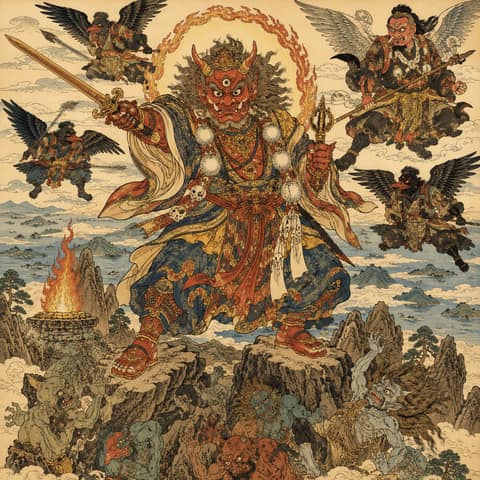
    The core of Sanki Daigongen lies in its reversed divine nature, transforming the originally feared oni into a "guardian deity that wards off evil." The three demon gods—Tsuicho, Jibi, and Mara—each govern fortune, wisdom, and subjugation, with Dainichi Nyorai, Kokuzo Bosatsu, and Fudo Myoo as their original Buddhist forms. This trinity structure demonstrates the fusion of the Honji Suijaku (original reality and manifested traces) thought of Shingon esoteric Buddhism with mountain asceticism and tengu worship. The fact that it commands large and small tengu as familiars is directly connected to folk tales of Mount Misen being a spiritual mountain of tengu (like the tale of Masanori Fukushima's tengu extermination). It embodies the sacredness of Mount Misen itself, characterized by Kukai's founding, the unextinguishable spiritual fire, and the strange rock formations likened to Mount Sumeru. The Itsukushima Shrine (Ichikishima-hime and Benzaiten) on the sea and Sanki Daigongen on the mountain form a pair as the guardian deities of the two poles of Miyajima—the sea and the mountain.

  • Sanmai Tarō

    Sanmai Tarō

    Uncommon

    SAHN-mai tah-ROH

    Zammai Taro (Folkloric Type)

    Ghosts & SpiritsIshikawa

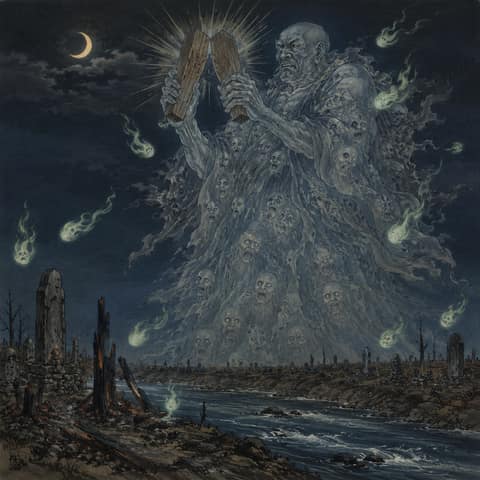
    A figure based on local lore in which death-spirits amassed at a burial ground (zammai) congeal and manifest as a single monster. In Toyama it appears as a humanlike specter that performs ominous signs, while in Ishikawa it is feared as a giant priest-like ogre. It is bound to human life, death, and the order of funerary practice, often marked by nighttime sounds and prescribed etiquette. Widely said to be unable to cross running water, a belief linked to folk practices of digging trenches around the zammai. Its form and stature are not fixed and vary with the density of gathered spirits. Folklore records note collections from the early Showa era, with regional spellings such as “Zammai” and “Zanmai.”

  • Sanuki Heike Crab

    Sanuki Heike Crab

    Uncommon

    sah-NOO-kee HAY-keh-gah-nee

    Sanuki Heike Crab (Linked to Yashimaura)

    Household SpiritsKagawa

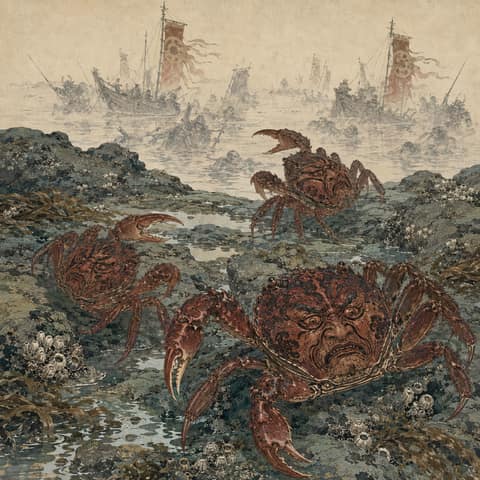
    An image based on folk belief that crabs with human-like patterns on their carapaces washed up on Sanuki shores embody the vengeful spirits of the defeated Taira clan. Historical sources tie these crabs to various locales, with Sanuki famed due to memories of the Battle of Yashima. As a yokai, it is said not to harm people directly, but to make onlookers recall the karma of the battle and feel awe. It is distinctly linked with acts of memorial service and consolation for the dead, and differences from other regional names are considered nominal only.

  • Saru-oni (Ape Ogre)

    Saru-oni (Ape Ogre)

    Uncommon

    SAH-roo-OH-nee

    Legend-Conform Noto Saru-oni

    Demons & GiantsIshikawa

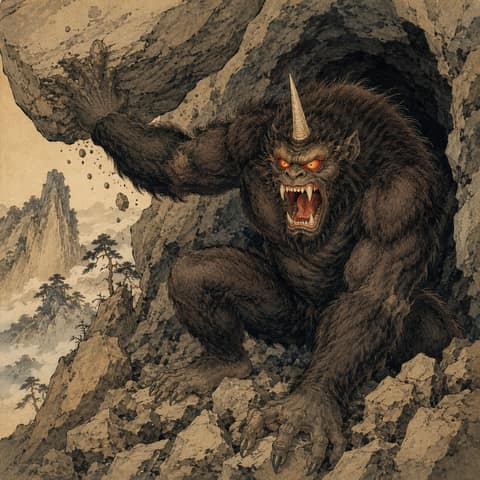
    Based on the Noto region’s distinctive image of the saru-oni. It has an ape-like body crowned with a single horn and dwells in rock caves, menacing livestock and people near settlements. It appears under cover of night and is feared as a boundary breaker between the mountains and the village. Communities sought the protection of local tutelary deities, and tales of subjugation by bow and arrow are tied to place-name origins. After its defeat, its horn is said to have been enshrined, and memorial shrines were established, pairing awe with appeasement. The saru-oni is told as a singular creature rather than a pack. Its range centers on cave mouths and the satoyama borderlands, its presence marked by a bestial stench and legends of black blood.

  • Sarugami (Monkey Deity)

    Sarugami (Monkey Deity)

    Epic

    sah-roo-GAH-mee

    Simian Deity in Medieval Tales

    Deities & Divine SpiritsShigaOkayama

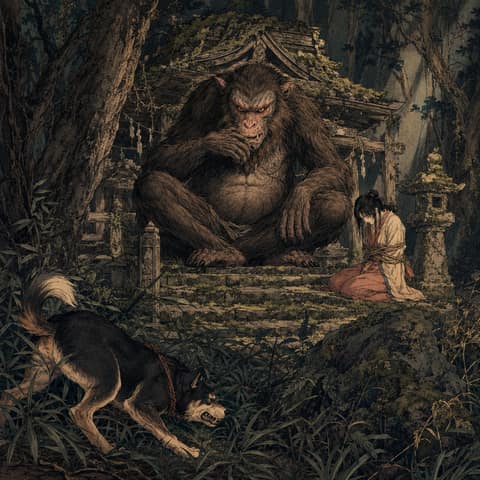
    In medieval Japan, the monkey deity was told as a fusion of mountain divinity and simian monster. It ruled mountain domains and demanded offerings like a calendar ritual, seen as a relic of ancient sacred marriage rites, yet storytelling emphasized its brutality as a yokai. In slaying tales, a passing hunter or a monk with sacred power stands in as a substitute, and a trained dog plays the decisive role. The defeated deity sometimes possesses a shrine official to beg forgiveness, hinting at lingering sanctity. In some regions it was known as a possessing spirit, with sudden rages blamed on its curse. Early modern ghost stories pair man‑eating ferocity with comic butt‑fondling, portraying the ambivalent scorn and fear directed at monkeys.

  • Sarutahiko-no-Mikoto

    Sarutahiko-no-Mikoto

    Legendary

    さるたひこのみこと

    Grotesque Guiding God of the Tenson Korin / Sarutahiko-no-Mikoto

    Divine Spirit / DeityMie

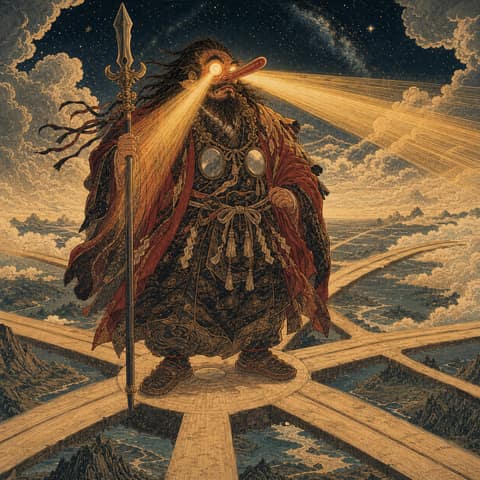
    Special Position in Ancient Mythology as the 'Grotesque Guiding God'. While the basic description touches on Sarutahiko-no-Mikoto's main myth, this detailed explanation delves into his unique position as a 'grotesque guiding god' in ancient Japanese mythology. His bizarre appearance, with a nose seven ata long and eyes shining like the Yata-no-Kagami, is extremely visual and concrete even among the descriptions of deities in ancient myths, serving as the ultimate religious expression of 'a deity standing at the boundary between the otherworld and this world.' The fact that such a strong contrast between the noble Amaterasu-lineage deities and a grotesque Kunitsukami was placed at the core moment of the Tenson Korin, the central ancient Japanese state myth, can be interpreted as an intentional narrative device by the myth's compilers. Grotesqueness is not just visual oddity; it is the concrete embodiment of universal religious feelings such as protection from the otherworld, crossing boundaries, and reconciling with the heterogeneous. Prototype of the Tengu ── Development into Shugendo and Mountain Beliefs. Sarutahiko-no-Mikoto's grotesque description (long nose, red face, glowing eyes) is folklorically positioned as the prototype of the later Tengu (shugendo-related mountain yokai). The Tengu beliefs of the Heian and medieval periods inherited Sarutahiko's grotesque nature while intricately intertwining with Buddhism, shugendo, and mountain worship to undergo unique development. The hierarchical system of Tengu, such as Daitengu, Karasu Tengu, and Konoha Tengu, can be understood as the medieval refinement of the 'grotesque deity' originating from the ancient Sarutahiko. The relationship between Sarutahiko and the Tengu is a crucial genealogical theory in Japanese yokai studies, serving as core material for examining the continuity between ancient mythology and medieval yokai culture. Reconciliation and Cooperation between 'Amatsukami and Kunitsukami'. In the political and religious event of the Tenson Korin, where 'Amatsukami (deities of the heavenly realm) descend into the territory of Kunitsukami (deities of the earthly realm),' Sarutahiko-no-Mikoto stands out as a rare Kunitsukami who proactively welcomed the Amatsukami. In contrast to Okuninushi's yielding of the land, which was a 'forced transfer,' Sarutahiko's guidance occupies the contrasting position of 'voluntary cooperation.' This represents two aspects of religious integration between the center (Amatsukami lineage) and the periphery (Kunitsukami lineage) in ancient Japan. The contrast between forced integration (Okuninushi) and voluntary cooperation (Sarutahiko) reflects the editorial intent of the ancient state myths and the complex multiplicity of ancient Japanese political history. The Tragedy of the Hirabu-gai ── Vulnerability of the Deity and the Meaning of His End. The ending where Sarutahiko-no-Mikoto drowns after being caught by a hirabu-gai is a unique tale in ancient mythology that expresses the vulnerability of deities, human contingency, and the unknowability of fate. The ironic conclusion in which the great guiding god receives a fatal wound from a small natural object like a shell mythologizes universal themes in ancient Japan, such as 'confrontation with nature,' 'the limits of heroes,' and 'the unknowability of fate.' Furthermore, the specific circumstance of 'an accidental death while fishing' includes a religious reflection of marine, fishing, and coastal life in ancient Japan, symbolically demonstrating Sarutahiko's essence as a god standing at the boundary of sea and land, the intersection of life and death. The ending of the myth is not merely a tragedy but an advanced symbolic device that narrates the essential attributes of the deity. The Core of Doso-jin and Crossroads Deity Beliefs ── The Heart of Nationwide Folklore. From the Middle Ages onwards, Sarutahiko-no-Mikoto was widely venerated as the guardian deity of village boundaries, crossroads, mountain passes, and barriers through syncretism with Doso-jin, Funado-no-Kami, and Sae-no-Kami. The fact that Sarutahiko is positioned at the center of folk religion, such as Doso-jin stone monuments, phallic stones, crossroads Jizo, and Sae-no-Kami festivals distributed nationwide, demonstrates the continuous inheritance from ancient state myths to medieval folk religion. Doso-jin worship is not merely a religious ritual but a folkloric practice that gives meaning to universal anthropological themes of 'boundaries, new beginnings, protection, and harmony' through ancient myths. As a deity supporting the roots of Japanese people's sense of life, movement, and boundaries from ancient times to the present, Sarutahiko possesses a cultural reach that transcends a single deity appearing in a myth. Association with Koshin Belief ── Popular Religion in the Edo Period. During the Edo period, due to the phonetic association of 'Saru' (monkey) in Sarutahiko, he was linked to the Koshin belief (originating from Chinese Daoism, involving an all-night gathering every 60 days to defeat the Three Corpses), and Koshin towers, Sarutahiko Koshin mounds, and the three wise monkeys (see no evil, hear no evil, speak no evil) spread nationwide. This is a representative example of the multilayered fusion of ancient mythology, medieval Doso-jin, early modern Daoism, and Edo popular religion, demonstrating the typical Japanese religious culture of 'syncretism through phonetic association.' The combination of Koshin and Sarutahiko beliefs functioned as a core institution supporting the collective religious life, village society, and nighttime socializing of commoners in the Edo period, leaving traces in the modern landscape of the three wise monkeys and Koshin mounds. Sarutahiko-no-Mikoto in the 21st Century ── Modern God of Travel, Guidance, and New Beginnings. Today in the 21st century, Sarutahiko-no-Mikoto is widely cherished as the god of 'roads, travel, new beginnings, and guidance,' serving as an object of prayer for new car purchases, traffic safety, starting new businesses, safe travels, and major life milestones. Pilgrimages to Tsubaki Grand Shrine, Sarutahiko Shrine, and Futamiokitama Shrine continue ancient customs, and the religious structure of the ancient myth of 'visiting Amaterasu-Omikami under the guidance of the guiding god' has been inherited to this day. Even in a modern society marked by globalization, informatization, and individualization, the universal theme of 'life's paths, choices, and guidance' continues to impart new modern meanings to the ancient guiding god. As a rare deity whose presence bridges ancient mythology and modern Japanese spiritual culture for over two thousand years, he bears a living inheritance in religion, culture, and tourism in the 21st century.

  • Saruyume

    Saruyume

    Epic

    saruyume

    The Nightmare Train with No Stopovers

    Spirit / GhostA dream ghost story originating on anonymous message boards / No specific location

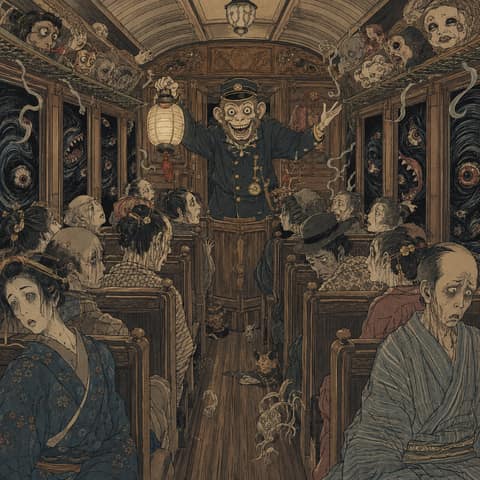
    This version of Saruyume is read as a single railway line laid out inside a dream. The train is a means of transportation, but simultaneously a device for determining order. Passengers are made to sit in seats, listen to announcements, and wait until their turn comes. The terror is not just what will happen. Because events are announced methodically like station names or sequences, the absurdity of the dream approaches wearing the face of a system, and that is what makes it terrifying. The "monkey" in Saruyume is more of an MC's mask than the true form of the yokai. Monkeys resemble humans, but deviate slightly from human ethics. Thus, when a monkey-like entity laughs in a dream, the comicality of an amusement park and the coldness of an execution ground rise simultaneously. In old monkey god folklore, monkeys stand at the boundary between mountain and village, but in Saruyume, they stand at the boundary between sleep and wakefulness. They are not messengers of mountain gods, but petty attendants advancing a dream's performance. The reason this ghost story is strongly remembered on the internet is that the telling is short and the structure is clear. You board a train, there are previews, passengers decrease, you wake up halfway, you become afraid of falling asleep next. This framework is concise, and even if readers forget the details, they do not forget the structure. Like many of the modern anomalies compiled by Itsuki Asazato, Saruyume is both a single completed story and a template re-enacted within the reader's brain. Viewed as a dream ghost story, Saruyume modernizes the custom of "telling others the dreams you had." Superstitions like "bad dreams fade when told to others" or conversely "telling them makes them real" exist everywhere. In Saruyume, posting on a message board does not fade the dream; it duplicates it. Readers read someone else's dream and take home material similar to their own dreams. Here, the internet is a dream archive and simultaneously a medium that infects dreams. The lack of place names in Saruyume's stage is not a weakness, but a strength. Kisaragi Station has an outline reminiscent of western Shizuoka Prefecture, but Saruyume does not even have that. Thus, readers can move the stage to any sleeping location: a futon at home, a nap at school, a seat on a night bus, a hospital bed. The feeling that "it could happen to me," which ASIOS emphasizes in the circulation of urban legends, is established with minimal conditions in Saruyume. Getting off this train midway is made possible only once by waking up. However, the story does not treat waking up as an exit. Rather, waking up is an interruption, a preview of resumption. It does not allow the terror to be consumed in one night, but carries it over to the next sleep. This time design is the very anomaly of Saruyume, and the reason it encroaches on real-life rhythms despite using a dream as its stage. If Saruyume were posited as a single yokai, its body would be the entire train, the voice, the sequence chart. Hands and feet directly chasing passengers cannot be seen. Instead, the voice announcing the next station name dominates the progression. This is the sense of security of a modern transportation system turned inside out into nightmare procedures within a dream. You don't know where you are heading, but the next stop is certain to come. That certainty elevates Saruyume from a mere nightmare to a memorable modern anomaly.

  • Satori

    Satori

    Epic

    sah-TOH-ree

    Traditional Version: Kakku of Hida and Mino

    Mountain & Wilderness SpiritsGifu

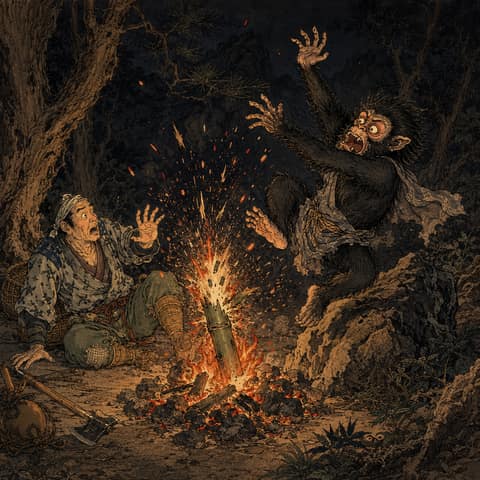
    A simian-form apparition modeled on Sekien Toriyama’s Konjaku Gazu Zoku Hyakki entry and natural-historical notes in Sino-Japanese texts. It appears on remote mountain paths, instantly voices the thoughts of woodcutters and travelers, and gauges their behavior. Disinclined to harm humans, it withdraws swiftly when sensing danger, in line with Sekien’s text. In folktales its figure varies by region—monkey, mountain man, tengu, or tanuki—but its core is “mind reading” and retreating at sudden noises. Its mind reading mirrors the other’s thoughts and repeats them, closer to a warning than provocation. It reads presences in mountain stillness yet proves vulnerable to the unexpected—sparks from a campfire or a flying splinter. The name Kakku is linked to the character 玃 through phonetic conflation, from which an independent yokai image emerged. Traditions span Chubu to Kanto, Tohoku, Chugoku, and Kyushu, telling of a being that measures the boundary between people and the otherworld in the mountains.

  • Satoru-kun

    Satoru-kun

    Epic

    satoru-kun

    The Telephone Prophet Approaching from Behind

    Spirit / GhostA telephone-ritual urban legend / The threshold between public and mobile phones

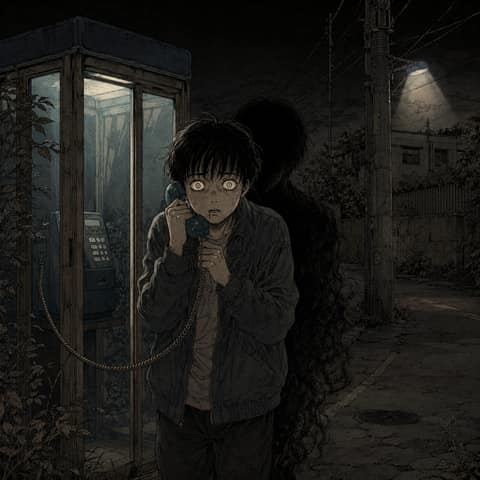
    This version of Satoru-kun appears as a prophet coming from the other end of the phone. He is not merely an anomaly of pure malice. He has a clear function: answering the caller's question. That is precisely why he is dangerous. If it were only terror, people could avoid it, but thinking they might get an answer draws them to the dangerous steps. Satoru-kun sees through that curiosity. The medium of the telephone allows only the voice to arrive first. An entity with no face or body announces its location right in your ear. When that distance shortens to "I'm at the station now," "I'm in front of your house now," "I'm right behind you now," the phone changes from a communication device to a summoning path. Like the cluster of telephone urban legends collected by Hiroshi Matsuyama, Satoru-kun's terror is born the moment remoteness reverses into proximity. A comparison with Kokkuri-san illuminates this anomaly's personality well. Because Kokkuri-san involves multiple people surrounding the paper, responsibility is dispersed among the group. Because Satoru-kun requires calling alone, responsibility returns entirely to the individual. There is no escape route of "Didn't someone else move the coin?" Call histories, ringtones, and your own voice become the only evidence. The feeling of wanting to know becomes the very signature for the summoning. The endpoint of standing behind the caller is also important. Because he is behind rather than in front, the desire to confirm is born. But the moment you confirm, you break the taboo. This is an old ghost story structure: the other world is exposed when prohibitions like "do not look," "do not open," or "do not turn around" are broken. Despite being a telephone ghost story, Satoru-kun is an entity that has transferred the "must not look" archetype—shared by the Crane Wife, Urashima, and Yomotsu Hirasaka—to modern devices. Following Itsuki Asazato's categorization of modern anomalies, Satoru-kun is strong as a "ghost story with a method". Rather than just listening to a scary story, the steps are written out. When there are steps, people are forced to choose whether to try it or not. That choice is already a participation in the story. Even readers who do not execute it will mentally lift the receiver of a public phone, press the numbers, and hear the ringtone. Because public payphones themselves have decreased in modern times, Satoru-kun may look like an antiquated ritual. But the decrease does not weaken the anomaly; it concentrates it. The phone booth left in the corner of the station, the green phone in the hospital corridor, the fogged glass on a rainy day. Unused communication devices look like ritual tools left solely to connect this side and the other side. Satoru-kun stands in the place where a tool that has lost its convenience regains a magical nature. The final remaining question is what to do after getting the answer. Satoru-kun answers the question, but he will not necessarily save your life. Far from erasing anxiety, knowledge confirms the fact that something is behind you. This anomaly shows the paradox often found in divination ghost stories—the moment when the wish "knowing brings peace of mind" flips to "I can't escape because I know"—through the distance of a single phone call. Therefore, he is a prophet, and simultaneously a punishment for knowledge.

Showing 409 - 432 of 592 yokai