Yokai Encyclopedia
Encyclopedia of Japanese Yokai
珍しい 
Hair-Cutter
KAH-mee-KEE-ree
The Hair-Cutter of Edo Streets
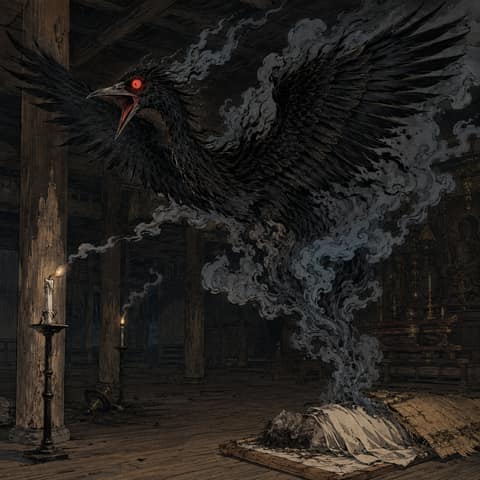
山野の怪 Edo and urban areas such as Ise Province An amalgam of hair-cutting incidents reported from Edo and other early modern towns. At night, in the street or at the threshold of an indoor privy, there is a sudden brush of contact, and moments later the victim’s hair falls away still neatly tied, without their noticing. Witnesses describe a figure black from head to toe, catlike, or with the feel of velvet, yet its true form remains uncertain. Servant girls and maids were often noted as victims, with rumor-mongering and official crackdowns recorded side by side. Folklorically, taboos surrounding hair as part of the body overlap with notions of impurity tied to night roads and privies, casting an unseen assailant as a yokai. Its method and motive are never stated in tradition, placing it among urban horrors shaped by fear and unease.
稀少 
Hair Oni (Kamikki)
KAH-mee-oh-nee
Sekien Zukai Edition
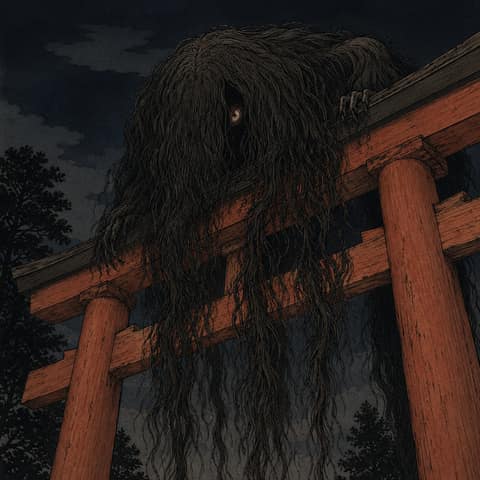
Animated Objects & Undead Japanese folklore An iconographic reading of the Hair Demon as depicted in Toriyama Sekien’s Hyakki Tsurezure Bukuro. A woman’s hair, infused with its owner’s passions, becomes autonomous, standing on end at midnight as its locks extend and contract like living things. Cutting it offers only brief respite, for it regrows and multiplies at once. Rooted in a dual folk view that both sanctifies and shuns hair, it is shown as a being where tsukumogami traits cross with vengeful-spirit nature. Its body is a mass of hair without face or limbs, asserting menace through motion and shifting length. Memorial offerings and proper hair-cutting rites are said to calm it, yet no certain banishment method is recorded.
伝説 
Oni
OH-nee
Oni (Traditional Folklore Form)
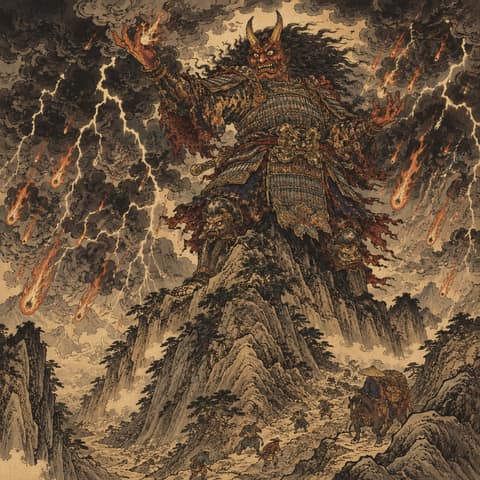
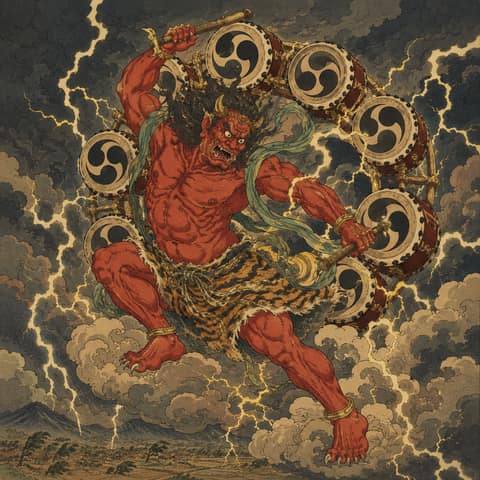
Demons & Giants Nationwide (Japan) A classic oni with red skin, proud horns, and a tiger-skin loincloth. Despite the fearsome look, he carries a warm heart. His booming laughter echoes through the mountains, and he treasures bonds with his comrades above all. Though terrifying when roused to anger, he is usually jovial and a dependable, big-brother figure.
珍しい 
Oni Hitokuchi
OH-nee HEE-toh-KOO-chee
Tradition-Faithful Edition
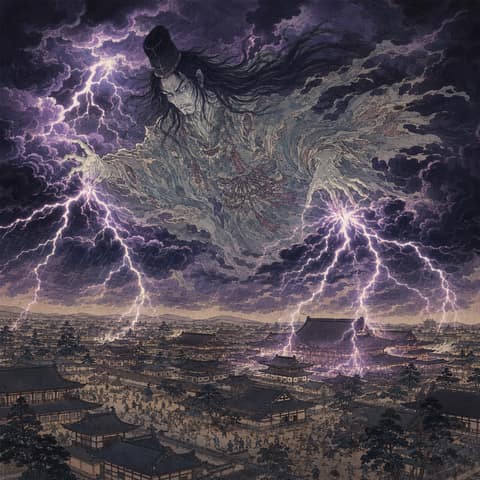
Demons & Giants Japanese folklore Oni Hitokuchi appears in pre-medieval tales less as a fixed figure than as a term for a demonic being that fells a human with a single bite. It typically emerges in liminal scenes—at night, in thunderstorms, near storehouses or by the roadside—often intruding upon lovers’ trysts or flights. In The Tales of Ise (the Akutagawa episode), thunder drowns out the screams, and the lack of remains underscores the instantaneous “one bite.” Nihon Ryōiki and Konjaku Monogatari depict its mimicry as a man, serving as a warning against deviating from social bonds such as marriage or vows. After Sekien’s imagery fixed the name, folklore used it to reframe wartime, famine, and disaster disappearances as otherworldly devourings. Thus “Oni Hitokuchi” here is a type-name: its form is not fixed, and its essence is speed of consumption and absence of traces.
珍しい 
Kijo (Demon Woman)
KEE-joh
Canonical Folkloric Type: Kijo (Ogress)
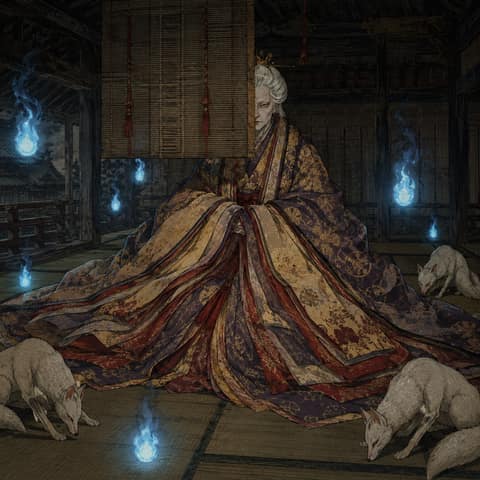
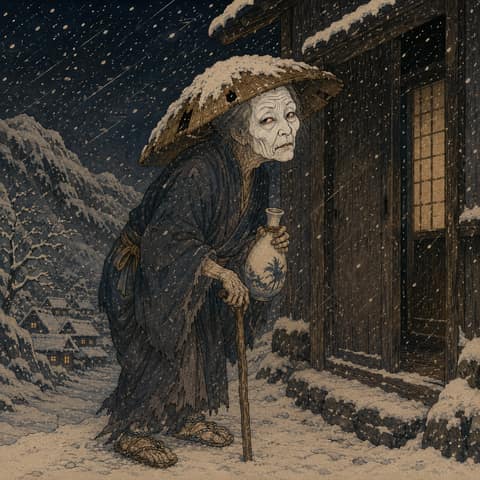
Demons & Giants Various regions (notably Tōhoku, Shinano, Ōmi, and around Ise) A standardized profile of the archetypal kijo found across regional tales. She embodies the belief that human passions can ripen into demonic nature, appearing as anything from a beauty to an old woman. By night she lures travelers in mountains or at crossroads, invites them into a lodge or hermitage, then reveals her true form. Many stories end with her being driven off or laid to rest by Buddhist rites, serving as both horror and moral instruction. Depending on locale she may eat humans, target infants, or drink blood, all understood as outcomes of taboo-breaking, suspicion, and obsessive attachment. In Noh, sekkyō, and origin-picture scrolls she is depicted with horns, fangs, and bristling hair, the shock between human guise and oni form being a key dramatic moment.
珍しい 
Oni Bear
OH-nee KOO-mah
Tradition-faithful Oni-Bear
Animal Shapeshifters Kiso Valley, Shinano Province (Nagano Prefecture) Based on Edo-period sources, this depicts an old bear transformed into a yokai. It usually keeps to deep mountains and avoids human presence, but during famines or seasonal shifts it slips down to villages under cover of night to carry off livestock. Its upright gait can be mistaken for a human silhouette, and its tracks mingle human and bear prints. Tales of great strength tie it to local megalith lore, serving as an unspoken boundary marker for dangerous mountain zones. In slaying legends, communal coordination, selective use of hunting tools, and reverence for the mountain deity are emphasized, and the Oni-Bear is told as more than a mere beast—a symbol that brings calamity to those who break the laws of the mountain. Descriptions in early modern illustrated compilations heighten its uncanny nature while reflecting memories of real bear attacks, showing the intersection of folk environment and ghostly tale.
名妖 
Kidōmaru (Demon Prodigy)
kee-DOH-mah-roo
Classical Lore Version
Demons & Giants Ichiharano, Yamashiro Province (trad.); Kumohara, Tanba Province (trad.), Japan Centered on Kokon Chomonjū, this version frames Kidōmaru as an oni confronting Minamoto no Yorimitsu (Raikō) and Watanabe no Tsuna. After escaping capture, he shadows his targets and, anticipating them on the road to Kurama, lies in wait at Ichiharano by hiding inside the body of a cow—an audacious ruse seen through by Raikō’s caution. When Tsuna’s arrow breaks the concealment, Kidōmaru reveals his oni form and charges, only to be felled by a single stroke from Raikō. Iconography was fixed by Toriyama Sekien as a figure draped in cowhide in the snow, and early modern warrior prints often depict him as a rival in contests of sorcery. His lineage is unsettled: in the Unbara tradition he is the child of Shuten Dōji, while in war tales he is a novice from Mount Hiei. In all strands he is understood as a being who hides in wilds, watching for opportunity through brute strength, transformation, and stealth. Avoiding later embellishments, this reconstruction centers on his core behaviors of concealment, transformation, and ambush.
名妖 
Batsu (Hiderigami)
BAHT-soo (hee-DEH-ree-gah-mee)
Bibliographic Transmission Batsu (Hiderigami) of the Wakan Zukai Lineage
Deities & Divine Spirits Chinese tradition (transmitted to Japan through texts) In Japan, images of the batsu (Hiderigami) were received mainly through later Chinese writings and bibliographic transmission. The Wakan Sansai Zue cites Sancai Tuhui, Bencao Gangmu, and Shenyijing, explaining that the batsu, called the “drought god,” has a human face and beastly body with a single hand and a single foot, runs like the wind, and wherever it dwells no rain will fall. Toriyama Sekien’s Konjaku Gazu Zoku Hyakki visualizes this composite form and notes the alias “Hanmu.” Rather than native Japanese yokai lore, these accounts reflect learned reception of Chinese views on calamities and calendrical omens, treating the batsu as an ideational symbol of drought more than an eyewitnessed apparition. Its form is not fixed, with a goddess aspect (Bo) and a beast-shaped aspect coexisting, though Japanese sources tend to emphasize the latter. Religious responses align with general drought countermeasures such as rain prayers and water-deity rites, and clear cases of direct worship of the batsu itself are not well attested. As a calamity deity, its approach was thought to wither plants and exhaust human spirits.
名妖 
Mōryō
MOH-ryoh
Mōryō (Classical Depiction)
Aquatic Spirits Uncertain (concept from ancient China, adopted in Japan) A generalized classical image of the mōryō based on historical sources. The term was used for uncanny phenomena tied to watersides, graveyards, ancient trees, and great stones, and is understood to be linked with disasters that defile corpses and the spread of death impurity. Its form is not fixed—some accounts call it childlike, others say it manifests only as a vapor or miasma. In Japan, the word came to denote corpse-stealing spirits and served to justify funerary taboos and rites of purification.
神格 
Mahō-sama (Magic Lord)
mah-HOH-sah-mah
Tradition-Faithful Guardian Deity Kyūmō Tanuki
Deities & Divine Spirits Bizen Kamo (present-day Okayama Prefecture) A local guardian whose tanuki shapeshifter lore was deified at sites such as the Mahō Shrine in Kari, Sōja City, and the Hinokaminari Shrine and Amatsu Shrine in Kibichūō. The name has no relation to Western magic, with a noted theory of corruption from Marishiten. Some local accounts place its arrival in the late Muromachi period. Worship centers on keeping cattle and horses healthy and on protection from fire and theft. On temple fair days, people would visit leading their cattle and horses, and tales speak of a tanuki’s passage hole and offerings of fried tofu. Hallmarks of tanuki lore appear—shapeshifting, omens, and money glamour that makes leaves seem like gold—yet it ultimately came to be enshrined as the village’s tutelary deity.
珍しい 
Maki-jo (Demon Woman)
MAH-kee-joh
Recorded Tradition Edition
Demons & Giants Makiyama, Ishinomaki, Miyagi Prefecture Maki-onna is a demon-woman figure found in temple chronicles and local histories around Ishinomaki, paired with the ogre Ōtakemaru of Mt. Nōgatake. While the slaying tales center on Ōtakemaru, she appears as his consort and later becomes an object of memorial rites and pacification. In the legend where General Tamura subdues various demons with a Kannon image attributed to Enchin and installs Kannon statues on each mountain, Makiyama preserves a tale of dedicating Maki-onna’s cut hair. Place-name and temple-name origin lore (Magiyama to Makiyama) and the transfer of Kannon images are recounted as religious history. Her concrete figure remains understated, yet she stands as a symbol of mountain dread fused with Kannon devotion. Anecdotes with strong fictional color are avoided, and some sources omit her entirely, showing the range of the tradition.
珍しい 
Salmon Daisuke
SAH-keh noh OH-oh-skay
Legendary Tale: Daisuke of the Salmon
Aquatic Spirits Tohoku region; Shinano River basin (Niigata Prefecture) and across eastern Japan Known as the King of the River, Daisuke of the Salmon marks forbidden periods and seasonal rites during the salmon run. On set dates—such as the fifteenth of the Frost Month and the twentieth of the Twelfth Month—Daisuke and his consort Kosuke are said to proclaim in loud voices. Anyone who directly hears them dies three days later, so riverside communities kept those days as no-fishing days, ringing gongs, singing, and pounding rice cakes to block out the sound. In tales along the Shinano River, a powerful elder who forces taboo-breaking meets a water authority in the guise of an old woman and dies suddenly with the run’s onset, embodying awe of nature and adherence to proper conduct. The old woman is read as a personified river spirit or Daisuke’s avatar, though never revealed outright. The name varies between “Daisuke of the Salmon” and “Daisuke the Salmon,” and his wife is called Kosuke. Recorded from the early modern period in surveys and folktale collections, this motif spreads across the salmon culture zone of eastern Japan beyond specific locales. Creative variants are few, and the core points—voice, dates, taboo, and fatal retribution—remain consistent.
珍しい 
Roaring Cauldron (Narigama)
nah-ree-GAH-mah
Ringing Cauldron (Hyakki Tsurezurebukuro)
Household Spirits Japanese folklore Based on the belief that tools become spirited after a hundred years, this yokai is depicted with an old iron cauldron for a head. It lingers in the night, issuing faint tremors and steam that produce low sounds. The ringing is read as an omen of fortune or misfortune, falling silent if met with careless clamor, and responding when approached with reverence. It embodies divinatory function and the memorial veneration of well-used objects.
伝説 
Nue
NOO-eh
Nue of the Palace’s Ominous Cloud
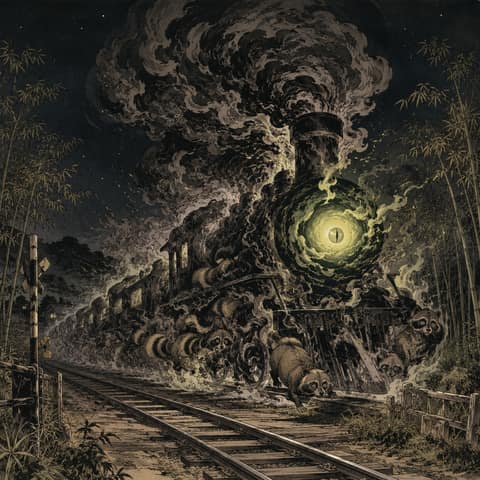
Animal Shapeshifters Kyoto region, Japan Manifesting above the imperial court with a black cloud, it unsettles hearts with uncanny cries. Though often depicted as a chimera with a monkey’s face, badger’s body, tiger’s limbs, and a snake’s tail, it ultimately symbolizes an unknown terror whose sound and presence arrive before any form. It is easily shot down, yet vanishes into cloud and darkness without a trace, matching its folk image. The composite-animal iconography spread mainly through later paintings.
神格 
Mugidono Daimyōjin
MOO-gee-doh-noh dye-MYOH-jin
Measles Iconography: Demon-Trampling Aspect
Deities & Divine Spirits Edo period A canonical image of Muginodo Daimyojin found in measles prints. A formidable deity subdues a red-black oni under both feet while onlookers press their hands in prayer. Though the god’s origins are unclear, the image renders the disease visible and calms anxiety through the act of trampling. The accompanying text lists convalescent care, dietary restrictions, and prayers for recovery, blending devotion with practical guidance. The design reflects the plain sincerity of folk belief.
珍しい 
Hair in the Hemp Bucket
ah-sah-OH-keh-no-keh
Traditional Record Edition (Awa Curious Tales)
Household Spirits Awa Province (Kamo Village, Miyoshi District; present-day Tokushima Prefecture) Based on an old Awa record. Hair kept in a hemp bucket acts as part of the deity’s body or a manifestation of divine power, restraining anyone who disrupts shrine order. It is understood to activate within the shrine precincts rather than roaming independently. The core image is hair that quietly elongates, splits into strands, and entangles targets one by one, reacting to acts like defilement or theft rather than attacking onlookers indiscriminately. Shigeru Mizuki depicted it as a massive hair mass under the name “Asaokege,” but the actual tradition emphasizes function over appearance. Often read as a symbol of in-shrine norms encouraging observance of faith and taboos.
珍しい 
Kuro-bōzu (Black Monk)
KOO-roh BOH-zoo
Kuro-bōzu (Traditional Folk Variants)
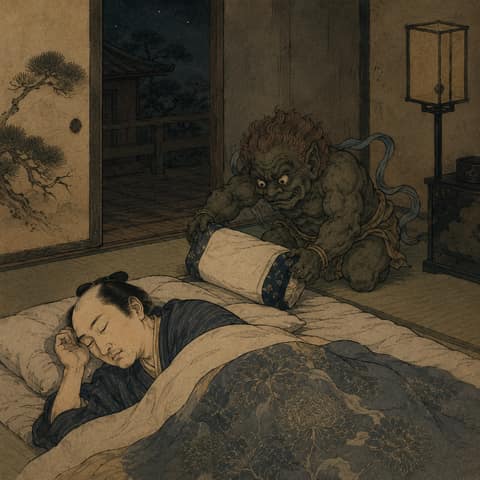
General Classifications Uncertain; tales recorded in Edo/Tokyo, Kumano (Kii Province), and Nomi District, Kaga Province The name Kuro-bōzu has long served as a catch-all for regionally varied apparitions. In Edo-Tokyo it was recorded as a bedroom prowler that drew close to women’s mouths to sip their sleeping breath, leaving a fishy odor before departing. Sightings are vague and it is sometimes classed with faceless ghosts. In the Kii Kumano region, meeting it in the mountains causes its height to shoot up, and the more one pursues it the larger it grows before fleeing at great speed. Near the Osada River in Kaga, it appears as a black mass outlined only by its silhouette and escapes into water when struck with a staff, a behavior some locals attribute to an otter spirit. Across Japan the term also substitutes for giants like Ōnyūdō or sea spirits like Umibōzu, sharing one or more traits of black coloration, monk-like appearance, sudden elongation, and affinity with watersides. None of these types show sustained habitation, and reports of appearances typically cease in time.
珍しい 
Black Hand
KOO-roh-teh
Lore-Faithful
Household Spirits Noto, Toita Village (present-day Ishikawa Prefecture) An image organized from the account “Kurote-giri” in volume six of Shifugoroku. The Black Hand dwells in household privies, extending only a black, shaggy hand to harry people. Its true form can disguise itself and once, in the guise of a monk, retrieved its severed hand. When it shed the disguise it was said to stand nearly nine shaku tall, possessed great strength, and displayed a strange power that enveloped a person. It combines motifs common in early modern toilet ghost tales—“the hand,” “a smothering presence,” and “a transforming monk.” Though often confused with fox or raccoon-dog tricks, the text explicitly names it “Kurote.” Visual depictions are not fixed, and Mizuki Shigeru’s portrayal is thought to reflect other traditions, so features like three fingers or simian traits should not be generalized.
珍しい 
Dragon Maiden
RYOO-joh
Dragon Maiden of the Water’s Edge
Aquatic Spirits Japanese folklore A folkloric type distilled from tales of a dragon maiden who appears to travelers and fishers near waters. She speaks in human form and asks for offerings or vows. If covenants are kept, she wards off floods and draws shoals of fish; if broken, she chastens with turbid torrents and tempests. She stands not in opposition to deities or Buddhism and is often revered as a rain-bringing dragon god. She shifts between human and dragon shape, with clues to her true nature felt in scales or the damp texture of her garments.
神格 
Dragon God
RYOO-jeen
Dragon God (Traditional Lore)
Deities & Divine Spirits Seas, lakes, and great rivers Revered since ancient times as a sacred deity of water, the Dragon God calms storms and shields people from calamity. Vast in size with radiant scales, its imposing presence inspires awe. With a compassionate heart, it watches over humanity and lends its power in times of hardship.
Showing 321 - 340 of 404 yokai