YOKAI.JP

🔤 Yokai by Kana

Find yokai in hiragana order

146 Yokai|12 Category|Page 4 of 7
Localization in Progress - More content available in Japanese version
View Japanese

Filter by hiragana row

Sort by: ReadingAscending
Inugami Gyōbu

Inugami Gyōbu

Uncommon

EE-noo-GAH-mee GYOH-boo

Kodan Tradition Version

Animal ShapeshiftersEhime

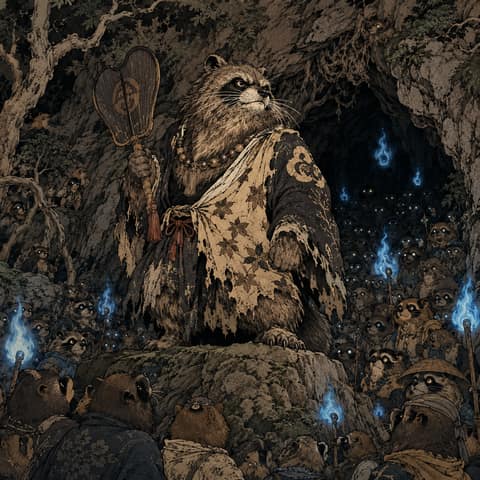
The chief of the shape-shifting tanuki in the Matsuyama region of Iyo. Said to dwell in a rock grotto on Mt. Kuma and to have acted as a guardian of Matsuyama Castle, he commands as many as 808 followers. The title “Gyōbu” was reportedly bestowed by the castle lord’s ancestor, and townspeople and retainers revered him. Popularized in late Edo-period storytelling, he appears in The Tale of the 808 Tanuki of the Matsuyama Disturbance as the tanuki leader who works sorcery and causes wondrous phenomena.

Ibaraki-dōji

Ibaraki-dōji

Legendary

ee-bah-RAH-kee DOH-jee

Ibaraki-dōji

Half-Human BeingsOsakaNiigata

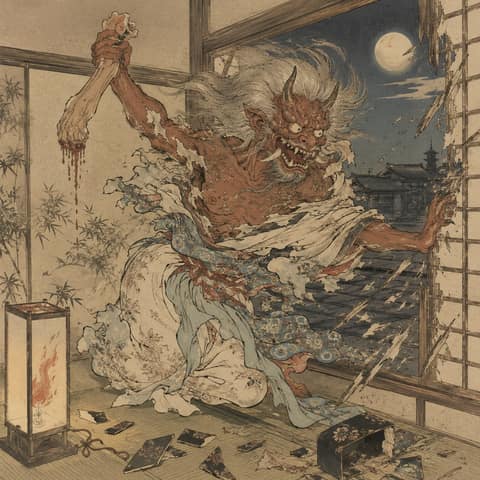
A demon (oni) of the Heian period, famed as the right-hand of Shuten-dōji. Accounts place Ibaraki-dōji’s birth either in Settsu (Tomatsu/Ibaraki) or Echigo (Koshi District, Karuizawa). From childhood the figure showed an uncanny appearance and prodigious strength. Joining the bandits of Mount Ōe, Ibaraki-dōji helped terrorize the capital until Minamoto no Yorimitsu (Raikō) and his retainers crushed the gang, whereupon Ibaraki narrowly escaped. Later, the warrior Watanabe no Tsuna cut off the demon’s arm; in later tales, the demon disguises itself and steals the arm back—episodes retold across medieval setsuwa, Noh, and Kabuki.

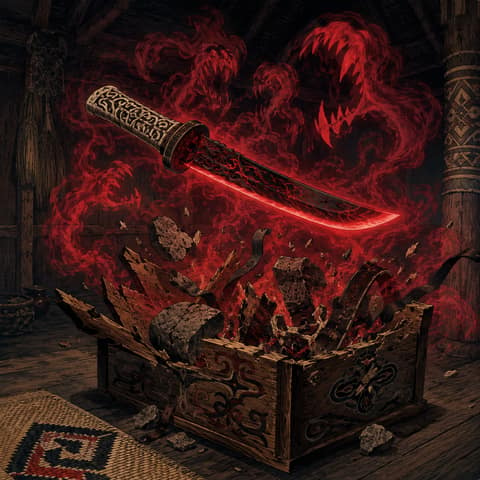
Ipetam (The “Eating Blade”)

Ipetam (The “Eating Blade”)

Uncommon

EE-peh-tahm

Tradition-Faithful Cursed Sword Image

住居・器物Hokkaido

Ipetam is a collective name in Ainu lore for cursed swords meaning “eating blade.” Kept in a box, they clatter as if biting stones or leather thongs, thirsting for blood. Once drawn, they were feared never to return to the sheath until they cut a person, and some tales say they fly through the air to strike. Regarded as ominous, they were often cast into bottomless bogs to quell their malice, yet even in storage they rattled and menaced their owners.

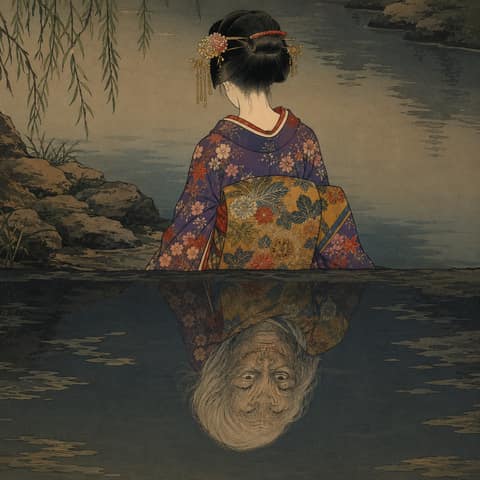
Iyaya (Negaya)

Iyaya (Negaya)

Rare

ee-YAH-yah

Sekien Iconography Standard

Household SpiritsUncertain; Japanese folklore

A yokai depicted by the Edo-period painter Toriyama Sekien in Konjaku Hyakki Shūi. Shown as a beauty from behind, yet the reflection on the water reveals a deeply wrinkled old face. Sekien notes he modeled its name “Iyaya” after the Chinese tale of the insect called “Guai zai” (“strange!”), rendering it as 否哉; no concrete traits are described. Later sources mention it under names like Iyami or Ijiami, but its existence in genuine tradition is doubtful.

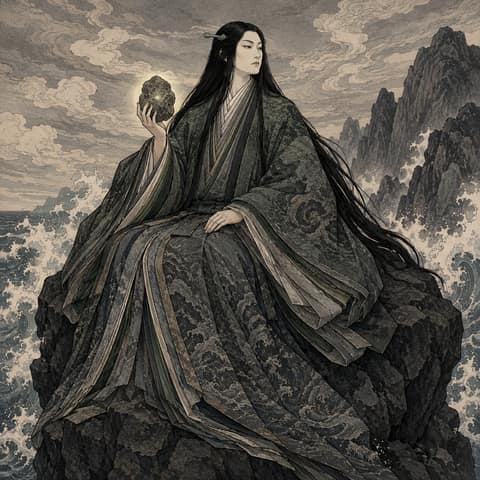
Iwanaga-hime

Iwanaga-hime

Divine

いわながひめ

Iwanaga-hime, Goddess of Eternity, Steadfastness, and Matchmaking

Divine Spirit / DeityShizuoka

A daughter of Oyamatsumi who appears at the end of Volume 1 of the *Kojiki* and in the 9th stage of the Age of the Gods in the *Nihon Shoki*, and the older sister of Konohana-sakuya-hime. Her divine name "Iwanaga" means "a woman as eternal, steadfast, and enduring as a rock," serving as a symbol of immortality, longevity, and unshakable solidity. She is also written as Ishinaga-hime in the *Kojiki*, and has an alias, Kokemusuhime. Following the descent of Ninigi-no-Mikoto from the heavens, her father Oyamatsumi presented both sisters together, but Ninigi sent Iwanaga-hime back because of her ugly appearance, marrying only Konohana-sakuya-hime. Because of this, Oyamatsumi declared: "If you had kept Iwanaga-hime by your side, the life of the heavenly descendant would have been eternal like a rock; but since you kept only Sakuya-hime, your life will be fleeting like a blossom." This is the origin myth of the shortened lifespans of humans and the imperial line in Japanese mythology (classified by comparative mythologist Tarō Ōbayashi as a Japanese variant of the "banana-type myth" of mortality origins from Sulawesi, Indonesia). She is enshrined at Kumomi Sengen Shrine, Hoshoishi Shrine, Shiromi Shrine (where legend states the mirror she threw in grief over her ugliness became the origin of the village's name), and Kifune Shrine Yui-no-Yashiro (a matchmaking shrine where she paradoxically hid in shame over her rejection, resolving to "grant good matches to the people"), presiding over matchmaking, longevity, and steadfastness.

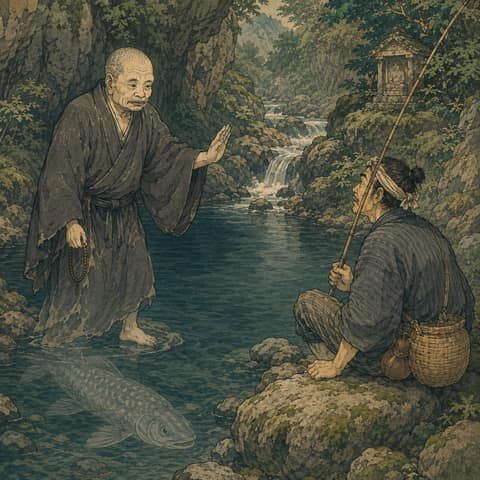
Iwanabōzu (Monk Trout)

Iwanabōzu (Monk Trout)

Uncommon

ee-wah-nah-BOH-zoo

Iwaname Monk (Tradition-Faithful)

Animal ShapeshiftersGifu

Iwanabōzu is a waterside apparition said to be an aged, oversized char (iwana) that takes human form—often appearing as a Buddhist monk. It approaches anglers, scolds them for fishing on temple lands or chats amiably before leaving. Later, when a giant char is caught and cut open, rice, mochi, or other foods previously offered to the “monk” are found in its belly. Recorded in the Edo-period miscellany Sōzan Chobunki with an example from Ena District in Mino; similar tales are told in Fukushima, Tokyo, and elsewhere. The motif reflects awe toward water tutelary beings and a moral against needless killing.

Ukemochi-no-Kami

Ukemochi-no-Kami

Divine

うけもちのかみ

Ukemochi-no-Kami, the Food Origin Deity Generating the Five Grains from Death

神霊・神格Ashihara-no-Nakatsukuni (The Earthly Realm in myth)

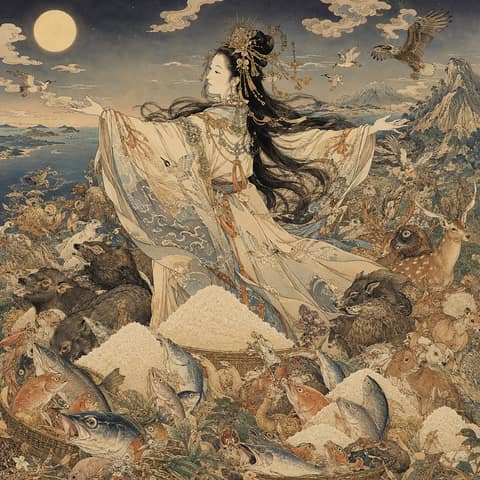
Ukemochi-no-Kami is a deity appearing in Book 5, Alternate Writing 11 of the *Nihon Shoki*, who single-handedly undertakes the generation of food. Hearing that this deity existed in Ashihara-no-Nakatsukuni, Amaterasu-Omikami dispatched Tsukuyomi-no-Mikoto to observe her. To welcome her guest, Ukemochi turned toward the land and produced boiled rice from her mouth, turned toward the sea and produced fish, and turned toward the mountains and produced beasts. She prepared these items and offered them as a feast. However, Tsukuyomi viewed offering things produced from the mouth as food as a defilement, and in a rage, struck and killed her. Here, Ukemochi appears not merely as a "god who provides food," but as a deity standing at the boundary where the sacredness and the defilement of eating have not yet been separated. The death of Ukemochi does not cause food to be lost from the world; rather, it becomes the catalyst for fixing food upon the earth. The *Nihon Shoki* recounts that when Ame-no-Kumahito verified her corpse, cattle and horses had grown from the crown of her head, millet from her skull, silkworms from her eyebrows, barnyard grass from her eyes, rice from her belly, and wheat, soybeans, and adzuki beans from her genitals. Amaterasu received these, designating millet, barnyard grass, wheat, and beans as seeds for dry fields, and rice as seeds for wet paddies. Furthermore, she placed the silkworm cocoons in her mouth and drew thread, thus opening the path of sericulture—the origin of the five grains, livestock, and sericulture. Therefore, Ukemochi is simultaneously a food deity generated from a corpse, and a deity who hands over the foundations of life—agriculture, animal husbandry, and silk—to the order of Amaterasu. A similar type of story is seen with Ogetsuhime-no-Kami in the *Kojiki*. However, as summarized in the Kokugakuin University entry for Tsukuyomi, the murderer there is Susanoo, and the rupture between Tsukuyomi and Amaterasu—so prominent in the Ukemochi tale—does not come to the forefront. This is the difference with Ogetsuhime-no-Kami. The significance of the Ukemochi tradition lies in the fact that the myth of the origin of food is simultaneously the myth of the separation of the sun and moon. The rift between the moon god, who views food as defilement, and the sun god, who transforms it into sustenance for the human world, simultaneously articulates day and night, food and defilement, and death and harvest. Ukemochi is the deity who was struck down at that boundary, yet still fills the world.
Ushi-oni

Ushi-oni

Legendary

ushi-oni

Ushi-oni, the Bull-Headed Spider of the Deep

Animal ShapeshifterEhimeKochi

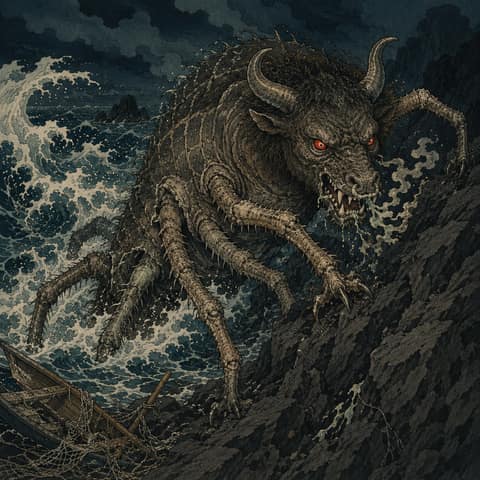
Ushi-oni appears chiefly on the coasts, in deep pools, and in the mountains of western Japan. It is among the fiercest and most numinous beings in the yokai tradition. Its body has no single form: some artists give it a bull's head on an oni's body, while others set the same head on the body of a spider. The Heian-period Pillow Book already names Ushi-oni among the things that inspire terror. Its most striking quality is a radical dual nature. In one guise, Ushi-oni is a cruel man-eater and bringer of disease that spreads poisonous breath without discrimination. In another, it leads a mikoshi procession and uses its tremendous force to drive away other evil spirits. Over time, a frightening presence in literature became part of regional worship and festival performance. Few yokai show so clearly how a destructive power could also be received as a guardian.

Cow Head

Cow Head

Legendary

ushi-no-kubi

The Forbidden Ghost Story from which Tellings Offer No Return

Generic / GeneralAn urban legend forbidding its telling / Reception through the works of Sakyo Komatsu

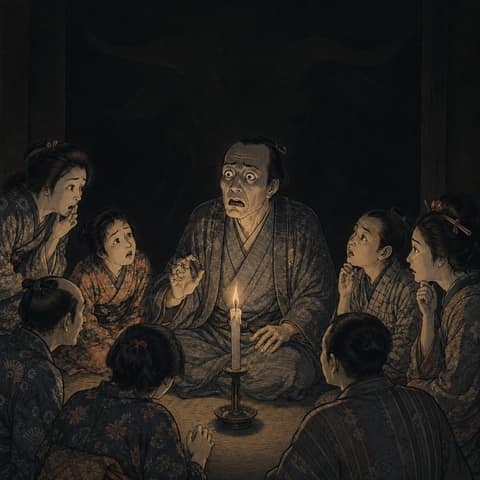
Cow Head is a forbidden ghost story that exists precisely because its contents are never told. Ordinary ghost stories make readers tremble by recounting what terrible events occurred. However, with Cow Head, only the framework circulates—"those who hear the story are driven to an irreversible state of absolute terror" and "therefore, no one can tell it to the end"—while the crucial text is left blank. This absence is the true form of the anomaly. Sakyo Komatsu's short story "Cow Head" is an important work that strongly impressed this blank space as a modern ghost story. Rather than directly presenting the contents of a terrifying ghost story, the work depicts the power of the rumor that a story too terrifying to tell exists. Cow Head, which later spread as an urban legend, incorporated elements like the title, taboos, ghost story sessions at schools or training camps, and tellings on buses or during trips, multiplying as a "story that is scary despite having no content." Categorically, Cow Head is a yokai name, but simultaneously the name of a ghost story format. It does not refer to a story where an ox-headed spirit or a beastly anomaly appears, but points to the danger of hearing, telling, and knowing. Among the urban legends handled in ASIOS's "Solving 'Urban Legends'," it is close to the type where "whether you know the story or not" becomes the core of the terror, rather than authenticity or eyewitness accounts. Because Cow Head makes the reader's imagination fill in the non-existent text, it leaves a blank space stronger than any concrete description. For this reason, Cow Head is established by including the desires of the person reading the ghost story. Wanting to know more scary stories, wanting to hear a story no one knows, wanting to touch something forbidden. Without such feelings, a ghost story that is only a title holds no power. Conversely, the more a reader loves ghost stories, the deeper Cow Head pierces them. It is not scary despite saying nothing, but rather, it uses the desire to hear as a mirror to frighten.

Ushi-no-koku Mairi (Cursing Rite at the Hour of the Ox)

Ushi-no-koku Mairi (Cursing Rite at the Hour of the Ox)

Epic

OO-shee-noh-KOH-koo MY-ree

Ritual Icon of the Cursing Hour

Ghosts & SpiritsKyoto

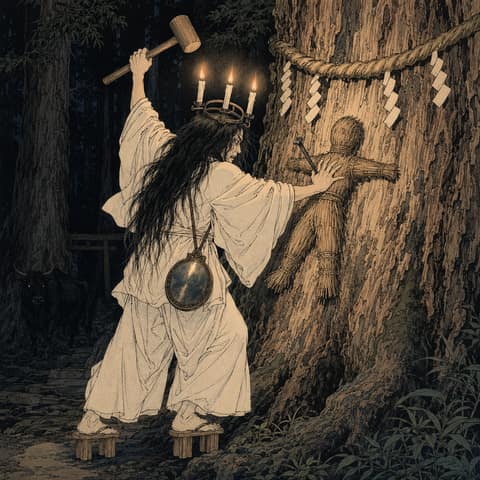
A nocturnal cursing ritual performed at the Hour of the Ox (around 1–3 a.m.). The practitioner nails a straw effigy modeled after the hated target to a shrine’s sacred tree, petitioning for a deadly curse. By the Edo period the rite had a fixed costume and toolkit: white funeral garb, an iron trivet (kanawa) with lit candles worn on the head, one-toothed clogs, a mirror, and five-inch nails. Completing seven consecutive nights was said to fulfill the vow. If witnessed, the spell fails; encountering a black ox promises success—if one mounts it. Scholars trace its roots to ancient doll-substitution curses and Onmyodo katashiro rites.

Ushirogami (The Back-Hair Spirit)

Ushirogami (The Back-Hair Spirit)

Rare

oo-SHEE-roh-gah-mee

Iconographic and Literary Tradition Type

Ghosts & SpiritsAcross Japan (primarily Edo-period and Tsuyama traditions)

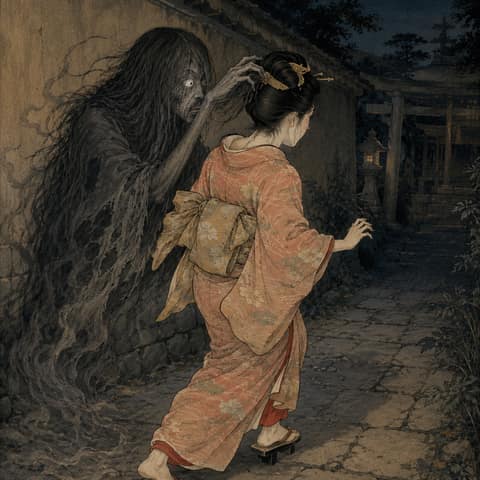
Ushirogami is a specter said to appear behind a person and tug their back hair. In Toriyama Sekien’s Konjaku Hyakki Shūi it is drawn as a one-eyed woman, interpreted as the personification of hesitation and lingering regrets. It haunts the timid or indecisive, amplifying the reluctance that keeps them from acting. The name’s wordplay reinforces its role, and in folk belief it is grouped with “cowardice spirits.”

Usuoi-baba

Usuoi-baba

Uncommon

usuoi-baba

The Pale Old Woman off Shukunegi, Sado

Maritime ApparitionNiigata

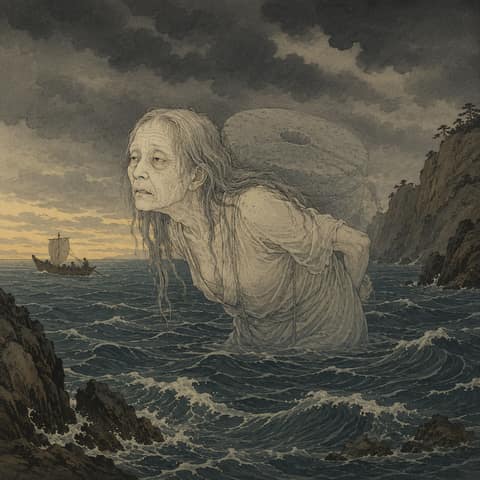
Usuoi-baba is a maritime apparition said to rise from the sea at Shukunegi on Sado Island, Niigata. She appears as a pale-skinned old woman floating on the surface, with both hands held behind her back as though she were carrying something, then sinks beneath the water again. Local accounts place her appearances several years apart. Although sightings have long been remembered around Shukunegi, no story says that she attacks people. Later yokai reference works often group her with female sea apparitions such as Iso-onna and Nure-onna.

Ubagabi (Old Woman’s Fire)

Ubagabi (Old Woman’s Fire)

Epic

OO-bah-gah-bee

Ubagabi (Traditional Accounts Version)

Natural Phenomena SpiritsOsakaKyoto

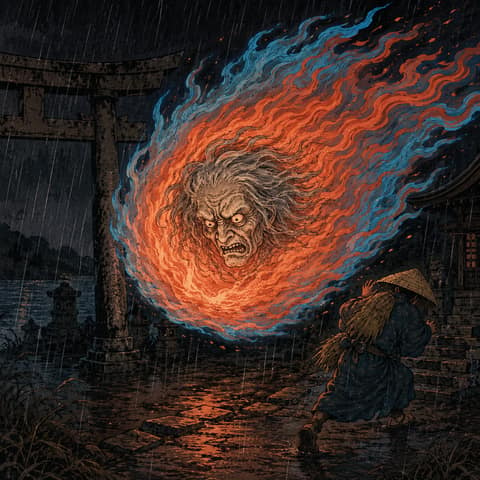
Ubagabi is a will-o’-the-wisp that appears on rainy nights, with traditions centered around Hiraoka in Kawachi and along the Hozu River in Tanba. It flies as a fireball about a foot across and is said to sometimes show the face of an old woman or the shape of a bird. Explanations tie it to the curse of an old woman who stole lamp oil from Hiraoka Shrine, or divine punishment upon a woman who drowned after discarding her child; the phenomenon is noted in old books and picture scrolls. Contact is considered a dire omen.

Ubagami

Ubagami

Divine

Ubagami

Ubagami, the Old Goddess Who Saves the Women of Tateyama

Deity / Divine SpiritToyama

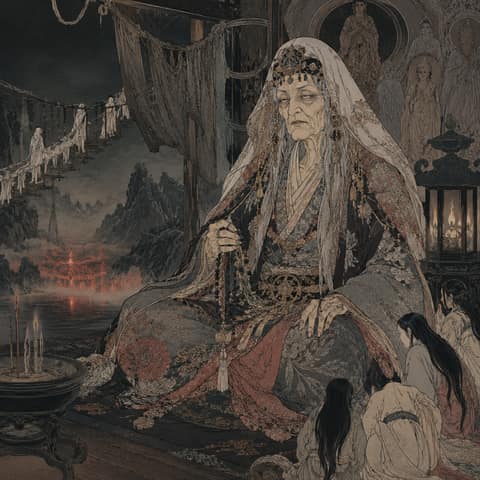
Ubagami is an old goddess enshrined at the Ubadō (Hall of the Old Woman) in Ashikuraji, at the foot of Mount Tateyama in Etchū Province. Because of the steam and sulfur venting from Jigokudani (Hell Valley), Tateyama was feared as the "Mountain of Hell"; concurrently, it was revered as a sacred mountain believed to harbor the Pure Land of Amida Buddha. Until the modern era, women were strictly forbidden from climbing Tateyama, and the Ubagami faith was established to save these female devotees who could not make the ascent. It is said that sixty-six statues of Ubagami were enshrined within the Ubadō, where women would pray to each statue one by one in the darkness. Often conflated with the wife of Enma Daio (Yama, the King of Hell) or Datsueba (the old woman who strips the dead of their clothes at the Sanzu River), Ubagami was depicted as an ambivalent goddess standing at the boundary of the afterlife—both judging the dead and offering them salvation.

Ubume

Ubume

Epic

ubume

Ubume (Traditional Form)

Ghosts & SpiritsVarious regions nationwide. A famous early example is found in the medieval Konjaku Monogatari Shu.

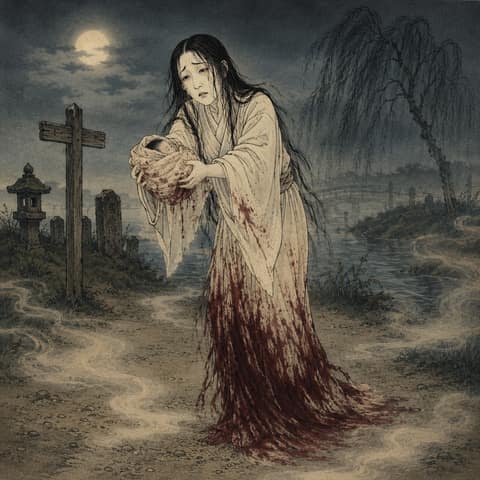
Ubume is a Japanese supernatural phenomenon (yokai) widely believed to be the spirit of a woman who died during childbirth or shortly after, appearing in the form of a woman cradling an infant. In many tales, she stops passersby at night at river crossings, bridges, and crossroads, pleading with them, "Please hold this child." The outcome varies depending on the region and the source: the baby received might suddenly become heavy, turn into leaves or a stone, or the person who manages to hold onto it until the end might be granted superhuman strength or wealth. Therefore, the Ubume is not merely an evil spirit that attacks people. She is an entity that gathers the severed bond between mother and child, the fear of the dead, and the courage and compassion of those who accept her plea into a single tale of an encounter. A famous surviving early example is found in the first half of the 12th century in *Konjaku Monogatari Shu* (Tales of Times Now Past), Scroll 27, Tale 43, "How Minamoto no Yorimitsu's Retainer, Taira no Suetake, Met an Ubume." When Minamoto no Yorimitsu was the Governor of Mino, his retainer Taira no Suetake went to a dark river crossing at night as a test of courage, where he was entrusted with a baby by a woman in the river. Upon returning to the mansion and opening his sleeve, he found only a few tree leaves. At the end of the tale, the narrator juxtaposes the theory that the Ubume is a shape-shifting fox with the theory that she is the spirit of a woman who died in childbirth, without deciding on her true identity. At this stage, the blood-stained waistcloth and bird feathers that became famous in later eras had not yet been depicted. On the other hand, care must be taken with the notation that writes "Kōkakuchō" (Guhō bird) but pronounces it "Ubume." The "nocturnal roaming woman" described in Scroll 16 of the Tang dynasty text *Youyang Zazu* (Miscellaneous Morsels from Youyang) is a Chinese monster bird that becomes a bird when wearing feathers and a woman when taking them off, and has a habit of snatching people's children. Because it involved babies and women who died in childbirth, it was conflated with the Japanese Ubume, but they originally belonged to different lineages. According to the research of Manami Yasui, Hayashi Razan, who assigned the Japanese name to the Chinese Kōkakuchō, first specified in the 1631 *Shinkan Tashikihen* that "Kōkakuchō" is the "Ubume-dori" (Ubume bird) or Nue. While the Japanese Ubume has as its core "a mother's spirit entrusting her own baby to someone else," the Chinese Kōkakuchō has as its core "a bird monster that snatches other people's children." Understanding this difference reveals how the yokai known as Ubume changed its form by layering medieval tales, memorials for those who died in childbirth, knowledge of monster birds from China, and early modern yokai illustrations.

Umashika (Horse-Deer Yokai)

Umashika (Horse-Deer Yokai)

Uncommon

oo-MAH-shee-kah

Emaki-Conforming

Animal ShapeshiftersUnknown; chiefly attested in Edo-period picture scrolls

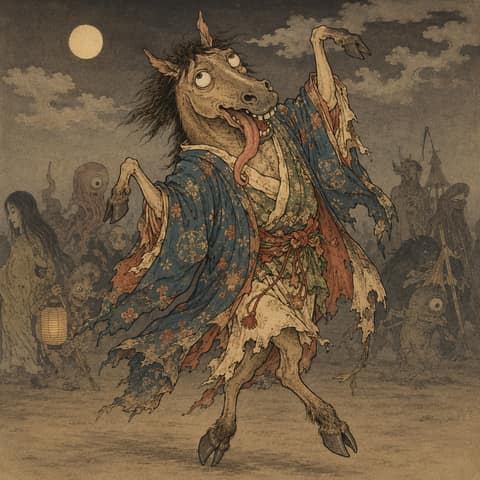
A spectral creature depicted in Edo-period yokai picture scrolls. It wears garments, spreads its forelegs wide, and has a horse’s face with bulging, upward-thrust eyes and cloven deer-like hooves. Identical images appear in late-18th-century works such as the Hyakumonogatari Kae Emaki, Oda Gyochō’s Night Parade of One Hundred Demons, and Bakemono-zukushi emaki. No period captions explain its behavior or origin. The imagery likely plays on the word baka (“fool”), but its function—harmful or helpful—remains unknown in the sources.

Horse Possession

Horse Possession

Uncommon

OO-mah-TSOO-kee

Tradition-Tale Variant

Ghosts & SpiritsAcross Japan (Mikawa, Tōtōmi, Awa, Musashi, and elsewhere)

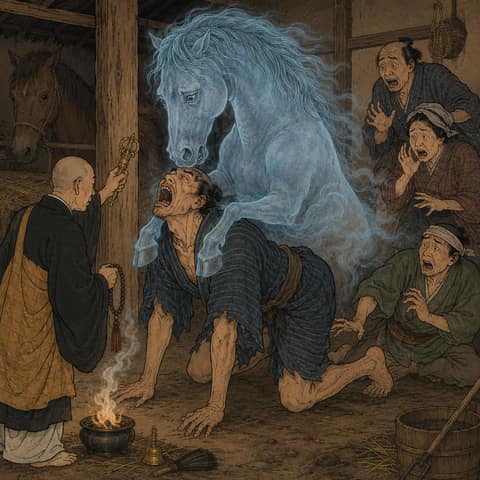
Horse Possession is a haunting in which the spirit of a dead horse attaches itself to a person, forcing them into horse-like behavior—neighing, nosing through dirty water buckets, and more—often leading to madness or death. It was believed to be retribution for abusing or neglecting horses, and cases were recorded among monks, warriors, and commoners alike. Prayers and memorial rites sometimes subdued it, but were often ineffective, with hosts dying within a short time.

Umisachihiko

Umisachihiko

Divine

うみさちひこ

Elder Brother of Sea Bounties & Hayato Ancestor, Umisachihiko

Divine Spirit / DeityMiyazaki

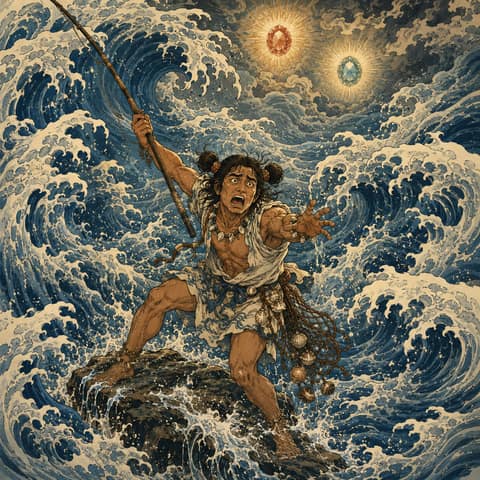
The eldest son of Ninigi-no-Mikoto and Konohanasakuya-hime, also known as Hoderi-no-Mikoto (or Honosusori-no-Mikoto in the Nihon Shoki). He is the protagonist's older brother in the myth of Umisachihiko and Yamasachihiko, a deity who presides over the bounties of the sea. He carries the myth of being defeated by his younger brother Yamasachihiko using the tide-ebbing and tide-flowing jewels, and swearing eternal servitude. As the ancestral deity of the Hayato people of southern Kyushu, he forms the core of local folklore in Satsuma and Osumi. The "Ashiura" (foot divination)—foot-rubbing, chest-rubbing, and cheek-rubbing gestures he made while drowning in the tide—is considered the origin of the Hayato-mai court ritual, embodying the subordinated side of the political myth that legitimized the ancient Ritsuryo court's rule over southern Kyushu. His main shrine is Ushiodake Shrine in Kitago, Nichinan City, Miyazaki Prefecture (the only shrine in Japan where he is the primary deity). He maintains local faith as the guardian deity of fishery, maritime transport, and Hayato lineage clans.

Umi-zatō

Umi-zatō

Rare

umi-zatō

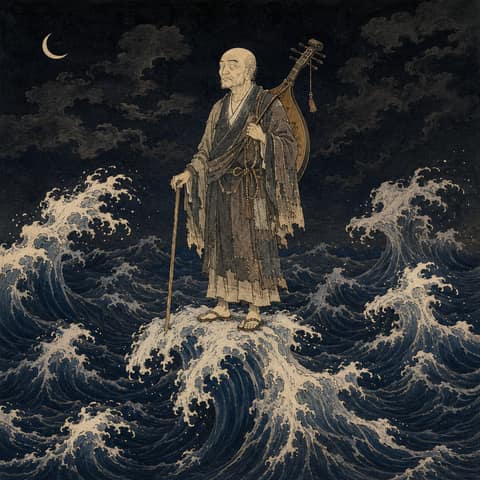
The Biwa-Playing Zatō Standing on the Waves

Aquatic YokaiToriyama Sekien's Gazu Hyakki Yagyō and other Edo-period paintings of a blind monk standing at sea

Umi-zatō is a maritime yokai depicted in Edo-period art as a zatō—a blind biwa player and Buddhist lay musician—standing at sea. Examples appear in Toriyama Sekien's Gazu Hyakki Yagyō and in a Hyakki Yagyō picture scroll held by the Matsui Bunko in Yatsushiro, Kumamoto. Neither image has an explanatory text, so the figure's origin and nature remain unknown. It carries a biwa and a walking staff and stands directly upon the waves. Some writers have connected the image with Umibōzu and other apparitions encountered offshore, but there is too little evidence to say more.

Umibōzu

Umibōzu

Legendary

umibōzu

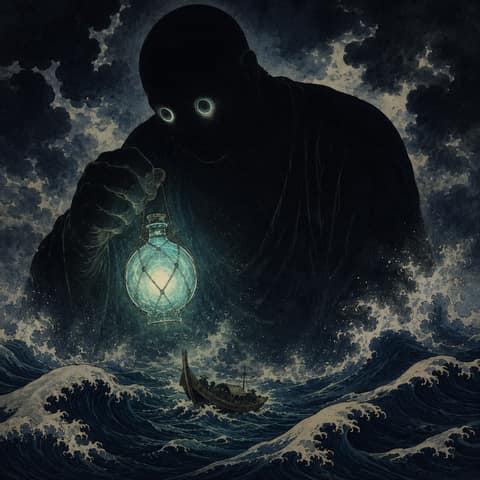
The Umibōzu That Whispers, “Lend Me Oil”

Aquatic YokaiNagasakiEhime

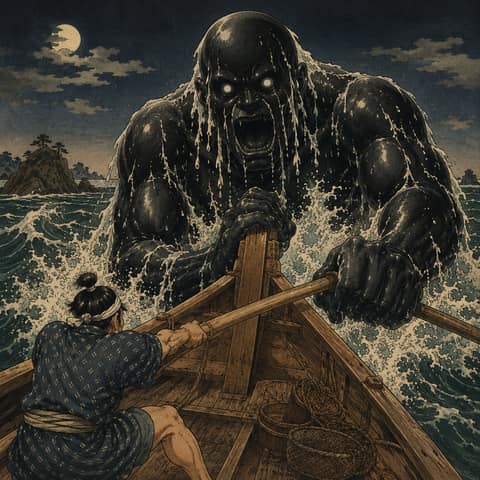
Umibōzu is a maritime apparition known along coasts throughout Japan and long feared especially by fishers. A calm sea is said to heave without warning, becoming an immense black shadow or the bald form of a Buddhist monk that blocks a vessel's path. Accounts rarely show a whole body; most describe only a head and shoulders rising above the water. It appears at night or in heavy seas, overturning boats and dragging people into the depths. Edo-period sources including the Wakan Sansai Zue (1712) and the Butsurui Shōko (1775) also record the name of a giant apparition standing at sea.

Umibōzu

Umibōzu

Legendary

umibōzu

Sea Monk of Kyushu and Shikoku

Aquatic YokaiNagasakiEhime

Umibōzu is a maritime apparition known along coasts throughout Japan and long feared especially by fishers. A calm sea is said to heave without warning, becoming an immense black shadow or the bald form of a Buddhist monk that blocks a vessel's path. Accounts rarely show a whole body; most describe only a head and shoulders rising above the water. It appears at night or in heavy seas, overturning boats and dragging people into the depths. Edo-period sources including the Wakan Sansai Zue (1712) and the Butsurui Shōko (1775) also record the name of a giant apparition standing at sea.

Umibōzu

Umibōzu

Legendary

umibōzu

Sea Monk of the Chugoku Region

Aquatic YokaiNagasakiEhime

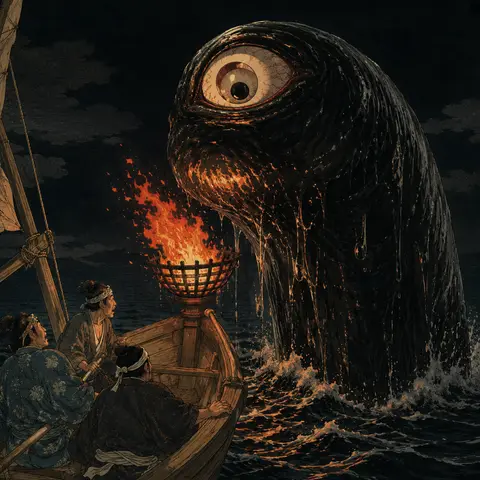
Umibōzu is a maritime apparition known along coasts throughout Japan and long feared especially by fishers. A calm sea is said to heave without warning, becoming an immense black shadow or the bald form of a Buddhist monk that blocks a vessel's path. Accounts rarely show a whole body; most describe only a head and shoulders rising above the water. It appears at night or in heavy seas, overturning boats and dragging people into the depths. Edo-period sources including the Wakan Sansai Zue (1712) and the Butsurui Shōko (1775) also record the name of a giant apparition standing at sea.

Uyauyashi

Uyauyashi

Rare

oo-yah-oo-YAH-shee

Iconographic Tradition Edition

Mountain & Wilderness SpiritsJapanese folklore

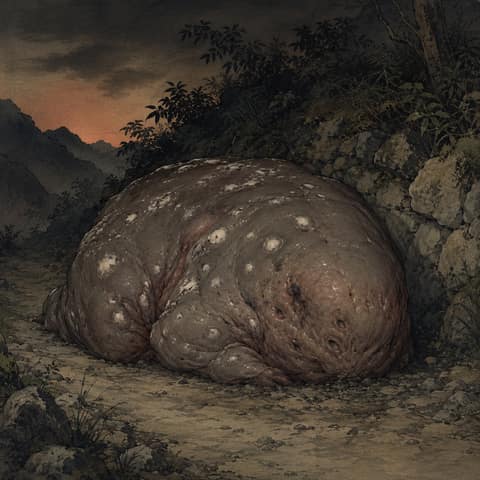
A yokai named in Edo-period picture scrolls, read as “uyauyashi.” It crouches curled up as if kneeling, appearing either like a lump of flesh akin to the nuppefuhō (nuppeppō) or like a toad, sometimes illustrated with scattered white spots on its skin. No concrete deeds or origin are recorded; only its form and name survive. It is treated as an amorphous presence that appears in fields and mountains.

Uwan

Uwan

Epic

OO-wahn

Emaki Manifestation Type (Mansion Apparition)

Household SpiritsJapanese folklore

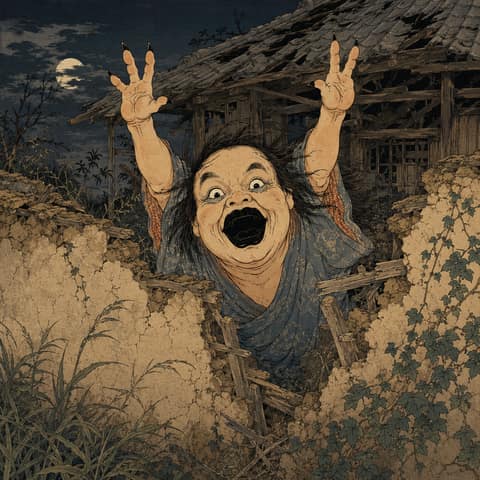
The Uwan is a yokai of uncertain identity found in Edo-period yokai art. In works like Sawaki Suushi’s Hyakkai Zukan and Toriyama Sekien’s Gazu Hyakki Yagyō, it appears as a humanlike figure with blackened teeth, both hands raised, startling people with its voice. With no attached notes, its origins are unknown, but backgrounds of estate walls or ruined houses suggest it haunts residences. Some point to its three-fingered hands as hinting at demonic nature, though this is not established.

Showing 73 - 96 of 146 yokai