YOKAI.JP

🔤 Yokai by Kana

Find yokai in hiragana order

146 Yokai|12 Category|Page 5 of 7
Localization in Progress - More content available in Japanese version
View Japanese

Filter by hiragana row

Sort by: ReadingAscending
Ungai-kyō (Mirror from Beyond the Clouds)

Ungai-kyō (Mirror from Beyond the Clouds)

Rare

OON-guy-kyo (oon-GAH-ee-kyoh)

Traditional Interpretation (Based on Sekien Toriyama)

Household SpiritsEdo period

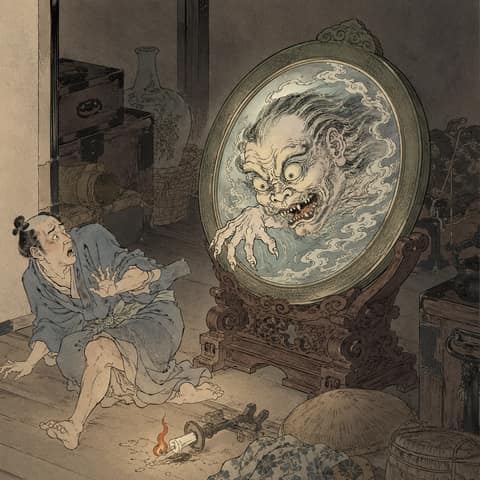
A mirror yokai depicted by Toriyama Sekien in the late Edo work Hyakki Tsurezurebukuro (1784). It appears as a round hand mirror set on an old wooden stand, within whose surface a strange face emerges. Sekien alludes to the legend of the shōma-kyō—“demon-revealing mirrors”—suggesting that the shadow of a yokai moved into such a mirror and came to life. Later traditions treat it as a tsukumogami: a mirror that has aged into sentience, merging with the concept of a truth-revealing mirror.

Branching Fox

Branching Fox

Common

eh-dah-BOON-kee-gee-tsoo-neh

Modern Variant

Animal Shapeshiftersthe deep layers of a virtual repository

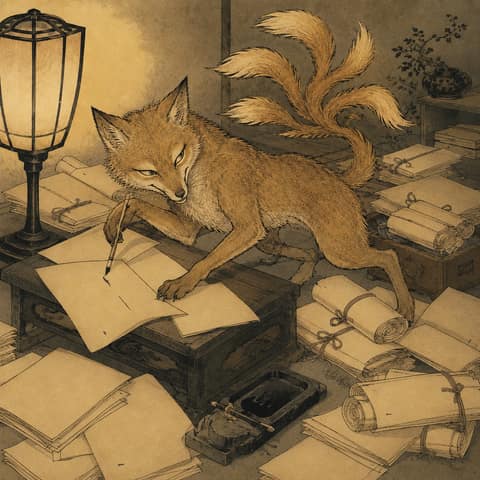
A cyber kitsune that dwells in a developer’s work tree. On quiet nights it sidles up to rushing fingers and slips edits onto untouched branches. Its arrival triggers cascades of inexplicable errors and merge conflicts, creating the paradox of a spotless history that won’t run. It feeds on human urgency and pride, masking one branch with another until the tangle hides the truth.

Ebisu

Ebisu

Legendary

えびす

Ebisu

Divine Spirit / DeityHyogoHiroshima

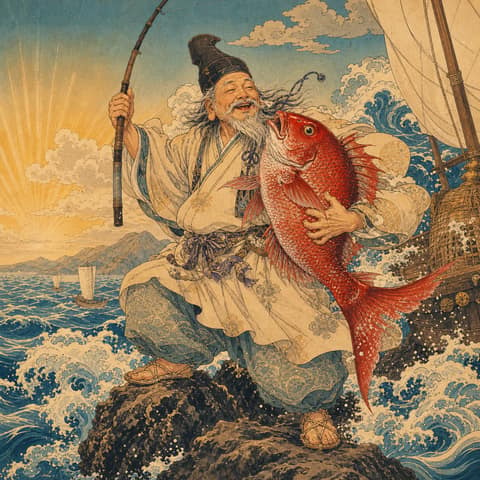
Ebisu is the only deity of Japanese origin among the Seven Lucky Gods (Ebisu, Daikoku, Bishamon, Benzaiten, Fukurokuju, Jurojin, Hotei). Depicted as a smiling old man holding a sea bream and a fishing rod, he is the god of business prosperity, fishing, and navigation. The term "ebisu" shares its etymology with "emishi" (barbarians), meaning "that which comes from afar or from beyond," and was originally a general term in ancient Japan for deities of abundance arriving from the sea or the otherworld. There are two major theories regarding his origin. (1) The Hiruko origin theory: The first child of Izanagi and Izanami in the *Kojiki* and *Nihon Shoki*, who was born deformed, set adrift in a reed boat, washed ashore in Nishinomiya, and brought good fortune, thus becoming enshrined as Ebisu. (2) The Kotoshironushi origin theory: The eldest son of Okuninushi, who was fishing during the mythological transfer of the land. The common elements of the sea, fishing, and fishing rods led to his syncretism with Ebisu. With two major head shrines—Nishinomiya Shrine (the head of over 3,500 Ebisu shrines, based on the Hiruko lineage) and Miho Shrine (the head of the Kotoshironushi lineage)—he is affectionately called "Ebessan" in the Kansai region, where the Toka Ebisu festival from January 9th to 11th is a major event. Incorporated into popular belief as a central figure of the Seven Lucky Gods during the Edo period, he remains widely revered nationwide as a guardian deity of business prosperity, fishing, and safe voyages.

Spirit of the Ema Plaque

Spirit of the Ema Plaque

Uncommon

EH-mah no SAY

Ema Spirit (Traditional Tale)

Household SpiritsKyoto

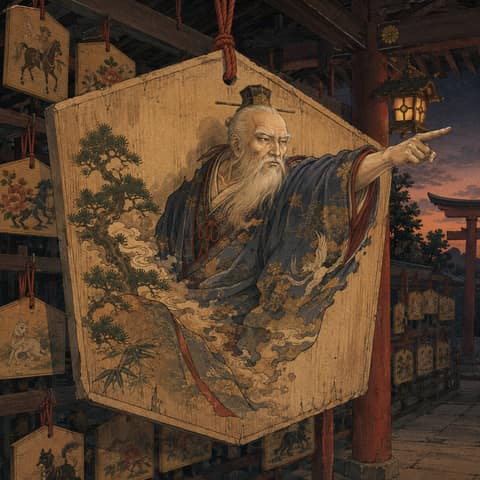
A spirit said to dwell in ema—wooden votive plaques dedicated at shrines and temples. Imbued with the power of long-held prayers and collective intent, it appears as an old man or a beautiful woman. Its form and aura shift to match the subject painted on the plaque. It is known to visit people in dreams or drowsy moments, foretelling fortune or misfortune and admonishing the proper treatment of ema. Though a tool-spirit, its numinous nature is viewed as linked to the sacred authority of shrines and temples.

Raised-Collar Robe

Raised-Collar Robe

Rare

eh-ree-TAH-teh-goh-ROH-moh

Ittan of Sekien Iconography

Household SpiritsJapanese folklore

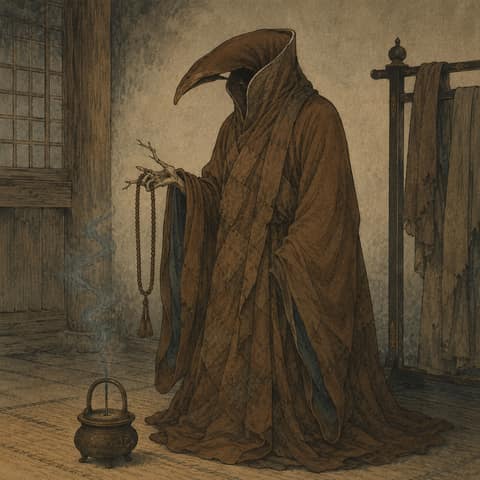
The Raised-Collar Robe is said to be a monk’s high-collared garment that, after many years, turned into a yokai. It appears in Toriyama Sekien’s Hyakki Tsurezure Bukuro, shown with a censer set before it and prayer beads in hand, its stiff standing collar drooping over the face like a beak. Sekien notes it “may be the raised-collar robe of Sōjōbō of Mount Kurama,” hinting that a tengu-related monk’s robe gained a spirit. Concrete episodes or folktales, however, are scarcely recorded.

Enenra

Enenra

Epic

eh-NEHN-rah

Gossamer Smoke Sprite

Household SpiritsJapanese folklore

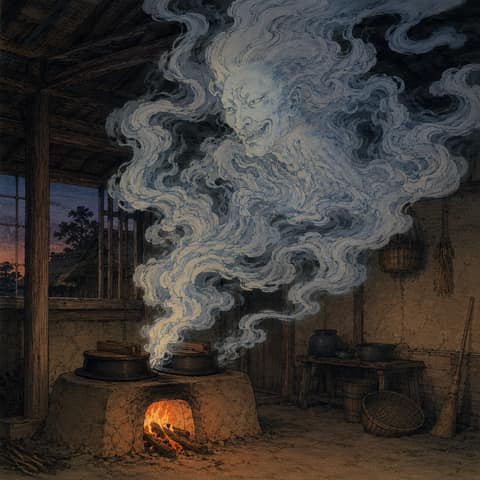
A smoke-born yokai depicted by Toriyama Sekien in Konjaku Hyakki Shūi. The “ra” in its name refers to a thin gauze, evoking a spirit of smoke that drifts like sheer fabric. Rooted in the age-old sense of presence within hearth and stove smoke, it appears as a formless, drifting entity. In sources, Sekien’s illustration is the primary standard; no specific harm or blessing is defined, and it’s understood as the very essence of smoke made animate.

Enkou

Enkou

Rare

enkou

The Hairy Kappa of Nanyo: Enkou

Water YokaiEhime

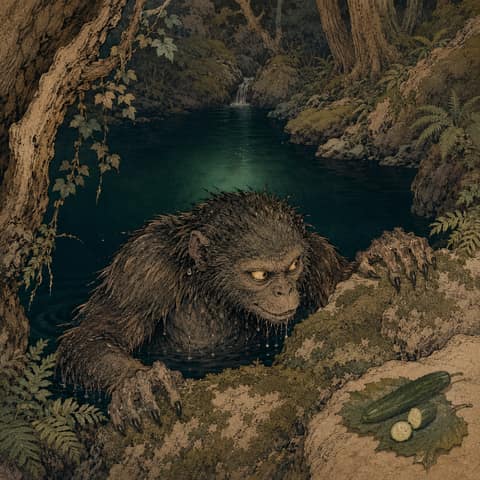
The *Enkou* is a dialect name for the *kappa* primarily used in the Nanyo region of Ehime Prefecture, as well as western Shikoku and the western Chugoku region. Unlike the standard *kappa* image with a dish on its head and a shell on its back, as its name (literally 'monkey') suggests, it is characterized by a body completely covered in hair and a monkey-like appearance, and is said to run agilely along the water's edge. In Ehime, besides *Enko* and *Enkou*, it is also called *Oso*, a name thought to originate from the overlapping of the *kappa* image with the ecology of the Japanese river otter (*oso*), which swims swiftly along the waterside. Dwelling in the deep pools of rivers, it comes ashore at night to play pranks on people, challenge them to sumo wrestling, exhibit a fondness for cucumbers, and drag children and horses into the water to extract their *shirikodama* (a mythical ball said to reside in the anus), fully inheriting the original nature of the *kappa*.

Enma Daio

Enma Daio

Divine

Enma-o

The Fifth Judge of the Underworld

神霊・神格インド神話のヤマが仏教化した渡来神格、在地発祥地なし

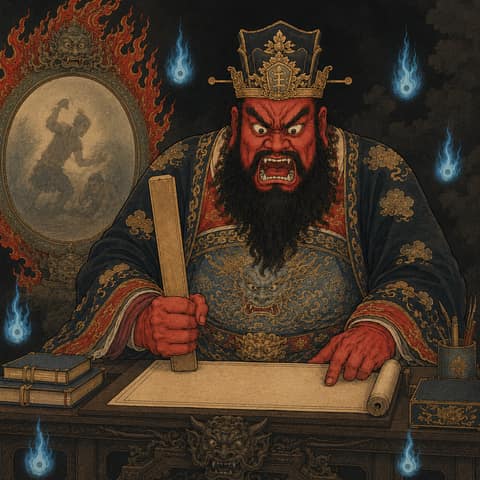
Enma-o (King Enma) is the most famous judge of the underworld in Japanese Buddhism and folk religion. Although commonly perceived simply as the "King of Hell," in the Ten Kings belief system (Juo shinko) that developed in medieval Japan, he sits as the fifth judge (judging on the 35th day after death), presiding over the core trial that determines a deceased's fate. He is traditionally depicted as a wrathful, imposing magistrate clad in the robes of a Chinese official, scowling with wide eyes. Before him lies the Johari no Kagami (the Pure Crystal Mirror), which plays back the deceased's past sins like a video. To his left and right are the scribes Shimei and Shiroku. In Japanese esoteric Buddhism and Pure Land sects, a unique theology emerged asserting that Enma is actually an incarnation of Jizo Bodhisattva, manifesting a wrathful form to forcefully guide sinners to salvation. Even today, the saying "If you lie, Lord Enma will pull out your tongue" remains a universally known moral caution among Japanese children.

Oitekebori

Oitekebori

Uncommon

oh-EE-teh-keh-BOH-ree

Ochikohori (Curated Traditional Tales Version)

Aquatic SpiritsTokyo

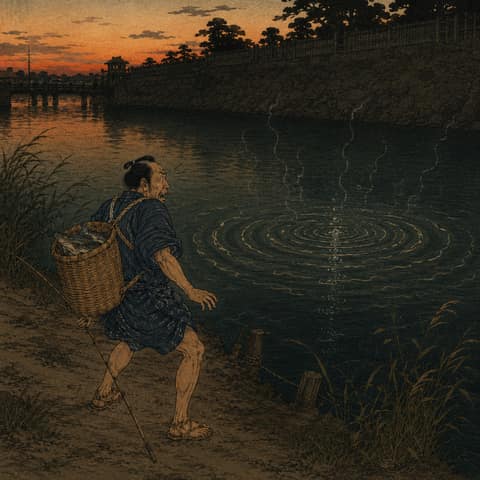
A water-born anomaly said to haunt the moats and canals around Edo’s Honjo. When anglers tried to take home their catch, a voice rose from the water—“Leave it behind!”—and the fish in their creels vanished or were stolen. Counted among the Seven Wonders of Honjo, the tale appears in rakugo and picture books. Explanations vary: kappa, tanuki, mujina, otters, or softshell turtles. Sites named include Kinshi-bori, Sendai-bori, and the area near Genmori Bridge. The phrase oitekebori (“left behind”) is sometimes linked to this legend.

Oiwa

Oiwa

Legendary

Oiwa

Oiwa of Yotsuya Kaidan

Spirit / GhostTokyo

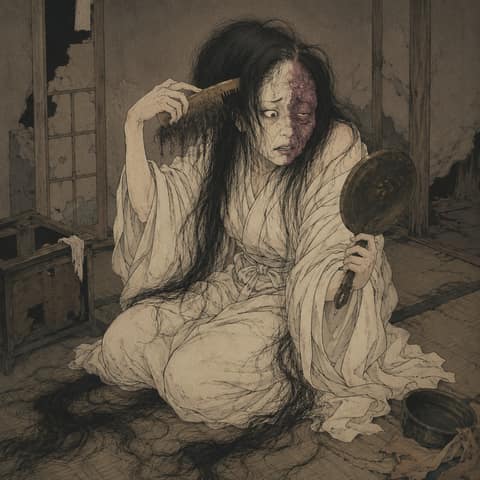
Oiwa is the protagonist of Japan's most widely known ghost story, renowned as a female ghost who was betrayed and poisoned by her husband, dying with a disfigured face and returning as a terrifying, vengeful spirit. However, this image is almost entirely a theatrical fabrication. In the kabuki play "Tokaido Yotsuya Kaidan" (written by Tsuruya Nanboku IV and premiered at the Edo Nakamura-za in 1825), the role of Oiwa was played by Onoe Kikugoro III. The iconic scenes—where she dies while combing her hair with half her face terribly swollen and decaying, washes ashore nailed to a wooden door, and later emerges from a burning lantern to torment her husband—established the archetype of the vengeful ghost Oiwa. Importantly, the real woman behind the legend was said to be the exact opposite. Oiwa (Tamiya Iwa), the wife of the Tamiya samurai family living in Samoncho, Yotsuya, was known as a devoted and faithful wife with a deeply loving marriage. She devoutly worshipped the family's Inari shrine and successfully restored her family's declining fortunes, making her an auspicious figure. The Oiwa Inari (Tamiya Inari) shrine dedicated to her was originally visited as a "god of luck that brings family prosperity." The name Oiwa stands upon the immense contrast between the historical virtuous wife and the vengeful spirit crafted by Nanboku two centuries later.

Echo-Worm

Echo-Worm

Uncommon

OHH-seh-ee-choo (ohh-OH-seh-ee-choo)

Edo Essays and Anecdotes Edition

Half-Human BeingsIntroduced from China; recorded across Japan

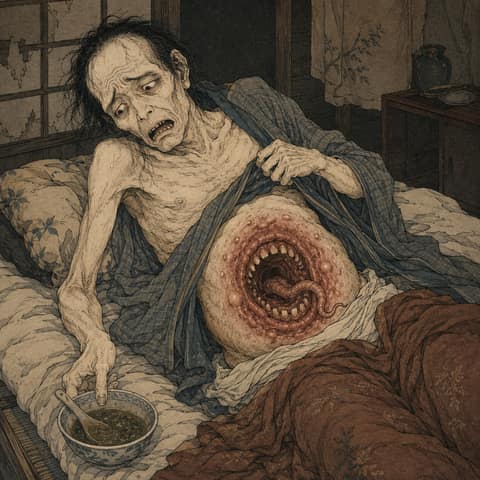
Echo-Worm is the name of a strange parasite and affliction found in Chinese anecdotes and materia medica, later noted in Japanese tale collections and essays. A worm is said to enter the body and answer questions from within the belly even when the host does not speak. In Japan it was described as a mouthlike sore on the abdomen that mimics speech and even demands food. Herbal texts mention that thunder-fungus (raimaru) and indigo could expel it, and the worm was said to emerge from the body. Many accounts link it to real-world parasite stories.

Oni of Hemp Fiber (O-uni)

Oni of Hemp Fiber (O-uni)

Rare

OH-oo-NEE

Iconographic Tradition, Sekien Lineage

Mountain & Wilderness SpiritsUncertain (derived from an Edo-period picture scroll)

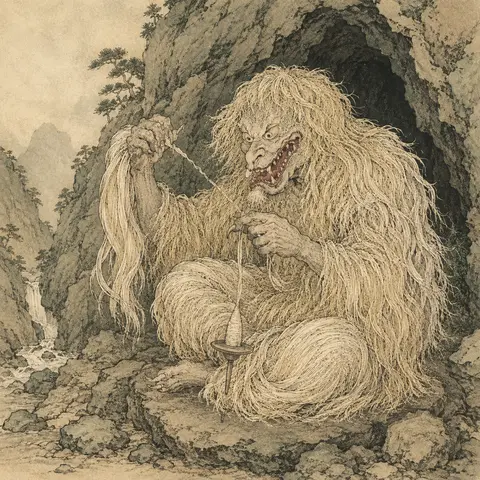
A hairy, ogress-like yokai depicted by Toriyama Sekien in Gazu Hyakki Yagyo. Its mouth is split to the ears, and its entire coat of hair evokes bundles of o (fiber from ramie or hemp), which is thought to be the source of its name. Sekien provided no caption, so its nature is unknown. Similar images appear in earlier scrolls like Hyakkai Zukan under labels such as “wōwō” or “uwan-uwan,” placing it within a visual lineage of related creatures.

Ōmagatoki

Ōmagatoki

Uncommon

Ōmagatoki

The Hundred Specters Arise at Twilight: Ōmagatoki

Natural Phenomena and SpiritsVarious regions across Japan

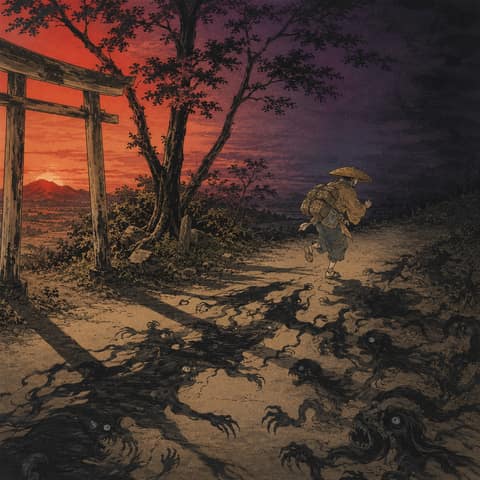
Ōmagatoki (逢魔時) is a term that designates the dim twilight just before and after the sun sets as a "bad hour" when one is prone to encountering the uncanny. Rather than a single yōkai with a distinct form or will, it refers to the shifting boundary between day and night itself, when it becomes difficult to distinguish human faces or distant objects. The *Seisen-ban Nihon Kokugo Daijiten* (Concise Edition of the Comprehensive Dictionary of the Japanese Language) defines it as the dim hour of dusk, namely twilight. It is not a fixed timeframe of "from this hour to that hour," but rather shifts according to the season and location based on the time of sunset. The variable hour system (futei jihō) widely used during the Edo period also divided day and night based on sunrise and sunset, meaning Ōmagatoki cannot be uniformly converted to a modern time like 17:00–19:00 or exactly 18:00. There are multiple layers to its reading and written forms. Dictionaries list variations such as Ōmagatoki (大禍時 - Hour of Great Calamity), Ōmaji (大魔時 - Hour of the Great Demon), Ōmagatoki (逢魔時 - Hour of Meeting Demons), and Ōmōji (王莽時 - Hour of Wang Mang), recording phonetic variants like *ōmagatoki*, *ōmagadoki*, *ōmagatoki* (with different kanji), and *ōmadoki*. It is explained that, in addition to *Ōmagatoki* (大禍時) understood as the "time of great calamity," the perception of the sound *ga* as a grammatical particle and *ma* as "demon" (魔) gave rise to the spellings *Ōmaji* (大魔時) and *Ōmagatoki* (逢魔時, "meeting demons"). Hayashi Razan documented the "Hour of Wang Mang" theory, comparing the day to the Former Han dynasty, the night to the Later Han, and the twilight in between to Wang Mang's Xin dynasty; Toriyama Sekien later introduced this older theory as well. Rather than viewing one of these as the sole, fixed spelling established in ancient times, it aligns better with historical sources to see them as variant transcriptions where associations of calamity, demons, and historical figures were superimposed onto a pre-existing sound. While *tasogaredoki* (twilight) is a neutral term broadly indicating dusk, Ōmagatoki is unique in that it overlays this with a vigilance against disaster and the supernatural. The word *tasogare*, derived from "Who goes there?" (*taso kare*), and *kawataredoki*, derived from "Who is that?" (*kare wa tare*), also convey the sensation of finding it hard to identify others in the dim light. However, *kawataredoki* was used for both dawn and dusk, and today it tends to refer specifically to dawn, so it is not perfectly synonymous with Ōmagatoki. Furthermore, unlike the Hour of the Ox (*ushimitsu-doki*), which is a specific time deep in the night, the core of Ōmagatoki lies not in the "middle of the night" but in the brief boundary transitioning from day to night.

Big-Headed Boy

Big-Headed Boy

Uncommon

oh-AH-tah-ma koh-ZOH

Edo Kibyoshi and Picture-Book Source Edition

General ClassificationsEdo period

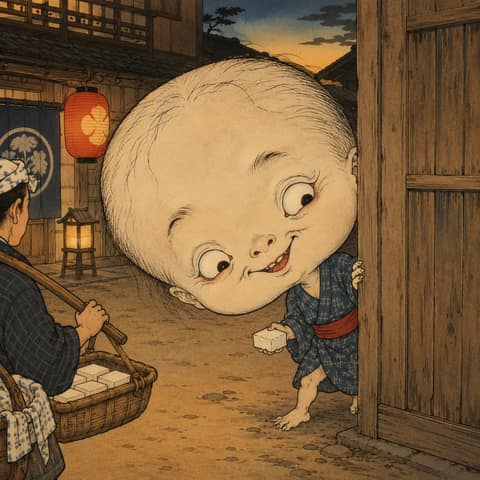
A yokai depicted in late Edo yellow-covered books such as Yokai Chakutōchō (1788): a child with an abnormally large head who startles people by showing off its enormous cranium. In the text it boasts of scaring a tofu seller to get tofu. Later writers sometimes confused it with the Tofu Boy (Tōfu Kozō), but period sources also portray it separately and occasionally link it to the Mikoshi-nyūdō.

Great Tonsure

Great Tonsure

Rare

OH-kah-BOO-roh

Sekien Iconography Standard

General ClassificationsEdo period

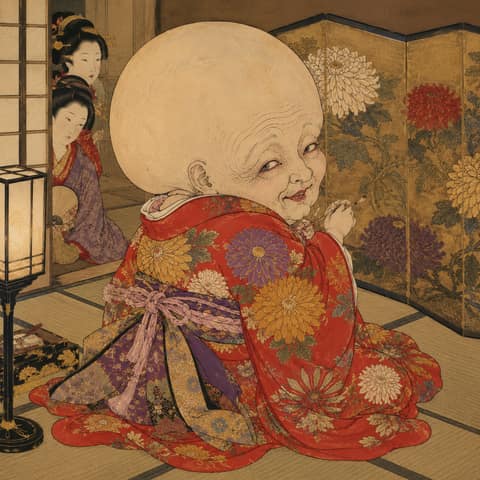
The Great Tonsure is a yokai known only from Toriyama Sekien’s Illustrated One Hundred Demons from the Present and the Past, Continued. It is depicted as taller than a folding screen, wearing a chrysanthemum-patterned long-sleeved kimono, and sporting a smooth, bald head. The caption juxtaposes the youthful longevity of the “Chrysanthemum Boy” with the wizened look of old age, functioning as an allegory that satirizes both the courtesans’ child attendants (kamuro) in the pleasure quarters and elderly monks in mountain temples. It lacks its own folklore episodes and circulated mainly as a pictorial theme and metaphor.

The Great Kiseru

The Great Kiseru

Uncommon

oh-oh-gee-SEH-roo

The Great Pipe of Awa (Aoiishise Variant)

Animal ShapeshiftersTokushima

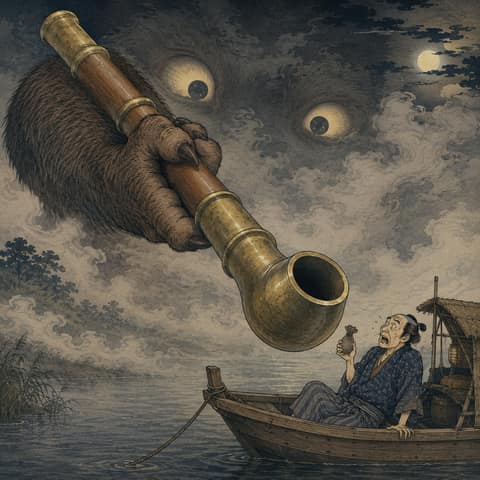
A shape-shifting tanuki specter from Keida in Mishō Village, Miyoshi District, Tokushima. It appears when boats anchor late at night at the Aoiseki (Blue-Stone Rapid) on the Yoshino River, extending an enormous kiseru pipe and demanding tobacco. If you can pack the pipe full, it causes no harm—but the amount required is absurdly large. If your supply runs out, it capsizes the boat or triggers strange disturbances. It is a waterside tanuki that frightens travelers and boatmen, told as a cautionary tale.

Okuninushi no Kami

Okuninushi no Kami

Legendary

Okuninushi no Kami

Okuninushi no Kami, Lord of Izumo Myth and God of Matchmaking

Deity / divine spiritShimane

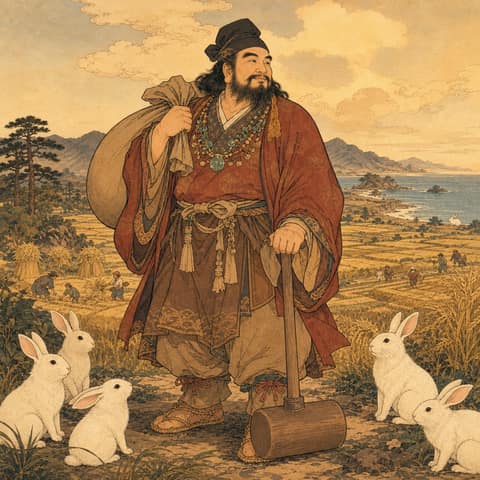
Okuninushi no Kami is the central deity of the Izumo myth cycle in the Kojiki and Nihon Shoki. Descended from the line of Susanoo, he governs Ashihara no Nakatsukuni, the earthly realm, before ultimately yielding the land to the heavenly grandson Ninigi no Mikoto. He is one of ancient Japan's greatest kunitsukami, or earthly deities. His unusually large number of names includes Onamuchi, Okuninushi, Omononushi, Ashihara-shikoo, Yachihoko, Utsushi-kunitama, and Okunitama. In the Kojiki he is a sixth-generation descendant of Susanoo, while the main text of the Nihon Shoki preserves a variant in which he is Susanoo's direct son. His mythology ranges from the compassion shown in healing the White Hare of Inaba, to the heroic cycle in which he escapes persecution by the eighty sibling gods, endures Susanoo's trials in Ne no Katasukuni, marries Suseribime, receives the living sword, living bow and arrows, and heavenly-speaking koto, and establishes rule over the earthly realm. He then develops the land together with Sukunabikona, teaching medicine, agriculture, and ritual healing. Under pressure from Takamagahara, especially Takemikazuchi and Futsunushi, he performs the kuniyuzuri, the yielding of the land, withdraws to Izumo Taisha, also called Kizuki Taisha, and becomes lord of the unseen world. Since antiquity he has been revered as a deity of matchmaking, medicine, and land-making. In the tenth month of the old calendar, called Kamiarizuki in Izumo and Kannazuki elsewhere, Japan's myriad gods are believed to gather at Izumo; Okuninushi remains the presiding deity of that living festival faith.

Great Head

Great Head

Epic

OH-oh-KOO-bee

Hybrid Sources, Record-Grounded Version

Ghosts & SpiritsVarious provinces (attested in Edo, Kaga, Nagato, and elsewhere)

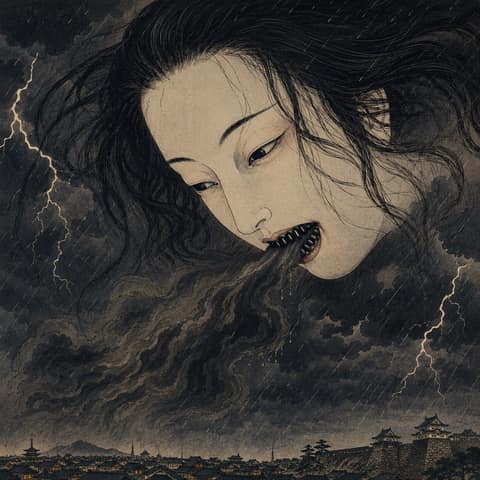
A bizarre apparition in which an enormous woman’s head appears in the sky or at a house’s doorway. It is often shown with ohaguro—blackened teeth—suggesting a married woman. Toriyama Sekien included an image in his mid-Edo Konjaku Gazu Zoku Hyakki, where the head drifts in a rainy night sky. While Sekien’s rendering is considered satirical, anecdotes and essays from many regions report encounters with giant female heads, interpreted as vengeful spirits, lingering grudges, or foxes and badgers in disguise.

Oguchi-no-magami

Oguchi-no-magami

Divine

Oguchi-no-magami

The Divine Messenger of Chichibu Mitsumine: Oinu-sama

Divine Spirits / DeitiesSaitamaTokyo

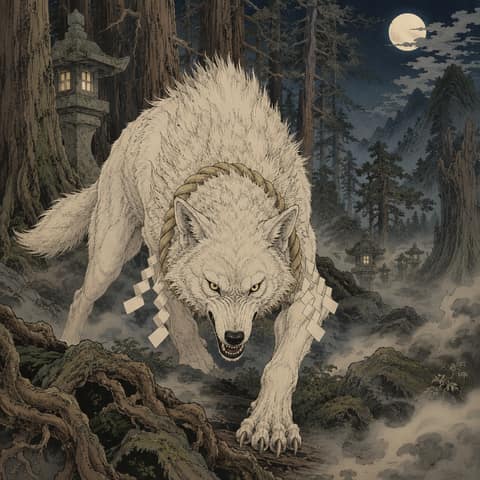
Oguchi-no-magami is a mountain deity born from the deification of the extinct Japanese wolf. It is also respectfully called "Oinu-sama" (Honorable Dog) or "Gokensoku-sama" (Honorable Divine Kin). "Makami" is an ancient name for the wolf, and its history is so old that it was sung of in Volume 8 of the *Man'yoshu* (Collection of Ten Thousand Leaves): "The snow falling on the plains of the great-mouthed true god". In the Asuka region of Yamato Province, there is a legend of the old wolf of the Makamigahara plains; the awe and reverence for a fierce beast that could devour humans was the source of its deification. At Mitsumine Shrine, nestled deep in the Chichibu mountains of Musashi Province, this wolf is worshipped as the divine messenger—or *gokensoku*—of the shrine's main deity, revered as a sacred beast that understands human speech and distinguishes good from evil. Believed to possess the power to ward off fire, theft, monsters, and possessing spirits, the faith in Oguchi-no-magami spread widely throughout the Kanto region from the early modern period onward.

Great Spider

Great Spider

Epic

OHH-goo-moh

Great Spider of Mountain and Wilds

Animal ShapeshiftersNagano

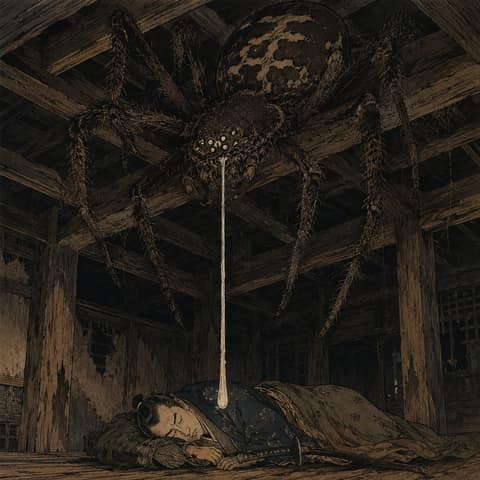
The Great Spider is a spider that has lived long enough to gain supernatural power, troubling people and monks. It hides in the mountains or in temple rafters, brushes people’s faces late at night, and drains their vitality, causing illness. It may take human form—often as an old woman—and ensnare victims with silk. References appear in records and essays; it may also be called “mountain spider” or “tsuchigumo,” though details and abilities vary by region.

Ogetsuhime-no-Kami

Ogetsuhime-no-Kami

Divine

おおげつひめのかみ

Ogetsuhime-no-Kami, the Food Goddess of Awa Who Bears the Five Grains from Her Body

神霊・神格Tokushima

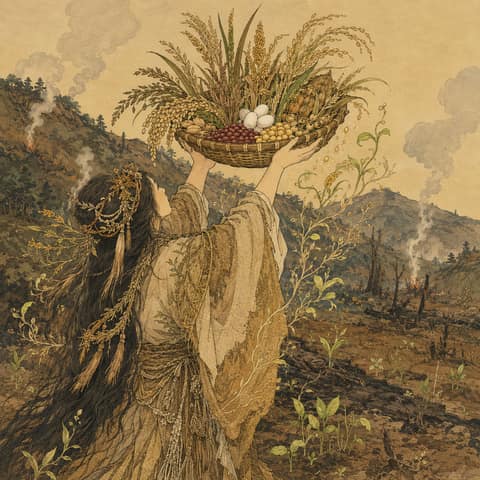
Ogetsuhime-no-Kami is a goddess of food appearing in the *Kojiki*, possessing multiple faces: she is the name of Awa Province, a deity born during the Kamiumi (birth of the gods), a goddess murdered by Susanoo-no-Mikoto to give rise to grain, and a mother goddess in the genealogy of O-toshi-no-Kami. The Kokugakuin University Deity Name Database lists her reading as "Ohogetsuhime-no-Kami / Ogetsuhime-no-Kami" and gives aliases such as Ogetsuhime, Ogetsuhime-no-Kami, Ogetsuhime, and Ogetsuhime-no-Kami (written with different kanji). Regarding the meaning of her name, "O" is an honorific prefix, "ge" is a sequential voicing (rendaku) of "ke" meaning food, and "tsu" is an attributive particle, establishing her divine nature as a goddess governing food. Her most powerful scene is the myth of the origin of grains, placed in the episode of Susanoo's banishment. Asked for food, Ogetsuhime produced various foods from her nose, mouth, and rectum, cooked them, and offered them. However, Susanoo, witnessing this, thought she was doing something filthy and killed her. From her murdered body, silkworms grew from her head, rice seeds from both eyes, millet from both ears, adzuki beans from her nose, wheat/barley from her genitals, and soybeans from her rectum. Kami-musubi-no-Mioya-no-Mikoto then had these seeds collected. Food does not suddenly appear as a pure offering; it becomes seeds through the body, death, and decomposition. Ogetsuhime is the deity who bears this dark transformation. Ogetsuhime is similar to Ukemochi-no-Kami, who carries the same myth of the origin of food, but simply equating them obscures their differences. In the *Nihon Shoki*, Ukemochi is killed by Tsukuyomi-no-Mikoto, linking the separation of the sun and moon with the origins of agriculture and sericulture. On the other hand, in the *Kojiki*, Ogetsuhime appears after Susanoo's banishment; in the interstitial space transitioning from the Takamagahara myth to the Izumo myth, she brings forth the seeds of food that will support the creation of the earthly realm. Including her name 'Awa' (millet) Province, her association with slash-and-burn crops, and her children with Haya-mato-no-Kami, she is a food goddess unique to the *Kojiki* who unites Awa, the mountains, food, and generation from a corpse.
Great Zato (The Blind Masseur Yokai)

Great Zato (The Blind Masseur Yokai)

Epic

OH-zah-TOH

Sekien Zue Version

Humanlike and hybrid yokaiEdo period

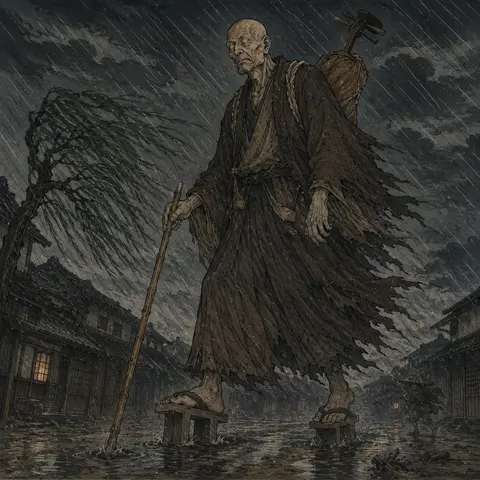
The Great Zato is a yokai depiction of a blind guildsman (zato) illustrated by Toriyama Sekien in Konjaku Hyakki Shūi. Wearing tattered hakama, wooden clogs, and leaning on a staff, it roams the main roads on stormy nights. When questioned, it replies that it “always plays the shamisen at brothels.” The image caricatures the nighttime presence of professional blind performers, blending otherness and social satire into a yokai form.

Ootakemaru

Ootakemaru

Legendary

おおたけまる

Ootakemaru, the Demon King God Holed Up in Mount Suzuka

Oni / Giant MonsterMieKyoto

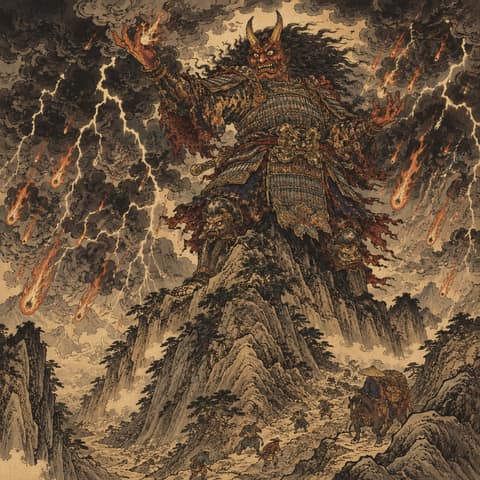
Ootakemaru is a demon god said to have made his stronghold at Mount Suzuka and the Suzuka Pass, located on the border between Ise and Omi provinces. In Otogizoshi and the Tamura stories, he appears as a Great Demon King who steals tributes meant for the capital and repels armies with black clouds, lightning, and rain of fire, only to be slain by Tamuramaru (modeled after Sakanoue no Tamuramaro) and Suzuka Gozen. The Tamuramaru of the story is not the historical Shogun himself, but a heroic figure born from the overlapping of medieval Kiyomizu Kannon worship, boundary beliefs of the Suzuka Pass, and Tamura legends from the Tohoku region. Ootakemaru is also sometimes cited as one of the "Three Great Yokai" alongside Shuten-doji and Tamamo-no-Mae. The fact that his severed head and remains are later incorporated into tales of treasures, temple origins (engi), and burial mounds reflects the medieval significance of a "slain great enemy".

Great Catfish

Great Catfish

Epic

oh-nah-MAH-zoo

Traditional Version: The Great Catfish Subdued by the Keystone

Weather & Calamity SpiritsIbaraki

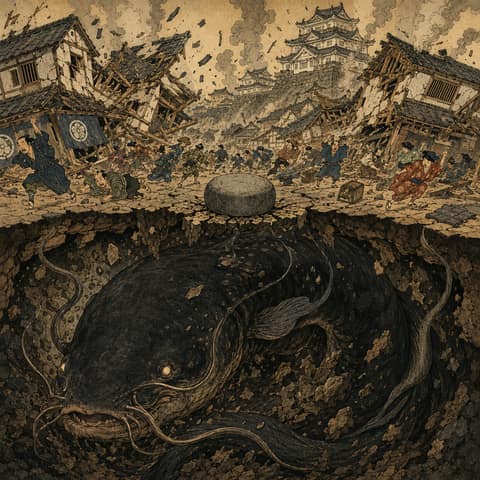
A colossal catfish believed to lurk underground, twisting its body to cause earthquakes. Earlier notions held that dragons or serpents beneath the earth triggered quakes, but by the Edo period the agent shifted in popular belief to a catfish. Faith spread that the keystones (kaname-ishi) of Kashima and Katori shrines pinned the creature in place. After the 1855 Ansei earthquake, woodblock “catfish prints” (namazu-e) proliferated, turning the catfish into an emblem of quake protection and social upheaval.

Showing 97 - 120 of 146 yokai