YOKAI.JP

🔤 Yokai by Kana

Find yokai in hiragana order

146 Yokai|12 Category|Page 6 of 7
Localization in Progress - More content available in Japanese version
View Japanese

Filter by hiragana row

Sort by: ReadingAscending
Great Nyūdō (Giant Priest Apparition)

Great Nyūdō (Giant Priest Apparition)

Epic

oh-oh-nyoo-DOH

Annotated Traditional Edition: Ōnyūdō (Giant Priest)

Demons & GiantsMie

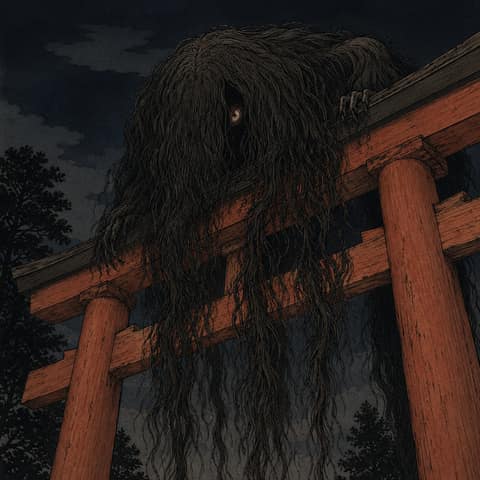
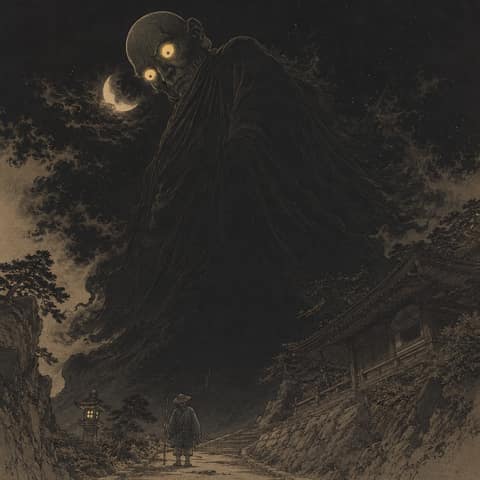
Ōnyūdō is a giant, priest-like apparition—and sometimes a towering shadow figure—reported across Japan. The name means “great monk,” yet it does not always appear in clerical form; accounts describe colossal humanoids or amorphous shadows looming overhead. Its glare is said to make onlookers faint or fall ill. While its true nature is often left unstated, some traditions claim it is a transformed animal—fox, tanuki, weasel, or otter—or even a bewitched stone stupa.

Ōmine Zenkibō

Ōmine Zenkibō

Legendary

Ōmine Zenkibō

The Dharma-Guarding Tengu Turned from an Oni — Ōmine Zenkibō

Mountain & Wilderness SpiritsNara

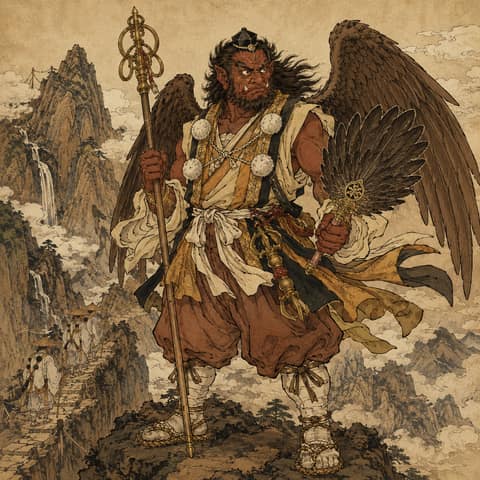
Ōmine Zenkibō is a great tengu enthroned on Mt. Ōmine in Yamato Province, and is counted among the Eight Great Tengu. He is chanted in the Muromachi Noh play Kurama Tengu as "the band of Zenki of Ōmine." His name derives from Zenki, the oni who followed En no Gyōja (En no Ozunu), the founder of Shugendō. En no Gyōja is depicted in the oldest extant tale collection, the Nihon Ryōiki, as a thaumaturge who commanded demons and flew through the air. Zenki was originally an oni who carried off human children, but he was captured by En no Gyōja, repented, and with Goki became his attendant. As an instance of an oni transformed into a great tengu through austerities, Zenkibō sits at Ōmine, the heart of Shugendō, and is handed down as one of the forty-eight tengu.

Giant Centipede

Giant Centipede

Epic

OH-oh-MOO-kah-deh

Giant Centipede (Mikami-yama Tradition)

Demons & GiantsShigaTochigi

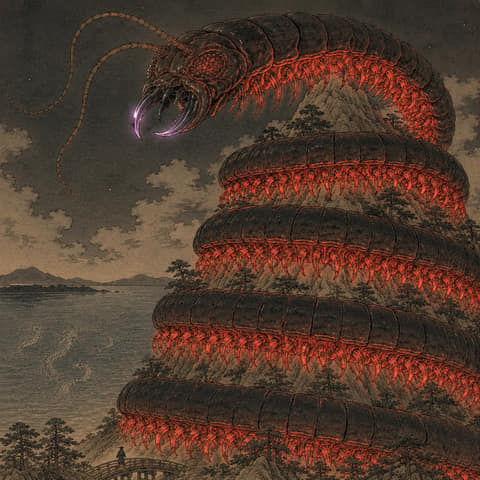
The Giant Centipede is a monstrous centipede yokai whose carapace is so hard it deflects blades and arrows. Its body is long enough to coil around mountains, its many legs glow a fiery red, and its venomous fangs were said to bite through armor. It is portrayed as an adversary of great serpents and dragons—water deities—with whom it battles in lakes, marshes, and the wilds. Centipedes symbolized fearless resolve and were seen as auspicious by warriors and merchants, though details of this creature vary widely by region.

Oyamatsumi

Oyamatsumi

Divine

oyamatsumi

The Supreme Deity of Mountains, Seas, and War

神霊・神格Ehime

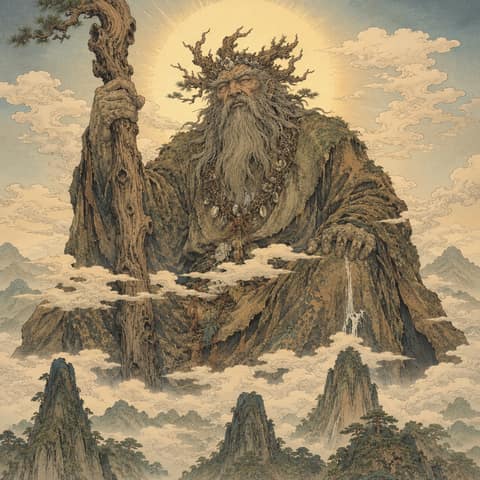
Oyamatsumi-no-kami is the great god of mountains in Japanese mythology, born from the "kamiumi" (birth of the gods) by Izanagi-no-mikoto and Izanami-no-mikoto. The "O" in his name is an honorific, "yama" means mountain, and "tsumi" means divine spirit, designating him as the supreme deity who governs vast mountain ranges in their entirety. In myth, he is also known as the father of Konohanasakuya-hime (who married the Heavenly Grandson Ninigi-no-mikoto) and her elder sister Iwanaga-hime. The choice he presented regarding his two daughters serves as an important origin myth explaining why human life is finite (short-lived). However, in folklore and historical tradition, he is far more than a mere mountain god; he possesses a highly multifaceted character as a god of the sea, agriculture, and warfare. He is widely worshipped nationwide as a presence that embodies Japan's ancient view of nature.

Ōyama Hōkibō

Ōyama Hōkibō

Legendary

Ōyama Hōkibō

The Great Tengu of the Transferred Seat — Ōyama Hōkibō

Mountain & Wilderness SpiritsKanagawa

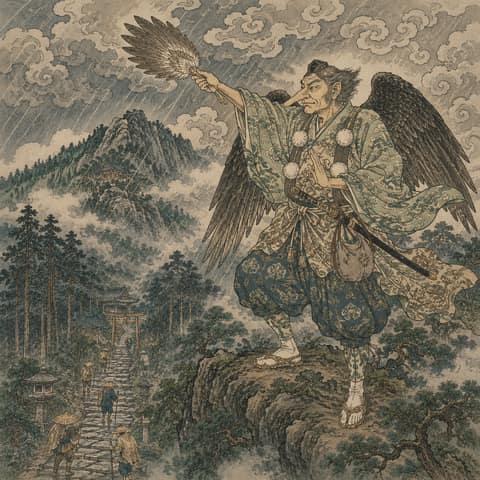
Ōyama Hōkibō is a great tengu enthroned on Mt. Ōyama in Sagami Province (also called Afuri-yama, the "Rain-falling Mountain"), and is counted among the Eight Great Tengu. His name appears as "Hōkibō of Ōyama" in the Muromachi Noh play Kurama Tengu. The Mt. Ōyama on which he sits is a sacred mountain reaching back to the ancient official histories. The Engishiki Jinmyōchō (927) lists the Afuri Shrine on its summit as an official shrine (shikinai-sha) of Sagami Province, showing that Ōyama's divinity had received state recognition in antiquity. The name Hōkibō is wreathed in a tradition of "seat transfer" within the tengu world. Mt. Ōyama of Sagami originally had a great tengu named Sagamibō, but he removed to Shiramine to console the spirit of the Retired Emperor Sutoku, exiled to Sanuki. Into the vacant seat of Sagami Ōyama, Hōkibō entered as successor from Mt. Daisen in Hōki Province (Tottori)—a paired structure set in order by Chigiri Kōsai of tengu scholarship. For this reason Ōyama Hōkibō and Shiramine Sagamibō are always told as a pair.

Okiku

Okiku

Legendary

okiku

Okiku of Sarayashiki

Spirit / Vengeful GhostHyogoTokyo

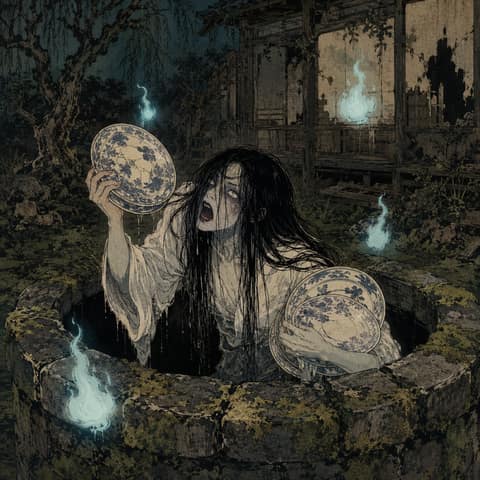
Okiku is the vengeful ghost of a woman who was drowned in a well over the suspected loss of a single heirloom plate, returning every night to the bottom of the well to count plates: "One... Two..." She features in two major lineages of legends: the *Banshu Sarayashiki* tradition set in Harima (Himeji), and the *Bancho Sarayashiki* tradition set in Bancho, Edo. Alongside Kasane and Oiwa, she is considered one of the most representative female vengeful spirits of early modern Japanese ghost stories. In the Banshu lineage, amid Aoyama Tetsuzan's conspiracy to usurp the Kodera (Hosokawa) clan during the Muromachi period, his retainer Machitsubo Danshiro hides one of ten heirloom Chinese plates, pins the blame on the maid Okiku, tortures her to death, and throws her into a well. In the Bancho lineage, Okiku is a maid in the mansion of the hatamoto Aoyama Shuzen who breaks a plate—or refuses her master's unwanted advances—and is slain and cast into a well. Both versions share the core motif of a cyclical haunting where she counts the incomplete set of plates, climaxing in an agonizing shriek when she reaches the missing piece. The Okiku Well still exists beneath the main keep of Himeji Castle, and the legend has taken deep root even in local place names, shrines, and the names of insects.

Escorting Sparrow

Escorting Sparrow

Uncommon

oh-KOO-ree soo-ZOO-meh

Systematized Folklore Edition

Mountain & Wilderness SpiritsWakayama

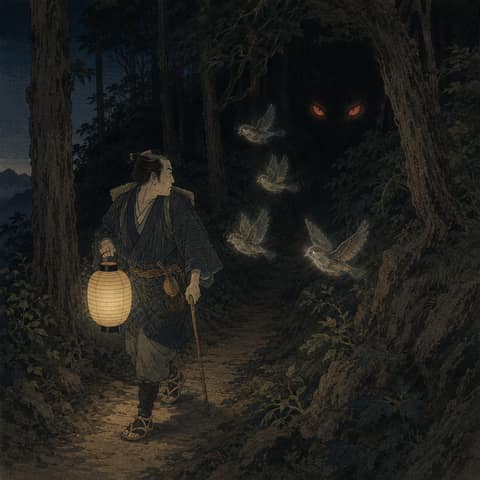
A mysterious bird said to follow travelers along mountain paths at night, chirping “chichichichi…” and sometimes drawn to lantern light. Its call was feared as a harbinger of wolves or the yokai known as the “escorting wolf.” Though described as sparrow-like, few claim to have seen it clearly. Some call it “Aoji” due to its call resembling the Eurasian siskin/black-faced bunting, but others doubt the identification since this creature flies at night. In some regions it is even said to be a rabbit.

Guiding Lantern (Okuri-chōchin)

Guiding Lantern (Okuri-chōchin)

Uncommon

oh-KOO-ree CHOH-cheen

Honjo Seven Wonders Tale: Okuri-Chochin (Guiding Lantern)

Mountain & Wilderness SpiritsTokyo

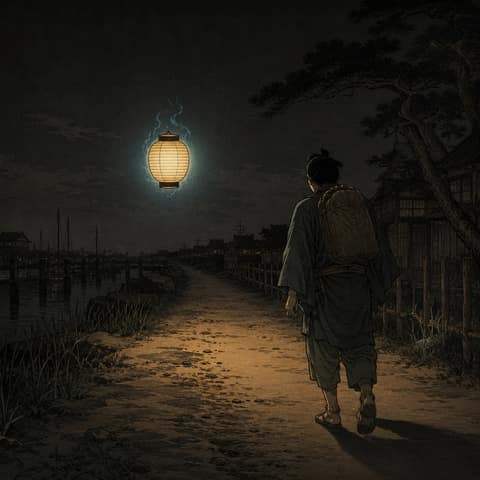
A will-o’-the-wisp-like light that appears before travelers without a lantern on night roads, gliding ahead as if to lead them on. When approached it snuffs out; when distance grows it reappears, always just out of reach. Counted among the Seven Wonders of Honjo in Edo, it’s akin to the “Guiding Clappers” and to Odawara lanterns that mislead people, and is related to the trickster lantern spirit known as Chōchin Kozō. It seldom harms; its nature is to toy with people and throw their journey into confusion.

Accompanying Hyōshigi

Accompanying Hyōshigi

Uncommon

oh-KOO-ree hyoh-SHEE-ghee

Tradition-Faithful Version

Household SpiritsTokyo

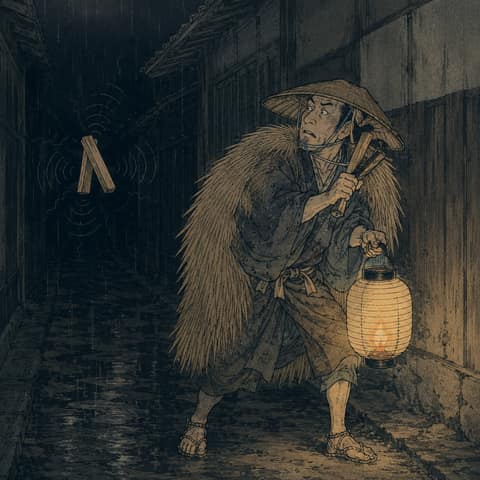
One of the “Seven Mysteries of Honjo” told around Edo’s Honjo district. When night watchmen struck their wooden clappers (hyōshigi) while calling “Beware of fire,” the same cadence would continue behind them even after they stopped, as if an unseen presence were escorting them. Some say it was simple echoing in the quiet streets, but accounts tell of the sound on rainy nights even without clappers being struck, so the tale endured as a mystery.

Osakabe-hime

Osakabe-hime

Epic

oh-sah-KAH-beh-hee-meh

Osakabe-hime (Traditional Tale Version)

Half-Human BeingsHyogo

A female yokai and castle deity said to dwell in the main keep of Himeji Castle. Early Edo怪談 depict it as a gender-shifting castle specter; later tradition fixed the image as a “princess.” Revered and feared as both guardian and avenger of the castle, bringing fortune or calamity according to the lord’s conduct. Its true nature varies by tale—an ancient fox, a castle god, a sacrificed woman, or the spirit of a long-departed noble lady. Also called Osakabe.

Osaki-gitsune

Osaki-gitsune

Rare

osaki-gitsune

The Small Fox Clinging to Family Lineages: Osaki-gitsune

Animal YokaiSaitamaTokyo

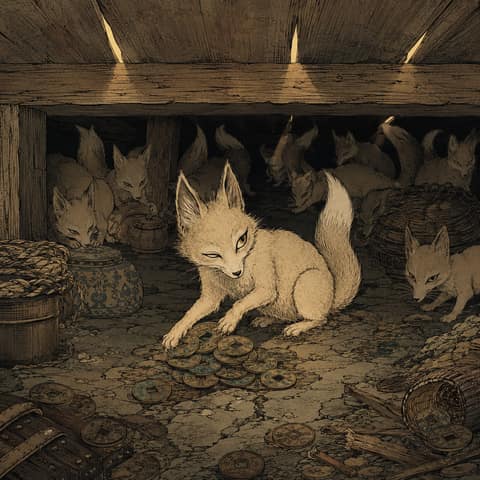
The Osaki-gitsune is a small fox spirit possession spoken of from the Kanto through the Koshinetsu regions, strongly tied to the concepts of "Osaki-mochi" (Osaki holders) and "Osaki-suji" (Osaki lineages) that possess specific households generation after generation. Its form is variously described as a small beast like a weasel or mouse, a fox with distinct tail features, or an invisible fox spirit, and is never fixed. However, its essence lies not in its physical appearance, but in being imagined as an invisible possession clinging to a family lineage. The Osaki-gitsune is a fox spirit that simultaneously generates a family's prosperity and the community's suspicion. Families holding it were said to become wealthy, but that wealth was feared as unnatural, sometimes leading to the family being avoided in marriage and social relations. Like the Kuda-gitsune and Inugami, it is a type of spirit possession belief, but the Osaki took root particularly deeply in the village societies from the Kanto mountains to Koshinetsu, functioning as a family's reputation. The yokai is not a one-time incident of a fox bewitching someone; the long memory that "something has been in that family for generations" is the true habitat of the Osaki-gitsune. The key to understanding this fox lies in its continuity as a "lineage" rather than as an individual yokai. The Osaki does not end with a one-night sighting; it was spoken of as something attached to a house for generations. Therefore, the terror lies not in the moment of encounter, but is amplified over the long timeframes of bloodlines, marriage, property, and reputation.

Long Crown

Long Crown

Rare

oh-sah-KOH-buh-ree

Iconographic Tradition Version

Household SpiritsJapanese folklore

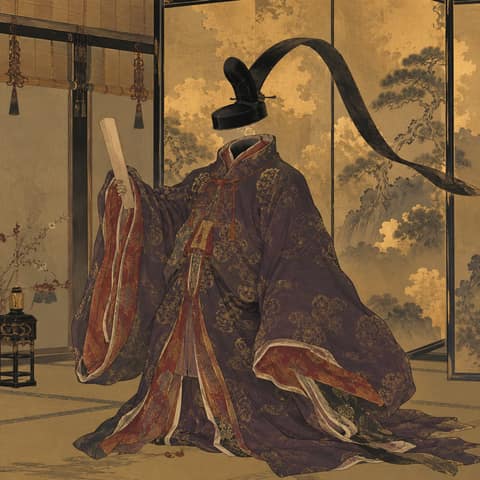
A crown-turned-yokai depicted by Toriyama Sekien in Hyakki Tsurezurebukuro. It wears court robes and carries a ritual baton, its head becoming a coiled-tailed court cap (kanmuri). Sekien alludes to a tale of a “wise man who hung his cap on the capital’s gate,” suggesting this specter embodies those who cling to office for self-preservation and refuse to let go of their rank. The crown—symbol of authority—turns monstrous when attached to a heart that has lost moral integrity, making the creature a moral emblem.

Powdered-Hag

Powdered-Hag

Epic

oh-shee-ROH-ee bah-BAH

Powder-Faced Hag of the Snowy Night

Half-Human BeingsNara

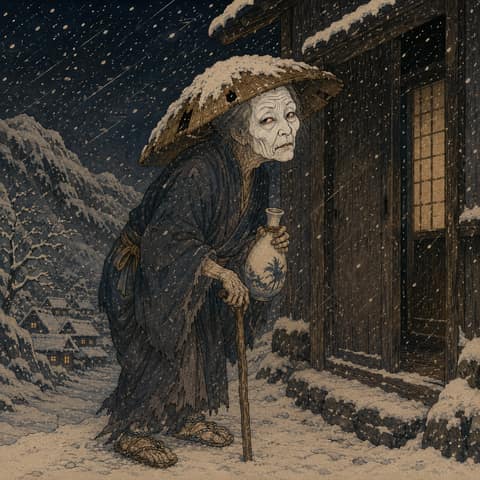
An old woman yokai with her face caked in white face powder, wearing a torn sedge hat. She appears on snowy roads, leaning on a staff with a sake flask at her side, and asks travelers for a drink. She is said to stand at doorways, drawn by the scent of amazake or sake. If given a little, she causes no harm; if refused, she knocks at the door until late into the night. Tales portray her as a wintertime admonition in poor villages and a reminder of hospitality toward visitors.

The Oak That Never Shed Its Leaves

The Oak That Never Shed Its Leaves

Uncommon

oh-chee-bah-NAH-kee SHEE-ee

Honjo Seven Mysteries – Traditional Lore Version

Natural Phenomena SpiritsTokyo

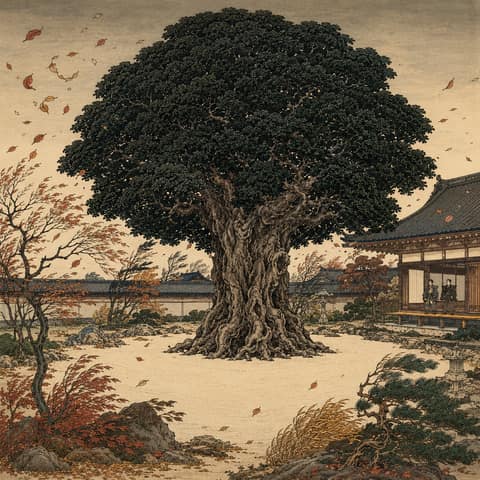
In the Edo period, a venerable chinquapin/oak tree in the garden of the Matsuura clan’s upper residence at Hirado Shinden, Honjo, was said never to drop a single leaf throughout the year. Counted among the “Seven Wonders of Honjo,” it was viewed as ominous because even evergreens shed leaves. Household members kept their distance, feeling it foretold misfortune. Accounts differ on the exact site and the identity of the actual tree, and details remain uncertain.

Otsuyu

Otsuyu

Legendary

おつゆ

Otsuyu of the Peony Lantern

Spirit / GhostOriginally from 'The Tale of the Peony Lantern' in the Chinese text 'Jiandeng Xinhua'; later adapted by Asai Ryoi and San'yutei Encho

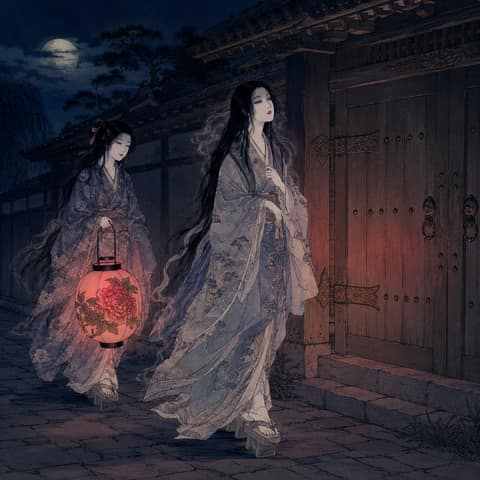
Otsuyu is the legendary female ghost protagonist of the ghost story *Botan Doro* (The Peony Lantern). Said to be the daughter of the hatamoto Iijima Heizaemon, she falls in love at first sight with the ronin Hagiwara Shinzaburo, whom she met through the introduction of the physician Yamamoto Shijo. However, unable to meet him again, she is said to have passed away from lovesickness. Unable to let go of her feelings even in death, she visits Shinzaburo every night accompanied by her maid Oyone, carrying a peony lantern, her wooden clogs echoing with a 'clippity-clop' (karan-koron) sound. After discovering her true identity as a spirit, Shinzaburo wards his house with the talismans of Kaion Nyorai and a solid gold Buddha statue. However, his neighbors, the married couple Tomozo and Omine, are bribed by the ghosts to peel off the talismans. Shinzaburo is ultimately cursed to death; he is found reduced to a skeleton, embraced by a skull. Because the story strongly evokes empathy for the dead rather than the living, Otsuyu is remembered not merely as a 'vengeful ghost,' but as a 'ghost who died for love and continues to love.' Alongside Oiwa of *Yotsuya Kaidan* and Okiku of *Sarayashiki*, she is counted among the most iconic female ghosts of early modern Japanese ghost stories.

Otoroshi

Otoroshi

Epic

oh-toh-ROH-shee

Iconography from Picture Scrolls (Early Modern Tradition)

General names and collective figuresUnknown

A name found in Edo-period yokai picture scrolls, depicted as a figure shrouded in long hair with its face hidden by bangs. It appears in works like Sawaki Suushi’s Hyakkai Zukan and Toriyama Sekien’s Gazu Hyakki Yagyo, but offers virtually no accompanying text; its nature and origins remain unclear. Spellings vary—such as “Odoro-odoro” or “Ke-ippai”—suggesting a play on the sense of dread and wild, disheveled hair.

Dancing Head

Dancing Head

Uncommon

oh-DOH-ree-KOO-bee

Classical Tale-Conforming

Ghosts & SpiritsHyogo

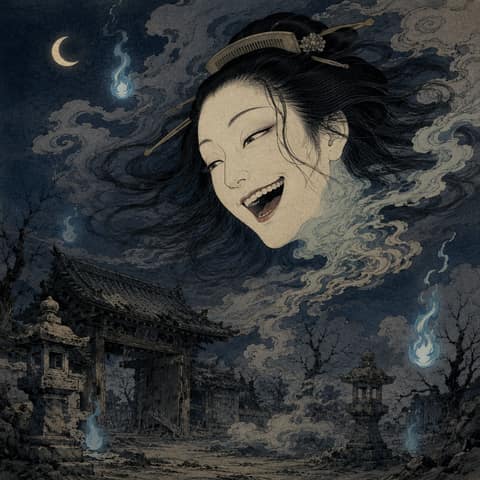
Odorikubi, the “dancing head,” is a type of revenant in which a human head drifts through the air detached from its body. Said to arise from warriors, women, or others who died bearing fierce grudges or obsessive love, the head may swell to enormous size and haunt old temples or desolate places, menacing the living. Early books and奇談 record fragments of the phenomenon: heads flitting across the night sky, laughing with gaping mouths, or groaning. Clear origins or a single canonical tale are rare.

Oni

Oni

Legendary

OH-nee

Oni (Traditional Folklore Form)

Demons & GiantsKyoto

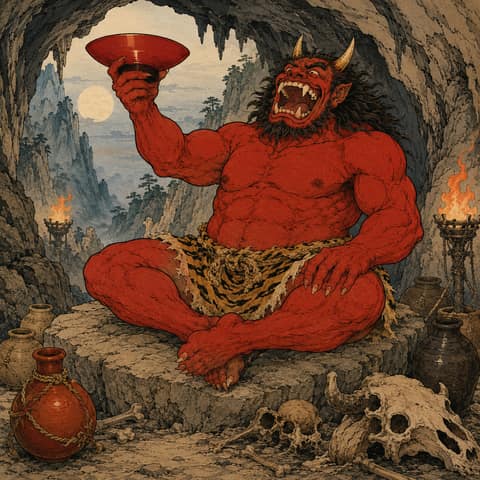
Powerful yokai with horns. Though fearsome in appearance, many are gentle at heart.

Oni Bear

Oni Bear

Uncommon

OH-nee KOO-mah

Tradition-faithful Oni-Bear

Animal ShapeshiftersNaganoHokkaido

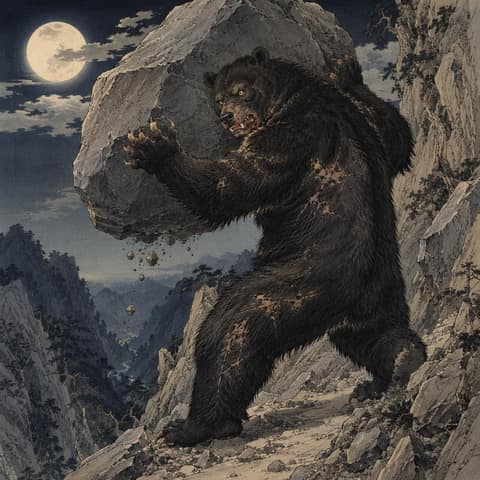
The Oni Bear is an aged bear said to have turned into a yokai in the Kiso Valley. It rarely shows itself to people, but at night it descends from the mountains, walks upright, and carries off cattle or horses to devour in the hills. Its strength is superhuman—stories tell of it heaving great boulders into ravines. It appears in the Edo-period miscellany Ehon Hyaku Monogatari and later yokai picture encyclopedias. In some regions the term was also used for especially ferocious bears.

Oni Hitokuchi

Oni Hitokuchi

Uncommon

OH-nee HEE-toh-KOO-chee

Tradition-Faithful Edition

Demons & GiantsOsaka

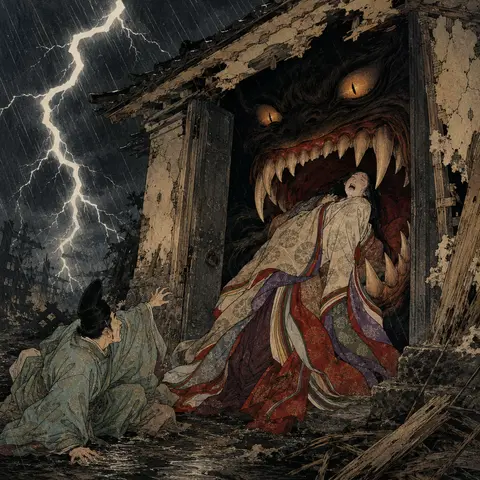
Oni Hitokuchi refers not to a single creature but to the phenomenon of an oni devouring a person in a single bite. The term appears frequently in Heian-period tales and romances. In The Tales of Ise (the Akutagawa episode), during a thunderstorm a woman hiding in a storehouse is swallowed whole by a lurking oni. Toriyama Sekien later illustrated the motif, popularizing the name “Oni Hitokuchi.” The idea often served to explain disappearances amid war or disaster as the work of the otherworld.

Ohaguro-bettari

Ohaguro-bettari

Rare

ohaguro-bettari

Ohaguro-bettari, the black-toothed bridal face

Humanlike and hybrid yokaiTokyo

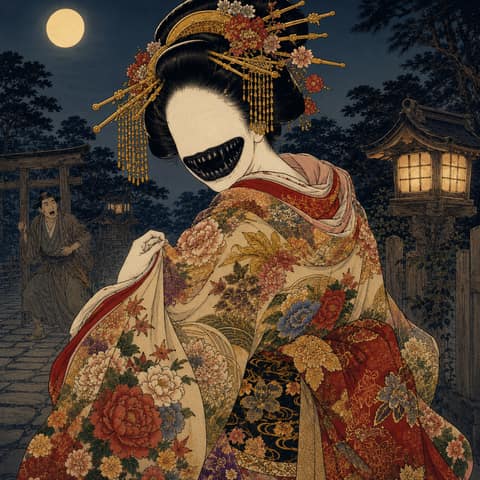
Ohaguro-bettari appears as a bride or young woman who keeps her face hidden. When someone approaches, she turns to reveal smooth white skin with neither eyes nor nose—only an enormous mouth of blackened teeth. *Ohaguro* was the historical practice of dyeing the teeth with an iron-based solution; *bettari* suggests that the blackness has been laid on thick. In the *Ehon Hyaku Monogatari*, bridal beauty and the sudden absence of a face are made to reverse into one another in a single image. Blackened teeth were not inherently monstrous. Ohaguro belonged to a history of marriage, adulthood, status and women’s formal appearance. Hara Mitsumasa’s study of ohaguro treats it as folklore and bodily adornment, reminding us that black teeth once signalled beauty and social maturity. The yokai becomes frightening when that familiar sign expands until it erases every other feature. Noppera-bō embodies the fear of having no face; Ohaguro-bettari sharpens it into the fear of having nothing but a mouth. A traveller sees a shy bride, steps closer, and finds no eyes returning the gaze—only a black smile opening across blank skin. The point is not simply a resentful unmarried woman. The image turns the etiquette of makeup, weddings and modestly hiding the face into a visual trap, transforming a recognised sign of beauty into the whole substance of the horror.

Oboroguruma (The Hazy Carriage)

Oboroguruma (The Hazy Carriage)

Rare

oh-BOH-roh-goo-ROO-mah

Oboroguruma (after Sekien’s Iconography)

Household SpiritsKyoto

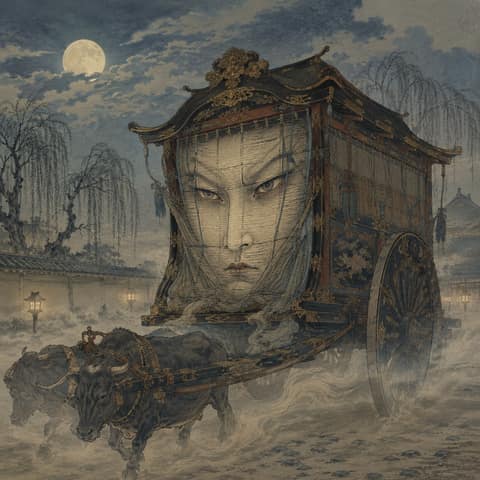
Oboroguruma is a haunted ox-drawn carriage depicted by the Edo-period artist Toriyama Sekien in Konjaku Hyakki Shūi. On hazy nights it arrives with creaking wheels, a gigantic face peering from where the carriage blinds would be. It is often read as the manifestation of grudges born from Heian-era “carriage disputes,” tied to court processions and the Kamo Festival. Scholars link it to the Night Parade of One Hundred Demons and classify it among haunted tools (tsukumogami).

Omoikane

Omoikane

Divine

omoikane-no-kami

Omoikane, God of Wisdom Who Devises the Rock Cave Plan

Deity / Divine SpiritNaganoSaitama

Omoikane is the god of wisdom who appears in the Heavenly Rock Cave (Ama-no-Iwayato) myth and the Descent of the Heavenly Grandson in the first volume of the Kojiki. The Kokugakuin University Deity Name Database notes his reading as "Omoikane-no-kami", and introduces that he is written as Omoikane-no-kami (思兼神) in an alternate account in the Nihon Shoki, and as Omoimizo-no-kami or Yagokoro-omoikane-no-kami in the Kogo Shui. The "Omoi" in his name means thought or consideration, and "kane" means to combine or hold simultaneously, symbolizing exceptional wisdom akin to possessing the thoughts of many people in one single mind. When Amaterasu-Omikami hid in the Heavenly Rock Cave, plunging the world into darkness, the myriads of gods gathered at the dry riverbed of the Ame-no-Yasu River (Ame-no-Yasukawara), and there they bade Omoikane, the child of Takamimusubi-no-kami, to think of a plan. At the apex of a crisis where the gods knew not what to do, this deity was entrusted with devising a solution. He is depicted not merely as having wisdom, but as a tactical god who designed the entire scenario of a massive ritual to open the Heavenly Rock Cave: gathering the long-crowing roosters of Tokoyo to crow, having mirrors and magatama jewels crafted, ordering norito prayers to be recited, and having Ame-no-uzume dance. In the section of the Descent of the Heavenly Grandson, he accompanies the Heavenly Grandson as Tokoyo-no-omoikane-no-kami, and is commanded to "take charge of preceding affairs and govern." This is the moment when crisis-management wisdom transforms into the wisdom of political governance on earth. At Togakushi Shrine in Nagano Prefecture, he is enshrined at the Chusha (Middle Shrine) as Ame-no-yagokoro-omoikane-no-mikoto, and at Chichibu Shrine in Saitama Prefecture, Yagokoro-omoikane-no-mikoto is enshrined as the ancestral god of politics, scholarship, industry, and good fortune. Rather than prying the door open by force, he is the embodiment of mythological wisdom who breaks through deadlocks by combining the strengths of those around him.
Female Tengu

Female Tengu

Uncommon

OHN-nah TEN-goo

Annotated Tradition Edition: Female Tengu

Mountain & Wilderness SpiritsTokyoYamanashi

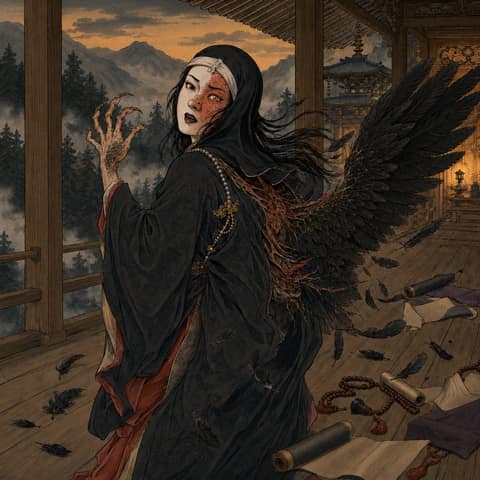
Female Tengu are the female-identified beings among the tengu. They are depicted with long hair, eyebrows darkened with ink, rouge and white powder on the face, teeth blackened with ohaguro, and dressed in scarlet hakama and gauzy robes, sometimes with wings on their back. Classical sources mention nuns who fall and become “nun tengu,” though records differ on whether women exist in the tengu world at all. Some regions describe river tengu with feminine traits, but details remain unclear.

Showing 121 - 144 of 146 yokai