YOKAI.JP

Traditional Yokai Encyclopedia

Yokai passed down through the ages

480 Yokai|19 Category|Page 10 of 20
Localization in Progress - More content available in Japanese version
View Japanese
Sort by: NameAscending
Kodama Mouse

Kodama Mouse

Uncommon

koh-DAH-mah NEH-zoo-mee

Kodamanezumi (Canonical Folkloric Version)

Animal ShapeshiftersAkita

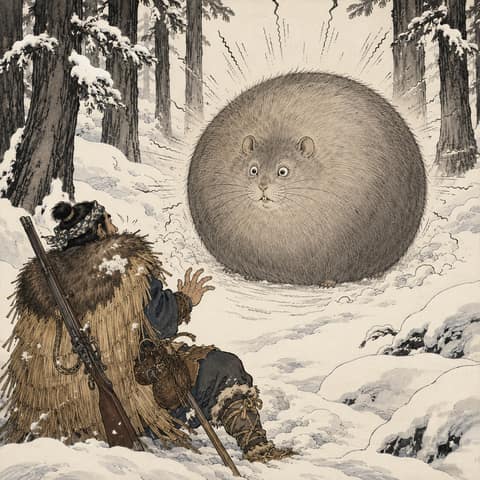
A curated version of a mountain anomaly told among matagi hunters in northern Akita, framed within hunting rites and taboos. It looks like a dormouse or tiny field mouse, round, small, and quick. When it faces a person, it suddenly swells and unleashes a single blast like a gunshot. In many accounts it bursts apart, scattering flesh and viscera, while other tellings say it only bounces about and booms without exploding. Either way, an encounter is a dire sign of the mountain god’s anger or warning, and hunts were to be halted after a sighting. To continue was feared to bring empty bags, bad weather, or avalanches. To avert the curse one should descend the mountain and purify oneself at home by chanting “Namu Aburaunken Sowaka.” As for origins, one tale says seven matagi of the Kodama school were punished and became Kodamanezumi, while another reads the legend as a taboo memory arising from digging up hibernating dormice. Dates and sources are uncertain, with most accounts preserved orally.

Koga Saburo

Koga Saburo

Legendary

Koga Saburo

Koga Saburo, the Serpent Deity of the Underworld

Half-Human / Half-YokaiNaganoShiga

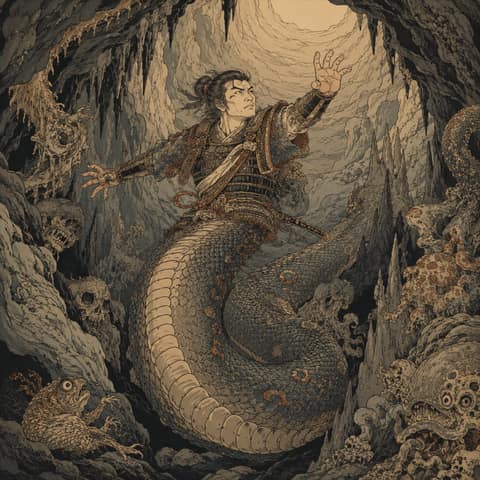
The fascination of the Koga Saburo legend lies not merely in its heroic epic, but in how it explains the origins of Suwa Myojin as "the return of a mortal who fell underground." Unlike Takeminakata-no-Kami from the Kojiki, who retreats to Suwa as the defeated figure in the myth of the transfer of the land, Koga Saburo travels from Omi to Shinano, falls into the underworld through a cave on Mount Tateshina, and returns as a serpent. The deity of Suwa does not simply descend from the heavens, nor does it merely arrive from central mythology; it manifests by passing through mountain caves, subterranean kingdoms, and the body of a snake. This narrative beautifully weaves together the elements of Suwa worship—water, mountains, dragons, serpents, hunting, and the syncretism of Shinto and Buddhism—into a single tale. This is precisely why it is meaningful to establish Koga Saburo as a distinct figure alongside the official enshrined deity Takeminakata.

Koinryō

Koinryō

Rare

koh-EEN-ryoh

Edo Iconography Conformant

Animated Objects & UndeadJapanese folklore

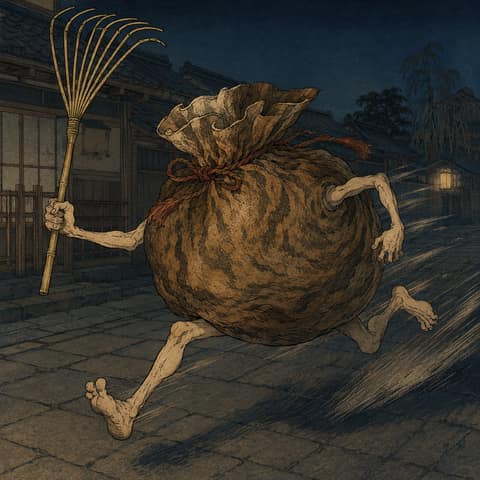
A reconstructive reading based on Toriyama Sekien’s compositional layout and notes. The主体 is a leather coin pouch that, with age, has become a tsukumogami. Its rake-like implement echoes motifs from medieval picture scrolls and likely implies the act of sweeping up or gathering, though sources do not state this conclusively. It moves with great speed, dashing like a herald at the head of a procession, and is imagined merging with the motley ranks of the Night Parade of Haunted Tools. Its name suggests echoes of “tiger hide” and “inrō,” yet no citation is given and the origin remains unknown. No region-specific lore survives; from its placement alongside Yarikechō and Zenkamanasu within the work, it is understood as one among a group of antiquated implements. The entry avoids embellishment, limiting traits to Sekien’s notes and comparable iconography.

Kokuri Baba (Temple Kitchen Hag)

Kokuri Baba (Temple Kitchen Hag)

Rare

KOH-koo-ree bah-BAH

Sekien Iconography Version

住居・器物Japanese folklore

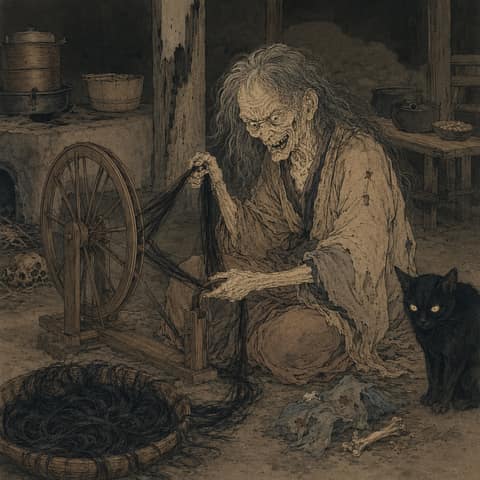
An interpretation grounded in Toriyama Sekien’s Konjaku Hyakki Shūi depiction. Said to be the transformed bōnsō of the seventh prior abbot haunting the temple kitchen quarters, it steals offerings and money, digs up graves to braid hair into garments, and eats human flesh. Artwork pairs an old woman twisting thread with a cat, suggesting satire of clerical corruption and monastic lapses. The name “Kokuri” may pun on a word for something terrifying. Lacking a fixed regional distribution, it is chiefly known as a bookborne pictorial yokai. Rather than field sightings, it likely served as a moral warning and social satire aimed at temple society.

Konaki-jiji

Konaki-jiji

Legendary

konaki-jiji

The Crying Old Man of Tokushima: Konaki-jiji

山野の怪Tokushima

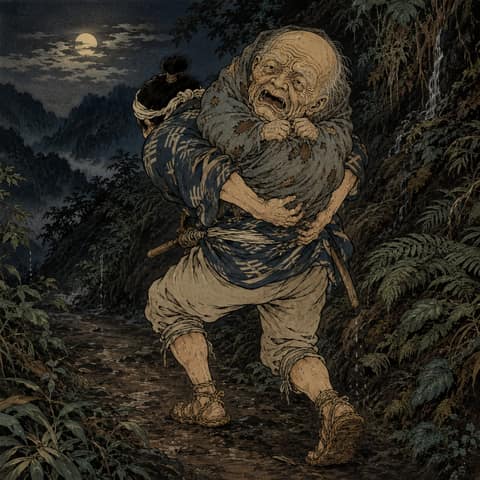
The Folkloric Cliché of the "Crying Baby on a Mountain Path". While the basic overview outlines the structure of the Konaki-jiji legend, this deep dive probes the dark undercurrents of the "crying baby on a mountain path" cliché. Historically, in Japan's rugged mountainous regions, practices like infanticide (mabiki), child abandonment, and high infant mortality rates cast a long, daily shadow over village life. Experiencing auditory hallucinations of a baby crying on a lonely mountain road was a universally shared psychological trauma among these communities. This is exactly why legends of the *Ubume* (the ghost of a woman who died in childbirth) are distributed so widely across the country. Hearing an infant's cry at liminal spaces—mountain passes, riverbanks, or forest paths—serves as the foundational, deep-rooted material for ghost stories across Japan. The Konaki-jiji is Shikoku's unique, composite yokai, created by welding this primal auditory fear to the "form of an old man" and the "crushing weight" motif. Kunio Yanagita's Structural Methodology. The methodological genius of Kunio Yanagita's *Yokai Dangi* (1956) lies not in treating a yokai in isolation, but in reading it structurally alongside its relatives. By aligning the Konaki-jiji's "getting heavier" mechanic with the *Obariyon* and the *Ubume*, Yanagita illuminated a developmental history: the fusion of the primal "crying baby" archetype with the later addition of the "crushing weight" narrative. This comparative approach became the gold standard for post-war folkloristics, heavily influencing later yokai scholars like Kazuhiko Komatsu and Noboru Miyata. The Gogya-naki and the Shikoku Folklore Sphere. The fact that "Gogya-naki"—a cousin of the Konaki-jiji—is distributed entirely across Shikoku highlights the uniqueness of the island's folkloric sphere. In Mima District, Tokushima, records detail a Gogya-naki that hops through the mountains on one leg, its cries powerful enough to trigger earthquakes; Yanagita rightly identified this as identical to the Konaki-jiji. Shikoku's mountain folklore possesses traits distinct from Honshu (the central highlands) and Kyushu (sacred mountain cults). It forms a highly complex religious ecosystem where Shugendo (mountain asceticism), the 88-Temple Pilgrimage, and indigenous Shinto are stacked in multiple layers. The Konaki-jiji is a direct product of this intense Shikoku mountain folklore. The "Real-Life Old Man" Theory and the Mechanics of Monsterification. The local account recorded by historian Masahiro Takita—suggesting that a real, eccentric old man used to mimic baby cries—is highly suggestive when analyzing how yokai are born. The phenomenon where a marginalized villager with abnormal behavior (due to mental illness, isolation, or dementia) is sublimated into a yokai legend over several generations is seen throughout Japan. "Yokai" often function as social devices used to process and mythologize a community's memory of its peripheral members (the elderly, beggars, foreigners, or the disabled). The local Konaki-jiji lore is a rare case that brings this folkloric mechanism to the surface, offering prime material for reading yokai studies through the lens of social history. Shigeru Mizuki's Post-War Yokai Revival Movement. Shigeru Mizuki (1922-2015) was the driving force behind the revival of yokai culture in post-war Japan. Through *GeGeGe no Kitaro* (serialized prominently in Weekly Shonen Magazine from 1968), he elevated half-forgotten, hyper-local folklore into household names across the nation. Within the Kitaro family, the Konaki-jiji was reconstructed as a "good-natured yokai from Tokushima," gaining massive popularity as a bearded, staff-wielding elder in a monk's robe. The transformation of the Konaki-jiji from a malicious, crushing murderer in local folklore to an agent of justice in modern pop culture is a subject of intense academic debate, serving as a prime example of how an author's intervention can fundamentally alter the DNA of a traditional legend. Regional Revitalization and Applied Yokai Studies. In 2001, Yamashiro Town in Tokushima (the legend's birthplace) erected a stone statue of the Konaki-jiji, kickstarting its regional branding as a "Yokai Village." Through initiatives like yokai haunted houses, mascots, and stamp rallies, post-war folkloristics successfully transitioned from an academic discipline into an engine for regional economic growth and tourism. This represents a classic structural model: local yokai (like Ittan-momen in Kagoshima, Sunakake-baba in Nara, and Nurikabe) gain national fame via *Kitaro*, only to be re-imported back to their hometowns as cultural capital for regional revitalization. The Modern History: From Local Lore → Kitaro Fame → Regional Tourism. The modern history of the Konaki-jiji perfectly maps the typical trajectory of Japanese yokai culture. It traces a three-stage cultural metamorphosis: an entity that was merely oral folklore in one specific region before the war, achieves national celebrity through Mizuki's manga in the post-war era, and finally flows back into its birthplace to be monetized as a tourism asset. This exact path is shared by several core members of the Kitaro family. It proves that the Konaki-jiji is not merely a "fairy tale from the past," but a yokai that actively embodies the ongoing, modern processes of cultural production and regional identity building.

Konoha Tengu

Konoha Tengu

Epic

KOH-noh-hah TEN-goo

Konoha Tengu (Classical Depiction)

Mountain & Wilderness SpiritsShizuoka

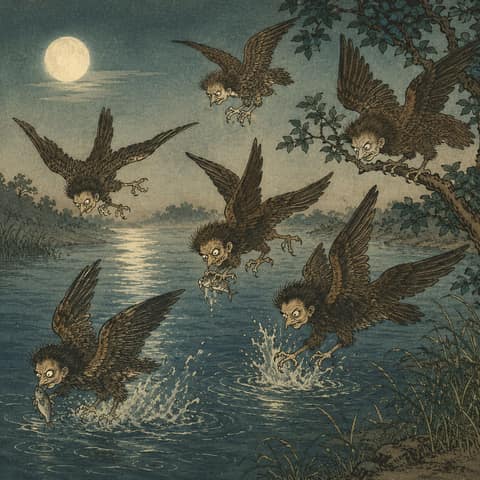
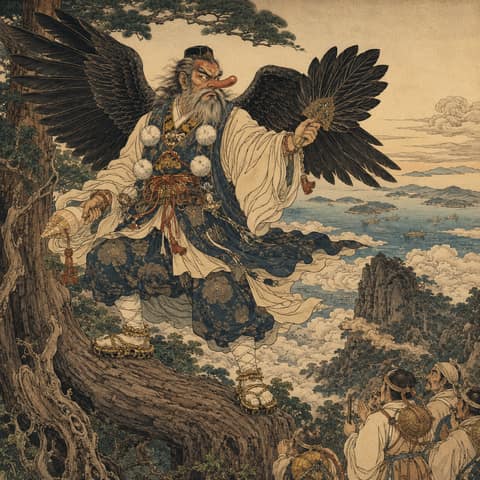
A figure based on Edo-period essays and ghost tales. Ranked below the long-nosed yamabushi-style tengu, it performs menial tasks and is described as birdlike or as a human-faced bird. Accounts vary by region and source: flocks seen at night catching fish on the Ōi River in Suruga, references to them as white wolves within the tengu realm and as elder wolves elevated in rank, and tales of trickery such as a hunter in Iwakuni being toyed with by a tengu disguised as a boy. Overall, rather than causing great harm to people or livestock, they tend to interact through shapeshifting and bewilderment. Ukiyo-e sometimes shows them resting in trees, suggesting they are not invariably violent. Their nature is tied to the mountain borderlands, quick to sense human intrusion and retreat.

Konohanasakuyahime

Konohanasakuyahime

Divine

Konohanasakuyahime

The Maternal Guardian of Cherry Blossoms: Konohanasakuyahime

Divine Spirits / DeitiesMiyazaki

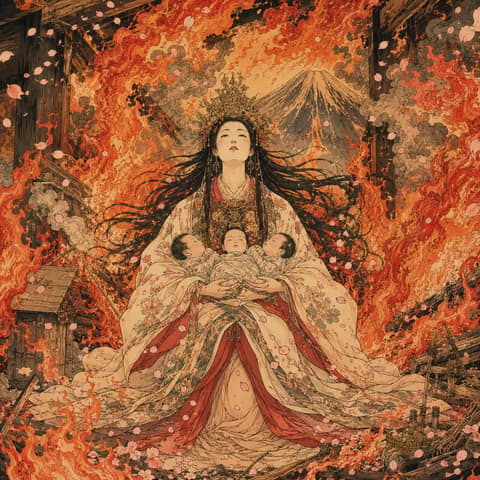
Konohanasakuyahime is a goddess who single-handedly embodies "beauty and the finitude of life" within Japanese mythology. In stark contrast to her older sister Iwanagahime, who symbolizes eternity, she bears the origin of the finite human lifespan, represented by the cherry blossom that is beautiful precisely because it falls. When her one-night pregnancy was called into question, she chose action over excuses—sealing a doorless delivery hut with earth, setting it ablaze herself, and proving her innocence by safely delivering three princes amidst the roaring flames. The sheer intensity of this birth-in-fire is the very core of her faith as the goddess of safe childbirth, fire prevention, and bountiful harvests. At Toman Shrine in Hyuga Province, she is enshrined as the symbol of the land of "Tsuma" (Wife) where she united with Ninigi-no-Mikoto, and as the mother who provided amazake to her three princes. Later, as the guardian deity of Mount Fuji and the Great Deity of Asama, her faith spread to 1,300 shrines nationwide. Her unparalleled charm lies in the fact that she possesses both the fleeting fragility of a flower and the fierce intensity of a flame.

Konpeika, the Golden Ogre of Kumano

Konpeika, the Golden Ogre of Kumano

Uncommon

kohn-PAY-kah

Kumanō Onigajō Legend Variant

Demons & GiantsMie

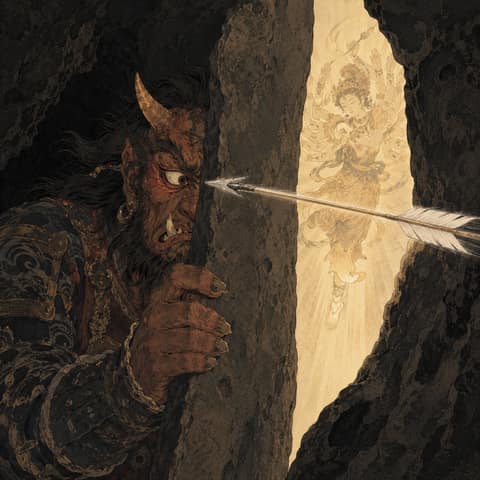
A compiled variant portraying the ogre-general aspect of Kanekira Shika within Tamuramaro-style oni-slaying tales along the Kumanonada coast. He is said to have ruled from the ogres’ sea-eroded cavern known as the Demon’s Rock Dwelling, commanding a band of oni to disrupt maritime routes. In the clash with Tamuramaro, he feared Kannon’s protection, tightened his wards, and barred the stone door to endure a siege. Entranced by the dance led by a child avatar of Senju Kannon, he peered through the doorway and was fatally shot in the left eye. After his defeat, the head was buried in a ravine and ritually pacified. Local lore sometimes names him the pirate chief Tagamaru, with traces preserved in temple-shrine origin tales and toponyms such as Mamigashima, Tomari Kannon (Seimizu-dera), Ōma Shrine, and Onimoto. Historicity is uncertain; some see memories of suppressing revolts or local powers in Kumano later recast into Tamuramaro legend, yet all survive as narrative tradition.

Konpira-bo

Konpira-bo

Epic

konpira-bo

The Forty-Eight Tengu Guarding Mount Zozu, Konpira-bo

TenguKagawa

Konpira-bo is a yokai that embodies the history of Kotohira-gu (Matsuo-dera Konpira Daigongen) as a sacred mountain of Shugendo during the era of Shinto-Buddhist syncretism. Listed as one of the "Forty-Eight Tengu," he is revered as the great tengu commanding Mount Zozu in Sanuki. His true form is either a yamabushi who accumulated harsh austerities and transformed into a tengu, or a familiar (guardian deity) of Konpira Daigongen. This duality represents a typical structure of tengu legends in mountain beliefs across Japan. Particularly within the Konpira faith, which holds aspects of a maritime guardian and water deity, he assumes the role of warding off evil and dispensing divine punishment while enshrined in the deep mountains behind the shrine. Although Kotohira-gu is a Shinto shrine today, ascending the stone steps to the inner shrine and walking along the approach lined with ancient trees still profoundly conveys the majesty of the forest once believed to be the domain of Konpira-bo, imbued with the atmosphere of Shugendo.

Koropokkuru

Koropokkuru

Legendary

koropokkuru

Little People Under the Leaves: Koropokkuru

自然現象・自然霊Hokkaido

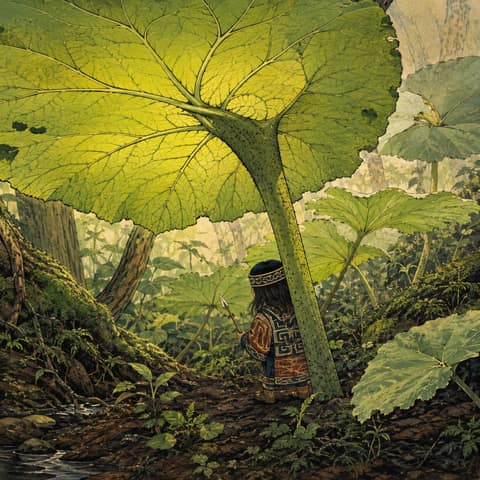
The Ecological Perspective: "People Under the Butterbur Leaves". While the basic overview touched upon the Ainu etymology, this deep dive explores how the Koropokkuru legend is fundamentally tied to the ecology of Hokkaido and Sakhalin. The giant butterbur (*Petasites japonicus var. giganteus*) native to Hokkaido possesses stalks taller than a human adult, with leaves exceeding 1.5 meters in diameter. The custom of repurposing these massive leaves as umbrellas or roofing is common among northern hunter-gatherers, and the Ainu themselves used them daily for shelter from the rain, drying racks, and containers. The image of "little people living under the butterbur" is a direct symbolic manifestation birthed from the sheer proximity and utility of this giant plant in their daily lives. Silent Trade as a Universal Ritual. The core of the Koropokkuru legend—"leaving goods in the dead of night and departing without ever showing their faces" (silent trade)—is not unique to the Ainu. Herodotus recorded silent trade between the Carthaginians and Libyans in his *Histories*, and identical customs have been confirmed among indigenous groups in Africa, Southeast Asia, and the Arctic. In cultural anthropology, this is defined as a "ritualized distancing to exchange goods across linguistic barriers or hostile relations." The Koropokkuru legend can be read as the narrative mythologization of this universal practice, suggesting it reflects a concrete history of trade rather than a mere fantasy of "imaginary little people." Tsuboi and Watase's Indigenous Theory and Its Refutation. During the 1890s, Shozaburo Watase's 1886 "Pit Dwelling = Koropokkuru Theory" and Shogoro Tsuboi's subsequent anthropological hypotheses ignited a massive academic debate that engulfed the entirety of Ainu studies. The academic world was split between the mainstream camp (descending from Siebold) asserting that "Stone Age Japanese were the ancestors of the Ainu," and Tsuboi's camp arguing that "the Koropokkuru were indigenous, and the Ainu were invaders." Tsuboi's popular serialization of his theories in 1895–1896 leaked the academic debate to the general public, mass-producing the "image of the Koropokkuru" in textbooks, novels, and paintings. While post-war archaeology confirmed the "Jomon to Ainu" lineage and entirely debunked Tsuboi's theory, the debate remains a rare historical instance where an academic dispute successfully molded the national imagination. Takuro Segawa's Paradigm Shift: "The Foreign Ainu". The innovation in Takuro Segawa's 2008 book *Who Were the Koropokkuru?* lies in rejecting the binary "indigenous or not" debate and connecting the legend to the concrete history of the Northern Kuril Ainu in the Middle Ages. He highlights the following points: - Silent trade was actually practiced by the Northern Kuril Ainu. - The Northern Kuril Ainu practically utilized pit dwellings into the Middle Ages. - The use of pottery and long-distance travel to gather clay are archaeological facts of the Northern Kuril Ainu. - The Koropokkuru legend exists everywhere *except* the Northern Kurils (as people do not mythologize themselves into "little people"). By rereading the legend not as "imagination" but as a "concrete memory of a different Ainu group," this perspective illuminates the regional differences and historical diversity *within* the Ainu, serving as an ethnographic achievement that deconstructs the monolithic image of the Ainu people. The Departure Tale and the "Ugly Visage" Motif. The story where a curious Ainu youth grabs a Koropokkuru woman's hand, causing the tribe to flee north in shame, belongs to a universal folklore archetype: "contact with another tribe → erroneous intervention → loss of the relationship." Structurally, it is deeply related to the Greek myth of Echo, the Japanese folktale of the Crane's Return of a Favor, and the taboo of Toyotama-hime in the *Kojiki* (where looking upon the true form brings disaster). The separation caused by "seeing what must not be seen" is the mythologization of the folk ethics governing the maintenance of boundaries and respect for distance between different tribes. Modern Children's Literature and the Ethics of Ainu Representation. Satoru Sato's post-war *Korobokkuru Tales* series (1959–) reconstructed the Koropokkuru as a unique, original fantasy world detached from Ainu folklore, becoming a multi-generational classic of Japanese children's literature. Conversely, in the 21st century, there is a growing movement demanding that mainstream works borrowing Ainu culture respect the voices and agency of the Ainu people themselves. The history of the Koropokkuru image is multi-layered, spanning academic controversies, literary creation, commercial branding (e.g., Jaga Pokkuru), and the ethics of cultural representation. Moving forward, it is necessary to move beyond consuming them merely as "cute little mascots" and to acknowledge the profound indigenous history and academic legacy that stands behind them.

Korōka (Ancient Lantern Fire)

Korōka (Ancient Lantern Fire)

Rare

koh-ROH-kah

Sekien’s Koro-bi (Ancient Lantern-Fire)

Household SpiritsJapanese folklore

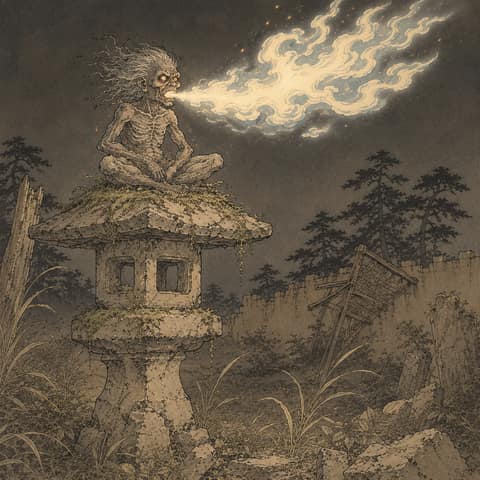
A version reinterpreting Toriyama Sekien’s fusion of a stone lantern and will-o’-the-wisp, casting it as a fire spirit dwelling in the lantern. When old courtyard or temple lanterns go long unused, a thin flame is said to rise at night, flickering as if lingering over the places it once lit. Historically, Sekien’s illustration and note form the core record, with little tied to specific locales or figures. It influenced later ghostly retellings, but firsthand accounts are scarce, so it is treated as a symbolic yokai of “the memory of light.”

Kosame-bō (Little Rain Monk)

Kosame-bō (Little Rain Monk)

Rare

koh-sah-meh-BOH

Sekiens Iconography Edition

Mountain & Wilderness SpiritsNara

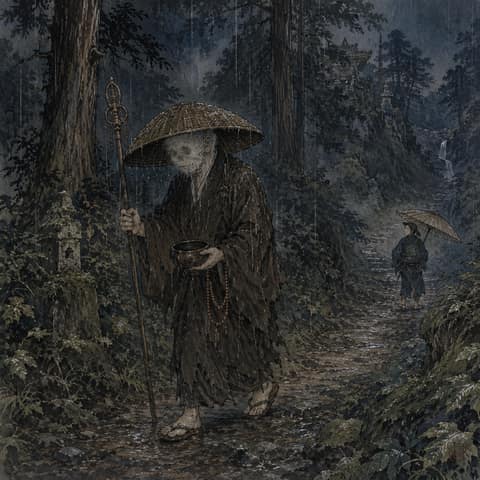
A reconstruction based on Toriyama Sekien’s image and brief note. It appears as a small monk drenched by rain, emerging on rainy nights in the mountains. It softly asks passersby for offerings due to a monk, but refusal does not necessarily bring harm. Its place is tied to the sacred Shugendō ranges of Ōmine and Katsuragi, yet no verified lore links it to specific temples or persons. Later sources that say it begs for food or small coins likely simplify Sekien’s term “sairyō” (offerings), with little direct oral backing. Its wandering is said to occur only on fine-threaded rainy nights, and reports from clear nights or downpours are uncertain. Methods to banish or summon it are unknown, and meetings on mountain paths are told merely as fleeting oddities.

Kosodate Yurei

Kosodate Yurei

Rare

kosodate-yurei

The Mother's Ghost Raising Her Child in a Grave, Kosodate Yurei

Yurei/WraithKyoto

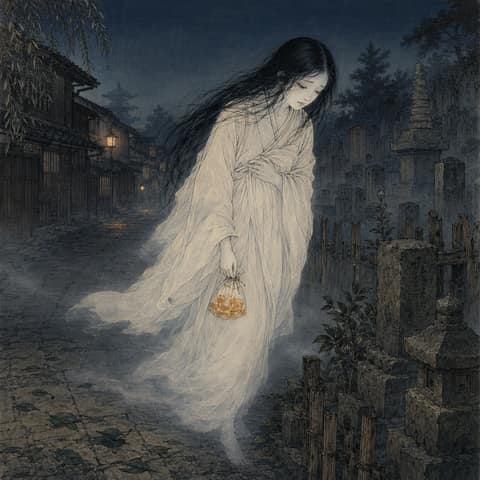
The Kosodate Yurei is a ghost of a woman who gives birth in a grave after death, or is buried with a child in her womb, and appears to raise that child. The core of the supernatural phenomenon involves, firstly, the "birth in the grave" where the child survives in the earth, and secondly, the "phantom money" where the coins paid by the ghost turn into shikimi leaves or tree leaves the next morning. In the story of Rokudo-no-Tsuji in Kyoto, the plot follows the woman to the candy store, sees her disappear into the Toribeno cemetery, and upon digging, finds a baby sucking on candy. Unlike ghost tales of terrifying curses and revenge, the center of this story is strictly maternal love. The woman holds no grudge against the living; she only seeks to keep her child alive. The epilogue, where the rescued child later becomes a monk and accumulates high virtue, takes the form of the deceased mother's affection being sublimated into a Buddhist connection, resonating with the Jizo and funeral beliefs of the Higashiyama area. As with the candy from Minatoya Yurei Kosodate-ame Honpo, the fact that the legend continues to live on in connection with a real object is also a characteristic of this ghost.

Kotofurunushi

Kotofurunushi

Rare

koh-toh-koh-roo-NOO-shee

The Forgotten Tsukushi Koto, Kotofurunushi

Tsukumogami / MukurogaiFukuoka Prefecture (Former Tsukushi Province / Spirit of a forgotten Koto)

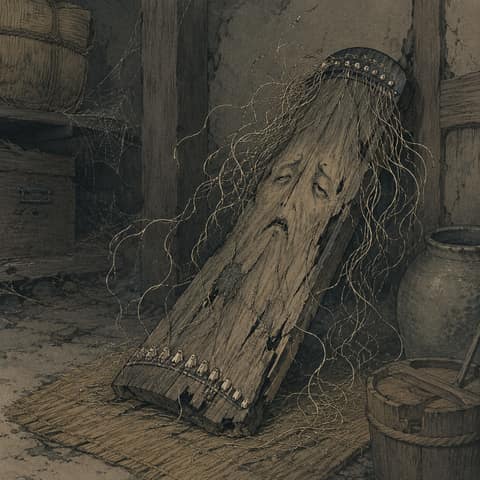
This is the most orthodox and tragic interpretation of the Kotofurunushi, embodying the despair and sorrow of the "Tsukushi Koto" buried in the darkness of music history by the rise of the genius Yatsuhashi Kengyo. This Kotofurunushi is not a savage yokai that attacks and devours humans. Its true horror and melancholy unfold quietly deep within unvisited storehouses or ruined mansions late at night. In the darkness, the old koto—abandoned for years, cracked, and covered in dust—begins to tune itself without the help of any hands. Then, the countless snapped and frayed strings writhe like living creatures, or like the black hair of a vengeful female ghost, and begin to play the archaic, heavy, obsolete melodies of the "Tsukushi school" that modern humans can no longer comprehend. That tone, mixing the pride once loved by aristocrats and high priests with the raw despair of now being ignored by everyone, induces a heart-wrenching, intense nostalgia and psychological unease in anyone who hears it. The goal of the Kotofurunushi is not revenge, but the pure and maddening thirst of an instrument: "I just want someone to listen to my sound." Therefore, swords or talismans are not needed to appease this yokai. If someone who understands old music wipes the dust off this old koto, carefully restrings it, and affectionately plays its ancient tunes once more, its years of resentment will be sublimated as if it were an illusion, and the Kotofurunushi will revert to just being a masterpiece instrument. It is an entity that brilliantly expresses the cruel transitions of art and the uniquely Japanese affection for tools.

Kuchisake-onna

Kuchisake-onna

Legendary

くちさけおんな

Woman in the Red Mask / The 1979 Kuchisake-onna

Human Yokai / Half-Human Half-YokaiModern urban legend originating in Gifu in 1978, no specific sacred site

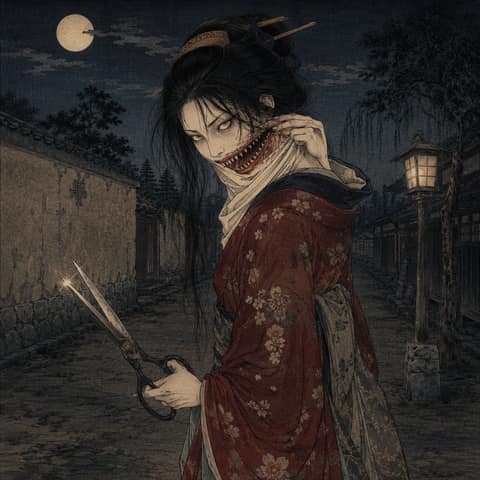
Reconstructing the 1979 phenomenon's outbreak timeline. The general overview of this entry outlined the 7-month progression, but here we delve into a finer timeline. Early December 1978: A farmer's elderly woman's toilet sighting in Shinsei-cho, Motosu-gun, Gifu Prefecture -> January 26, 1979: Gifu Nichinichi Shimbun "Editor's Notes" (written by editorial writer Mutsumi Murase) notes "According to rumors among Gifu children, a beautiful woman resembling an actress," forming the oldest layer as a local paper before national papers -> March 23 issue: Shukan Asahi's "The Tokaido Trek of the Kuchisake-onna Legend" by Teruo Kanauchi et al. marks the first national magazine appearance -> April-May: Nationwide strengthening of school commute patrols -> June 29 issue: Shukan Asahi's large feature by Etsuro Hiraizumi peaks the event -> June 21: A 25-year-old woman in Himeji City, Hyogo Prefecture, arrested for violating the Swords and Firearms Control Law while wandering around carrying a kitchen knife dressed as Kuchisake-onna (first copycat) -> July: Shukan Josei and Josei Jishin follow up -> August: Rapid subsidence with the start of summer vacation. This 7-month progression can be accurately tracked through newspapers, weekly magazines, and police records. Concurrently, police cars were dispatched in Koriyama City, Fukushima Prefecture and Hiratsuka City, Kanagawa Prefecture, group dismissals were implemented in Kushiro City, Hokkaido and Niiza City, Saitama Prefecture, and hostesses in Ginza started services asking customers "Am I pretty?", showing ripples into the adult world. These precise timeline trackings are theoretically impossible for Edo-period oral yokai, demonstrating a unique case of the undulation structure where a yokai of the post-war mass media age "conquers the country in a short period and disappears in a short period". The dual mechanism of cram schools and national magazines: Yoshiyuki Iikura's point. Yoshiyuki Iikura of Kokugakuin University (oral literature, modern folklore) points out that post-war cram schools served as the medium for the spread of Kuchisake-onna. Pre-war children's rumors were basically confined within school districts, but post-war cram schools created places where children gathered across school districts, acting as a catalyst for cross-district word-of-mouth diffusion before mass media. This, combined with national magazine features from March 1979 onwards, established a diffusion mechanism where word-of-mouth and print mutually amplified each other. Edo-period yokai basically spread through oral media alone (although ukiyo-e and picture books intervened, the mutual amplification of children's daily word-of-mouth and print did not occur), and modern folklore collections were recorded solely by researchers' investigations. In contrast, Kuchisake-onna covered the country in half a year through a three-layer structure of cram school word-of-mouth + national magazine print + television wide shows. This is a form of yokai generation born from the urban space of 1970s Japan, unique to the post-war mass media age. The condensation of modern social symbols: "Mask + Plastic Surgery + City". The standardization of Kuchisake-onna's image as a "beautiful woman covering her lower face with a mask" is highly valuable for sociological decoding. The 1970s Japanese cosmetic surgery boom—a social background where cosmetic surgery clinics rapidly increased in Tokyo and Osaka, and double-eyelid surgeries and nose jobs became common—created a complex fear of "beautiful women who had plastic surgery," establishing the association of mouth hidden by mask = plastic surgery scars. One of the origin theories, the "botched plastic surgery theory," retroactively narrativized this association, becoming widespread during the resurgence of Kuchisake-onna in the 1990s. Furthermore, post-war nuclear families + dual-income households + women's social advancement created anxiety in children left alone at home without their mothers, destabilization of "mother" and "female" representations, and wariness of "unknown women encountered on night streets", all of which were projected onto the image of Kuchisake-onna. In other words, Kuchisake-onna is a symbol condensing the "anxieties of 1970s Japan concerning the city, family, and body" into a single yokai figure. This has a yokai function unique to a post-war individualized society, distinct from the Edo-period yokai's role of maintaining the order of the local community (lessons for children, moral warnings). Distance from the Edo-period Kuchisake-onna prehistory: Continuum or independent occurrence? The Edo-period tales of "women with slit mouths" mentioned in the general overview—the umbrella man tale in Okubo Hyakunincho from "Kaidan Oi no Tsue", the Yoshiwara tayu tale in "Ehon Sayo Shigure", the tale of Nakabashi's Takano Shozaemon's wife in "Shin Chomonju", and the Meiji-era real-life example of Otsuya in Shigaraki, Shiga Prefecture—certainly form the archetype of the "woman whose mouth is slit to her ears" motif, but a direct lineage with the 1979 phenomenon has not been academically confirmed. Toru Joko's "School Ghost Stories" and Yoshiyuki Iikura adopt the position of reading the 1979 Kuchisake-onna not as a continuum from the Edo period but as an independently occurred post-war phenomenon, with the Edo-period archetype merely waiting in the ancient layer and not having a direct parental relationship. This is an important distinction in yokai research: emphasizing "continuity" tends to be the inclination of local tourism materials (local histories of Gifu, Izumo, etc.), while emphasizing "independence" is the inclination of folklore and modern sociology. It is academically honest to introduce the Edo-period archetype as an ancient motif while positioning the 1979 incident as an independent phenomenon that re-occurred under post-war specific conditions. Modern reception: Incorporation into yokai dictionaries and cross-East Asian re-creation. The fact that Shigeru Mizuki's "Illustrated Encyclopedia of Japanese Yokai" (1991) included Kuchisake-onna as an item in the yokai dictionary is often pointed out as a symbolic moment when "modern bizarre phenomena were formally incorporated into the framework of yokai." With this, the urban legends originating from post-war mass media were formally incorporated into the "yokai" framework alongside Edo-period tsukumogami and modern folklore collections. Film adaptations are represented by Koji Shiraishi's "Carved: The Slit-Mouthed Woman" (2007), produced as a post-war horror film that tackled the 1979 phenomenon head-on. The Korean version, "Ghost Mask: Scar" (2019, directed by Go Sone), was a Japan-South Korea co-production that combined Korea's plastic surgery culture with Kuchisake-onna, demonstrating the vitality of cross-East Asian modern bizarre phenomena. In manga, Episode 31 of Shou Makura and Takeshi Okano's "Hell Teacher Nube" is a representative sympathetic re-creation, rewriting it as a story where a woman branded a "yokai" has an animal spirit possessing her exorcised by Nube, returning to her beautiful self—a story of recovery rather than exclusion. This indicates that post-war yokai culture embodies modern ethics (individual dignity, representation of minorities) distinct from the Edo period. The very fact that modern yokai born in the 1970s continue to maintain their vitality in yokai culture even in the 2020s, 50 years later, proves the enduring power of post-war mass media-generated yokai.

Kuda-gitsune

Kuda-gitsune

Rare

kuda-gitsune

The Possessing Fox Lurking in a Bamboo Tube: Kuda-gitsune

Animal YokaiNaganoYamanashi

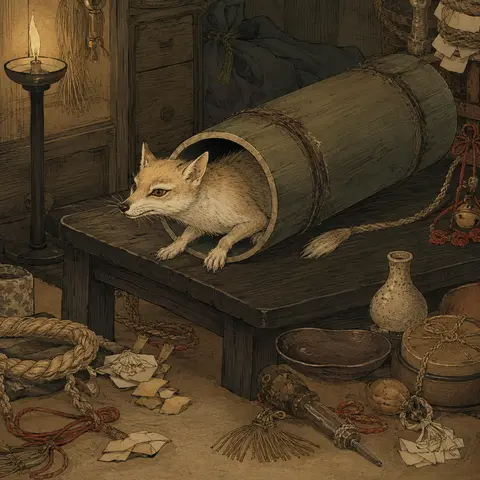
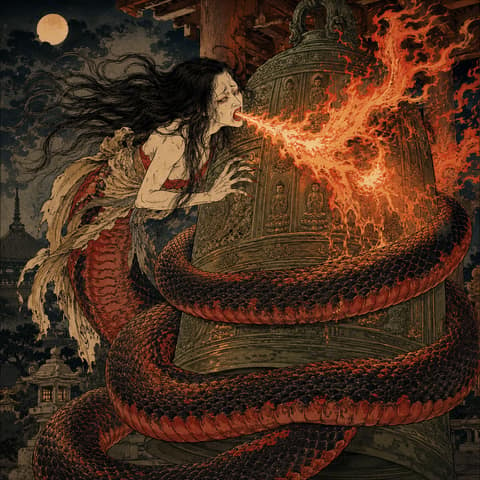
In this version, we read the Kuda-gitsune as the "commanded fox lurking in a bamboo tube." The smallness of the Kuda-gitsune is not just its appearance. Because it is small enough to fit in a tube, it can be carried around. Because it can hide under the floorboards or in the storage room, it becomes a family secret. Because it is out of public sight, the rumors that "it possessed another family," "it called in wealth," or "it sent an illness" can take hold. Being small is precisely its power to slip into the cracks of society. The premise of a commanded fox spirit distances the Kuda-gitsune from the Inari fox. While Inari foxes are often enshrined as divine messengers, the Kuda-gitsune is spoken of as a tool carrying human desire. While moving on its master's orders, it simultaneously affixes the reputation of a "possessed lineage" (tsukimono-suji) to that master's household. The power to bring profit is also the power to invite suspicion. The more the Kuda-gitsune fulfills human wishes, the murkier it makes human relationships. The Kuda-gitsune as an explanation for illness is folklorically significant. When unknown diseases, sudden madness, or abnormal appetites occurred, it was sometimes said that a fox had possessed the person. This is an explanation from an era outside modern medicine, but simultaneously the language expressing tension between households. The questions of "Who sent it?" and "Which family has the fox?" drag not only the sick person but the entire community into the fray. The relationship with Izuna magic strengthens the sorcerous nature of the Kuda-gitsune. In the belief spheres of Izuna Gongen and fox users, the imagination of commanding tiny fox spirits overlapped with mountain asceticism and magical power. Here, the Kuda-gitsune is not a wild fox, but a spiritual familiar placed under a practitioner's management. The container of the bamboo tube symbolizes this dominant relationship. Foxes are confined, carried, and dispatched to wherever necessary. The Kuda-gitsune in this version is not a cute little fox, but a fox serving as a family secret. Though its form is small, its impact is immense. Wealth, illness, marriage, reputation, and prayers revolve around a single fox spirit. Therefore, when reading the Kuda-gitsune, we must look at it not just as an animal yokai, but as a mechanism through which village society named invisible imbalances. The tube of the Kuda-gitsune is a symbol of domination. The imagination of shrinking a spirit, putting it in a container, and taking it out when needed perfectly expresses the human desire to possess invisible power. However, the spirit that was supposed to be possessed eventually turns the household itself into an object of suspicion. The Kuda-gitsune brings profit to its user while eating away at their reputation. In this version, we also read the Kuda-gitsune as the "reverse side of wealth." When there is wealth that cannot be explained by effort or luck, people imagine a secret spirit behind it. Tales of foxes carrying wealth are words mixed with envy and caution. Families possessing them are envied and shunned at the same time. The Kuda-gitsune brings profit and isolation together. Furthermore, the Kuda-gitsune is a spirit at exceptionally close range, even among foxes. It is not encountered in the wild mountains, but resides under the floorboards of the house or inside a tube. It is not in a distant otherworld, but lurking in the storage spaces of daily life. This proximity is the creepiness of the Kuda-gitsune. Because it is small, it is overlooked, and because it is overlooked, it can slip in anywhere. Reading the Kuda-gitsune is also reading what it means to "possess a fox." Holding a spirit might bring profit, but from that moment, the owner is also possessed by the spirit. The Kuda-gitsune shows that the more people desire secret power, the more they are bound by that secret.

Kudan (Prophetic Human-Cow Yokai)

Kudan (Prophetic Human-Cow Yokai)

Epic

koo-DAHN

Late Edo Kawaraban Woodblock Version of the Kudan

Half-Human BeingsKyotoHiroshima

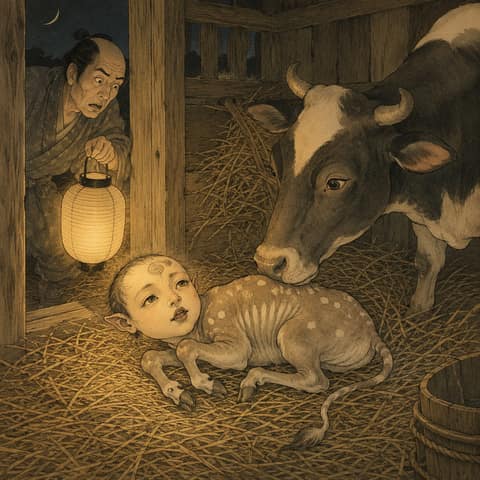
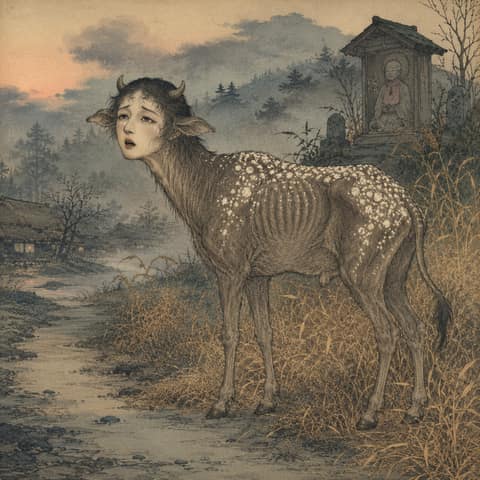
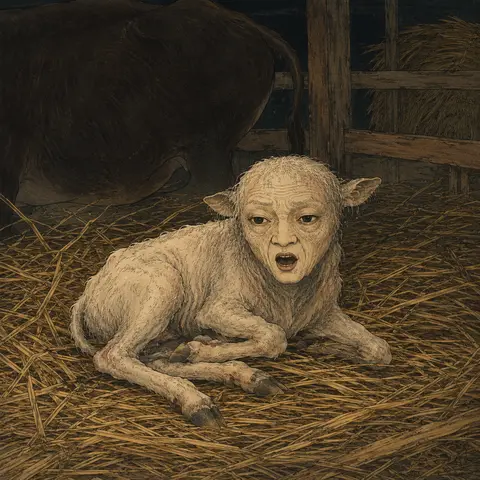
A Kudan image that spread in the late Edo period through kawaraban broadsides and printed books. Depicted as a human-faced cow, it appears, utters a prophecy, and soon dies. A Tenpō-era broadside recounts an appearance in Tango, stressing powers over harvest fortunes and averting misfortune, with cases recommending the display of its image. Meanwhile, the Kutabe of Etchū’s Mt. Tateyama appears in records from the 1820s onward, showing diverse traits such as a woman’s or elder’s face, sharp claws, and eyes drawn on the torso. Both share a reputation for prophecy and warding off epidemics, and their circulation increases during crises. The folk etymology linking the formulaic phrase “kudan no gotoshi” at the end of documents to the monster Kudan is viewed skeptically based on earlier linguistic usage. In folklore, the core pattern is appearance, proclamation, short life, and the image used as an amulet, while place names, dates, and specific efficacies vary widely by source.

Kudan (Prophetic Human-Cow Yokai)

Kudan (Prophetic Human-Cow Yokai)

Epic

koo-DAHN

Kurahashiyama Notice of Protective Talismans (Kudan Variant)

Half-Human BeingsKyotoHiroshima

Known as the Kurahashiyama Notice of Protective Talismans, this variant is said to have appeared from the mountain valleys of Yosa District after the Tenpō Famine. Though half-ox and half-human, its face looks somewhat young, with a broad brow, moist eyes, and a faintly upturned mouth. The ox body is gaunt with ribs showing, yet white flecks like morning dew scatter across its back, taken as signs that mark the year’s omens. It appears mostly between midnight and dawn, at paddy ridges along the mountain foot or before boundary shrines, witnessed typically by those on night rounds or out to relieve themselves. The kudan speaks no more than three times. First, it declares the Path of Pestilence, fixing from which direction the sickness will come and in which month it will intensify. Second, it details the Method of the Posted Image: draw its likeness on a half-sheet, paste it facing north on the inner lintel of the doorway or atop the rice bales, use fresh soot for ink and half-size paper offered at the previous autumn festival, and allow only one sheet per household. Third, it states the Year’s Aspect, leaving brief lines on bounty or scarcity and on protections within the home. When it finishes, it chews the paddy grass, bows its head, its breath thins, and it expires before sunrise. The village carries its body to the mountain’s base, covers it shallowly with earth, and sets a sprig of bamboo above. After seven days, when unearthed, the bones are soft and only the hooves remain hard; fitting a hoof to a brush shaft and tracing the edge of the charm was said to let misfortune flow out of the house. The image has fixed conventions: a single vertical crease at the center of the human brow, three white dots on the ox shoulder, and a bifurcated tail flowing to the left. Errors weaken its efficacy, and if the tail is drawn to the right, the disease’s direction reverses and brings calamity. The kudan also teaches that replacement of the posted image is limited to twice a year, at barley harvest and on the first day of the Frost Month. The artist must purify the hands with salt, keep the lamp dim at night, speak no words while drawing, and at the end write small, This extends not only to this house but to the neighboring hamlet. Homes that keep these rules know fewer domestic quarrels and lighter crop damage. The Kurahashiyama kudan closely matches the archetype of a prophetic beast in that it announces both good omens and protections from pestilence, yet it never speaks of profit in trade or victories in war, confining its words to home and field. A Kurahashiyama broadsheet states that posting its image in a storehouse or earthen-floor entry will drive out damp from the granary and keep illness from the threshold, and when sending copies to distant villages, they must circulate within three nights. Delay was thought to wither the effect, prompting village youths to run them by night. Later tales try to link a formulaic closing phrase of legal documents to the kudan, but this version forbids it, warning that using that phrase in a talisman blunts its power. Those who see it suffer a brief fever, which lightens after seven days, and they avoid serious illness for three years. Its short life is a vow not to linger in the world, and the more it returns to the earth, the deeper its words take root.

Kudan (Prophetic Human-Cow Yokai)

Kudan (Prophetic Human-Cow Yokai)

Epic

koo-DAHN

Ushi-no-Ko, Entrusted Oracle Variant

Half-Human BeingsKyotoHiroshima

This Entrusted Oracle variant of the Ushi-no-Ko is born with mingled human and bovine features and speaks human language the moment it emerges from its cow mother, asking to be called a kudan. It appears only in byres attached to human homes or in pens on mountain pastures, distinct from types that manifest in the open wilds. Its face ranges from a young woman’s to a gaunt elder’s, yet the eyes are always moist and fixed, piercing the listener without widening. Instead of a cry it sighs briefly, first urging that the mother cow not be slaughtered. It then foretells roughly seven years of abundance, household prosperity, or the dispersal of epidemics, and declares that in the eighth year war or calamity will cast a shadow. It ends by stating its own short life, saying it will die within three days. If the body is buried shallowly it averts misfortune, but display as a spectacle draws gloom upon the house. Even so, antiquarians have preserved it as taxidermy or portraits, and capturing its image in broadsheets or records is accepted as apotropaic. Its oracles address only large-scale matters such as harvests, plagues, drought, and war, and it remains silent on personal fortunes. This preserves the weight of its words and tests the listener’s judgment, keeping it apart from trivial divination. The truer the prophecy, the healthier the mother cow remains thereafter, and the household’s cattle and horses are said to avoid disaster. If its birth is treated as a joke and made a commotion, it bites its tongue to blood and falls silent. When drawn, give it short horns, a thick neck, and the rounded body of a calf. It has four legs, a tail thin and long like straw rope, and small hooves. A single swirl of hair sits on its brow; stamping that spot with ink and hanging the image at home was believed to ward off fire and theft for seven years. During the three days after birth it wishes to look outside once late at night. If the back door is cracked open at moonrise and it is faced northeast, its words will carry clear, according to oral lore. It does not call itself a god, only one who knows the world’s turn ahead of time. Offerings should be simple, a pinch of salt and a bowl of pure water. After death it is wrapped in a straw mat and buried in a byre’s corner or on a raised ridge of a field; setting a hat upside down to keep off rain is said to keep grain luck in the family line. It appears most in checkpoint towns by the sea and along mountain herb-gatherers’ roads, especially in border villages where travelers mingle, places thought to gather the world’s signs for it to read.

Kugutsushi (Puppet Troupers)

Kugutsushi (Puppet Troupers)

Uncommon

koo-GOO-tshee

Kugutsu Performer (Traditional Figure)

Half-Human BeingsHyogo

The figure of the kugutsu performer is distilled in accounts of a perpetual wanderer who appears at shrine fronts and market squares with the seasons and festivals, showcasing many arts such as puppet play, comic turns, sword dances, and sumo. Old records note mastery of archery and horsemanship, juggling two swords, manipulating seven balls, and astonishing onlookers by making wooden figures dance. Female performers, known as kugutsume, excelled in song and dance and were linked to ideas of purification. In later eras they were tied to temple and shrine guild quarters, joined troupes praising Ebisu and puppet guilds, and are regarded as forerunners of sarugaku, kagura, and puppet theater. Some received patronage from court and samurai, contributing to the transmission of songs and narrative arts. As a yokai, they are told of as liminal wanderers who appear suddenly at village borders or before shrines, offer their art, leave lucky coins or a patter of words, and vanish. Folklorically they are noted in relation to outcaste status, guild systems, and ritual entertainment, understood—without embellishment—as mediators whose itinerant arts bridge the human world and the otherworld.

Kumitezuri

Kumitezuri

Epic

KOO-mee-teh-ZOO-ree

Historico-Philological Edition

Deities & Divine SpiritsOkinawa

Named in the Chūzan Seikan and centered on the sacred Kuntama image that links royal authority with rites, this critical edition presents both the goddess interpretation and the reading of ritual names. It concerns prayers for maritime safety, abundance, and dynastic peace. Rather than fixing a concrete personal deity, it understands the being as manifesting through ritual practice such as possession, oracular revelation, and the prayers and gestures of noro priestesses. Aware of regional variations and early modern conflations with Kinmamon, it prioritizes the symbols of the sea, the sun, and the far-off Nirai Kanai, situating the figure within the Ryukyuan ritual system.

Kurama-yama Sōjōbō

Kurama-yama Sōjōbō

Legendary

Kurama-yama Sōjōbō

Kurama-yama Sōjōbō, Who Taught the Art of War to Ushiwaka

Mountain & Wilderness SpiritsKyoto

The legend of Kurama-yama Sōjōbō is a subject to be read with careful separation of historical fact from later accretion. The credibility of its setting rests in the history of Kurama-dera. The Kurama-buki-dera engi relates that Ganchō built a hermitage in the first year of Hōki (770) and that Fujiwara no Iseto raised the temple halls in the fifteenth year of Enryaku (796). This ancient sacred mountain holds the valley of Sōjō-ga-tani where Sōjōbō dwells, and was held to be the place of descent of Gohō Maō-son. The firm dramatization of the tale of martial transmission to Ushiwakamaru begins with the Muromachi-period Noh play Kurama Tengu. In its plot the great tengu of Kurama teaches the art of war to Ushiwaka, who, pursued by the Heike, had taken refuge at Kurama-dera; performed as a fifth-category Noh, it unfolded widely into later kabuki and ukiyo-e. Yet this transmission tale does not exist in the older Gikeiki. What the Gikeiki transmits is the tale of Ushiwaka's acquiring the books of strategy (the Rikutō and Sanryaku) treasured by the onmyōji Kiichi Hōgen—no tengu appears. The identification that binds the two, "Kurama Tengu = Kiichi Hōgen," arose in early-modern times. Its source is the jōruri Kiichi Hōgen Sanryaku no Maki (1731, premiered at the Takemoto-za), which has a scene calling Kiichi Hōgen "the tengu who long ago taught swordsmanship to Ushiwaka on Mt. Kurama." Here the Gikeiki's Kiichi Hōgen and the Noh's tengu-transmission tradition were fused into one. Thus the story widely known today—that Ushiwaka learned the art of war from the Kurama tengu—is rightly seen not as deriving from the Gikeiki, but as a layered legend that began with the Muromachi Noh and was bound to Kiichi Hōgen in the Edo jōruri. One further point to note is the relation to Gohō Maō-son. The grand present-day doctrine by which Kurama-dera links it to Sōjōbō is a modern teaching arranged only after the temple became independent of the Tendai school and founded Kurama-kōkyō in Shōwa 24 (1949)—a lineage apart from the medieval Sōjōbō tradition. The Sōjōbō of the medieval tradition was, as one of the forty-eight tengu, a master tengu who imparted the martial arts and the way of the mountains.

Kuro-bōzu (Black Monk)

Kuro-bōzu (Black Monk)

Uncommon

KOO-roh BOH-zoo

Kuro-bōzu (Traditional Folk Variants)

General ClassificationsUncertain; tales recorded in Edo/Tokyo, Kumano (Kii Province), and Nomi District, Kaga Province

The name Kuro-bōzu has long served as a catch-all for regionally varied apparitions. In Edo-Tokyo it was recorded as a bedroom prowler that drew close to women’s mouths to sip their sleeping breath, leaving a fishy odor before departing. Sightings are vague and it is sometimes classed with faceless ghosts. In the Kii Kumano region, meeting it in the mountains causes its height to shoot up, and the more one pursues it the larger it grows before fleeing at great speed. Near the Osada River in Kaga, it appears as a black mass outlined only by its silhouette and escapes into water when struck with a staff, a behavior some locals attribute to an otter spirit. Across Japan the term also substitutes for giants like Ōnyūdō or sea spirits like Umibōzu, sharing one or more traits of black coloration, monk-like appearance, sudden elongation, and affinity with watersides. None of these types show sustained habitation, and reports of appearances typically cease in time.

Kurozuka

Kurozuka

Legendary

kurozuka

The Tragedy of Adachigahara: The Hag of Kurozuka

鬼・巨怪Fukushima

The Embodiment of the Abyss of "Karma". Kurozuka (Iwate) is not merely a flesh-eating monster lurking in the mountains. Originally a refined wet nurse for Kyoto aristocrats, she resorted to the madness of murder to cure her mistress's illness, only to plunge into utter insanity and devolve into a demon after unwittingly killing her own daughter. This sequence of events is Japanese literature and theater's most harrowing depiction of "maternal devotion gone rogue," "blind loyalty," and the "inescapable retribution of karma." Her image, brandishing a butcher knife, radiates not just monstrous terror, but the bottomless sorrow and despair of a human toyed with by the cruelty of fate. The "Taboo of Looking" and the Boundary to the Otherworld. In the Kurozuka legend, the taboo of "do not look into the inner room" plays a pivotal role. The front room of the hut represents the "mundane human space," while the inner room is the "otherworld of death and demons" filled with white bones. The moment the traveling monk breaks the taboo, everyday reality collapses, exposing the "monstrous abnormality" hidden within the old woman. This is a perfect medieval adaptation of the ancient Japanese mythic motif of "forbidden viewing" (like Izanagi looking at Izanami in the underworld), symbolizing how terrifyingly fragile the boundary between human and demon, life and death, truly is. Immortal Rebirth Through Art and Tourism. Continuously reinterpreted across Noh, Joruri, Kabuki, and Ukiyo-e (such as Yoshitoshi's bloody prints), Kurozuka established itself as a core repertoire of Japanese theater history. In the modern era, it remains vividly alive as an "active folklore" through works like Baku Yumemakura's *Onmyoji*, Osamu Tezuka's manga, and the tourism efforts in Nihonmatsu City, Fukushima (Adachigahara Furusato Village, Kurozuka Historical Site). Kurozuka has transcended a simple ghost story, elevating into an eternal symbol exploring the philosophical question of the "demonic nature lurking within the human heart."

Showing 217 - 240 of 480 yokai