Yokai Encyclopedia

Encyclopedia of Japanese Yokai

55 Yokai|14 Category|Page 2 of 3
Localization in Progress - More content available in Japanese version
View Japanese
Sort by: NameAscending
霊・亡霊
  • Kera-kera Woman

    Kera-kera Woman

    Rare

    keh-rah KEH-rah OHN-nah

    Sekien Illustrative Edition

    Ghosts & SpiritsJapanese folklore

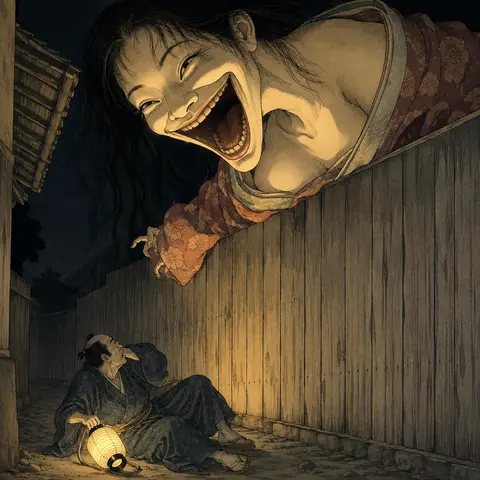
    This entry centers on Toriyama Sekien’s imagery, supplemented only minimally by the popular explanations found in modern yokai handbooks. Citing the anecdote of Song Yu of Chu, Sekien likened a woman laughing alluringly over a wall to the spirit of a wanton. The plate itself does not detail temperament, degree of harm, or methods of dispelling, offering only form and associative origin. Later commentators emphasize a dry laugh heard by one person alone on an empty road, framing it as a psychological apparition that provokes fear, shame, and unease. Tangible harm is rarely noted, sometimes limited to shock, freezing in place, or fainting. Its hauntings are not tied to a specific region, and are imagined wherever sightlines are blocked—along city walls, crossroads, or over hedges—though sources are not cited. Accordingly, this version keeps Sekien’s visual prompt at its core, treating confusion by laughter as an ancillary function.

  • Kinrei (and Kintama)

    Kinrei (and Kintama)

    Epic

    kee-NREH

    Kinrei • Kintama, Curated Tradition Edition

    Ghosts & SpiritsAcross Japan (noted in Edo, the Kanto region, and Suruga)

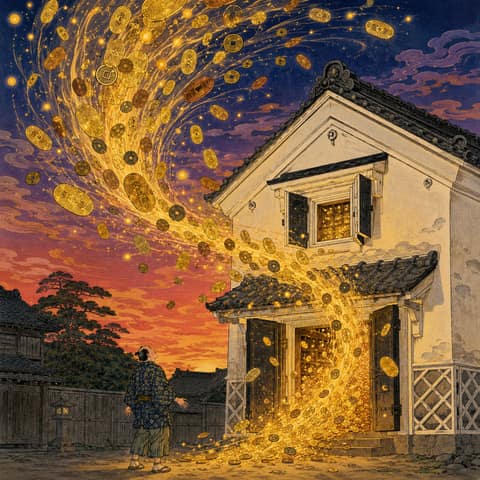
    Kinrei appears in Edo-period art and commentary as a spiritual notion symbolizing the reward for moral practice, with household prosperity explained as part of a heaven-given order. Rather than a visitor like a tangible kami, it is understood as the auspicious aura born of selflessness and good deeds. Kintama, by contrast, is told across regions as a strange fire or orb-like visitant that brings luck to a home when respectfully enshrined, yet turns ominous if scraped or damaged, a taboo tied to its form. Early chapbooks and ghost collections depict swarms of coin-spirits drifting in the evening sky, or a roaring sphere flying in to enter the honest. Postwar retellings often link it to the rise and fall of household fortunes, but older records stress symbolic meaning and will-o’-wisp tales. Because names and traits overlap among regional traditions, sources differ in how they use “Kinrei” and “Kintama.”

  • Kiri Ichibē

    Kiri Ichibē

    Uncommon

    KEE-ree EE-chee-bay

    Traditional Lore Version

    Ghosts & SpiritsNiigata

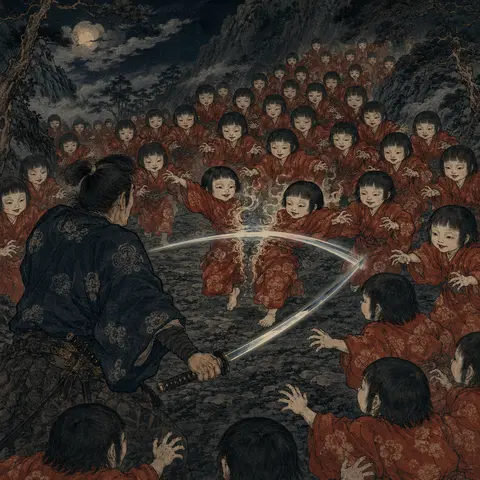
    A multiplying apparition said to appear at night on mountain passes and bypaths in Niigata. It takes the form of a small child to lower one’s guard, then hounds its target into striking; each cut doubles its number, forcing flight. Its true nature is unstated—seen as a vengeful spirit or a mountain entity—but folklore stresses that its power fails at dawn or at the cock’s crow. The name “Ichibai” points to its doubling trait, and tales note chicken motifs on sword fittings acting as talismans. Its exact origin is unknown; encounter stories warn against night travel on mountain roads.

  • Kokkuri-san

    Kokkuri-san

    Epic

    こっくりさん

    Composite Deity of Fox, Dog, Raccoon Dog: Kokkuri-san

    Spirits / GhostsDerived from Western table-turning; became popular starting from Shimoda, Izu in 1884.

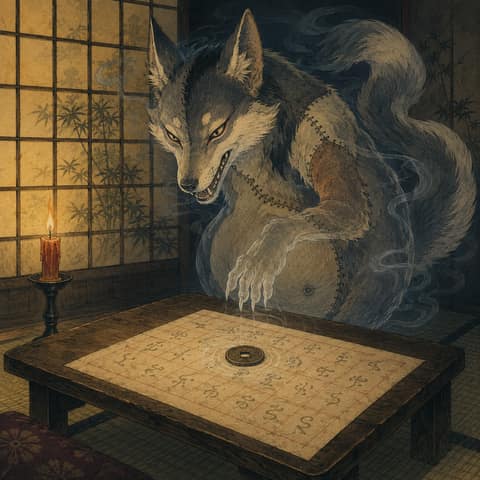
    The Ideomotor Effect and the Significance of 'False Wonder'. While the basic explanation touched upon Enryo Inoue's classification, the detailed explanation delves deeper into the significance of its scientific demystification. The ideomotor effect is a phenomenon named by British physiologist William Carpenter in 1852, referring to involuntary micro-movements of muscles without human awareness. Table-turning, dowsing, Ouija boards, and Kokkuri-san—these all share the exact same principle for moving a coin or pointer. Inoue independently verified this latest Western theory in Meiji-era Japan, demonstrating that 'yokai can be explained by science,' making it a representative case of pre-war Japanese enlightening rationalism. Kokkuri-san's mystery shifted from a 'physical mystery' to a 'psychological mystery triggered by the unconscious.' Selection of the Three Beasts 'Kokkuri'. Choosing which kanji to assign to the sound 'kokkuri' was arbitrary, but the selection of 'fox, dog, raccoon dog' (狐·狗·狸) had roots in the lineage of Japanese animal spirit beliefs. Foxes represent the ability to bewitch humans, as seen in Inari worship and Tamamo-no-Mae; raccoon dogs are equally famous shape-shifters known for belly-drumming (haratsuzumi) and Bunbuku Chagama; dogs are known as mediums for spirit possession in local beliefs like inugami (dog gods). Combining the three beasts was an intellectual invention that summoned the three major representatives of Edo-period animal shape-shifter tales at once, wrapping the alien nature of the 1884 Shimoda origin (Western table-turning) in traditional Japanese spiritual concepts. Inheritance of Summoning Rituals in School Spaces. Since the 1970s boom, Kokkuri-san has become a significant game played during recesses and after school in elementary and junior high schools. Folklorist Noboru Miyata pointed out in *The Folklore of Yokai* (Iwanami Shoten, 1985) that post-war Japanese schools became new 'sites for summoning rituals.' Kokkuri-san (1970s-) → Hanako-san (1980s-) → Hasshaku-sama (2008-). All these share the common structure of 'summoning/sealing spirits in school spaces,' reading as modernized, secularized, and gamified versions of magical rituals from the Heian period (such as Ushi-no-koku Mairi and chanting the Sonsho Dharani). Bans and the Tradition of the 'Correct Ending'. From the late 1970s to the 80s, many schools issued bans on Kokkuri-san. This responded to the frequent occurrence of abnormal behavior among children (mass hysteria, hyperventilation, trance states), demonstrating the effect when the ideomotor effect combines with group psychology. Concurrently, the tradition of the 'correct ending method' became refined among children—chanting 'thank you' together, returning the coin to the torii, tearing up and throwing away or burning the paper, etc. These ritualistic steps are structurally similar to medieval curse-breaking practices (henbai, scattering rice, scattering salt), drawing folkloric attention as a case where modern children unwittingly reenact classical magical rituals. Re-creation in Manga and Anime. Following Jiro Tsunoda's *Ushiro no Hyakutaro* (1973-1980), Kokkuri-san became a staple motif appearing repeatedly in manga and anime. It was a key element in the 1995 Toho film *School Ghost Stories 2* (directed by Hideyuki Hirayama), and in the 2012 TV anime *Inu x Boku SS*, Kokkuri-san was incorporated into the protagonist's bloodline. Recently, comedy manga personifying Kokkuri-san, like *Gugure! Kokkuri-san* (by Midori Endo, serialized in Square Enix's *Monthly G Fantasy* 2011-2016, animated in 2014), have also become massive hits. It is a rare case where Meiji scientific demystification and modern subculture reception intersect through the same apparition. 2010s Modern Kokkuri-san. Around 2015, a modern version of Kokkuri-san resurged among junior high and high school students. This involved displaying the syllabary on a smartphone app, with friends placing multiple fingers on the screen to move it. Some schools again reported students yelling and making strange noises, prompting faculty intervention. A table-turning trick shown by shipwrecked sailors in Izu Shimoda 140 years ago has continuously changed form while being passed down through modern Japanese youth culture—this is Kokkuri-san's most peculiar trait.

  • Kosodate Yurei

    Kosodate Yurei

    Rare

    kosodate-yurei

    The Mother's Ghost Raising Her Child in a Grave, Kosodate Yurei

    Yurei/WraithKyoto

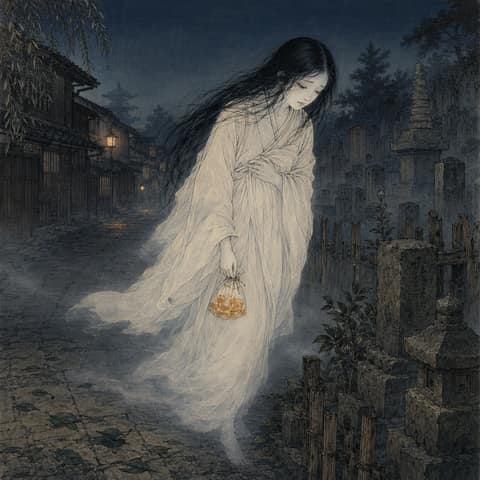
    The Kosodate Yurei is a ghost of a woman who gives birth in a grave after death, or is buried with a child in her womb, and appears to raise that child. The core of the supernatural phenomenon involves, firstly, the "birth in the grave" where the child survives in the earth, and secondly, the "phantom money" where the coins paid by the ghost turn into shikimi leaves or tree leaves the next morning. In the story of Rokudo-no-Tsuji in Kyoto, the plot follows the woman to the candy store, sees her disappear into the Toribeno cemetery, and upon digging, finds a baby sucking on candy. Unlike ghost tales of terrifying curses and revenge, the center of this story is strictly maternal love. The woman holds no grudge against the living; she only seeks to keep her child alive. The epilogue, where the rescued child later becomes a monk and accumulates high virtue, takes the form of the deceased mother's affection being sublimated into a Buddhist connection, resonating with the Jizo and funeral beliefs of the Higashiyama area. As with the candy from Minatoya Yurei Kosodate-ame Honpo, the fact that the legend continues to live on in connection with a real object is also a characteristic of this ghost.

  • Kunekune

    Kunekune

    Epic

    くねくね

    The White Silhouette Standing in the Rural Distance: Kunekune

    Spirit / GhostModern internet ghost story originating around 2000

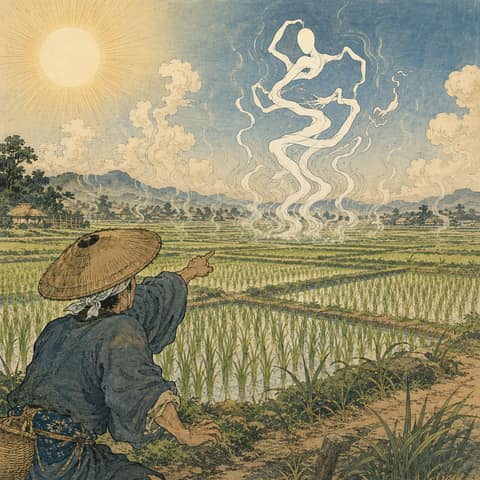
    The epistemological horror of "looking itself is a curse". The basic description touched upon the narrative structure and visual elements, but this thorough breakdown dives into Kunekune's greatest uniqueness—the punishment for cognition itself. Many traditional Japanese ghost stories inflict harm through physical contact (having legs cut off, being decapitated, being severed at the waist) or by approaching a specific location (abandoned houses, mountain passes, tunnels). Kunekune is different. Standing in the distance, it causes no harm, but the moment an observer uses binoculars or strains their eyes to "see its true identity"—attempting to complete their cognition—they go insane. This structure, which punishes the observer's subjectivity (understanding, interpretation, verbalization) itself, is unique for bringing a philosophical dimension to the ghost story. Undercurrents with Lovecraftian cosmic horror. In the 1920s and 30s, H.P. Lovecraft (1890-1937) established the concept of cosmic horror: "attempting to understand an existence beyond human cognitive abilities results in the loss of sanity." Representative works include "The Call of Cthulhu" (1928) and "At the Mountains of Madness" (1936). Kunekune can be read as an entity that reconstructs this structure within the Japanese rural landscape. While it is unclear if the Japanese internet writers directly referenced Lovecraft, the idea of a "punishment for cognition" parallels the central theme of American weird fiction, demonstrating the intellectual depth of post-war Japanese horror culture. The significance of selecting "rural landscapes" as the space. Kunekune always appears in open rural spaces such as "rice paddies, riverbanks, and beaches." In contrast to many urban legends set in "enclosed spaces" (abandoned houses, schools, bathrooms, train stations), Kunekune appears in the distant, unobstructed view. This is not unrelated to the increase in urban-born populations during the post-war rapid economic growth period, where urban youths' opportunities to experience "rural life" were limited to vacations, returning to hometowns, or summer camps. For an urban youth visiting their grandparents during summer vacation, the distant view of a rice paddy is the epitome of "non-ordinary scenery" disconnected from daily life. Placing Kunekune there gives form to the "vague anxiety towards the countryside" felt by urban residents. The cultural background of the 2003 2channel Occult board. The 2ch Occult board in 2003 supported the golden age of internet forum-posted ghost stories, alongside Hachishakusama in 2008 and Kisaragi Station in 2004. 2ch's anonymity, the blurred boundary between fiction and reality, and its copy-paste virality served as the incubator for ghost stories like Kunekune, where "fiction disclaimers are dropped, making them real." Folklorist Ryuhei Hirota (ASIOS) terms this "internet folklore," categorizing it as a new ghost story generation mechanism distinct from the oral tradition of urban legends. The difficulty of visual adaptation. The 2010 film adaptation "Kunekune" (directed by Hisataka Yoshikawa) highlighted the difficulty of visually reproducing the original's "looking itself is a curse" structure. Because film is a visual medium, depicting something that "should not be looked at" creates a self-contradiction. The same issue applies to SCP Foundation entities that "punish visual contact," which are similarly difficult to adapt for the screen. Kunekune is rather a rare ghost story that maintains its vitality in "media that leave room for imagination," such as text, illustrations, and dramatic readings. As one of the "Three Major 2ch Forum Ghost Stories". Kunekune (2000/2003), Kisaragi Station (2004), and Hachishakusama (2008) are representative forum-posted ghost stories born on the 2ch Occult board between the early and late 2000s, often grouped together in later years as the "Three Major Forum Ghost Stories." Kunekune presents epistemological horror, Kisaragi Station the eeriness of traveling to the otherworld, and Hachishakusama the structuralization of folkloric wards—each offering unique narrative mechanisms. Repeatedly reproduced on TikTok and YouTube horror channels in the 2020s, they have become a pathway for Gen Z to rediscover "2000s Japanese internet ghost stories."

  • Majimun

    Majimun

    Legendary

    majimun

    The Collective Ryukyuan Demon: Majimun

    霊・亡霊沖縄·奄美の魔物の総称、特定地点なし(沖縄圏汎存在)

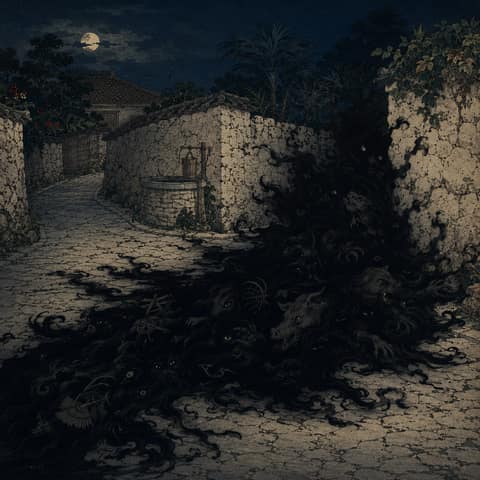
    "Mamono" vs. "Majimun": Similar Words, Different Worlds. While the basic overview touched upon the shared etymology with the ancient word "Majimono," this deep dive explores how "Majimun," despite sounding akin to the mainland Japanese "Mamono," operates within an entirely different conceptual framework. The mainland "Mamono" is an abstract concept that absorbed the Buddhist and Onmyōdō notion of "Mara" (demons/impediments to enlightenment). In stark contrast, the Ryukyuan Majimun is rooted in the indigenous, pre-Buddhist animism of the southern islands, holistically encompassing nature spirits, ghosts of the dead, localized spirits, and haunted objects. This reflects the historical trajectory of the Ryukyu Kingdom, which received relatively little influence from the centralized Buddhist cultural sphere, thereby preserving its unique religious ecosystem. The Logic of Genesis: "The Generation of Demonic Force". While the mainland Japanese *Tsukumogami* relies on the generative logic that "a tool left for 100 years will have a soul dwell within it," the Ryukyuan object Majimun operates on a more abstract dynamic theory: "demonic force is generated from old objects." This aligns perfectly with the Ryukyuan religious concept of *Seji* (spiritual power), grounded in a worldview where invisible forces inherent in all things manifest under certain conditions. Following Chōei Kinjō's classification, Majimun can be understood as the "photographic negative of Seji"—spiritual power turned malignant. A Structural Analysis of "Crotch-Crawling". The universal Ryukyuan taboo that "you will die if an animal Majimun crawls between your legs" is structurally fascinating. In the schema of the human body, the crotch is a privileged liminal space acting as a "bottom-to-top passageway." For an otherworldly entity to pass through this space signifies an invasion and a violent forced extraction of the soul. While this parallels mainland Japan's spiritual anxieties regarding boundaries like "bridges, crossroads, and borders," Ryukyu is unique in its emphasis on the boundaries of the physical body. In Ryukyuan belief, the *Mabui* (soul) is not fixed to a specific spot but flows in and out; "crotch-crawling" is positioned as a violent connection that forces this extraction. The Epistemological Trait: "Majimun Have No Fixed Form". Surveying the cases in the *Yokai Database*, the greatest characteristic of the Majimun is its "lack of inherent visual form." It is only named by appending "Majimun" to whatever it has possessed or transformed into (a pig, a rice scoop, an infant). There exists no iconographic representation of "Majimun itself." This stands in sharp contrast to mainland Japanese yokai, which, since Sekien Toriyama's *Gazu Hyakki Yagyo* (The Illustrated Night Parade of a Hundred Demons), moved toward solidifying "visual identity as individual characters." Ryukyu retained the Majimun as an abstract concept of "invisible demonic force" until the very end, making it a uniquely challenging subject in comparative yokai studies. Kinjō, Iha, and Orikuchi: The Lineage of Pre-war Okinawan Studies. In the pre-war era, Majimun research blossomed within the broader context of Okinawan Studies. Sparked by Fuyū Iha's *Ko Ryukyu* (Ancient Ryukyu) in 1911, prominent mainland scholars like Shinobu Orikuchi and Kunio Yanagita frequently visited Okinawa, positioning the southern islands' folklore as a vital comparative mirror to the mainland. Chōei Kinjō's yokai treatises were written amid this academic tide, providing a perspective that read the Majimun not merely as a "bizarre Okinawan oddity," but as a "systematic expression of the Ryukyuan concept of the soul." Post-war scholars like Ken'ichi Tanigawa and Kenji Murakami inherited this mantle, shaping the modern discipline of Ryukyuan yokai studies. Systemic Integration with Shisa and Utaki Faith. The Majimun concept does not operate in isolation; it forms a cohesive system with the entirety of Ryukyuan religious culture. Majimun shoulder the "demonic power," while the *Shisa* (guardian lion statues), *Utaki* (sacred groves), *Yuta* (shamans), and *Nuru* (priestesses) shoulder the "sacred power." The symmetry and mutual necessity of these two sides construct the Ryukyuan cosmic order of the sacred and the profane, the pure and the impure, and this world and the next. To study Majimun is directly tied to studying the entire worldview of Okinawan folklore, possessing a cultural anthropological scope far beyond a single monster encyclopedia entry. Modern Legacy: Folkloric Tourism and Entertainment. In post-war Okinawa (and especially after the reversion to Japan), Majimun legends have been adapted into tourism resources, children's books, and manga. They appear in children's literature like *Okinawa no Majimun-zu!* (Border Ink), in exhibits at the Ocean Expo Park's "Native Okinawan Village," and even in mainland exhibitions like the Hyogo Prefectural Museum of History's 2017 showcase on Ryukyuan Yokai. However, because Majimun are inextricably linked to Okinawan living ethics, boundary consciousness, and views on life and death, their consumption in the context of tourism and entertainment demands a respectful attitude toward their profound cultural depths.
  • Mizo-Idashi

    Mizo-Idashi

    Uncommon

    MEE-zoh-ee-DAH-shee

    Ehon Hyaku Monogatari Version

    Ghosts & SpiritsKanagawa

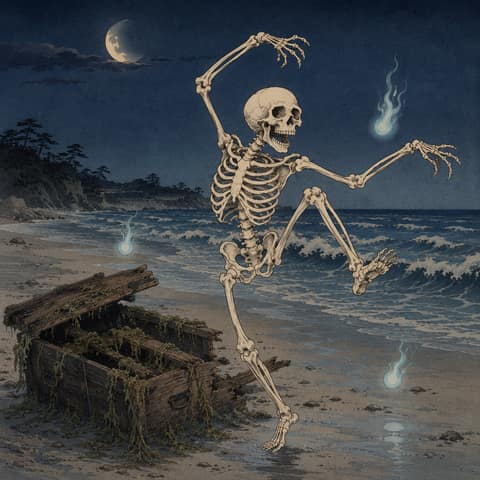
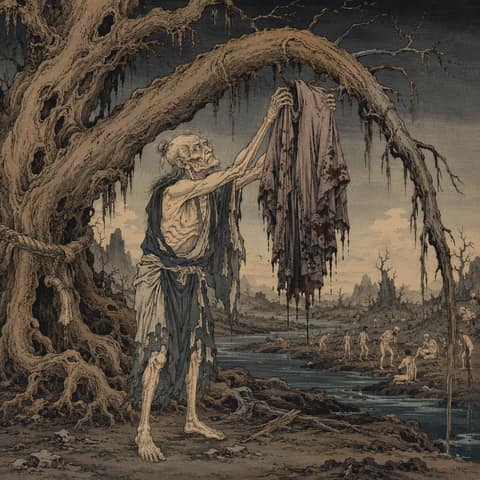
    Based on the depiction of Mizude in Takehara Shunsen’s Ehon Hyaku Monogatari. As censure for the abandonment of a corpse, bare bones rise of their own accord to sing and dance, symbolizing that mistreating the dead invites the uncanny. Closer to a tale of vengeful spirits than to a mere monstrosity, it manifests signs from the unoffered dead. Though the dancing and singing appear comical, the didactic thrust is strong, urging proper funerary rites. Specific places and names—Yuigahama, Hachirō of Tone, Hōjō Tokiyuki—anchor the story in the memory of war chronicles. The plot in which temple monks bury the bones to quell the anomaly exemplifies the temple’s social role of pacifying spirits through memorial rites.

  • Oiwa

    Oiwa

    Legendary

    Oiwa

    Oiwa of Yotsuya Kaidan

    Spirit / GhostTokyo

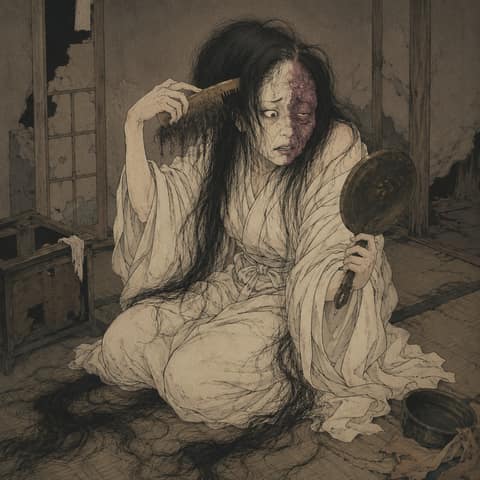
    Oiwa in the kabuki play "Tokaido Yotsuya Kaidan" debuted in July 1825 at the Edo Nakamura-za, staged as a mixed, two-day performance intertwined with "Kanadehon Chushingura". The ronin Kamiya Iemon of the Enya clan, despite having Oiwa as his wife, seeks to switch to a marriage proposal from a neighboring family for the sake of his career, feeding Oiwa a poisonous concoction. In the second act, the scene known as "Kamisuki" (hair-combing)—where Oiwa, half her face grotesquely swollen from the poison, dies in agony upon seeing her altered reflection while combing her falling hair—became the Kikugoro family's most polished and renowned spectacle. In the third act at Sunamura Onbobori, the corpses of Oiwa and Kobotoke Kohei wash ashore nailed to the front and back of a wooden door. The "Toitagaeshi" (door-flipping) scene, where the door turns over before Iemon's eyes—with a single actor playing both roles through lightning-fast costume changes—is the pinnacle of stage mechanism. In the final act at the Heikiyama hermitage, countless stage tricks (keren) are rapidly deployed, including the "Chochin Nuke" (lantern escape), where the ghost emerges from a burning lantern, and the "Butsudan Gaeshi" (altar flipping), where someone is pulled into a Buddhist altar. These bizarre phenomena are purely theatrical fiction with no connection to the historical virtuous wife Tamiya Iwa, yet their compelling realism led people to fear Oiwa as though she were an actual vengeful spirit. The story's framework hinges on the selfishness of a man who discards his wife for social advancement and the helpless desperation of a woman whose sincerity has been trampled. Oiwa is not an evil spirit cursing without reason; she is formulated as an existence whose lingering love for the husband who poisoned her has been violently inverted. Evoking both sympathy and terror in the audience simultaneously is the true essence of Nanboku's drama. A custom arose whereby the cast and crew, centered around the actor playing Oiwa, would visit Oiwa Inari in Yotsuya to pray for success and safety before the performance. This tradition continues to this day in modern kabuki, film, and theater (by ancient custom, the actor playing the betrayer Iemon does not visit, as doing so is said to anger the spirit instead). The very fact that accidents and injuries occurring on stage have often been passed down as "Oiwa's curse" stands as a rare case where a fabricated vengeful spirit attracted real-world religious belief. Ironically, the source of that belief, Oiwa Inari, was originally an auspicious shrine dedicated to the virtuous wife Oiwa who had restored her family's prosperity.

  • Okiku

    Okiku

    Legendary

    okiku

    Okiku of Sarayashiki

    Spirit / Vengeful GhostHyogoTokyo

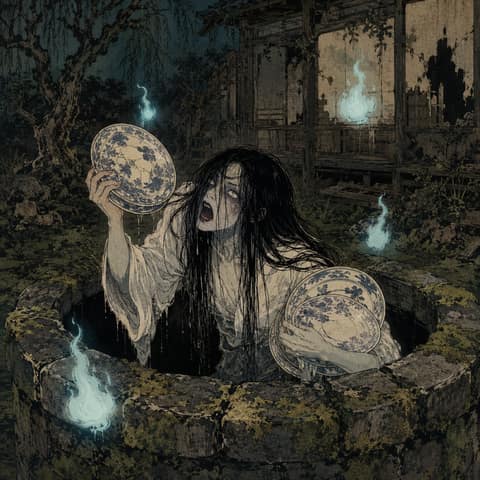
    "Okiku of Sarayashiki" is a vengeful spirit shaped as a creature of repetition, eternally counting her broken plates. Her terror lies primarily in her voice and numbers rather than her appearance—counting low in the darkness, "One... Two..." and unleashing a bloodcurdling scream upon reaching the ninth and missing the last. This structure of loss and repetition is the core of the Sarayashiki tales, causing the audience to cringe in anticipation of the inevitable dread of the "ninth." Okiku's grudge erupts from the absurdity inflicted upon the weak in early modern society: false accusations, class disparities, and the unreasonableness of masters. Here, the two major lineages must be strictly distinguished from their modern adaptations. First is the Banshu lineage—set in Himeji, where the maid Okiku is caught in Aoyama Tetsuzan's conspiracy to usurp the household. Tricked by Machitsubo Danshiro, she is framed for losing one heirloom plate, tortured to death, and sunk into a well. Second is the Bancho lineage—at the Edo Ushigome mansion of hatamoto Aoyama Shuzen, the maid Okiku is slain for breaking a plate (or for rejecting her master's unwanted affections), or throws herself into the well, becoming a well-dwelling haunt. Both are "Ghost Okiku," nurtured by early modern ghost stories, storytelling, and joruri. These must be sharply separated from the third layer—Kidō Okamoto's *Bancho Sarayashiki* (1916). Okamoto wrote this not as a ghost story but as a modern drama (New Kabuki), discarding the clan dispute plot and reimagining it as a tragic cross-class romance between the hatamoto Aoyama Harima and the maid Okiku. Okiku deliberately breaks the heirloom plate to test Harima's love; upon learning this, Harima, enraged that his true feelings were doubted, strikes her down—no ghost appears here, and the tale is elevated into a drama of tragic love and human psychology. In short, the "ghost Okiku counting from the well" is an image from early modern ghost stories, whereas Okamoto's Okiku is a distinct literary creation reinterpreted by a modern intellectual. The two must never be conflated.

  • Oni of Gango-ji

    Oni of Gango-ji

    Epic

    GAHN-goh-jee no OH-nee

    Canonical Folkloric Tradition

    Ghosts & SpiritsNara

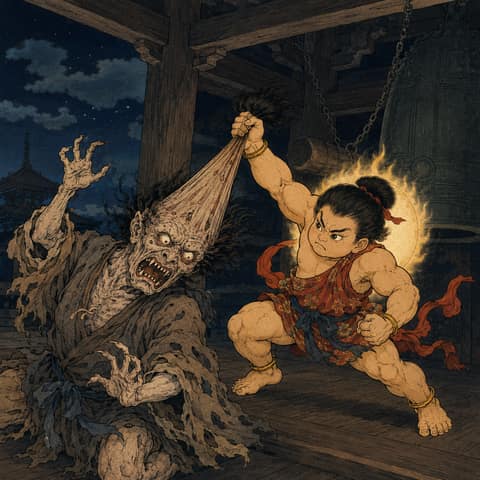
    This version follows storylines found in Heian-period tale collections and represents the type fixed as the bell-tower apparition of Gangoji. The demon’s true form is the restless spirit of a servant connected to the temple, manifesting as a figure that frightens monks and children. It appears at midnight, and accounts say its form can be verified by lamplight, reflecting a folk view that sacred beings hide yet reveal themselves under certain conditions. A preceding thunder-god episode is linked as a strong-child birth tale, reinforcing the idea that the power of thunder can dwell in a person. The subjugation is not by beheading but by tactile restraint—“grabbing the hair,” “tearing it out”—with the hair remaining as a relic treasured by the temple. Thereafter the monster is calmed, and the child takes vows and is known as Dōjō Hōshi. Words like Gagoze and Gagoji appear regionally as generic terms for yokai, but their etymology is debated and left unspecified.

  • Onryō (Vengeful Spirit)

    Onryō (Vengeful Spirit)

    Legendary

    ohn-RYOH

    Goryo Cult

    Ghosts & SpiritsKyotoFukuoka

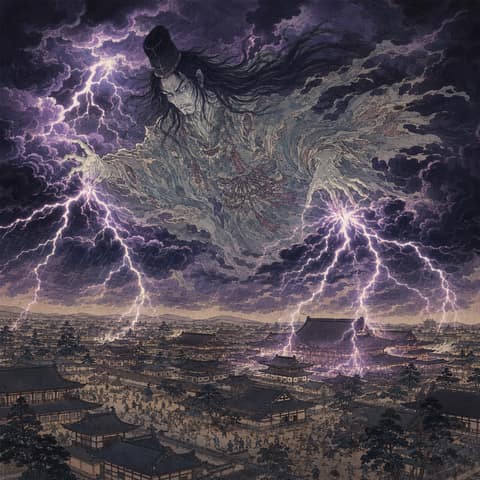
    A framework that enshrines vengeful spirits as goryo to pacify their curses and turn them into sources of blessing. Epidemics and natural disasters were seen as manifestations of resentment, and reconciliation was sought through founding shrines, conferring divinity, and institutionalizing festivals. Curse deities bear a dual aspect of fear and veneration, and their wild power was believed to transform into communal guardianship through proper requiem rites. Practices ranged from state rituals to village memorials, including era name changes, imperial envoys, Goryo-e, and Hojō-e. For individuals, memorial offerings, sutra copying, nenbutsu, and esoteric prayers were performed, while restoring honor and granting divine ranks were means to ease a spirit’s grievances. Narratives and origin legends explained why resentment arose, giving social memory to causes such as false accusation, untimely death, and broken lineages. A vengeful spirit’s power was not indiscriminate but signaled its intent according to causes, believed to speak through dreams, oracles, thunder and fire, and plague. Pacification was not a one-time act but continued through annual festivals and shrine upkeep, with warnings that neglect would invite resurgence.

  • Otsuyu

    Otsuyu

    Legendary

    おつゆ

    Otsuyu of the Peony Lantern

    Spirit / GhostOriginally from 'The Tale of the Peony Lantern' in the Chinese text 'Jiandeng Xinhua'; later adapted by Asai Ryoi and San'yutei Encho

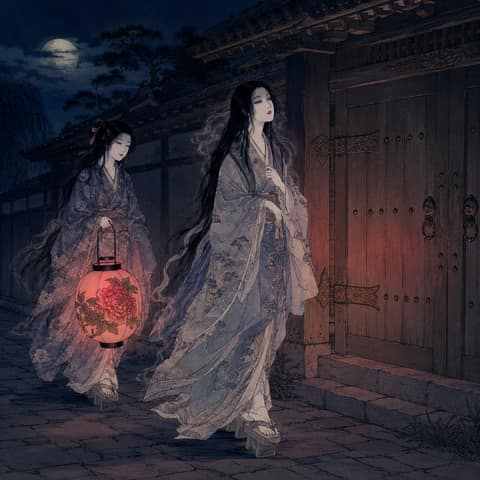
    Otsuyu of the Peony Lantern is a ghost who embodies 'love continuing after death' rather than sheer terror. Raised as the daughter of a hatamoto, she fell in love at first sight with the ronin Hagiwara Shinzaburo, whom she visited under the guidance of the doctor Yamamoto Shijo. However, due to family circumstances, they were unable to meet again, and it is said she died of lovesickness while yearning for him. Yet, her attachment could not be erased by death. Starting on the night of her first Obon (festival of the dead), accompanied by her maid Oyone, she begins visiting Shinzaburo every night, holding a lantern painted with peonies and making her clogs ring out with a 'clippity-clop' sound. Believing she is alive, Shinzaburo meets her repeatedly, but his neighbor Tomozo sees through their true nature—they are actually buried dead spirits. Terrified, Shinzaburo places talismans of Kaion Nyorai on every door and wears a solid gold statue of Kaion Nyorai on his person to set up a ward. Blocked by the talismans, Otsuyu cannot enter the house and stands outside the gate every night, calling Shinzaburo's name reproachfully and sorrowfully. The tragedy of the story is sealed here by the intervention of human greed. To fulfill Otsuyu's desire, the ghosts bribe the married couple Tomozo and Omine with one hundred ryo. Tomozo replaces the Kaion Nyorai statue with a fake clay one and strips away the protective talismans. Losing his wards, Shinzaburo finally lets Otsuyu inside. The next morning, he is found as a white skeleton, embraced around the neck by a skull, his face contorted in terror. Otsuyu's essence is not a curse or grudge, but her unwavering devotion, persistently seeking her beloved even after death without reward. The sheer purity of this devotion has elevated her to one of the foremost ghosts in early modern Japanese ghost stories. Through the three layers of the Chinese original 'The Tale of the Peony Lantern', Ryoi's adaptation *Otogiboko*, and Encho's rakugo, Otsuyu's image gradually crystallized into a ghost of tragic romance that brings Japanese audiences to tears.

  • Prince Sawara

    Prince Sawara

    Epic

    SAH-wah-rah shin-NOH

    Emperor Sudō as Vengeful Spirit – Traditional Goryō Version

    Ghosts & SpiritsNaraKyoto

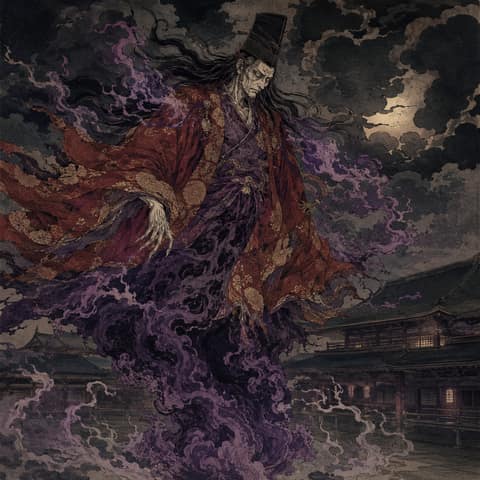
    An image grounded in local and court memories that Prince Sawara’s resentment manifested as a goryō. Amid suspicion over his alleged crimes he died by fasting, and later plagues, famine, and illnesses afflicting the imperial line were seen as his curse. The court sought reconciliation through land donations, sutra recitations and esoteric rites, reburial, and posthumous honorific titles, carefully enshrining him as a goryō. Revered as a power that judges right and wrong, he received offerings at shrines and temples, seasonal services, and apologies at his mausoleum. In later years, rites centered on the Sudō Tennō Shrine took form, spreading protective faith between the capital and Yamato. His grudge was understood not as private spite but as a warning against political disorder and calumny, prompting rulers to vow purity and justice with sacrifices, written oaths, and sutra offerings. The spirit bears a wild aspect, yet when appeased turns to guardianship.

  • Raigō

    Raigō

    Epic

    RAI-goh

    Iron Rat (Raiyō’s Vengeful Spirit Tale)

    Ghosts & SpiritsShiga

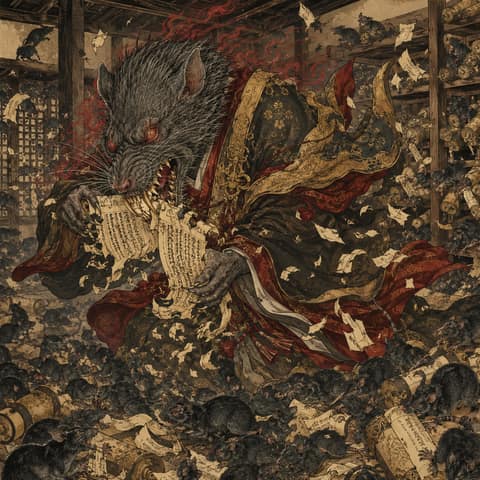
    A version grounded in medieval tales where the spirit of the monk Raiyō becomes a swarm of rats or a monstrous iron-furred rat known as the Tesso and gnaws through the sutra repository of Enryaku-ji. Rivalries among temple powers are projected onto a narrative of vengeful deification, linking ritual efficacy with retribution. In literature it appears mainly in war chronicles, blending a real monk’s biography with a settled ghost-vengeance legend. Later yomihon and paintings amplified this image, symbolizing rat blight and the ruin of sutra scrolls, yet at its core lies a folk pattern of a rancorous spirit bringing calamity upon sacred objects and scriptures.

  • Sanmai Tarō

    Sanmai Tarō

    Uncommon

    SAHN-mai tah-ROH

    Zammai Taro (Folkloric Type)

    Ghosts & SpiritsIshikawa

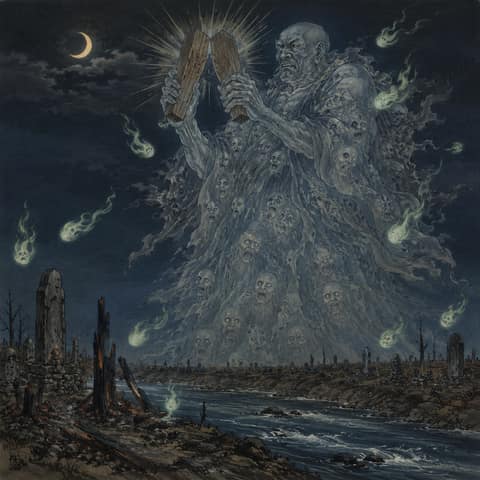
    A figure based on local lore in which death-spirits amassed at a burial ground (zammai) congeal and manifest as a single monster. In Toyama it appears as a humanlike specter that performs ominous signs, while in Ishikawa it is feared as a giant priest-like ogre. It is bound to human life, death, and the order of funerary practice, often marked by nighttime sounds and prescribed etiquette. Widely said to be unable to cross running water, a belief linked to folk practices of digging trenches around the zammai. Its form and stature are not fixed and vary with the density of gathered spirits. Folklore records note collections from the early Showa era, with regional spellings such as “Zammai” and “Zanmai.”

  • Shibiru-biru (Buru-buru) – The Quiver Spirit

    Shibiru-biru (Buru-buru) – The Quiver Spirit

    Uncommon

    boo-roo-BOO-roo

    Shindanda (Tradition-Faithful)

    Ghosts & SpiritsJapanese folklore

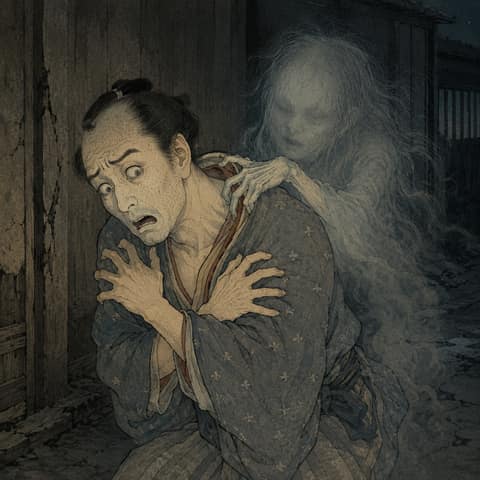
    Reconstructed around the conceptual yokai image based on Sekien’s illustration. Shindanda does not fix its form, appearing as a presence in lonely places or as something at one’s back. It brushes a person’s collar, sending a chill that freezes the heart and guts. Its alternate names, “Coward-Spirit” and “Zozogami,” personify the psychological and physiological reactions that arise on battlefields or night roads, reflecting a premodern view that treated the signs of fear themselves as a kind of possession. Specific methods of exorcism are not standardized; folk practice records distractions such as fire, light, or traveling with companions, but no systematic rite is known. Lacking a physical body, it is rarely a target for capture or slaying, and has been explained mainly as the cause of chills and gooseflesh that overtake the mind and body.

  • Shichinin Misaki

    Shichinin Misaki

    Legendary

    shichinin-misaki

    The Seven Phantoms of Tosa

    霊・亡霊Kochi

    The Deep Religious History of the "Misaki" Concept. While the basic overview touches upon the distribution of Shichinin Misaki, this deep dive explores the religious and historical undercurrents of the term "Misaki" itself. Written in kanji with characters meaning "vanguard" or "cape," "Misaki" originally denoted a divine attendant acting as the "herald or vanguard of a primary deity" in ancient Japan. Entities like the Kumano Misaki and Inari Misaki were recognized as orthodox heralds in shrine rituals. The folkloric evolution of this concept—transforming into "possessing collective spirits that cause illness" in the folk beliefs of western Japan—is profoundly fascinating. The shift in meaning from "herald gods" to "cursing collectives" physically embodies the historical stratification of ancient Ritsuryo-system Shinto, medieval Goryo (vengeful spirit) worship, and early modern folk belief. Global Comparison of Collective Spirits. "Multiple spirits acting collectively" like the Shichinin Misaki have parallels worldwide. The Lemures of ancient Rome (spirits appeased during May festivals), the Erinyes of ancient Greece (the three Furies), the Draugr hordes of Norse mythology, the "Yexing Shen" (Night-walking gods) of China, and the "Chilseong Shin" (Seven Star Gods) of Korea show that collective spirit lore developed globally from antiquity through the Middle Ages. However, the "fixed-number reincarnation structure" of Shichinin Misaki is structurally aberrant. It surpasses simple ghost stories, embodying an ancient societal imagination regarding the "eternal exchange between the dead and the living," making it a highly significant subject for comparative religious studies. Sengoku Samurai Tragedy and Spectral Transformation. The most famous lineage of Shichinin Misaki—the tragedy of Lord Kira Chikazane and his retainers—is the ultimate expression of collective suicide, martyrdom, and the lord-vassal bond among Sengoku-era samurai. Chikazane's forced seppuku after angering Chosokabe Motochika is a textbook case of "internal clan strife over succession, purging by a lord's wrath, and the martyrdom of retainers." The structure of "a lord and his seven men sharing their fate" encapsulates the essence of Japanese samurai ethics. The continuation of this bond after death as a collective spirit reveals how folkloric imagination repurposed the extreme tragedy of Sengoku samurai society into post-mortem grudges. The Magic of Hiding Thumbs: East Asian Funerary Rites. The defensive spell against Shichinin Misaki—"hiding the thumbs inside the fists"—is an ancient physical reflex common across East Asian (China, Korea, Japan) funerary and magical cultures. It was believed that in places heavily associated with death (funeral processions, graveyards, night roads, crossroads), evil spirits could invade the body through the thumbnails (ancient Japanese believed the soul resided in the nails). This reflects a shared ancient East Asian view of the body, where "the thumb is the center of the body and the seat of the soul." This connection proves that "Shikoku yokai legends" are not isolated provincial folklore, but vital research materials inextricably linked to the broader East Asian religious network. Medieval Goryo Worship and the Uniqueness of Western Japan. The structure of pacifying collective spirits, building shrines for them, and inheriting their rituals is seen throughout medieval Japan. So why did it develop so strongly in western Japan (Shikoku, Chugoku, Seto Inland Sea, northern Kyushu)? During the Heian and medieval periods, western Japan was the hub of maritime trade with the Korean Peninsula and the continent, making it a cultural sphere heavily infused with continental Daoism, Buddhism, and folk beliefs. Furthermore, as the periphery of the central court (Kyoto/Nara) dominated by aristocrats and elite monks, regional adaptations of Goryo worship, magic, and festivals thrived. The concentration of collective spirit lore like Shichinin Misaki in western Japan reflects this ancient and medieval cultural and religious geography. Natsuhiko Kyogoku and Modern Yokai Literature. Natsuhiko Kyogoku's *Jorougumo no Kotowari* (1996) reconstructs the collective spirit lore of western Japan as modern mystery, folkloric critique, and philosophical inquiry. Through his protagonist Akihiko Chuzenji (an antiquarian bookseller, Shinto priest, and folklorist), Kyogoku decodes Shichinin Misaki using modern perspectives: "yokai as the shadow of the mind" and "collective spirits as communal memory." As the flagship example of how post-war literature and modern horror reconstruct historical folklore with academic rigor, Shichinin Misaki—fueled by Komatsu's Goryo research and Kyogoku's literary decoding—remains a core engine driving 21st-century yokai studies. Shichinin Misaki in the 21st Century: Tourism and Academia. Today, Shichinin Misaki is actively sustained through Kochi tourism, the Shikoku Pilgrimage, paranormal media, and local history research. Kira Shrine and the memorial towers of Chikazane and his retainers are preserved as local cultural assets, spotlighting the "Shichinin Misaki of Tosa" as a representative folk heritage of Shikoku. Simultaneously, at the intersection of folkloric research and modern pop culture, they survive as "active" folkloric entities. It is one of the few collective spirit legends carrying a five-fold cultural lineage: Sengoku samurai tragedy → Medieval Goryo worship → Early modern folk belief → Modern tourism/literature → Academic research.

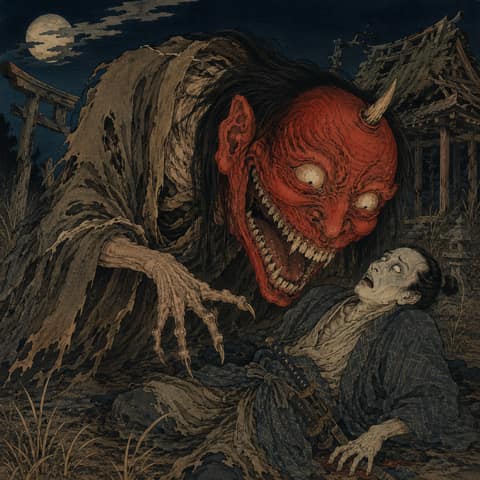
  • Shu no Ban

    Shu no Ban

    Uncommon

    SHOO noh BAHN

    Classical Sources Version: Vermilion Tray (Watcher of Necks)

    Ghosts & SpiritsFukushima

    In early modern tales, the Vermilion Tray is depicted as a red-faced monk-like figure, appearing as an accomplice of the Long-Tongued Crone or showing its visage alone, reappearing to unnerve and harm people. The name varies between “Watcher of Necks” and “Vermilion Tray,” commonly read as Shunoban. Classic illustrations and yokai prints note a red face, horns, a split mouth, and a fiery aura, though details differ by source. Encounters occur mainly at night at shrine gates, in wastelands, and in tumbledown shacks, and the harm is told as loss of spirit leading to fainting, lingering illness, or death. Reports span regions such as Aizu and Echigo, not as a fixed local deity but as a circulating tale-type of the uncanny.

  • Shōkera

    Shōkera

    Epic

    SHOH-keh-rah

    Traditional Iconography Interpretation

    霊・亡霊Japanese folklore

    Based on Toriyama Sekien’s depiction, this interpretation frames the yokai as a watchful presence peering through a skylight during Kōshin night. It is identified with the Sanshi or treated as a spiritual agent acting on their behalf, examining human sloth and broken vows and, upon transgression, bringing misfortune with sharp claws. The name also appears in historical kana as “Shaukerá” or “Seukerá,” and its concrete form varies by region and source, yet it is positioned as a yokai that visualizes the normative ethos of Kōshin belief. Early modern sources offer little explanatory text, with later folkloric readings filling the gaps.

  • Teke Teke

    Teke Teke

    Epic

    てけてけ

    Teke Teke, the Crawling Half-Woman

    Spirit / GhostModern urban legend of the 1990s-2000s, based on train accident motifs

    The "Woman Missing Her Lower Half" as a Post-War Japanese Horror Motif. While the basic description traces her origins and spread, a deeper analysis repositions Teke Teke within a broader cultural sphere: the motif of the "physically mutilated female ghost" in post-war Japan. The "female ghost lacking a complete body" is a recurring archetype in Japanese horror. From Oiwa (facial disfigurement, Nanboku Tsuruya's "Tokaido Yotsuya Kaidan," 1825) and Kasane (facial and bodily disfigurement, Encho Sanyutei's "Shinkei Kasanegafuchi"), to post-war entities like the Slit-Mouthed Woman (mouth disfigurement, first appeared in Gifu in 1979), Teke Teke (missing lower half), Kashima-san (missing lower half), and Hachishakusama (abnormal height), there is a common thread of "the loss of female physical integrity." Within this lineage, Teke Teke is unique for her connection to the "railway," a piece of post-war Japanese infrastructure. The Linguistic Choice of the Onomatopoeia "Teke Teke". The name "Teke Teke" mimics the sound of crawling on both arms, and this specific onomatopoeia is the result of several linguistic choices. First, the combination of the plosives 't' and 'k' suggests the hard, striking sound against a wooden floor or concrete. Second, the repetition (teke-teke) creates an eerie sense of a "slow, continuous pursuit." Third, it rolls easily off the tongue, making it easy for children to reenact. Derivative names like "Patapata," "Kotokoto," and "Katakata" have all undergone similar phonological selections, demonstrating a folk-acoustic pattern of "expressing the sound of movement with a two-syllable onomatopoeia." The Genealogy of Railway Accident Urban Legends. Japan's railways during the post-war period of rapid economic growth were the site of numerous fatal accidents, becoming a hotbed for ghost stories. Alongside Teke Teke, various railway and crossing-related legends have been recorded nationwide since the 1970s, such as "a woman standing behind you when you look back at a crossing," "a figure missing its lower half at the edge of a platform," or "being spoken to by a woman waiting for a train along the tracks." In "The Folklore of Yokai" (Iwanami Shoten, 1985), folklorist Noboru Miyata argued that post-war urban infrastructures (railways, tunnels, housing complexes) function as new spaces for generating ghost stories, replacing traditional locations like bodies of water, crossroads, and mountain passes. Teke Teke is perhaps the most successful entity born of these "infrastructure ghost stories." Cross-referencing with Kashima-san and the Structure of the "Answer". The method to survive Teke Teke—"answering 'Kashima-san'"—spread widely as a derivative rule. This follows the same pattern as answering "pomade" or "bekko ame" (tortoiseshell candy) to the Slit-Mouthed Woman, actively engaging children's imaginations by embedding a "correct answer" within the story. The countermeasures for Kashima-san herself are diverse, such as "answering 'Kamashi'" or "chanting the full name 'Reiko Kashima'," turning the countermeasures themselves into a trend among children. This can be read as a secularized form of the spells and mantra beliefs that have existed since the Heian period, now taking place within the school environment. Interpretation of the 2009 Film Adaptation. Director Koji Shiraishi's film "Teke Teke" (2009) adopted the Kakogawa, Hyogo origin theory, depicting the monster as a woman (real name "Reiko Kashima" = Kashima Reiko) whose lower body was severed in a post-war railway suicide. The film reconstructed the oral cross-referencing between Teke Teke and Kashima-san as "two sides of the same person." Bolstered by its connection to the idol culture of the time—starring AKB48's Yuko Oshima—Teke Teke served as a prime example of how post-war children's oral ghost stories were mediated into mainstream Heisei-era cinematic horror. Reproduction in the Internet Age. Since the 2010s, Teke Teke has been repeatedly reproduced through ghost story reading channels on YouTube, paranormal content on Niconico, and horror shorts on TikTok. In the 2020s, she has been embraced anew by Generation Z as a "scary story told at school during childhood," making her a rare case of an 80s-90s children's oral tradition successfully passing down through generations. Teke Teke is perhaps the clearest example of how the lifeline of a ghost story can endure while adapting its medium from "oral tradition → children's magazines → movies → the internet."

  • Tesso

    Tesso

    Uncommon

    TEH-soh

    Edo Picture-Book Standard, Traditional Iconography

    Ghosts & SpiritsShiga

    Based on Toriyama Sekien’s “Tesso” motif, it appears as a giant rat draped in robe-like shadows, with red eyes and teeth said to be iron-hard. Its origin lies in the vengeful spirit tale of Raigō tied to disputes over the ordination platform at Onjōji, where rivalry between Enryakuji’s Sannō faction and the Miidera side was cast into story and overlapped with real rat damage to temple sutras and treasures. Names vary by period and source, with “Raigō Nezumi” and “Miidera Nezumi” coexisting. Medieval war tales exaggerate its numbers into a calamity of swarming rats, while from early modern times it links to shrine legends of pacification and blessings. Chronologies in records do not always align and the tale is highly narrative, yet shrine and temple names, linked verse, and oral lore support a core tradition. In some regions, extermination stories feature a great cat of Mount Hiei or guardian deities, reflecting the boundary-conscious rivalry between two religious centers.

  • The Seven Companions

    The Seven Companions

    Uncommon

    shee-chee-neen DOH-gyoh

    Collected Tradition Edition (Shikoku Type)

    Ghosts & SpiritsKagawa

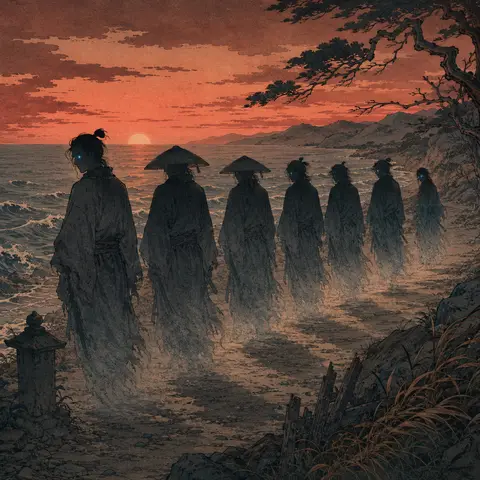
    An amalgam of seven-in-a-row ghost tales found across Shikoku. Its core traits are threefold: seven figures advance in single file without a word, they appear at crossroads, on night roads, or at rainy dusk, and an encounter portends misfortune. Names, time of appearance, and garb vary by locale. In Sanuki they look human but are usually invisible, perceptible only through a ritual vantage—peering from beneath a cow’s hindquarters. A subtype limited to crossroads at the dead of night is called Shichi-nin Dōji, and certain once-busy junctions are remembered for their passage. The Shichi-nin Dōshi, who appear in rain wearing straw raincoats and hats, are linked to executed souls; a folk remedy to dispel the gloom after meeting them is to fan oneself with a winnowing basket. In Tokushima, seven child spirits accompanying the Headless Horse are said to have faded after Jizō statues were erected for their repose, reflecting a regional belief that memorial rites quell calamity. Though sometimes conflated with Shichi-nin Misaki, local names and functions differ; Shichi-nin Dōkō are identified by the outward feature of seven spirits marching in a line.

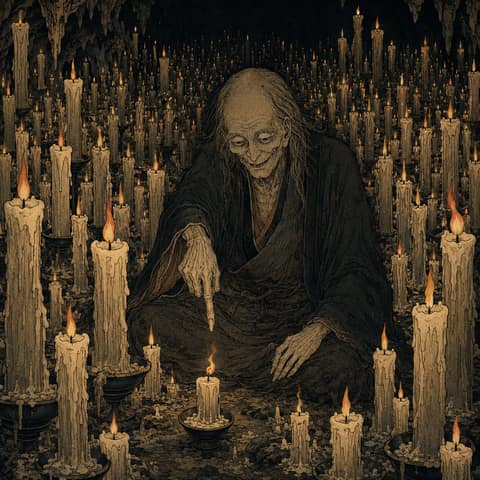
  • Tōdaiki (Human Candelabrum)

    Tōdaiki (Human Candelabrum)

    Rare

    toh-dai-kee

    Setuwa Iconography Edition, after Sekien Toriyama

    Ghosts & SpiritsUnknown (said to be in Tang China in the tales)

    An edition based on visual readings of Toriyama Sekien’s Konjaku Hyakki Shūi and related images. Depicted as a human figure in Tang-style robes with a candle set upon a tray or stand on the head. Said to have had the voice destroyed by drugs and the body tattooed, composing poems in tears or fingertip blood in place of speech. Its true nature is not a monster per se but the tragic end of a person enslaved in a foreign land, giving it a strongly narrative character of human ethics and suffering, even while included in yokai catalogs. Details vary by source, yet the figure consistently stands in the night holding a light. Accounts of salvation or death are inconsistent and left unspecified.

Showing 25 - 48 of 55 yokai