ubume
Ubume (Traditional Form)
Ghosts & SpiritsVarious regions nationwide. A famous early example is found in the medieval Konjaku Monogatari Shu.
The core of this version is not to view the Ubume as a completed "blood-soaked female yokai," but to trace how the relationship between humans and the supernatural changes the moment the baby is received. In *Konjaku Monogatari Shu*, Scroll 27, Tale 43, Taira no Suetake makes a bet in a test of courage with his fellow retainers of Minamoto no Yorimitsu. On a dark night in late September, fully equipped with armor, helmet, and bow, he heads alone to a river crossing in Mino Province to plant an arrow on the opposite shore as proof. On his way back, he is stopped by a woman's voice in the river. The woman presses him, "Hold this," the baby cries, and a strong, fishy stench of blood reaches the guards on the shore. Suetake receives the child on his sleeve, repels the woman who now chases him demanding it back, and takes it straight back to his mansion. When he opened his sleeve, what remained was neither a baby nor a stone, but a few tree leaves.
What this scene shows is not the true identity of the Ubume, but the human attitude in the face of the supernatural. Suetake does not slash the woman, nor does he drive her away with prayers; he accepts her request and holds the child. His companions praise his courage, but the end of the tale merely juxtaposes the theory that the Ubume is a shape-shifting fox with the theory that she is the spirit of a woman who died in childbirth, without settling the matter. The fixed tropes of later eras, such as the blood-stained waistcloth, long black hair, and bird wings, are nowhere in the text. In other words, what is fixed in the oldest class of Ubume tales is the dark river crossing, the woman's voice, the crying baby, the stench of blood, the demand to hold it, and the transformation into leaves—not the yokai's appearance.
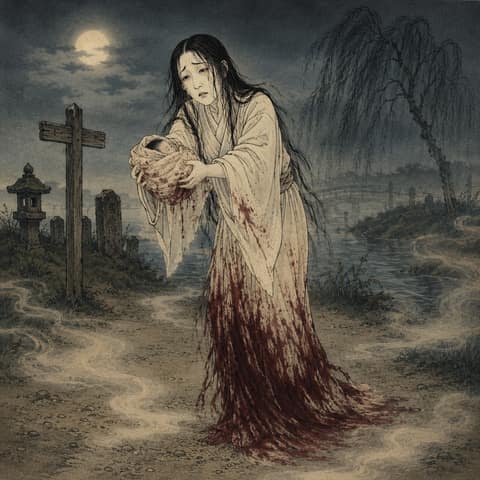
It is in the early modern period that the physical bodies of women who died in childbirth came to the forefront. *Hyaku Monogatari Hyōban* explains that the lingering attachment of a woman who died "upon giving birth" becomes the Ubume, who cries with her lower body dyed in blood. *Kii Zōdanshū* tells the origin story where a pregnant woman who died was abandoned in a field, the child in her womb was born, and the mother's soul walks at night holding the child; it states that those who accept her request to carry the child on their back will be given wealth. Here, the blood of the Ubume is not merely a cruel depiction, but a sign that explicitly carves the cause of death onto the body. At the same time, the act of the encounterer holding the baby is reinterpreted from a test of courage to an act of temporarily taking on the unfulfilled childbirth and child-rearing of the dead.
The transformation of the baby rearranges the conclusion of the story depending on the region. In a recording from Niigata City, the child received on the bridge gradually becomes heavier, and upon looking, it has turned into a stone. In a recording from the Naoiri region of Bungo Province, it is said to become a mallet or a stone. On the other hand, in the "Ubume's Gift" type, those who withstand the weight or do not refuse the request are bestowed with superhuman strength, a great sword, and wealth. The baby becoming heavier is not a uniform attack capability, but also a device to test the one holding it. If they cannot bear it, it becomes a horror story; if they hold it all the way through, it becomes a tale of bestowed fortune. This reversal makes it impossible to classify the Ubume purely as an aggressor or purely as a guardian spirit.
The waterside functions as the boundary where the Ubume passes her request to the living. The river crossing in *Konjaku Monogatari Shu*, the bridge in Niigata, and the riverbank illustrations of later eras are all places that connect "this side" and "that side." Manami Yasui's iconographic research points out that the *nagare-kanjō*—a custom of hanging a cloth by a river for a woman who died in childbirth and asking passersby to pour water over it to hold a memorial service—is also depicted in Sekien's drawing. While it cannot be definitively concluded that memorial services by water were the origin of all Ubume tales, the structures of "asking a favor of an unknown passerby" and "the dead and the living making contact at the waterside" resonate strongly. The Ubume's request can be read as a story of handing over not only the baby, but also the duty of the memorial service to the next person.
The syncretism with the Kōkakuchō (Guhō bird) added wings and the nature of snatching children to the mother's spirit. The nocturnal roaming woman in *Youyang Zazu* becomes a bird when wearing feathers and a woman when taking them off. Because she has no children, she takes the children of others, and it is a bird monster that warns against leaving children's clothes exposed to the night dew. In contrast, the Japanese Ubume tries to entrust the child she is already holding to someone else. Both share the explanation of being a woman who died in childbirth and an attachment to babies, but the direction of action is "snatching" for one and "entrusting" for the other. As Hayashi Razan applying "Kōkakuchō" to the "Ubume-dori" or Nue in the 1631 *Shinkan Tashikihen* shows, this became a major node that folded two stories with opposite directions into a single name.
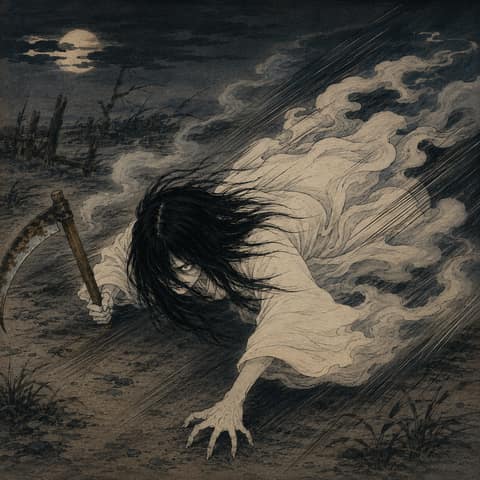
Painters visualized this folding together. In *Hyakkai Zukan*, the Ubume became a member of the named yokai illustrations, and Toriyama Sekien's *Gazu Hyakki Yagyō* consolidated the blood-stained white cloth, the baby, the rain, and the waterside into a single image. Tsukioka Yoshitoshi's *Wakan Hyaku Monogatari*, "Shume-no-Suke Urabe Suetake," takes the medieval Suetake tale as its subject but gives the woman wings on her back, superimposing the image of the Chinese bird monster. Because the original text has no wings, this is not a faithful illustration, but a reinterpretation that returned the "Ubume" understood by 19th-century audiences to the medieval tale. Looking at the iconography chronologically, we can see that the appearance of the Ubume was not the starting point of the folklore, but was created through the accumulation of reading, publishing, and painting.
The "Onmesama" handed down at Daigyōji Temple in Kamakura demonstrates another reversal of the Ubume. According to temple legend, in 1532, Priest Nichitō saved a woman who died in a difficult childbirth by chanting sutras, and he built a pagoda for the Ubume to enshrine her as a guardian deity of safe childbirth. Folklore materials recount that the woman appealed to the priest on the bridge over the Namerigawa River, saying, "I cannot cross the river, and the child is sucking on my breasts, causing me pain," and later she requested a pagoda to save people suffering from difficult childbirth. Here, the Ubume who passes her request to the living on a bridge at night moves to the side of helping childbirth after receiving a memorial service. Terror and safe-childbirth beliefs are not separate attributes, but a continuous story of an unsaved spirit transforming into an enshrined deity.
Even compared to the closely related Kosodate Yūrei (child-rearing ghost), they cannot be equated simply because of the theme of the death of a mother and child. The core of the Kosodate Yūrei is the story of a mother coming to buy candy to feed her child in the grave even after death; the nurturing continues from mother to child. The Ubume stops others on night roads and temporarily transfers the role of holding the baby. The former is a story of "the dead raising," while the latter is a story of "entrusting to the living." If we relate them while maintaining this difference, we can read the Ubume neither as a beautiful tale of maternal love nor as a punishment for death in childbirth, but as a supernatural encounter where the fear surrounding death in childbirth, memorial services, gift-giving, and the memory of society intersect.