Yokai Encyclopedia

Encyclopedia of Japanese Yokai

65 Yokai|14 Category|Page 2 of 3
Localization in Progress - More content available in Japanese version
View Japanese
Sort by: NameAscending
住居・器物
  • Ita-oni (Board Demon)

    Ita-oni (Board Demon)

    Uncommon

    EE-tah-oh-nee

    Canon-Concordant (Based on Tradition)

    Household SpiritsCourtly and aristocratic residences around Heian-kyō (Kyoto), Japan

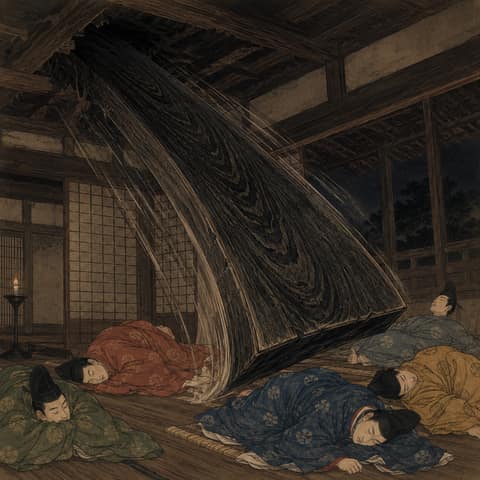
    Drawing on the Konjaku Monogatari-shū, later scholarship calls it “Ita-oni” (Board Ogre). The entity is either a board itself or a phenomenon dwelling in a board, taking a plank-like form that juts from roof beams or lattices. Its motive and will are unstated, but its core act is crushing sleepers to death. In Heian court and aristocratic residences, night watch and gate duty were crucial, and tales of the uncanny often served to reinforce discipline. Here too, it bypasses two armed men and strikes a defenseless sleeping place, embodying the ethic that negligence invites death. While it aligns with the idea of spirits inhabiting objects, it lacks tales of aging into autonomy or growth, and is told as a transient manifestation of a specific board appearing to suit the scene. There are no records of pursuit or capture, and it appears and vanishes swiftly without leaving traces.

  • Ittan-Momen

    Ittan-Momen

    Epic

    ee-tahn moh-men

    The Strangling Cloth of Satsuma's Night Sky: Ittan-Momen (Folklore Version)

    Household SpiritsKagoshima

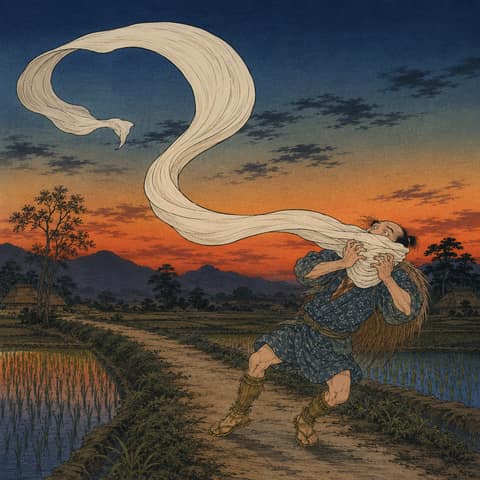
    Completely stripped of the pop-culture motif of a "friendly yokai with eyes and a mouth that speaks a local dialect" depicted in later anime and manga, this interpretation faithfully reproduces the "fundamentalist terror" of the oldest folktales passed down in the Osumi Peninsula of Kagoshima Prefecture. This version of the Ittan-Momen is depicted as an entirely "Faceless, silent assassin" completely incapable of communicating with humans. The core of its terror lies in its overwhelming "silence" and "otherness." On dimly lit paths between rice paddies at dusk, or at the edge of deserted woods at night, it glides down from the sky just like an ordinary piece of white cloth, making no sound of flapping wings or footsteps. Then, it silently descends from above the target's head, completely covering the human's entire face with the sensation of cold, damp cloth, and rapidly suffocates them by wrapping tightly around their neck multiple times. Since it is merely a long piece of cloth with no eyes, nose, or mouth, the victim can neither read its emotions nor beg for their life; they are simply robbed of their sight and breath in the darkness, experiencing the ultimate "claustrophobic terror." Furthermore, it is accompanied by a highly gruesome episode showing that it is not merely a "moving piece of cloth (a tool spirit)." A man who was attacked by this apparition on a dark road and was about to die of suffocation unsheathed the wakizashi (short sword) at his waist and frantically slashed at the cloth wrapped around his face. At that moment, the cloth instantly vanished into the darkness, but the blade of the sword left in the man's hands was thickly smeared with warm "fresh blood." This vivid, physical tale of confrontation—where "slashing it causes it to bleed"—strongly suggests that the Ittan-Momen is not merely a trick of the wind or a cloth monster, but an unidentified "fleshy, grotesque predator," brilliantly embodying the primal fear lurking in the rural darkness.

  • Iyaya (Negaya)

    Iyaya (Negaya)

    Rare

    ee-YAH-yah

    Sekien Iconography Standard

    Household SpiritsUncertain; Japanese folklore

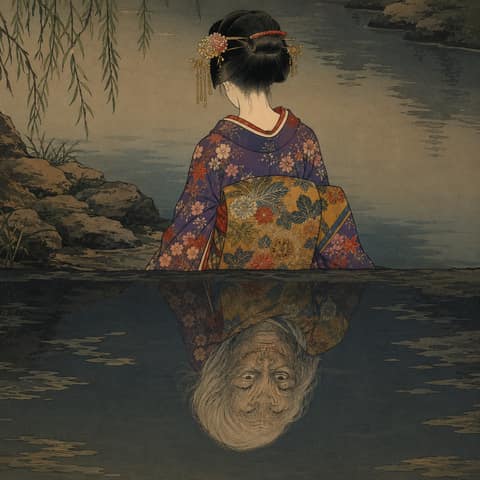
    Adheres strictly to Toriyama Sekien’s image and notes, avoiding later embellishments. The yokai is shown as the back view of a young woman standing by water, while the surface reflects the visage of an old man. The name draws on Dongfang Shuo’s “kaizai” expressions of wonder, suggesting Sekien likely fashioned an allegory. Youth and age, beauty and ugliness, front and back are opposed within a single frame, read as a design warning against being deceived by appearances. Firm oral traditions are scarce, so its character is defined largely through image interpretation. The readings iyaya or iyami vary by source, possibly evoking refusal or repulsion akin to “no,” but the literature offers no certainty.

  • Kanazuchibō

    Kanazuchibō

    Rare

    kah-nah-ZOO-chee-boh

    Iconographic Reconstruction (According to Tradition)

    Household SpiritsJapanese folklore

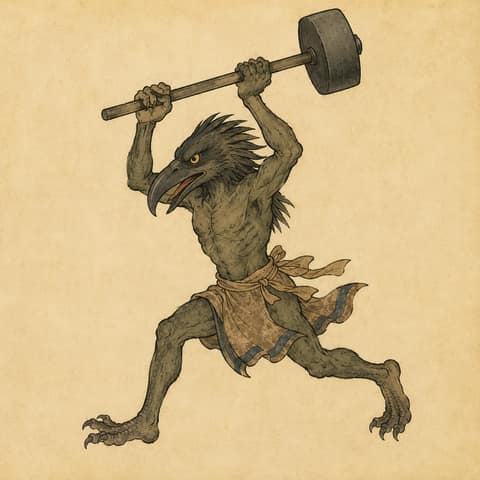
    Reconstructed after the iconography seen in the Matsui Library Hyakki Yagyō handscroll and other monster scrolls held by institutions such as the National Museum of Japanese History: a bird-faced figure brandishing a raised hammer. Following the sources, its name is noted as Kanezuchibō, with a comment on its affinity to the cognate form Daichiuchi; its deeds and origins remain unknown. While the hammer suggests a tool-turned-tsukumogami reading, no explicit statement in the sources confirms this. It is most often depicted as a member of a procession, one of the recurring motifs in Hyakki Yagyō imagery. Later metaphorical readings (e.g., caution or self-effacement) are treated as secondary interpretations and not conflated with the original tradition.

  • Karakasa-kozou

    Karakasa-kozou

    Uncommon

    KAH-rah-KAH-sah koh-ZOH

    Karakasa-kozou, the Old Umbrella Hopping on Night Roads

    Dwellings & ObjectsAll over Japan ── A tsukumogami of an old umbrella, without a specific origin.

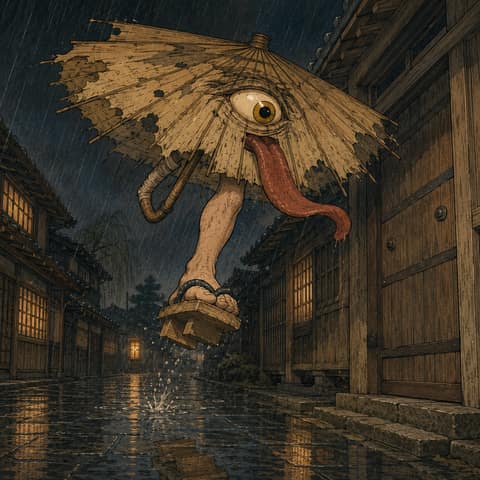
    This is an interpretation of the one-eyed, one-legged paper umbrella monster, typified by post-Edo period kusazoushi (illustrated entertainment books) and performing arts. In this version, Karakasa-kozou is not a terrifying vengeful spirit that takes human lives, but exhibits an extremely comical and mischievous nature, lurking in the dark to surprise passersby and enjoying their reactions. Although its iconographic roots trace back to the Muromachi period's *Hyakki Yagyo Emaki*, the widely recognized form of "the umbrella handle becoming one leg, with a single eye and long tongue sticking out from the umbrella's fabric" is the result of repetitive production in late Edo "monster playing cards," sideshows, and kabuki trick props. Lined up with visually impactful yokai like the Rokurokubi and Mitsume-kozou, it became a staple star of "toy prints" for children due to the amusement of its design. It appears in alleyways and under eaves at night, hopping on one leg while rustling its frame, causing visual and onomatopoeic strange phenomena, such as licking human faces with its long tongue, but it causes no essential harm. Because it lacks region-specific legends, its haunts and activities are freely adapted depending on the medium, which ironically made it easy to adapt to modern movies and animation. In a sense, it is the ultimate form of Edo townspeople culture completely deodorizing the primal fear of "tsukumogami"—the idea that old objects possess souls—into a "character (toy)" and sublimating it into entertainment.

  • Katawaguruma (One-Wheeled Carriage)

    Katawaguruma (One-Wheeled Carriage)

    Uncommon

    kah-tah-wah-GOO-roo-mah

    Kyo’s One-Wheeled Fire Cart

    Household SpiritsKyotoShiga

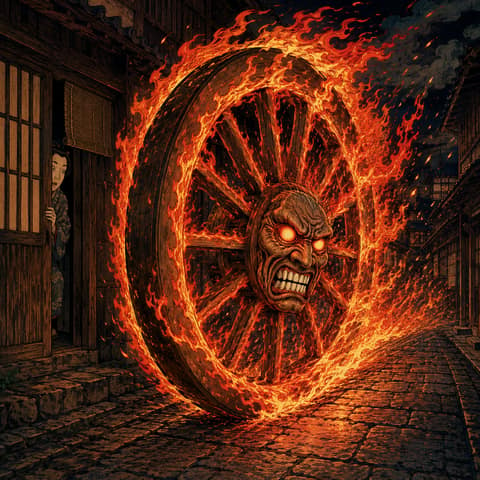
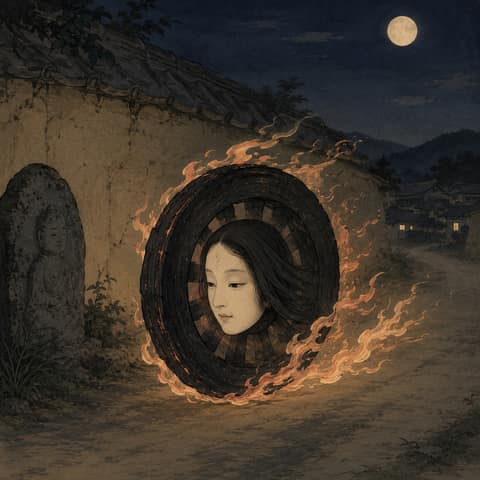
    A variant of the Katakuruma said to haunt Kyoto’s Higashi-no-Toin, marked by a strong urge to chasten with words. In the Enpo era, disliking the city’s taste for night roaming and nosy tongues, it rolled through the streets as a single ring of fire. It appears as one lone ox-cart wheel, cypress spokes sooted and red-hot, with a broad-jawed man’s face set in the hub. Its eyes flicker like lantern flames, its teeth gleam like a comb, and it often arrives biting a child’s single foot. Its first cry is always “Look to your child before you look at me,” both a threat and a plain command to tend the home; those who rush inside sometimes avert harm. But peep out of curiosity and, before rumor can spread, calamity befalls the household’s child. The foot it holds is not some stranger’s far away but is bound to the onlooker’s own child—the terror of this type—its fire slipping thinly through the door crack, drawing blood like beriberi in the sleeping room, leaving a tear. This speech-making Katakuruma is often confused with the Wheel Monk, yet it prefers admonition to mockery, and a single line of speech sets both the cause and the end. When a housewife once peered through a slit on Higashi-no-Toin, the wheel halted before the home, pressed its nose to the door, uttered a verse, and left; she ran to the parlor and found the child only lightly harmed, cured by prayer and decoctions. Thereafter, from the bell at sunset, households barred lattices tight, hung dim lamps within, and vowed not to speak of the strange at their lips. Sightings waned, yet during festivals and pilgrimages it returns, rolling as if stepping on the shadows of paper lanterns. It feeds above all on named gossip; if one whispers “katawa-guruma” thrice, its flame licks the eaves and seeks the lattice gap. Elders avoided the name, saying “the one-wheeled fire” or “the wheel’s voice.” Still, a gate warded with waka or votive words can halt it; honoring the power of speech, it eases if the text is orderly and heartfelt for the child. In towns thick with rumor it grows strong, in towns that mind their words and households it wanes, a monster mirroring Kyoto’s temperament.

  • Katawaguruma (One-Wheeled Carriage)

    Katawaguruma (One-Wheeled Carriage)

    Uncommon

    kah-tah-wah-GOO-roo-mah

    Katawaguruma of Shiga

    Household SpiritsKyotoShiga

    A regional variant of the katawaguruma said to haunt the Koka foothills and the lake winds’ thoroughfares since the Kanbun era. Its flames are steady like a watchfire, and a single scorched ebony wheel skims along nighted earthen walls. A woman’s face floats at its hub, classical and composed, hair unruffled by wind, the mouth faintly smiling yet almost mocking. When it circles a village threshold, lamps shiver and a far voice calls the names of sleeping children. More feared than its form were its “looks” and “rumor”: those who peeked through a door’s crack at midnight, or joked about it next morning, drew misfortune. The calamity was never grand but left a house half wanting—children vanish for a time, a mother’s milk stops, sheaves on the drying rack grow damp on one side. Villagers called this “stealing the half.” Yet it is no lawless fiend; if humans observe propriety, it answers with reason. One tale tells of a woman who repented peeping and pasted a tanka on her door; the katawaguruma sang it back the next night, saying “How gentle you are,” and returned her child. This is its Koka nature: to chide those who break night taboos and mend order through the power of words. When wayside deities and crossroads shrines waned, it appeared like a night watch, staying travelers’ feet and reminding households of latches and silence. Its female visage is said to echo ancient awe of birth goddesses who govern children’s comings and goings, or the many nights in Koka when women kept the home. The wheel is a lone wheel of an old ox cart, scorched axle-grain traced with sigils like Siddham; its fire gives light without heat. If people pierce its guise and spread tales of its traces, it deems its whereabouts too well known and departs. Thus it rarely lingers after a single appearance, blending back into roadside dark once rumors subside. Often confused with Wanyudo, but this kind favors admonition over scorn and prides itself on always returning the children it takes. Sensitive to song, norito, and quiet prayers at the threshold, it favors dignified speech; hence local house codes forbade loud late-night talk, door cracks, and calling children’s names at night. So the katawaguruma came to be seen as Koka’s hidden guardian, teaching courtesy through affliction and undoing affliction through courtesy.

  • Kejōrō (Hair Courtesan)

    Kejōrō (Hair Courtesan)

    Epic

    keh-JOH-roh

    Printed Edition – Sekien School Variant

    Household SpiritsEdo period

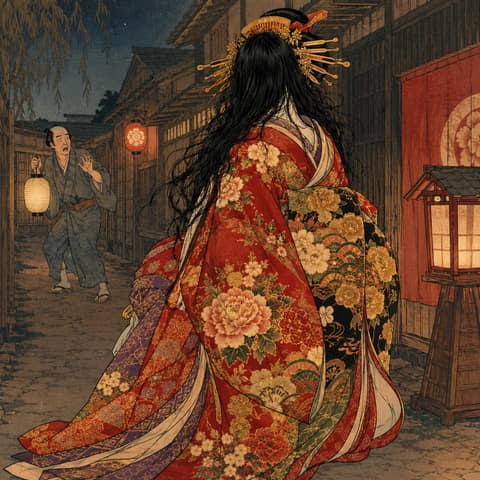
    A canonical image based on Toriyama Sekien’s illustrations and Edo kibyoshi. Dressed like a courtesan of the pleasure quarters, its hair grows unnaturally long to shroud the body so the face cannot be discerned. Born from urban satire centered on Yoshiwara and a pun linking courtesans with shapeshifters, it appears as a literary construct with no proper name or origin tale. Sometimes read as a faceless yōkai, it serves as a symbol that reverses the viewer’s desires and assumptions. Sources are primarily printed editions, with scant oral tradition.

  • Killing Stone

    Killing Stone

    Epic

    Sesshōseki

    The Killing Stone of Nasu, the Poison-Breathing Stone

    Dwellings and ObjectsTochigi

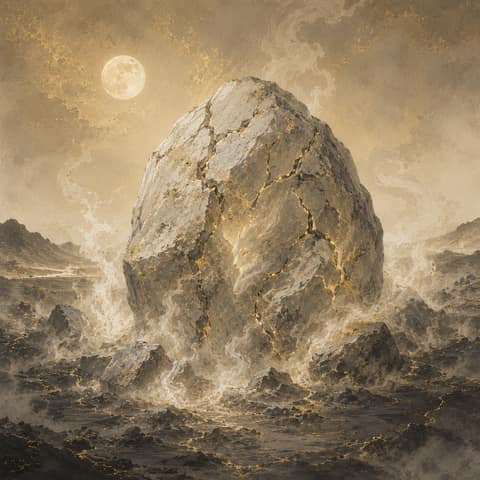
    This version looks at how the Sesshōseki, as a poison stone, has been told of on the noh stage and at sites of worship. In the noh play Sesshōseki, when the traveling priest Gennō approaches the stone on the Nasu Plain, a village woman appears and tells the stone’s origin; in time the stone splits open and the spirit of the fox emerges from within. The spirit repents of the evil deeds of its life, vows to attain buddhahood, saved by the priest’s ritual power, and vanishes. Here the Killing Stone is not merely a stone that kills, but something in which a lost soul dwells, to be quieted through memorial rites. Around the Killing Stone lies a desolate land where no plant grows and sulfurous smoke hangs in the air, called from of old the Sai-no-Kawara, lined with countless Jizō statues that mourn the dead. The Nasu Onsen Shrine stands close by, and at its Goshinka (Sacred Fire) Festival each May, a rite is said to be held in which the shrine’s fire is carried before the stone to quiet the mountain’s fire and the stone’s numinous power. Seen this way, the dread of the Killing Stone is rooted less in a stone that moves of its own will than in the sense of a boundary: “step past here and you lose your life.” The very zone filled with poison fumes was feared as a threshold between the world of the living and the world beyond, and it was believed that calamity reached only those who trespassed that boundary.

  • Kisaragi Station

    Kisaragi Station

    Legendary

    kisaragi-eki

    The Unmanned Station Slipping into the Otherworld

    Dwelling / ObjectShizuoka

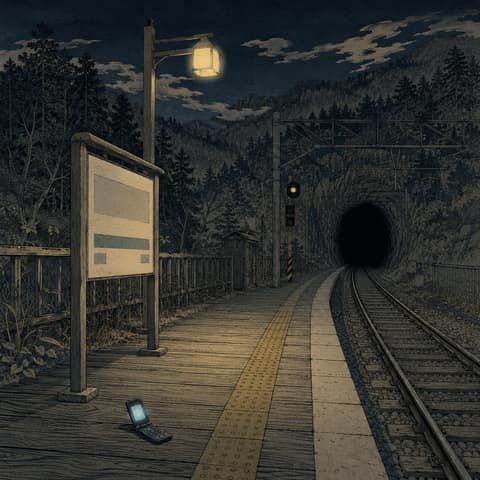
    This version of Kisaragi Station is a form for reading the station itself as a yokai. Instead of depicting a monster with a physical shape, it combines elements like platforms, tracks, tunnels, in-train announcements, and mobile phone signals to capture the moment everyday space changes slightly into different rules. The otherworld is not in the deep mountains far away. When you think you've slept past one station on your usual way home, the train has already entered an unknown order. The initial terror begins with the breakdown of the sense of time. The distance between stations is too long, the train passes stations it should stop at, the scenery out the window changes to something unfamiliar. At this stage, it can still be explained as "got on the wrong train" or "half asleep." But as explainability is crushed one by one, the reader is placed in the same closed train car as the poster. The message board format plays a major role here. Because a third party is advising but cannot save her, the voice of reason itself is incorporated into part of the anomaly. The hiragana notation of the station name is also important. If written in kanji as "如月駅," it leans toward an elegant place name or month name, but writing it as "きさらぎ駅" (Kisaragi) makes it an inorganic symbol printed on a station nameplate. A softness that even a child can read and a blankness that doesn't belong to any municipality stand simultaneously. According to Asazato Itsuki's organization of modern anomalies, there is a naming power here that pierces memory with just short words, the same as "Red Paper, Blue Paper" in school ghost stories or "Mary-san" in phone ghost stories. If Kisaragi Station were to be connected to the lineage of classical yokai, it would be spiriting away (kamikakushi) and road anomalies. Tengu taking people to the mountains, travelers bewitched by foxes walking in circles in the same place, festival music heard at crossroads. They have all spoken of the moment a road leaves human control. In Kisaragi Station, that road became a railway track. Tracks are originally a modern promise guaranteeing destination and time, but in this ghost story, the very strength of the guarantee flips. You can't go back even if you get off, and you won't reach your destination even if you stay on. The reason there are so many subsequent derivatives is that the stage setting is very easy to expand. Change the station name, change the route, add a smartphone or map app, and another Kisaragi Station is immediately born. As the urban legend theory compiled by ASIOS shows, modern ghost stories circulate by not only preserving fixed original texts but including verification, denial, and reenactment. Kisaragi Station is an anomaly including its circulation format, and even the reader's act of searching becomes an extension of the story. Therefore, the most sincere attitude toward this unmanned station is not to determine a real station. There is an outline that looks like western Shizuoka Prefecture. But the moment you crush the outline into a real station name, the essence of Kisaragi Station is lost. On YOKAI.JP, we treat it as an otherworld originating from a creation, while simultaneously leaving the realistic texture of the railway network. A station not on the map is not scary because it's off the map. It's scary because the more people believe in maps, the more they arrive there. Another point of interest is that advice does not become salvation. The message board residents think rationally and propose realistic means like the police, station staff, family, and confirming the current location. But once she enters the otherworld, all that rationality arrives slightly too late. Kisaragi Station does not deny modern safety devices, but lets them idle while making them look like they're functioning. Therein lies a coldness typical of Heisei internet ghost stories.
  • Kokuri Baba (Temple Kitchen Hag)

    Kokuri Baba (Temple Kitchen Hag)

    Rare

    KOH-koo-ree bah-BAH

    Sekien Iconography Version

    住居・器物Japanese folklore

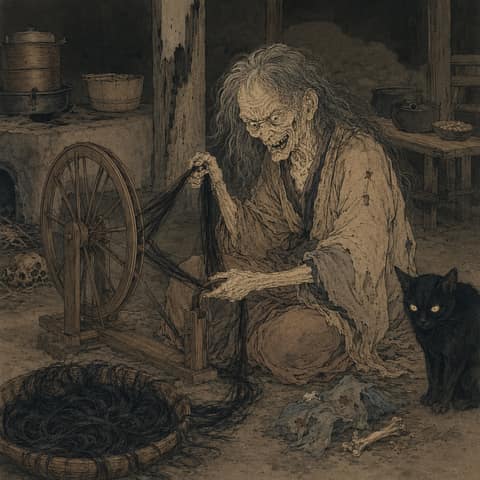
    An interpretation grounded in Toriyama Sekien’s Konjaku Hyakki Shūi depiction. Said to be the transformed bōnsō of the seventh prior abbot haunting the temple kitchen quarters, it steals offerings and money, digs up graves to braid hair into garments, and eats human flesh. Artwork pairs an old woman twisting thread with a cat, suggesting satire of clerical corruption and monastic lapses. The name “Kokuri” may pun on a word for something terrifying. Lacking a fixed regional distribution, it is chiefly known as a bookborne pictorial yokai. Rather than field sightings, it likely served as a moral warning and social satire aimed at temple society.

  • Korōka (Ancient Lantern Fire)

    Korōka (Ancient Lantern Fire)

    Rare

    koh-ROH-kah

    Sekien’s Koro-bi (Ancient Lantern-Fire)

    Household SpiritsJapanese folklore

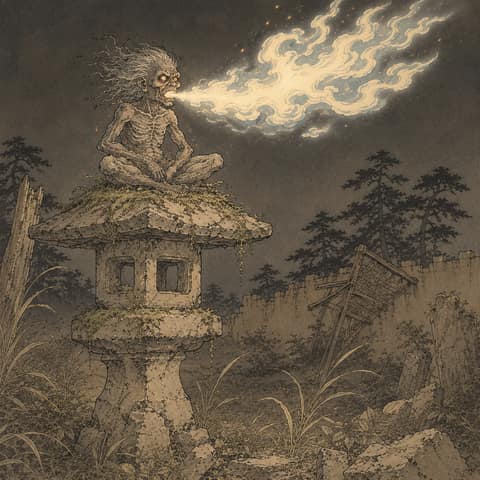
    A version reinterpreting Toriyama Sekien’s fusion of a stone lantern and will-o’-the-wisp, casting it as a fire spirit dwelling in the lantern. When old courtyard or temple lanterns go long unused, a thin flame is said to rise at night, flickering as if lingering over the places it once lit. Historically, Sekien’s illustration and note form the core record, with little tied to specific locales or figures. It influenced later ghostly retellings, but firsthand accounts are scarce, so it is treated as a symbolic yokai of “the memory of light.”

  • Long Crown

    Long Crown

    Rare

    oh-sah-KOH-buh-ree

    Iconographic Tradition Version

    Household SpiritsJapanese folklore

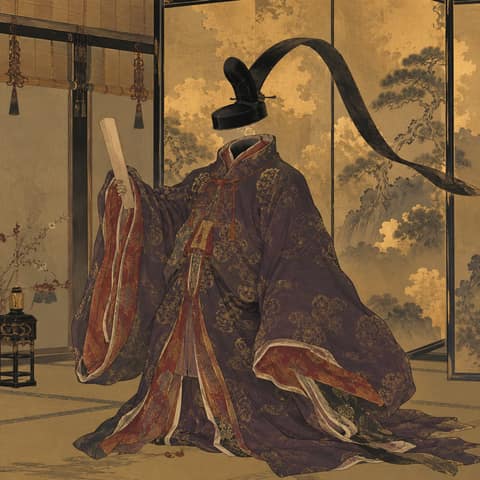
    Based on Sekien’s image and caption, the crown is shown as if it stands on its own and walks with proper manners, a satire aimed at minds fixated on authority. A crown should rightly regulate decorum and rank, yet when one refuses to remove it for selfish ends, the vessel is said to curse its master, gain form, and wander. Firsthand accounts are scarce; it appears mostly in paintings and texts as an unspoken warning, paired with Kutsuhō as a lesson in suspect behavior and knowing one’s proper place. Later artists like Yoshitoshi echoed this by adding a crown-spirit to Hyakki Yagyō processions. Among early modern aficionados, it was treated as an example of tsukumogami, in which ceremonial items like crowns and scepters acquire spirits as they age.

  • Manhole-Backed Cat-Boar

    Manhole-Backed Cat-Boar

    Common

    EE-boo-tah SEH-oh-ee neh-koh-jee-shee

    Midnight Patrol Variant

    Household SpiritsSewer networks of coastal cities

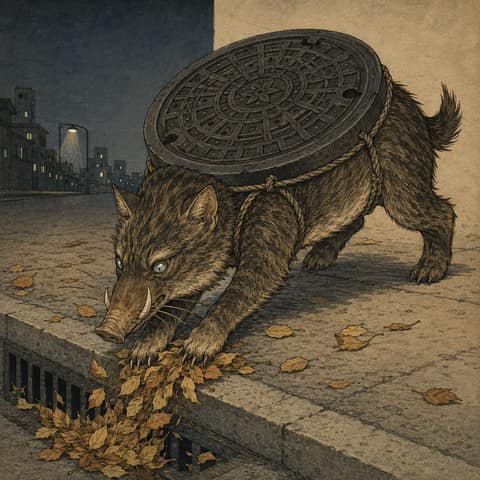
    After one in the morning, tiny hoofbeats dot the asphalt as a soft clatter of manhole lids joins in. They travel in lines of two to five, with the lead sniffing the wind to read the flow of damp air. The second tilts the lid on its back, flashing back the streetlight as a signal. On rainy nights after the storm, they rake fallen leaves into the gutters with noses and forepaws like closing staff at a shop. One courier said that just before a tunnel, when his bike light suddenly died, two large eyes aligned ahead and cast a faint glow only at his feet. The eyes look like crystal, but they seem to gather the city’s reflections and dim automatically when the light turns red. As dawn begins, the herd returns behind park fountains or to the corners of underground garages, props their back lids against the wall, and grooms. Parents teach their young to fold a receipt corner into a neat triangle, giving a gentle bonk if they fumble. Sometimes their playfulness goes too far and they spin a lid so much that neighborhood cats end up dizzy. They rarely harm people and instead help the city breathe by straightening misaligned covers and clearing clogged drains. Photos often fail as the lid’s reflection throws off focus, though a clear shot is said to be possible if you stand a can of coffee on the gutter’s edge.

  • Mokumokuren

    Mokumokuren

    Epic

    MOH-koo-moh-koo-REN

    Toriyama Sekien Zue–Conformant Edition

    Household SpiritsJapanese folklore

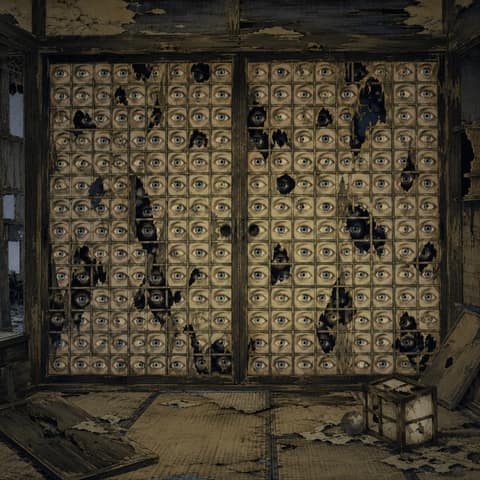
    Reconstructed from Toriyama Sekien’s imagery and captions as a swarm of disembodied eyes gathering on the shoji of a ruined dwelling. Rather than inflicting direct harm, it unsettles by staring. It is mediated by domestic neglect and unappeased sentiments, yet belongs to a generalized lineage of house-haunts not tied to specific individuals or locales. This reading also aligns with later variations in collected names and with links to visual illusion phenomena.

  • Muku-Mukabaki (Awakened Gaiters)

    Muku-Mukabaki (Awakened Gaiters)

    Uncommon

    MOO-koo MOO-kah-bah-kee

    Traditional Edition

    Household SpiritsEdo period

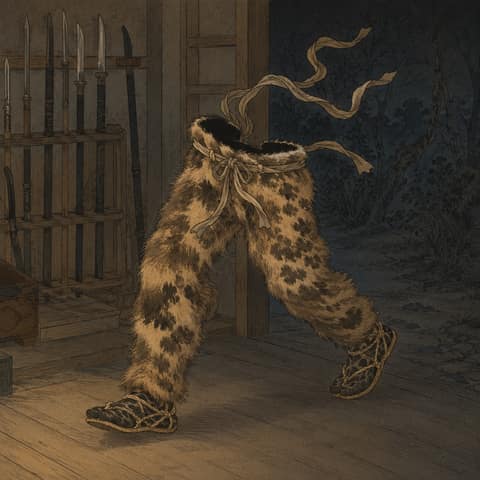
    An edited version consolidating Edo-period pictorial sources of the “Inugake” apparition. Inugake are fur leggings worn from the waist to the legs for warmth and protection in hunting gear, placed within the lineage of tool-spirits that gain sentience after long use or separation from their owner. In Sekien’s illustration only the legs seem to walk independently, with the caption evoking the inugake of Kawazu Saburō in The Tale of the Soga. This is a literary hint by the artist rather than evidence of a specific vengeful-ghost tale. In early modern Night Parade of One Hundred Demons and tsukumogami scrolls, yokai wearing inugake appear, emphasizing the uncanny form of the gear. Its nature is generally to show up at night and startle people, with no clear record of harm or benefit. Localized traditions are scant, and most examples belong to urban pictorial culture. It is understood as a classic example of the idea that aged implements come to house spirits.

  • Murasaki-kagami

    Murasaki-kagami

    Epic

    murasaki-kagami

    The Word Curse Engraved with an Age Limit

    Spirit / GhostA curse of words / Memory infection with an age limit

    This version of Murasaki-kagami does not appear as a tangible yokai. Its true form is the word "Murasaki-kagami" itself, and the memory of the person who received it. Because the anomaly resides within the brain, locking doors or fleeing far away is meaningless. The moment you hear "you will die if you remember," the contract of the curse is unilaterally established. This unreasonableness is the very characteristic of an anomaly parasitic on words. The curse being set to the deadline of "age twenty" is by no means accidental. It is not just a legal boundary, but a symbol of the end of childhood. In the process of becoming an adult, people discard and forget many things. Murasaki-kagami acts as a ritual testing "whether you can forget the ominous superstitions of childhood as mere superstitions." Dying if you do not forget by twenty implies that if you fail to complete this rite of passage, the shadows of childhood will consume you. This ghost story paradoxically increases its survivability by attaching counter-curse words like "White Crystal" or "Light Blue Mirror." If there were no way to break the curse, people would try to erase it from their memory; however, by teaching them that they must remember another word to break it, the foundational word "Murasaki-kagami" becomes even harder to forget. This is a highly calculated structure parasitic on the human memory mechanism, multiplying like a virus in the manner of urban legend transmission mechanics organized by ASIOS. A purple mirror is an uncommon object in reality. In Japanese color psychology, purple is often viewed as noble but also carrying a sickly or unsettling tone. Combining this color with a "mirror" that reflects one's face creates a word that evokes an eerie visual image. Even without knowing the backstory of the burned girl, the mere sound of "Murasaki-kagami" radiates an unforgettable eeriness. Murasaki-kagami does not seek physical harm. Its purpose is to remain dormant in a corner of memory for the years until the person turns twenty. It suddenly awakens when you casually see the color purple or look in a mirror, bringing small anxieties until age twenty arrives. Rather than appearing like a ghost, it exists as unerasable data in the brain. It continues to spread via text on the internet, surviving as a modern word curse that uses human memory as its incubator.

  • Nyūbachibō

    Nyūbachibō

    Rare

    nyoo-bah-chee-BOH

    Emaki Seigan Iconography Version

    Household SpiritsJapanese folklore

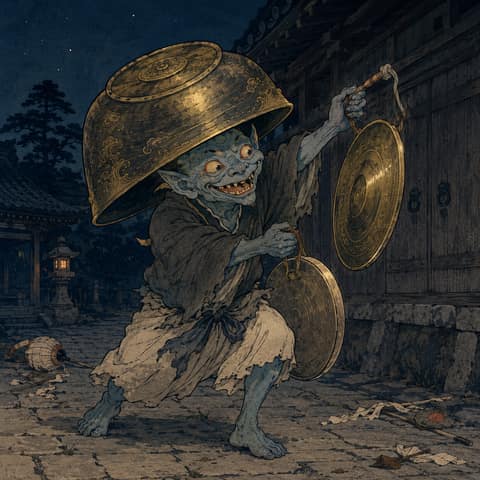
    Taking as precedent the disc-like apparition found in Muromachi-period Night Parade of One Hundred Demons scrolls, the Edo artist Toriyama Sekien shaped it in Hyakki Tsurezure Bukuro as a human figure bearing a bronze plate. Sekien frequently depicted utensils turned yokai, and Nyūchibō is one of these, yet the textual notes are brief and its conduct remains undefined. Amid overlapping names and forms—nao-bachi, dōbachi, and surigane used in temple rites and theater orchestration—later commentators supplied the trait of startling people by sounding. No specific regional lore is attached; it is recognized iconographically within the broader class of utensil-spirits. Its qualities today largely reflect fragments of folk materials and modern reinterpretations in yokai handbooks.

  • Oboroguruma (The Hazy Carriage)

    Oboroguruma (The Hazy Carriage)

    Rare

    oh-BOH-roh-goo-ROO-mah

    Oboroguruma (after Sekien’s Iconography)

    Household SpiritsKyoto

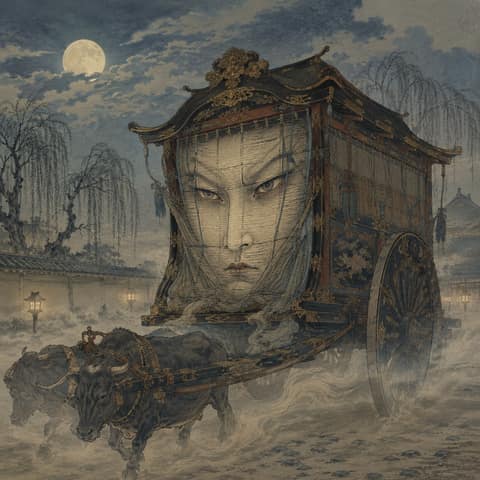
    A depiction of the Oboroguruma based on Toriyama Sekien’s image and Edo-period readings: a half-transparent ox-drawn carriage appears on a hazy night, its blinds blocked by an enormous face. It is said to echo rancor from Heian-era carriage quarrels, yet avoids naming individuals or tying to single incidents, instead embodying social tensions from festivals and spectacles that possess objects. It is also understood as part of the Night Parade of One Hundred Demons, startling people through a double sign of sound (creaking wheels) and form (an ox cart with a face). Direct harm is not always told; it manifests as a token of dread and ill omen, prompting witnesses to recoil. As an object-yokai, old carts and festival gear set the stage, and disputes over space or viewing cause the tale to arise. Excess specifics are avoided, with the hazy night and cart sounds serving as its marks of appearance.

  • Oil Baby

    Oil Baby

    Rare

    AH-boo-rah AH-kah-go

    Sekien Iconography Edition

    Household SpiritsShiga

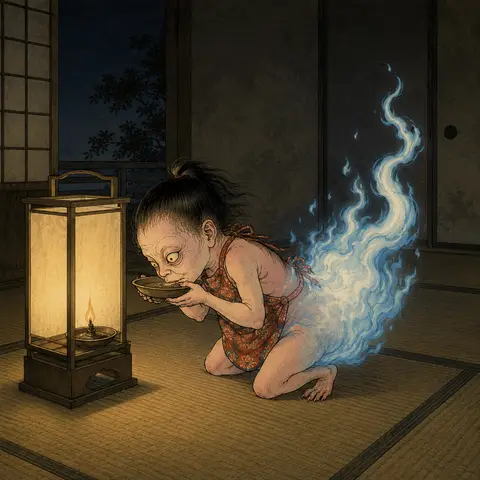
    This version is grounded in Toriyama Sekien’s imagery and the Edo-period essays cited in his notes, interpreting the infant form as a minimal personification of a ghostly fire. Its core is the idea of an oil-thieving flame, with the baby figure best read as Sekien’s visual cue. Lamp oil was a daily necessity, and offerings of oil at temples and shrines were held in special regard. Stealing oil violated religious and ethical taboos and was told as a fire that wanders after death. Later handbooks retell it as a fireball entering a house, becoming a baby, and licking oil, but region-specific oral examples are scarce and no widespread template is certain. Accordingly, this version presents a three-step pattern—phantom fire appears (at crossroads or within shrine-temple precincts), the infant image manifests (gesturing as if licking oil before a lamp), then departs again as flame—while avoiding unverified details and foregrounding its symbolism as a warning against defiling offered oil.

  • Painted Buddha

    Painted Buddha

    Epic

    NOO-ree-boh-TOH-keh

    Canonical Traditional Iconography

    Household SpiritsJapanese folklore

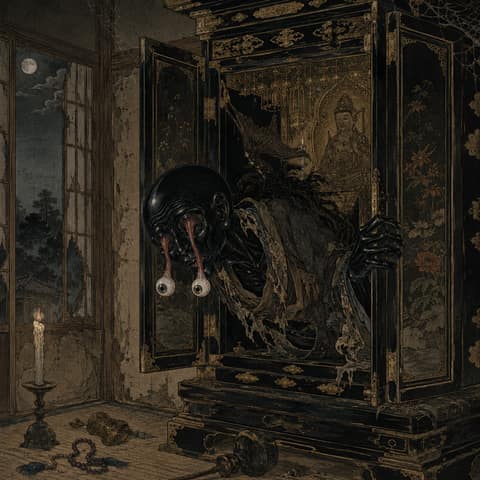
    Based on Edo-period yokai picture scrolls: a monk-like figure lacquer-black in color with protruding drooping eyes, accompanied behind by hairlike or fishtail-like elements. Most sources lack commentary, leaving its nature and origins unclear. In Sekien’s depiction it emerges from within a household Buddhist altar, which later encouraged reinterpretations as a possessed object or tool-spirit, though the original intent is uncertain. Accordingly, it is treated as an image embodying anxieties and awe surrounding domestic ritual spaces, with abilities limited to what the images suggest.

  • Paper Dance

    Paper Dance

    Uncommon

    KAH-mee-mai

    Documentary Compilation Edition

    Household SpiritsJapanese folklore

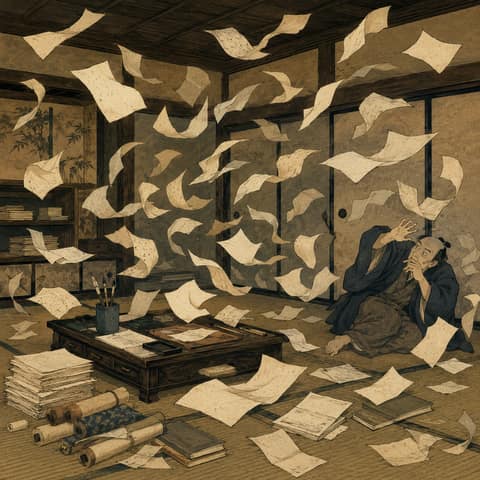
    Rather than an independent entity, Kamimai is a later整理 as a label for a household anomaly in which paper moves and scatters on its own. Fujisawa Eihiko is cited as authority and places its appearance in the tenth lunar month, yet his illustration reuses a scene from Ino Mononoke Roku, and the original source does not limit it to any particular month. Since the Showa era, folklore and ghost-story collections have introduced cases of contracts or manuscripts lifting and swirling, naming them “Kamimai,” but firsthand credibility and regional distribution remain unconfirmed. Accordingly, this entry treats Kamimai as a generic yokai image signifying inexplicable motions tied to dwellings and objects, specifically the self-propulsion or levitation of paper, with no fixed form or clear place of origin. In lore it rarely harms people or livestock, tending instead toward startling or teasing behavior.

  • Pillow-Flipper

    Pillow-Flipper

    Uncommon

    mah-koo-rah-GAH-eh-shee

    Traditional Type – Temple and Shrine Anomaly Affiliation

    Household SpiritsAcross Japan

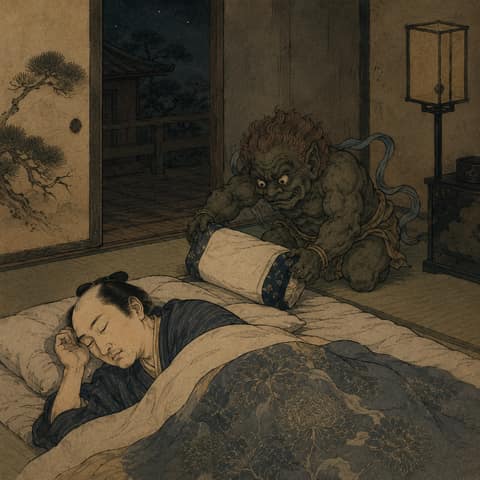
    A pillow-flipping subtype rooted in old beliefs that pillows are linked to the movement of the soul and to boundaries. It manifests at thresholds between sacred and secular spaces such as certain parlors, pillars, or Buddhist rooms, turning sleepers’ heads toward a Buddha or principal icon, or simply inverting the pillow to signal a reversal of order. Noted in essays and picture scrolls from the Edo period onward, it often ties into temple Seven Wonders and scroll-haunt tales. In some regions it is read as the play of a zashiki-warashi, the sign of a spirit of someone who died in the house, or a guise of a shapeshifting animal. The fear it inspires has shifted over time: once viewed as a portent of deadly curse, in modern times it tends to be treated as a lighter bedroom haunting and prank.

  • Poverty God

    Poverty God

    Uncommon

    BEEN-boh-gah-mee

    Classical Folktale-Concordant

    Household SpiritsAcross Japan

    The Binbōgami traces its roots to the personification of medieval poverty and began to be named explicitly from the Muromachi period onward. It commonly appears as a gaunt old man carrying a plain paper fan, believed to dwell in closets or the corners of tatami rooms. Banishment is not easy, and ritual sending-off is preferred over force. Saishōshi records guiding it outside the gate with a branch on the last night of the month, Tankai describes setting grilled rice and roasted miso on a wooden tray and letting them drift downriver from the back door, and Nihon Eitaigura tells of honoring it respectfully on the Night of the Seven Herbs so that, appeased, it turns to bring fortune. Numerous folk beliefs link it with fire and household order, as in Niigata’s New Year’s Eve hearth customs and Ehime’s taboos against disturbing the fire. Miso, said to be its favorite, is cited both as an attractant and a taboo, with roasted miso rites preserved in many regions. Though a punitive deity, it is said to grow uncomfortable where diligence, cleanliness, and frugality are observed, and in folk religion it functions as the counter-concept to household gods of fortune, serving as a barometer of family luck.

Showing 25 - 48 of 65 yokai