Yokai Encyclopedia

Encyclopedia of Japanese Yokai

65 Yokai|14 Category|Page 3 of 3
Localization in Progress - More content available in Japanese version
View Japanese
Sort by: NameAscending
住居・器物
  • Rainfall Page-Boy

    Rainfall Page-Boy

    Uncommon

    ah-meh-FOO-ree koh-ZOH

    Rain-Attendant Page

    Household SpiritsEdo period

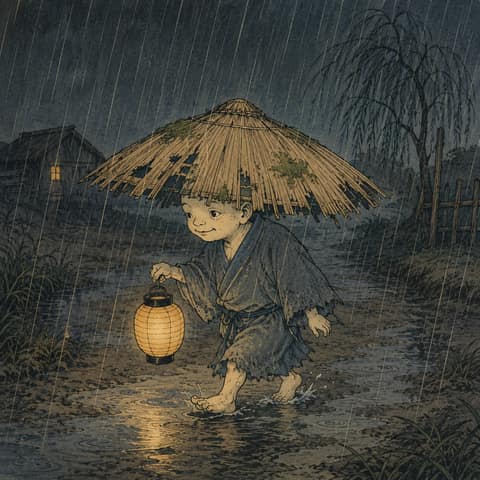
    Based on Toriyama Sekien’s imagery, this version foregrounds the character of a page serving the Rain Master. It appears with a Japanese umbrella stripped of its ribs worn like a hood and a lantern in hand. Its origins lie more in printed books than in oral folk tradition, and in yellow-covered comic books it shows up as a menial helper. The ideas of rain and service to nobility converge, shaping it as an attendant akin to small child-deity retainers. It does not wield an explicit divinity that summons rain, remaining subordinate to a being that governs rain’s power. Depictions vary—one eye, hat, lantern—depending on period and source, with no single fixed image. Lacking a known local provenance, it spread notably through Edo’s publishing culture.

  • Raised-Collar Robe

    Raised-Collar Robe

    Rare

    eh-ree-TAH-teh-goh-ROH-moh

    Ittan of Sekien Iconography

    Household SpiritsJapanese folklore

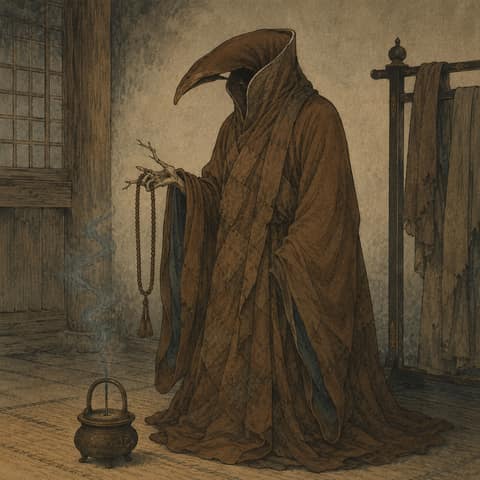
    A reconstruction based on the designs in Toriyama Sekien’s Hyakki Tsurezure Bukuro. The monk’s robes are a dull brown, layered thickly, with the collar hanging before the face to cast a beaklike shadow. Beads are held in one hand, a censer is set before it. Movements are unhurried; with each step the rustle of cloth sounds and a faint scent of incense drifts. Hints linking it to tengu remain only in the captions of the image, with no direct wings or long nose. It maintains autonomy as a tsukumogami, its tears and seams perceived as bearing will. It appears not where reverence for sacred implements is lacking, but shows signs near neglected robes and ritual tools, prompting awe rather than harm.

  • Resurrection Incense

    Resurrection Incense

    Uncommon

    hahn-GOHN-koh

    Canon-Conforming Incense Apparition

    Household SpiritsUnknown

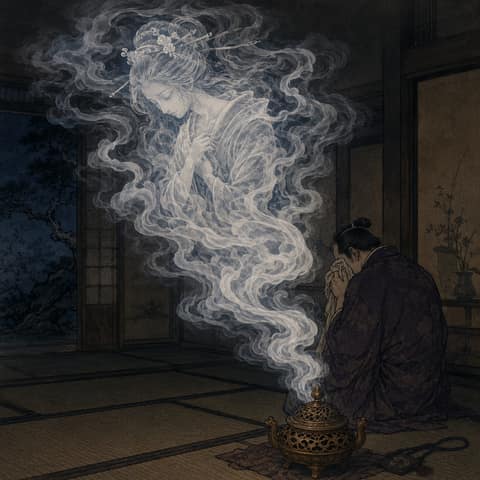
    Rather than a physical substance, the reviving incense is told in narrative tradition as a medium for reunion with the dead. The Chinese motif of seeing a figure within smoke was adopted into early modern Japanese literature and theater, where the handling of censers, incense wood, and ash is rendered with ritual care. In yokai picture compendia it sometimes appears as a type of tool-born apparition, with set-piece depictions of a visage forming in the incense smoke. It is often interpreted not as recalling a spirit itself, but only as manifesting a semblance or shadow. Medicinal virtues are mentioned as apocrypha in materia medica, yet Edo-period notes record skepticism and file it among curious tales. In Kamigata and Edo rakugo, a tryst lasts only until the incense or stick burns out, making the quantity and duration of incense a key stage device.

  • Reverse Pillar

    Reverse Pillar

    Epic

    sah-kah-BAH-shee-rah

    Traditional Kaidan Edition Gyakubashira (Inverted Pillar)

    Household SpiritsVarious regions of Japan

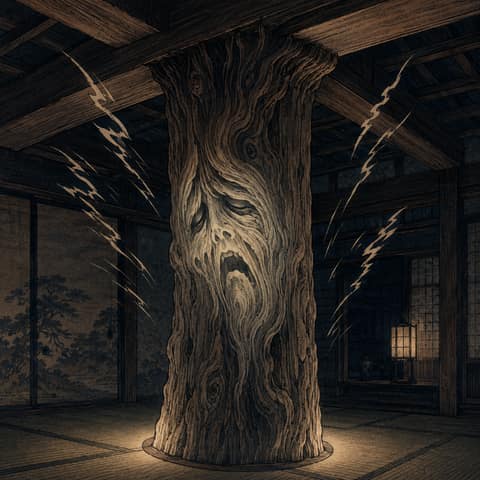
    A post–early modern belief that a pillar installed upside down, defying carpenters’ respect for a tree’s natural root spread, brings mishaps to a house. Persistent midnight house-settling, creaking beams, and uncanny whispers were read as the “curse of the inverted pillar,” prompting reinstallation or prayer. Shigeru Mizuki notes leaves birthing a spirit from the reversed wood, or the pillar itself transforming, yet older records more often treat it as signs of noise, misfortune, and ill omen. Deliberate inverted motifs used as apotropaic design (e.g., Yomeimon) belong to the ritual idea of intentional imperfection and are distinct from this yokai. As a taboo rooted in building folklore, it appears in regional carpenters’ lore, temple and shrine records, and essays.

  • Roaring Cauldron (Narigama)

    Roaring Cauldron (Narigama)

    Uncommon

    nah-ree-GAH-mah

    Ringing Cauldron (Hyakki Tsurezurebukuro)

    Household SpiritsOkayama

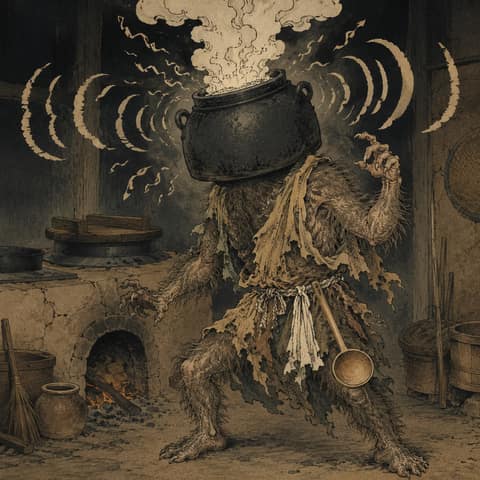
    Based on the belief that tools become spirited after a hundred years, this yokai is depicted with an old iron cauldron for a head. It lingers in the night, issuing faint tremors and steam that produce low sounds. The ringing is read as an omen of fortune or misfortune, falling silent if met with careless clamor, and responding when approached with reverence. It embodies divinatory function and the memorial veneration of well-used objects.

  • Sanuki Heike Crab

    Sanuki Heike Crab

    Uncommon

    sah-NOO-kee HAY-keh-gah-nee

    Sanuki Heike Crab (Linked to Yashimaura)

    Household SpiritsKagawa

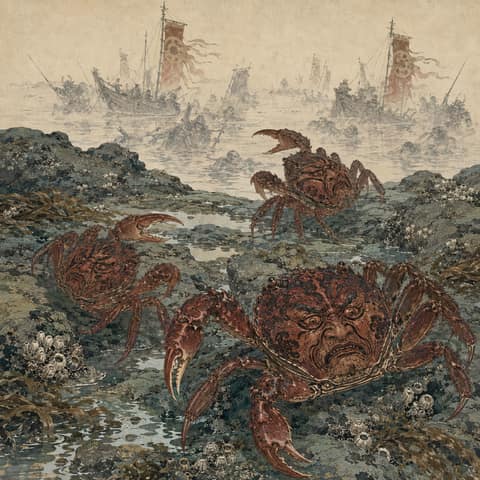
    An image based on folk belief that crabs with human-like patterns on their carapaces washed up on Sanuki shores embody the vengeful spirits of the defeated Taira clan. Historical sources tie these crabs to various locales, with Sanuki famed due to memories of the Battle of Yashima. As a yokai, it is said not to harm people directly, but to make onlookers recall the karma of the battle and feel awe. It is distinctly linked with acts of memorial service and consolation for the dead, and differences from other regional names are considered nominal only.

  • Shell Child

    Shell Child

    Rare

    KAI-chee-go

    Iconographic and Encyclopedic Interpretation

    Household SpiritsJapanese folklore

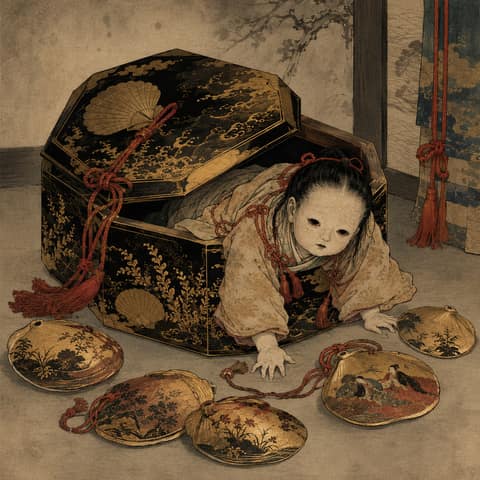
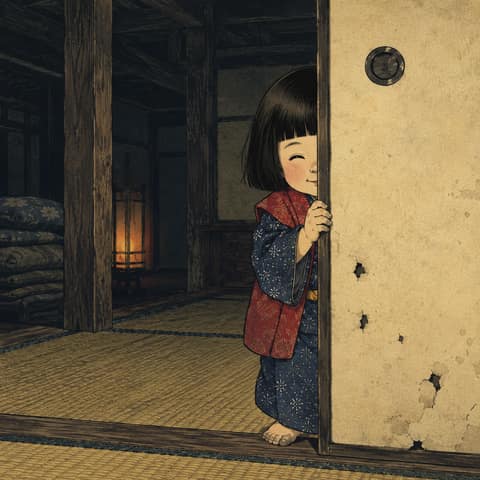
    Rooted in Toriyama Sekien’s illustration and brief caption, this lineage reads the shell box through the history of kaiawase shells and bridal trousseau chests. Lacking firsthand anecdotes, it stays within the general tsukumogami frame, overlaying the folk view that long-serving objects acquire feeling. Its form is childlike, with a key association to crawling baby dolls. Late at night in a silent tatami room, the lid of the shell box is said to open slightly, and a small childlike figure peeks out. It causes little harm, and is said to vanish when household goods are treated carelessly.

  • Snake-Obi

    Snake-Obi

    Rare

    jah-TIE

    Sekien Zukai Version

    住居・器物Edo period; derived from painted sources

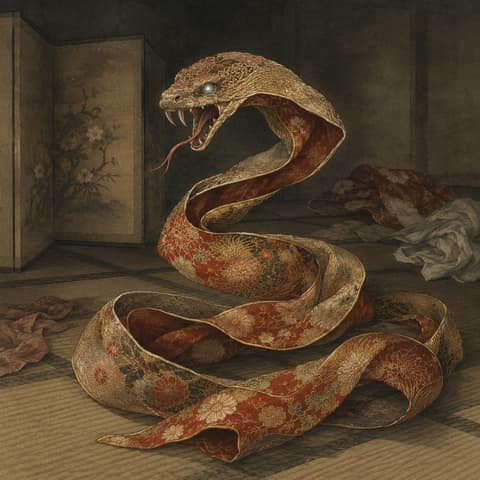
    A version based on Toriyama Sekien’s interpretation of the obi in Konjaku Hyakki Shūi. Though an everyday garment, the obi was said to turn into a serpent at the threshold of sleep and dream. This draws on the Natural History note that sleeping on a sash brings dreams of snakes, a belief also known in Japan. Sekien further composed that the triple sash of a jealous woman coils into a sevenfold venomous snake, punning on the kinship of malice and serpent-body, and presenting a visual reading in which emotion is projected onto objects. In folk terms, it warns that keeping a sash by the pillow invites ominous dreams, admonishes jealousy, and entwines concepts of sleep, dreams, and taboo. Rather than a literal attacker, the Snake-Obi is a symbolic specter that mirrors the viewer’s heart and reminds proper handling of sashes and bedding within the home.

  • Spirit of the Ema Plaque

    Spirit of the Ema Plaque

    Uncommon

    EH-mah no SAY

    Ema Spirit (Traditional Tale)

    Household SpiritsKyoto

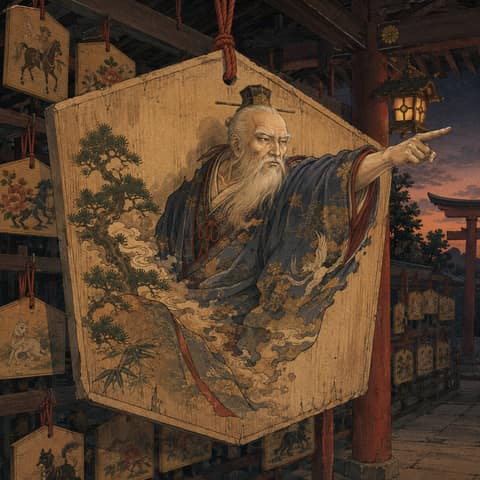
    A spiritual presence dwelling in votive ema plaques, known from shrine and temple origin tales and ghost stories. It appears most often at dusk or in dreams, and its form is thought to reflect the donor’s wish or the plaque’s artwork. As an old man it teaches or warns, and as a woman it may invite or manifest. It is not a deity itself, but a spirit residing in an offering, revealed through the power of the sacred precinct. It shuns being taken home without cause, defiled, or thrown into fire, and favors proper return or ritual burning. Encounters can be auspicious or ominous, with fortune depending on one’s conduct.

  • Suzu-hiko-hime

    Suzu-hiko-hime

    Rare

    SOO-zoo-HEE-koh-hee-meh

    Based on Sekien Toriyama Plates

    Household SpiritsJapanese folklore

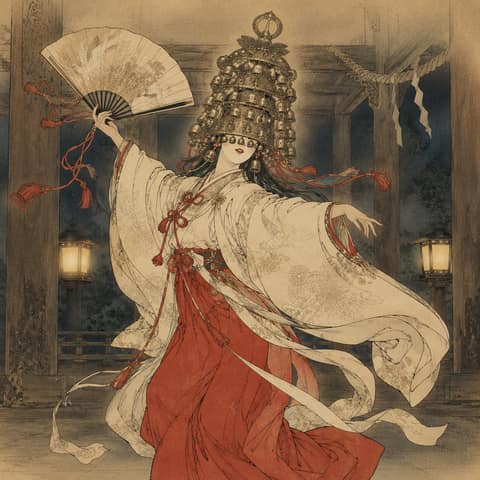
    A reconstruction grounded in Toriyama Sekien’s illustration and notes. Shown as a woman bearing a kagura suzu, she serves as a symbolic presence moving between summoning spirits and soothing souls. Rather than a concrete monster, she personifies the numinous power tied to the ritual bell, evoking the Ama-no-Iwato myth while remaining distinct from its deities. Edo painters placed her within the Night Parade lineage, and Tsukioka Yoshitoshi offered a comparable image to Suzuhiko-hime. No fixed haunt is recorded; she is thought to appear in the imagination at kagura offerings, festival floats, and shrine fairgrounds.

  • Tall Woman

    Tall Woman

    Epic

    tah-kah-OHN-nah

    Iconography-True (Sekien-Based)

    Household SpiritsJapanese folklore

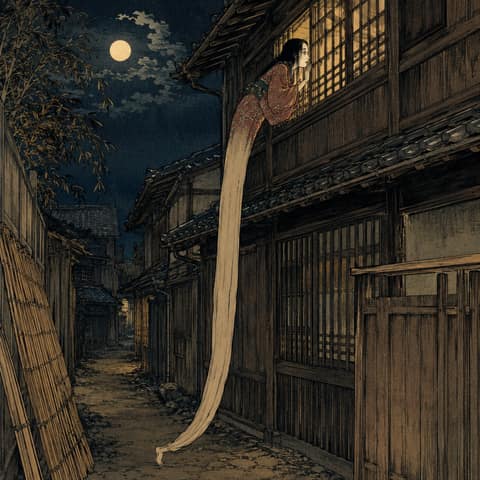
    Reconstructed strictly from Sekien’s original image while preserving the absence of contemporaneous commentary. The figure is a gaunt woman whose body from the feet to the hips stretches like a serpent, extending from an alley up to the second-floor lattice of a townhouse to peer inside. Her actions are chiefly to startle, with no fixed malice. Regional proper names are uncertain, and later popular tales (brothels, satire, etc.) are treated as accretions. She is understood as a symbolic apparition that exploits nighttime quiet and architectural features, instilling unease in residents through her gaze.

  • The Dōjōji Bell

    The Dōjōji Bell

    Rare

    doh-JOH-jee no kah-NEH

    Sekien Zue – The Dōjōji Bell

    住居・器物Wakayama

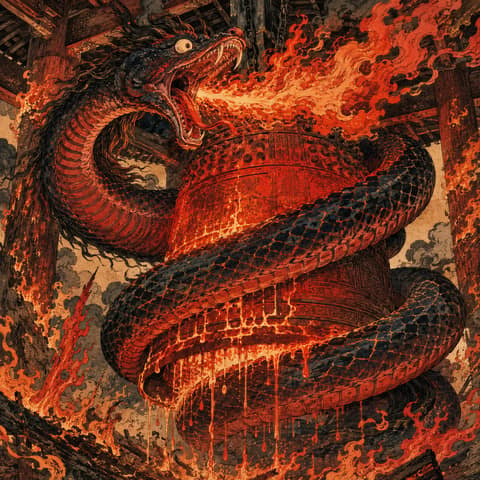
    An iconographic reading of the Dōjōji bell as depicted in Toriyama Sekien’s Konjaku Hyakki Shūi. While a note alludes to a variant in which the woman, transformed into a serpent, coils around the bell hiding Anchin and heats it until it melts into scalding liquid, hearsay also holds that the bell itself survived in historical record. Its “yokai nature” here is less an ensouled object than a visualization of folk belief in obsession possessing a vessel and causing anomalies. It represents Edo-period reception where Noh, sekkyō, and engi traditions intermingle.

  • The Tsugaru Drum of Honjo

    The Tsugaru Drum of Honjo

    Uncommon

    tsu-GAH-roo no TIE-koh

    Bansho Seven Wonders – Traditional Lore Version

    Household SpiritsTokyo

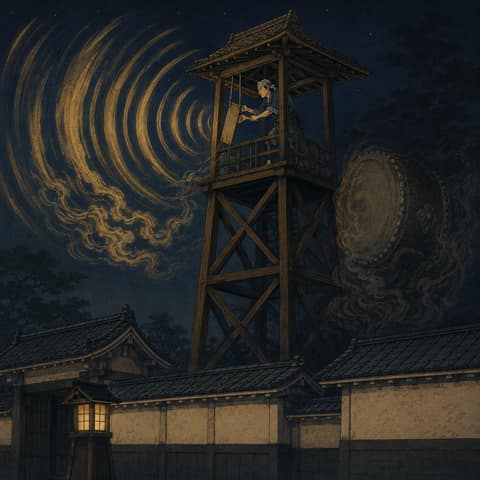
    Told as an urban-legend-style ghost tale from Edo’s Honjo district, this curiosity lies in the pairing of objects and institutions rather than vivid supernatural feats. The phenomenon itself is scarcely described; the very adoption of a drum for duty is treated as uncanny. Shaped by the locale, samurai compound regulations, and a city prone to fires, the oddity of sound lingered in memory and became a tale. A variant recounts that striking a wooden clapper produced a drum’s sound, hinting at auditory error or transmission drift. Sources appear in local topographies and essays, and typically lack specific origins or named figures. Later creative retellings add ghosts of fire brigades or watchmen, but older lore is restrained, focusing on the strange pairing of residence and watchtower.

  • Tsukumogami

    Tsukumogami

    Legendary

    tsoo-KOO-moh-gah-mee

    Tsukumogami (Classical Depiction)

    Household SpiritsMedieval Japan, chiefly the Kinai region

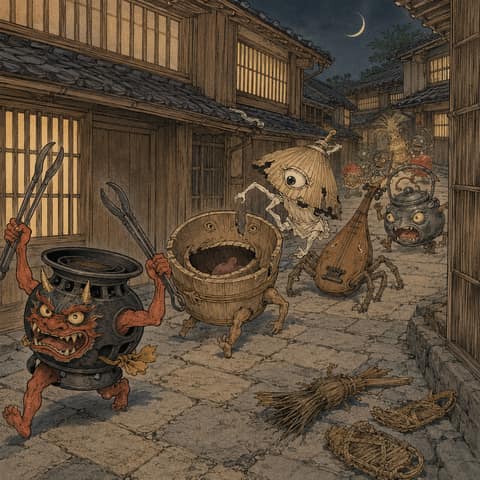
    Rooted in Muromachi-period picture scrolls, this portrayal centers on tools and household objects that gain spirit through long use. When discarded carelessly, they bear resentment and cause disturbances, yet they can be calmed by Buddhist rites, prayers, or renewed respectful use, and may act protectively thereafter. The number of one hundred years is symbolic, expressing the accumulated time that grants spiritual potency. Their forms vary widely—humanoid, demonic, bestial—with everyday implements such as braziers, washbasins, and sake pourers often depicted transforming. Although the name spread less in the early modern era, tool-spirits continued to appear in Night Parade of One Hundred Demons imagery, reflecting attitudes toward tools and impermanence. Local names are not fixed, and sources chiefly trace to the Tsukumogami picture scrolls and old glosses. The tales avoid fanciful additions, serving as moral lessons urging people to cherish and respect their tools.

  • Ungai-kyō (Mirror from Beyond the Clouds)

    Ungai-kyō (Mirror from Beyond the Clouds)

    Rare

    OON-guy-kyo (oon-GAH-ee-kyoh)

    Traditional Interpretation (Based on Sekien Toriyama)

    Household SpiritsEdo period

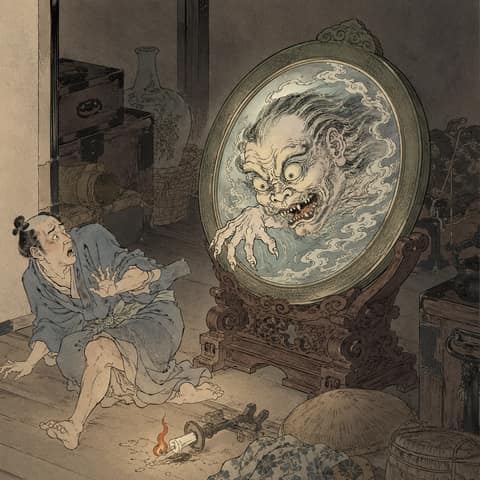
    This version is grounded in Toriyama Sekien’s illustration and notes, emphasizing its link to the concept of the demon-revealing mirror. Faces of the uncanny appear on the surface, not necessarily reflecting an external yokai but a spirit residing within the mirror itself. In the lineage of tsukumogami tales, it accords with the belief that long-used implements gain numinous life, sometimes changing mood according to how their owner treats them. Relying on early modern woodblock-book imagery, it has few concrete encounter or harm narratives, and is mostly told in general ghost-story frames such as glimpsing a strange visage when peering into a mirror in a dim room at night. Later depictions of raccoon-dog forms or showy powers are traced to films and children’s books and are set apart from the classical image.

  • Uwan

    Uwan

    Epic

    OO-wahn

    Emaki Manifestation Type (Mansion Apparition)

    Household SpiritsJapanese folklore

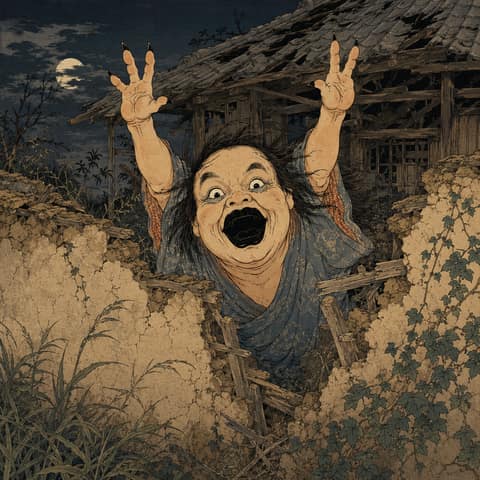
    A reconstruction based on Edo-period yokai picture scrolls. Depicted with a humanlike face marked by iron-blackened teeth, raising a three-fingered hand, appearing from behind fences or in ruined houses and shouting “uwan.” No early sources clearly state direct harm to people; its main behavior is appearing and intimidating. Because of similar regional names and frequent mansion backdrops, it is sometimes taken as a house-dwelling entity, but this is unproven and the portrayals are spare. Later creative tales—such as being driven off by a retort or killing victims—should be treated separately from the core record.

  • Wanyūdō

    Wanyūdō

    Epic

    wah-nyoo-DOH

    Traditional Iconography, Sekien School

    Household SpiritsKyoto

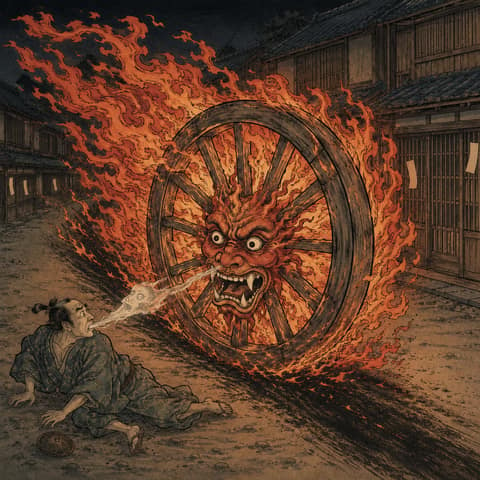
    An interpretation grounded in Toriyama Sekien’s depiction. On night roads and at crossroads, a blazing wheel cruises low to the ground, its axle set with a monk-demon mask that fixes passersby with an unblinking stare. Meeting its gaze or succumbing to fear is said to drain one’s vital spirit, leaving the victim stupefied. Its origins trace to Kyoto wheel-ghost tales and likely overlap with the katagiriguruma motif, yet Sekien adopted a nyūdō mask and fixed it as a male figure. The source is uncertain, defying a firm label as vengeful spirit, tsukumogami, or will-o’-the-wisp. Countermeasures include posting a paper charm reading “This is the village of Katsumo” at the doorway, or avoiding eye contact and hiding. Few variants name specific places or people; the core image remains a plain yokai preserved in classical records.

Showing 49 - 65 of 65 yokai