Tengu
The Forty-Eight Tengu – The Great Tengu of the Provinces in the Tengu Sutra
The tengu do not stop at the Eight Great Tengu. Each of the sacred mountains of the provinces was believed to have its own great tengu, and the early-modern esoteric prayer-scripture the Tengu Sutra lists their representatives as forty-eight seats—the "Forty-Eight Tengu." This edition is an overview that surveys the full roster and the provenance of the scripture itself.
The Tengu Sutra is an esoteric, Shugendō-lineage prayer text said to have been compiled in the Edo period. It is not an orthodox sutra of the Buddhist canon, but belongs to the lineage of incantation-scriptures that a yamabushi recites in his devotions to summon (invoke the descent of) the tengu of the sacred mountains of the provinces, borrowing their numinous power to pray for the dispelling of demons, the subjugation of enemies, and the fulfillment of all wishes. The text begins with the chant "Homage to the great tengu and the small tengu," lists the names of the various tengu, then gives the total of the tengu as "one hundred twenty-five thousand five hundred in all," and closes with the mantra "On aromaya tengusumanki sowaka." This "one hundred twenty-five thousand five hundred" is not a real count but a symbolic number representing innumerable tengu, and the forty-eight seats named by their proper names are positioned as the representatives among them. As for the transmission of the manuscripts and printed editions of the Tengu Sutra, there are philological studies such as Takahashi Sei's "The Tengu Sutra: Its Present State and Whereabouts" (2016), and it is difficult to fix the date of compilation strictly to a single point.
The roster of the Forty-Eight Tengu runs in the form of "bō" titles (sacred-mountain name + the name of the bō). The opening begins with the great tengu of the Kinai—Atago-san Tarōbō, Hira-san Jirōbō, Kurama-san Sōjōbō—and is followed by the tengu of the Shugendō sacred mountains across the land such as Fuji, Nikkō, Haguro, Akiba, Hikosan, and Ishizuchi. Below are listed all forty-eight seats, collated against two confirmable lines of sources, together with the bō title, sacred mountain, and province (present-day prefecture). ★ marks the Eight Great Tengu that have their own pages in this encyclopedia.
1. ★Atago-san Tarōbō (Mt. Atago, Yamashiro / Kyoto)
2. ★Hira-san Jirōbō (Mt. Hira, Ōmi / Shiga)
3. ★Kurama-san Sōjōbō (Mt. Kurama, Yamashiro / Kyoto)
4. Hiei-zan Hosshōbō (Mt. Hiei, Yamashiro / Kyoto)
5. Yokawa Kakkaibō (Yokawa, Mt. Hiei, Yamashiro / Kyoto)
6. Fuji-san Daranibō (Mt. Fuji, Suruga / Shizuoka)
7. Nikkō-san Tōkōbō (Mt. Nikkō, Shimotsuke / Tochigi)
8. Haguro-san Konkōbō (Mt. Haguro, Dewa / Yamagata)
9. Myōgi-san Nikkōbō (Mt. Myōgi, Kōzuke / Gunma)
10. Tsukuba-san Hōinbō (Mt. Tsukuba, Hitachi / Ibaraki)
11. ★Hiko-san Buzenbō (Mt. Hiko (Hikosan), Buzen / Fukuoka)
12. Ōhara Sumiyoshi Kenbō (Kengamine, Mt. Daisen (disputed), Hōki / Tottori (tentatively identified))
13. Etchū Tateyama Nawadarebō (Mt. Tate, Etchū / Toyama)
14. Amanoiwafune Dantokubō (Amanoiwafune, location unknown)
15. Nara Ōku Sugisakabō (unknown, location unknown)
16. Kumano Ōmine Kikujōbō (Kiku-no-iwaya, Mt. Ōmine, Yamato / Nara)
17. Yoshino Minasugi Kozakurabō (Mt. Yoshino, Yamato / Nara)
18. ★Nachi Takimoto Zenkibō (Nachi Takimoto, Kii / Wakayama)
19. Kōya-san Kōrinbō (Mt. Kōya, Kii / Wakayama)
20. Niitayama Satokubō (Mt. Niita (disputed), Kōzuke / Gunma (tentatively identified))
21. Kikaigashima Garanbō (Kikaigashima, Satsuma / Kagoshima (tentatively identified))
22. Itatōyama Tondonbō (Mt. Itatō, location unknown)
23. Saifu Takagaki Kōrinbō (Mt. Kamado (Mt. Hōman), Chikuzen / Fukuoka (tentatively identified))
24. Nagato Fumyō Kishukubō (unknown, Nagato / Yamaguchi (tentatively identified))
25. Tsudoki Oki Fugenbō (Oki Island (disputed), Oki / Shimane (tentatively identified))
26. Kurokenzoku Konpirabō (Mt. Zōzu, Sanuki / Kagawa)
27. Hyūga Obata Shinzōbō (unknown, Hyūga / Miyazaki (tentatively identified))
28. Iōjima Kōtokubō (Iōjima, Satsuma / Kagoshima (tentatively identified))
29. Shiōzan Rikyūbō (Mt. Shibi, Satsuma / Kagoshima (tentatively identified))
30. ★Hōki Daisen Seikōbō (Mt. Daisen, Hōki / Tottori)
31. Ishizuchi-san Hōkibō (Mt. Ishizuchi, Iyo / Ehime)
32. Nyoigatake Yakushibō (Nyoigatake, Yamashiro / Kyoto)
33. Tenmanzan Sanmanbō (Mt. Tenman (disputed), Mino / Gifu (tentatively identified))
34. Itsukushima Sankibō (Mt. Misen (Itsukushima), Aki / Hiroshima)
35. Shiragayama Kōshakubō (Mt. Shiraga, Tosa / Kōchi (tentatively identified))
36. Akiba-san Sanshakubō (Mt. Akiba, Tōtōmi / Shizuoka)
37. Takao Naigubu (Mt. Takao, Yamashiro / Kyoto)
38. ★Iizuna Saburō (Mt. Iizuna, Shinano / Nagano)
39. Ueno Myōgibō (Mt. Myōgi, Kōzuke / Gunma)
40. Higo Ajari (Mt. Kinpō (disputed), Higo / Kumamoto (tentatively identified))
41. Katsuragi Takamabō (Mt. Kongō (Katsuragi), Yamato / Nara)
42. ★Shiramine Sagamibō (Shiramine, Sanuki / Kagawa)
43. Kōra-san Chikugobō (Mt. Kōra, Chikugo / Fukuoka)
44. Zōzu-san Kongōbō (Mt. Zōzu, Sanuki / Kagawa)
45. Kasagi-san Daisōjō (Mt. Kasagi, Yamashiro / Kyoto)
46. Myōkō-san Adachibō (Mt. Myōkō, Echigo / Niigata)
47. Ontake-san Rokkokubō (Mt. Ontake, Shinano / Nagano)
48. Asamagatake Kinpeibō (Mt. Asama, Kōzuke / Gunma (tentatively identified))
Three cautions are needed in reading this roster. First, the bō titles (the names of each seat) agree across multiple sources and are reliable, but errors mixed into secondary web information mar the identification of the province and prefecture. For instance, Mt. Shibi is in Kagoshima Prefecture (Satsuma), and "Hyūga" is the old province name of Miyazaki Prefecture—misattributions confusing these with places in the Kantō or Tōhoku are in circulation. In this roster, "tentatively identified" is appended to seats whose identification has latitude, and "location unknown" to seats whose whereabouts cannot be confirmed among the sources. Second, there are seats such as Amanoiwafune Dantokubō, Nara Ōku Sugisakabō, and Itatōyama Tondonbō whose location multiple sources hold to be "unknown," and no place name has been forced upon these. Third, there is variation between the bō titles of the Eight Great Tengu and the wording of the Tengu Sutra text. For example, the Ōyama Hōkibō of the Eight Great Tengu appears in the text as "Hōki Daisen Seikōbō," and Ōmine Zenkibō appears in the "Nachi Takimoto Zenkibō" / "Kumano Ōmine Kikujōbō" line of wording. The Eight Great Tengu are commonly explained as eight representative seats drawn from among these forty-eight, but the bō titles do not agree word for word.
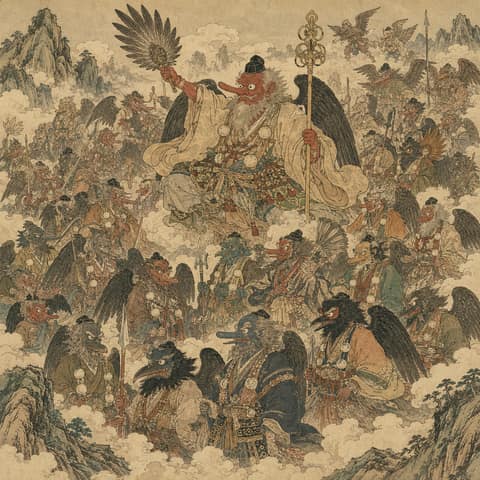
The framework of the Forty-Eight Tengu shows most plainly that the tengu was not a solitary yokai but a deity of mountain worship seated throughout the sacred mountains of the whole country. Chigiri Kōsai, who compiled the study of tengu, likewise organized these mountain tengu into a single system. Each seat of the Eight Great Tengu (★) is treated in detail on its own page, but they too are simply the especially high peaks within this sea of one hundred twenty-five thousand five hundred tengu.