Yokai Encyclopedia

Encyclopedia of Japanese Yokai

Complete Index
536 Yokai|14 Category|Page 23 of 23
Localization in Progress - More content available in Japanese version
View Japanese
Sort by: NameAscending
  • Yūrei (Ghost)

    Yūrei (Ghost)

    Legendary

    YOO-ray

    Toriyama Sekien “Yūrei” (An’ei era)

    霊・亡霊Across Japan

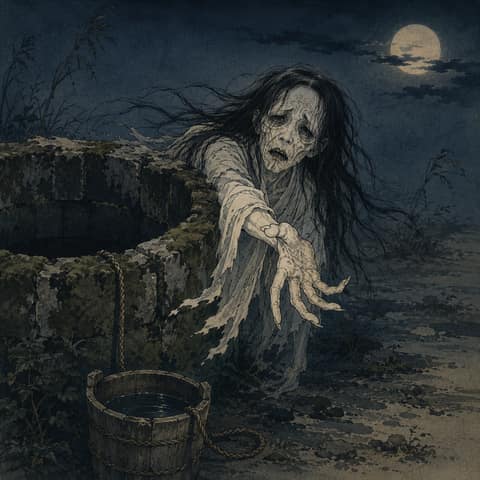
    An image based on the “Yūrei” in Toriyama Sekien’s Gazu Hyakki Yagyō, published around 1776 (An’ei 5). In a nighttime graveyard a woman’s ghost appears between drooping willows, wearing a white burial robe and a forehead cap, raising her arms as if to halt a passerby. It is a transitional depiction from before footless forms and the triangular headcloth became fixed conventions, emphasizing the lifelike force of the arms and the willow and gravestones as symbols of place. Sekien’s plates organized contemporary strange tales, Buddhist views, and funeral customs, profoundly shaping the visual codification of yūrei. While indicating gender and costume, the image leaves the source of attachment unspecified, inviting the viewer to imagine the relationship.

  • Zan

    Zan

    Epic

    Zan

    Zan, the Tsunami-Predicting Mermaid

    Water SpiritOkinawa

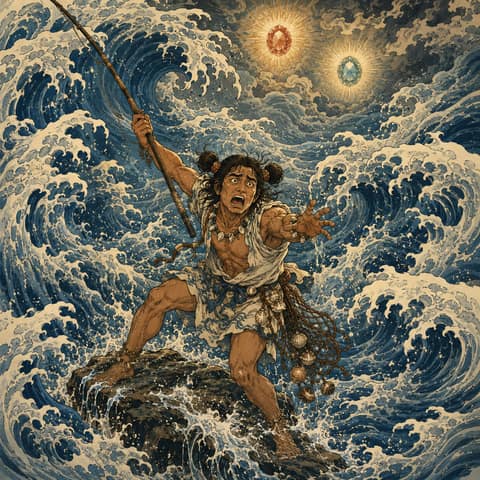
    This is the legendary mermaid Zan, famously caught in the net of a Nosoko fisherman, weeping tears as it begged for its life. It is said that in gratitude for being released, it warned the village of an approaching tsunami, ultimately saving the entire community. Its true identity is the dugong, a marine mammal that has long been revered in Ryukyuan waters as a sacred messenger of the gods. Rather than raging and bringing forth calamity, the Zan stands between the ocean and the land to warn humans of impending disaster before it strikes. As the most compassionate prophet born of the Ryukyuan sea, the Zan's story continues to be told to this day.

  • Zashiki-warashi

    Zashiki-warashi

    Legendary

    za-shi-ki-wa-ra-shi

    Child Protector of Iwate Homes: Zashiki-warashi

    Half-Human / Half-YokaiIwateAomori

    This version is interpreted as a child deity that resides in old houses in Tohoku and governs the rise and fall of the household. In this iteration, the zashiki-warashi possesses both the innocent, friendly side of a "god of fortune" and the cold side of a "god of fate" that will mercilessly abandon the family to ruin if displeased in the slightest. Its nature varies depending on the space where it appears: the pale, beautiful Chopirako appears in "hare" (sacred/formal) spaces like the inner parlor, while the Notabariko or Usutsukiko appear in "ke" (profane, or spaces closest to death) like the dirt floor or kitchen. A popular theory once claimed in some dictionaries that the description of "Chopirako" was found in the Edo-period essay "Jippoan Yureki Zakki," but this is a clear error caused by confusion with other literature; the first mention of zashiki-warashi hierarchies comes strictly from the Tohoku local studies by Kizen Sasaki and others. It is said that zashiki-warashi are mainly visible to the children of the house or outside guests. Even today, there are places like the inn Ryokufuso in Ninohe City, Iwate Prefecture, where guests from all over the country visit in hopes of meeting a zashiki-warashi (= being granted wealth). If someone tries to harm it, such as by shooting it with a bow, it will disappear; if enshrined warmly, it will enrich the home forever. Its adorable childlike appearance is a thin veil concealing the most painful sacrifices (infanticide) of village life, making it the ultimate "guardian deity of the home" born from regret for dead children and the obsession with family continuity.

  • Zen-Gama-no-Shō (Zen Kettle Monk)

    Zen-Gama-no-Shō (Zen Kettle Monk)

    Rare

    ZEN-gah-mah-noh SHOH

    Iconographic Tradition: Tsukumogami Kettle

    Animated Objects & UndeadJapanese folklore

    Based on examples by Toriyama Sekien, this image depicts an aged tea kettle manifesting with spiritual authority. Its posture and arrangement inherit compositional methods akin to the Night Parade of One Hundred Demons scrolls, often shown marching alongside Torakakushi and Yarinaga. The name plays on the kinship between chanoyu and Zen, hinting at a caricature of a Buddhist priest. By the logic of mononari, tools long used or neglected accrue ki, appear before people, and inspire awe. Meiji painters continued this iconographic lineage, and yokai catalogues and dictionaries classify it as a type of tsukumogami, though specific local legends are scant. Later commentaries add anecdotes of startling humans, but early records offer little confirmation, so it is understood chiefly through its iconographic tradition.

  • Zhong Kui (Shōki)

    Zhong Kui (Shōki)

    Divine

    SHOH-kee

    Traditional Iconography Shoki, Warding Demon-Queller

    Deities & Divine SpiritsKyoto

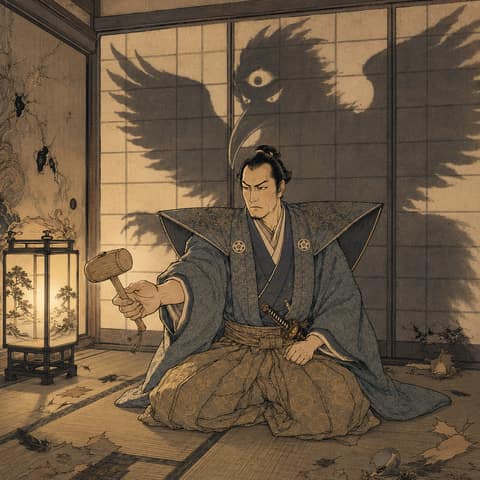
    Shoki, a demon-quelling deity spread across East Asia from Tang dynasty lore, took root in Japan as a talismanic power against calamity and smallpox. He is depicted as a bearded martial figure in official robes and cap, glaring with fierce eyes and wielding a sword in one or both hands. He often appears hunting, trampling, or bagging small demons. At New Year and Boys’ Festival he is displayed on hanging scrolls, banners, and screens, and many townhouses placed ceramic Shoki figures on eaves or roof corners. In Japan the earliest examples trace back to late Heian apotropaic paintings; from the Muromachi period the theme became established, and by late Edo he also appeared as May Festival dolls. Images and figures were hung at entrances, gates, or the upper seat of reception rooms to stop plague deities and malign spirits. Although dedicated shrines are limited today, regional folk belief since early modern times continues, and rooftop Shoki statues are still found from Kinki through the Chubu region. His powers are symbolized by the subduing glare and swordplay that drive off evil sprites, functioning as amulets against drug harm and epidemics.

  • Ōmagatoki – The Bewitching Hour of Dusk

    Ōmagatoki – The Bewitching Hour of Dusk

    Uncommon

    OHH-mah-gah-TOH-kee

    The Witching Hour (Traditional Narrative)

    Half-Human BeingsVarious regions across Japan

    Though lacking a concrete form, the Witching Hour has long been understood as the effect of dusk’s dimness upon landscape and mind. Households would shut doors, call children inside, and avoid wandering, linking daily rules to this time. Toriyama Sekien depicted a hundred specters gathering at twilight, framing the hour itself as a stage that summons the uncanny. Folklore notes that the difficulty of recognizing faces stirs fear, and mishaps—losing one’s way, waterside accidents, and mountain village straying—were cautioned against as “meeting demons.” Dialects across Japan share this semantic field, often referring to twilight in general without explicit monstrosity. Thus it is not a combative yokai but a sense of peril dwelling in a liminal hour, preserved as a warning tied to the rhythm of daily life.

  • Ōmine Zenkibō

    Ōmine Zenkibō

    Legendary

    Ōmine Zenkibō

    The Dharma-Guarding Tengu Turned from an Oni — Ōmine Zenkibō

    Mountain & Wilderness SpiritsNara

    The essence of Ōmine Zenkibō lies in the structure of rebirth: "an oni turning into a tengu." It is a tale that embodies the heart of Shugendō in a single being. His source lies in the old tales of En no Gyōja and the oni. The oldest extant text depicting En no Ozunu is the Nihon Ryōiki (early Heian), which portrays him as a thaumaturge who flew through the air commanding demons. The Konjaku Monogatarishū, Book 11 carries the tale of En no Gyōja having demons build a bridge across the mountains, showing the fixing of the image of En no Gyōja as one who commands demons. Zenki was originally a violent oni who carried off human children. En no Gyōja captured him with the secret rite of Fudō Myōō and reformed him into an attendant. By one account, En no Gyōja hid the youngest child of the Zenki couple in an iron cauldron and, through the grief of having one's own child taken, brought them to realize the sin of carrying off the children of others. The reformed Zenki and Goki became dharma-protecting oni and supported En no Gyōja's practice. This Zenki, sublimated into a great tengu at the end of long austerities, is Ōmine Zenkibō. This plot, of a violent being turning into a guardian of the Buddhist law, shows most clearly that the dread of a child-snatching tengu and the faith in a tengu who guards people share a single root. The Ōmine on which Zenkibō sits is the holy ground of Shugendō. The Ōmine training ground founded by En no Gyōja, and the Ōmine Okugake-michi registered as World Heritage, is a perilous route that ascetics still tread at the risk of their lives, and Zenkibō was conceived as its guardian. He is chanted as "the band of Zenki of Ōmine" in the Muromachi Noh play Kurama Tengu, and stands among the forty-eight tengu of the Tengu-kyō (some sources give "Nachi Takimoto Zenkibō"). And the heaviest single point of this lore is that the bloodline of Zenki is said to live on into the present. Of the five lodges kept by the five children of Zenki and Goki, only the Onakabō of the Gokijo family remains today, and the present-day Gokijo Yoshiyuki continues to receive the ascetics of the Ōmine Okugake-michi. This genealogy is hard to source explicitly in old documents and is transmitted as the oral lore of the surviving lodge; yet this real continuity—descendants of a reformed oni guarding the path of Shugendō beyond thirteen hundred years—makes Ōmine Zenkibō not a mere legend but a symbol of living faith. Chigiri Kōsai of tengu scholarship, too, placed him within the system of the great tengu of the many mountains.

  • Ōyama Hōkibō

    Ōyama Hōkibō

    Legendary

    Ōyama Hōkibō

    The Great Tengu of the Transferred Seat — Ōyama Hōkibō

    Mountain & Wilderness SpiritsKanagawa

    The core of Ōyama Hōkibō lies in a tale of succession to a seat within the tengu world—the "seat transfer." Yet the Mt. Ōyama on which he sits was a sacred mountain established in antiquity, without need of the transfer legend. The Engishiki Jinmyōchō (927) ranks the Afuri Shrine among the official shrines of Sagami Province, showing that Ōyama's divinity was recognized by the ancient state. On the Buddhist side, the Ōyama-dera engi emaki depicts how Rōben—carried off by an eagle and raised in Nara—opened Ōyama-dera and enshrined Fudō Myōō (the Sagami version; a different work from the engi of Hōki's Daisen-ji). And in early-modern times the official gazetteer the Shinpen Sagami no Kuni Fudoki-kō (1841) conveys the summer ascent season and the bustle of pilgrims from many provinces. The manners of pilgrimage—purifying oneself at the waterfalls under a sendatsu's guidance before climbing—and the Ōyama confraternities everywhere: this density of faith gave Hōkibō, the successor tengu, the character of a guardian watching over the common people. The seat-transfer tradition overlays this sacred-mountain history. According to the arrangement of Chigiri Kōsai of tengu scholarship, Sagami Ōyama originally had a great tengu named Sagamibō. But when the Retired Emperor Sutoku—defeated in the Hōgen Rebellion (1156) and exiled to Sanuki—passed away, Sagamibō removed to Shiramine in Sanuki to console and guard his bitter spirit (= Shiramine Sagamibō). The one who succeeded to the vacant seat of Sagami Ōyama was Hōkibō, come from Mt. Daisen in Hōki. This symmetrical transfer—"Sagamibō to the west, Hōkibō to the east"—is a Chigiri-derived arrangement lacking explicit sources in the classical literature, and should be read not as historical fact but as lore that mirrors the notion that a tengu's seat is succeeded through mountain and bond (en) rather than being a fixed individual. Chanted as "Hōkibō of Ōyama" in the Muromachi Noh play Kurama Tengu, and standing among the forty-eight tengu of the Tengu-kyō, his seat continues to be remembered, together with this distinctive engi, as one of the Eight Great Tengu.

Showing 529 - 536 of 536 yokai