しょうじょう
Wine-loving Red-haired Beast, Noh Master of Dance, Shojo
Animal YokaiChinese Classics (Classic of Mountains and Seas, Book of Rites, Chuci, Huainanzi, Commentary on the Water Classic - legendary beast) / Introduced to Japan (Wakan Sansai Zue 1712, Noh play Shojo Muromachi period) / Nagoya, Arimatsu, Tokai City (Shojo giant doll festival, first appearance 1779)
The origins of the Shojo lie in two lineages of lore from Chinese classics. ① The "Speaking Beast" Lineage — In the "Quli" section of the "Book of Rites", it is stated: "The parrot can speak, but it still belongs to the birds; the shojo can speak, but it still belongs to the beasts" (a moralistic quote meaning that even if it understands human speech, it does not transcend the realm of beasts). The "Erya" describes it as "small and fond of howling," while the "Classic of Mountains and Seas" states: "On Mount Zhaoyao, there is a beast whose shape resembles a macaque with white ears; it crouches to walk and runs like a human. Its name is xingxing (=shojo), and eating it makes one a good runner." ② The "Beast Fond of Wine and Blood" Lineage — The "Commentary on the Water Classic" notes that the shojo of Pingdao County in Jiaozhi "looks like a yellow dog or a badger, has a human face with regular features, is good at talking with people, and its voice is as beautiful as a fine woman's." The "Lüshi Chunqiu" considers "the lips of the shojo" a great delicacy, while Li Shizhen's "Bencao Gangmu" (1596) details it as a creature from Jiaozhi (modern-day northern Vietnam) with a human face, beast's body, yellow hair, and a fondness for wine. The modern associations with the orangutan or palm civet are later identifications; academically, the classical shojo is best understood not as a real animal but as a composite image of a legendary sacred beast.
Its introduction to Japan occurred before the Middle Ages via Chinese texts and Buddhist scriptures. The "Wamyō Ruijushō" (10th century) introduced it as a "speaking beast" citing the "Erya", and it appeared indirectly in the "Konjaku Monogatarishu". Terajima Ryoan's "Wakan Sansai Zue" (1712) was groundbreaking — it explicitly pointed out that "yellow hair is correct, and the 'red hair' theory circulating in Japan is mistaken." Nevertheless, the image of "red hair" became entrenched in Japan due to the influence of Noh theater, a divergence that forms an interesting point of debate in art history and folklore. The uniquely Japanese image of red hair flowed backward from Noh costumes and became fixed.
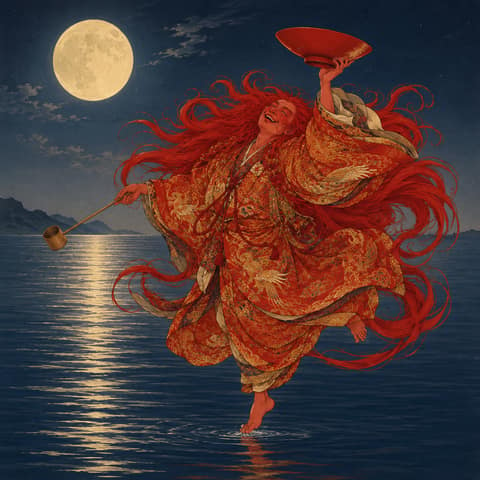
The Noh play "Shojo" (established in the Muromachi period, author unknown) is a current repertoire piece for all five schools, and is one of the most beloved plays, serving as a fifth-group play and kiri-Noh. Set at the Xunyang River in Tang China, it tells the story of Kofu, a filial son who sells wine in the village of Yangzi, and succeeds after a dream revelation. A red-faced customer who frequents Kofu's shop daily introduces himself as the "Shojo who lives in the sea." Waiting at the Xunyang River on a moonlit night, the Shojo appears, drinks wine, performs a dance, and bestows an "inexhaustible wine jar" — a celebratory theme of rewarding filial piety. The play fuses sources like the "Tang Guo Shi Bu", the "Chuci" (The Fisherman), and Li Bai's poem about the Xunyang River. The costume features a red wig, red Karaori robe, scarlet divided skirts, and a dedicated Shojo mask (painted red, with a smiling mouth and eyes). Its highlight is the "chu-no-mai" dance, or the special performance (kogaki) "midare" — a highly advanced technique where the performer glides over the water with erratic, flowing steps.
In the Edo period, because Jurojin and Fukurokuju of the Seven Lucky Gods were identical, a variant Seven Lucky Gods circulated where Jurojin was replaced by the Shojo. Kita Sadakichi's "Study of the Gods of Fortune" (1920) cites primary sources like the "Genroku Gorui Setsuyo", making it academically robust. This variant form also appears in treasure ship paintings by Hokusai, Kuniyoshi, and Yoshitoshi.
A "Shojo" giant doll festival has been passed down since the mid-Edo period in Arimatsu and Tokai City in Nagoya. Spreading along the old Tokaido highway, it already appeared in the "Narumi Festival Picture" of 1779. Giant red Shojo dolls chase children, and being tapped by one is believed to ward off summer diseases and epidemics. There are also local legends across the country, such as oral traditions of small Shojo appearing at sea in Toyama, or a ship-ghost variant demanding "give me a barrel" in Yamaguchi.
"Shojohi" (Shojo scarlet) is a deep crimson color originating from the red costumes of the Noh play "Shojo". Though popularly called the "color of Shojo's blood," the actual dye was cochineal/kermes, and the "Shojo's blood" is merely a myth. Scarlet woolen cloth imported via the Nanban trade in the late Muromachi to early Edo periods was highly prized by Sengoku warlords for their surcoats. During the Edo period, it was such a rare luxury that the shogunate would confiscate it from merchants, making it a symbol of martial prowess and authority.
In modern times, it appeared in Hayao Miyazaki's "Princess Mononoke" (1997) as the "sages of the forest," trying to replant trees to restore the forest but unable to keep up with humans, begging San to "let us eat humans, we want human strength". The red image of the Shojo is also inherited in biological names like the fruit fly (Drosophila, named for its attraction to alcohol), the Shojo dragonfly, and the Shojo-bakama flower.