🔤 Yokai by Kana

Find yokai in hiragana order

32 Yokai|12 Category|Page 2 of 2
Localization in Progress - More content available in Japanese version
View Japanese

Filter by hiragana row

Sort by: ReadingAscending
Yudonosan-daigongen

Yudonosan-daigongen

Divine

Yudonosan-daigongen

The Unspeakable Deity of the Sacred Rock of Mount Yudono

Divine Spirits / DeitiesYamagata

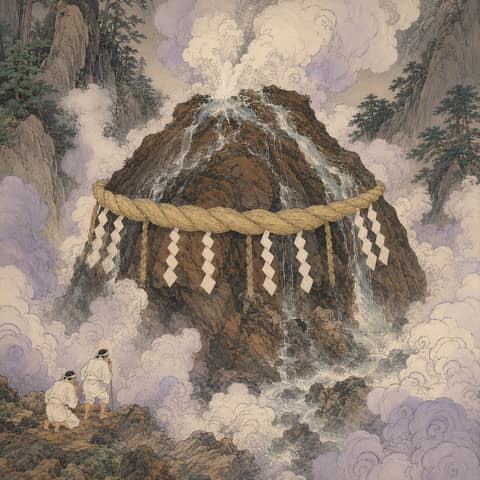
Yudonosan-daigongen is the syncretic deity (gongen) enshrined at Mount Yudono, the inner sanctuary of the Three Mountains of Dewa (Dewa Sanzan). Before the government-ordered separation of Shinto and Buddhism in the Meiji era, the Dewa Sanzan were sacred mountains of Shugendō (ascetic mountain worship). They enshrined "gongen," which were manifestations of Buddhas appearing in the form of Shinto deities. Mount Haguro, Mount Gassan, and Mount Yudono constituted a single ascetic training ground, symbolizing the past, present, and future, respectively. There is no shrine building on Mount Yudono; the object of worship itself is a giant, brownish-red sacred rock from which hot water gushes out. Pilgrims are not allowed to wear footwear; they must climb this sacred rock barefoot to directly receive the power of the earth. Since ancient times, there has been a strict taboo against revealing what one sees or hears on this mountain, encapsulated in the saying, "Do not speak of it, do not ask of it". Although the title of "gongen" was abolished during the separation of Shinto and Buddhism and the anti-Buddhist movement (haibutsu kishaku) in the 6th year of Meiji (1873), and the site was reorganized into the Yudonosan Shrine enshrining the deities Ōyamatsumi-no-Mikoto, Ōnamuchi-no-Mikoto, and Sukunahikona-no-Mikoto, the core of the faith—worshipping the silent sacred rock as the divine body—remains unchanged to this day.
Spirit of Dreams

Spirit of Dreams

Uncommon

YOO-meh no say-RAY-ee

Historical Source-Critical Version

Natural phenomena and nature spiritsJapanese folklore

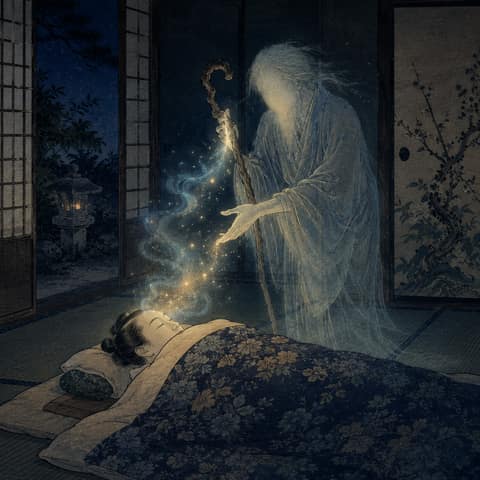
Understood as a spirit linked to dreams, it approaches sleepers at night and brings visions that portend good or ill. Some accounts depict it beckoning with a staff, but its name and character are not fixed; it is often treated as the personification of dreams themselves. It is said to be named in an Edo-period picture scroll, but no definitive image is identified, records are sparse, and its origins are unknown.

Yosuzume (Night Sparrow)

Yosuzume (Night Sparrow)

Uncommon

Yosuzume

The yosuzume that chirps along night roads

Animal shapeshiftersKochiEhime

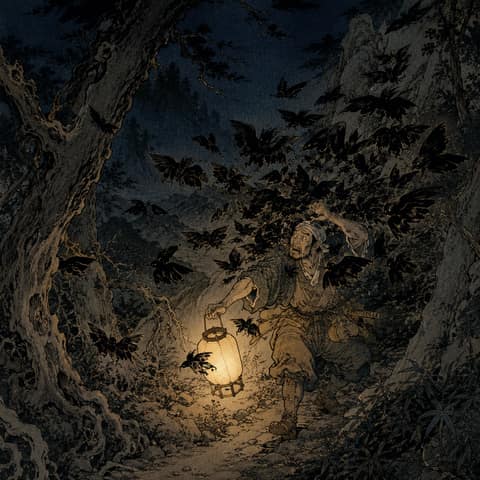
The yosuzume (“night sparrow”) is something that follows people walking a mountain road at night, chirping “chi-chi” like a small bird. In Hata district, Kōchi, being possessed by it is said to bring misfortune; in Minami-Uwa district, Ehime, when its voice blocks your way so that you cannot walk on, you are said to be “possessed by the yosuzume,” and it is also called a herald of mountain dogs. Yanagita Kunio’s “Yōkai meii” sets it beside the okuri-suzume of Wakayama, said to fly ahead and behind people on night mountain roads, and describes the yosuzume of Minami-Uwa as a kind of moth that heralds dogs.

Yokkabu-i

Yokkabu-i

Common

Yokkabu-i

Deity Preaching Warnings of the Water

Gods & SpiritsKagoshima

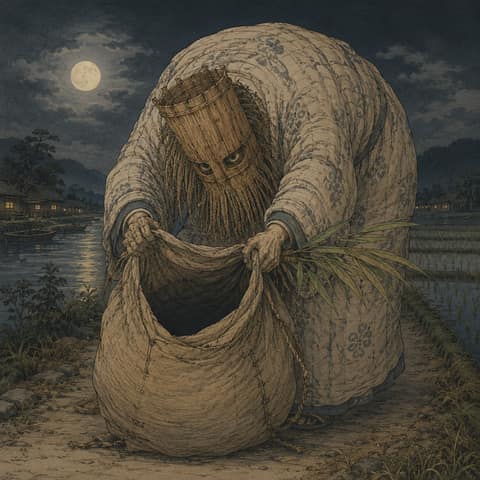
A visiting deity believed to be an incarnation of a Garappa (kappa), appearing during the "Water God Festival (Takahashi Juhachido Odori)" held every August on the lunar calendar in the Takahashi district of Kinpocho, Minamisatsuma City, Kagoshima Prefecture. It earned the name "Yokkabu-i" because it covers itself entirely with a "Yogi," a traditional form of bedding. Emitting strange shrieks, it threatens children with a hemp sack, acting as a warning against water accidents while being worshipped as a deity that brings good health and protection from illness.

Weeping Stone

Weeping Stone

Uncommon

yo-NAH-kee ee-shi

Legend of Sayo no Nakayama

Mountain & Wilderness SpiritsShizuoka

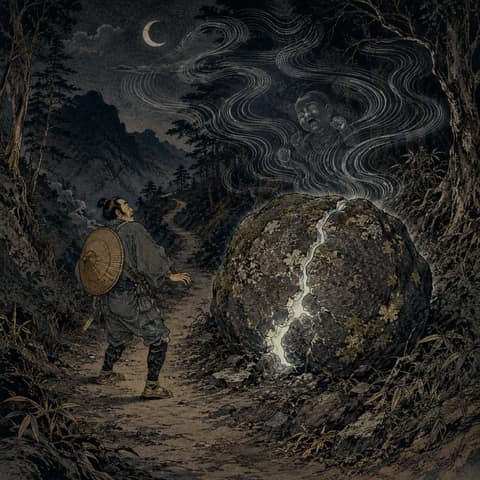
A catch-all term for stones said to cry or moan at night. In some tales the stone itself emits eerie sounds; in others, a restless spirit inhabits it and laments. The Weeping Stone of Sayo no Nakayama in Shizuoka is famous and often linked to tragic mother-and-child legends. Elsewhere, certain stones are enshrined as talismans to soothe a child’s night crying, blending beliefs in a stone’s numinous power, potential curse, and pacification.

Yonatama

Yonatama

Rare

Yonatama

A Human-Faced Fish That Speaks: Yonatama

Sea SpiritOkinawa

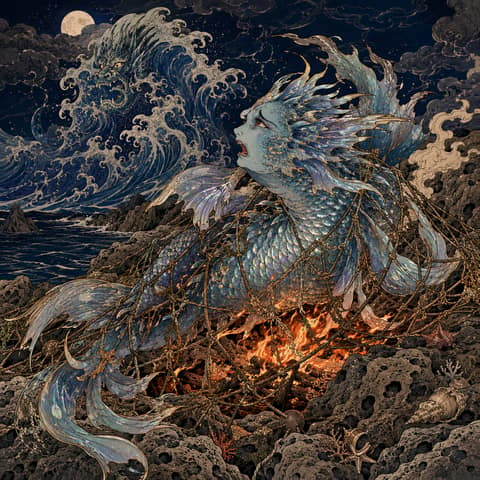
Yonatama is a fish with a human face that speaks, told of on Irabu and Shimoji islands in the Miyako group. According to Miyakojima kyūshi (1748), which Yanagita Kunio quoted verbatim in "Mono iu uo" ("The Talking Fish"), a man of Shimoji, a village on Irabu Island, caught a fish called Yonatama with a human face and a fish's body and set it over charcoal to roast and dry. In the night a voice called from the open sea, "Yonatama, Yonatama, why are you so late coming home?" When the Yonatama answered that it had been roasting on the coals half the night and asked that the tide be sent to fetch it, Shimoji village was found the next morning washed away entirely. Only a neighbor's boy, who had cried to be taken to Irabu village, and his mother survived. Yanagita held that yona is an old word for the sea, also found as ina and una, and that Yonatama means "sea spirit," that is, the god of the sea. The Tōri-ike ponds on Shimoji Island are said to be the site of a fisherman's house that sank in a tsunami sent as punishment for catching a human-faced fish that was the embodiment of the sea spirit.

Yomotsushikome

Yomotsushikome

Legendary

よもつしこめ

Pursuer from Yomi in the Kojiki: Yomotsu-shikome

Divine Spirit / DeityShimane

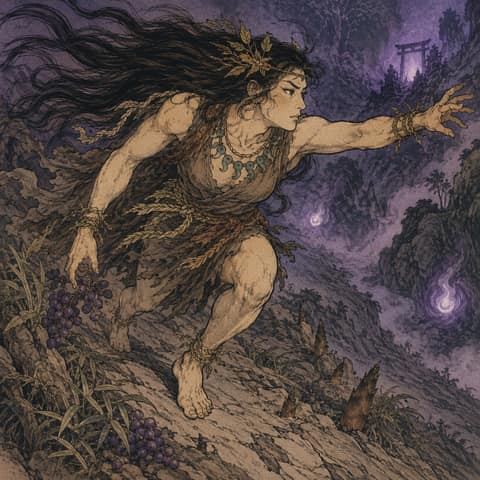
Yomotsushikome ("hag of Yomi") is the demon woman who, in the myths of the Kojiki and the Nihon shoki, chases Izanagi out of the land of the dead. The Kojiki writes her name phonetically as Yomotsu-shikome. When Izanagi, in the land of Yomi, saw what had become of his dead wife Izanami and tried to flee, Izanami said, "You have shamed me," and sent Yomotsu-shikome after him. Izanagi threw down the black vine headdress from his hair and wild grapes sprang up; while the shikome picked and ate them he fled. He broke teeth off the many-toothed comb in his right hair-loop and threw them down, and bamboo shoots sprang up; while she pulled them up and ate them he fled again. The peaches he threw at the slope of Yomi drove back those who came after her: the eight thunder deities and the fifteen hundred warriors of Yomi. One variant account (the sixth) in book one of the Nihon shoki writes the name with the characters 泉津醜女 and says that Izanami sent "eight hags of Yomi," or, in another version, Yomotsu-hisame. The headdress turns into grapes and the comb into bamboo shoots, and each time the hags pick and eat them before resuming the chase. The shiko of shikome was originally a word meaning strong and fearsome; the Nihon kokugo daijiten defines shikome as "a frightening, ugly female demon said to live in the land of Yomi". Motoori Norinaga, in Kojiki-den, explains that the name means frightening and hideous to look at, and notes that the Wamyōshō lists the shikome in its section on demons and goblins.

Takuhatachijihime

Takuhatachijihime

Divine

よろずはたとよあきつしひめのみこと

Takuhatachijihime, the Mother Goddess Who Weaves the Heavenly Grandchild

神霊・神格Mie

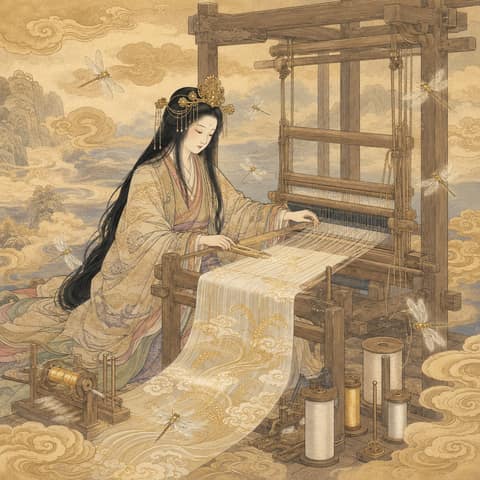
Takuhatachijihime (Yorozuhata-Toyoakitsushi-Hime-no-Mikoto) appears in the *Kojiki* account of the Tenson Korin (the descent of the heavenly grandchild) as the daughter of Takagi-no-Kami (Takamimusubi). She is the heavenly goddess who gave birth to Ame-no-Honoakari-no-Mikoto and Hikoho-no-Ninigi-no-Mikoto with Ame-no-Oshihomimi. In the text, when Ame-no-Oshihomimi, acting on the orders of Amaterasu and Takagi-no-Kami, reports that a child was born while he was preparing to descend, the name of Takagi-no-Kami's daughter, Yorozuhata-Toyoakitsushi-Hime is introduced as the child's mother. Thus, she is not merely inserted as the "mother of Ninigi", but serves as the crucial node connecting the bloodline of Amaterasu's child, Ame-no-Oshihomimi, with the lineage of Takamimusubi, converging in the heavenly grandchild. The Kokugakuin University Deity Name Database also summarizes her as the daughter of Takagi-no-Kami, who bore two deities with Ame-no-Oshihomimi. Since one of these two deities, Ame-no-Honoakari, branches off into a different lineage, while Ninigi proceeds with the Tenson Korin, her motherhood is not just a single familial relationship but the very point where multiple lineages of heavenly descendants diverge. The database explains that the word "hata" (幡) in her name is related to woven cloth or weaving. In various versions of the myths, names containing "hata", such as Takuhatachijihime, Yorozuhatabime, and Amayorozutakuhatachihatahime, overlap. Even if her name fluctuates across the different versions of the *Nihon Shoki*, her outline as the mother of the heavenly grandchild and a goddess of "hata" (cloth/weaving) is maintained. Therefore, her brief appearance causes the heavenly grandchild to be read not as a single hero, but as an existence woven from multiple heavenly authorities. The metaphor of weaving echoing behind her name expresses this role well. Just as threads cross to form cloth, Takuhatachijihime weaves together Amaterasu's light, Takagi-no-Kami's generative power, Ame-no-Oshihomimi's succession, and Ninigi's descent.

Showing 25 - 32 of 32 yokai